
Suppose two suppliers quote the same pouch size and thickness. One lists aluminum foil, the other metallized PET. Which sample should you order? If the whole pouch must shield the food from light and has no window, start with foil as your reference. If moisture pickup is the problem, look for water vapor data on the exact laminate. A metallized PET pouch with data that meet your limit can be the better first sample.
Two coffee pouches with the same listed size
Two of our Australian coffee pouch projects have the same published dimensions, 14 × 18.5 + 7.5 cm. Both show flat-bottom bags with a valve, and each project FAQ gives a nominal wall thickness of 140 microns (140 μm). The black pouch’s material field reads PET/AL/PE. The white pouch’s reads MATOPP/VMPET/PE.
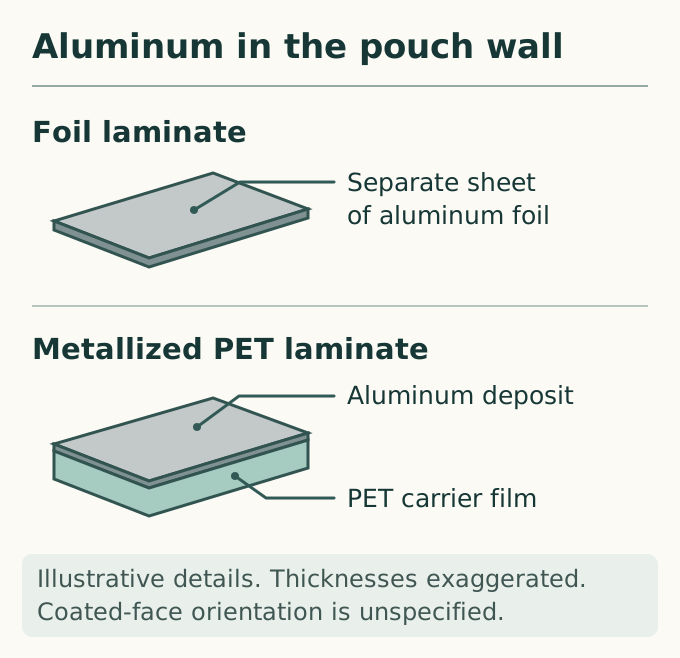
Look at the middle entry in each material line. In the foil pouch, AL identifies a separate sheet of aluminum bonded into the pouch wall. In the metallized pouch, VMPET identifies a vacuum-metallized PET film. In this type of pouch, the PET carries a thin aluminum deposit. A number quoted for the thickness of the entire metallized film includes the PET that carries the deposit. If the supplier gives you that number in response to a request for “aluminum thickness,” make sure you know what they measured before adding it to the purchasing specification.
The matte black coffee pouch lists PET/AL/PE. Its project description identifies the foil, gravure printing, a side closure and a degassing valve. The stated 140 microns describes the full pouch wall. The individual foil thickness and its tolerance are still questions for the supplier. If a repeat order requires the same foil ply, ask for the agreed material revision or gauge. Reordering by total thickness alone leaves the supplier some latitude over how that thickness is distributed among the layers. Matte black coffee pouch project

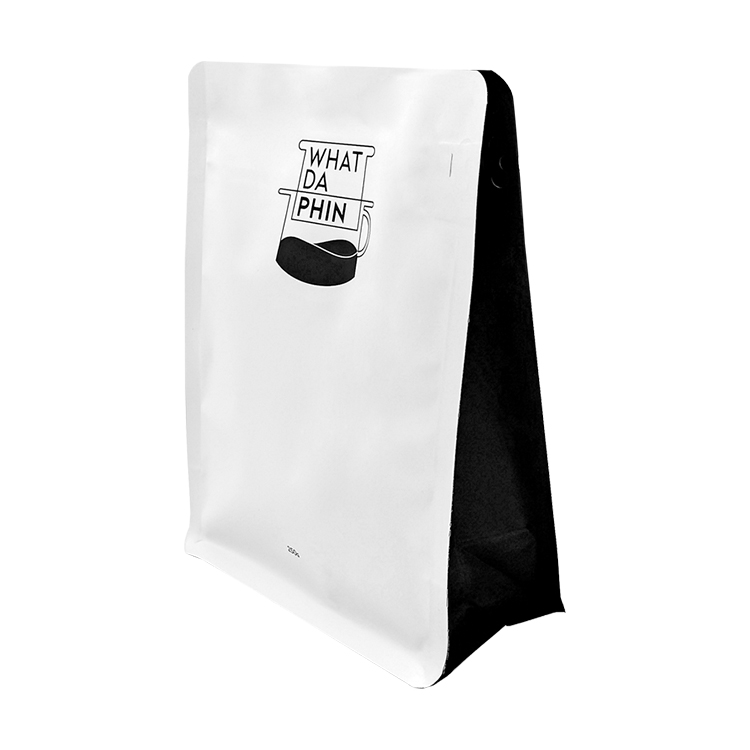
The matte white pouch also uses gravure printing and has a valve. It was made for 250 g of specialty coffee beans and has a pocket-style closure. Its published material field reads matopp/vmpet/pe. The first entry identifies matte oriented polypropylene, so a buyer proposing this entire construction in place of PET/AL/PE would change the outer film as well as the middle layer. If you approve the print finish from this sample, record the approved outer film on the artwork or finish specification as well. Matte white 250 g coffee pouch project
Only the white project specifies a 250 g fill. Leave the black pouch’s net weight blank if you use these two records to start a comparison. Neither project publishes paired oxygen, water vapor or light transmission results. A roaster considering a change can copy the two layer lists into a sample request, add the actual coffee and fill weight, and ask each supplier to identify the valve model and the report for its proposed laminate.
What you ask the converter to make depends on the decision. To isolate the effect of the middle layer, request trial laminates that keep the outer film and sealant as close as practicable, and document any other changes. To decide whether to buy the white design as offered, request that exact combination of films, finish and fittings. A successful trial of the second kind would support buying the complete new construction. It would leave open how much of the result came from the metallized layer itself.
Which pouch should you sample first?
If you need a second supplier for an approved foil pouch, put the signed material revision on the first quote line. Ask the supplier to price a VMPET alternative on a second line if it offers one. You can then compare like-for-like prices for the approved pack while deciding whether the alternative deserves a trial of its own.
| What the food or project needs | First sample or next action | Evidence to request with it |
|---|---|---|
| Strong light protection across the whole pouch, with no display window | Request a foil laminate as the reference. | Identify the parts that must block light and the protection required there. |
| A possible replacement for an approved foil pouch | Sample the proposed metallized PET construction when its data support the intended use. Keep an approved foil pouch for comparison. | Match the supplier's data to the exact laminate, including its outer film and sealant. |
| Both structures appear suitable, but the filled pouch will bend repeatedly in distribution | Request both for the same filled-pack trial. | Compare samples before and after an agreed flexing treatment when loss of barrier at folds is a concern. |
| Retail requires a clear display window | Mark the window first, then sample the design that can provide both visibility and the agreed protection. | Ask what covers the window and which area each result represents. |
| Neither quote identifies the material that was tested | Ask for the missing sample references before commissioning a custom run. | Get a drawing or revision linking each result to its proposed pouch. |
Consider a cracker brand that already sells its product in an opaque bag. Its reason for reviewing the pack is moisture pickup and loss of crispness. The buyer gets one quote for a foil pouch with an oxygen transmission result and another for a metallized PET pouch with water vapor data for the proposed laminate. The second supplier has provided evidence that addresses the immediate question. If its test conditions and result match the brand's moisture requirement, that is a good reason to try the metallized pouch first. The foil option stays open while its supplier obtains comparable moisture data.
Now suppose the retailer asks for a clear strip so shoppers can see the crackers. Mark its width and position on the drawing and send that sketch back with the moisture report. Ask the supplier to circle the area it tested. If the circle falls entirely on the opaque panel, request evidence for the window as well before paying for printed samples.
Can you compare the two barrier reports?
Put the quotation, the sample label and the test report next to each other. Find the code for the proposed pouch wall on all three. A VMPET supplier might send a technical sheet for the metallized film it buys, while the foil supplier sends results for the finished laminate it sells. Each sheet can be accurate. The second sheet describes a complete pouch wall. The first covers just the metallized film within that wall. Ask the first supplier for data on its laminated structure, or for an explanation of how it qualified that structure for your application.
Read the heading above each number. Oxygen transmission rate (OTR) tells you about oxygen passing through the specimen under the reported conditions. Water vapor transmission rate (WVTR) concerns water vapor. For light, ask what was measured, over which wavelengths and on what area. A figure for visible light cannot by itself answer a question about a particular ultraviolet band. If the actual concern is a change in your food during storage, ask your quality team which measure it uses to decide whether the finished pack is acceptable.
Copy this sheet for each pair of quotes. Use the supplier's words in columns A and B and attach the report reference. A blank on one side is a follow-up question. If a supplier declares a value to be typical, record it as typical. Your order may require the supplier to commit to a maximum for the specified material.
| What the food or design requires | A · foil laminate | B · metallized PET laminate | What would make the comparison usable? |
|---|---|---|---|
| Quoted material and revision | Code / revision ___ | Code / revision ___ | Match the report to the laminate being quoted. |
| Part and condition tested | Region / state ___ | Region / state ___ | Identify wall, window or whole pouch. Record any prior flexing. |
| Oxygen transmission | Result / units ___ | Result / units ___ | Match method, temperature, humidity and the oxygen partial pressure or pressure basis stated on the report. |
| Water vapor transmission | Result / units ___ | Result / units ___ | Match temperature, humidity on both sides and test method. |
| Light protection | Area / band / result ___ | Area / band / result ___ | Check the food's required light range and the region that must protect it. |
Buyer’s limit for each property ___ | Result / reporting limit ___ | Result / reporting limit ___ | Can the reported range establish that the requirement was met? |
Two commonly cited methods are ASTM D3985 for oxygen transmission through films and sheeting, and ASTM F1249 for water vapor transmission through films and sheeting. Copy the full units from each report. A rate per square meter of wall and a rate per finished pouch describe different specimens. Even if you know the area of the pouch, multiplying a film value by that area will not measure the contribution of its seals, folds or valve. Ask for the type of evidence that corresponds to your acceptance criterion. ASTM D3985 · ASTM F1249
A worked example. Suppose your target for an unflexed laminate is an OTR of at most 0.5 cm³/(m²·day). A supplier reports less than 1.0 cm³/(m²·day) (written < 1.0) for the correct specimen under matching conditions. The actual rate could be 0.3 or 0.7. Both satisfy the statement on the report, but only 0.3 meets your target. Keep the less-than sign when you copy the result. Write “unable to determine at this reporting limit” in the decision column and request a result capable of resolving 0.5. These figures illustrate how to read a report. Neither coffee project supplied those numbers.
A result below the agreed limit settles one question about that specimen. For example, a usable result for the undisturbed body film can justify ordering a small set of converted bags. You may still need a second measurement after flexing or a test of the filled product before approving production. Keep those decisions on separate lines so that accepting a film sample does not accidentally authorize a material substitution. The barrier layers guide lists the fields to match when requesting data for a proposed structure.
What changes at a fold, a window or a seal?
A flat piece cut from the front panel avoids the region that forms the bottom of a flat-bottom bag. If it is the bottom fold you worry about, make it part of the trial question. In one published experiment, researchers compared three laminates under repeated flexing. Ge and colleagues held the oriented PET print film and the linear low-density polyethylene seal film constant. Between them they laminated either aluminum foil or one of two metallized PET films. They measured oxygen and water vapor transmission before and after laboratory flexing.
In their foil laminate, oxygen barrier remained strong after 20 flex cycles. After 270 cycles, that specimen no longer retained its earlier oxygen barrier performance. Flexing had a smaller effect on the oxygen barrier of the two metallized laminates in that experiment. The numbers describe laboratory conditioning of those materials. They do not tell a buyer how many times a coffee bag can be handled. You can use the same approach when ordering test films. Keep the other layers as consistent as practical and ask for measurements before and after the same treatment. Ge and colleagues, Journal of Plastic Film & Sheeting
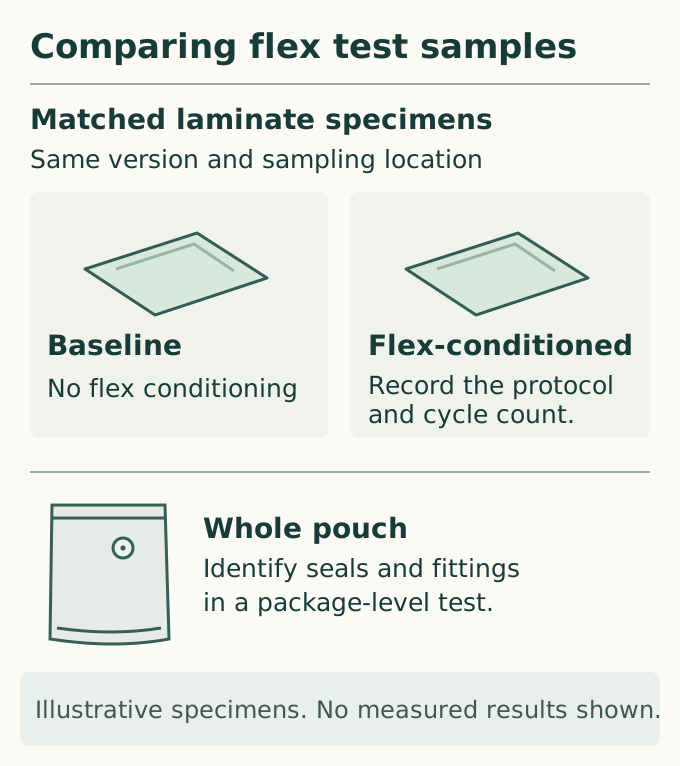
If flexing matters to the decision, reserve matched pieces of the same laminate revision for the initial and flexed measurements. Identify the treatment used and compare both materials under that treatment. ASTM F392/F392M describes conditioning flexible barrier materials by flexing. The lab still needs to perform the chosen examination or transmission test afterward. Ask the lab which conditions address your question. A crease you see when you unfold a bag can help you identify a sampling location. Its appearance alone gives no measured transmission rate. ASTM F392/F392M

A window changes the question from “which film?” to “which part of the bag?” A continuous aluminum foil ply is opaque across the area it covers. Leaving the ink off that area will not reveal the food. A converter can design clear and opaque regions, for instance by using a film metallized in stripes. Ask for the proposed construction in the window and in the adjacent wall. On the artwork, mark the largest area that must be transparent. Have the person responsible for product quality decide whether that light exposure is compatible with the intended display. Aluminum foil properties · Dunmore’s packaging films and striped metallizing
At a seal or valve, the issue is how the assembled pack performs. Imagine that both suppliers have produced acceptable wall data but the proposed valve changes on the second quotation. Hold the valve question open and request a converted pouch with the proposed part fitted. Record the model or part reference on the pouch drawing. If an issue shows up around that fitting, your team can investigate the component and its attachment before changing the entire wall material. The same logic applies when an irregular seal appears only on one filling line. Preserve the sample and its settings so you can investigate the point where the difference occurred.
Run a filled-pouch trial on your line
Give each candidate a sample ID as soon as it arrives. Keep one empty pouch with its supplier label, drawing revision and material specification. Put the same ID on the trial sheet and on the carton of filled packs. If you already have an approved pouch, fill a set of those pouches from the same food lot during the trial. Mark them as the reference when packing the cartons. Record the age and storage history of any previously filled packs used for a separate comparison.
Write down what would earn a release before running either sample. For a cracker brand, one condition might concern texture after a defined storage period. The product team should specify the storage conditions, timing and evaluation it will use. The filling team might have a separate requirement for sealing at its production speed. The buyer needs both decisions. A sample can run smoothly on the filling line while its product trial is still underway.
Fill both versions from the same food lot to the same target weight. Match the filling line, pack count per carton, orientation and planned handling. For a trial focused on the middle layer, also match the outer film, sealant, dimensions and fittings wherever practicable. Write down any differences the supplier has to introduce. If two items change together, enter both on the trial record so the result can be traced to the design as supplied.
At the sealer, give the operator the recommended working range for each sealant. Record the jaw temperature, pressure and dwell time actually used, together with the line speed. A new structure may need a different setting to make an acceptable seal. The buying question is whether each design works at the speed and seal quality the plant needs. Establish suitable settings for each and repeat the checks at the production settings.

On a valve pouch, identify the valve model and where it was fitted. If the line trial used generic sample bags with a different valve, record which checks those bags allowed. An operator may be able to confirm that the pouch opens and feeds through the machine. Approval of the fitted pack can wait for a sample with the specified valve. The same approach works for an unprinted blank supplied while printed samples are in production.
Filled-pouch trial and release record
| Check | Foil sample | Metallized PET sample | Acceptance condition or decision |
|---|---|---|---|
| Supplier sample and construction | ID / revision ___ | ID / revision ___ | Drawing and layer specification ___ |
| Food and fill | Lot / net weight ___ | Lot / net weight ___ | Product and target weight ___ |
| Pouch and fittings | Size / valve / closure ___ | Size / valve / closure ___ | Required configuration ___ |
| Run on the filling line | Line / settings / speed ___ | Line / settings / speed ___ | Seal check and operating speed ___ |
| Filled packs in cartons | Pack count / position ___ | Pack count / position ___ | Agreed handling and inspection ___ |
| Condition after handling | Location / observation ___ | Location / observation ___ | Check or retest required ___ |
| Product after storage | Conditions / result ___ | Conditions / result ___ | Product criterion and date ___ |
| Release | Evidence / open item ___ | Evidence / open item ___ | Decision / owner / date ___ |
When opening the cartons, retain a pack with any mark you want investigated and note its position in the case. A photograph of a fold against a carton seam can help the supplier find the spot. If the question is whether the fold changed the barrier, identify the sample for the agreed follow-up measurement. Keep the result with the photograph so the next reviewer can distinguish what the team saw from what it measured.
Once both versions satisfy the agreed requirements, compare prices per thousand finished pouches. Ask for the same quantity per artwork, printing specification, fittings, currency and delivery basis. Show one-time charges separately. If printing setup is included in one first-order quote, ask how the repeat order would be priced. That gives purchasing two useful figures for its actual order pattern.
What to include in the sample request
Send the supplier your food description, target fill weight, current drawing and the requirement driving the change. Attach the approved pouch specification if you have one. Ask the supplier to put the same quote reference on its report and on the sample label, so the packer can match the bag that arrives to the data you reviewed.
Please quote foil and metallized PET versions of this pouch for the same quantity and fittings. Identify the laminate revision, specimen, test conditions and reporting limit for each barrier result. If the design includes a window, mark the area covered by the report. Please supply finished samples identified to each quote for a trial on our filling line.
Include the question you want answered first when you request pouch samples. A packer trying to qualify a second source may want a sample matching the existing valve. A brand trying to make the food visible may need to settle the window drawing first. Naming that decision helps the supplier send a sample you can actually use.
Frequently asked questions
When should a food brand sample an aluminum foil pouch first?
Start with a foil laminate when the product requires strong protection from light across a closed, opaque pouch. If you already buy a foil pouch with documented performance for that food, keep it as the reference for any proposed replacement. Identify which requirement the new sample must match and where on the package that requirement applies.
What evidence do I need before switching to metallized PET?
Request the specification for the full replacement laminate, reports for the relevant oxygen, water vapor or light requirements, and samples converted to your actual design. Match the old and new samples to the same intended use. If flexing is important on your route, include a matched comparison after flexing before releasing the change.
Can two 140-micron pouches have different barrier performance?
Yes. That figure can describe a complete pouch wall with different outer films, middle layers and sealants. The two coffee projects illustrate how much can differ at that same nominal thickness. To say which wall passes less oxygen, you need measurements on the specific laminates under comparable conditions.
Can a pouch have a clear window where the body needs to block light?
A clear window admits visible light in that region. If the whole front must shield the food from visible light, remove the window or move it to an area where light exposure is acceptable. If the product can tolerate a window, specify its position, size and construction, then evaluate that version under the expected display conditions.
Does a visible crease mean the pouch has lost its barrier?
A crease identifies a part of the pouch worth checking. Keep a sample from the same version as a reference, record where the crease appeared, and select a test for the property that matters. An oxygen transmission measurement, for example, answers a different question from a visual check for wrinkles.
How do I compare prices after both trial pouches meet the requirements?
Ask for prices per thousand finished pouches at the same quantity, with the same fittings, printing scope, currency and delivery terms. Separate any one-time charges. For a repeat order, confirm that the quoted price applies to the same approved material revision and pouch configuration you tested.