
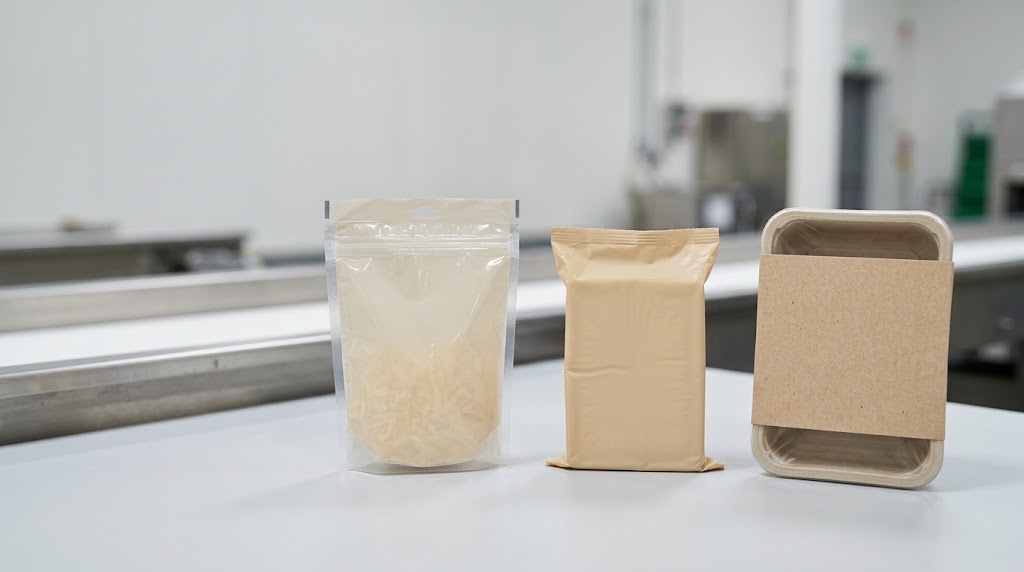
Short answer: Some cheese bags may be eligible for a specific flexible-film collection program, but the answer is never “yes” for every bag. Look at the whole empty package: the film layers, zipper, label, ink, window, and any attached parts. Then check whether the relevant local program accepts that structure and whether the bag can meet its food-residue rules. A PE-based design can be promising for certain streams, yet a cheese-smeared bag, a foil or mixed-material laminate, or a package without an applicable collection route may need a different disposal instruction. Do not put flexible cheese packaging into curbside recycling unless that local service explicitly accepts it.
For a shopper, the practical questions are “what is this exact package?” and “what does my collector accept?” For a dairy brand, the questions extend to barrier performance, seal integrity, shelf-life validation, and what the printed claim implies in each sales region. This article gives both audiences a way to make those decisions. Other articles in this cluster cover cheese format selection, filling, swollen packs, condensation, sealing, goat-cheese styles, and cream-cheese foil choices. Here the focus is end-of-use decisions and evidence for claims.
A Three-Minute Check for the Empty Bag
Follow the package's approved disposal instruction when it is clear and current for your area. If the instruction is absent or ambiguous, use this sequence before placing anything in a recycling bin:
- Identify the complete item. Is it a soft PE film pouch, a metallized or foil laminate, a paper/plastic wrap, a lidded tray, or several separable pieces? A shiny surface or a resin code does not reveal the full construction.
- Check the exact collection route. Does the local curbside program name flexible food films? Does a participating store or other drop-off point accept this specific type of bag? A store bin for eligible PE film is not a blanket invitation for every package sold in that store.
- Check residue and moisture. Cheese, oil, whey, seasonings, and condensation may make the pack unacceptable. If the program requires clean and dry film, assess whether the bag can realistically reach that state without excessive effort.
- Check separable components. A removable paper sleeve, cardboard box, rigid overcap, or separately labeled insert may have its own route. Do not rip apart a permanently bonded laminate or cut off an integral zipper merely because two materials look different.
- Follow the local instruction for uncertain items. When a material is unsupported or the bag is too contaminated for the program, use the local residual-waste route rather than contaminating a recycling stream.
In the United States, How2Recycle's Store Drop-off guidance describes a label for eligible flexible PE-based packaging, says the category list does not mean every item qualifies, and asks that food-contact film be clean and dry. That is a program-specific instruction. It is not permission to print a Store Drop-off label on an unassessed cheese bag or to assume the same route exists in another country.
Read the Package as a Set of Components
A cheese bag is often described by its visible face alone. A procurement specification is longer. It includes the exterior print web, any adhesive, barrier layer, inner sealant, gusset, clear window, reclosure, opening feature, label, and sometimes a carton. Each component can change how the pack is sorted and reprocessed.
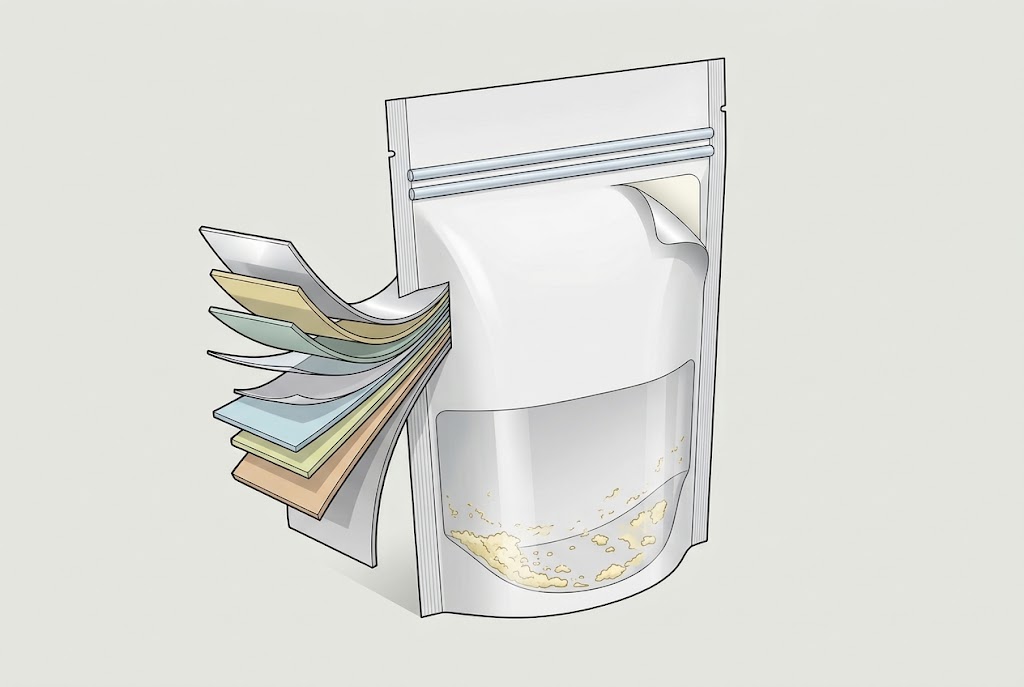
Conceptual component illustration: a layered pouch with a smooth plastic reclosure, window and food residue. Actual materials, labels and disposal routes must be checked for the finished pack.
The body film. A single-family PE construction can contain oriented and unoriented PE layers while still being described as PE-based. A structure with PET, nylon, paper, aluminium foil, or other non-PE layers introduces different sorting and reprocessing questions. A manufacturer should provide the actual layer stack and mass fractions; the consumer cannot reliably identify them by touch.
The barrier. Oxygen-barrier requirements may lead to EVOH, coated film, metallization, or foil. Even a thin functional layer can affect recycling compatibility depending on its composition and how the complete laminate behaves. The Association of Plastic Recyclers' PE Flexible design guidance evaluates design features including base resin, barriers, metallized layers, closures, labels, inks, and attachments. A favorable design assessment is still separate from local collection access and a finished-pack marketing claim.
The zipper. A press-to-close plastic rib-and-groove reclosure may be integral to the pouch. Its polymer and proportion matter. Consumers should not be told to remove a permanently welded zipper unless the approved program and pack design explicitly call for it. A different-material slider, spout, or clip is a separate issue. The correct specification asks what each part is made of and whether ordinary users can detach it as directed.
The label and print. A paper label glued across a large area, a removable sleeve, heavy ink coverage, or a metallic decoration can affect the package differently. Ask whether the label is intended to remain attached in normal use, whether it can be peeled cleanly, and how the receiving stream treats adhesives and inks. A small recycling icon on the label cannot override an incompatible structure beneath it.
The cheese left inside. A dry, near-empty pack and a pouch holding oily shredded cheese clumps are different end-of-use objects. Product on the zipper track or in a gusset can be hard to remove. A design that is technically compatible with a film stream may still fail a clean-and-dry condition in households.
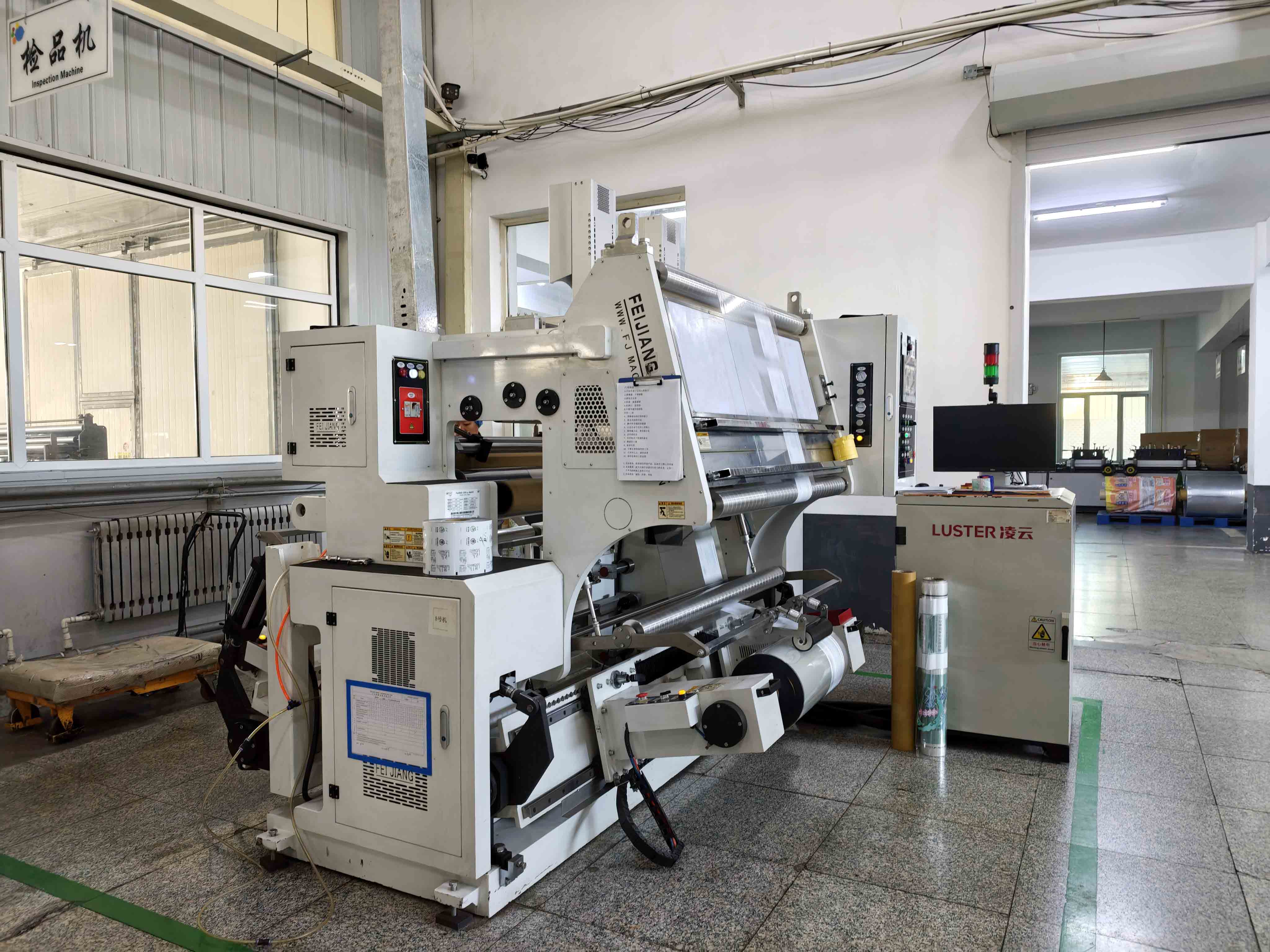
Real factory image: inspection of packaging web during conversion. This equipment photograph does not certify recyclability or prove a cheese package's shelf life.
How Common Cheese-Pack Materials Change the Question
Do not reduce the answer to “plastic bad, paper good” or “mono-material always accepted.” This table is a screening guide, not an instruction to place any particular bag in a bin.
Use exact terms. “PE-compatible in a design test,” “accepted at a named local film collection point,” and “recycled into new material after collection” describe different stages. A bag can meet the first and fail the second. A clean sample may behave differently from an ordinary used cheese pouch. For a consumer article, the safe shorthand is check the label, the full item, and the local program.
PE-based films are a starting point
A converter can design a flexible pouch primarily from PE-family films and choose compatible seals and reclosures. That gives the brand a plausible route to evaluate against PE-film design guidance. It does not prove that the finished pack qualifies for a particular label or is widely recyclable where sold. The brand still has to assess every feature and the collector's real acceptance criteria.
For cheese, a barrier change is not a free swap. Shredded cheese, sliced cheese, blocks, and portions have different handling and oxygen, moisture, puncture, and seal challenges. An outer MDO-PE layer may improve handling or printing characteristics, but the specific product, laminate and filling line need testing. If EVOH or another barrier is added, request its actual proportion and the relevant structure assessment; do not infer approval from a generic “mono-PE” pitch.
Foil and metallized films need their own evidence
Rolled aluminium foil, a plastic film carrying a deposited metal layer, and a foil-stamped logo are three different things. A silver interior alone cannot establish recycling compatibility or even identify the barrier. Ask for a supplier layer declaration. If the pack contains a bonded foil/plastic structure, a local authority's acceptance of clean household foil cannot simply be applied to the composite. If it contains metallized film, ask how the specific sorting system treats it.
Cream-cheese foil and tub selection is a separate packaging-format question. This article stays with disposal of the actual used components and the evidence behind a recycling claim.
Compostable is not another word for recyclable
The US EPA explains that compostable plastics are not intended for ordinary plastic recycling and can disrupt that stream. A certified compostable film also needs a collection route that accepts the finished package, not simply a resin certificate. In the United States, the FTC Green Guides summary addresses scientific substantiation and qualification of compostable claims when suitable facilities are not sufficiently available.
For a dairy product, there is a second task: verify that the compostable package delivers the required barrier, seal, cold handling, and food-contact performance. Do not trade away a validated food-protection system for a label claim that cannot be used in the target market. Conversely, do not dismiss a candidate without a product-specific trial. The decision requires both disposal and product data.
Food Residue Is the Practical Bottleneck
Cheese leaves behind fat, whey, crumbs, shreds, spices, and soft product that can collect in folds and zipper tracks. These are not abstract contamination risks; they are the condition of the pack when a household finishes it. A bag designed for a dry snack may become nearly empty with a simple shake. A cheese pouch may remain greasy after the last serving. The disposal instruction should be based on a realistic used sample.
How2Recycle tells users to make food-contact Store Drop-off film clean and dry. A brand should not treat that phrase as an afterthought. Test whether ordinary users can empty the pack, wipe it if appropriate, and let it dry without dismantling it or using disproportionate water. If significant food remains and the program does not accept it, follow local residual-waste guidance. Never instruct people to put wet, cheese-covered film into a retailer's PE bin merely because the bag is made mainly of PE.
For producers, run a simple use simulation. Have several people open, use, reseal, and empty a full retail pack under normal household conditions. Photograph the empty bag's interior and zipper. Record whether residue remains in inaccessible areas, whether the label is removable if required, and whether the pack dries reasonably. This is a usability observation, not a substitute for the collection program's own requirements.
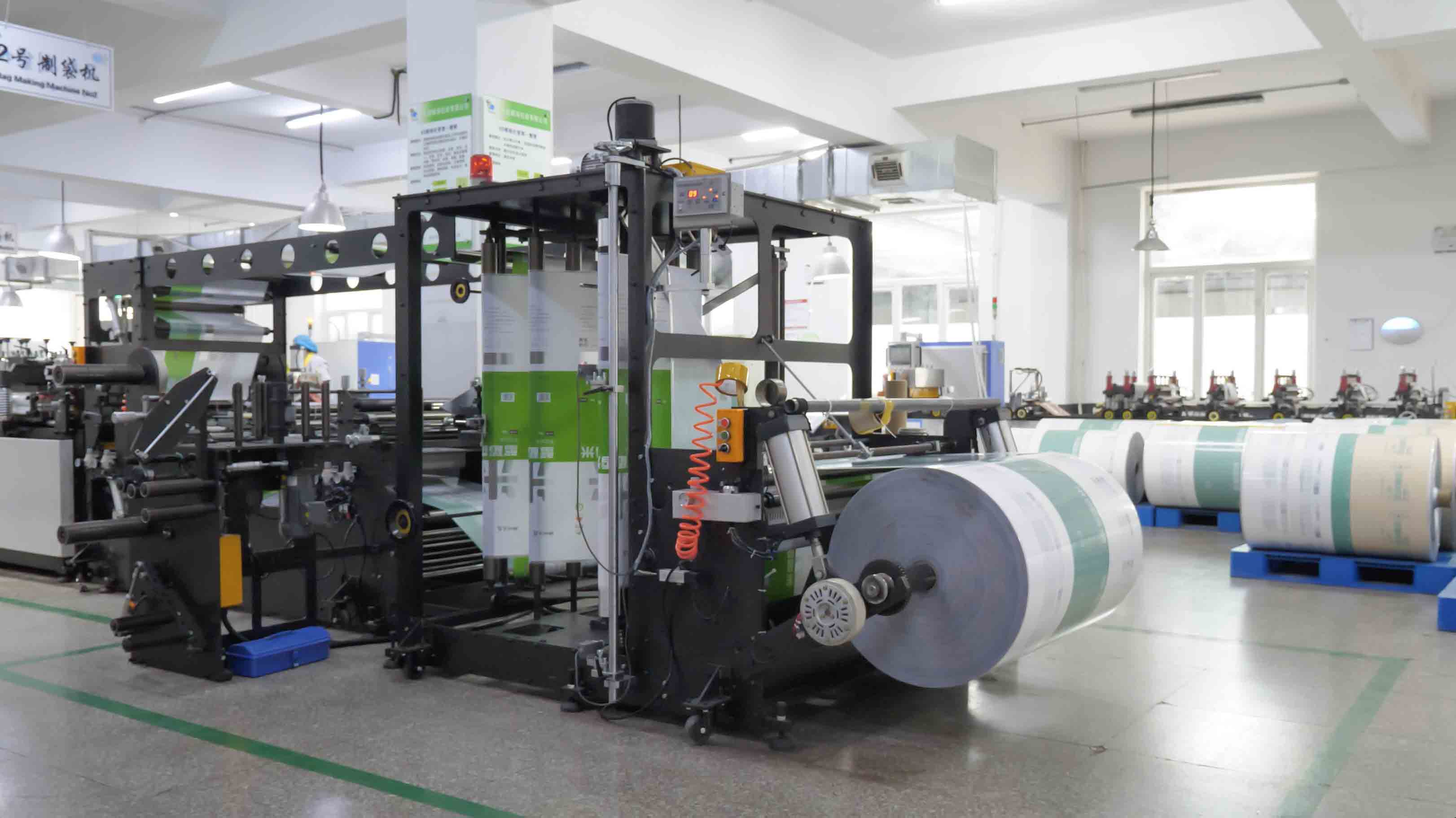
Real factory image: pouch conversion. An empty production sample is not representative of a consumer-used cheese bag with residue.
Check the Collection Route, Not Just the Resin Code
Curbside and drop-off are different services. A municipality may accept rigid tubs and bottles while excluding loose flexible film from its curbside carts. A retailer may accept only a defined set of eligible PE bags and wraps. A mail-back or specialized program may set other rules. Check the actual program for the consumer's location and keep the date of that check in a brand's claim file.
For a US Store Drop-off-style route, a matching label on the specific finished pack is more meaningful than an unlabeled sample of a PE resin. Confirm the label owner's assessment and the participating collection network before printing instructions. How2Recycle's own page says not every plastic film belongs in its Store Drop-off stream and that food-contact material should be clean and dry. If a city explicitly accepts some film curbside, follow that city's instructions; do not generalize that exception nationally.
For a brand selling across countries, create separate market rows. The same package can be collected differently in two places. Label language, component separation, and what qualifies as an unqualified claim can also differ. A single global “100% recyclable” artwork file may be misleading even if the pack has a technically recyclable structure.
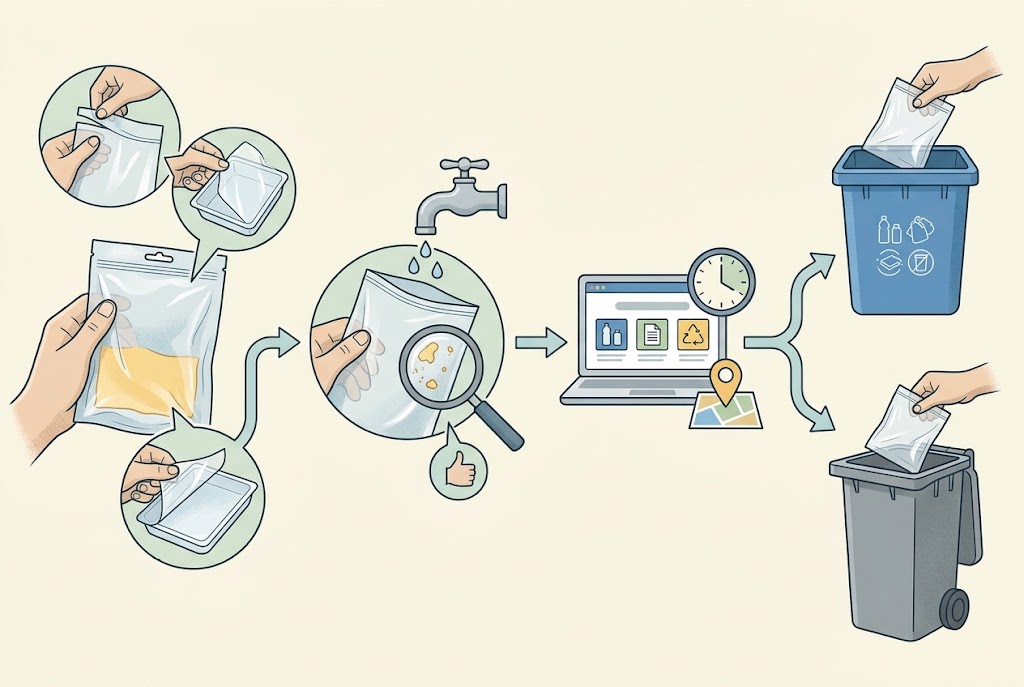
Conceptual decision illustration: inspect components and residue, then check local rules. The two bins are conditional outcomes: use a recycling route only when it accepts the exact pack in its actual condition.
What to do with a carton, tub, lid, and flexible bag
A multipack may have a corrugated shipping carton, printed retail carton, rigid cup, peelable lid, and loose overwrap. Evaluate them separately. If the consumer can readily separate a clean carton, give its paper route if that market accepts it. A peelable lid may differ materially from the tub. A foil/plastic laminate lid should not be described as plain aluminium simply because one layer is metallic.
Do not give consumers a complicated disassembly task that the package cannot support. “Remove the label” is only useful if the label peels off as sold and the program requests that step. “Separate the zipper” is misleading if it is fused into the bag. Test the instruction with the actual consumer-facing package, including any food residue, before claiming the whole design is easy to recycle.
Design for Recycling Without Losing Cheese Protection
The environmental aim and the food-protection aim must be measured together. A dairy brand should compare candidate structures using the same cheese formulation, fill mass, line settings, and distribution profile. Measure both packaging outcomes and product quality. A design that enters a recycling stream but causes more spoiled product or leakers is not automatically a better operational choice.
Start with the current failure mode. Is the problem oxygen ingress, moisture loss, puncture, seal contamination, condensation, or repeated opening? Then ask whether a PE-oriented construction can meet that requirement and remain compatible with the intended recycling stream. The APR PE Flexible guidance is a useful design review for components, but it should be applied to the actual structure, not used as a generic badge.
Ask for barrier data with units and test conditions. ASTM D3985 is a method for oxygen transmission rate through plastic films and laminates; ASTM F1249 addresses water-vapor transmission. OTR and WVTR for flat film are inputs to a package decision. They do not include oxygen already in a filled bag, a leaky seal, or damage from distribution. Set product-specific target values through the dairy's validation work; do not copy a number from a coffee pouch into a cheese specification.
Seal performance deserves its own tests. ASTM F88/F88M covers seal-strength measurement for flexible barrier materials. ASTM F3039 addresses dye-penetration leak location in nonporous packages or flexible barriers. Choose appropriate tests and acceptance criteria with the dairy's quality team. Also check actual opening and reclosure, cold handling, transport compression, and label durability.

Real factory image: lamination capability. A photograph cannot establish whether a particular finished laminate is accepted by a local recycler or protects a cheese SKU for a specified period.
Food safety remains the producer's responsibility
A recycling-led redesign does not replace the food-safety plan. The FDA notes that Listeria can grow at refrigeration temperatures. Packaging cannot undo contamination introduced before sealing, and a printed “high barrier” claim cannot validate the producer's process. The dairy should test the actual recipe, filled package, refrigerated distribution, intended life, and microbiological controls under its own plan. This is especially important if a material change alters the seal window or pack integrity.
Make a side-by-side pilot rather than comparing supplier brochures:
- Define the cheese SKU, filling conditions, target market and current package baseline.
- Select a small number of candidate structures; document each layer, zipper, label and barrier.
- Obtain food-contact documentation for the actual time, temperature and product conditions.
- Test empty material and filled packs, including seal strength, leaks, opening, and line rejects.
- Put matched cases through the intended refrigerated route and retail display.
- Evaluate product quality and food safety with the dairy's program at relevant intervals.
- Assess the used empty package against the intended collection route and cleaning expectation.
- Approve the claim and artwork only after both performance and end-of-use evidence are in hand.
A Real PE/MDO-PE Case, With the Right Boundary
Mylarbag's Australian PE/MDO-PE side-gusset coffee-bag project lists Australia, PE/MDO-PE, gravure printing, and a side-gusset format with a coffee degassing valve. It is a real example of a PE-family flexible package in the supplier's portfolio. It is not a cheese bag, and its valve does not belong in a refrigerated cheese specification merely because the same converter can make the format.
The project's own page describes it as recyclable. That is a product-page claim, not independent evidence that a cheese adaptation with a different barrier, zipper, print and food residue qualifies for a program in every market. For a dairy inquiry, the relevant transfer is a manufacturing discussion about PE-oriented construction and printing. The brand must still obtain a current, finished-pack assessment and test cheese protection.
This distinction matters commercially. A buyer may ask, “Can you make a recyclable cheese pouch like your coffee bag?” A good supplier answer begins with the cheese's barrier and seal requirements, the destination's collection route, and the components that will actually appear on the pack. It does not promise that removing PET from a structure automatically creates a universally recyclable dairy bag.
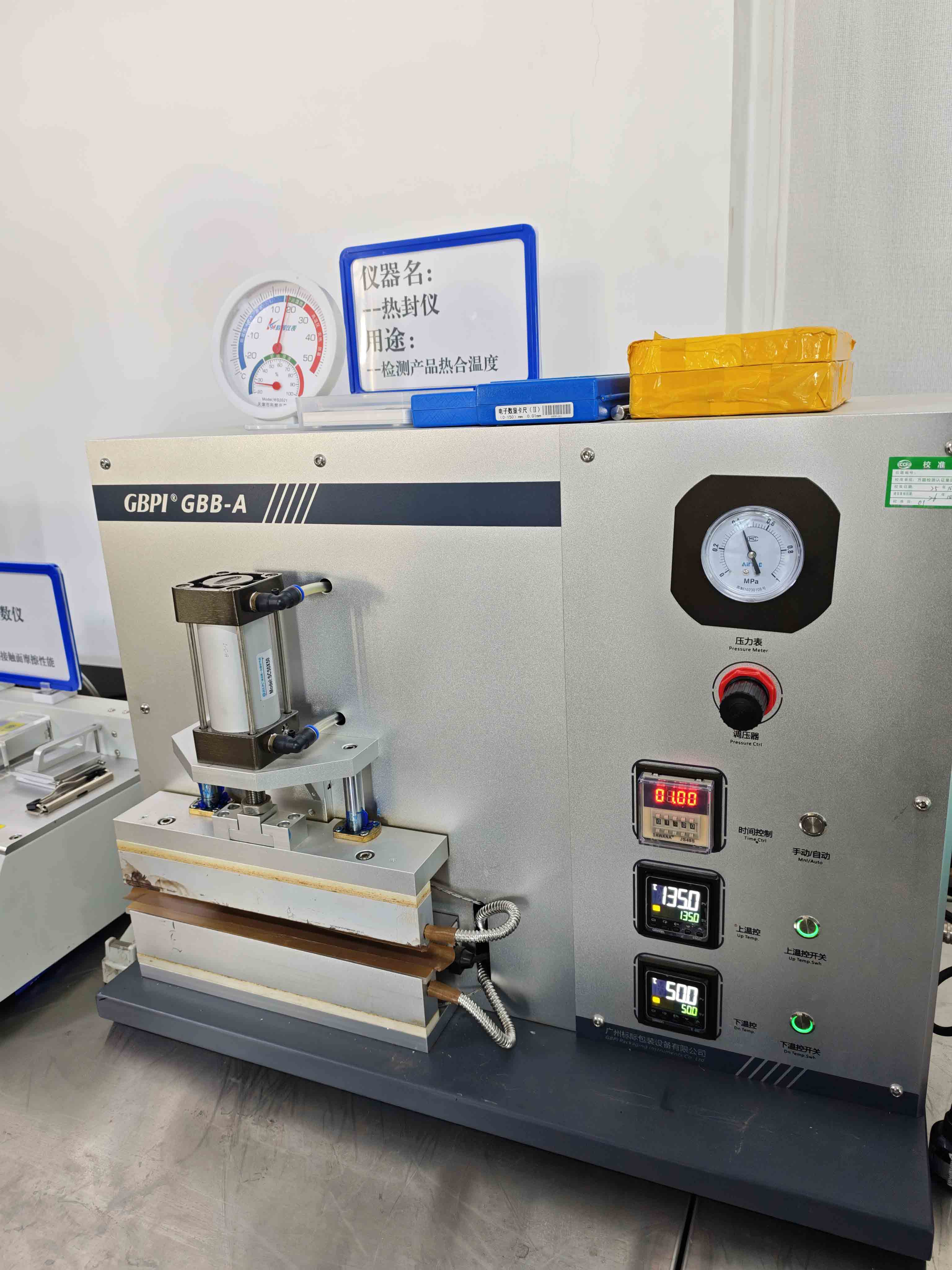
Real factory image: seal-testing equipment. The result for a redesigned cheese pack must be measured and documented separately.
Audit “Recyclable,” “Store Drop-off,” and “Compostable” Claims
In the United States, the FTC's Green Guides summary says marketers should qualify recyclable claims if facilities are not available to at least 60 percent of consumers or communities where the item is sold. The summary also calls for evidence behind compostable claims and qualification when suitable facilities are not broadly available. These are US marketing guidance points, not worldwide collection rules. Have the brand's reviewer apply the current rules in every intended market.
Keep a claim dossier: final bill of materials, structure drawings, relevant recycling-design tests, program letters or approvals, local access evidence, representative used-pack observations, artwork version, date, and owner for revalidation. Recheck after a supplier change, barrier adjustment, new label, different market, or significant collection-program update.
Do not state that all cheese bags are recyclable because one PE option exists. Do not state that none are recyclable because some laminates are difficult to process. A strong B2B article gives the buyer a conditional path and the evidence needed to make a narrower, useful claim.
What to Send a Cheese-Packaging Supplier
To discuss a lower-impact package with Mylarbag's cheese-bag team, send the real SKU and current packaging performance, then ask for a structure-specific proposal. The plastic-film options and eco-friendly packaging options are starting points for a trial, not proof that a particular design meets a recycler's criteria.
Provide cheese style, fat and moisture behavior, pack weight, fill method, target life, distribution temperature and duration, current film stack, and observed failures. State the intended markets and whether you seek curbside, film drop-off, or another verified route. Ask for a complete bill of materials including barrier, inks, adhesives, closure and labels, plus sample quantities for a filled-line trial. Request OTR/WVTR results with conditions, food-contact documentation, seal-test plan, and a reasoned end-of-use assessment.
Finally, ask the practical question: “After an ordinary household uses this cheese, can the empty pack meet the collection program's condition?” If the answer is uncertain, design and test again before printing a confident environmental claim. A supplier can help make a better package; the producer and brand own the validation and the wording shown to customers.
FAQ: Can Cheese Bags Be Recycled?
1. Are cheese bags recyclable?
Some may be eligible for a particular local program, but many cannot be placed in ordinary curbside recycling. Check the entire package structure, approved disposal instruction, local route, and food residue.
2. Are shredded-cheese bags recyclable?
Not as a category. One brand's PE-based pouch and another brand's mixed-material pouch may differ; both may contain cheese residue. Follow the specific pack's instruction and the local collection program.
3. Can I put a cheese bag in my curbside recycling cart?
Only if your local service explicitly accepts that type of flexible packaging. In many places, rigid containers and flexible films use different routes. A resin code alone does not authorize curbside disposal.
4. Can a clean PE cheese pouch go to a store drop-off?
Possibly, if the exact finished pack is eligible for the program, the store participates, and the pouch satisfies its clean-and-dry requirements. A generic PE appearance is not enough.
5. Do I need to wash the bag?
Follow the program's instruction. The relevant question is whether the used pack can meet its clean-and-dry condition. If food remains trapped and cleaning is impractical, do not contaminate the collection bin.
6. Is the zipper recyclable with the bag?
It depends on the actual zipper polymer and program assessment. An integral zipper is not automatically a reason to discard the pack, and consumers should not be told to cut it off without an approved instruction.
7. Should I remove a paper label?
Only if the finished-pack instruction asks for it and the label can be removed as intended. The brand should assess label adhesive, size, and realistic separation during design.
8. Is a silver cheese bag aluminium foil?
Not necessarily. It might contain rolled foil, metallized plastic film, or a metallic decoration. Obtain the material specification before assuming a disposal route.
9. Can foil-lined cheese wrappers go with clean household foil?
Do not assume that. A bonded foil/plastic or foil/paper wrapper is different from a separate piece of clean aluminium foil. Ask the local program about the actual composite.
10. Are paper cheese bags recyclable?
The outer paper appearance is not enough. A plastic coating, bonded film, wax-like layer, or cheese residue may change acceptance. Check the full construction and the local paper route.
11. Does “compostable” mean I can recycle a cheese pouch?
No. Compostable plastics are a separate material route and should not be mixed into ordinary plastic recycling. Check the complete pack's certification and whether a local composting program accepts it.
12. Can PE/EVOH cheese film be recycled?
Some specifically engineered PE structures with functional barriers may be compatible with a relevant recycling-design framework. The exact layer proportions, tie layers, other components, and collection program still require assessment. Do not infer acceptance from the abbreviation.
13. Why does food residue matter if the film is recyclable?
Collection and reprocessing systems handle used objects, not clean laboratory samples. Cheese fat, whey, and shreds can make a pack unsuitable for a clean-and-dry film stream.
14. Can a brand print “100% recyclable” because a supplier sells mono-PE bags?
The brand should first substantiate the claim for its finished pack and markets, including closure, label, barrier, food residue expectations, and collection access. A supplier's unrelated product case is not proof for the new cheese SKU.
15. What is the first step toward a more recyclable cheese pack?
Document the current package, cheese-protection requirements, target collection routes, and actual end-of-use residue. Then trial candidate structures on the real filling line and verify both product performance and the proposed disposal claim.