
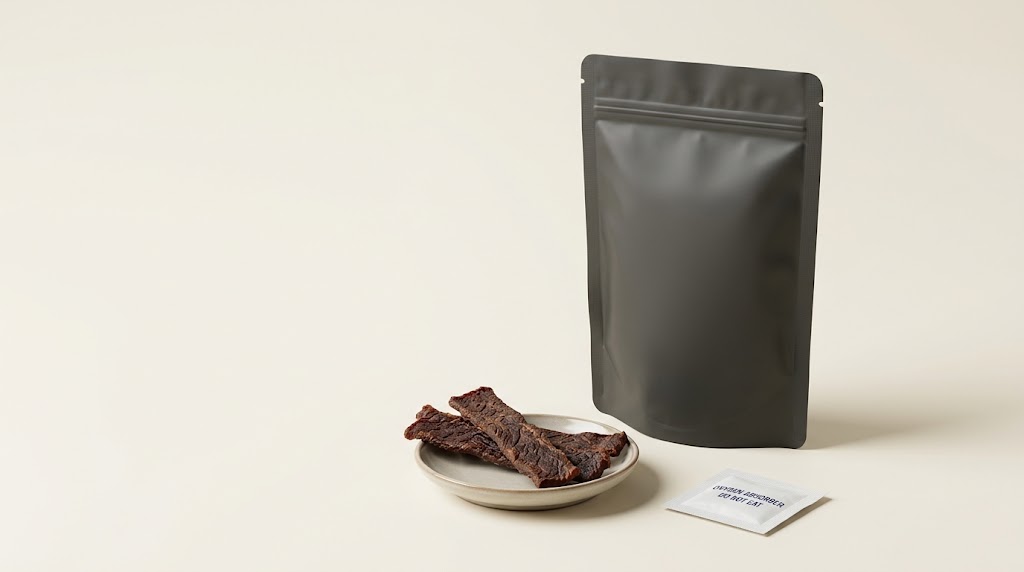
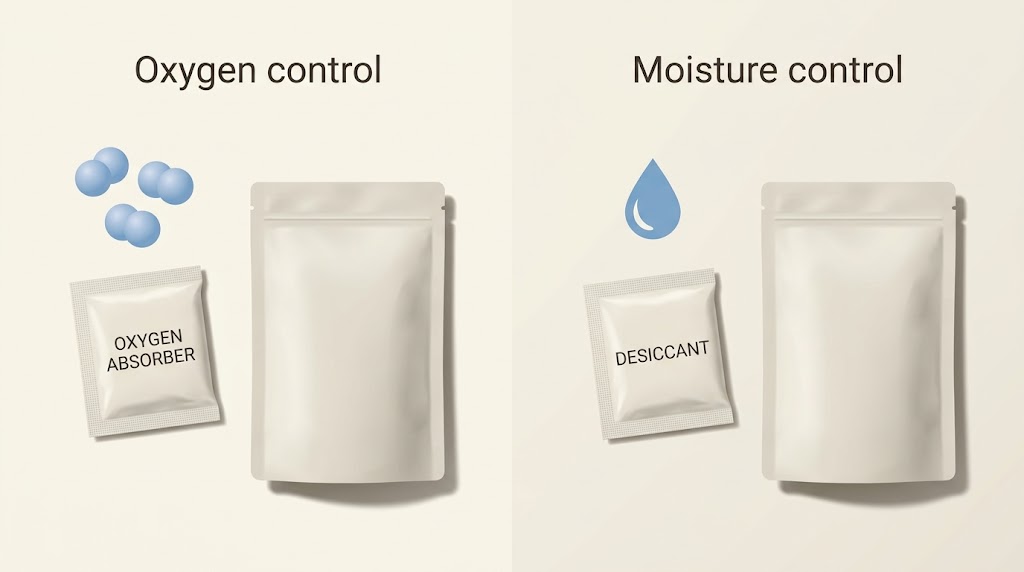
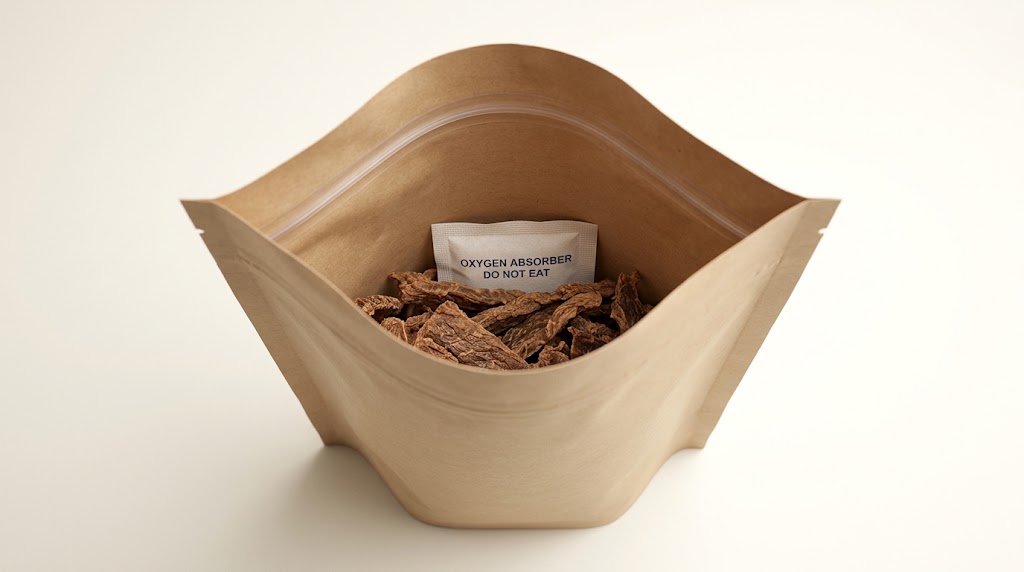
The small packets in beef jerky are commonly oxygen absorbers, also called oxygen scavengers or deoxidizers. They remove oxygen from the sealed package to help protect the meat from oxidation. An oxygen absorber is different from a desiccant, which controls moisture. Check the packet's markings or the food manufacturer's information to identify the one in your bag.
That little white bag is packaging, not food. Leave the sachet intact and follow the product's handling and disposal instructions. Its color, shape or “Do Not Eat” warning alone does not tell you which material is inside.
For a jerky brand, the bigger question is how the packet works with the pouch around it. An absorber has a limited job and a finite capacity. Choosing beef jerky bags means planning the barrier material, sealing process and packet together, then checking the filled package under the conditions in which it will actually be sold.
1. Identify the packet before deciding what it does
Start with the words printed on the sachet. “Oxygen absorber” identifies its purpose much more reliably than a white wrapper or a familiar rectangular shape. A brand name and product code can help the food manufacturer trace the specification.
For example, Multisorb's FreshPax and FreshSnax packets are designed to remove residual oxygen from sealed food packages, and the manufacturer lists jerky among their applications. This confirms the use of oxygen absorbers in the category; it does not identify every unmarked sachet found in a meat snack.
Do not cut a sachet open to identify its contents. There is no purchasing advantage in examining loose powder when the specification can be obtained from the supplier.
Keep the packet identity in the production record
If you buy inserts for a packing line, record the exact item number. “White packet, small” is too vague for an approved materials list. Include the supplier, lot reference, nominal capacity, storage instructions and the technical document revision used during approval.
This also makes substitutions easier to control. A replacement may fit the dispenser perfectly while having different performance or handling requirements. Treat a new grade as a technical change, even when its wrapper looks familiar.
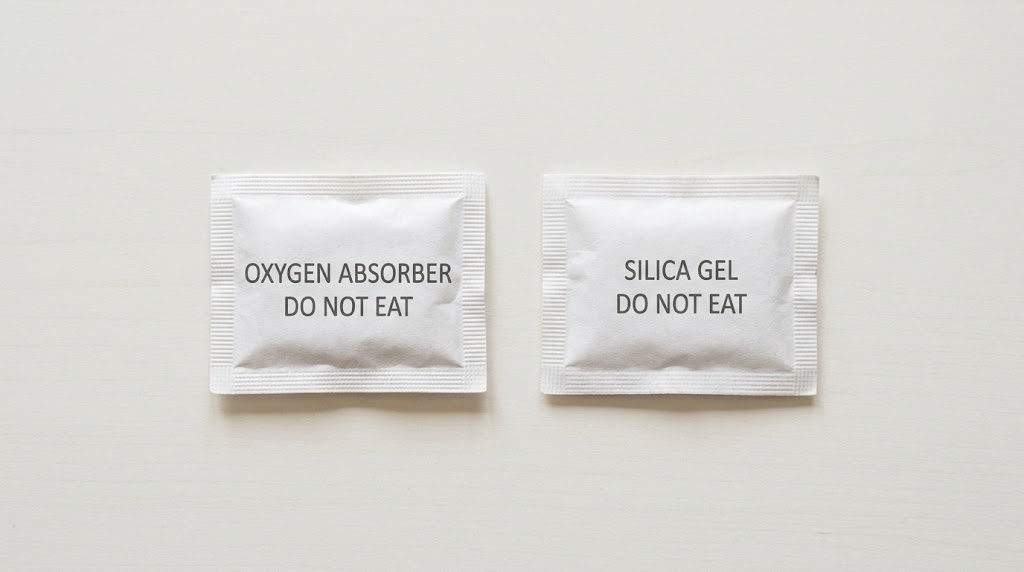
2. Oxygen absorbers and desiccants solve different problems
An oxygen absorber targets oxygen. A desiccant takes up moisture from its surroundings. Those functions are distinct, even though both products may arrive as small sachets. Multisorb's explanation of oxygen and moisture control makes this distinction when describing active packaging.
For a chewy meat snack, “drier” is not automatically a better result. Establish the texture you intend to sell and discuss any moisture-control insert with the product developer. Adding a desiccant merely because another packaged food uses one can create a different product experience.
The reverse shortcut also fails: a moisture-control packet cannot be treated as an oxygen-control specification. If the purchasing brief says “protect against oxidation,” ask the supplier to explain how the proposed insert addresses that particular requirement.
Match the grade to the food
Oxygen absorbers are not one interchangeable product. MGC's AGELESS selection information distinguishes several types, including grades with different moisture requirements and applications. Product water activity and packing conditions belong in the selection discussion.
Ask for a recommendation against your measured product specification. Avoid selecting a grade from a generic “dried food” description, especially when moving between crisp, dry snacks and soft, seasoned meat. A supplier should explain the conditions under which its recommendation applies.
3. What an oxygen absorber can protect—and what it cannot
Jerky still contains components that can deteriorate during storage. MGC's explanation of fat oxidation describes oxygen reacting with fats and oils, with heat and light encouraging that process. Reducing oxygen exposure is therefore a useful packaging objective for products where oxidation limits quality.
Define the intended benefit in measurable terms before running a trial. Are you investigating an unwanted flavor change, a color change, or another specified quality endpoint? “Keeps it fresh” is too broad to serve as a trial conclusion.
Oxygen removal does not make an inadequately processed food safe. MGC's usage precautions explain that its absorbers do not suppress every group of microorganisms, including organisms capable of growing without oxygen. Low oxygen is not sterilization.
For commercial jerky, establish the food process with qualified food-safety support. The USDA FSIS guideline for jerky produced by small and very small establishments is a relevant starting reference for process development. Keep that work connected to the packaging project without asking the pouch or sachet supplier to stand in for process validation.
A useful internal brief separates three questions: Is the food process suitable? Does the packaging maintain the required environment? Does the product meet its quality specification through the proposed storage period? Each needs its own evidence.
4. The outer bag controls the absorber's working environment
An absorber deals with oxygen inside the package. The pouch must also restrict further entry. MGC's packaging guide specifies a high gas barrier, a suitable absorber, complete sealing and correct handling as linked conditions.
When comparing quotations, ask for the finished laminate specification. “Mylar,” “kraft” and “premium barrier” are useful conversation starters, but none supplies the complete performance information needed for approval.
Read the barrier report with its test conditions
OTR is oxygen transmission rate; WVTR is water-vapor transmission rate. AMETEK MOCON explains that flat-film OTR is commonly reported in cc/m²/day and WVTR in g/m²/day. Whole-package results use package-based units instead. Temperature, relative humidity and the gas concentration difference affect the measurements.
Request missing information before ranking suppliers. A small OTR number without units or test conditions is not enough to support a material decision. Keep the report attached to the exact structure approved for production.
Include the retail design in the technical brief
A window, a larger gusset or a different laminate should trigger a review of the relevant packaging evidence. Do not let the artwork team finalize a design while the technical team evaluates a different pouch.
For a new range, send both teams the same filled sample and specification revision. When discussing custom jerky pouch materials, identify which features are essential and which can change after testing. That gives the supplier room to propose a workable structure without losing the intended shelf appearance.
5. Choose packet capacity from the oxygen load, not the jerky weight
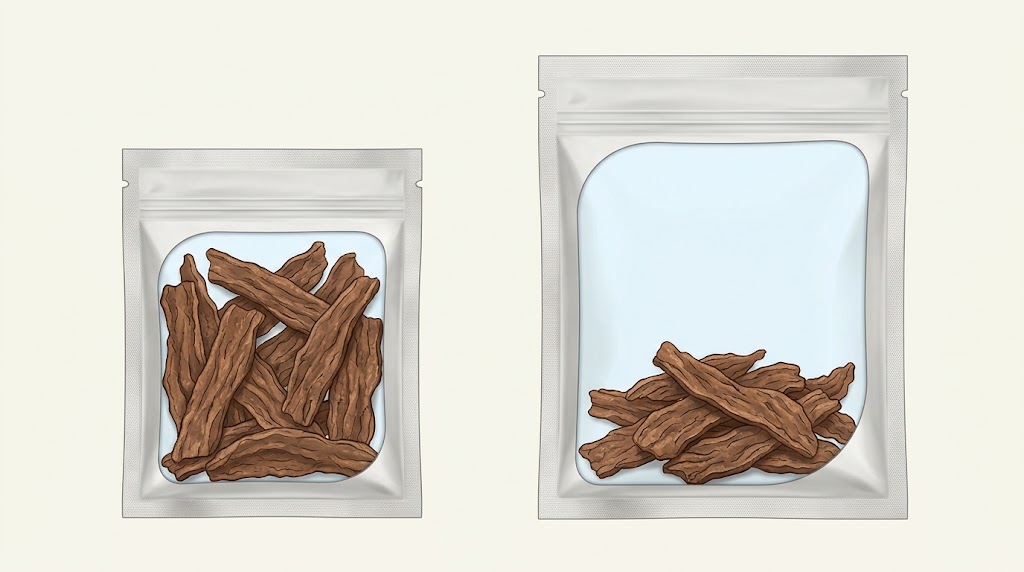
An 80 g pack weight does not reveal how much air remains after filling. Strip size, packing arrangement and pouch dimensions all affect the space around the product. Two packs with the same net weight can therefore present different starting conditions.
Separate the packet's physical dimensions from its oxygen capacity. A sachet must fit the dispenser and pouch, but its width is not a substitute for the supplier's absorption specification. Also ask how quickly the chosen grade works under the proposed conditions; a nominal capacity alone does not describe the whole process.
A calculation that shows why headspace matters
NOAA lists oxygen at about 20.95% of dry air by volume. Using that proportion, the following arithmetic illustrates the oxygen initially present in three hypothetical volumes of trapped air:
These are teaching examples, not absorber size recommendations. They describe only the assumed starting air volume at the same reference conditions. They do not account for later oxygen entry, oxygen associated with the product, supplier margins or absorption speed. A gas-flushed or vacuum-packed product requires different starting inputs.
Use a filled-pack assessment to establish those inputs with the absorber supplier. Do not calculate the usable gas volume from the outside width and height of a flexible pouch as though it were a rigid box.
Give the supplier a complete selection brief
Provide the pack weight, actual pouch, filling arrangement, product specification, intended temperature range and target storage period. Describe any vacuum or gas-flushing equipment. Request the proposed packet code, capacity, operating limits and trial method in writing.
Ask what must be reassessed if the pack size changes. A successful small-pouch trial should not silently become approval for a larger family pack. Keep each approved combination identifiable so purchasing cannot mix a bag revision with an unrelated packet specification.
6. Build a reliable seal around the chosen system
The zipper helps the consumer reclose an opened pack. For a conventional top-filled retail zipper pouch, establish the initial heat seal above the zipper using the pouch supplier's drawing and sealing guidance. Closing the zipper alone is not evidence that the unopened package meets the intended oxygen-control specification.
Give the packing team a clear acceptance reference. Show the intended seal location, acceptable appearance and the area that must remain clear during filling. Jerky pieces, loose seasoning and a misplaced sachet are all practical things to inspect before the jaws close.
Qualify the filled pouch on the production equipment
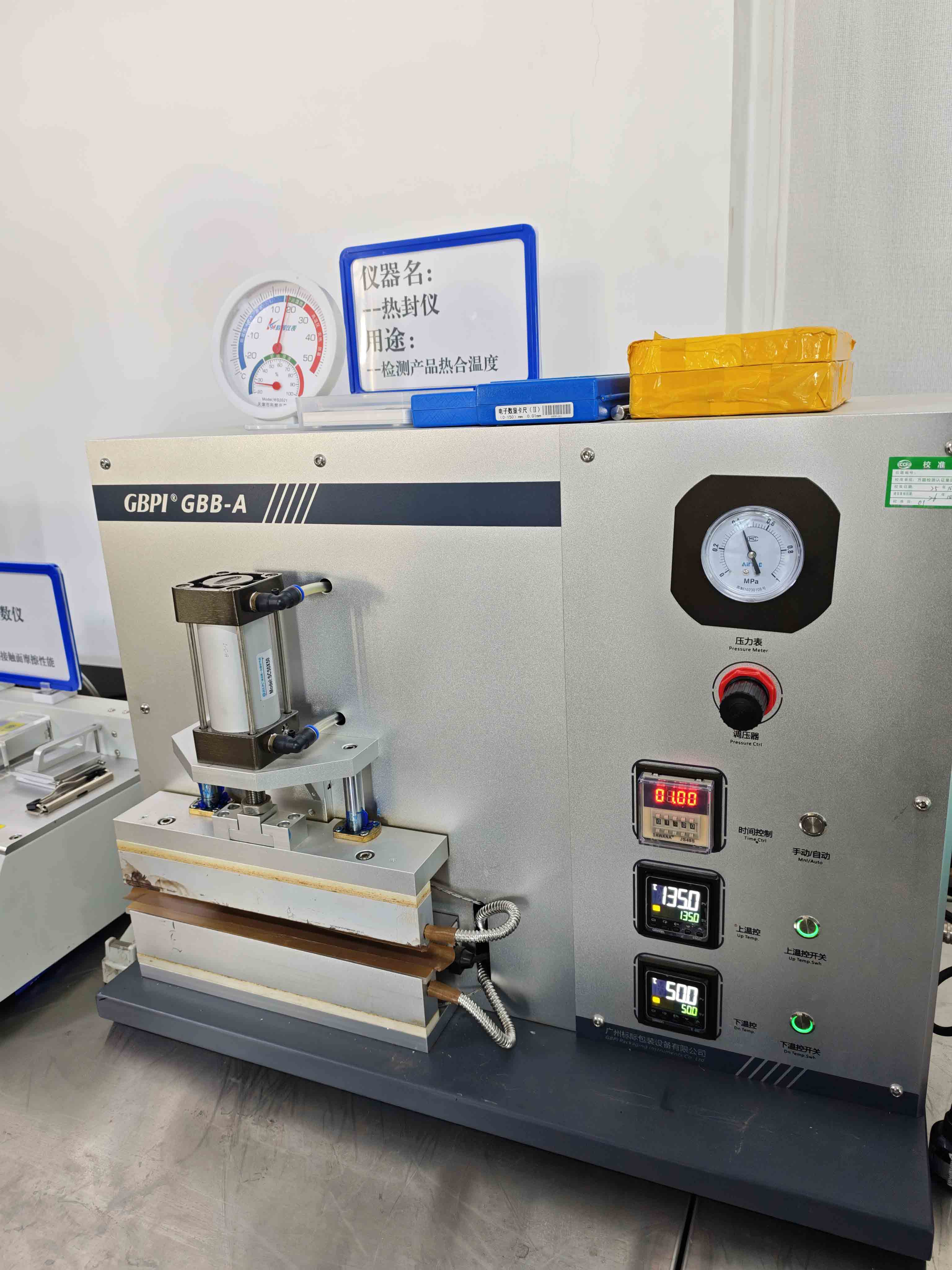
Record the machine, temperature settings, dwell time or line speed, pressure where applicable, and the sample identification. Use the actual laminate and normal filling conditions. A neat laboratory seal is a useful development sample, but the production process still needs its own checks.
Agree with the testing team how seal strength and leakage will be assessed. These questions are related, but a strong-looking seal does not answer both. Keep the results with the approved process settings and define what operators should do when a check fails.
7. Manage packets from the master bag to the final seal
An approved packet can still be mishandled. Make its journey through the packing room part of the written procedure, including what happens when the line stops.
MGC's handling instructions address taking out the needed quantity, protecting unused sachets and discarding material exposed beyond its specified limit. Follow the instructions for the actual grade you buy. There is no single open-air working time that should be copied across every oxygen absorber.
Give each shift a short, usable record
The operator should be able to answer these questions without hunting through a folder:
- Which packet item and lot are approved for this product run?
- When was the protective master bag opened?
- How many packets were issued to the line?
- What is the supplier's applicable exposure limit?
- How are interruptions, leftovers and rejected packets handled?
- Who checks that the correct insert reaches each pouch?
For manual packing, trial a batch size the team can handle consistently. For automatic insertion, test the feed and cutting arrangement with the exact sachet format. Include startup, replenishment and restart checks in the trial, since steady running is only part of a production shift.
Keep placement repeatable
Choose a location that leaves the final seal area clear and can be reproduced on the line. Ask the supplier to evaluate that position during application testing. MGC's technical Q&A notes that placement can affect oxygen-removal speed and that vacuum and gas-purge applications need specific consideration.
Write the approved arrangement into the packing instruction with a photograph. If operators have to force the packet past densely packed strips or retrieve it from the seal area repeatedly, revisit the sequence or pouch dimensions. A practical layout should make the correct action easy to repeat.
8. A real packaging reference: an 80 g New Zealand meat snack pouch
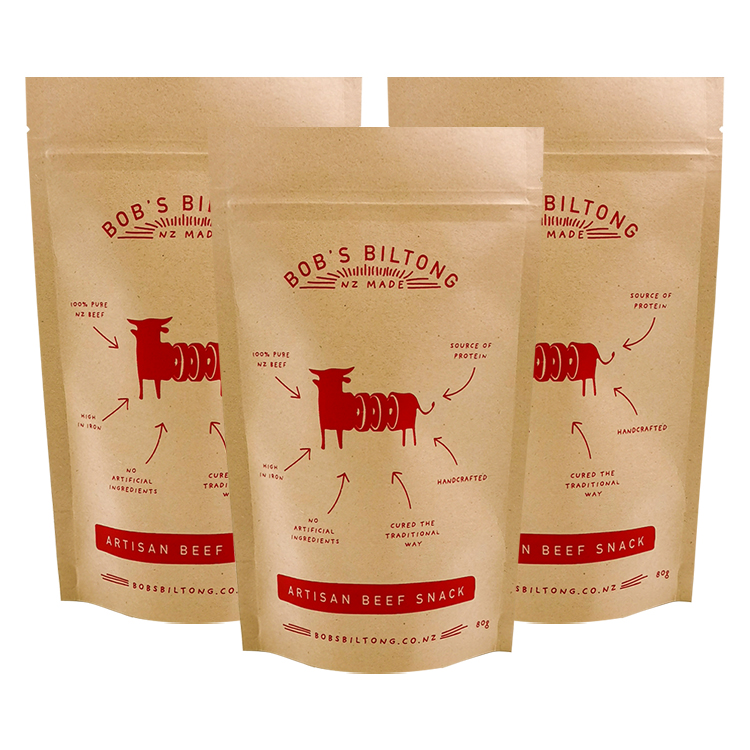
Mylarbag's 80 g kraft paper meat snack pouch case provides a useful construction reference. The case library records a New Zealand project using a stand-up pouch and a MATOPP/kraft paper/VMPET/PE structure. The photographed product is Bob's Biltong, with “NZ Made” and 80 g visible on the pack.
Biltong and jerky should not be assumed to share a production process. This example is used here to examine the pouch, not to transfer food-processing conditions from one meat product to another.
What the structure helps a buyer discuss
The kraft appearance is the feature a shopper sees. The complete material description tells the buyer that the pack also contains film layers, including metallized PET and a PE sealing layer. The engineering question is how the finished construction performs, rather than whether the paper appearance alone looks protective.
For a brand developing a similar presentation, turn each visible or documented feature into a question for the sample review:
This is a practical way to use a case: start from a real construction, then identify the evidence needed for your own application.
What the case does not establish
The available case record does not identify an oxygen absorber grade, its capacity, residual-oxygen results or a validated shelf-life figure. It would therefore be wrong to say this pack proves that a particular sachet works for every 80 g meat snack.
For a new absorber-equipped version, request a trial plan covering the proposed insert and actual food. Keep the case image as a visual reference while the specification and test report become the basis for approval. That distinction lets the sales team tell a clear story without turning an attractive photograph into a performance claim.
9. Check the complete pack before approving a production order
Write the questions you want the trial to answer before filling samples. Otherwise, a team can collect photographs and measurements without reaching a decision.
MGC's packaging evaluation guidance calls for testing the actual product and package arrangement under prescribed storage conditions. Build your own protocol with the processor, absorber supplier and packaging test team, using agreed acceptance criteria.
Use a trial record that connects the results
Treat this table as a planning template, not a universal test standard. Sample numbers, methods, timing and limits should be set for the application. A trial should also have a named decision maker, so a borderline result is resolved before stock is ordered.
Keep changed variables visible
If you compare two pouch structures, label them before filling and preserve the records separately. If you then change the sachet, give that combination another identifier. This simple discipline avoids a common reporting problem: attributing an improvement to the film when the packet or sealing conditions changed too.
Also decide what will trigger a new review after approval. Useful examples include a recipe change, a different packet supplier, a window added to the bag, new filling equipment or a revised distribution plan. Put that list beside the approved specification, where purchasing and production can see it.
10. Investigate a failed pack before changing the packet size
An unexpected result is a reason to examine the system. A larger sachet should not become the automatic response to every complaint.
The table below is an investigation aid. Its entries are possible questions to check, not diagnoses made from package appearance.
If the same issue appears at a particular point in a shift, preserve that timing. It may be more useful than a general note saying “some packs failed.” Photograph the unopened pack, identify the lot and keep representative samples under the agreed investigation procedure.
Avoid judging absorber performance by whether a pouch looks tightly drawn around the food. Package appearance is not a substitute for the selected measurement method. Likewise, squeezing a sachet does not produce a traceable capacity result.
11. Send a useful brief when requesting jerky bag samples
Make the inquiry specific enough for a packaging supplier to respond with a sample proposal. Include the food format, net weight, intended pouch style, required appearance, filling method and distribution conditions. Add the absorber supplier's proposed specification if one has already been selected.
You can adapt this short brief:
We are developing a jerky pouch for [net weight and product format]. The pack will be filled using [equipment or manual method] and sold through [channel]. We need [pouch style, window preference and closure]. Our proposed insert is [supplier and grade, or selection pending]. Please propose the bag structure and sample size, identify available barrier documentation, and explain what information you need for filling and sealing trials.
Separate sample approval from artwork approval. First confirm that the bag works with the product, packet and equipment. Then use the approved construction and dimensions for the final print layout. Keep any unresolved technical item visible on the purchase specification.
If a sachet has not been selected, say so. The pouch quotation should make that assumption clear. It is better to coordinate the two specifications during development than to discover after delivery that the insert needs a different packing arrangement.
For a new project, start with Mylarbag's custom beef jerky packaging options and send your sample brief. Ask for a pouch recommendation tied to the product and filling process, with the remaining test requirements clearly identified.
Frequently asked questions
What are the little bags in beef jerky?
They are commonly oxygen absorber sachets. Their purpose is to remove oxygen from the sealed package and help protect product quality. Confirm the identity from the printed description, supplier code or food brand. The little bag itself is not edible.
Is the little white bag in beef jerky silica gel?
Not necessarily. Silica gel is a desiccant used for moisture control, while an oxygen absorber targets oxygen. White wrappers and “Do Not Eat” warnings can appear on different kinds of inserts. Those features alone cannot identify the contents.
Does every beef jerky package need an oxygen absorber?
No single insert choice applies to every product. The processor must evaluate the food, pouch, packing atmosphere and intended storage conditions together. Do not add or remove a sachet from an approved commercial packing specification without reviewing the effect on that system.
How do I choose the right packet size for an 80 g bag?
Start with the actual filled pouch and product specification. Net weight alone does not establish the oxygen load. Ask the absorber supplier to recommend a grade and capacity using the gas volume, packing method, expected oxygen entry and operating conditions, then verify the proposed combination.
Can I reuse the packet after opening a jerky bag?
Do not treat a used food-packaging oxygen absorber as a fresh insert for another pack. Multisorb describes oxygen absorber sachets as generally single-use, with a finite oxygen capacity. Follow the original food label's instructions after opening; moving the sachet does not establish a new shelf life.
Can a larger oxygen absorber replace a high-barrier pouch?
A larger packet is not a substitute for qualifying the bag. Oxygen control depends on the pouch, seals, insert and handling together. Review an unsatisfactory pack with both suppliers and verify the revised combination instead of assuming that additional capacity resolves the underlying problem.