
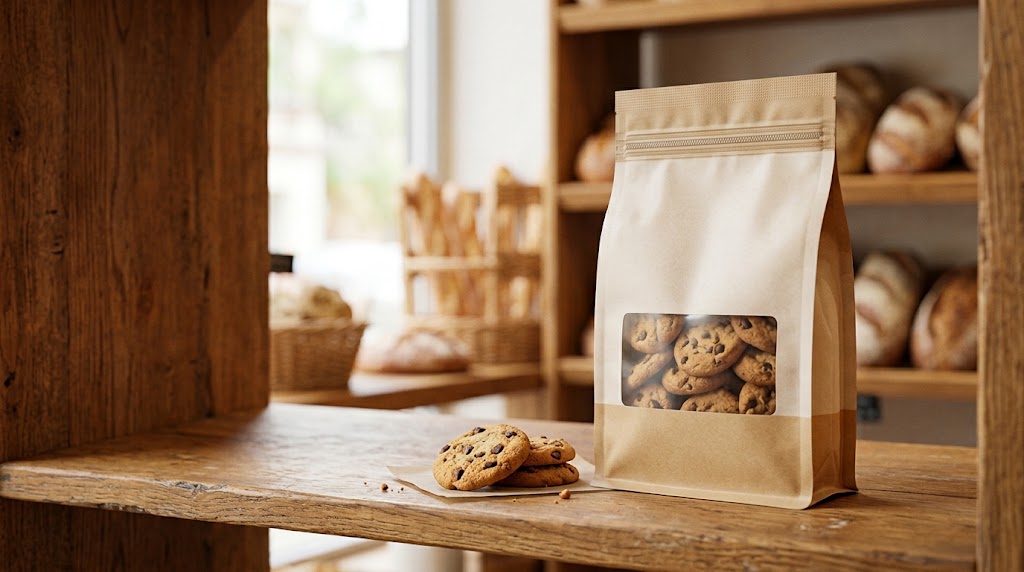
A bag that looks excellent in an empty sample can fail after the first production run. Cookies may rub against one another and leave crumbs in the seal. A crisp product can lose its snap in humid storage. A soft cookie can change texture in a very dry environment. An oily recipe may leave a visible mark where the brand expected a clean paper look. None of these problems is solved by choosing the most expensive pouch on a catalogue page.
The short answer: the best packaging for cookies is a food-contact bag that fits the actual product, keeps the intended texture through its tested selling period, seals reliably on the packer's process, and survives handling. Start with the cookie recipe and sales route. Compare a small number of plausible bag formats. Then fill, seal, store, and handle real samples before approving artwork or a shelf-life claim.
This guide concerns bags for cookies intended for people to eat. It is written for bakeries, packaged-food brands, product developers, and buyers choosing a retail flexible package. A bag supplier can help specify and make the package. The food business must validate the finished cookie, label, and declared shelf life under its own process.
Start With the Cookie You Actually Sell
“Cookies” is not a useful packaging specification by itself. A thin, brittle biscuit, a thick chocolate-chip cookie, a soft oat cookie, and a cream-filled sandwich do not put the same demands on a bag. The same recipe can also be sold as one large piece, two individually wrapped pieces, or a loose multipack. The bag choice changes with the portion and the handling path.
Write down the finished product, not only the dough recipe. Measure the largest and thickest pieces in a representative production run. Record net weight, count, diameter or longest dimension, thickness, edge shape, crumbs, free oil, icing, inclusions, and the way pieces are stacked or poured. Note whether the cookie is fully cooled before filling and whether it will be sold at ambient temperature under a validated food safety plan. A filled cookie or another formulation with special storage needs cannot be assumed to follow an ordinary dry-biscuit route.
Then map the commercial route. Will the pack hang on a hook, stand on a shelf, sit inside a gift box, or travel in a parcel? Is it opened once or used over several days? Will the producer fill premade bags by hand, use an automated line, or ask a co-packer to fill them? A pouch that works in one route may create unnecessary cost or handling problems in another.
| Cookie or selling unit | First question to resolve | Bag directions worth sampling |
|---|---|---|
| Crisp, thin biscuit | How quickly does it lose the desired snap under the planned humidity and distribution route? | A tested moisture-barrier flat bag for a portion, or a stand-up bag for a multipack |
| Thick, chewy cookie | Does the product dry, stick, compress, or transfer oil during the intended life? | A properly sized flat bag or a pouch with enough room to avoid surface abrasion |
| Large single cookie | What clearance is needed around its widest edge and thickness without allowing excessive movement? | A flat, three-side-seal bag or flexible sleeve, trialled with actual pieces |
| Loose bite-size cookies | Will crumbs migrate into the mouth of the bag? Will the pack need repeated opening? | A stand-up or flat-bottom pouch with a validated first seal and an optional zipper |
| Decorated or filled cookie | Is the surface stable, and do the filling and storage conditions require a different safety review? | An individual bag with deliberate surface clearance; separate product-specific trials |
| Gift assortment | Do different textures influence one another, and which layer takes transport loads? | Individual inner bags or separated portions within a larger flexible retail pack |
These are trial directions, not approvals. A brand may reject an apparently suitable bag after measuring the filled product or testing its seal. That is a useful result: it is cheaper to revise a sample than to scrap printed inventory.
Decide What the Bag Must Protect
A retail bag has several jobs. It keeps the food contained and presents it to the shopper. It limits the environmental exposure that matters to the recipe. It must withstand filling, sealing, cartons, retail handling, and opening. A printed surface adds branding, but the graphic design cannot replace a sound food-contact layer or a continuous top seal.
Crispness and softness call for different questions
A crisp cookie often loses desirable texture when it absorbs moisture. A soft cookie can lose moisture or change its bite under different conditions. The controlling variables include the formulation, initial water activity, temperature, humidity, package structure, and seal integrity. The FDA explains that water activity relates to food stability and should be maintained within an appropriate range during storage. That statement does not supply one acceptable water-activity number or shelf life for every cookie. See the FDA's water activity technical guide.
Ask the food team what quality change marks failure: a measured texture limit, loss of snap in a sensory panel, unacceptable sticking, an off-odor, or a product-specific safety criterion. The bag can then be screened against a defined problem. “High barrier” is not a specification if no one has defined what the cookie needs to resist.
Oil, aroma, light, and breakage need separate checks
Butter, nut ingredients, and other fats may raise concerns about oil marks or flavor change. Evaluate the visible outer surface after the filled pack has been stored at realistic conditions. A paper-looking outer layer may be combined with other layers, but its appearance does not prove grease resistance or food-contact suitability. Check the construction and the actual cookie in contact with it.
A metallized layer or opaque design can change light exposure. A clear window helps show the product but may change the barrier and handling performance of the finished pack. Request data for the exact windowed construction where available. Do not treat the opaque area and the window as if they were identical.
A flexible bag can limit movement, but it is not a rigid crush protector. Fragile cookies may require a tighter portion arrangement or support outside the bag. A heavy carton placed on top of a bag can still break the contents. Keep the bag and the distribution package in the same test, while keeping their functions distinct.
Compare Flexible Bag Formats by Use, Not by Appearance
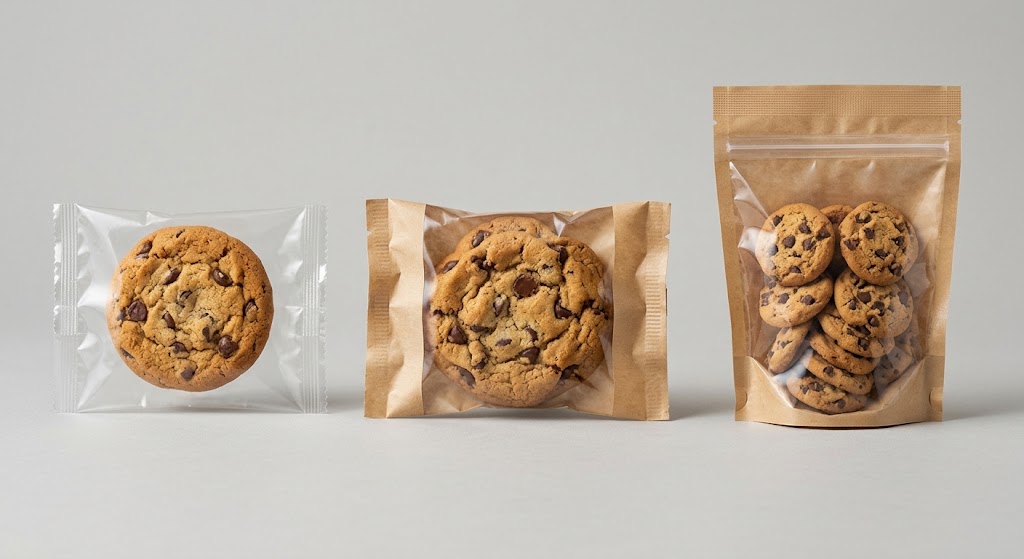
The custom cookie bags page shows several formats available for a packaging project. Use those shapes to start a comparison with real cookies. The most useful question is not “Which pouch looks premium?” It is “Which format fills, seals, stands or lies as intended, and protects this portion through its route?”
| Flexible format | Strong reason to trial it | Point to inspect on a filled sample |
|---|---|---|
| Three-side-seal flat bag | Single portions, flat biscuits, or compact units with a simple front panel | Edge clearance, seal allowance, orientation, and ease of opening |
| Flexible sleeve or wrapper | A single cookie or compact stack where close fit matters | Surface rubbing, fold placement, and whether the seal crosses crumbs or decorations |
| Stand-up pouch | Loose multipacks with shelf presence and a broad front panel | Bottom-gusset shape at the real fill, stability, zipper access, and top-seal clearance |
| Flat-bottom pouch | A larger or bulkier retail portion needing a defined base | Fill volume, folds, carton efficiency, and pressure on cookies near the base |
| Side-gusset pouch | A particular volume or presentation that benefits from side expansion | Gusset folds, filled footprint, seal transitions, and product settling |
A stand-up pouch can work well for a loose multipack, but an underfilled one may look oversized and allow pieces to shift. A flat pouch can be efficient for an individual cookie, but a thick piece may push too hard against the sides. Neither format is automatically “best” because its empty sample looks neat.
Try two or three candidate structures and formats, not an endless menu. Hold the portion, fill method, and storage conditions constant when comparing them. Write down what changes: opening width, fill time, crumb accumulation, filled dimensions, shelf presentation, and breakage after handling. An improvement in display can be cancelled by a high reject rate at the sealer.
Specify the Material Structure Instead of Asking for “Mylar”
“Mylar,” “plastic,” “paper,” and “cellophane” are often used as broad shopping labels. They do not state the layer sequence, sealant, barrier treatment, thickness, printing arrangement, or conditions of use. Two bags sold under the same common name can behave differently at the filling line and in storage.
Ask the supplier to describe the proposed construction layer by layer. Identify the surface that contacts food and the layer designed to heat-seal. Ask whether the body is transparent, opaque, metallized, paper-faced, or made with a window. For a printed bag, record where the ink and adhesive sit relative to food contact. Request food-contact documentation tied to the actual materials and intended conditions rather than an unsupported “food grade” logo.
For a US application, the FDA says that the regulatory status of a food-contact material depends on the status and intended use of its individual substances. Its guide to the regulatory status of food-contact components is a starting point for the relevant documentation. A US example is not a compliance determination for another market. The food business and its regulatory advisers should review the exact construction and destination requirements.
Oxygen transmission rate (OTR) and water-vapor transmission rate (WVTR) are screening measures for a material tested under stated conditions. ASTM D3985 addresses oxygen transmission through plastic film; ASTM F1249 addresses water-vapor transmission through film and sheeting. Compare the construction, units, temperature, humidity, and method before comparing supplier numbers. A film result does not describe a hole in a finished seal, the initial air trapped in the bag, or a cookie's actual shelf life.
| Material question | Evidence to request | What the answer still cannot prove |
|---|---|---|
| Moisture resistance | WVTR for the specified material and conditions, plus a filled-pack trial | That every crisp cookie stays crisp for a fixed number of days |
| Oxygen and light exposure | OTR and the exact opaque or window design | That an oily recipe will not develop off-flavors |
| Food-contact use | Construction-specific component records for the intended market and contact conditions | Approval of the bakery's finished product or label |
| Heat-seal behavior | Sealant identity and a trial on the actual sealing process | Integrity of every commercial bag without inspection |
| Physical toughness | Suitable film tests and filled-pack handling evidence | That a flexible bag alone prevents all cookie breakage |
Size the Filled Bag Around the Cookie, Then Test It
Net weight is not enough to order dimensions. Two 100 g assortments can occupy different volumes if one contains small dense biscuits and the other contains irregular, aerated pieces. Even a single large cookie can vary in diameter and thickness across a bake. A useful dimension begins with actual production samples.
For a single cookie, measure the widest pieces in more than one batch. Lay them in the proposed orientation, including any required board or food-contact insert if one is actually used. Allow practical clearance at the sides so the cookie is not forced through the opening. Reserve an uncontaminated top area for the initial heat seal, opening feature, and any zipper. A design with just enough width on an empty drawing can tear a corner or crush the cookie during filling.
For a loose multipack, fill candidate pouches at the intended count and weight. Shake them gently in the way the packing process will move them, let them settle, then measure filled width, height, and depth. Check whether pieces migrate into gusset folds or above the intended seal line. Observe the final pack when upright and when laid flat in a carton. A bottom gusset helps a bag stand only when its geometry and the actual fill cooperate.
Document both the nominal size and the dimension that matters in production. The bag supplier may quote an outer width and height; the bakery needs the usable filling opening and the space below the seal. A zipper, tear notch, rounded corner, or gusset changes the useful interior. Approve dimensions on physical samples with representative production variation, not on a ruler drawing alone.
The detailed individual-cookie sizing work belongs in a separate guide. At this stage, the decision is whether the candidate bag protects the real portion without excessive movement, difficult insertion, or an obstructed seal.
Treat the First Seal and the Reclosure as Different Features
A zipper is for consumer reclosure after first opening. The unopened retail unit still needs a first seal appropriate to the product and distribution route. Place the zipper and tear feature so the consumer can access the contents without cutting away the reclosure. Leave enough headroom for the packer to form a clean, continuous top heat seal above the zipper if that is the chosen design.
Cookie crumbs are a practical seal hazard. They can land in the top seam during filling, especially with small loose pieces or a high fill level. Oil or decoration can also contact the seal area. Ask the packer to run the actual product at startup and normal line speed. Photograph representative sealed samples. Inspect the top, sides, corners, gusset transitions, and area around the zipper.
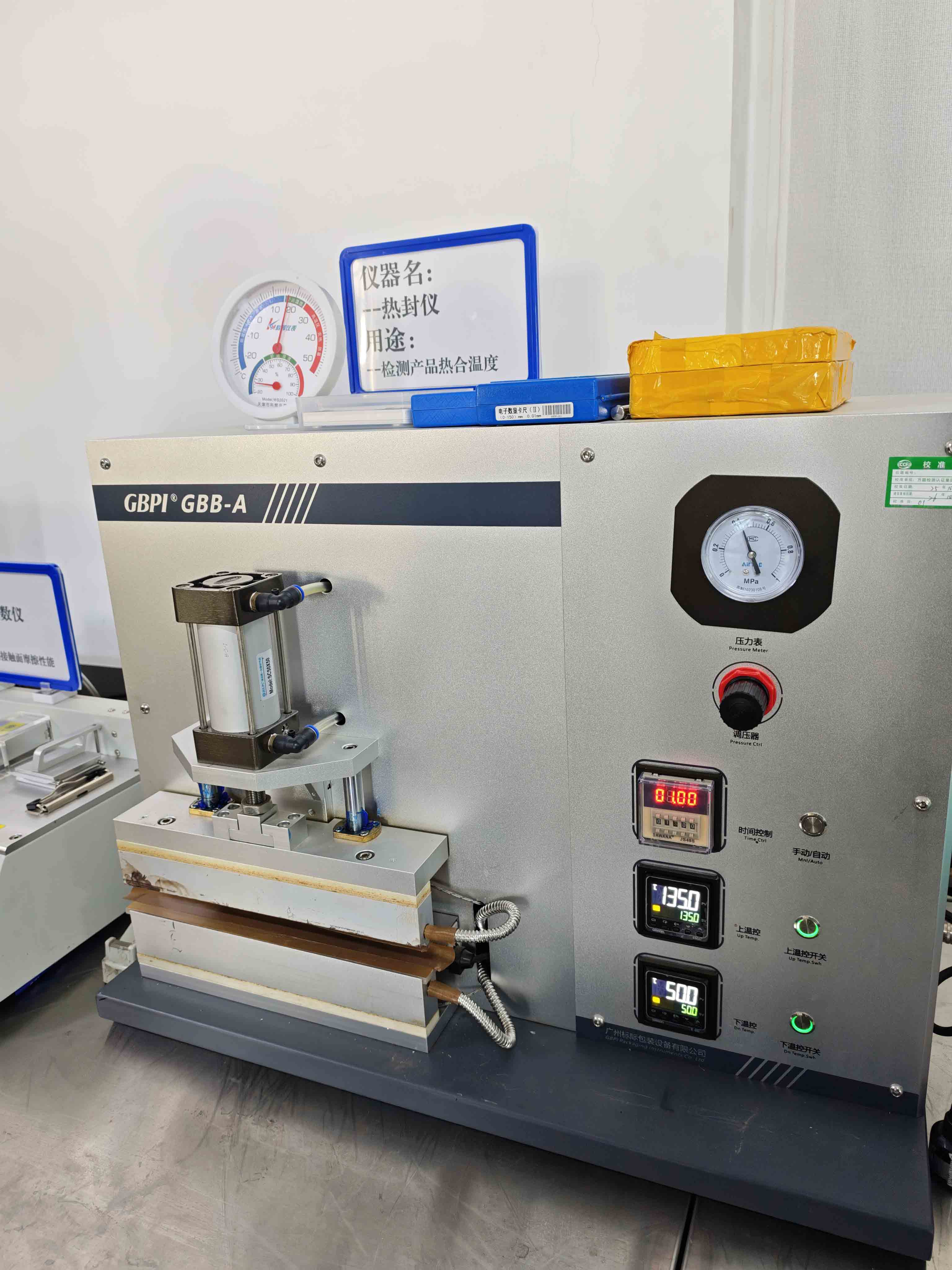
Keep the variables separate during a trial. Record the bag construction, equipment, jaw temperature, dwell, pressure, line speed, and fill level if the process uses heat sealing. A seal can look closed while a small channel remains. Seal strength and leak detection answer different questions; neither is replaced by a hand squeeze. ASTM F88/F88M describes a method for measuring seal strength of flexible barrier materials. The food packer should establish the applicable method, acceptance criteria, and corrective action for the finished product.
Cookies should be packaged under a defined product and process condition. If the bakery closes a warm product before it has reached its approved packing condition, moisture may redistribute or condense in a way the cold sample did not reveal. Validate the actual cooling and filling process. Do not assume a decorative closure, tape, or zipper corrects a poor first seal.

What a Real Cookie Pouch Project Can Teach
A published Mylarbag 3.5 oz organic cookies and bakery bites project provides a concrete example. The case page identifies a US project, a digitally printed stand-up pouch with zipper, and a PET/VMPET/PE material sequence. It lists a 12 × 18.5 + 3 cm bag size; its description calls the inner PE layer anti-static.
Those are useful facts for a buyer. The stand-up form suggests a multipiece retail presentation rather than a close-fitting single wrapper. The zipper makes sense to discuss where a consumer may take several servings. The stated material gives the team a specific layer sequence to ask about rather than a vague “Mylar bag.” The listed size provides a reference for a sample request, not a universal dimension for every 3.5 oz cookie assortment.
The public case page also contains broad statements about barrier, static control, and fit. It does not publish the bakery's measured water activity, film transmission results for its exact commercial lot, seal-strength distribution, breakage rate, or shelf-life study. We therefore cannot say that this bag guarantees a certain number of fresh days or that the same structure and size will work for another bakery. The practical next step is to sample the construction with the new recipe and its actual fill process.
The case also shows why a project brief should separate a manufactured configuration from a performance claim. A supplier can document the pouch it made. The brand then has to establish how its own cookies behave inside a production-sealed version over the intended route. This is useful first-hand experience without pretending that one customer outcome transfers automatically to another food.

Build a Trial That Can Reject the Wrong Bag
A sample order should answer a question. If all candidates differ in material, size, zipper, and fill level at the same time, the team may like one finished sample without knowing which change helped. Keep a simple comparison record and change variables deliberately.
First: confirm the product and packing condition
Select representative cookies from normal production, including the largest pieces and a batch that produces typical crumbs or oil. Record the time and condition at packing, the count and weight, and the intended storage route. If the product is decorated, filled, or sold under a special temperature condition, add the appropriate food safety and quality checks rather than treating it like a dry plain biscuit.
Second: screen empty and filled bags
Check material identification, dimensions, opening width, film feel, print area, window placement, and zipper position. Then actually fill the bag. Note fill time, catches at the mouth, cookie damage, wasted headroom, appearance after settling, and whether the pack stands or lies as intended. Retain the rejected sample and write down why it failed.
Third: test the production seal
Run the chosen bag on the intended equipment with the real cookie and operator practice. Include startup and restart samples, not only the cleanest steady-state packs. Inspect crumbs at the top seam and any gusset fold. Use agreed seal-strength and integrity methods suited to the project. If the pack cannot be sealed consistently, change the fill, size, geometry, or sealant selection before approving the artwork.
Fourth: check storage and handling
The food business should set product-specific endpoints for texture, flavor, appearance, package integrity, and safety where relevant. Compare candidate packs with representative lots at the planned storage conditions and meaningful points across the proposed shelf life. Include anticipated distribution conditions in the protocol. A laboratory material report can help choose candidates; it cannot replace tests on the filled, sealed cookie pack.
Handling deserves its own observation. Pack the bags into the intended transport carton, move them through a defined handling trial, and inspect breakage, scuffing, punctures, zipper damage, and print abrasion. A stronger moisture barrier cannot compensate for crushed biscuits if the bag is too loose or the outer pack applies pressure in the wrong place.
Fifth: approve a recorded specification
Keep the signed sample, construction, size, opening features, artwork, print proof, sealing process, test record, and acceptance criteria together. Define what triggers a new check: a changed cookie recipe, different inclusion or fill weight, new pouch dimension, altered window, material-source change, zipper change, or a different packing line. Without version control, a successful first trial can be lost when the next order looks “almost the same.”
Make the Bag Work on the Shelf and After Opening
Presentation is part of performance. A pack that falls over or hides the cookie may be a poor retail choice even if its film has promising barrier data. Stand-up pouches need enough fill and a stable base. Flat bags need a proportion that shows the product without leaving an empty banner above it. A window should be large enough to serve a real shopping purpose and positioned away from damaging folds or seals.
Consider how a shopper opens the bag. Does the tear route leave a usable zipper? Will a large cookie catch on a narrow mouth? Can the customer remove one piece without breaking the rest? A tight bag can reduce movement but make the first extraction difficult. A generous opening may help use but require more headroom and a different heat-seal area. Test the interaction with an actual person and product, not only a rendering.
The label and printed panel also need space. Reserve readable areas for the information required in each sales market, the lot and date code, and any barcode or traceability mark. The bakery's regulatory team decides the final label; a bag converter can support panel dimensions and print legibility. For a multi-flavor assortment, check whether the SKU change affects ingredients, allergens, fill, or color control before reusing artwork.
A retail decision should be conditional. A single crisp biscuit sold as a portion may justify a flat, well-fitted bag. Loose bakery bites may benefit from a stand-up pouch with a reclosure. A large delicate cookie may need a flexible individual bag plus external support. Each of those choices must pass the actual product trial.
Give Suppliers a Brief They Can Quote and Sample
A supplier can give a better answer when the question contains the real application. “Best cookie bag” leaves too many decisions open. Send the same core information to each shortlisted supplier so material and cost proposals can be compared fairly.
| Brief field | Information to include or request |
|---|---|
| Product | Recipe category, crisp or soft texture target, free oil, inclusions, coating or filling, and the condition at packing |
| Portion | Count and net weight, largest piece dimensions, production variation, and expected crumbs |
| Sales route | Retail shelf, gift assortment, foodservice, or parcel distribution; expected handling and storage |
| Format | Candidate flat, sleeve, stand-up, or other flexible bag, with actual filled samples |
| Material | Complete layer sequence, nominal thickness, sealant, transparency or window, OTR/WVTR with methods and conditions if relevant |
| Closure | Initial seal, optional zipper, tear route, opening width, and clean top-seal allowance |
| Food contact | Documentation for the exact material and intended food-contact use in each market |
| Packing process | Hand fill or line equipment, speed, sealing method, and known crumb or oil problems |
| Artwork | Dieline, print process, barcode, lot/date area, label text space, and proof approval |
| Evidence | Sample quantity, filled-pack checks, seal criteria, handling and shelf-life protocol owners |
| Commercial terms | MOQ, setup, tolerances, lead time, sample costs, and the true cost of rejected or obsolete bags |
A short request could read:
We sell [exact cookie and portion] through [retail route]. The largest production pieces are [dimensions], packed at [approved condition]. Our target texture and proposed unopened life are [targets pending validation]. We will fill by [process] and need [opening and reclosure requirements]. Please propose two testable flexible-bag constructions, identify the complete layers and food-contact documentation, state material test conditions, provide filled-sample quantities, and quote size, MOQ, printing setup, and lead time.
The quoted unit price is one number in the decision. Include trial wastage, filling rejects, storage space, carton use, SKU changes, and returns from damaged or stale product. A lower-priced bag can cost more if it is difficult to fill or produces weak seals. A costly laminate can also be wasteful if the limiting issue is a poor fit or transport pressure rather than film transmission.
A Decision Checklist Before Printed Production
Before committing to an order, the brand and packer should be able to answer these questions:
- Have we tested cookies from normal production, including dimensional and crumb variation?
- Does the proposed bag fit the real portion and leave a clean, accessible first-seal area?
- Is the material structure identified, with food-contact records for the intended use?
- Do any OTR or WVTR numbers refer to the exact construction and stated test conditions?
- Has the bag been filled and sealed on the planned process, including starts and restarts?
- Have we checked visible oil marks, loss of texture, package leaks, scuffs, and breakage over the planned route?
- Does the opening feature remain usable after the first heat seal is opened?
- Are print panels, code placement, and approved artwork recorded?
- Has the food business established its own finished-product shelf-life evidence and label review?
- Is the approved sample tied to a controlled material and dimension specification for repeat orders?
If several answers are still unknown, the next useful purchase is often a sample or trial quantity, not a larger printed run. Document the question each sample must settle.
FAQ: Best Packaging for Cookies
What is the best packaging for cookies sold in a bakery or shop?
There is no universal format. A single cookie, a loose multipack, and a gift assortment have different size and handling needs. Start with the desired texture, product shape, pack count, selling route, and filling process. Trial a small set of food-contact flexible bags and approve the one that performs with real, sealed product.
Are stand-up pouches better than flat bags for cookies?
A stand-up pouch can give a loose multipack shelf presence and room for an optional zipper. A flat bag may fit a single portion more closely and use less empty space. Compare filled dimensions, breakage, sealability, and opening experience. A stand-up silhouette in a photograph does not establish better protection for every recipe.
Can I put one cookie in a resealable pouch?
You can trial one, but first ask whether reclosure serves a real use. A single portion commonly gets eaten after opening. A zipper consumes material and top area that could be better used for product fit and a reliable first seal. A flat bag or flexible sleeve may be more appropriate. The detailed dimensions must come from actual cookie samples.
Does a thicker cookie bag always keep cookies fresh longer?
No. Thickness alone does not specify moisture or oxygen transmission, seal quality, initial product condition, or distribution. Ask for the exact layer construction, relevant test data, and the conditions in which the data were measured. Then compare finished cookies in production-sealed packs under the proposed storage route.
Will a zipper keep cookies fresh before and after opening?
Before opening, the initial heat seal and whole package matter. The zipper is a consumer reclosure feature. After opening, air and moisture enter when the pouch is used, and the cookie's remaining quality depends on the product and use conditions. Do not turn the zipper into an unsupported shelf-life claim.
Is a clear window a problem for a crisp cookie?
It is a design variable to test. A window helps shoppers inspect the cookie, but its material and size may differ from the opaque body of the bag. Ask for the complete windowed construction and trial the finished pack. The decision balances visibility, barrier, light exposure, print design, and cost for the actual product.
Can a flexible bag stop cookies from breaking in shipping?
A properly sized bag can limit some movement and contain crumbs, but it cannot replace adequate external protection when cartons are dropped or compressed. Test the filled bag within the intended distribution package. Inspect product damage and the bag itself after handling. A future guide can go deeper into shipping configurations.
How do I know whether a cookie bag is suitable for food contact?
Request documentation for the complete construction and its intended food-contact use, including the contact layer and applicable conditions. Requirements depend on the sales market. In the United States, the FDA explains the status of individual components rather than issuing a general approval for every bag carrying a particular marketing label. The food business should review the evidence for its own use.
How much headspace should a cookie bag have?
Enough to fill and seal consistently without crushing the product or blocking the opening, but not so much that pieces move excessively or the pack looks empty. There is no percentage that fits every cookie. Fill physical samples at the planned count, seal them, observe settling and movement, and test handling.
Should I choose a paper-looking or metallized cookie bag?
Choose according to the cookie's requirements and the complete structure, not the visible finish alone. A paper-looking outside does not tell you what contacts food. A shiny metallized layer does not guarantee a particular shelf life. Compare food-contact evidence, measured material data, real-product tests, appearance, and disposal implications for the exact construction.
What should I send a cookie-bag manufacturer first?
Send the product type, net weight and count, representative piece dimensions, texture and storage targets, packaging process, sales markets, desired format, opening features, artwork status, and target quantity. State which performance claims still require validation. A clear brief lets the supplier propose samples that can answer a real question.
The Practical Choice
The best packaging for cookies is the bag that survives a complete decision: it fits the portion, seals cleanly, presents the product, uses an appropriate documented food-contact construction, and passes the brand's filled-pack quality and handling trials. Start with the cookie, narrow the formats, test real samples, and record the approved specification. If the project needs a custom flexible format, use the custom cookie bags page to discuss the product, portion, process, and samples with the packaging team.