
The best packaging for rice depends on what the pack must do. A heavy wholesale sack, a 1 kg premium retail pouch, and a long-storage liner do not need the same material structure. Woven polypropylene can be practical for bulk handling, BOPP can be used as a printable film or as part of laminated woven packaging, and multi-layer flexible pouches can provide a different balance of barrier, shelf presentation, sealing, and weight.
The important point is to compare complete package structures, not plastic names in isolation. “PP,” “BOPP,” “PE,” “nylon,” and “Mylar” describe materials or material families. They do not by themselves tell you whether a finished rice bag will resist moisture, survive distribution, seal correctly, display well, or qualify for a recycling program.
For rice brands, mills, importers, and private-label buyers, material selection should begin with five questions:
- How much rice will the pack carry?
- How sensitive is the product to moisture, oxygen, light, pests, or rough handling?
- Will the pack be sewn, heat sealed, zipper closed, or used with an inner liner?
- Does the package need premium shelf graphics, a window, or a box-like shape?
- What recycling or environmental claim, if any, must be supported in the target market?
This guide compares the main material families used in commercial rice packaging and explains where recyclability claims become more complicated than the resin name on a specification sheet.
The short answer: match the package to the rice, pack weight, and route to market
There is no single “best rice bag” for every project.
For heavy commodity and wholesale packs, woven polypropylene sacks are common because the woven construction is suited to sack handling and stacking. For branded retail packs, converters can use printed flexible pouches such as stand-up or flat-bottom formats when the project needs a heat-sealed package, more printable surface area, and a different shelf presentation. For stronger moisture or gas control, the complete structure may include additional barrier layers or a separate liner.
The FAO's grain-storage guidance discusses woven polypropylene sacks and how bagged grain is handled and stacked in warehouses. This makes woven PP an established bulk-package format. It does not make every woven sack a high-barrier package. The weave, coating, lamination, liner, closure, and storage conditions still matter.
For premium retail rice, the decision often shifts from “which sack material?” to “which package system?” The buyer may be comparing a stand-up pouch, flat-bottom pouch, quad-seal bag, or another converted format. Those formats can be built from different film structures, so the pouch style and the material structure should be specified separately.
First, separate woven PP from BOPP film
One of the most common material mistakes in rice packaging discussions is treating “BOPP rice bag” and “polypropylene woven bag” as if they were the same thing.
They are related because both can involve polypropylene, but they are not the same material form.
What is woven polypropylene?
A woven polypropylene sack is made from polypropylene tapes or strips that are woven into a fabric-like structure. The woven construction gives the sack its characteristic texture and load-carrying behavior. Depending on the design, the sack may be uncoated, coated, laminated, printed, or combined with a separate liner.
The important procurement question is not simply “Is it PP?” Ask whether the specification refers to:
- the woven PP base fabric;
- a coated woven sack;
- a laminated woven sack;
- a woven sack with a separate PE or other inner liner;
- or a woven construction laminated with a printed outer film.
Each version behaves differently.
What is BOPP?
BOPP means biaxially oriented polypropylene. It is a film, not a woven fabric. ASTM D2673 is a specification for oriented polypropylene film; any coating or modification belongs in the supplier's actual film specification. The standard's existence is not a test report for a finished rice bag.
BOPP is widely used where clarity, printability, surface appearance, or film performance is useful. In a rice package, BOPP may appear as one component of a laminate or as a printed outer film laminated to a woven PP substrate. Therefore, a supplier saying “BOPP rice bag” may be describing a BOPP-laminated woven sack rather than a pouch made only from BOPP film.
This distinction matters for both performance and recycling. A BOPP film laminate, a woven PP sack, and a woven PP/BOPP composite are not automatically equivalent at end of life.
What materials are rice bags made from?
Commercial rice packaging can use several material families. The exact choice depends on package size, machinery, market positioning, and required protection.
A material list should always be read as a construction. “PET/NY/PE,” for example, means the supplier is specifying multiple functional layers. It does not mean that every layer contributes equally to every property.
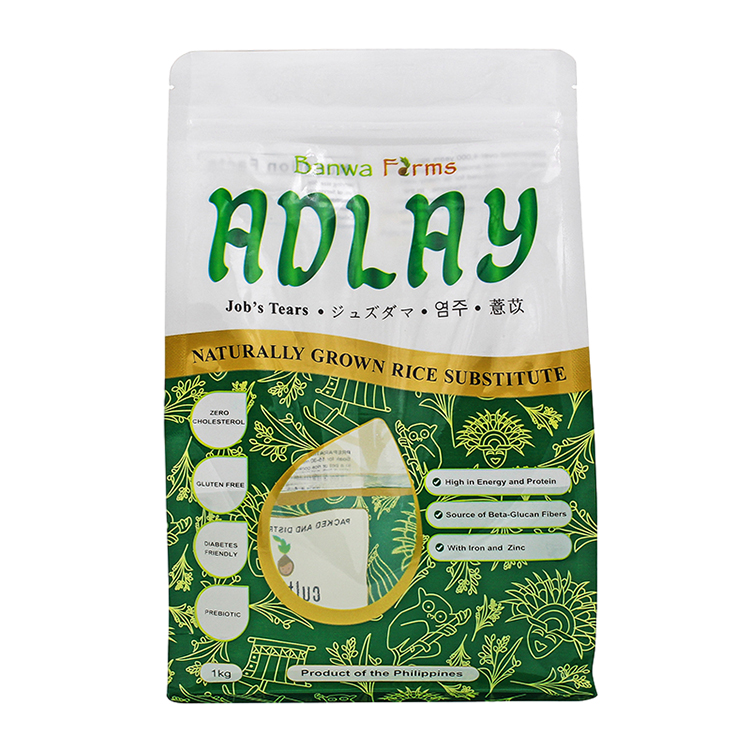
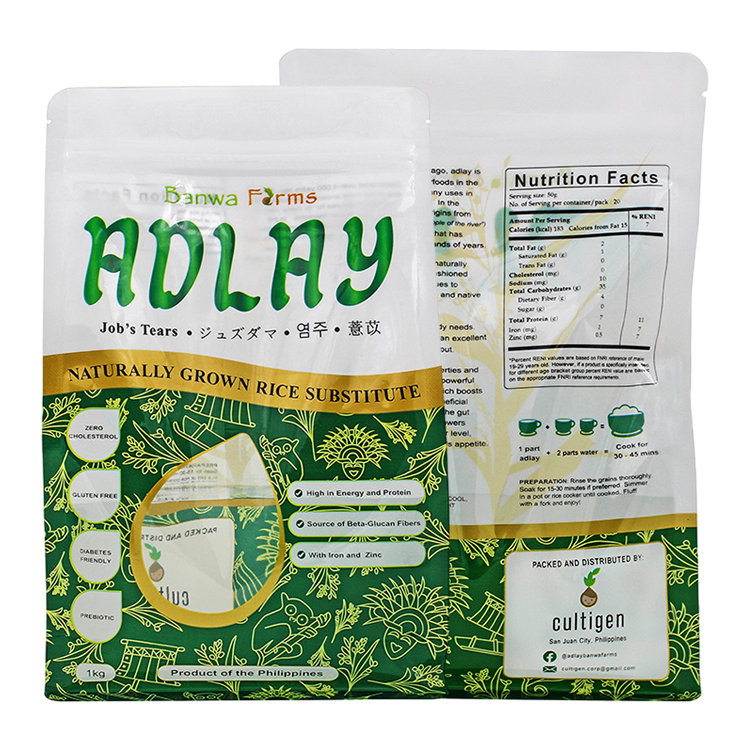
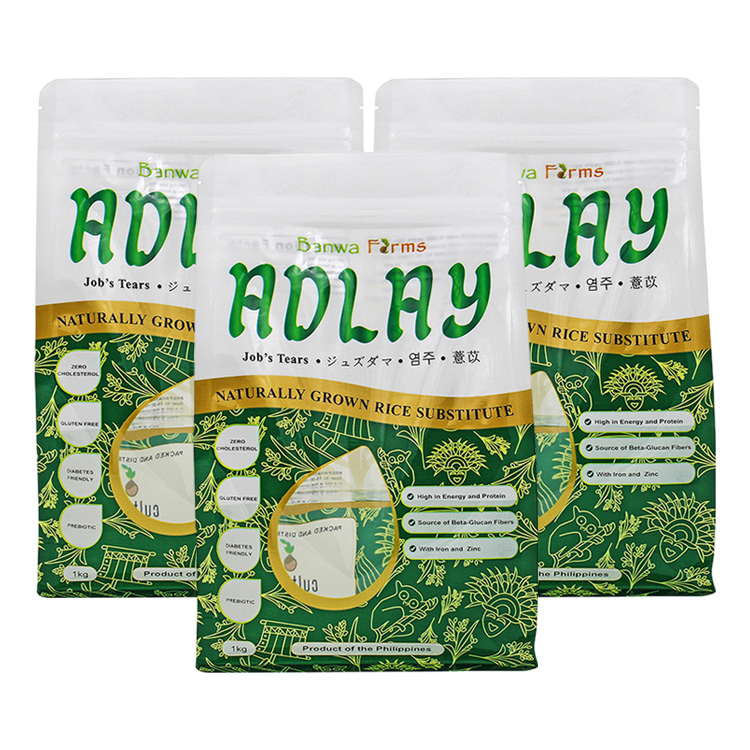
A real Mylarbag rice and ancient-grain project published on the site uses a 1 kg flat-bottom pouch with a PET/NY/PE structure, gravure printing, and a teardrop window. That project is useful evidence that this construction has been manufactured for a rice-related application, but it should not be copied as a universal recommendation for every rice product.
The published project record lists the Philippines, a 1 kg fill, a 15 × 24 + 6 cm flat-bottom format, PET/NY/PE, gravure printing, and a teardrop window. These are useful manufacturing facts. They are not a measured WVTR, OTR, puncture value, shelf-life result, or recycling certification.
The format provides a concrete way to frame a new specification. A buyer can ask how a different rice variety settles into the flat base, whether the window position leaves enough uninterrupted seal area, and how the filled pouch will be packed in cartons. Nylon is one component of the listed laminate, but this record does not establish that nylon is necessary for every 1 kg rice bag. A window makes the rice visible; its local material, bond, and placement still need review against the project's barrier and strength targets.
That is first-hand project evidence used at the right level: a real produced pouch and its disclosed parameters. The buyer's next step is to define fill weight, package format, filling method, distribution route, and barrier targets, then test a representative filled sample of the proposed new bag.
Moisture barrier is usually more important than a generic “plastic bag” label
Rice is a dry food, so moisture control is a central packaging concern. But “plastic” does not automatically mean “moisture proof,” and a material name alone does not establish package performance.
A woven sack has interlaced tapes. An uncoated woven construction can behave very differently from a coated or laminated sack. A separate inner liner changes the system again. A converted flexible pouch can use continuous films and heat-sealed seams, but its actual water-vapor protection still depends on the film structure, thickness, seal quality, closures, windows, and any intentional perforation.
A FAO packaging resource describes a sealed storage liner placed inside an existing woven storage bag. The woven outer sack and the barrier liner have different jobs. Do not turn that example into a claim that any ordinary woven sack is hermetic.
For a buyer, this suggests a practical rule:
Do not ask only “What plastic is this?” Ask “What is the complete moisture-control system?”
That system includes:
- the film or woven substrate;
- any coating or lamination;
- any inner liner;
- the seam construction;
- the top closure;
- the zipper, if present;
- windows or perforations;
- and the actual storage/distribution conditions.
If the project has a numerical WVTR requirement, request the test method, units, test conditions, and the exact structure represented by the data. Do not convert a generic film data sheet into a finished-bag performance claim without confirming that the result applies to the complete construction.
Oxygen barrier: important for some projects, but not the same question as moisture control
Oxygen barrier and moisture barrier are separate properties.
A structure can perform well against water vapor without being the strongest oxygen barrier, and vice versa. For polished white rice sold through normal retail distribution, the required barrier level may be different from that for a specialty grain, a brown rice product with higher lipid content, or a long-storage application.
That is why phrases such as “high barrier” should be translated into measurable project requirements before a purchase order is approved.
Ask:
- Is the concern mainly moisture uptake?
- Is oxidation a relevant product-quality risk?
- Is light exposure important?
- Is the pack intended for months of retail distribution or a different storage program?
- Is the package sealed in ordinary air, vacuum packed, nitrogen flushed, or simply closed?
- Are there target OTR or WVTR values?
- Which test method and conditions apply?
The packaging supplier can help select candidate structures, but the brand should connect the specification to its own shelf-life and product-quality validation. No film name by itself proves a fixed shelf life.
Strength and puncture resistance depend on more than thickness
Rice is dense and can create concentrated stress at corners, seams, gussets, and folds. Heavier pack weights also create more force during lifting, stacking, and transport.
This is where woven PP and laminated pouches solve the problem differently.
A woven sack carries load through its woven tape structure. A retail flexible pouch carries load through the films, laminate bonds, heat seals, gusset geometry, and converted seams. A flat-bottom pouch may provide a stable retail shape, but its structure still has to be qualified for the intended net weight and distribution route.
Thickness is useful, but it is not enough. Two packages with the same nominal micron value can perform differently because the polymer mix, orientation, laminate structure, sealant, bag geometry, and manufacturing process differ.
For a rice packaging trial, record:
- actual filled weight;
- rice variety or blend;
- bag dimensions and material structure;
- seam and closure type;
- carton configuration;
- stacking and handling route;
- any agreed drop, compression, seal, or leak test method;
- observed failure location.
The purpose is not to prove that one material is universally “stronger.” It is to find the weakest part of the complete package under the project's real conditions.
Shelf presentation changes the material decision
Bulk rice sacks and premium retail pouches solve different commercial problems.
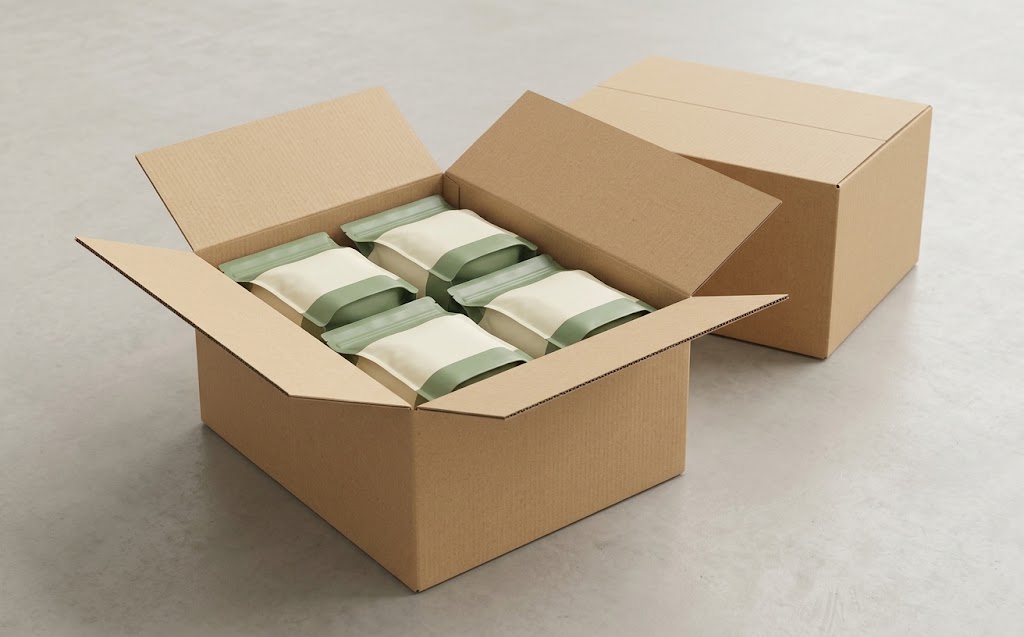
A large woven sack may prioritize cost-effective load handling, filling speed, sewing or closure compatibility, pallet stability, and wholesale distribution. A 500 g, 1 kg, or 2 kg retail pouch may prioritize shelf stability, front-panel appearance, zipper reclosure, window placement, tactile finish, and high-resolution printing.
This is one reason BOPP appears frequently in packaging conversations. BOPP film can provide a useful printing and appearance layer, and BOPP-laminated woven sacks can combine printed graphics with a woven substrate. A laminated retail pouch can instead use PET, BOPP, nylon, PE, metallized film, foil, paper, or other layers in different combinations.
The buyer should therefore separate three decisions:
1. Bag format
Examples include woven sack, stand-up pouch, flat-bottom pouch, side-gusset bag, flat pouch, or rollstock.
2. Material structure
Examples include woven PP, BOPP-laminated woven PP, PET/NY/PE, PE/PE, and other project-specific structures.
3. Graphics and finishing
Examples include gravure or digital printing, matte/gloss appearance, windows, spot effects, handles, zippers, or tear features.
Treating those three decisions separately makes quotations easier to compare and reduces the risk of approving a beautiful visual mockup without understanding the actual package construction.
Are rice bags recyclable?
Some are technically recyclable within specific collection and reprocessing systems; others are not accepted in common programs. The correct answer depends on the complete package, not simply whether it contains PP or PE.
This is where packaging marketing language often becomes misleading.
A package can be made mainly from one polymer family yet still have inks, coatings, barriers, adhesives, zippers, labels, windows, or other components that affect recycling compatibility. Even a technically recyclable structure needs a collection pathway and an end market.
In the United States, flexible-film collection is not the same as curbside recycling
How2Recycle's U.S. Store Drop-off guidance applies to qualifying flexible PE-based packages and describes a store collection route rather than an automatic curbside route. Its FAQ distinguishes PE film from other flexible plastics in that U.S. stream. A rice brand should check the finished pack and the current labeling rules before printing disposal instructions.
This is especially important for rice brands comparing PE pouches with PP- or PET-based films. A resin may be recyclable in theory or in an industrial process, but that does not automatically mean a consumer can place the finished rice bag in a local household recycling bin.
In Europe, design-for-recycling guidance evaluates the full flexible structure
RecyClass design-for-recycling guidance provides separate assessments for PE and PP flexible packaging and considers components beyond the main polymer. Consult its current version for the intended package and market. A guide may be updated, so a draft assessment should be checked again before artwork claims are approved.
The key procurement lesson is simple:
“Made of recyclable plastic” and “this finished rice package is recyclable in the target market” are not the same claim.
Before printing a recycling statement, a brand should identify:
- the target country or region;
- the collection system being referenced;
- the complete package structure;
- all attachments and components;
- the applicable labeling program or assessment method;
- and the consumer preparation instructions.
Are stand-up pouches eco-friendly?
A stand-up pouch is a package format, not an environmental classification.
Some stand-up pouches are multi-material laminates. Others are designed around a PE or PP mono-material family. Some use metallized barriers, paper layers, foil, nylon, or other components. Therefore, asking whether “stand-up pouches are eco-friendly” is too broad to produce a reliable yes-or-no answer.
A better comparison considers several factors:
A lighter pouch is not automatically the environmentally best choice if it fails to protect the product or cannot be handled by the existing supply chain. Likewise, a mono-material pouch is not automatically recyclable everywhere.
Use environmental language that describes the actual verified attribute. For example, “designed as a mono-PE structure” is more precise than “100% eco-friendly.” If a third-party program has evaluated the package, use the program's exact approved wording and market scope.
When does a mono-material rice pouch make sense?
A mono-material approach can be worth evaluating when the brand has a clear recyclability goal and the target market has an applicable flexible-plastic recycling pathway.
But “mono-material” should be treated as a design objective, not a shortcut around performance testing.
The package still needs to:
- run on the filling and sealing equipment;
- provide enough moisture and oxygen protection for the product;
- carry the intended fill weight;
- survive distribution;
- accept the required printing;
- work with zippers or other closures;
- and satisfy the relevant recycling-design criteria.
For some retail projects, a PE-family structure may be evaluated because PE film collection pathways exist in certain markets. For others, a PP-family flexible structure may be considered. The choice should follow the target-market recycling framework rather than a generic global claim.
If the brand is moving from a PET/NY/PE or metallized laminate to a mono-material design, compare both structures using the same filled-product validation plan. A sustainability objective does not remove the need for barrier, seal, compression, and transport testing.
When is a multi-layer laminate still the practical choice?
Multi-layer laminates remain relevant because each layer can perform a different job: printing, stiffness, toughness, barrier, or heat sealing.
For example, the published Mylarbag rice project using PET/NY/PE combines more than one polymer family. That structure should not be marketed as a simple mono-material recycling solution. Its value as a case study is that it shows how a real premium rice pouch can be built when package geometry, print, window design, and mechanical needs are part of the brief.
A multi-layer construction may be appropriate when:
- the project needs a specific barrier level that has been validated with that structure;
- distribution creates puncture or handling demands;
- the filling or sealing process requires a specific sealant behavior;
- the visual design needs a particular print web or finish;
- or the current mono-material alternative cannot yet meet the validated project requirements.
The environmental discussion should then stay factual. Instead of calling the package “green” or “bad,” document why the structure was selected, whether recovery options exist, and whether a lower-complexity structure could be validated in a future redesign.
How to compare woven PP, BOPP-laminated sacks, and flexible pouches
The table below is a procurement framework, not a universal performance ranking.
This table shows why the phrase “best packaging for rice” needs context. A woven PP sack can be the practical answer for one distribution model while a flat-bottom pouch is the better commercial format for another. Neither result can be reached from a resin name alone.
Recommended packaging configuration: start with four specification paths
For a custom rice packaging project, it is more useful to begin with a short list of candidate systems than to request one “best material.”
Path A: bulk woven sack
Evaluate this when the project prioritizes larger fill weights, sack handling, warehouse stacking, and conventional bulk distribution.
Specify:
- target net weight;
- woven PP basis and construction;
- coating or lamination if used;
- liner if used;
- printing method;
- closure/sewing method;
- handle or carry features if required;
- pallet and warehouse conditions.
Path B: printed BOPP-laminated woven sack
Evaluate this when the buyer wants the structural behavior of a woven sack with a smoother, high-graphics outer surface.
Specify both parts of the package: the woven base and the BOPP/laminated outer construction. Do not let “BOPP bag” replace the complete specification.
Path C: multi-layer stand-up or flat-bottom pouch
Evaluate this for retail rice when shelf display, heat sealing, windows, zippers, premium print, and compact flexible packaging are priorities.
Specify:
- bag format;
- exact film structure;
- net fill and dimensions;
- window or no window;
- zipper or no zipper;
- seal geometry;
- printing process;
- required barrier data and test conditions;
- carton and distribution trial.
Path D: mono-material flexible pouch
Evaluate this when the project has a defined recycling-design objective and an applicable target-market pathway.
Specify the intended PE- or PP-family design, then validate both package performance and the recycling claim. Do not approve the environmental wording before the full structure and market have been reviewed.
The point of these four paths is not to narrow every project to four standard SKUs. It is to make the first supplier conversation precise enough to generate useful samples and comparable quotations.
Questions to send a rice bag manufacturer before choosing the material
A good material discussion begins with project data.
Send:
- rice type or blend;
- target net weight;
- target countries;
- preferred bag format or reference package;
- filling and sealing process;
- expected storage and distribution route;
- required window, zipper, handle, or carrying features;
- any known moisture/oxygen barrier target;
- current recycling or sustainability objective;
- artwork and printing requirements;
- expected order quantity;
- any specific test report or compliance documentation the project requires.
Then ask the supplier to state the proposed structure in writing.
If a quotation says only “BOPP bag,” “PP bag,” “Mylar bag,” or “recyclable pouch,” ask for the actual layer or component description before comparing it with another quote.
Common material-selection mistakes
Calling every shiny rice bag “Mylar”
“Mylar” is often used loosely in packaging marketing. It should not replace the actual material specification. Ask for the full construction.
Assuming BOPP means woven PP
BOPP is oriented polypropylene film. A BOPP-laminated woven sack uses BOPP as part of a construction; it is not the same thing as the woven substrate.
Assuming a woven sack is moisture barrier because it is plastic
The weave, coating, lamination, and liner determine the moisture-control system. Verify the complete construction.
Choosing the highest-barrier laminate without defining the need
More complex is not automatically better. Define the product risk and required test criteria first.
Printing “recyclable” because the main resin is PP or PE
Recyclability depends on the complete structure and the target collection system. Verify the claim using the relevant market framework.
Copying a competitor's layer structure
A competitor may use different rice, pack weight, machinery, shelf-life target, transport route, and label requirements. Use their package as a reference, not a specification.
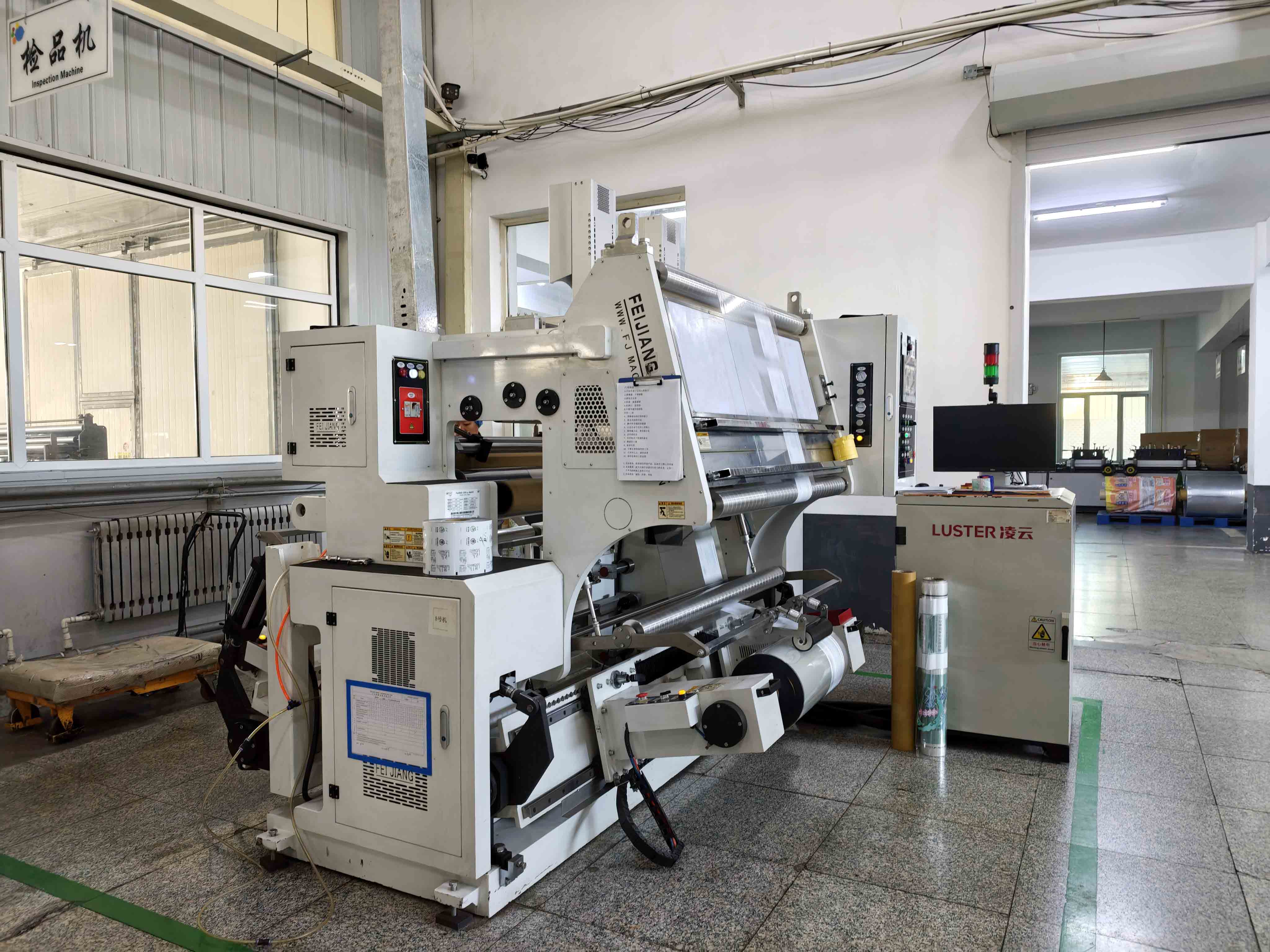
Approving material before testing the filled package
A film data sheet does not show how the gusset, zipper, window, seams, and carton behave after filling. Approve the complete package system.
Frequently asked questions
What is the best packaging material for rice?
There is no single best material. Woven polypropylene can suit bulk sacks, while laminated flexible pouches may suit premium retail rice. The correct choice depends on fill weight, moisture and oxygen requirements, sealing method, distribution, shelf presentation, and end-of-life goals.
What kind of plastic are rice bags made of?
Rice bags can use polypropylene, polyethylene, PET, nylon, metallized films, and other materials in different forms and combinations. Bulk sacks are often made with woven polypropylene. Retail pouches may use multi-layer laminates or mono-material flexible structures.
Is BOPP the same as a polypropylene woven rice bag?
No. BOPP is biaxially oriented polypropylene film. Woven PP is made from polypropylene tapes woven into a fabric-like substrate. Some rice sacks combine both by laminating a printed BOPP film to woven PP.
Are rice bags recyclable?
It depends on the complete package and the local collection system. A mono-material PE or PP design may simplify recycling compatibility, but zippers, inks, barriers, labels, coatings, and market-specific collection access still matter. A PET/NY/PE laminate is not a simple mono-material structure. Do not assume a finished bag is recyclable because its main polymer is recyclable.
Are stand-up pouches eco-friendly?
“Stand-up pouch” describes a bag format, not an environmental result. Some are multi-material laminates, while others are designed as mono-material structures. Evaluate material use, product protection, recycling compatibility, collection access, and the substantiation behind any environmental claim.
Is woven PP waterproof?
Do not assume every woven PP sack is waterproof or a complete moisture barrier. The woven construction, coatings, lamination, liner, seams, and closure determine how the finished package handles moisture exposure.
The practical next step
Choose the package system before debating isolated resin names.
For a bulk rice project, compare woven sack constructions, coatings, liners, and closures. For a branded retail project, compare pouch formats and then specify the film structure needed for the product, filling line, and distribution route. If recyclability is a project goal, add the target market and recycling framework to the specification from the beginning rather than trying to add an environmental claim after the package has already been designed.
Mylarbag's rice packaging page can be used as the commercial starting point for stand-up, flat-bottom, and other custom rice packaging discussions. A useful inquiry should include the rice type, target fill weight, market, bag format, filling method, barrier needs, and any recycling-design objective.
The best rice package is not the one with the most layers or the simplest marketing claim. It is the structure whose material, closure, barrier, handling, presentation, and end-of-life claims have all been specified for the same real project.