
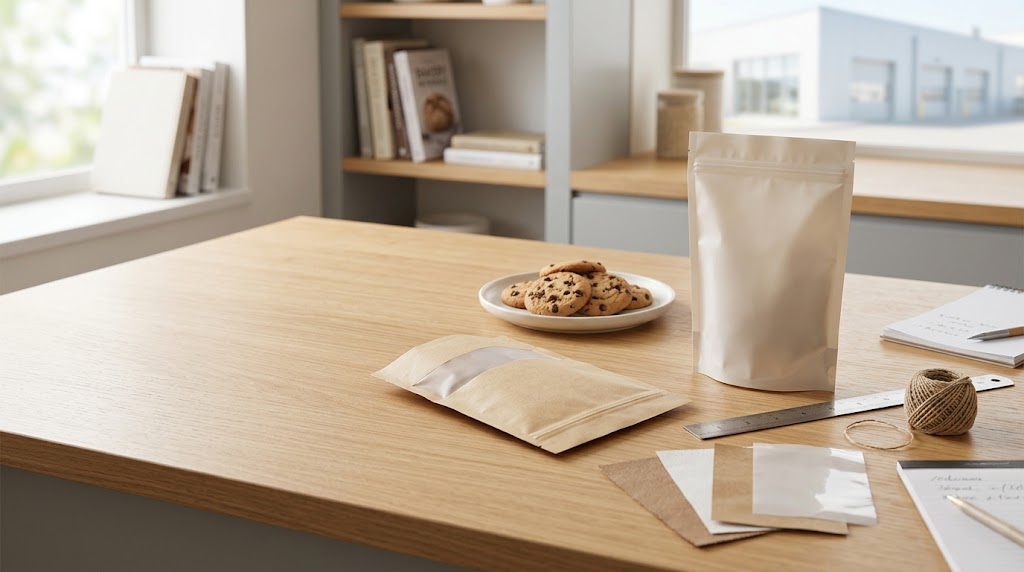
A search for “where to buy cookie packaging” can return a stock-bag catalogue, a print shop, a custom pouch manufacturer, a marketplace, or a seller of filled cookies. They do not offer the same thing. A bakery buying food-contact bags for its own cookies needs to know who can supply a suitable empty bag, what information each supplier needs, and what a sample actually proves.
The short answer: choose a supply route after defining the cookie and the bag's job. Stock-bag sellers can help with a standard unprinted format. A custom flexible-packaging supplier can specify a construction, size, closure, and artwork for repeat production. Ask for physical samples, a complete material description, food-contact information for the intended use, and a quote that separates setup from unit price. Test filled and sealed bags on the real packing process before approving a printed order.
This is an educational guide for brands, bakeries, co-packers, and procurement teams buying bags for cookies people eat. It concentrates on the empty flexible package. A supplier's film data and quality records help a buyer make a decision; the food business remains responsible for its product, label, packing process, and shelf-life claim.
What Are You Buying: Stock Bags or a Custom Project?
The first purchasing decision is usually about the job, not the supplier's location. A standard clear or plain bag may be enough for a short trial, a limited market stall, or a portion that fits an existing size. A recurring retail product with defined artwork, a required barrier, or a particular filling line may need a custom specification. The volume alone does not settle the question. A high-volume order of plain bags can still be a stock item; a smaller multi-SKU project may need custom print and controlled dimensions.
| Supply route for empty cookie bags | Useful when | Questions to ask before ordering |
|---|---|---|
| Stock-bag distributor | A standard size and material can be sampled quickly, and the brand can add a compliant label if suitable | Who made the bag? Is the material and food-contact use documented? Is the same construction available for repeat orders? |
| Packaging marketplace or catalogue reseller | A buyer wants to compare available formats and obtain small evaluation quantities | Is the product listing a precise specification or only a trade name? Can the seller trace lots, dimensions, and material changes? |
| Custom flexible-packaging manufacturer | The bakery needs its own dimensions, print, closure, window, or tested material direction | What is included in sampling, tooling, print proof, tolerances, and repeat-order control? |
| Co-packer's nominated bag supplier | The co-packer has a filling and sealing process that already uses certain materials | Who approves the construction, owns the artwork, keeps the records, and handles a bag change? |
A packaging marketplace can help find a sample, but a photograph on a listing cannot tell you how the bag behaves around your cookie. A converter can make a custom bag, but it cannot choose the food's expiration date merely from a film description. A co-packer may strongly prefer one material because it runs well on its line; that preference still needs the product and food-contact checks. Ask each seller which decisions it owns and which require your approval.
If a buyer searches for “empty cookie packaging,” clarify whether the request is for an unfilled bag, an unprinted bag, or both. These are different. A custom printed bag is still shipped empty for the bakery to fill. A stock bag may already carry generic printing. Put the actual requirement in the inquiry rather than relying on a category name.
Define the Cookie Before Asking for Prices
A supplier cannot compare meaningful options from “500 g cookie bag” alone. Cookie count, density, shape, and packing method change the useful dimensions. A thin crisp biscuit, thick soft cookie, decorated piece, and loose mini-cookie mix each create different fill, abrasion, crumb, and moisture questions. Tell suppliers what goes into the bag and what must still be acceptable when the customer opens it.
Start with a small set of representative production samples. Measure the largest diameter or longest edge, the thickest piece, stack height, and the natural variation between batches. Record fill weight and count, the amount of loose crumbs, visible oil or coating, and whether the product has a filling. Describe the approved product condition at packing. A bag trial based on warm or incompletely set cookies may not represent the intended process.
Then describe the selling and use route. Is the bag opened once or repeatedly? Does it lie flat, hang, or stand on a shelf? Will it be handled inside a shipping carton? What storage temperature and planned unopened life will the food business validate? Do not give the supplier a desired shelf life as if it were already achieved. State it as a target for product-specific testing.
A compact first brief should contain:
- The exact cookie and portion: count, net weight, largest piece, and any fragile surface.
- The intended flexible-bag format and whether a first heat seal, zipper, tear feature, or window is needed.
- The filling process: hand packing or a named line, available opening width, and known crumb or seal-area issues.
- The sales market and intended food-contact and storage conditions.
- The number of flavors or artwork versions and an initial quantity range.
- The questions samples must resolve: fit, seal, appearance, storage, handling, and repeatability.
The supplier may respond with more than one construction or format. That is useful if each option addresses a stated problem. A long list of unexplained film names is not a substitute for a test plan.
Ask for a Complete Bag Specification
“Food grade Mylar,” “kraft cookie bag,” and “high barrier” are not complete purchasing specifications. Ask for the proposed layer sequence, nominal thickness, sealant layer, dimensions and tolerances, surface finish, printing arrangement, zipper type, and any window. Identify the material that contacts the cookies. If a paper-looking outside is part of a laminate, ask what is behind the paper and what is on the food side.
Barrier data require conditions. Oxygen transmission rate (OTR) and water-vapor transmission rate (WVTR) can help compare exact materials if units, test methods, temperature, and humidity are provided. ASTM D3985 is an oxygen transmission test method for plastic film, and ASTM F1249 addresses water-vapor transmission. A number from one test condition is not automatically comparable with another. Neither film result establishes the integrity of a top seal made later by the bakery.
For a US food-contact project, the FDA explains that the status of a food-contact article follows the status and intended use of its component substances. Its food-contact component guidance is a primary source for that question. Ask the supplier for documentation connected to the quoted construction and intended conditions. For other markets, have the appropriate team check the applicable local requirements. A blanket “FDA approved bag” slogan does not replace a construction-specific review.
| Supplier statement | Better follow-up request |
|---|---|
| “High barrier” | Full construction; OTR/WVTR values for that construction, with method and conditions; window details if present |
| “Food safe” | Material and component documentation relevant to the intended food-contact use and destination market |
| “Custom size” | Drawing of outer and usable dimensions, opening width, gusset, seal allowance, and stated tolerances |
| “Resealable” | Position and type of zipper, first-seal plan, tear route, and actual opening trial |
| “Premium printing” | Print method, proof type, color reference, artwork acceptance, and change-control procedure |
| “Fast production” | Written scope, sample and proof milestones, quantity by SKU, and the agreed delivery date |
Not every buyer needs the same barrier structure. A crisp cookie that absorbs moisture and a soft cookie that loses its desired bite may lead to different trials. Cookie composition, initial condition, package seal, humidity, and temperature all matter. Resist the urge to buy a film by nickname or thickness alone.
Order Samples That Answer Different Questions
A good sample sequence separates appearance, technical compatibility, and commercial approval. Buyers often skip that separation and treat a handsome empty pouch as a final sign-off.
1. Stock or construction samples
These show the feel, approximate size, opening, zipper, opacity, and plausible layer options. They can help eliminate a format quickly. They do not prove that your production cookies fit, that the material will seal on your equipment, or that the printed commercial run will match them.
2. Filled and sealed trials
Use real cookies from normal production. Fill each candidate at the planned count and weight, including the largest pieces and a crumb-producing batch. Inspect whether the cookie catches at the opening, presses on a seam, moves excessively, or leaves oil marks after appropriate storage. Seal with the planned equipment and operating window. Record rejects, wrinkled areas, and product in the seal zone. If a zipper is included, confirm that the first heat seal and opening route leave the reclosure usable.
3. Artwork and production approval
A digital mockup checks layout, not print on the final material. A physical color proof or preproduction sample, where available, helps evaluate panel legibility, placement, window alignment, and changes at gusset folds. Approve the exact dieline and version by SKU. Ask what constitutes an authorized change if the film, print method, adhesive, zipper, or dimensions later differ.
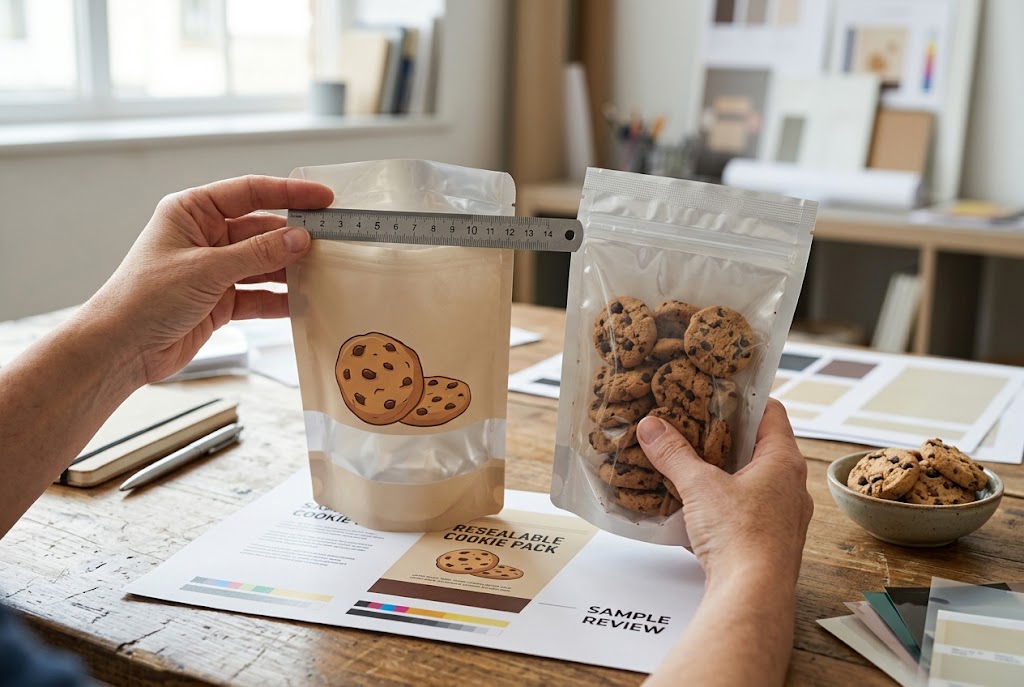
Samples cost time and sometimes money, but a clear sample question prevents a much larger mistake. Before requesting them, state which decision each sample will make possible. A plain stock bag may answer the size question; a custom printed proof may answer the color question; a production-sealed filled pack answers a different question again.
Inspect the Evidence Behind Supplier Claims
A supplier page can show machinery and material options. A buyer should ask for evidence tied to the proposed bag rather than assume that a factory photograph proves a cookie-specific result. Three levels of evidence matter: what the supplier can manufacture, what the specific bag construction measures, and how the bakery's finished pack performs.
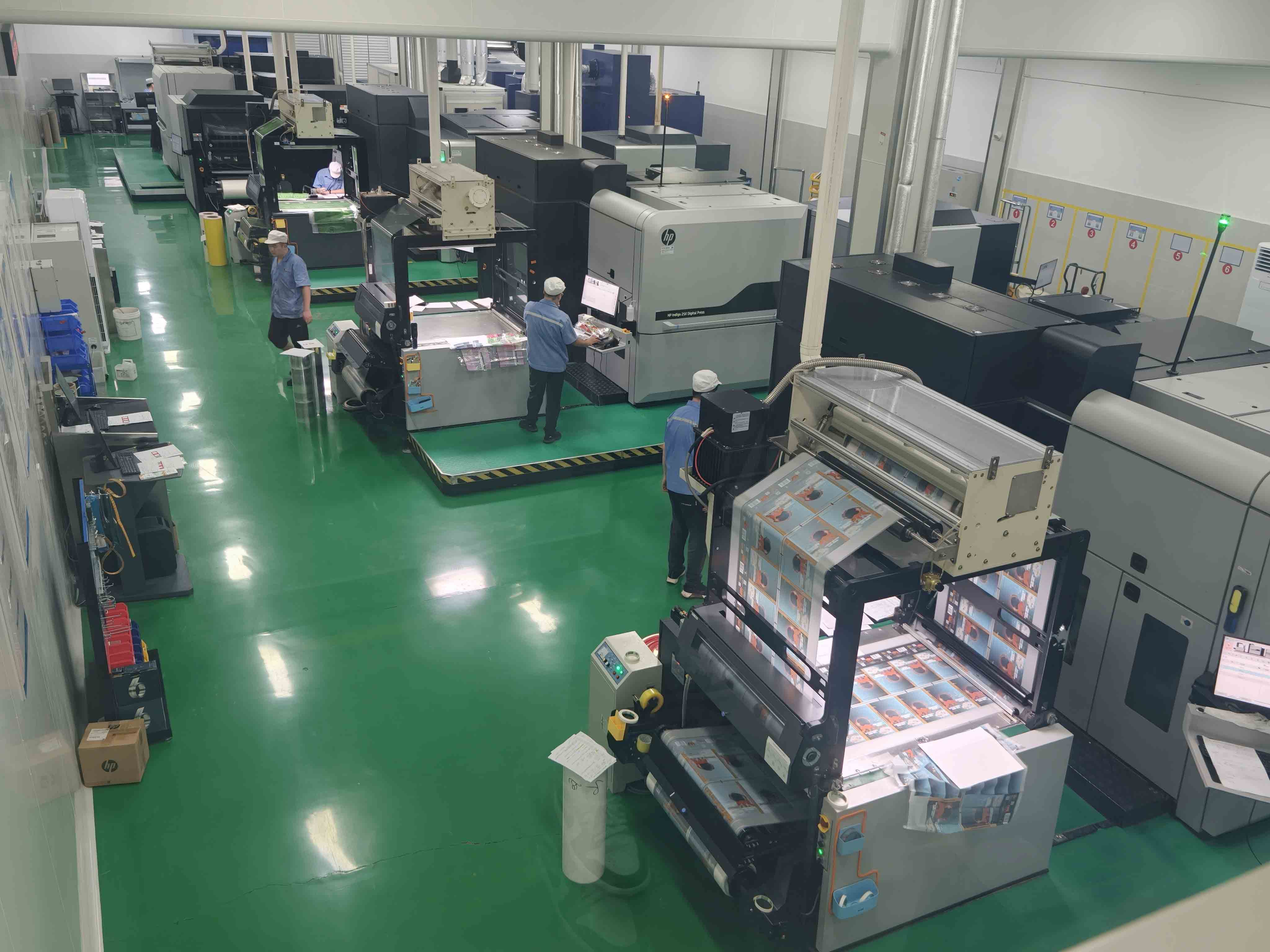
A digital press photograph can support a discussion of available print processes. It does not prove that every quantity is economical or that every color matches perfectly. Ask whether the quote is digital or gravure, what proof you will approve, whether there are plate or setup charges, and what happens when flavors or artwork versions change. The live digital-printing process page provides one route for discussing a multi-SKU printed project; the actual quote controls the terms.
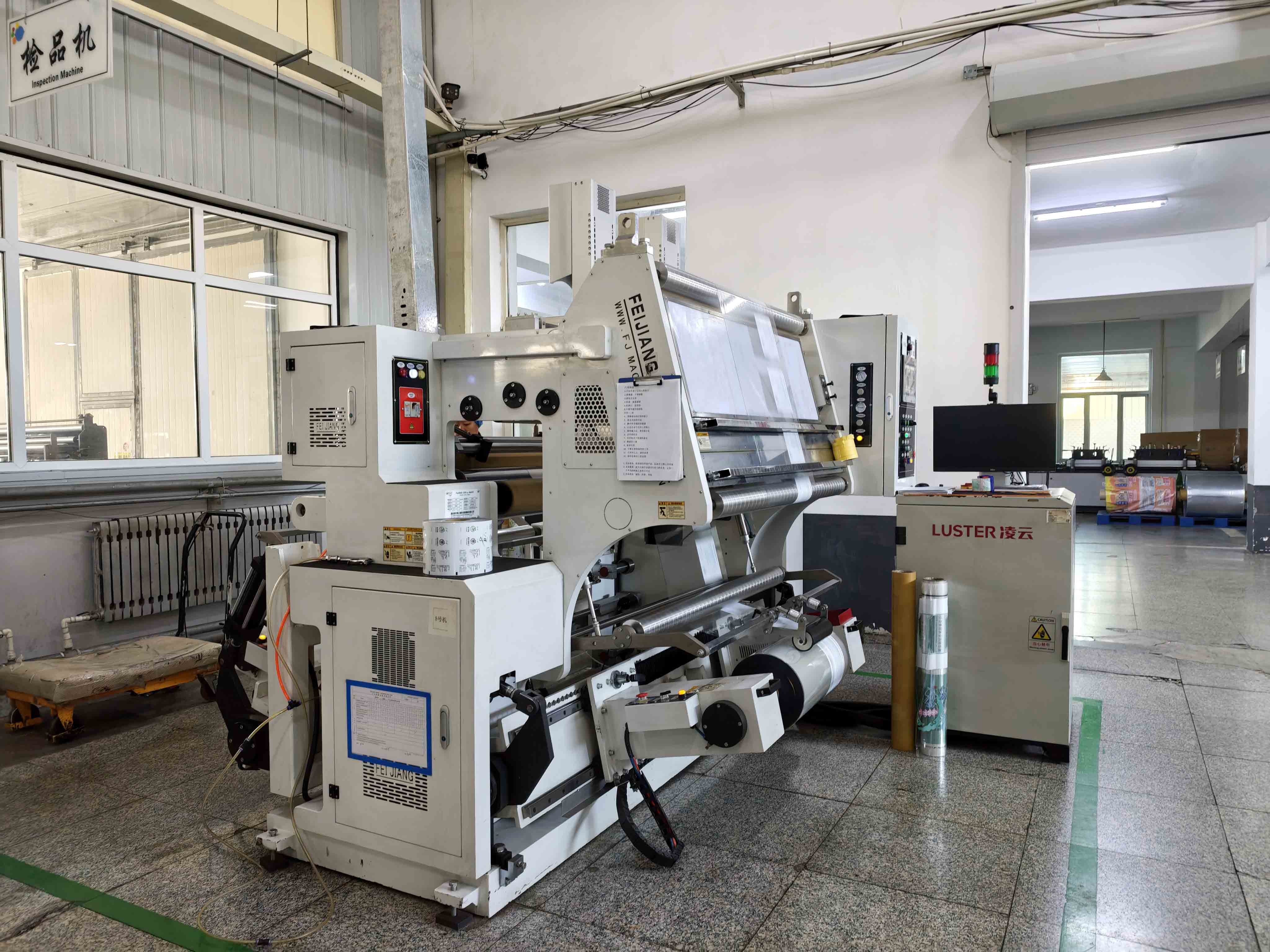
A film inspection station supports a discussion of print defects, registration, physical appearance, and documented release checks. Ask which measurements are recorded for the quoted bag, how often samples are taken, what tolerances apply, and how a failed lot is handled. A broad claim such as “100% inspected” needs a defined inspection method and acceptance rule before it can inform a purchase decision.
Finally, separate material and pouch quality from the bakery's final top seal. A bag converter may test its manufactured seams. The bakery or co-packer must validate the first retail seal made after filling. ASTM F88/F88M is a method for seal-strength measurement of flexible barrier materials. The specific project still needs a sampling plan, acceptance criteria, and complementary integrity checks where relevant. A strong test strip does not automatically prove there is no channel at a crumb-contaminated corner.
A Real Cookie Case as a Better RFQ Example
A published Mylarbag organic mini-cookie pouch project lists a 3.5 oz product, a digitally printed stand-up bag with zipper, PET/VMPET/PE materials, and a 12 × 18.5 + 3 cm size. The description calls the inner PE anti-static. These details are more useful for a request for quotation than “nice cookie packaging.” The site's stand-up pouch format page provides a starting point for discussing that bag style; the case specification and a new buyer's filled-pack trial remain separate.
For example, a buyer could ask: “Can you sample a stand-up pouch for our 3.5 oz mini-cookie portion? Our largest pieces and fill process are attached. Please propose a material structure, state the food-contact documentation, show the usable opening and first-seal allowance, and tell us which proof and filled-pack trials are needed.” That request uses the case to frame questions. It does not order an identical bag before testing a different cookie.
The selected case-gallery photograph shows both a 3.5 oz cookie bag and a smaller cookie SKU. Only the listed 3.5 oz project has the public size and material information quoted here. Do not infer the smaller SKU's dimensions, construction, unit price, or performance from the photograph. If you are buying multiple sizes or flavors, specify each SKU and ask whether any tooling, material, or test result is actually shared.
The public case does not provide a production reject rate, the bakery's shelf-life protocol, measured OTR/WVTR for that final package, or a universal MOQ. Treat its known configuration as a concrete example of what a buyer can document, not a promise that your cookie will behave the same way.

Compare Quotes on the Same Basis
A bag price is difficult to compare if one supplier assumes plain stock, another includes custom printing, and a third omits a zipper or samples. Send one controlled brief and ask suppliers to mark any deviation. If two quotes describe different layer structures, dimensions, or artwork methods, they are not directly comparable until those differences are made visible.
Build a comparison sheet with the following fields:
| Quote field | What to compare | Common hidden difference |
|---|---|---|
| Bag construction | Layer sequence, thickness, sealant, window, and any zipper | “Equivalent material” without the same contact layer or barrier |
| Unit and SKU | Quantity per design, order increment, tolerances | A low price that assumes one design rather than several flavors |
| Artwork | Dieline, printing process, proof, plates or setup | Setup omitted from the unit price |
| Samples | Stock sample, printed proof, preproduction run, shipping | One quote includes a working sample; another includes only a mockup |
| Quality | Tests, inspection frequency, batch identification, acceptance rule | A claim of quality without agreed measurements |
| Timing | Artwork approval, sample approval, manufacture, dispatch, delivery | A lead time counted from an earlier or later milestone |
| Commercial total | Unit price, setup, samples, inventory, filling rejects, delivery | Lowest bag price with higher changeover or wastage cost |
The purpose is not to choose the lowest number. A less expensive stock bag may be perfect when it meets the product's needs and remains available consistently. A custom bag may reduce fill rejects or improve print and fit enough to justify its development cost. A high-cost laminate may add nothing if the actual problem is a narrow opening or weak outer handling. Use the filled-pack results to interpret the quote.
For multi-flavor products, ask how the order is split. Are minimums stated per design, per size, or for the whole project? Will a text-only ingredient change require another proof? How is obsolete printed inventory handled when a recipe or label changes? Do not assume a quoted “wholesale” price answers these operational questions.
Approve the First Order With a Controlled Record
Once a sample passes, record exactly what passed. Keep the physical reference sample and the signed drawing together with the material sequence, nominal size, tolerances, print files, color standard, zipper and tear details, and the test evidence. Identify which team approves the food-contact use, label, filled-pack trial, and production sealing settings.
A sensible first-order sequence is:
- Approve the cookie and bag requirements, including the intended use and product condition at packing.
- Approve material and food-contact records for the exact proposed construction.
- Test fit, closure, oil appearance, and storage with real cookies in real sample bags.
- Sign off the print proof, code area, dimensions, and acceptance tolerances.
- Confirm the commercial quote and the milestones that start the production lead time.
- Define lot identification, incoming checks, and what the buyer will do if the delivered bags differ from the approved sample.
On receipt, verify the lot against the approved specification. Inspect a practical sample of dimensions, print, zipper, seal edges, opening behavior, and packaging condition. The exact sampling and acceptance rule should be agreed in advance. Retain a sample and record any discrepancy before starting a full filling run.
A repeat order is not a reason to stop checking. Material sources, film thickness, inks, zipper components, and production equipment can change. Ask what the supplier will notify you about and which changes trigger a new test. A digital image from last year is not a controlled specification for the next lot.
A One-Page RFQ for Empty Cookie Bags
A request for quotation should help suppliers return comparable proposals, not ask them to guess the product. The following template can be adapted and sent with a filled product sample or measurements.
Product: [Exact baked cookie, key ingredients relevant to oil or moisture, texture target, coatings or fillings].
Portion: [Count, net weight, largest diameter/length and thickness, batch variation].
Use: [Sales channel, storage conditions, planned unopened shelf-life target pending our validation, after-opening use].
Bag: [Candidate flat or stand-up format, dimensions to trial, window, first heat seal, zipper/tear feature if needed].
Packing: [Hand or machine fill, equipment and speed if relevant, product condition at filling, seal-area concerns].
Markets and artwork: [Destinations for food-contact and labeling review, number of designs, print files or design brief].
Supplier response requested: [Full construction, contact documentation, OTR/WVTR methods and conditions if applicable, samples, proof, tests, tolerances, MOQ by SKU, setup, lead time, delivery scope, and quotation validity].
If a supplier proposes a different bag, ask it to explain the difference and the test it would use to demonstrate suitability. That response is more valuable than a bare assertion that the new material is “better.” The custom cookie bags page can serve as a starting point for a flexible-bag inquiry, but the filled product and agreed specification should drive the final quote.
FAQ: Buying Cookie Packaging Bags
Where can I buy empty cookie packaging for a business?
For standard unprinted sizes, compare stock-bag distributors and catalogues that can provide traceable material information. For a custom size, construction, print, or closure, contact a flexible-packaging manufacturer. A co-packer may also nominate a bag that works on its line. In every route, request actual samples and documents for the intended food-contact use.
Is wholesale cookie packaging the same as custom cookie packaging?
No. Wholesale describes the purchasing arrangement or quantity, while custom describes a bag made to an approved specification or artwork. A plain stock bag can be purchased in bulk. A custom printed bag can have multiple SKU-specific proofs and quantities. Ask the supplier how minimums, setup, and reorders are defined.
Should I buy cookie bags near me?
A nearby source can be useful when a suitable stock bag is available quickly or when hands-on samples are important. The decisive questions remain the bag's material, food-contact use, fit, sealability, consistency, cost, and reliable supply. Do not accept or reject a bag based only on distance from the supplier.
How do I compare two quotes for cookie bags?
Give both suppliers the same product and bag brief. Align construction, size, zipper, print method, quantity per SKU, samples, tests, tolerances, and delivery scope. Then compare total project cost and filled-pack performance. If the proposals differ, record the differences before ranking price.
What should a cookie-bag sample prove?
It should prove a defined point. An empty stock sample can show physical feel and approximate dimensions. A filled and sealed sample can show fit, seal clearance, appearance, opening, and handling. A printed proof addresses artwork. Shelf life requires a food-business trial with the actual finished cookie and production package.
Are all bags marketed as food grade suitable for cookies?
A marketing phrase alone is insufficient. Ask for the exact construction and intended food-contact conditions, then review applicable documents for the market where the cookies will be sold. A cookie with unusual oil, filling, temperature, or storage route may need a more specific assessment.
Do I need OTR and WVTR numbers before buying?
They are useful when oxygen or moisture transfer is a relevant design question, especially when comparing alternative films. Request the method and test conditions for the exact material. They do not replace a filled-pack test or a sound seal. A project with an obvious size or filling failure may need those problems fixed first.
Is a zipper necessary for every retail cookie bag?
No. A multipack used over several occasions may benefit from reclosure. A single portion may not. In both cases, the unopened retail pack needs its intended first seal. Test the opening route and whether cookies or crumbs interfere with the zipper.
Can I order the same bag as a published cookie case?
You can request a similar sample, but the case documents one customer's configuration. Your cookie dimensions, recipe, line, storage, and label may differ. Use the case to ask clear questions, then approve your own bag from trials and documentation.
How many samples should I request?
Enough to test the important variation in product size, fill condition, artwork, and production process. There is no useful universal sample count. Agree on the number of constructions and SKUs being compared, the observations required from each, and which sample stage must be approved before printing.
What happens if a delivered bag differs from the approved sample?
Hold the affected lot while the buyer and supplier compare the delivered construction, dimensions, print, closures, and records with the agreed specification. Document the discrepancy and its effect on filling and food-contact use. The purchase agreement should identify tolerances, notification rules, and the process for resolution before production begins.
Buy the Evidence With the Bag
The best place to buy cookie packaging is a supplier that can provide a bag matching the actual cookie and a clear record of what is being sold. The buying process is a chain: product brief, material and food-contact review, physical samples, filled-pack tests, print approval, comparable quote, and repeatable lot control. If any link is missing, a low unit price does not resolve the underlying uncertainty.
Start with a short product brief and ask for two testable bag options. Fill them with the real cookies, inspect the seal and handling, and document why one is approved. A business ready for a custom flexible package can use the custom cookie bag options page to begin that specific conversation.