
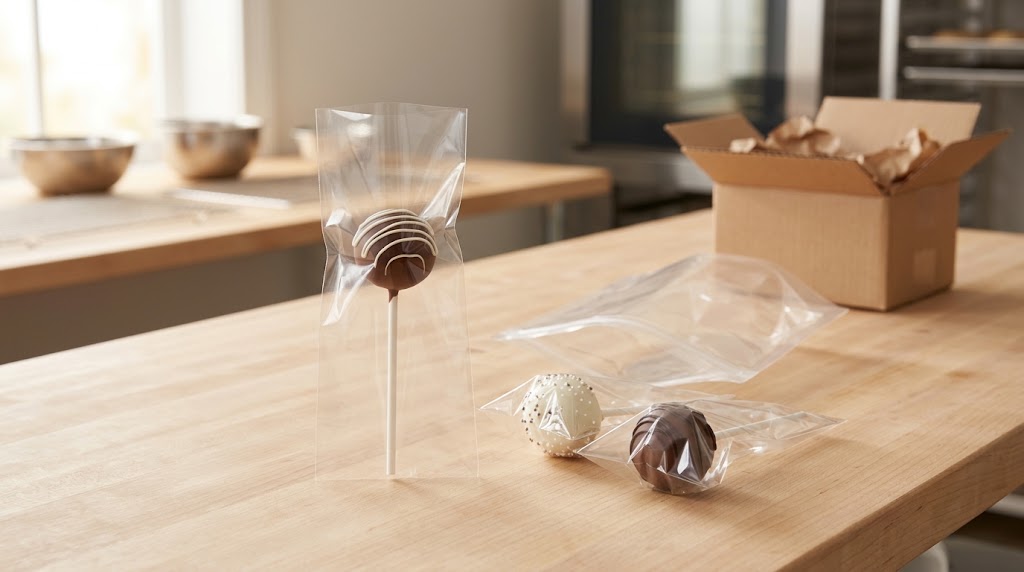
To package cake pops, choose a food-contact bag or sleeve that clears the finished coating, accommodates the stick, and closes without dragging film across the decoration. Buy stock sleeves for a small trial or specify a custom flexible pack once the filled sample and packing method are stable. For shipping, individual bags cover the food; a separate arrangement must hold the pops apart and protect them from impact and temperature changes.
This guide is for bakeries and confectionery brands comparing flexible food bags for cake pops in the United States. It covers an individual sleeve and, where appropriate, a larger pouch containing a grouped retail unit. It does not assume that every cake pop is shelf stable, that every sleeve can be heat sealed, or that a soft bag can keep a decorated pop intact in a parcel. The recipe, distribution route, market, and final bag structure determine what still needs validation.
What does the bag need to do for a cake pop?
A cake pop has two delicate features: a coated head that may chip, smear, or lose decorations on contact, and a stick that can lever against the head when the unit moves. A bag can create a clean individual covering, present the product, provide space for required retail information, and offer a closure appropriate to the intended use. Its thin walls do not restrain the head against a hard impact. A photograph of an upright pop in a bag therefore says little about what will happen when several packs rattle together in a shipping carton.
Start by naming the actual selling unit. A single pop handed over at a counter may need a clear sleeve closed around the stick, with an approved labeling method. A group of individually covered pops may also go into an outer pouch for a set or promotion, but that larger pouch is a second packaging decision. A pop with broad sugar flowers, projecting sprinkles, or a soft finish may be unsuitable for a close-fitting film even though a plain dipped pop fits. Record the finish that will actually be sold rather than sizing from an undecorated model.
| Selling situation | Bag's useful role | Decision before ordering | What the bag cannot establish |
|---|---|---|---|
| One pop sold individually | Clean covering and product visibility, subject to the chosen food-contact structure | Head clearance, sleeve opening, stick exit, closure, label placement | Protection from crushing or a shelf-life period |
| Several individually covered pops sold together | Optional outer flexible pack for presentation and handling | Whether each pop is already covered, total pack dimensions, how sticks and heads are arranged | Separation of every decorated head by the outer film alone |
| Counter pickup or local delivery | Cover during ordinary handoff | Handling orientation, moisture or condensation behavior, temperature plan | Suitability for uncontrolled parcel shipment |
| Parcel shipment | Primary covering inside a validated shipment assembly | Positive location of each stick and head, transit exposure, outer protection | Impact resistance or refrigeration from the sleeve itself |
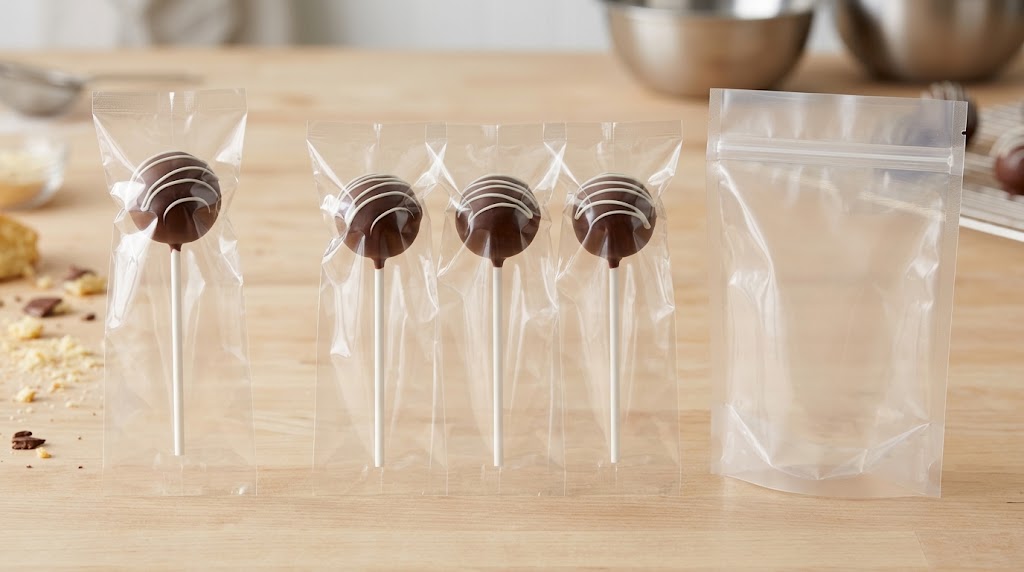
The head of a cake pop may be cake crumb mixed with frosting, coated in chocolate or compound coating, and topped with other ingredients. Those recipes behave differently at room or chilled conditions. Decide the product's safe handling and storage plan with the food producer before using packaging to talk about freshness. A sealed bag is no substitute for a validated shelf-life study or a temperature-control plan. For a perishable recipe, follow the applicable cold handling requirements; general FoodSafety.gov guidance describes prompt refrigeration for perishable food, but it does not classify a particular cake-pop recipe for you.
Where can you buy cake pop packaging bags?
The quickest buying route depends on whether the dimensions and method are already known. For an event-sized run, an established food-packaging retailer may offer clear stock cake-pop bags or sleeves in small quantities. Review the actual film, food-contact information, inside dimensions, closure compatibility, and return policy; the product name alone is not a specification. Buy enough for a realistic trial with the largest decorated pop, the shortest and longest sticks, and the person or machine that will fill the packs. A nominal bag width is not the same as usable internal clearance after the side seams are accounted for.
For repeated production, seasonal artwork, a distinctive shape, or a larger branded group pack, ask a flexible-packaging manufacturer to quote against a filled sample and a written brief. Mylarbag publishes custom cake packaging bags and flat-pouch options. Those pages establish general flexible-packaging formats. They do not verify that a stock cake-pop sleeve, a stick-exit cut, or a tested cake-pop project is available. Ask the team to confirm whether the proposed construction and converting method are feasible for this specific pop before treating a mockup as a purchasable design.
| Route | Best first use | Information to obtain | Practical limitation |
|---|---|---|---|
| Stock bag or sleeve from a food-packaging retailer | Fast physical fit trial or a small, unprinted run | Actual inside dimensions, film and intended food-contact use, closure directions, quantity | Available geometry may force too much head contact or excessive loose film |
| Custom individual bag or sleeve inquiry | Stable repeated format, artwork, specific width or length | Physical product/sample, flat and filled dimensions, stick/closure plan, material documentation, print area | Feasibility, tooling, sample timing, volume and price require a project quote |
| Custom outer pouch for a grouped unit | Branded set of already covered pops, if a trial proves fit | Number of pops, arrangement, thickness when filled, distribution path, seal and label position | A flexible pouch does not replace the positioning system around fragile heads |
If searching “where to buy cake pops packaging” returns stands, boxes, or rigid display trays, decide which problem you are purchasing for. This article addresses the food bag and sleeve portion of that search. A bakery needing a structure to hold stems upright or protect large decorations must specify that as a separate part of the completed pack. Do not substitute a prettier sleeve for a missing physical support. Conversely, a shipment may already have a satisfactory support but still benefit from cleaner individual covering and a better specified flexible pouch.
Ask each seller the same questions. Is the named food-contact side identified for the finished cake and coating? Does the declaration cover the intended food type, contact duration, and room, refrigerated, or frozen use? What are the internal rather than only external dimensions? Can the closure be made consistently with the bakery's equipment? Is the film clear enough for inspection and appropriate for the selected printing or label method? A supplier who can provide a relevant sample and documents is more useful than an unqualified “food grade” slogan. Avoid borrowing material claims from a different SKU.
How should you measure a cake pop and trial the bag?
Measure after dipping and decorating, once the coating has set under the producer's normal process. Record the maximum head width, maximum head depth including protruding toppings, head height, exposed stick length, and total end-to-end length. For a shape that is not round, note the widest orientation likely to pass through the bag opening. Measure several actual units from the production range; an average pop does not reveal the occasional larger rosette or uneven coating. Keep the units identified so the sample-trial notes are traceable.
Next, distinguish the dimensions a catalogue may report. An outer flat width includes material at the seams; an inner useful width is what the decorated head can pass through without scraping. A narrow mouth may defeat a bag that looks wide enough in the body. The vertical allowance must cover the head, the stick segment inside the bag, and the clean area needed for the planned closure. If the stick exits below a gathered closure, assess whether the closure actually isolates the food and whether that method suits the intended retail and handling use. A puncture made with a stick through an unplanned film wall is a defect, not a closure design.
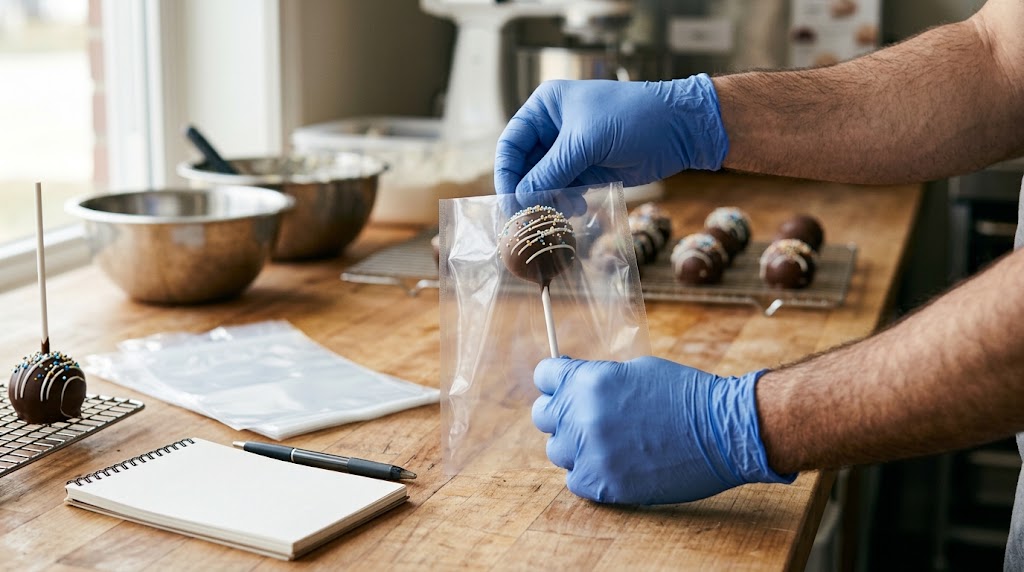
Rather than publish a universal “cake pop bag size,” make a sample worksheet for each SKU. The following is a field list, not a set of recommended dimensions. Record measurements in millimeters or inches consistently and photograph the same sample both empty and filled.
| Field to record | How to observe it | Failure that it helps detect |
|---|---|---|
| Largest decorated head width and depth | Several finished pops, including the most protruding topping | Snagging during insertion or film pressed against decoration |
| Maximum overall length and exposed stick length | From top of head to stick end, plus stick below head | Stick end pushing against a closed edge or insufficient closure space |
| Bag's clear opening and useful body | Actual sample laid flat, then opened in the normal filling motion | Catalogue width concealing a restrictive mouth or side seams |
| Top or gathered closure area | Filled unit held in its intended orientation | Coating, crumbs, stick or label entering the closure |
| Packed unit after handling | Close, stand or hang, lift, and gently transfer using actual workflow | Head rotating, contact marks, lost decorations or loose closure |
Do the trial in the bakery's normal environment. If a coating is still tacky when it enters a trial bag, a larger bag may not solve the cause: the finish may need to set before contact. If cooling a finished product creates surface moisture during later handling, evaluate that transition as part of the product and package process. Do not promise that a clear film prevents condensation, eliminates fat bloom, or gives a fixed shelf life. For a custom bag, send the supplier the filled sample and a short video of the insertion and closing motion, subject to your confidentiality arrangements. Ask for a dimensional drawing and a physical unprinted sample before final artwork.
Which film, food-contact evidence, and print plan matter?
The consumer-facing phrase “food-safe cake pop bag” is incomplete without a specific structure and intended use. The FDA distinguishes food types, including bakery foods with and without free fat or oil at the surface, and conditions such as room-temperature, refrigerated and frozen storage in its food-contact use tables. A cake pop may present a fatty coating, a moist cake center, and a different topping. Ask for the final pack's relevant food-contact documentation and confirm the side that touches food, time and temperature of contact, and any use of labels or inks. This is a specification review, not a claim that a picture or a generic material name proves compliance.
For visibility, a clear film and simple outside decoration may be enough. For an opaque printed group pouch, a transparent individual sleeve might still show each pop when unpacked. If the pop is sold as a retail unit inside a larger printed bag, plan the regulatory information for the actual package and market; do not assume a small tie tag has adequate space. In the US, packaged-food allergen labeling is especially relevant to cake, milk-based coatings, egg, wheat, nuts and sesame where present. The FDA's current allergen guidance should be checked against the exact ingredients and selling format by the food business. Artwork approval is not a food-label compliance review by a bag factory.
Printing should be planned from the physical bag. Show the front and back, any transparent area, the top closure, bottom fold, side seams, and the position of each pop in a filled sample. Keep essential wording off folds and closure areas, and check legibility when the film curves around the product. Printed appearance should be checked on a made-up sample under the intended retail lighting. A digital rendering does not expose every issue with seam placement, film glare, or text hidden behind the stick. Confirm whether printing or labeling is on the outside surface of the relevant construction; do not infer direct-contact suitability from a colorful prototype.
For a grouped unit, Mylarbag's publicly shown cake and bakery white kraft stand-up pouch project is a reference for a published pouch format and window, not a cake-pop fit study. Its pictured product and listed specifications do not establish that a pop on a stick will stand, seal, or ship in that same pouch. A narrower flat sample or a different pouch may be worth discussing only after the physical arrangement and opening are tested.

How do you put a cake pop in a bag and close it cleanly?
Write the method as an operation that two packers can repeat, rather than an idealized styling photo. Begin with completed pops whose coating has reached the producer's required handling state, clean hands or appropriate hygienic tools, and bags stored away from crumbs and moisture. Inspect a few empty bags for incorrect size, damaged seams, and foreign material. For a sleeve with a wide open mouth, guide the head through the center without letting projecting decorations scrape the edge. Support the head and stick as one unit; pushing only on the stick can load the joint between stick and cake.
Hold the filled pop in the orientation the buyer will see. Check that the film is loose around fragile toppings, while still controlled enough that the head does not roll freely into a seam. Keep the closure area free of coating, oil, sprinkles and crumbs. If the bag is closed above the head by heat sealing, the product and stick must remain clear of the seal area and the exact structure and sealer need a validated operating window. If the intended sleeve is gathered below the head around the stick, confirm that the chosen tie or closure gives the level of coverage the product actually needs; a decorative ribbon or sticker is not automatically a hermetic or tamper-evident seal. Do not invent a hole in the bag or pierce a finished seal to accommodate the stick.
Where the head sits close to the bag's top and the stick points downward, a below-head gathering method may be more practical than a top heat seal. Where the entire pop fits in an end-to-end flexible pouch, a clean heat seal may be possible after a physical trial. Neither method should be selected merely because a product listing says “sealable.” The bag material, thickness, contamination at the sealing zone, sealer type, dwell, pressure and cooling all affect the result. Record the approved settings for the actual film and machine after a trial, and inspect the filled pack. A pleasing straight line in a photo is not a seal-strength result.
Check what a customer actually receives. Does the bag stay closed when the stick is gently handled? Are decorative pieces trapped at the seam? Is the cake face visible, or obscured by wrinkled film? Does the label cover the food or important decoration? Can staff place units into the next handling step without rubbing heads together? Record failed samples by failure mode. Change one specification at a time—opening width, length, closure position, film construction or loading motion—so the next trial has a clear purpose.
How do you package cake pops for shipping?
First establish whether the product can be shipped by the proposed route, under its required time and temperature conditions. A shelf-stable plain pop and a cream-containing or otherwise perishable recipe may need very different distribution decisions. The food producer owns that determination. The individual bag is the food-contact covering; it does not isolate each decorated head from movement, take the load of a drop, or maintain a cold temperature. Keep those functions separate when designing a parcel trial.
One workable trial sequence is to bag each finished pop, then positively locate the stick and support the head so that neighboring pops cannot strike one another. The support and cushioning are elements of the shipping assembly, selected for the actual pop shape, quantity, handling orientation and outer shipper. If cooling is required, place and separate refrigerant according to a tested temperature plan so condensation and direct cold contact do not damage the product or compromise packaging. Use a sturdy outer shipper and limit void movement. This describes functions to verify, not a promise that a particular tray, carton or coolant configuration is already supplied by Mylarbag.
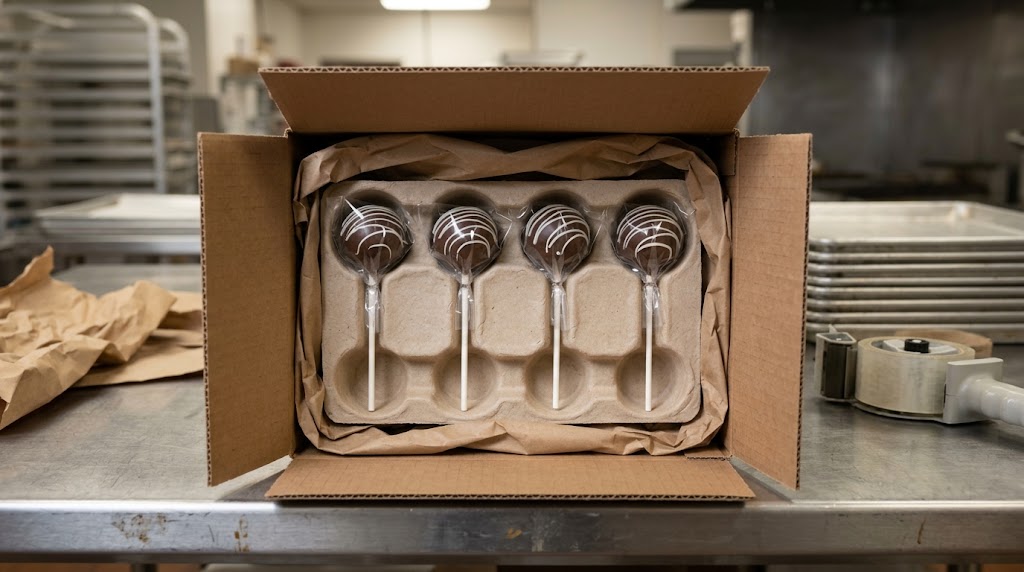
UPS's food-shipping guidance separates wrapping, insulation, packing to minimize movement, and service timing; FedEx's perishable-shipping guidance also treats material and thermal testing as a distinct step. These are useful checks on the whole shipment. They do not validate a cake-pop recipe or a Mylarbag film. Verify the current carrier's acceptance conditions for the exact product, destination, refrigerant and service. Keep a realistic transit margin for delays and destination weather; an overnight service label alone does not demonstrate maintained product temperature.
Run a route-representative packed trial before selling a new shipment option. Use the pop sizes and decorations most likely to fail, the intended unit count, all bag and closure components, and the actual outer assembly. Define acceptance criteria beforehand: intact head and stick joint, acceptable decoration, no contact marks from the film, closure remaining intact, legible label, and the product's own temperature and quality limits at arrival. Review the complete unpacking experience, because a pop may survive transit yet break when the recipient pulls a stick through tight film. Change the failed part of the system and trial again.
Do not advertise “ships safely” or “no melting” merely because one photographed sample looks pristine. Results depend on the recipe, route, season, handling and test design. If a shipment is perishable, food-safety rules and carrier requirements take priority over the marketing description of the bag. A bag supplier can help specify the flexible covering; the food producer and shipper must qualify the complete product-and-parcel system.
What should go on the sample-approval and purchasing checklist?
Before approving a first purchase order, turn the trial into a concise specification. Identify the cake-pop SKU, finished head shape, coating and toppings, stick size, number per selling unit, target market, distribution conditions, chosen bag construction, filling and closure method, print/label plan, and required documents. Attach photographs of a passing and a failing fit, as well as the drawing approved by the bakery and supplier. A group pouch needs its own filled dimensions, closure and artwork proof; do not reuse measurements from the individual sleeve.
| Review point | Evidence to keep | What requires another trial |
|---|---|---|
| Physical fit and loading | Actual finished pops in physical bags, photos from front and side, operator notes | Seasonal decoration, changed stick or film geometry |
| Food-contact and storage use | Final material identification and documents for intended product/contact conditions | Recipe, coating, temperature, duration or supplier structure change |
| Closure and presentation | Filled-pack samples and approved operating/inspection method | New sealing equipment, tie, label, or automated filling line |
| Printed retail information | Approved artwork on a made-up pack and market-specific label review | New ingredients, allergens, claims, unit size or market |
| Shipping, if offered | Complete shipment trial with arrival and temperature review as needed | Different route, season, unit count, refrigerant or outer assembly |
This record is also a useful way to avoid false precision in a supplier conversation. A quotation for “4 × 6 cake pop bags” may be based on an external flat size, an assumed orientation, or a bag that closes where your stick needs to sit. A question with a finished sample and closure sketch has a much better chance of producing a relevant physical proof. Confirm price, order quantity, lead time, sample terms and the availability of a cake-pop-specific format in the actual quotation rather than borrowing figures from unrelated cake pouch marketing.
Recommended packaging configuration to discuss
For a plain, firm-finished single pop sold individually, begin with an unprinted individual food-contact sleeve that allows insertion without touching the coating, then trial its intended closure and label. For a branded set, consider individually covered units plus a separately specified flexible outer pouch only if its opening, filled geometry and handling method are workable. Mylarbag's cake packaging range provides a starting point for a conditional custom-pouch discussion; a cake-pop sleeve design and its availability must be confirmed against your physical sample. If the project requires it, ask about a flat pouch, print layout or film sample rather than assuming a ready-made SKU. No proposed bag should be described as validated for a particular coating, shelf life or parcel route until that evidence exists.
Frequently asked questions
Can I put a cake pop straight into a clear bag after dipping?
Wait until the finish reaches the product's normal handling state and trial a real decorated pop. A tacky or fragile coating can mark when it touches film or the bag mouth. A larger opening and a careful loading motion may reduce contact, but the bakery must set and verify its own coating and handling process. The bag does not make an unstable finish ready for packing.
What size bag should I buy for a cake pop?
There is no reliable size based only on the word “cake pop.” Measure the widest finished head including toppings, overall length, exposed stick, usable bag mouth and intended closure area. Then test physical bags across the production size range. Ask a supplier whether quoted dimensions are internal or external and whether seams reduce the usable opening.
Do cake pop bags have to be heat sealed?
No single closure works for every product and sales format. A gathered sleeve, label, tie, or heat-sealed pouch has different handling and coverage implications. If heat sealing is chosen, use a film intended for the machine, keep food and stick clear of the seal, and validate settings and filled-pack inspection. A decorative closure should not be represented as airtight or tamper evident without supporting evidence.
Can individually bagged cake pops be shipped without more protection?
Individual bags cover the food but do not immobilize sticks or prevent coated heads from hitting one another. Shipping needs a separate support and cushioning arrangement, an appropriate outer shipper, and temperature management when the product requires it. Test the complete assembly and destination route before promising arrival condition.
Are cake pop sleeves automatically food safe if the seller calls them bakery bags?
The description alone is insufficient. Request documentation for the final material's intended food type, food-contact surface, duration and storage conditions, and check it against the cake pop's ingredients and distribution. In the US, FDA's use categories distinguish bakery products with different surface characteristics and temperature conditions; another market may impose additional requirements.
Can Mylarbag supply a custom cake-pop sleeve or a group pouch?
Mylarbag publicly lists custom cake soft-packaging and flat-pouch capabilities, but a specific cake-pop sleeve, stick accommodation and production fit are not established by those pages. Send a finished sample or measurements, desired closure, use conditions, print requirements and quantity through the contact page. Request confirmation of feasible construction, food-contact documentation, sample options and commercial terms for your particular project.
Send a useful brief before ordering
The best next step is a physical fit trial. Photograph the largest fully decorated pop beside a ruler, show the stick and proposed closing point, state whether you sell one or several, and describe counter sale, local delivery or parcel shipment. Include the target market, required storage conditions, expected quantity, filling method, and whether you need printed film or a clear sleeve. Use those details to discuss a conditional bag specification through Mylarbag's cake packaging page or request a project review. Approve the finished pack and any shipment assembly only after the corresponding product, material and handling checks.