
A bird food bag may have a recycling route, but it should not be put in a curbside bin just because it is flexible plastic, looks like paper or displays a recycling-related symbol. The correct answer depends on the finished bag’s construction and components, whether it is empty enough for the program, and the rules of the actual collection service available to the household. For most U.S. households, EPA says plastic bags, wraps and films do not belong in household recycling bins, although some retail and grocery stores collect specified materials.
That is a practical starting point, not a declaration that every bird seed bag belongs in a store drop-off bin. Packaging formats, labels, closures and collection programs vary. This guide gives consumers a decision process and gives bird-food brands a framework for discussing a finished-pack claim without overpromising.
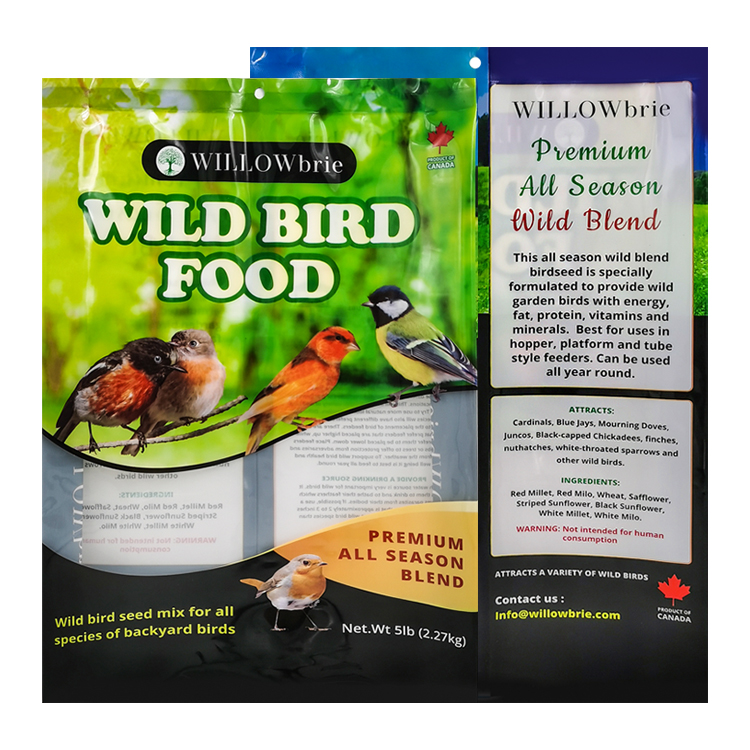
visual format reference only.
The two answers people need
The consumer wants an immediate answer: “Where does this empty bag go?” The brand needs a technical answer: “Can we state an end-of-life claim for this exact product in this market?” They use the same word—recyclable—but they are not the same decision.
Do not let the fourth answer substitute for the first. A designer can develop a pack with an intended recycling stream in mind, but a shopper still needs a collection program that accepts the exact item in the place where they live.
Start with the bag in your hand
Before searching a brand name online, inspect the specific bag. Look at the back panel, bottom seam and side gussets. The same company may sell different sizes, mixes and formats with different construction or disposal instructions. A bag purchased in another country can carry a different instruction from the version sold locally.
Record:
- product name and size;
- country/market shown on the pack;
- any written disposal instruction;
- visible zipper, handle, window or paper-like outer layer;
- whether the bag is flexible film, a rigid container, or an unknown composite;
- whether food residue remains.
This is not a material-analysis exercise for a consumer. It is simply a way to avoid putting a generic answer onto the wrong package.
The U.S. curbside rule: do not assume flexible bags belong in the bin
EPA’s current guidance says plastic bags, wraps and films are recyclable but cannot go in a household recycling bin. It notes that retail and grocery stores often accept these materials and tells consumers to ask local stores or locate an appropriate collection site. EPA also repeatedly emphasises that local rules control what should go into a curbside bin.
For a flexible bird-food bag, the practical conclusion is:
- Do not put it in curbside recycling unless the local program expressly accepts that category.
- Do not put it in a retail film bin unless the program accepts that exact type of bag.
- Do not use a material icon or a product review as a substitute for program instructions.
- Do not assume the same route exists after moving, changing stores or buying a different format.
The consumer has not failed if no route is available. The responsible choice is to follow the local system rather than wish-cycle an item into a stream that does not accept it.
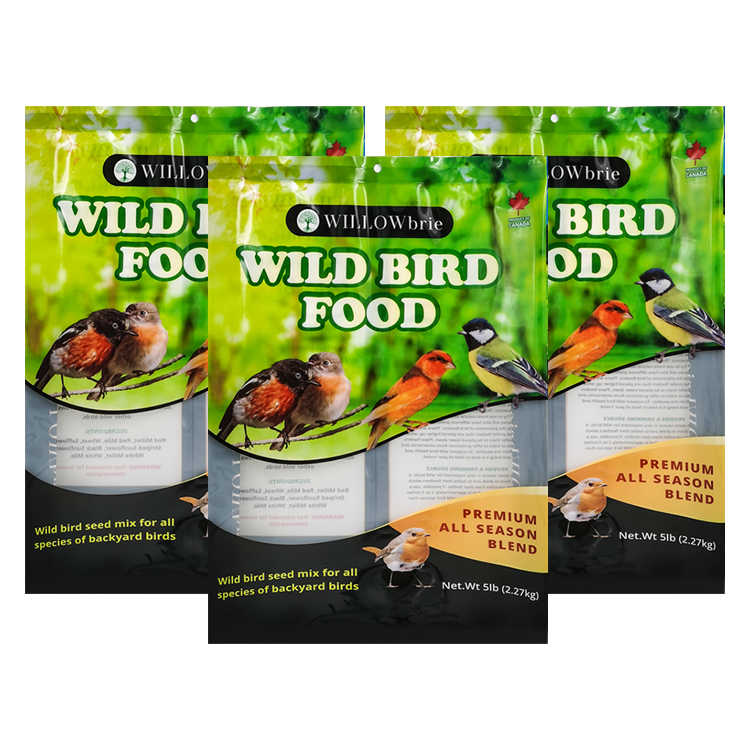
visual format reference only.
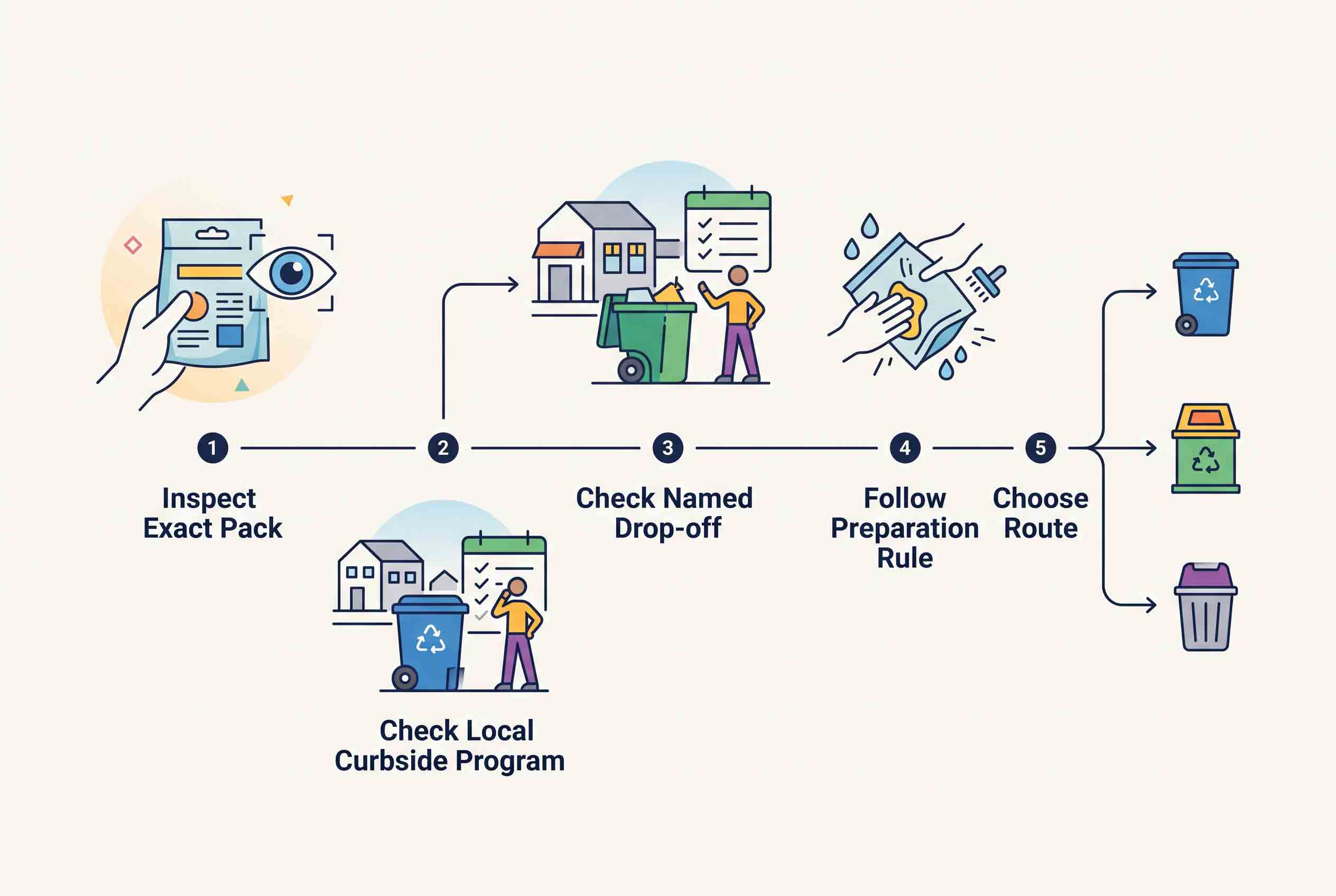
A five-step process for an empty bird-food bag
1. Empty the bag
Remove remaining bird food as practical. A collection program can set its own preparation requirements. Do not rinse, cut or dismantle the bag unless the accepted route tells you to do that.
2. Read the complete package
Look for a country-specific disposal statement. It may appear near the barcode, on a side seam or on the back panel. Do not read only the front graphic.
3. Check curbside guidance by provider
Search the local municipality, waste hauler or collection provider. If flexible film, pet-food bags, seed bags or composite pouches are not on the current accepted list, keep the item out of the curbside bin.
4. Check a named drop-off program
Some stores collect selected flexible film. Confirm the exact location participates and review what the program accepts. A large bin is not evidence that every food bag belongs in it.
5. Follow preparation rules from that route
The program may say whether closures should stay attached or be removed, how clean the bag must be, and which materials are excluded. Follow that instruction exactly; a generic “remove the zipper” statement can be wrong for another program.
Creating a disposal record for repeat purchases
Households often buy the exact same bird seed mix regularly to attract specific species throughout the seasons. Rather than trying to interpret the physical packaging from scratch every time an empty bag requires disposal, households and brands can benefit from maintaining a simple, structured tracking record. This tracking method creates an actionable, reliable reference that stays entirely specific to the actual item and the available collection system. It replaces everyday guesswork with a properly documented routine.
To establish an effective and accurate repeat-purchase record, start by noting the exact product name, the precise bag size, and the specific package version currently in your hands. Do not group all items from the same brand into a single note. A trial-size pouch, a large bulk bag, and a premium zipper-sealed variant can each require an entirely different end-of-life approach. Write down the full on-pack disposal wording exactly as it appears on the printed label, including any country-specific or regional instructions provided by the manufacturer.
Next, carefully document the physical preparation steps required by the destination facility. Record whether the system demands that the bag must be completely empty, clean, and dry before collection. Follow this by noting the precise verified route that explicitly accepts this finished bag. Name the actual local curbside service provider, the specific participating retail take-back store, or the specialist route available where you live. Add the exact date you verified this information, and explicitly write down the programme’s current preparation rule—for instance, specifying whether closures, handles, or labels must be removed prior to drop-off.
This tracking record is only dependable if it remains current. It must be actively rechecked whenever any relevant variable changes. A package may look virtually identical on the store shelf, but a manufacturer might quietly alter the inner film structure, the adhesive layers, or the closure mechanism. Similarly, routine artwork updates can introduce completely new disposal panels. A local curbside programme or a major retailer can also revise its accepted-materials list without public announcements. Therefore, any material, closure, artwork, or local-programme change is a mandatory trigger to pause and verify the collection route once again. This proactive check ensures the item continues to be sorted correctly rather than being misplaced into an incorrect stream based on outdated assumptions.
Why a paper-like bird seed bag may not be paper recycling
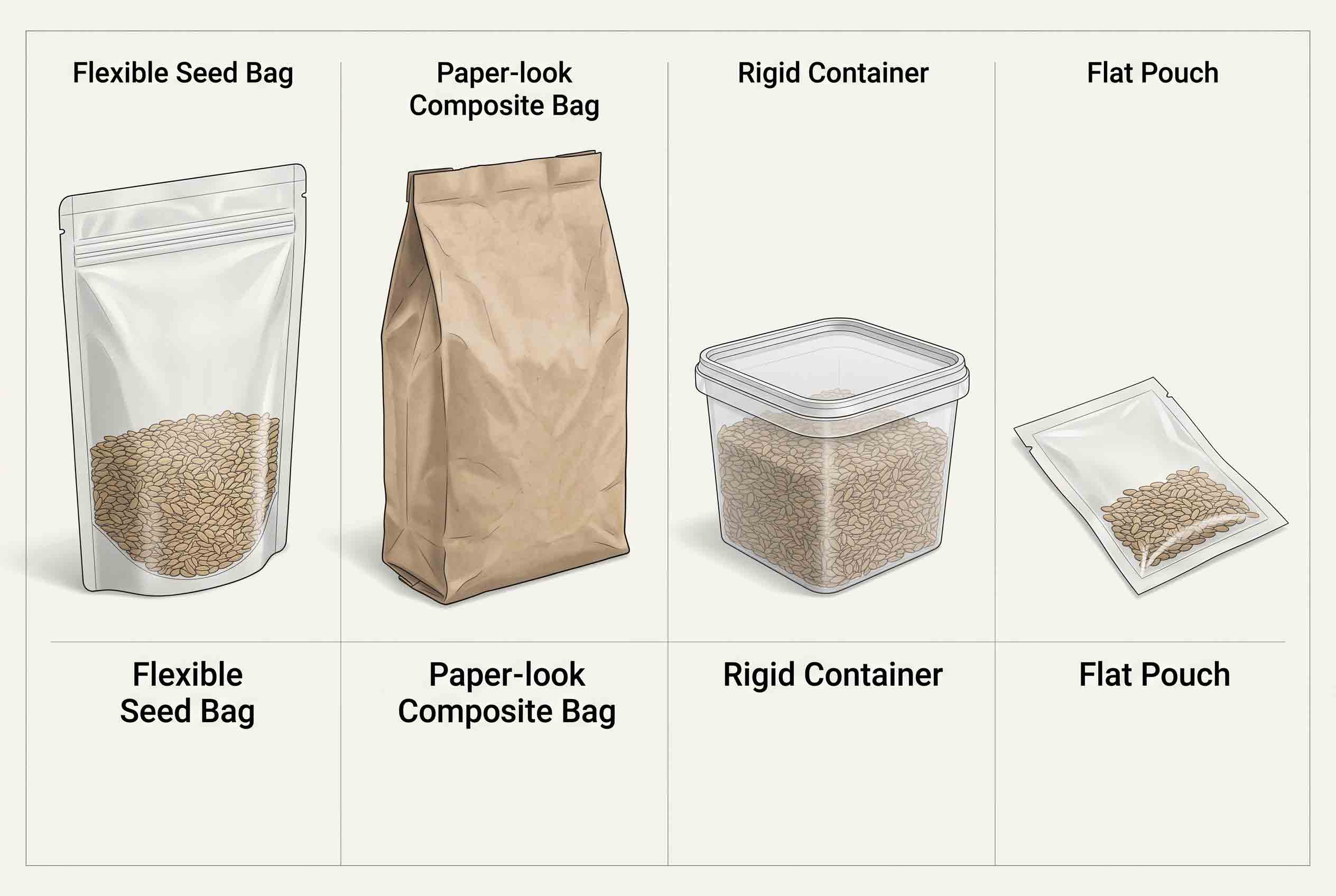
Bird seed packaging can have a natural-paper appearance while using other layers, coatings, seals or components. A shopper cannot determine the full construction from a kraft-coloured surface. A paper recycling program may accept plain clean paper but exclude a finished composite package.
The same logic applies to a bag that looks metallic, glossy or highly plastic. Surface appearance helps a shopper recognise the product; it does not tell a collection facility how the complete item will behave in its system.
For a consumer, this means “paper bag” is not enough information. For a brand, it means a paper look is not enough basis for a paper-recycling claim.
What about zippers, handles and windows?
Components can change the conversation. A flexible bag can include a closure, window, handle, label or reinforcement. Whether any component must be removed, left attached, or keeps the bag out of a route depends on the current program and the finished construction.
EPA gives an example about removing sealable zippers from sandwich bags for plastic-film recycling when necessary, but it does not turn that example into a universal requirement for every packaging format. The local program’s instructions take priority.
Do not pull components off a bag just to make it look more recyclable. A torn or mixed item may be less acceptable to the program you hoped to use.
Can bird food bags be composted?
Composting and recycling are different systems. A bag that looks natural, says plant-based, or contains paper is not automatically suitable for home compost, industrial composting or a local organics collection. Conversely, a flexible bag designed for a recycling route should not be placed in a compost bin unless its exact instructions say so.
For brands, compostability needs a defined final package, relevant certification/standard where applicable, intended disposal environment, target market, access route and claim review. Closures, inks, labels and other components can matter. A broad claim such as “eco-friendly bird seed bag” does not give a household a correct disposal action.
Illustrative technical diagram.
A brand’s recycling claim is a finished-pack decision
Bird-food brands often want to reduce packaging impact, and packaging suppliers may offer options described by material family. The appropriate next step is not to place a broad recycling badge on the pouch. It is to document the final configuration and determine what consumer action is both accurate and available.
Before using a public claim, record:
- the finished bag construction, not merely its primary film;
- zipper, handle, window, inks, adhesive, labels and other relevant components;
- target country and any regional access limitation;
- proposed collection route;
- consumer preparation instruction;
- evidence and review for the wording used;
- revision trigger if a material, component, market or program changes.
This process also helps customer service. A brand can answer the question “Can I recycle this bag?” with a market-specific instruction instead of a vague sustainability slogan.
If you are developing a custom bird-food pack, Custom Bird Food Bags is a starting point for a format discussion. Bring the target market and intended end-of-life outcome into the initial brief. Do not treat an online material option as a completed recycling claim.
Why brand-name searches often lead to bad answers
A consumer may search a retailer or bird seed brand followed by “recycle bag.” Search results can mix old guidance, another country’s packaging, reviews and generic recycling articles. Brands can also change packaging or collection partners without every older web page being updated.
Use the brand name only to locate the official current instruction for the exact product. Then compare it with the local program. Do not transfer a claim from one seed mix, bag size or country onto another.
This caution is not evasive. It is how a useful disposal guide stays correct when packaging and collection access evolve.
A packaging example does not establish recyclability
Mylarbag’s Pet Food & Treats collection includes a 5 lb (2.27 kg) bird-food/pet-feed back-seal pouch with a clear window and a PA/PE structure. It can be used as a reference for those visible packaging details. It does not establish whether a local curbside or retail collection programme accepts that exact finished bag, or whether a later version of the package would be eligible.
Whether a package can be recycled depends on the complete finished pack and on a collection route that actually accepts it where the consumer lives. A product photo or the fact that a package is used for bird food is not enough to support a recycling conclusion.
What consumers should not do
- Do not put flexible bird-food bags in curbside recycling just because they are empty.
- Do not treat an all-paper appearance as proof of paper-recycling acceptance.
- Do not put a flexible bag in a store film bin without checking the current accepted list.
- Do not copy a disposal rule from another country’s package.
- Do not put a recyclable pack into compost, or a compostable pack into film collection, unless its instructions say to do so.
- Do not use a resumption code, recycle arrow or marketing graphic as the only decision factor.
- Do not assume an old brand FAQ governs the bag now in your hand.
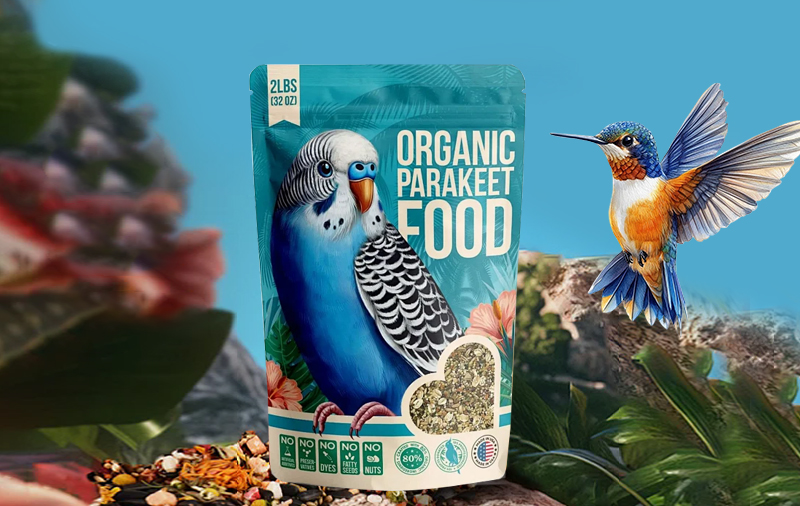
visual format reference only.
How to make disposal instructions easier for customers
The best brand instruction is specific enough to guide action and cautious enough not to overstate access. It should name the relevant market, say whether curbside is appropriate, identify a verified drop-off/take-back route where one exists, and tell the consumer any required preparation step. It should also be reviewed if a supplier changes a component or a program changes acceptance.
Avoid statements like:
- “Put this bag in any recycling bin.”
- “Fully recyclable everywhere.”
- “Compostable in your backyard.”
- “Remove all parts” without a named program instruction.
Better wording describes the action that is genuinely available to the buyer. If no widely accessible route exists, the brand should not disguise that limitation with a generic icon.
visual format reference only.
Keep a local disposal record for repeat purchases
Households that buy the same bird seed regularly can save time by making a short, specific note after they verify a route. Record the exact product/size, the city or collection provider, the program checked, the date and the preparation rule. Do not write a broad note such as “bird seed bags recycle here.” A flexible seed bag, a different size with a zipper, and a paper-look product can be separate questions.
Recheck the note when:
- the brand changes bag artwork or construction;
- the product gains a new closure, window or handle;
- the household moves or the collection provider changes;
- a retailer removes or changes its collection program;
- the local authority issues revised recycling guidance.
This is a small habit, but it prevents recycling guidance from becoming an outdated household myth. It also avoids taking an item to a store based on a collection bin that no longer accepts it.
The difference between collection, sorting and recycling
Consumers often use “recyclable” to describe an item that can be placed in a bin. In practice there are at least three stages:
- Collection: A program accepts the item at curbside, drop-off or take-back.
- Sorting and preparation: The item is handled in a way the system can process; it meets any size, contamination and component rules.
- Reprocessing: The collected material is processed into a usable recovered feedstock.
An article should not collapse those stages into a single promise. Collection access is the question most consumers can act on; sorting and reprocessing are why program-specific instructions exist. A brand’s public claim must be aligned with all relevant stages, but a consumer should still follow the local route’s directions rather than trying to make their own engineering judgement from a pouch.
Why “empty” does not mean “clean enough for every program”
Food residue and loose seed dust can matter to a collection route. EPA’s general recycling guidance tells consumers to check local instructions for area-specific requirements. The correct preparation is therefore not “always wash the bag” or “always leave it untouched.” Some flexible packaging is not suited to rinsing; some routes may state a different preparation expectation; some may not accept the item at all.
Use the least-assumptive sequence: empty the contents, read the exact package, find the program that accepts it, and follow that program’s published instructions. If the route does not explain what it accepts, contact the program rather than turning a bag into an experiment.
A better question for brands and buyers
Instead of asking only “Is this recyclable?”, ask: “What can a customer in our target market do with this exact finished bag after use?” That question forces the right details into view: the package components, the collection route, the realistic customer instruction and the evidence behind the wording.
It also produces better packaging decisions. A brand may decide to change a component, choose a different claim, limit a statement to a market with real access, or refrain from making an end-of-life promise until the system is clear. None of those outcomes is a failure. They are more credible than a broad claim that sends customers to a bin which does not accept the bag.
Recheck when the package changes
Treat an end-of-life instruction as part of the finished SKU record. Revisit it when a supplier changes film, closure, print process, handle, window, bag size or the market in which the product is sold. A small package change can affect the collection question, and an old recycling panel can become misleading even if the bird food itself has not changed.
Frequently asked questions
Can bird food bags be recycled?
Some exact bags may have an accepted collection route, but there is no universal answer. Check the full package and the current local curbside or named drop-off program.
Can I put a bird seed bag in curbside recycling?
Not unless your local program explicitly accepts that category. EPA says plastic bags, wraps and films do not belong in household recycling bins; local rules still control.
Can I recycle an empty bird-food bag at a grocery store?
Only if the specific store program accepts that bag type. Store film bins may accept a limited set of materials and can exclude food bags, mixed constructions or certain components.
Are paper bird seed bags recyclable?
Not automatically. A paper-like exterior does not identify the complete package or prove acceptance in a local paper-recycling stream.
Should I remove the zipper before recycling?
Follow the current instruction of the program that accepts the exact bag. Do not apply a generic zipper rule to every flexible food bag.
Are bird food bags compostable?
Not by default. Composting is different from recycling and depends on the exact finished package and the available collection/composting route.
Illustrative technical diagram.
Sources and scope
- U.S. EPA: How Do I Recycle Common Recyclables
- U.S. EPA: Frequent Questions on Recycling
- Association of Plastic Recyclers: PE Flexible Guidance
- Mylarbag: Custom Bird Food Bags
- Mylarbag: Pet Food & Treats Projects
Scope note: This U.S.-first guide is current as of September 2026. It does not guarantee collection, sorting or recycling of any package. Rules and access vary by locality and change over time; the exact package and current local program are controlling.