
A 16 lb bag of cat food contains 16 lb of product by net weight, but it does not have one standard outside dimension or one reliable cup count. The bag’s size depends on the food’s density, the pouch shape, gussets, headspace and the brand’s packing design. Its cup count depends on how much that exact kibble weighs per cup. The accurate method is to use the product’s grams-per-cup information or weigh one level measuring cup, then divide the bag’s net mass by that weight.
That answer applies to 5 lb, 7 lb, 8 lb, 10 lb, 15 lb, 16 lb and 20 lb bags alike. The number on the bag is a net quantity statement—not a universal bag dimension, scoop volume or feeding plan. This guide gives the formulas, explains why online averages fail, and shows how shoppers and product teams can get a useful answer without inventing a cups-per-pound number.
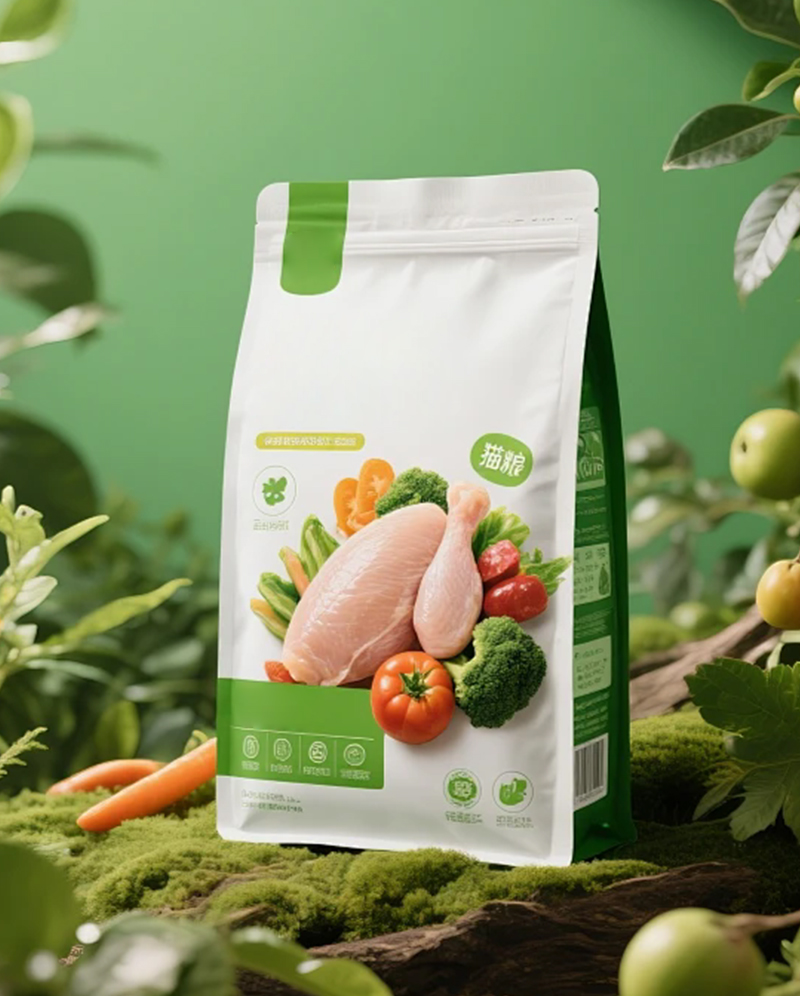
First separate the three questions people mean by “how big”
When someone searches “How big is a 16 lb bag of cat food?” they may be asking one of three things:
- How much food is inside? The answer is the stated net weight: 16 lb, before considering the package itself.
- How large is the physical bag? The answer is product- and brand-specific external dimensions.
- How long will it last or how many cups does it contain? The answer depends on the food’s mass per cup and the product’s labelled feeding directions, not on the bag number alone.
Those questions are related, but treating them as one creates misleading answers. A light, airy kibble can occupy more volume than a dense small-piece formula at the same net weight. A boxy bag, a stand-up pouch and a side-gusset pack can hold the same weight while using different shelf footprints. And two cups of different dry foods can weigh different amounts.
In U.S. pet-food labelling, the quantity statement is required on the principal display panel and is expressed in the appropriate weight, metric, liquid or count terms. AAFCO’s label guide explains why the label carries more than a marketing number. For dry cat food, the pounds printed on the bag identify net content, not a guaranteed cup count or outer dimension.
The fast answer for common bag weights
The gram figures use the exact conversion 1 avoirdupois pound = 453.59237 grams. They are useful because a kitchen scale is normally a better way to calculate food quantity than a volume-only assumption.
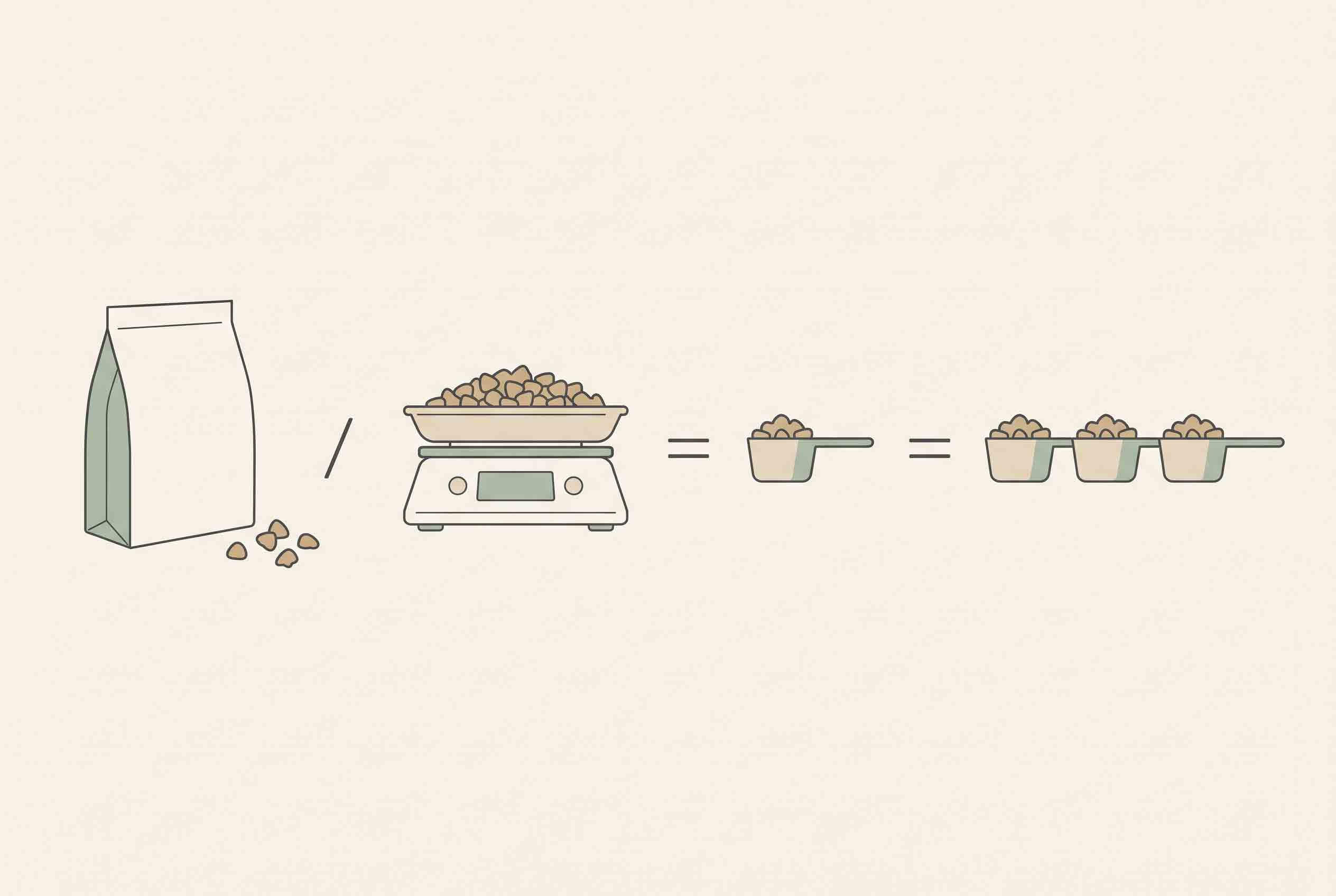
How to calculate how many cups are in a cat-food bag
Use this formula:
Estimated cups in the bag = net bag weight in grams ÷ grams of this food in one level cup
If the package says a level cup of the exact food weighs 95 g, then a 16 lb bag contains approximately:
7,257.5 g ÷ 95 g/cup = 76.4 cups
That is an illustration of the method, not a claim that every 16 lb bag has 76 cups. If another food weighs 75 g per cup, the same 16 lb net weight would yield about 96.8 cups. If it weighs 115 g per cup, it would yield about 63.1 cups. The bag weight did not change; the food’s density did.
Find the grams-per-cup number in this order
- Use the product’s own label or manufacturer guide. Some brands publish the mass for a cup or the mass for a stated volume.
- Ask the manufacturer for the mass of one level measuring cup of that exact recipe. Include the product name and formula; similar products can differ.
- Measure it yourself. Put an empty bowl on a digital scale, tare it, add one level cup using the serving measure specified for the product, and record the grams. Repeat two or three times if the pieces are irregular or the cup is packed inconsistently.
- Calculate from net mass. Divide the grams in the bag by your measured grams per cup.
Do not reverse the calculation from a generic blog table. “Three to four cups per pound” may sound convenient, but it is not a property of cat food as a category. It can be wrong enough to mislead both a shopper planning storage and a reader trying to understand product quantity.
Why cups are an imperfect measure
A U.S. customary cup is a volume measure—8 fluid ounces, approximately 236.6 millilitres—not a measure of mass. NIST’s volume reference provides the measurement context. Kibble is a collection of pieces with air spaces between them. The volume occupied by a scoop therefore changes with:
- piece size and shape;
- recipe density;
- how much the pieces settle during transport;
- whether the cup is level, rounded, shaken or compressed;
- moisture and manufacturing variation;
- the particular scoop a consumer uses.
That is why a labelled feeding cup, if the product supplies one, should be treated as a product-specific measure. A kitchen cup used for baking may have the right nominal volume but still produce a different mass if it is heaped or packed.
For a more precise record, weigh the food in grams. For day-to-day feeding, use the manufacturer’s directions and any veterinary advice relevant to the animal. This article does not prescribe feeding amounts.
How many cups are in a 16 lb bag of cat food?
There is no fixed answer. A 16 lb bag contains about 7,258 g of food. Divide that by the grams in one level cup of the exact recipe.
This table demonstrates sensitivity, not product data. It shows why the same 16 lb keyword cannot have one universal cup answer. Use it only to understand the formula, then replace the denominator with the exact food’s stated or measured grams per cup.
How many cups are in 5, 10, 15 and 20 lb bags?
The calculation is the same. The table below gives the net mass so you can use the formula with your own grams-per-cup value.
For example, if a particular food weighs 85 g per level cup, a 5 lb bag is about 26.7 cups and a 20 lb bag is about 106.7 cups. Do the arithmetic with more decimal places if you need inventory accuracy; round sensibly for household planning.
How big is a physical 16 lb cat-food bag?
There is no standard physical size. A 16 lb bag might be taller and narrower, shorter and wider, flat-bottomed, side-gusseted or made as another format. The outside dimensions also include seals and headspace, while the usable interior is reduced by those same features.
If you need to know whether a retail bag fits in a cabinet, bin, drawer or delivery box, use the exact product listing or measure the actual bag after purchase. Request:
- width;
- depth or gusset measurement;
- height;
- whether the measurement is of an empty or filled bag;
- whether the closure and handle are included;
- whether the stated dimension reflects the retail pack or a shipping case.
Do not calculate outside dimensions from pounds. Weight becomes useful for package development only after you add density, target headspace, construction and filling process.
A note for packaging buyers
For a custom cat-food package, a bag marked “16 lb” is still not a dieline. The brand or co-packer should provide target net weight, product density, particle dimensions, required headspace, filling method, feature requirements, artwork area and case configuration. Physical fill trials then determine whether a proposed pouch is appropriate.
That method is more reliable than copying an unrelated 16 lb bag from a shelf. If you are preparing a specification, the custom cat food pouch page is a suitable starting point for format discussion—but actual product samples and line conditions decide the final dimensions.
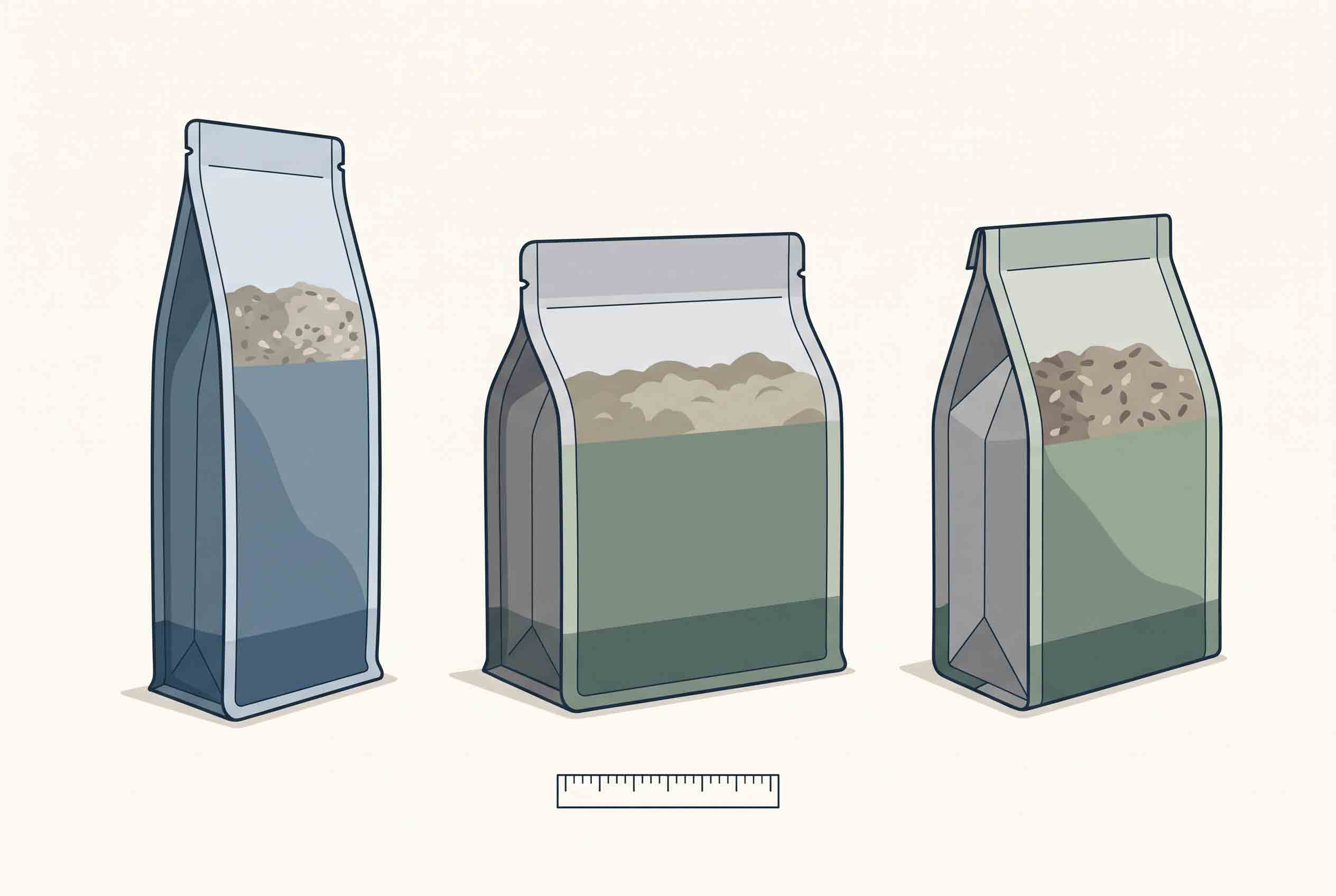
How to measure a bag when you need cabinet or bin clearance
If the question is really “Will this bag fit here?”, measure the filled bag rather than relying on a marketing image. Put the unopened or normally filled bag upright on a flat surface without forcing the gussets wider than they naturally sit. Record the maximum width, depth and height, then add reasonable clearance for removing the bag and closing the cabinet or container lid.
For a bag that has been partly used, its shape may differ from a full bag because product settles and the upper section folds. Record both full-bag and open-bag measurements if storage space is tight. Do not measure only the front panel; the filled side gussets and top closure can be the dimension that prevents a bin from closing.
When comparing a storage bin, use interior dimensions, not the outside dimensions printed on the bin. If the original bag is meant to stay inside the container, allow room for the bag’s top and any fold or reseal feature. This is a physical-fit check, separate from the grams-per-cup calculation and separate from manufacturer storage instructions.
How long does a 16 lb bag of cat food last?
This is a usage-duration question, not a package-dimension answer. If the food’s label provides a daily amount in grams, calculate:
Days of food = net bag mass in grams ÷ labelled daily amount in grams
For a household with more than one cat, add the applicable labelled daily amounts, then divide the net mass by that total. If directions are expressed in cups, first establish the product-specific grams per cup or follow the manufacturer’s stated system.
Example only: a 16 lb bag contains about 7,258 g. If the label for the particular product indicates 70 g per day for a particular feeding situation, the arithmetic is 7,258 ÷ 70 = about 104 days. That is not a recommendation for any individual cat. Age, health, energy needs, other food and veterinary advice can change appropriate feeding. Use the product label and qualified advice for the actual animal.
This formula belongs here because it resolves the “how long does a 15/16/20 lb bag last?” search without turning a packaging page into nutrition advice. It also does not answer how long an opened bag remains fresh—that is a storage and product-instruction question.
The difference between “bag lasts” and “food stays fresh”
These phrases are often used interchangeably, but they need different answers.
Keeping these questions separate makes the answer more useful and avoids false certainty. Our companion storage article will address the opened-bag question without repeating the cup calculation.
What a storage bin needs to hold
People often use bag size to shop for a storage container. A container’s “holds 16 lb” marketing label can be misleading for the same reason that a 16 lb bag has no standard outside size: the food’s volume varies.
If using a bin, check:
- the manufacturer’s stated interior dimensions or volume;
- whether the claim is for a particular type of kibble;
- whether the original bag can fit inside as recommended by the food manufacturer;
- whether there is enough clearance for the lid to close without crushing the bag or its closure;
- whether the container is clean, dry and dedicated to the food.
AAFCO’s handling guidance says to keep dry pet food in a cool, dry place below 80°F and, if possible, keep it in its original container inside a clean, dedicated lidded plastic container. That is a useful general handling principle; the product label remains the controlling source for the particular food. AAFCO’s product-handling guidance gives the full context.
Why package teams should measure in grams and millimetres
For retail shoppers, pounds and cups are familiar. For package development, consistent mass and dimension measurements are more useful. A good technical brief records:
- target net fill in grams;
- product bulk density measured under an agreed method;
- approximate product particle size;
- target pouch width, gusset, height and seal dimensions in millimetres;
- expected filled dimensions and case count;
- maximum case and pallet weight;
- the exact artwork panel requirements.
This avoids a common misunderstanding: a bag’s “capacity” is not a single fixed property. It changes with the product and the way it is filled. A converter should not promise that a nominal pouch “holds 16 lb” until the product has been sampled and the conditions are known.
A practical worksheet
Copy this worksheet before buying a storage bin, comparing products or requesting a custom pouch:
The worksheet makes the missing information obvious. If you do not know the grams per cup or the outside dimensions, no generic search result can reliably fill that gap.
Frequently asked questions
How many cups are in a 16 lb bag of cat food?
It depends on the grams per level cup of that exact food. Convert 16 lb to about 7,258 g, then divide by the grams per cup shown by the manufacturer or measured on a scale. The same applies to other sizes: for a 5 lb bag, use 2,268 g divided by the exact food’s grams per level cup. There is no reliable universal cup count for every 16 lb or 5 lb bag.
How big is a 10 lb bag of cat food?
It contains 10 lb of food by net weight, about 4,536 g. Its physical dimensions are brand- and format-specific, so check the exact product listing or measure the filled bag.
Is a 16 lb cat-food bag always the same size?
No. Net weight does not establish bag width, height, gusset, headspace or shape. Food density and package construction vary.
How long does a 15 lb bag of cat food last?
Divide the bag’s net mass, about 6,804 g, by the product’s stated daily amount in grams. This is an arithmetic estimate only; use the label and appropriate professional advice for feeding decisions.
Can I use cups instead of a scale?
You can use a level product-specific cup for routine measuring, but a scale is better for calculating how many cups a bag contains because different foods have different masses per cup.
Does a bag’s outside size tell me its capacity?
Not reliably. A pouch’s usable capacity depends on construction, seals, gussets, product density, headspace and filling method. A custom pack requires real product trials.
Sources and scope
- AAFCO: How to Understand a Dog or Cat Food Label
- AAFCO: Product Handling Safety
- NIST: SI Units — Volume
- FDA: Pet Food
- Mylarbag: Custom Cat Food Pouches
Scope note: This article is current as of September 2026. It explains package quantities and measurement, not veterinary or nutritional advice. Always follow the exact product label and consult an appropriate professional for a cat’s feeding or health needs.