
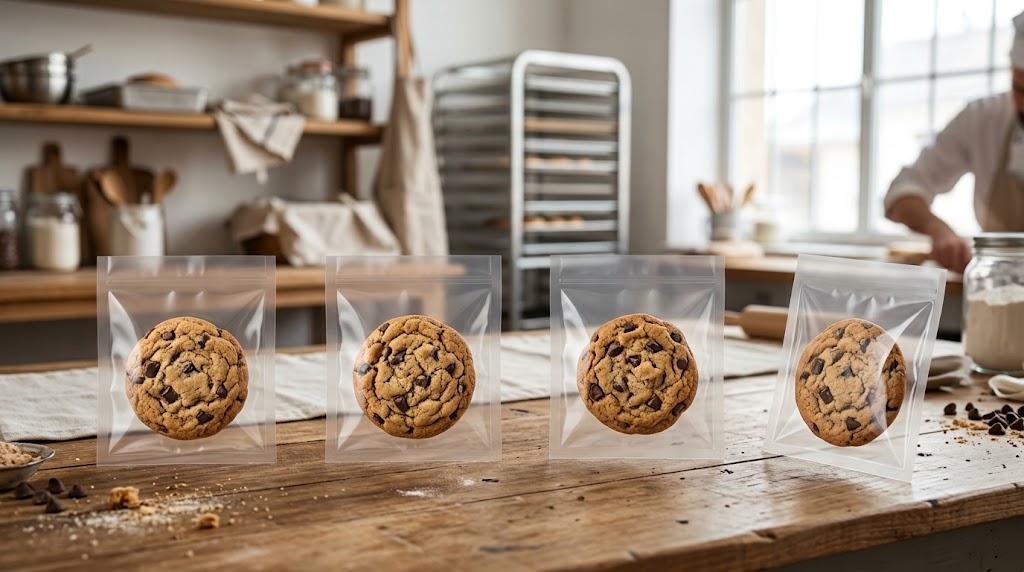
A baker asks for cellophane cookie bags. One seller offers a crisp, glossy sleeve; another shows a soft clear pouch; a third lists a heat-sealable cellulose film. All three let customers see the cookies. They may behave differently at the sealer, in humid storage, and when a butter cookie rests against the inside panel. The purchase decision starts with a material description, not the photo in a catalog.
The short answer: ask what the clear bag is made of, whether it has a coating or separate sealant layer, which surfaces can be sealed, and what its food-contact documentation covers. Match the exact construction to your cookie, closure and expected selling period. Then fill, seal and store trial packs under the conditions your product will actually meet. “Cellophane,” “cello,” “OPP,” “plastic” and “crystal clear” are not substitutes for a film specification.
This guide covers bags for cookies people eat: single-piece bakery bags, small clear retail packs and clear windows in larger flexible pouches. It explains how to compare materials and ask for evidence. The cookie maker remains responsible for the finished food, intended market, storage instructions and shelf-life decision.
First, Find Out What “Cellophane” Means on the Quote
In a technical description, cellophane has a more specific meaning than “a shiny transparent bag.” In the United States, 21 CFR 177.1200 describes cellophane as a base sheet made from regenerated cellulose and permits specified optional substances in the base sheet or coatings under prescribed conditions. A sales listing that calls a bag “cello” is not enough to identify that base sheet, its coating or its permitted use. Ask for the actual film name and construction in writing.
There is also no single performance profile for every cellulose film. Film producer Futamura describes an uncoated base cellulose film as clear and highly permeable to water vapor, with no heat-sealable surface in that product family. Its lacquered barrier grades can offer heat sealing and more moisture protection. That is a useful lesson for cookies: coated versus uncoated can matter as much as the broad material name. It does not mean every cellulose film has either supplier's particular properties.
Many buyers use “cello bag” informally to request the look of cellophane. The offered bag may instead be polypropylene, polyethylene or a laminate. That shorthand is understandable at the first inquiry. It becomes a problem when it is copied into a purchase order without a grade, layer description and closure plan. Clear film samples can look nearly identical under shop lighting while needing different sealing equipment and different tests.
A practical vocabulary for a sample request
| Term on an inquiry | What it can describe | What the supplier still needs to specify |
|---|---|---|
| Cellophane | Regenerated-cellulose base film when used precisely | Film grade, coatings, thickness, sealable side, approved food use |
| “Cello” or clear bag | A requested transparent appearance in casual trade language | Actual polymer or cellulose construction; do not infer composition |
| OPP or BOPP | Oriented polypropylene film; BOPP is biaxially oriented | Exact grade, orientation, coating, sealant surface and barrier data |
| PP bag | Polypropylene family description | Whether oriented, cast, coextruded, coated or laminated; sealing details |
| PE bag | Polyethylene family description | PE grade or layers, thickness, optical properties and intended closure |
| Clear laminated pouch | More than one film or coating working as a structure | Every layer in order, food-contact face, adhesives, window and seal design |
Use this table to request evidence, not to rank materials. A seller might offer a transparent BOPP film that seals on one side or both sides. Another transparent BOPP film may be non-heat-sealable and intended as an outer web. Jindal's HNA data sheet describes a clear heat-sealable BOPP grade; its NNH data sheet describes a clear non-heat-sealable grade. The shared acronym does not settle the seal question.
Choose the Clear Pack Around the Cookie
The cookie sets the packaging brief. A plain butter cookie, a moist chewy cookie and a chocolate-coated sandwich cookie should not inherit the same barrier or handling decision just because they all look good through a clear face. Describe the finished product as packed: size range, texture, oil or fat content, topping, crumb generation, filling, intended portion and display setting. Record whether the bag is an individual primary pack, an inner bag inside another retail presentation or the entire consumer-facing pouch.
Crisp cookies and moisture exposure
A crisp cookie can lose its intended bite if it picks up water during storage. The rate of change depends on the formulation, starting condition, exposed film area, seams, ambient humidity and time. For a clear pack, request the candidate film's water vapor transmission rate (WVTR) with the temperature, relative-humidity conditions, thickness and method. Then compare packed cookies in realistic conditions. A supplier's bare-film number cannot include a loose tie, an unsealed fold or a channel through a top seal.
The common error is to read a cellulose-film brochure's oxygen-barrier statement and assume it also gives the moisture barrier needed for a crisp cookie. Futamura's uncoated and barrier-lacquered cellulose families show why those properties must be asked about separately. The right answer may be a suitable coated transparent film, a different clear polymer grade or a clear viewing window paired with a more protective surrounding pouch. Each option still needs a filled-pack trial.
Soft cookies, fatty recipes and decorated surfaces
A soft cookie can face a different problem: unwanted drying, sticking, or flavor change. A cookie with butter, nut paste or a chocolate coating can leave a visible mark or interact with a bag face under contact and warmth. Ask whether the exact inner surface suits the food and use conditions. Inspect a deliberately representative sample after the planned holding period for oil marks, tack, transfer, odor, haze and appearance. A seller's generic “greaseproof” phrase does not report a test on your cookie.
Decorated cookies add a physical-contact issue. A clear bag may display the artwork yet rub raised icing or sprinkles during filling and transport. Measure the tallest finished detail, trial the actual insertion method and add suitable support if needed. Material selection alone cannot keep a flexible face away from a protruding decoration. If a product contains a filling that requires its own storage controls, a transparent bag cannot substitute for those controls.
Whole clear bag or a clear window?
An all-clear bag gives uninterrupted product visibility. That may be valuable for single cookies sold on a counter. It also exposes the entire display face to light and demands a construction whose seal, barrier, scuff resistance and printed information work together. A smaller window in a printed pouch can show the product while leaving other panels available for branding or a different film structure. The window material, its location and its seal or laminate interface need their own checks. Do not assume an opaque pouch's published barrier number describes a transparent window area.
The custom cookie bags page shows several bag formats, including flat and stand-up options. Treat them as starting shapes. The filled cookie, film and seal determine whether a proposed clear version is suitable. For one or two flat cookies, a flat pouch may simplify the physical trial; a heavier assortment can change the required dimensions and support. Neither format name states a tested shelf life.
Read a Film Data Sheet Without Overreading It
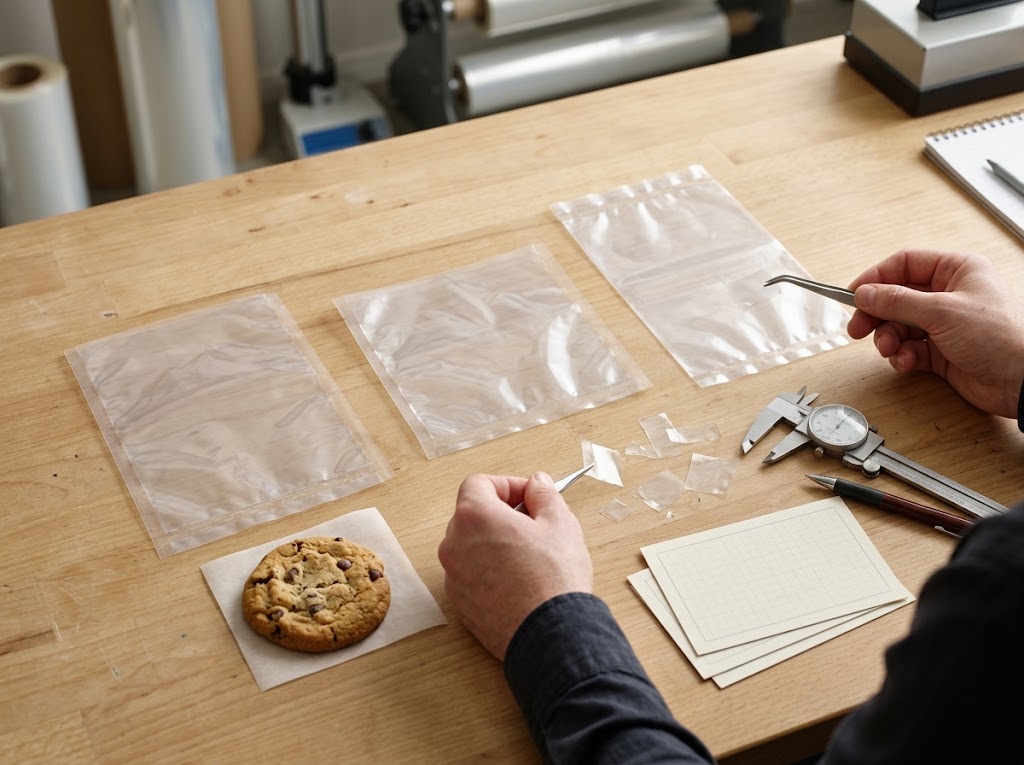
When two samples look equally clear, a technical data sheet helps separate them. Request the exact proposed grade, thickness or thickness range, layer order, contact side, coatings, test methods and conditions. Match those details to the label on each sample bag. If the quotation later changes the film, coating, thickness or converting site, repeat the relevant review. A screenshot of an unrelated clear film is not a specification for the delivered bag.
| Data or feature | Why it matters for a cookie bag | Useful follow-up question |
|---|---|---|
| Film and layer identity | Clarifies cellulose, BOPP, PE and any other webs | Is the sample a single web, coated film or laminate? |
| Thickness and tolerance | Affects feel, handling and the comparison of barrier data | What range is accepted on the actual supplied lot? |
| WVTR and conditions | Helps compare water-vapor transmission of candidate webs | At what temperature/RH and by which method was it measured? |
| OTR and conditions | Relevant when oxygen-sensitive ingredients or flavor are the concern | Is the figure for this exact grade and complete structure? |
| Haze, gloss and visual defects | Relates to how the cookie looks on shelf | Can we review filled samples under actual store lighting? |
| Seal initiation and sealable face | Determines whether the planned closure is feasible | Which sides must meet, and what machine trial is recommended? |
| Surface treatment and friction | Can affect printing, feeding, scuffing and machine travel | Are measured values available for the intended web and line? |
| Food-contact scope | Connects components to actual food and conditions of use | Which documents cover the finished construction and target market? |
WVTR expresses water vapor passing through a material under defined test conditions. The ASTM F1249-25 scope covers a test method for water-vapor transmission through flexible barrier materials, including coated films, and stresses agreed sampling and test conditions for comparisons. A lower bare-film result under a common method may be useful, but the filled bag also has edges, seals, closures and possible handling damage. OTR describes oxygen transmission and answers a different question; do not substitute one number for the other. Ask for comparable conditions and units before placing values in a spreadsheet.
For a concrete reading exercise, Jindal lists typical WVTR values for its transparent, heat-sealable Bicor HNA grades at 38°C and 90% RH: 5.5 g/m²/24 h for HNA25 and 4.6 g/m²/24 h for HNA30. The sheet identifies its test method as ITM 46, and says typical values are not finished-product specifications. Do not assume these values were generated by ASTM F1249 or compare unlike methods without review. The numbers illustrate why the grade, thickness, method and conditions belong beside the result. They are not a target for every cookie, a comparison against every cellulose or PE film, or a prediction of days on shelf. A filled-pack stability study still has to answer the latter question.
Ask for an apples-to-apples comparison
If two candidates have different test temperatures or humidity, ask the supplier for measurements under the same stated conditions. If one number refers to a film web and the other to a finished laminate, label that difference. If a window occupies only part of the pouch, record the geometry rather than pretending the entire pack has one homogeneous transmission rate. For a final buying decision, request the complete bag drawing and production sample, then check the packed product.
Look at the printed and unprinted areas under realistic lighting. A film can be wonderfully transparent when empty yet wrinkle around a cookie, show scuffs, or turn a dense pile of crumbs into the visual focus. Compare haze and gloss in the filled geometry, and inspect any print or label placed near the sealing strip. Ask the converter to explain whether a treatment is for ink adhesion, a barrier coating, a sealant or another function. Those are different jobs even when all of them are invisible in a product photo.

Specify the Closure Before Ordering Clear Bags
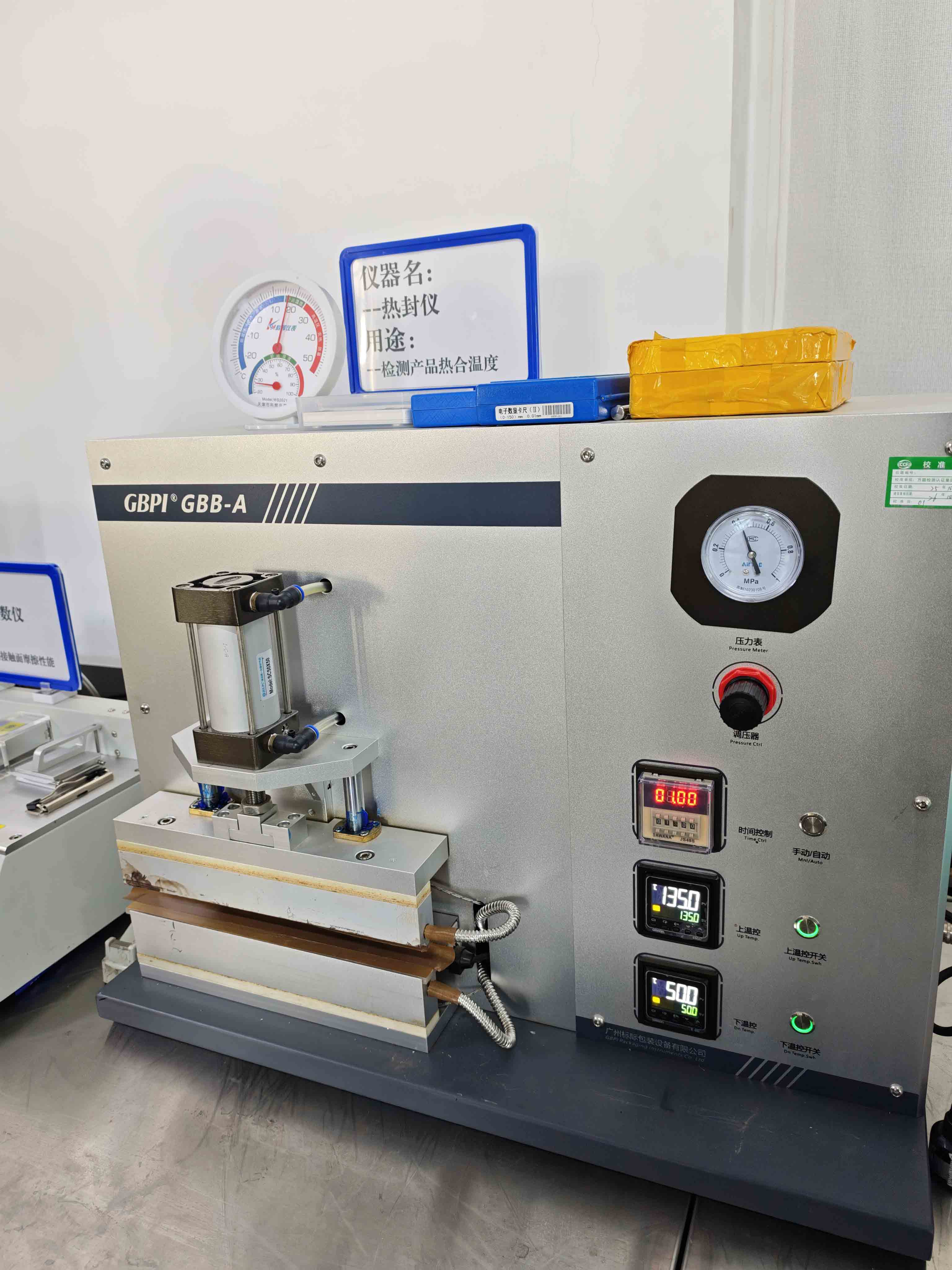
“Can I heat seal these cello bags?” is a question about the specific contact surfaces. A plain cellulose base film, a barrier-lacquered cellulose grade, heat-sealable BOPP and non-heat-sealable BOPP can require different closure approaches. PE may be used as a sealing layer in a laminate, but the outer web is not necessarily the surface that is sealed. Request the supplier's approved sealing orientation and trial guidance. Do not transfer an impulse sealer's dial setting from an unrelated bag.
For a commercial pack, draw where the cookie sits, where crumbs can travel, and where the final top seal will land. Leave enough clean film above the product for the equipment to grip and form the intended seam. Crumbs, grease, wrinkling or an overfilled opening can interrupt an otherwise suitable material. A bag that looks fully closed from a distance may have a weak corner. A decorative tie or folded flap can be appropriate for a very short-use presentation, but it should only be accepted against the business's actual freshness and handling target.
Use the intended machine and operators during the trial. Record sample ID, film side orientation, fill weight, product height, jaw condition, settings, reject reasons and samples from the beginning and end of a run. Inspect the whole seam, especially at corners and where a wrinkle approaches the edge. Test strength and integrity under an agreed plan. ASTM F88/F88M-23 measures seal strength in flexible barrier materials; a measured strength is a process and sample result, not a guarantee that every finished cookie pack is leak-free. The bakery and packer set acceptance criteria for their product and closure.
What if the bag has an adhesive strip or a zipper?
Ask what that feature is designed to do. An adhesive strip may make a bag convenient for hand packing, while a zipper lets a consumer close a larger pouch after opening. Neither feature automatically supplies the same initial closure, moisture protection or tamper presentation as a validated first seal. Some designs include both a factory top seal and a zipper below it. Get a physical sample and a drawing that shows the top seal, opening instruction, tear feature and zipper in the correct order. This topic is developed further in the separate cookie-bag sealing guide; a material inquiry should still identify the required closure now.
Food-Contact Evidence Belongs to the Exact Construction
“Food grade” on a listing is a starting claim, not a complete file for a packed cookie. In the United States, the FDA explains that the status of a food-contact material depends on its individual substances and their conditions of use. It also notes that a food-contact notification applies to the identified manufacturer, substance and conditions. The cellophane provision in 21 CFR 177.1200 addresses a defined construction and permitted optional substances; it does not approve an anonymous clear bag simply because it resembles cellophane.
Tell the supplier what the inner face will touch: a dry plain biscuit, a high-fat cookie, a chocolate coating, or another actual formulation; whether the cookies are ambient, chilled or otherwise handled; and the intended contact duration and market. Request documents appropriate to the complete film, coatings, adhesives, inks where relevant, and finished use. The packaging supplier should identify the basis for its claim; the food business should review it against its specific application and applicable rules. A compostability logo, recyclability icon or clear appearance is not food-contact evidence.
Keep samples traceable. Record which lot and construction went into each trial and retain the corresponding supplier declaration or guaranty, as applicable. If the delivered bag has a different inner layer from the approved sample, the previous trial is not evidence for the substitution. If a customer later reports an off-odor or a visibly greasy panel, batch traceability makes an investigation possible instead of turning it into guesswork.
Run a Filled-Bag Comparison That Can Answer the Decision
The most useful comparison holds everything constant except the candidate packaging. Select representative cookie lots. Include the largest accepted piece, the fattiest formulation in the range where relevant, and the amount of crumbs an ordinary production run produces. Set the comparison conditions before seeing the result: target appearance, seam quality, texture, odor, acceptable breakage and time points. Avoid choosing a winner from whichever clear bag happens to look nicest when empty.
- Write the brief. State cookie type, unit count, dimensions and weight range, packing method, distribution and display conditions, required visibility and intended storage period.
- Label the candidates. Give each sample a code linked to its precise film grade, coating, thickness, bag drawing and supplied documents. Keep unused controls from each lot.
- Trial the real fill. Use normal operators and line or hand-packing steps. Watch for curl, sticking, drag, wrinkles, cookie breakage and product in the seal. Record the line settings for heat-sealable candidates.
- Inspect the finished bag. Check appearance, scuffing, oil marks, seam continuity, dimensions, readable label space, fit in any secondary display and opening experience.
- Store and handle matched samples. Use conditions representative of actual sale and distribution. Include the periods and endpoints selected by the food business. Compare cookies and packs against retained controls at scheduled times.
- Make the decision from recorded results. Reject a candidate that fails a critical food-contact, pack-integrity or product-quality requirement even if it is visually attractive. If a candidate passes one format but fails another, approve only the supported use.
| Trial observation | Possible cause to investigate | Evidence to collect before changing the film |
|---|---|---|
| Crisp cookie softens earlier than the control | Starting moisture, storage exposure, film transmission or closure | Product condition, matched storage record, WVTR conditions, seal inspection |
| Cloudy or marked window | Condensation, scuff, grease transfer or film/print issue | Locate inside/outside mark, product and temperature history, sample lot |
| One corner opens | Seal surface, fold, alignment, contamination or equipment setting | Corner photographs, seam specimen, process log, sample orientation |
| Film clings or catches during filling | Static, friction, format or operator motion | Observed fill sequence, grade and treatment, line settings |
| Cookies break in a well-sealed bag | Movement or mechanical support | Product and bag fit, outer handling setup, arrival inspection |
There is no useful universal “best number” of trial bags for every project. Plan replication and sampling with the product-quality team, based on production variability and the consequences of a failure. A few attractive prototypes may be enough to reject a poor geometry; they are not enough to set a commercial shelf-life claim. The full shelf-life protocol, including product endpoints, belongs in the separate cookie-freshness guide. Here the immediate question is whether a candidate transparent bag deserves further validation.

What a Real Cookie Pouch Case Teaches About a Clear-Bag Quote
Mylarbag's 3.5 oz organic cookies and bakery-bites project documents a digitally printed stand-up pouch with a zipper, a nominal 12 × 18.5 + 3 cm format and a PET/VMPET/PE structure. The product page also names an anti-static PE component. It is a real cookie package and a useful example of how a project identifies the product, format and layer stack instead of stopping at “cookie bag.”

The case also shows the boundary of a comparison. A customer seeking a see-through flat sleeve would change the visual format and the film construction. Removing VMPET to gain transparency is a material redesign, not a color change. The stand-up pouch's dimensions cannot be copied into a single-cookie bag merely because both are described in ounces; product geometry and fill trial still decide the size. Nor does a zipper prove the nature or strength of the unopened top closure. These are questions to ask when converting a general cookie-pouch inquiry into a transparent-film brief.
The case page's broader preservation language is a supplier claim for that product presentation; no published test values on the page establish an equivalent result for a cellulose, BOPP or PE clear bag. Keep the evidence attached to the exact structure. For a new clear project, request its own specifications, samples and tests. The plastic films and rollstock page can start a discussion about possible webs and sealant layers, but an approved construction must be documented for the actual cookies.
Where to Buy Cellophane or Clear Cookie Bags: A Better Request
You can look for clear cookie bags through bakery-supply sellers, packaging distributors or converters that make custom food bags. The channel is less important than whether the supplier can identify what it is selling and provide samples that match your required use. For a very small hand-packed run, a stocked clear flat bag may be the simplest trial. For a printed retail SKU, a custom film, defined top seal and production drawing may be necessary. A “near me” search can help you inspect stock quickly; it does not establish composition, food-contact status or performance by itself.
Send one brief to each prospective supplier so the responses are comparable:
We pack [cookie type and formulation notes], [count/weight] per bag. Finished cookies measure [maximum length × width × height] and may contact the inner film. We need [full transparency or window], [flat or stand-up format], and [hand filling or line details]. Our planned closure is [heat seal or other named method]; the packed product will be displayed/stored under [conditions and intended period] in [target market]. Please identify the exact film and layer order, coatings, food-contact face, thickness and tolerances; supply the bag drawing, relevant food-contact documents, WVTR/OTR values with methods and conditions where available, sealing guidance and matching production-representative samples. State which claims still require our filled-pack trial.
On receiving a quotation, check what is included. Does “bag size” refer to outside dimensions? Are the usable internal dimensions, top seal position and tolerance shown? Does the quoted film match the sample? Is the same grade available for the proposed order volume? Is there an alternate grade if a barrier or seal trial fails? A supplier who can answer those questions gives the bakery a path to approval. A low price for an unidentified clear bag does not.
For a project that needs a custom bag, share the filled-cookie dimensions and test brief with the custom cookie packaging team. Ask for a small set of named candidate structures rather than a universal recommendation. The relevant decision is what passes the food-contact review, packing process and product-quality trial for your own SKU.
Frequently Asked Questions
Is a clear cookie bag the same thing as cellophane?
No conclusion follows from clarity alone. Genuine cellophane has a regenerated-cellulose base sheet under the relevant U.S. definition. A seller may use “cello” as a shorthand for a clear-looking bag of another material. Request the film grade and layer description before ordering. The packaging can look transparent in either case.
What is the difference between cellophane and BOPP cookie bags?
They name different film families: regenerated cellulose versus biaxially oriented polypropylene. The usable differences depend on the specific grade and any coatings or layers. A base cellulose film may be non-heat-sealable and permeable to water vapor, while a barrier-lacquered cellulose grade can behave differently. BOPP also includes both heat-sealable and non-heat-sealable grades. Compare actual data and filled samples under the same task.
Can I heat seal a cellophane cookie bag?
Some identified coated cellulose grades are heat-sealable; an uncoated base grade may not be. Ask which surfaces seal and what equipment trial the film maker recommends. Verify a clean, continuous seam on the actual filled bag. The answer printed on a generic “cello” product listing is insufficient if its composition is not identified.
Is OPP or BOPP better for keeping cookies crisp?
The material family alone cannot settle a shelf-life question. Request WVTR for the actual proposed grade, with its test conditions, then inspect the complete sealed pack and the real cookie during storage. A high-performing web can still be undermined by a weak seam or an unsuitable closure. Compare candidate packs against the same product and conditions.
Are PE cookie bags always softer or less clear?
PE encompasses many formulations and film constructions. A particular sample may differ in feel, stiffness, haze and seal behavior from an oriented-PP sample, but a blanket visual rule is unreliable. Compare labeled finished bags with the actual cookie inside and ask for the proposed grade's optical and processing information.
How long do cookies stay fresh in cellophane bags?
There is no sound universal number. The cookie's recipe and starting condition, the exact film and coating, closure, package area, temperature, humidity and quality endpoint all matter. Establish the proposed sell-by period through an appropriate filled-pack study. A film data sheet and an empty bag photo cannot certify that period.
Does “food grade” prove a clear bag is suitable for my cookies?
Ask for the basis of the claim for the finished construction and intended food-contact use. Include the target market, cookie composition, contact duration and storage conditions. A general logo or a food-contact statement for only one unmodified raw film may leave questions about coatings, sealants, inks or substitutions.
Should I buy an entirely clear bag or a pouch with a window?
Choose based on desired visibility, available label and brand area, light exposure, required product protection and the pack's geometry. A window introduces its own material and interface for review. Test both formats with your cookies, then approve the one that meets the complete brief. An opaque pouch's data cannot automatically be applied to a clear window.
Can a ribbon, fold or adhesive strip replace a heat seal?
That depends on the validated packaging requirement. A decorative closure can hold a short-use bag closed; it does not inherently produce the same pack integrity or moisture control as a qualified primary seal. Describe the intended holding period and test the actual closure. Do not promise freshness from the appearance of a neatly folded top.
What should I ask when searching “where to buy clear cookie bags near me”?
Ask whether the available bags are suitable for food contact under your intended use, what the actual film and coatings are, whether they can be sealed by your method, what their finished dimensions are and whether the shop can supply matching samples and documentation. Buying locally can shorten sample review, but the location of the stock does not answer technical questions.
What is the first reason to reject a clear-bag sample?
Reject a candidate that lacks a usable basis for food contact in the intended application, cannot form the required closure, or visibly damages the real cookie. Those are gating issues. After that, compare product quality, display appearance, machinability and cost against the brief. An attractive pack is a useful presentation choice only after the essential requirements have been met.
The Buying Decision in One Sentence
Buy the identified, documented and trialed clear bag that works with your finished cookie, your filling and sealing process, and your required selling conditions. Start with film identity; use data sheets to narrow the candidates; make the final choice from the filled pack and a product-quality plan. That is a more reliable answer to “where to buy cellophane cookie bags” than any material nickname or stock photo.