
A retailer reports droplets on a pouch of shredded cheese. A buyer calls it a defective film. A packer says the cheese was too warm. Both might be guessing. The first useful question is simpler: are the droplets outside the unopened bag, on its inside surface, or on the cheese itself?
The short answer: packaged cheese gets condensation when a surface falls below the dew point of the air next to it. Outside droplets often form when a cold pack meets warm, humid room air. Inside droplets can come from moisture already in the sealed headspace, warm product packed against cooler film, temperature cycling, or moisture released by the cheese. A wet mark can also be cheese whey or oil, not condensed water. Film water-vapor transmission and a faulty seal are separate routes to investigate. Anti-fog film can make an inner window clearer by changing how condensed water spreads; it does not remove water, repair a leak, or make a temperature excursion safe.
This guide is for cheese brands, quality teams, co-packers and packaging buyers. It gives a practical route from observation to a controlled pack trial. It does not assign one universal film structure or storage temperature to every cheese. The cheese producer's food-safety plan, product specification and destination-market requirements govern release decisions.
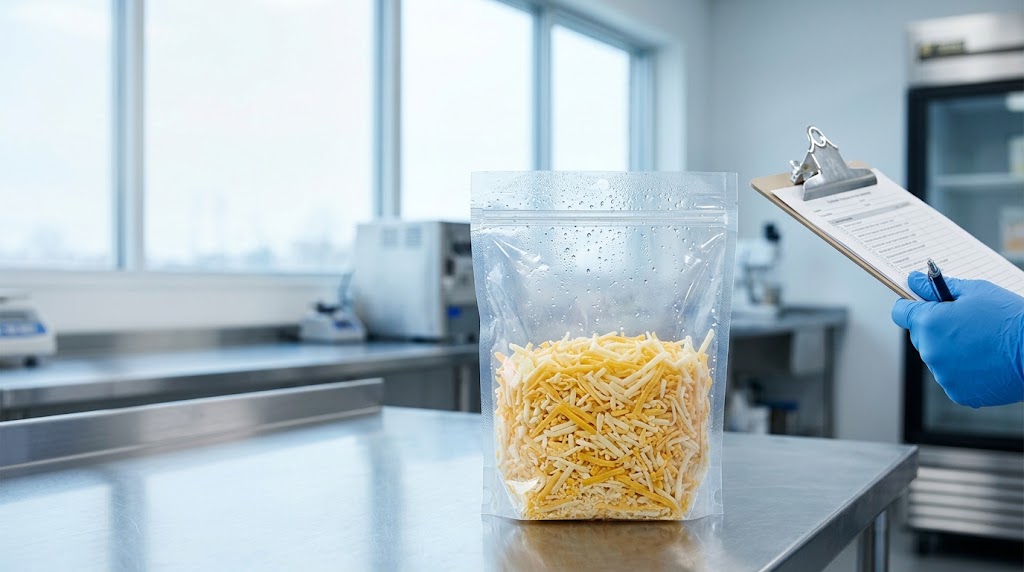
Illustrative cheese-pack condensation inspection. This scene does not represent a documented customer complaint.
Start by Locating the Water
Do not open the first suspect package just to settle an argument. Photograph the whole intact pack, both faces, the top and side seals, the date code, and the shelf or carton where it was found. Note the time since transfer from the cooler. A bead on the outside may vanish when the surface warms. An inner droplet will remain behind the film. A smear that moves with the cheese or collects at the bottom may be purge.
Keep these observations separate. Condensation is a physical description, not a food-safety diagnosis. A visibly wet or swollen pack may require product and microbiological assessment. No photo alone establishes whether it is safe to sell or eat.
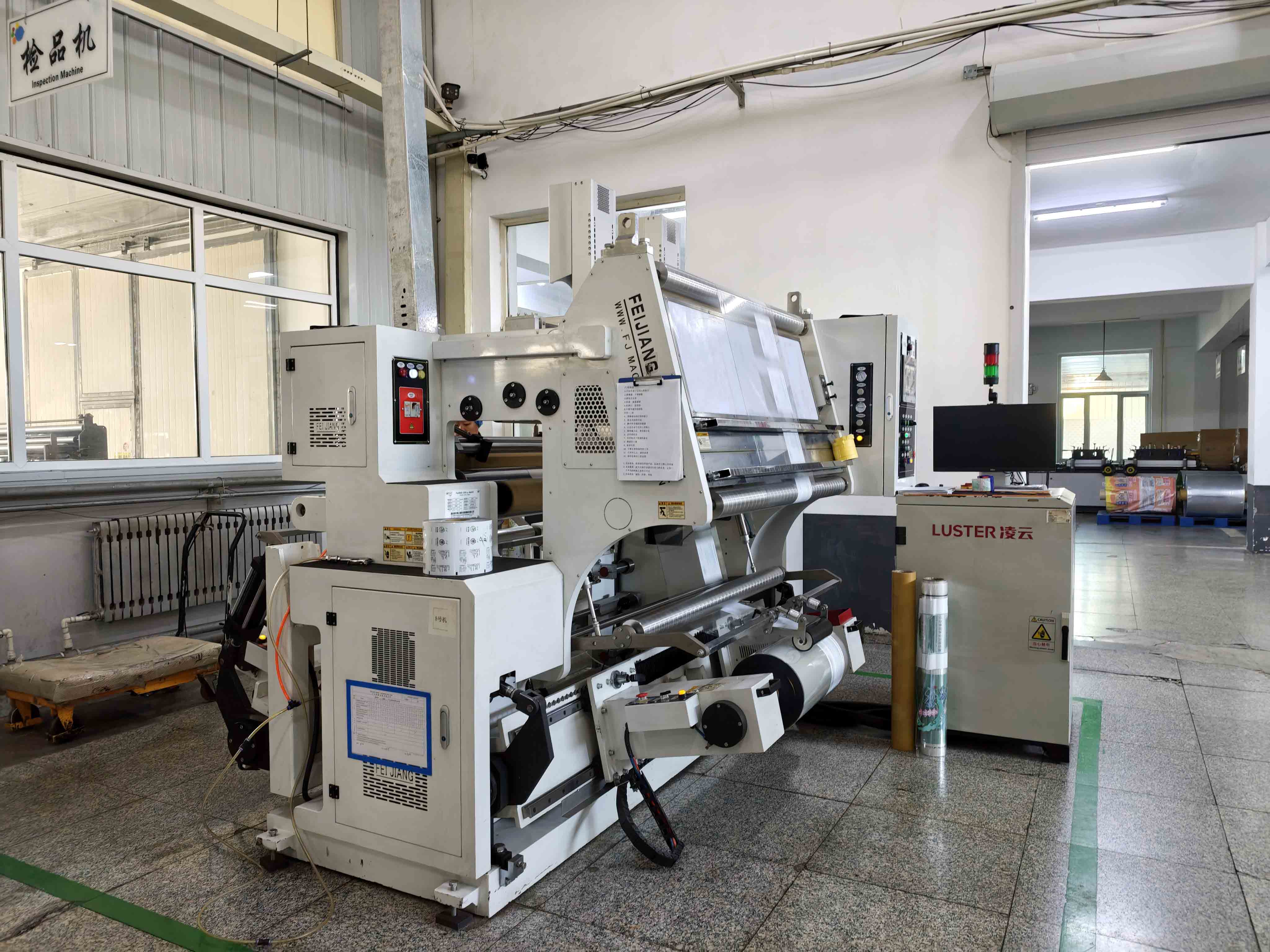
Real factory image: film inspection equipment. It demonstrates a possible converter-side control, not a test result for the cheese in this article.
Inside versus outside: a simple handling protocol
At receipt, hold representative intact packs at their documented storage condition while the quality team records them. Wipe only an outer patch of a retained sample with a clean dry cloth and photograph before and after. If the patch clears while the visible droplets remain behind it, the moisture is internal. Avoid warming a suspect pack to room temperature merely to improve photographs; doing so changes the evidence and may affect product safety.
Record whether droplets are scattered over the whole window, clustered above the product, located under a gusset fold, or concentrated near the seal. A localized streak that begins at a cheese cut surface suggests a different investigation from uniform mist across a transparent panel. Compare multiple units from the same and neighboring lots. One pouch is a complaint; a pattern tied to line, time and route is a clue.
When a report comes from a shopper, ask for unopened-package photographs and storage history through the company's normal complaint channel. Do not ask anyone to taste a suspect product. The brand's quality team should decide if stock is held, sampling is expanded or a food-safety process is triggered.
What the Dew Point Explains—and What It Does Not
Air can hold water vapor. The amount it can hold changes with temperature. When humid air touches a sufficiently cool film surface, some vapor becomes liquid water. The dew point is the temperature at which that air would become saturated under the stated conditions. A cold package leaving a refrigerated room can therefore collect moisture on its outside even if its film is intact and its contents are unchanged.
Inside a sealed package, the relevant air is the headspace trapped at filling, together with moisture exchanged with the cheese and the inner film surface. A cheese piece at one temperature, a gas-flushed headspace at another, and a colder film panel can create a transient inner droplet pattern. Later cooling or warming may move moisture again. A perfectly good gas barrier does not abolish that physics.
The first commercial lesson is to measure both sides of the film and the time course. An outer dew event during receiving may call for a retail handling change. Inner fog present from day zero may point back toward fill temperature, product equilibration or initial headspace. Inner fog appearing only after a warehouse excursion calls for a route and package comparison. A wet food surface with little panel fog may be product purge instead.
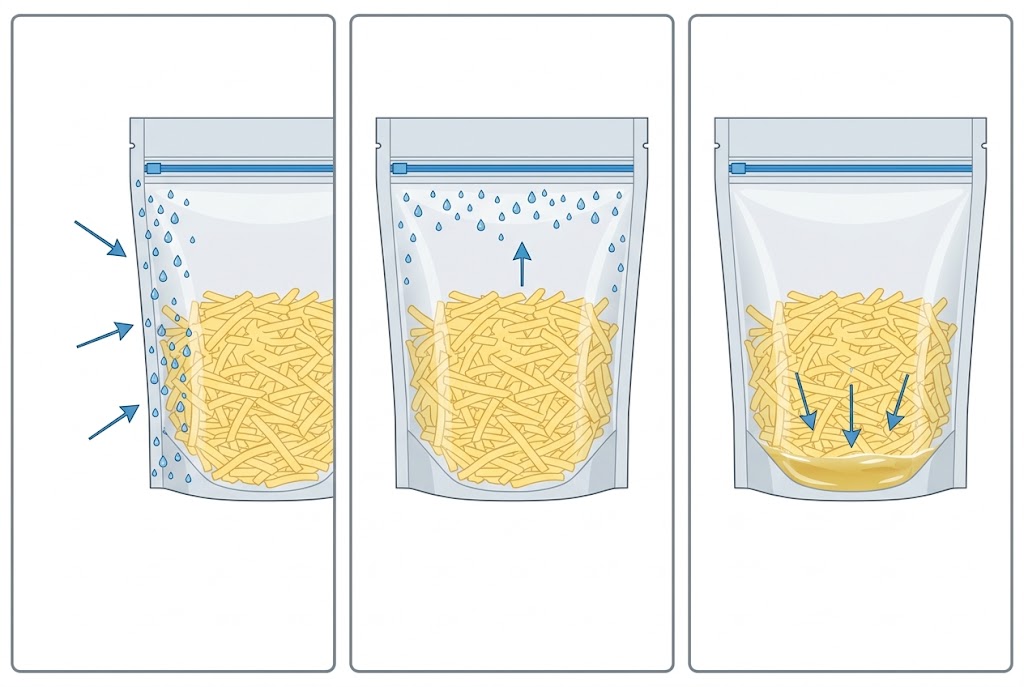
Conceptual illustration of outside dew, internal condensation, and cheese purge. Arrows do not represent measured moisture-transfer rates.
A realistic temperature-transition example
Imagine a sealed cheese pouch held in a cold room. It is moved to a warm, humid packing office for photography. Its outer film initially remains cold, so outside air may condense on it. The moisture can appear within minutes and disappear as the surface warms. That observation by itself is not evidence of water entering through the laminate.
Now imagine a pouch sealed while the cheese is warmer than its intended storage condition. Cooling changes both product and headspace. Moisture can collect on a cold internal surface. If the same pattern recurs in retained packs that never left the controlled refrigerator, focus on the filling and cooling sequence. If only traveled packs show the pattern, compare shipment logs and controls before changing film.
Do not turn these examples into a formula for a safe maximum excursion. Product type, actual time-temperature history and the food-safety plan matter. The FDA advises keeping refrigerated foods at 40°F (4°C) or below and notes that Listeria can grow at refrigeration temperatures. That public guidance reinforces the need for product-specific controls; a clear-looking package does not prove safety.
Trace Four Sources of Moisture Before Replacing the Film
1. Water already associated with the cheese
Fresh mozzarella, brined cheese and soft cheese can release or carry liquid. Shredded cheese can have surface moisture, especially if product temperature and handling change. A firm block may have little free liquid but still exchange water with its headspace. Ripened surfaces, salt distribution, cut geometry and recipe matter.
Record the product's condition at filling: temperature, time after cutting or draining, surface wetness, brine or whey carryover, fill weight, and whether pieces are pressed against the window. Weighing whole finished packs at different times cannot by itself reveal whether a visible droplet came from the product, outside air, or a leaking seal. The food team may need product moisture, water activity, purge mass or other product-specific measures.
A paper on gas exchange in MAP soft cheese reports that a low-permeability wrapping design for a Camembert-type cheese could lead to severe internal condensation under that study's conditions. It is evidence that cheese type and gas and moisture exchange must be considered together. It is not a prescription to perforate all cheese pouches: holes could compromise a different product's safety or shelf life.
2. Moisture in the filling environment and headspace
A gas flush changes the headspace composition, but the finished pack still reflects the filling environment, gas supply and product conditions. Ask the line team how temperature and relative humidity are logged near the filling point, whether the product equilibrates before sealing, and whether a change in the gas or cooling program coincided with complaints. Check the intended gas mix for the actual cheese rather than assuming that every cheese uses the same MAP recipe.
A bag closed after temporary exposure to a warm, humid production area may behave differently from one filled under stable conditions. So can a pouch that waits on a pallet before entering the cooler. Build a chronology: product preparation, fill, first heat seal, cooling, case packing, dispatch and receipt. A timeline often resolves more than a material catalogue.
3. Temperature cycling across distribution and display
Dock doors, mixed-load staging, delayed unloading, defrost cycles and a poorly controlled retail display can change a package's local conditions. The pack's outer surface and the cheese core may respond at different rates. The commercial Cheddar MAP distribution study found higher oxygen readings and more package failures in its simulated transport group than in its minimally moved group over the reported trial. It did not measure a universal condensation rate or show that every foggy cheese bag has a transport leak. Use it as a reason to retain route records and test completed packs under realistic handling.
If outer condensation occurs repeatedly when cartons move from cooler to sales floor, review handling and display. If inner fog develops after a route that includes warmer periods, retain controls and examine product and seal integrity too. A package may show two phenomena at once.
4. Water-vapor transfer or a compromised package
A film has a water-vapor transmission rate (WVTR) under a stated test method and conditions. A high-quality intact film still allows some transfer unless a special barrier construction is used. More important, a microleak, contaminated heat seal or damaged corner can bypass the flat-film specification. The direction and amount of water movement depend on the humidity gradient, area, time, temperature and full package geometry.
ASTM F1249 is a method for measuring WVTR through film or sheeting. Ask for the tested structure, units and conditions. Do not compare numbers measured under different conditions as if they were interchangeable. Nor should a flat-film WVTR be treated as a prediction of droplets in a finished cheese pouch. Inspect the seal, window junction and gussets of the filled pack.
A barrier structure must also suit the cheese. A very low WVTR may reduce drying yet retain released water; a more permeable structure may alter moisture loss and quality. Choose from product behavior and validation, not a universal “lowest possible” number.
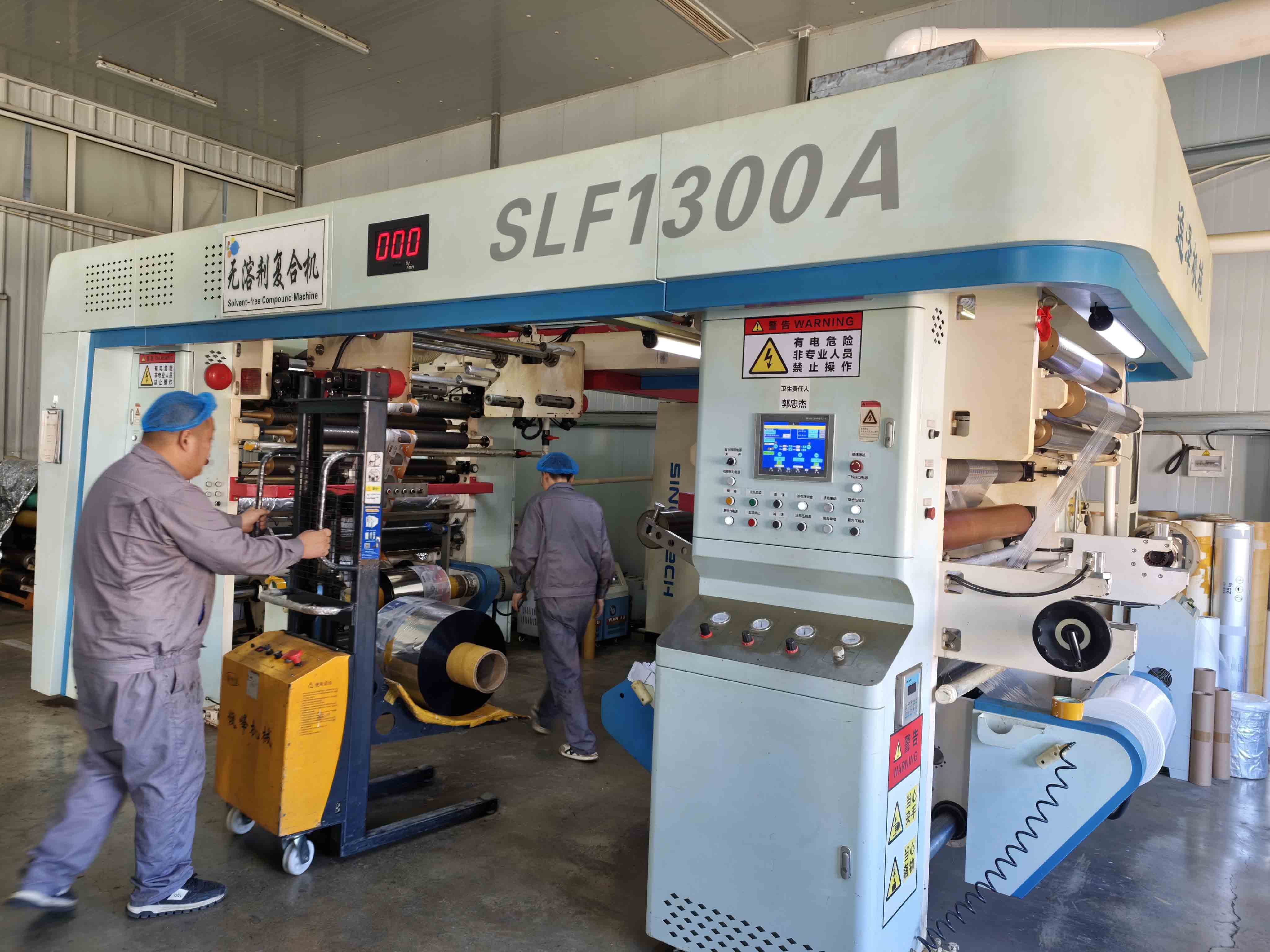
Real factory image: a film-lamination process. No cheese-specific barrier value or anti-fog result is claimed for this machine photo.
Compare Cheese Formats Before Setting a Packaging Specification
The phrase “cheese bag” hides very different moisture systems. Use the table as a trial brief, not as automatic material approval.
For a retail shredded-cheese project, begin with the custom cheese packaging options and ask for a trial construction with the real cheese. A clear window can help shoppers inspect the product, but its transparency, barrier, anti-fog surface, print registration and seals all need to work together. If the food is frequently wet, a pouch may be less suitable than a formed pack with a more deliberate liquid-management strategy.
What an Anti-Fog Window Actually Does
Fog consists of many small water droplets that scatter light. An anti-fog surface changes the wetting behavior so moisture spreads differently, often forming a more continuous, less light-scattering layer. This may preserve a useful view of the cheese. It does not make moisture vanish. Water can still collect, move or reach the product. A clear view is a merchandising result; package integrity and food quality need their own tests.
A food-packaging anti-fog coating study measured wettability and seal behavior on coated oriented polypropylene in a laboratory setting. The authors also called for further tests under simulated conditions and on real foods. Its chemistry and numbers are not specifications for a Mylarbag cheese pouch. The transferable lesson is to assess clarity and sealing together for the actual film.
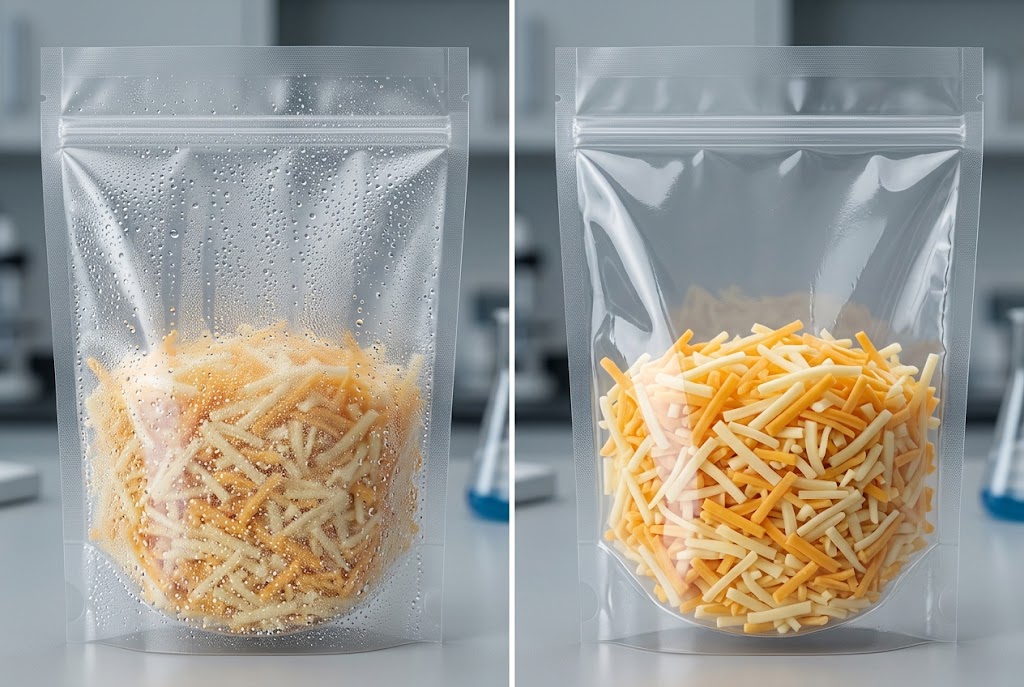
Conceptual comparison of water beading and spreading on packaging surfaces. A clearer anti-fog window does not establish dryness, sterility, or validated shelf life.
Specify the whole window, not an adjective
Ask the supplier where the anti-fog function sits. Is it a treatment on the food-facing side of a transparent panel, an additive in the film, or a coating on a separate layer? Which side will actually face the pouch headspace after converting? Is the treatment present over the full panel or only the window? Does a transparent window change the OTR or WVTR of an otherwise opaque bag? Are print, adhesive, heat-seal, food-contact and migration requirements documented for the exact construction and destination?
The window should be trialed after converting and filling. Observe it at the intended storage condition, through planned temperature changes and at the desired shelf-life checkpoints. Include a regular clear window as a control. Photograph both packs with the same lighting and angle; otherwise a matte finish or glare can masquerade as an anti-fog difference. Score visibility with a written rubric—for example, whether a specified part of the product is legible through the window—before seeing the results.
Never claim that an anti-fog treatment prevents mold or extends shelf life without product-specific evidence. It may improve display clarity while leaving product purge, seal failure, temperature exposure or microbiological risk untouched. A supplier should state the scope of its own test data, not borrow a journal article's result.
Barrier, breathability and package geometry
The plastic films and barrier-layer options provide different starting structures, but an opaque foil laminate can defeat a visible-window objective. A window can become the relevant local barrier path. The choice between a clear high-barrier design, an opaque format, or a different primary pack depends on the product and merchandising brief.
For every candidate, request the full layer sequence and nominal thickness, panel and window constructions, sealant, coating location, gas and water-vapor test conditions, pouch dimensions and closure. Do not paste a WVTR from a material brochure into a shelf-life claim. A package's exposed area, seal perimeter, product contact points, gas volume and distribution route change the result. A test on a dry empty film says little about a wet cheese pressed against a sealed corner.
The first heat seal protects the unopened pack. A press-to-close plastic zipper can help after opening, but it does not replace that seal. Place the zipper below the intact tear-open seal where the chosen commercial format requires it; test the actual profiles and opening geometry with cheese shreds, wet fingers and cold handling.
Check the Line, Seals and Filled Pack
Condensation complaints sometimes begin with a change that happened before the pouch left the line. Compare a good and bad run: product temperature at dosing, room conditions, pouch lot, machine speed, gas settings, fill weight, time before cooling, jaw temperature, dwell and pressure, and rejected seal count. A small amount of cheese across the seal can create a channel. A clear film or anti-fog additive cannot correct it.
Ask for records from startup, steady production and restarts. Check whether the window or zipper crossing affects how the top seam lies flat. Review bottom gusset and corner stresses after filled cases are stacked. If an inner droplet cluster sits at one corner, inspect that location instead of treating the whole laminate as uniformly defective.
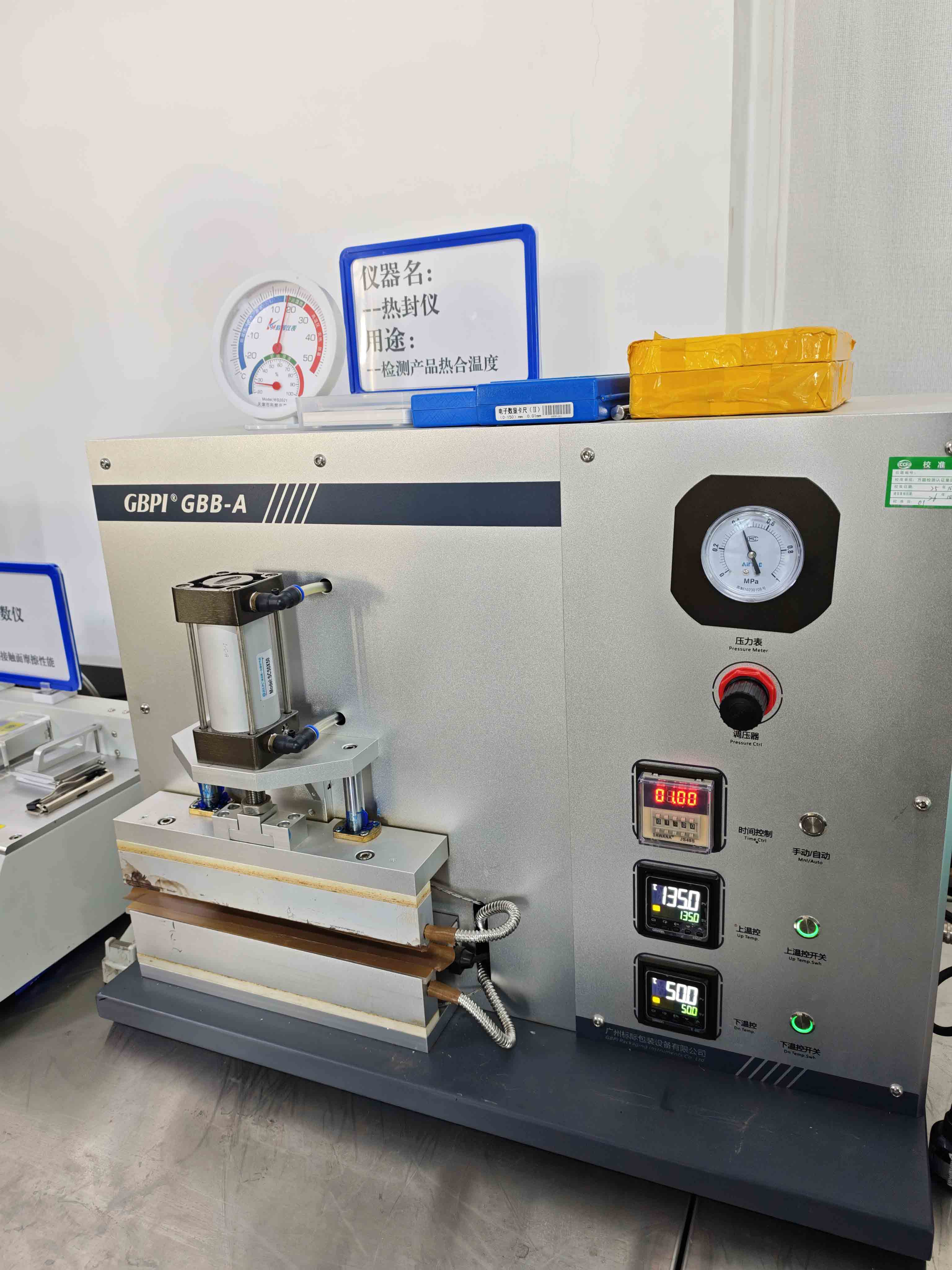
Real factory image: seal-test equipment. A finished cheese pouch still requires its own acceptance criteria and sampling plan.
Use tests for the question they answer. ASTM F88/F88M measures seal strength in flexible barrier materials; ASTM F3039 addresses dye-penetration leak detection in nonporous packages or flexible barrier materials. A strong peel result does not prove there is no pinhole or channel. A leak test does not identify the water source by itself. Follow the methods' limitations and the brand's approved sampling and food-safety procedures.
If a suspect pack is punctured for gas analysis, mark it as destructive-tested. Do not later use it as proof of its former seal integrity. Use matched retained samples when several tests cannot be performed on the same intact unit. Temperature loggers should travel with the sample route, not sit on a desk while the cases undergo handling.
A Real Adjacent Project: Australian Chilled-Food Pouch
The Mylarbag project for 500 g fresh pasta and chilled foods lists Australia as the destination, an MOPP/PET/PE structure, a stand-up format, a zipper and a euro slot. Those are concrete design choices in a refrigerated-food retail setting. The project's frosted, partly visible presentation raises a useful design question for cheese: how much product visibility does the brand need, and what happens to that view when the pack moves through a cooler and store?
This is not a cheese case. The listing does not supply a controlled condensation comparison for cheese, a cheese shelf-life result, or a transferable numerical anti-fog specification. Do not treat its material structure as a ready-made recipe for mozzarella. Fresh pasta and cheese differ in surface water, acidity, processing, microbes and packing atmosphere.
A cheese buyer can still use the adjacent project to sharpen a request for samples. Ask the converter for the actual transparent-area design, coating and sealant position, and a refrigerated trial with the cheese plant's product. If the retailer needs hanging display, test euro-slot loads in the real filled format. If the pack will be opened repeatedly, test reclosure separately from the original heat seal. If no clear window is needed, do not add one solely because another chilled product used a frosted finish.
Run a Small Controlled Trial Before Buying Production Film
A trial should tell the team whether a change addresses the observed failure. Start with a written definition: for example, “inside panel droplets appear after refrigerated transport and obscure the product at day 10.” Specify the product, equipment, target shelf life, acceptable appearance and safety review. Retain the current approved package as a control.
Separate the variables
Run a practical comparison rather than changing cheese temperature, film, gas and display simultaneously. If the problem is fogging, compare the current clear panel with a proposed anti-fog panel while keeping cheese lot, fill mass, gas process, machine settings and storage route as close as possible. If product temperature is suspect, compare two approved fill-temperature conditions using the same pouch. A second round can test the interaction. The cheese producer determines what process changes are safe and allowed.
Do not make a four-arm matrix mechanically if a food-safety team has not authorized the conditions. This is a troubleshooting framework, not a suggestion to expose saleable cheese to abuse. Keep experimental packs out of the saleable stream unless released under the plant's own procedure.
Measure appearance and integrity at the same checkpoints
Photograph packs immediately after sealing, after cooling, after a defined refrigerated hold, after the intended distribution simulation, and at relevant shelf-life intervals. Record the camera distance, light, pack orientation and location of drops. Inspect outside and inside separately. For a retailer-facing window, score visibility against the same printed test target or cheese feature behind each sample.
Then compare evidence that could explain the result: product and ambient temperatures, relative humidity where relevant, time out of refrigeration, net weight or purge, headspace composition if the process calls for it, seal strength, leak observations and microbiological and sensory findings under the cheese maker's plan. The quality team should define sample numbers and acceptance limits before the trial. A good photograph without a sound seal is a failed package decision.
A commercial Cheddar study followed packaged blocks with non-destructive oxygen sensors during storage and simulated distribution. Its method illustrates why a time series and handling history can be more informative than one final pack photo. Its oxygen-failure results should not be repackaged as anti-fog data.
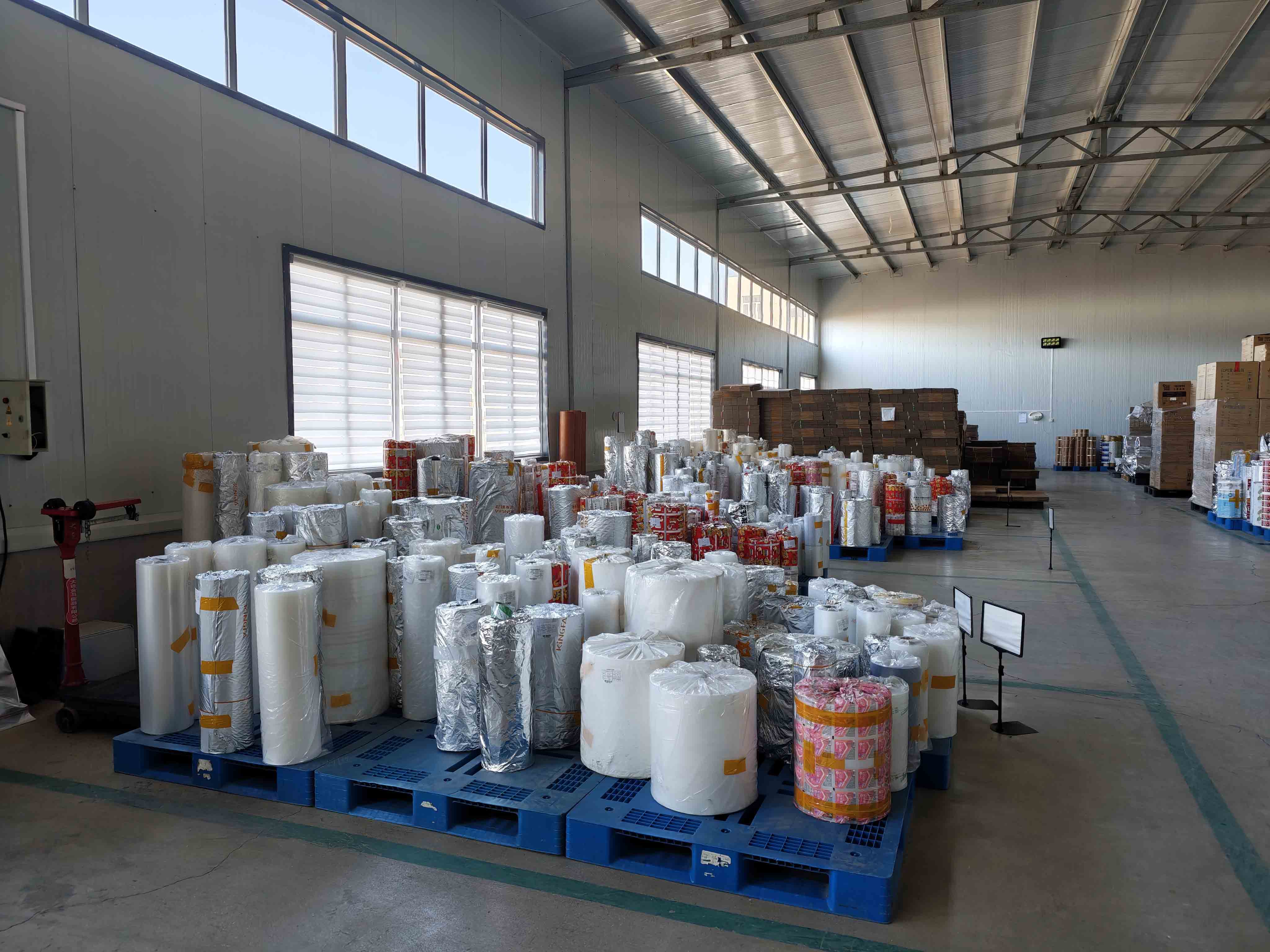
Real factory image: incoming film-roll storage. Use roll and batch identification when matching trial pouches to converter records.
Decide which change won
Approve a candidate only if it meets the prewritten criteria as a whole finished pack. The anti-fog window might score better for visibility but need another sealant or a different food-contact review. A warmer-product change might reduce one visual pattern while worsening another quality outcome. A more permeable film might alter ripening or weight loss. A thicker film might still have a channel at the top seam.
Report the trade-offs: visibility, liquid accumulation, product condition, integrity, line speed, material use, cost and claim support. If two options perform similarly, favor the one that can be controlled consistently by production and distribution. Keep retained samples and test records tied to the exact pouch construction so later artwork or film substitutions do not erase the evidence.
A Supplier and Cold-Chain Troubleshooting Checklist
Send a concise brief to the cheese plant, co-packer, converter and logistics partners. Each party has different evidence.
For a quote, describe the symptom before naming a film. Send photographs that distinguish inside from outside water, the cheese format, pack dimensions, target market, filling method, intended gas or vacuum process, refrigerated route, desired window, and whether the complaint occurs before or after retail delivery. Request two or three sample constructions for a controlled comparison. The cheese-bag team can discuss pouch materials, windows and seal samples; the brand remains responsible for validating its cheese and making food release decisions.
Frequently Asked Questions
Why does packaged cheese get condensation even when the bag is sealed?
A sealed bag can contain moisture in its headspace and cheese. If a surface cools below the headspace dew point, water can appear on the inside. A cold bag can also collect droplets outside when moved into warmer, humid air. Locate the water before investigating a material fault.
Is condensation inside a cheese bag always a sign of spoilage?
No single photo proves spoilage or safety. Condensation can follow physical temperature and moisture changes, but unexpected wetness may accompany product deterioration or package failure. The producer's quality and food-safety team should assess the lot, especially when swelling, off-appearance or a broken seal is also reported.
Is it safe to eat cheese from a foggy pack?
A consumer should follow the producer's label and food-safety guidance and avoid tasting a pack that is damaged, swollen or otherwise suspicious. A packaging article cannot assess a particular package by sight. For a commercial complaint, keep the intact pack and contact the brand through its normal channel.
Why is the outside wet after a pack leaves the refrigerator?
Warm humid room air can condense on the cold outer film. It is the same basic physical process seen on a chilled container. Record the room humidity, pack surface temperature and timing; do not mistake that outer water for moisture transmitted through an intact bag.
Can anti-fog film prevent water from forming?
It can change how condensate wets a treated surface, improving visibility in some conditions. It does not eliminate moisture from the cheese or headspace. Test the exact coated film on the intended cheese pack, including clarity, sealing, food-contact suitability and performance over time.
Will a lower WVTR always stop cheese-bag fogging?
No. WVTR characterizes water-vapor passage through a film under specific conditions. Inner fog can form from moisture already sealed with the cheese; a very low WVTR could retain that moisture. Finished-pack geometry, seams, cheese behavior and cold-chain history need separate checks.
Is a foggy window proof of a bad heat seal?
No. A bad seal is one hypothesis. Compare sealed controls and run suitable integrity tests. Fog can arise in an otherwise intact pack, while a leaking pack may not show the same fog pattern.
Does a resealable zipper replace the first heat seal?
No. The first unopened heat seal and the consumer's later press-to-close reclosure perform different jobs. Test both features in the finished cold pack. Shreds or liquid near the zipper and seal can change their real performance.
What should a cheese brand request from a pouch supplier?
Request full material and window constructions; relevant gas and water-vapor data with methods and conditions; coating side and food-contact documentation; seal trial results; dimensions; closure drawings; and lot traceability. Provide the actual cheese, pack and distribution brief so samples can be tested together.
What is the first test when only one retailer reports water droplets?
Preserve unopened complaint samples and photograph both sides. Compare same-lot retained packs and neighboring lots, then obtain storage and transport history. Avoid changing material based on one image. The quality team decides product disposition while the investigation proceeds.
Can a cheese pack be clear and still fail its shelf-life target?
Yes. Window clarity, food safety, microbial quality, sensory quality and package integrity are distinct endpoints. A successful anti-fog appearance trial is one part of a larger finished-product validation.
Should soft-ripened cheese use the same pouch as shredded mozzarella?
No universal pouch fits both. Ripening, gas exchange, free liquid, filling process and shelf-life goals differ. The producer must validate its own pack and controls before changing the barrier or introducing a window.
Do I need to measure OTR as well as WVTR?
If the cheese's atmosphere and oxygen exposure are relevant, ask for OTR and finished-pack gas or leak evidence as appropriate. OTR and WVTR answer different material questions; neither alone diagnoses condensation. Pair them with product, headspace and seal observations.
How many images should an investigation report include?
There is no universal number. For a useful complaint record, obtain enough consistent images to show whole pack, both faces, water location, seals, code and comparison samples. Add a temperature timeline and measured results; attractive images cannot substitute for evidence.