

If you are searching for where to buy chocolate bar packaging, start with the component your bar actually needs. A stock packaging distributor can supply blank bags or wraps for a trial. A wrapper converter can quote individual sheets or machine-ready film. A custom flexible-packaging manufacturer can make a printed pouch to your size and artwork. A paper printer can supply the sleeve or carton that goes around a separately protected bar. If a co-packer is wrapping the chocolate, ask it to approve the material and format before placing an order.
The right answer depends on the physical bar and the line that packs it. A two-ounce bar has no universal length, width or thickness. An embossed slab, a chunky inclusions bar and a slim molded tablet can all have the same weight and need different clearances. A beautiful sleeve does not necessarily contain the chocolate; a food-contact inner wrap may do that job while the sleeve carries the brand. A finished package may use one layer or several.
This guide walks through that bar-specific decision. It explains what to buy, how to size a sample, how foil-free constructions change the questions, and what a supplier needs before making a custom quote. It also shows where published Mylarbag chocolate pouch projects help as references—and where their dimensions cannot be copied to a new bar.
Start with the bar and the finished sales unit
Put an actual production bar on the table. Record its maximum length, width and thickness, including raised squares, inclusions and any irregular edge. Then document the bar's condition at the moment it will be packed: completely set, cooled to the packer's target, and handled with the same orientation and speed expected in production. Measure several representative pieces rather than one unusually neat sample. If a backing card or divider will travel inside the primary pack, measure the combined assembly.
Next draw the unit the shopper will buy. Will one wrapped bar be sold by itself? Does a paper sleeve slide over a sealed inner pack? Is a multipack of several bars inside one outer pouch? Will the retailer hang the bar, shelve it flat or stand it upright? These decisions affect the opening, display panel, print space and way the package is handled. They are more informative than the weight printed on the front.
Make one person responsible for each physical part. The inner material may touch fatty chocolate directly. A paper sleeve may touch only the sealed inner wrap. A shipping carton touches only the retail unit. A supplier of the outer sleeve cannot establish the contact suitability of an unquoted inner film. Equally, a film supplier does not automatically provide the decorative carton, label review or filling service.
| Record before sourcing | Why it changes the bar package | What to hand the supplier |
|---|---|---|
| Actual bar envelope | Shape and protrusions drive usable cavity and insertion clearance | Several measured bars, maximum dimensions and photos |
| Sales unit and count | One bar, two bars or an assortment may use different components | A sketch of the intended finished unit |
| Contact surfaces | Direct chocolate contact differs from a sleeve around a sealed pack | A layer diagram naming the food-contact face |
| Packing method | Hand wrapping, pouch sealing and automatic flow wrapping need different materials | Equipment details and the packer's approval owner |
| Display and coding | A hang hole, shelf orientation and date code compete for panel space | Retail/display brief and reserved code area |
An early layer sketch saves a surprisingly common rework: the artwork is designed for a dramatic outer sleeve, then the team discovers that nobody ordered a way to contain the bare bar. A simple annotated photograph of the actual bar beside the intended components is often enough to begin a productive supplier conversation.
Decide what the inner wrap, sleeve and pouch each do
An inner wrap is the material closest to the bar. It may be a formed wrapper around the product, a sealed flow-wrap film or a small flat pouch. Its contact face and closure need to suit the real food and packing process. A paper sleeve or carton is often a presentation and information layer around an already wrapped bar. A flexible pouch can itself be the primary pack if the selected construction and seal are approved for direct contact, or it can be an outer pack around bars that have individual wraps.
The same word, “wrapper,” is used for all three in catalogs. When asking where to buy empty chocolate bar wrappers, send a picture of the desired finished pack with the layers pulled apart. Say explicitly whether you need individual precut sheets, preformed pouches, printed rollstock or a paperboard sleeve. For a pouch, distinguish the finished outside dimensions from the usable opening and internal space. For rollstock, the machine determines further details.
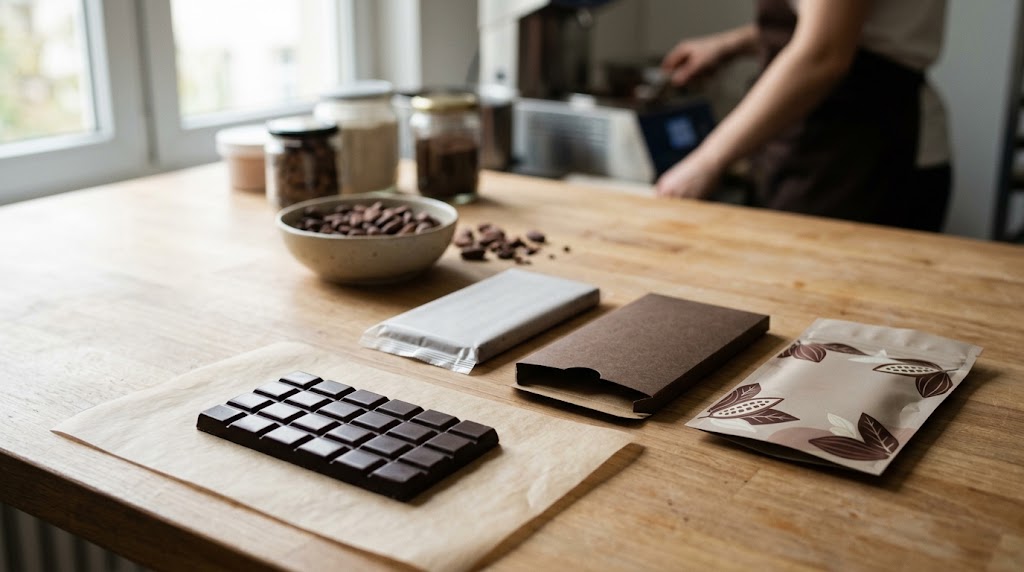
None of these layers should be given a job it cannot perform. A decorative sleeve may help display and carry approved text, but an exposed bar inside it still needs a suitable primary arrangement. A sealed pouch may be one part of a moisture and odor management plan, yet the finished chocolate still needs product-specific shelf-life and shipping assessment. A soft pack alone does not guarantee that a thin or brittle bar will survive crushing forces.
If the product is a bar with fillings, nuts or pieces that protrude, the packaging team should also examine scuffing and puncture during insertion. A film that lies well against a plain slab can catch on a sharp inclusion. That is a sample-test issue, not a reason to prescribe a universal thicker film from a distance.
Compare the practical bar formats
Start with the format that fits the filling method. A hand-packed chocolatier can trial a stock inner wrap and sleeve with limited tooling. A higher-volume line may use printed film on a horizontal flow wrapper. A pouch can suit a single bar, a sampling size or an assortment when its opening, internal fit and sealing method are validated. A zipper is often unnecessary for a bar eaten in one sitting; include it only when the product and customer use justify it.
| Format | What to specify | Useful first trial | Watch point |
|---|---|---|---|
| Precut inner sheet plus sleeve | Sheet material, contact face, folds, closure and sleeve fit | Wrap actual bars by hand and check the closed pack | Folded paper or foil-like appearance alone says nothing about contact approval |
| Horizontal flow-wrap film | Machine, film width, unwind, registration and cold- or heat-seal route | Short production trial on the intended wrapper | Attractive film may track, register or seal poorly on the line |
| Preformed flat pouch or sachet | Finished and usable size, opening, film structure and top seal | Fill and seal the bar on the intended equipment | Seal allowance and product corners reduce usable space |
| Outer printed pouch over a wrapped bar | Inner-pack envelope, desired opening and any reseal feature | Test the finished inner pack inside a sample pouch | The pouch quote does not include the inner wrap |
| Paper sleeve or folding carton | Wrapped-bar envelope, board, seam, print and code area | Physical fit proof around the approved primary pack | A loose sleeve can slide; a tight sleeve can crush or scuff |
Mylarbag's published 3 oz artisan chocolate project shows digitally printed branded packaging and lists a 13 × 21 cm size with MATT OPP/white kraft/VMPET/PE construction. The page title calls it a stand-up zipper pouch, while a key-feature field calls it a three-side-seal flat pouch. Its published photos and listed size are useful reference points, but request the current physical sample and approved drawing before treating either format label as a specification. Its 3 oz size is not a sizing answer for a 2 oz bar.

A flat sachet around a small bar segment may have a very different relationship between its outside size and the food inside. In contrast, a pouch holding a paper-wrapped full bar may be dimensioned around the bulky wrapped assembly. Choose the actual contents first, then test the format.
What size bag fits a 2 oz chocolate bar?
There is no reliable answer in ounces alone. “What size bag for 2 oz chocolate bar?” and “what size packaging for a chocolate bar?” are dimension questions disguised as weight questions. Two ounces describes mass. The flexible pack must accommodate the bar's maximum three-dimensional envelope, the way it enters the opening, the material's folds, and the space kept clear for sealing or closing.
Use a small fit trial instead of a guessed size chart. Measure several finished bars at their largest points. If the piece sits in a protective tray or on a board, measure that assembly. Ask the pouch supplier how it states width and height, whether those are outside finished dimensions, and what internal space remains after side, bottom and top seals. Put a real bar into each candidate sample in the orientation the packer will actually use. Close the sample with the intended equipment; do not judge fit from an unsealed empty bag.
For a manual pouch, the opening must let the operator place the bar without breaking corners, smearing the front window or contaminating the top-seal area. A bar that just barely fits once may be slow and wasteful across a production batch. Conversely, large unused headspace can leave the bar free to slide, change the display appearance and complicate a sleeve or carton fit. The acceptable clearance is established by the trial and the bar's tolerance, not by a fixed number copied from another product.
| Fit-trial step | Record this result | Reject or revise when |
|---|---|---|
| Measure the product | Minimum and maximum length, width, thickness and protrusions across a small production set | One sample misses a frequent raised or irregular feature |
| Insert into the sample | Orientation, opening clearance, handling time and scuffing | The operator must force the bar past the seal area |
| Close and inspect | Seal position, product-to-seal gap, wrinkle, trapped chocolate and final external size | The seal is dirty, distorted or obstructed |
| Match the outer layer | Sleeve/carton fit and the readable front/back panels | Required text, code or barcode sits under a fold or seam |
| Repeat after handling | Bar movement, corners, seal appearance and pack damage | The approved bench fit fails in normal packing or distribution |
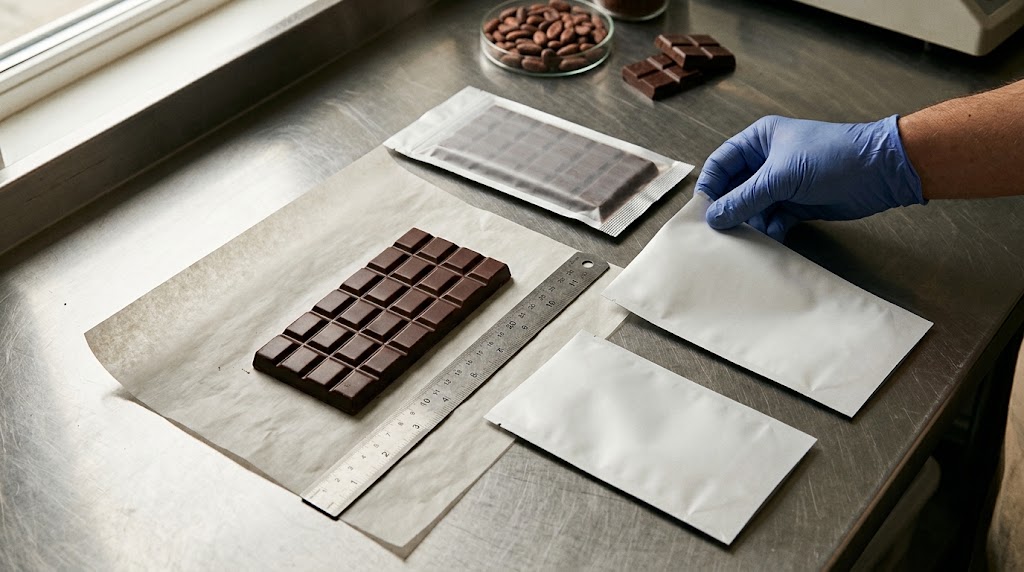
Write the result as an approved assembly, not merely “2 oz bag.” For example: product revision and measured envelope, inner wrap revision if used, finished pouch drawing revision, orientation, allowed filled appearance, sealer and approval date. Keep a retained filled sample. When the bar mold, inclusions or inner wrap changes, repeat the fit check before reordering the old bag.
How to wrap a chocolate bar without foil
Foil-free can mean several different projects. You may want a film wrapper that directly contacts the chocolate, a sealed pouch around the bar, or a paper-look outer layer over a separate food-contact pack. Removing a visible foil sheet does not automatically make uncoated paper suitable for direct contact. It also does not prove that a paper-look laminate contains no metallized barrier layer. Ask for the layer construction and identify the face that touches the product.
For U.S. food-contact review, the FDA explains that the regulatory status of components depends on their substances and intended use. Its food-type and condition-of-use tables distinguish fatty foods and different time and temperature conditions. Describe your actual chocolate recipe, contact surface, intended contact time, storage and packing conditions to the supplier, then obtain documentation applicable to that exact construction. A generic “food grade” label is not a complete technical answer.
Ask about the sealing method as well as the material. A foil-free inner wrap folded around a bar may need an outer sealed pack. A preformed pouch may close on a heat sealer, while a film running on a flow wrapper may be specified for a cold-seal or heat-seal process. There is no one foil-free film that suits every line, flavor and storage route. Evaluate aroma, grease marks, moisture exposure, appearance and shelf life with the finished product under the brand's own test plan.
Hand packing and flow wrapping need different purchase orders
“How to package a chocolate bar” is partly a process question. In a manual operation, a worker can place a bar in an approved inner pack, fold or heat-seal it as specified, apply the sleeve and check the label and lot code. A semi-automatic pouch operation adds machine settings and operator technique. A horizontal flow-wrap line feeds bars into continuous film and forms sealed individual packs. The wrapper, film and product must be trialed together.
The machinery manufacturer's information is useful here. Campbell Wrapper describes chocolate bars on horizontal flow wrappers and offers models for cold- and heat-seal films. In one documented PAC Machinery chocolate bar application, the customer chose cold-seal adhesive to avoid heated jaws near its chocolate. That is a specific line decision; it does not mean every chocolate bar requires cold seal or that a buyer can switch films without adjusting the machine.
For machine-ready film, have the packer give the converter the machine model and the exact approved film drawing. The brief should include web width, roll core and diameter limits, unwind direction, print repeat and registration mark requirements, product pitch, intended seal system, coding position and sample-roll quantity. The packer may have its own format sheet; use that rather than reconstructing settings from a product photo. If the converter proposes a material change, schedule a line trial and record the result before committing to the full printed run.
For a preformed pouch, ask a different set of questions: how the bag is presented to the filling station, whether a notch or zipper interferes with the top seal, where the bar rests after insertion, and how the final seal is checked. An empty pouch may look correct yet put printed artwork under the jaw or position an inclusion in the seal path. The packer should sign off on a filled, sealed sample of the intended construction.
Avoid promising that any flexible wrapper prevents heat damage in distribution. Film selection, shelf life and physical wrapping are one part of the project; the actual transport temperature and outer shipping protection require separate evaluation. A strong retail seal does not cool a bar in a hot truck.
Where to buy blank chocolate bar packaging
Blank chocolate bar packaging is often the fastest way to learn what size and format work. A stock distributor may offer plain sheets, bags or food-contact pouches in existing dimensions. A local supplier may be practical when a trial must happen this week, but “where to buy chocolate bar wrappers near me” should lead to checks of the exact stocked SKU, repeat availability, contact documentation and physical sample—not just a nearby address. “Who sells chocolate bar wrappers?” has several answers because a sheet, a printed roll and a sleeve are different items.
Before paying for blank stock, request its material identification, intended food-contact basis, finished dimensions, closure method and lot or SKU. Verify whether the item is a plain inner wrapper, a complete pouch, or only a decorative paper band. Order enough for a realistic packing trial; a single beautiful sample is too little to see variation, handling time and seal rejects. Ask how many can be reordered from the same specification when the product launches.
A blank package plus an applied label can be sensible while recipes or artwork are changing. Check that the label has a suitable surface and that the required information stays readable on a curved or folded pack. Include the label, labor and rejects when comparing it with a printed bag. A stock item does not become a better long-term choice merely because its first order is small.
When custom chocolate bar packaging is the better brief
Custom chocolate bar packaging is useful when the stock opening, cavity, finish or presentation compromises the actual bar, or when several stable flavors justify controlled print versions. “Custom packaging for chocolate bars” can still mean different components. State whether you want a printed food-contact pouch, printed rollstock for a named wrapper, or a non-contact sleeve. A flexible-bag maker can quote a pouch; a specialist paper printer may be required for the sleeve. Do not assume either supplier fills the package.
If you are asking where to get custom chocolate wrappers, provide a complete assembly sketch and designate the part to quote. For a printed pouch, request the material structure, finished drawing, print method, artwork quantity, sample/proof route, lead time and price at realistic volumes. For film on a line, add the wrapper's technical sheet and trial-roll plan. For paperboard, include the protected bar's external size and fold pattern. Compare suppliers against the same written scope.
The back panel needs as much attention as the front. Reserve space for the responsible brand's approved ingredient, allergen, net-quantity and other market-specific text; do not invent those details from a sample. Keep the barcode away from wrinkles and the date or lot code clear of seams. For several flavors, record a separate approved artwork filename and label version for each. The supplier prints approved content; the brand's qualified reviewer owns its accuracy for the actual recipe and market.

The package should be specified by a revision-controlled drawing rather than a marketplace title. Agree on finished dimensions, tolerance, seal regions, opening, print position, finish and packing method. Include the number of designs and the amount for each. Ask whether the supplier is making a finished pouch or printed film, and whether tooling and proof charges are one-time or repeated. A quote without that detail is hard to use when the first run needs a correction.
Published chocolate pouch examples: what they show and what they do not
Published projects are useful to see format and print possibilities. They are not performance certificates for a different bar. Three Mylarbag examples show distinct product scales and constructions:
| Published project | Site-listed details | Useful question for a new bar |
|---|---|---|
| 12 g dark chocolate single-serve sachet | 8 × 8.5 cm, MATOPP/VMPET/PE, gravure, three-side-seal description | Would the real bar segment fit the usable cavity and top seal? |
| Artisan bean-to-bar flat pouch | 12.7 × 15.3 cm, BOPP/PMP822/CPP, gravure and spot UV | Which construction, finish and test evidence apply to our recipe? |
| 3 oz artisan chocolate package | 13 × 21 cm, MATT OPP/white kraft/VMPET/PE, digital print; conflicting format labels on the page | What are the actual finished format, opening and usable dimensions? |
The 12 g project is a small single-serve sachet. Its listed size cannot be scaled up by dividing or multiplying weights; bar geometry and seal allowances do not scale that way. It demonstrates that a compact printed pouch is one possible choice for a small piece.

The bean-to-bar example illustrates a different flat-pouch construction and finish. Its project page calls the pouch recyclable, but the project name or polymer family does not by itself establish acceptance of a finished printed pouch in the buyer's local collection system. Similarly, descriptions of a barrier film do not prove that it will stop heat-related bloom or melting in another product. Request the actual material data, intended-use documentation and finished-package testing plan.

Taken together, the examples show why one search result for “chocolate bar packaging wholesale” can hide several unlike purchases. Compare a 12 g single unit, a wrapped artisan bar and a multi-flavor 3 oz pouch by actual component and use, not only by a photograph or pack weight.
Trial samples before approving a production order
Begin with three checkpoints: a material specimen to identify appearance and construction, an empty physical sample in the proposed finished size, and a filled and sealed sample made by the intended packer. Keep the written specification next to the sample. A photo can help colleagues judge design, but it cannot show whether a real bar catches at the opening or whether a seal forms across a clean area.
For a hand-wrapped bar, time several operators doing the full sequence. Notice where the chocolate is touched, whether corners crumble, how consistently the inner wrap closes, and whether the sleeve conceals important print. For a preformed pouch, repeat insertion and sealing across bars that represent the dimensional range. For rollstock, run the intended wrapper at the agreed trial settings and record feed, registration, seal and finished-pack appearance. Do not treat a bench-sealed prototype as proof that the production machine will run.
Use a simple rejection log: broken corners, rubbing, grease marks, film tears, trapped crumbs, failed seals, scannability problems and mismatched back panels. Link each defect to the material/drawing revision, bar batch, operator or machine setting and date. Ask the supplier and packer to identify whether a change belongs in the bag, the process or the bar itself. Repeat the relevant trial after a change rather than approving a corrected rendering alone.
The people signing the sample should be named. The pouch maker approves what it can manufacture against the drawing; the packer approves filling and sealing; the brand approves appearance and product claims; the responsible food and label specialists approve the intended contact and content. Keep a retained approved sample and a final artwork proof. When a new flavor has different inclusions or ingredients, its approval needs its own review even if the graphic template is shared.
| Approval gate | Physical evidence to keep | Decision owner |
|---|---|---|
| Contact and material | Structure, contact-face identification and intended-use documentation | Brand's food/quality reviewer with supplier evidence |
| Dimensional fit | Empty drawing, measured filled sample and bar envelope | Brand and packer |
| Machine or hand process | Trial record, seal checks and reject notes | Packer/line owner |
| Print and label | Final proof, SKU files, barcode and code-zone check | Brand's artwork and label approvers |
| Release and reorder | Signed sample, revision number and purchase-order scope | Purchasing and supplier |
A bar-specific RFQ you can send
A concise request for quotation might read:
We sell a molded chocolate bar as one retail unit. We need a custom printed flexible pouch for the bar shown in the attached measured photos. The bar's maximum length, width and thickness are in the attached dimension sheet; one wrapped/board-backed variation is also shown. Please quote a proposed finished pouch size with its usable internal dimensions, opening and top-seal area. State the full material structure and the intended food-contact face for our specified fatty-food contact and storage conditions. The packer uses the equipment in the attached process sheet. Quote physical samples, proof method, minimum quantity, price by artwork and quantity, setup charges, schedule and delivery to the named location. Tell us which assumptions still need a sample trial.
If you need film for a flow wrapper, replace the pouch portion with the packer's approved web and rollstock sheet. If you need only a sleeve, send the measured dimensions of the already wrapped bar and specify that the sleeve is a separate non-contact component. For blank stock, ask for the exact SKU and its supporting document instead of a custom production schedule. Each version keeps the scope legible.
For a custom pouch discussion, Mylarbag's chocolate packaging bags page is the relevant product starting point. Send the real bar dimensions and layer sketch through the contact page to request a physical sample and written quotation for the flexible component. If the solution also needs a separate carton, foil sheet or a co-packer, identify those as separate scopes with their own responsible suppliers.
Frequently asked questions
Where can I buy empty chocolate bar wrappers?
For a small trial, ask a stock packaging distributor for the exact plain sheet or pouch SKU and food-contact documentation for its intended use. For machine film, ask a wrapper converter to quote against the packer's technical sheet. For a printed sleeve, use a paperboard supplier and give it the dimensions of the already protected bar. Be clear about which component you mean before comparing prices.
What size bag should I use for a 2 oz chocolate bar?
Measure the actual maximum length, width and thickness, including any inclusions and inner wrap, and test several finished pouch samples. Ounces express weight, not a bag dimension. Confirm usable internal space, insertion clearance and the completed seal. Do not adopt a published 3 oz or 12 g project size as a universal two-ounce answer.
Can I wrap a chocolate bar without foil?
Yes, a project can use an appropriate food-contact film or pouch instead of a visible foil sheet, but the exact construction and closing process must suit the bar and its packing conditions. A paper-look outside does not establish the inner contact material. Request the layer specification and intended-use documentation, then test the finished pack and shelf life with the actual chocolate.
Who makes custom chocolate bar packaging?
Different makers produce different components: flexible-package converters make pouches or rollstock, paper printers make sleeves and cartons, and co-packers may fill and seal them. Ask what each company actually manufactures and whether its quote covers material, printing, filling and delivery. For Mylarbag, the published chocolate examples support a conversation about custom flexible pouches; they do not establish a rigid-box or copacking service.
Is a pouch or a sleeve better for a chocolate bar?
They solve different needs. A suitable sealed pouch can be a primary pack, while a sleeve usually serves as an outer presentation layer around a protected bar. A brand may use both. Choose after mapping the food-contact layer, retail display, packer process, physical fit and approved label area.
Can I order printed chocolate bags before testing the bar?
You can request a preliminary quote, but approve the production drawing only after a physical fit and packing trial. A completed artwork proof cannot establish opening clearance, seal position, handling time or bar damage. Keep the approved sample and revision with the purchase order so a reorder reproduces the intended pack.