
For chocolate boxes packaging wholesale, buy the components as a coordinated pack system: the layer touching the chocolate, any separate pouch or wrapper, the tray or paper pad that controls presentation and movement, the printed box, and the shipping case. Choose the selling format and count first. Then make a filled physical sample, identify which component contacts the food, and obtain separate quotes against one shared drawing and bill of materials. An elegant empty carton that will not fit a wrapped bar or a loaded bonbon tray is an expensive design error at wholesale quantity.
You can buy stock empty chocolate boxes from confectionery packaging wholesalers or commission custom paperboard cartons from a box converter. Printed flexible pouches are a different purchasing category. Mylarbag can provide chocolate boxes and inserts on request alongside flexible packaging, with the proposed structure, materials, component responsibilities and quote to be confirmed for the actual project. Its published chocolate photographs document flexible pouches and sachets; they are not photographs of a Mylarbag paperboard-box project. This guide explains how to compare routes and specify the full pack without treating one pictured component as proof of every other component.
Map the complete chocolate pack before asking for a quote
Start with the product: a single molded bar, several small wrapped bars, loose bonbons, a mixed gift assortment or bulk chocolate pieces. Each has a different contact surface, movement problem and opening experience. A rigid-looking outer carton can organize and display a gift set, yet it need not be the primary food-contact package. A sealed bar wrapper or pouch can protect an individual bar while the carton adds presentation and sometimes mechanical support. A bonbon tray can separate pieces without itself establishing the barrier or shelf life of the sale unit.
List the layers from the chocolate outward. Make it explicit whether the paper or tray actually touches unwrapped chocolate; “the chocolate is in a box” does not answer that question. A divider, pad and sleeve may have different materials and different suppliers. Put each named part on the bill of materials, including the glue or coating on an intended food-contact component, and distinguish supplied empty items from a filled-and-sealed finished product. The packer’s work is another line in the project, even if the finished photograph looks like a single object.
| Component | Job in the selling unit | Specify or check before wholesale order | Likely sourcing route |
|---|---|---|---|
| Direct-contact wrapper, sachet, cup or liner | Separates chocolate from other surfaces and helps maintain the chosen product condition. | Exact food-contact surface and intended use; fit; closure; supporting documentation; product-specific protection target. | Flexible-film converter, qualified cup/liner maker or another appropriate primary-pack supplier. |
| Inner tray or cavity insert | Positions individual pieces and reduces movement; may itself touch food. | Cavity count, piece size, depth, loading method, clearance and actual contact surface. | Confectionery tray specialist, carton/insert converter or Mylarbag on request. |
| Paper pad or divider | Separates layers, covers or cushions pieces, or supplies a presentation surface. | Purpose, dimensions, coating/finish, whether it directly touches chocolate and supporting contact documentation if so. | Confectionery packaging wholesaler or paper converter. |
| Printed carton, sleeve, lid and base | Carries branding, holds components and presents the assortment. | Internal dimensions with the loaded insert, board specification, opening and closure, print proof and transit fit. | Stock-box wholesaler, custom paperboard box converter or Mylarbag on request. |
| Shipping case and protective transport material | Groups sale units for handling and distribution. | Units per case, orientation, compression and route-specific handling/temperature plan. | Corrugated case supplier and fulfillment/packing team. |
This table is a specification map, not a promise that a given supplier provides all five rows. A published confectionery packaging catalog from BOXit, for example, lists boxes, interchangeable trays, pads and cups as distinct products, with some items sold separately. That is a useful reminder to quote the assembled set, rather than comparing the unit price of a bare box with a rival's box-plus-insert offer. It is a market example, not a Mylarbag customer case or a recommendation that its stock dimensions fit your product.
Choose the box structure for the chocolate you actually sell
A small folding carton or sleeve can work for a wrapped bar when the wrapped bar fits, stays oriented and can be removed without tearing its primary layer. A two-piece lid and base can provide a slower gift opening for an assortment. A tray with a sleeve can display a row of individually wrapped pieces. Some rigid gift boxes are delivered already erected; folding cartons ship flatter but must be erected consistently. Ask the carton supplier which structure is quoted, how it arrives, whether it requires separate assembly labor, and how the board and joints behave through the intended distribution route.
Do not choose solely from an attractive exterior measurement. The inside of a box must accommodate the finished wrapped product, tray walls, pads and practical loading clearance. A lid needs to close without bearing down on a protruding chocolate or scraping a printed pouch. When the box has a window, confirm its material, attachment and relevance to the actual visible layer. If the product is already sealed inside an opaque pouch, a window may show only the pouch. If loose chocolate is meant to be seen, the contact and closure plan is a separate question.
Likewise, a box-bottom pouch is a flexible bag with a broad base, sometimes called a flat-bottom bag. Its box-like silhouette does not make it a folding carton or a replacement for a cavity insert. It may be a useful sale unit for chocolate pieces, but the buyer still has to test how those pieces are packed and how that pouch travels. Use exact material and construction names in your inquiry so a “chocolate box” quotation is not answered with a bag that happens to contain the word “box.”
For a bar, the initial choice is often simple: one primary wrapper or pouch and, only when it serves a defined retail purpose, an outer sleeve or carton. For bonbons, an insert and direct-contact plan may matter more than a large exterior board weight. For a mixed gift set, start with the number and arrangement of each item, including unusually tall inclusions, and define whether each is separately wrapped. The same exterior artwork may be adaptable to several counts, but cavity geometry and packout might not be.

Why is there paper in chocolate boxes?
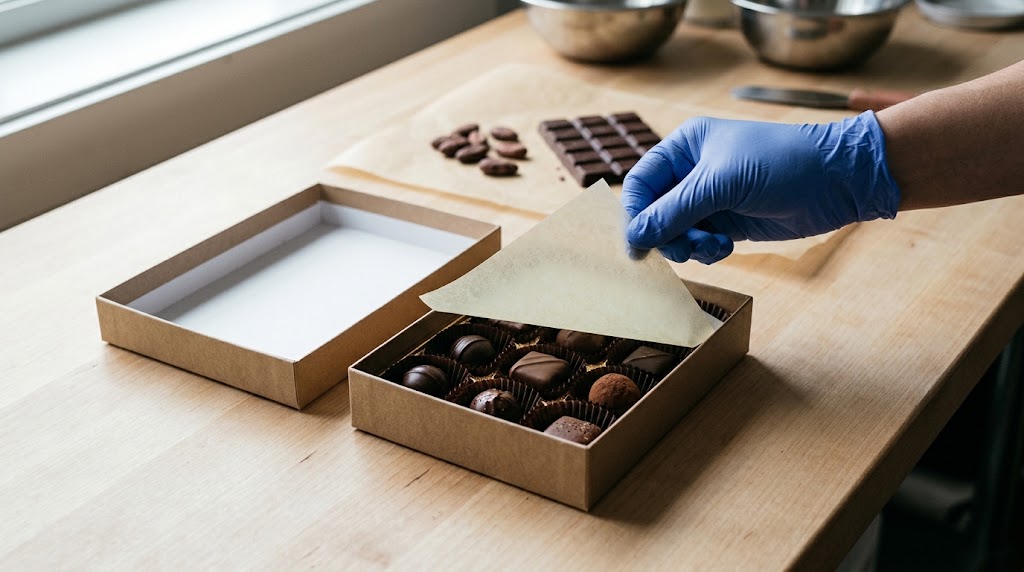
Paper inside a chocolate box can have several jobs. A paper pad may sit on top of an assortment or between stacked layers so pieces do not rub; a liner may dress the base; a divider can separate products; a wrapper or cup may surround an individual piece. The answer depends on the actual packaging structure. The BOXit catalog's candy-pad section explicitly describes pads between layers and markets its own specified three-ply glassine pads for an oil and moisture barrier. That vendor claim does not mean ordinary tissue, all printed paper or every pad has the same construction or performance.
Paper can also create a cleaner reveal when a lid lifts, but appearance and direct-food-contact suitability are separate. If a bare bonbon touches a cup, pad, printed tray or liner, ask for the exact material construction, coatings/inks where relevant, and documentation for the proposed conditions of use. If the chocolate first sits in a qualified sealed wrapper, the outside of that wrapper can contact a different set of secondary components. The FDA's food-contact component guidance explains that the status of a food-contact article depends on the substances in it and their conditions of use. A generic “food grade” sentence is not a substitute for the exact component and intended contact situation.
Keep the role of each paper part on the drawing. A protective top pad may not stay with the product after first opening; a cup remains beneath a bonbon; a decorative sleeve never touches exposed chocolate if the inner pack is intact. Those are different specifications, costs and handling steps. Before reducing materials for an environmental claim, physically test whether the remaining parts keep the pieces in place. An omitted pad that increases scuffing or breakage is not automatically a better complete-pack decision.
Measure the finished assembly from the chocolate outward
An empty-box specification often fails because its parts were measured in isolation. Record the largest credible finished piece after production variation: length, width, height and any raised decoration or inclusion. If it will be wrapped, make a real wrapped sample using the proposed material and closure, then measure that item. For an assortment, place the actual product in sample cups or cavities and check that decorations do not touch the lid. Include any pad in the stack. Only then agree the usable internal carton space and the final exterior size for a shelf or shipper.
Ask suppliers for the dimensions that matter to a loaded pack: box inside length, width and depth; usable cavity and tray heights; sheet thickness or pad stack; and the closed pouch's usable interior rather than only its flat outside dimensions. Allow clearance for normal tolerances and fast packing without giving contents so much freedom that they shift. The correct clearance is a tested outcome, not a universal millimeter rule. Check both minimum and maximum normal product sizes, including how hand-finished pieces vary. For a seasonal gift, trial the full range of flavors and shapes that will share the printed box.
An efficient sample progression is: plain structural mockup; real tray and contact materials; filled/closed sales unit; decorated printed proof; transport pack. Keep the accepted physical sample, revision-coded dielines and an itemized component list together. An approved exterior print proof does not prove the cavities work; a fitting white sample does not prove the artwork has a readable barcode or ingredient panel after folding. The packaging engineer, food producer and designer should sign off on the same revision.
| Sample record field | What the team should write down | Decision it prevents |
|---|---|---|
| Product and selling count | Actual bar or piece assortment, maximum observed piece envelope, units per sale pack. | Choosing a cavity or carton from a generic photo. |
| Contact path | Every material that may touch unwrapped chocolate, including cup, pad, tray, wrapper and adhesives/coatings where relevant. | Assuming the outer box alone settles food-contact questions. |
| Completed inner pack | Wrapped sample dimensions, seal and fold position, surface scuffing, openability. | Ordering a carton around the unwrapped product size. |
| Loaded insert and outer box | Insert orientation, top-pad placement, inner box dimensions, closing force, user removal. | Lid interference, piece movement or assembly delay. |
| Distribution unit | Units per case, orientation, weights, route, temperature plan and arrival observations. | Approving a display mockup that fails in delivery. |
For flexible primary packaging, the published Mylarbag 3 oz artisan-bar project is a reference for printed film appearance, but its page uses inconsistent pouch-format language. Do not infer a paperboard box, actual wrapped bar dimensions or the correct format for your line from the photograph. Request the current drawing and a sample bag when quoting a new application.
Where can I buy empty chocolate boxes or custom chocolate boxes?
For a first physical trial, search a confectionery packaging wholesaler for stock empty chocolate boxes in the required structure. Request samples of the matching tray, pad and cups, not only the attractive outer box. Stock parts can shorten the design loop and reveal whether your product concept works. Check what is included, the actual current availability and how parts are packed for delivery. A catalog can list compatible components while selling them separately; the vendor's current quotation controls.
For a distinctive shape, structural print, seasonal range or exact cavity fit, ask a custom paperboard carton converter or confectionery tray specialist. Supply a real product and target configuration, then request a structural sample and dieline before print approval. The converter may source inserts, or an insert vendor may supply them independently; name the component owner and the party responsible for verifying fit. A brand can also purchase a plain stock box and commission an appropriate sleeve or label, but should verify how the additional part affects opening, labeling and packed cost.
For a sealed bar wrap or printed flexible pouch, ask a flexible-packaging converter about that specific component. Mylarbag publicly presents custom chocolate packaging bags and pictured sachet/flat-pouch projects. Use the contact and quote page to ask about a pouch with product dimensions, intended contact, finish, filling/closure process and target quantity. If you also want Mylarbag to provide the paperboard box or insert, include those components in the inquiry and request a project-specific scope, material proposal, physical sample and separate line items. The public pouch photos do not demonstrate the construction of a future carton or tray. Confirm separately who fills, dates, seals and assembles the order.
The phrases where to get custom chocolate boxes and where to buy custom chocolate boxes therefore lead to several practical routes: a stock wholesaler for standard empty formats and quick prototypes; a carton/insert specialist for bespoke structures; Mylarbag for a project-specific quote on boxes, inserts and flexible packaging; and a co-packer or your own line for filled assembly. Ask each bidder to show a relevant physical sample and identify exactly which layers are included. A “box-bottom pouch” is still a flexible bag format, regardless of whether the same supplier can separately quote a paperboard carton.

Compare wholesale quotes using one component schedule
“Wholesale chocolate boxes and packaging” can mean several prices: an unprinted box shell, a printed lid-and-base pair, a box plus insert, a filled gift set, or hundreds of cartons inside a shipping case. Build one request for quotation with a line for each component and a final assembly line. Request the order quantity and repeat-order price basis, minimum order quantity by component, print setup and tooling, structural samples and color proof, unit packing, production lead time, freight basis, damage/shortage process and who pays when a part is revised. Do not compare a bare-carton price with an all-in pack price.
Print approvals should refer to the assembled pack. A carton dieline may contain folds, glue flaps and panels that become invisible. A flexible pouch may have seal areas, gussets, an opening path or registration tolerance that constrain artwork. Keep food information, allergens, barcode, date and lot locations within the finished selling configuration that the responsible team has reviewed. For U.S. products, the FDA's allergen information is one starting point; the actual ingredient formula, sale configuration and market determine the final label review. A supplier mockup cannot certify a label for all jurisdictions.
Separate unit cost from total cost at the sellable-pack level. A cheaper carton that needs a custom tray, extra hand labor and more protective shipper space might cost more when assembled. Conversely, a simple primary pouch may be sufficient for some bars without an outer carton. Calculate material, setup, assembly loss, storage and freight with your actual volumes. Ask for samples from the same proposed board, film and print specifications as the quote; a generic showroom sample can look excellent while leaving your contact or fit questions unresolved.
| Quote comparison | Supplier A entry | Supplier B entry | Evidence to attach |
|---|---|---|---|
| Components included | Box, tray, pad, cup, wrapper/pouch and case: mark each yes/no. | Same fields on the same selling-unit basis. | Numbered bill of materials and sample photos. |
| Ownership and assembly | Who makes each part, fills chocolate, seals primary pack and erects the box? | Same roles, with subcontractors disclosed where material. | Named scope and revision-controlled drawing. |
| One-time and repeat costs | Tooling, structural prototype, print proof, setup, unit prices, freight and assembly. | Same cost units and quantity breaks. | Written quote with dates and validity. |
| Acceptance and documentation | Contact-material support, physical fit, artwork/label approval, transit trial and reject process. | Same checks. | Spec sheets, accepted samples and test plan. |
The table is a template, not a statement of any company's current price, minimum order or lead time. Revisit it if the product count, insert, board finish, pouch dimensions or route changes. A change to one part can change the acceptable size and cost of every part around it.
Check product contact, claims and transit as a complete pack
For unwrapped chocolate, identify every plausible direct-contact material and obtain the applicable supplier evidence for the proposed use. The FDA notes that substance identity, specifications and conditions of use matter for food-contact materials. This is why a photo of a glossy tray, a “food-safe” badge or a general paper description is insufficient on its own. A printed outer carton might be secondary, but only after you have mapped the true contact path in a real assembled sample. Have the responsible food business review the documents for its destination markets and actual product.
Environmental terms should be similarly specific. A recyclable cardboard box does not make an attached film window, multi-layer inner pouch, coated pad or entire assembled gift pack universally recyclable. The U.S. FTC Green Guides discuss qualification of broad environmental claims. Record each separable part, its material and its available local collection route before making a consumer-facing statement. A listed mono-material formulation in a pouch case is not proof of collection access everywhere a chocolate gift is sold.
Physical protection has its own limits. Chocolate can soften under warm conditions, take on foreign odors and suffer visible condensation when moved from cold to warm surroundings. A paperboard box or glossy pouch should not be advertised as a heat shield. Plan the handling and transport temperature for the product, avoid an unqualified promise that a barrier film prevents melting, and examine real arrival units. The Callebaut confectionery storage guidance describes cool, dry, odor-free storage and avoiding condensation as relevant to chocolate quality; your exact product and journey still need their own plan.
Test the assembled pack in its likely distribution route. The tray may hold pieces neatly on a bench yet let them lift when a parcel turns over. A lid can rub decorative tops, a printed sleeve can abrade against another box, and a pouch can crumple when a heavy assortment is stacked above it. Make representative finished units, place them in the intended shipping case and record pre- and post-shipment condition. Use the relevant carrier or distribution test program where appropriate. ISTA describes package testing procedures, but a marketing photo does not show a passed test. Record the actual method and acceptance criteria rather than writing “drop tested” without a record.
Build a brief a carton and pouch supplier can both answer
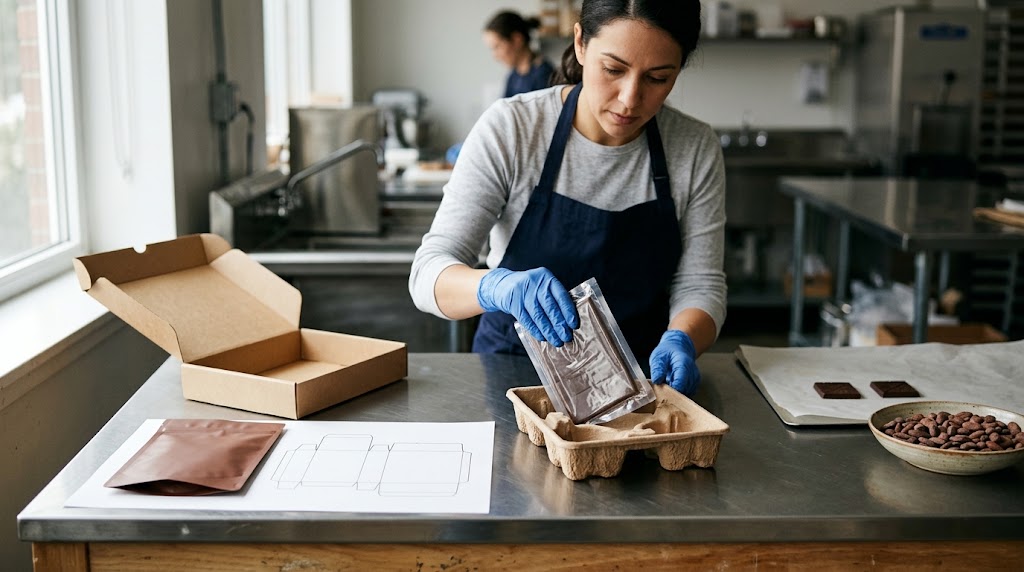
Send the same concise brief to all relevant vendors. Include product photographs and a physical sample if practical, but give measurements and variation as well. State the number of bars or bonbons; whether they are bare, in cups or individually wrapped; the exact contents and opening experience; the intended market and distribution; annual estimate and first-order quantity; target launch date; print colors/finishes; and the contact-material evidence needed for each part. Provide a simple exploded drawing that labels the food-contact layer, pouch, pad, insert, carton and case. Mark unknowns as decisions to test, not as presumed supplier responsibilities.
Request three deliverables: a structural and material proposal for each quoted component, physical samples to fill and assemble, and an itemized quote with lead time and revision terms. Ask the carton source to confirm loaded insert fit, and the pouch source to confirm usable internal dimensions, supplied condition and intended sealing process. Ask the co-packer or your production team whether the items can be filled, closed, dated, placed and inspected at the expected throughput. Reconcile their answers on the same revision before approving artwork or tooling.
This is also the moment to decide whether you need a box at all. If an individually sealed bar sells well as a pouch, adding a box should have a specific job: gift presentation, retail display, grouped count or secondary protection demonstrated by a trial. If a bonbon assortment needs organized cavities, a pouch alone may not deliver the desired display or movement control. The decision is tied to the product and channel, rather than a universal ranking of boxes and bags.
For a chocolate pouch, sachet, paperboard box or insert, share the finished product, dimensions, count, contact path and closure requirements through Mylarbag's inquiry page and specify which components you want it to provide. Request a written, itemized proposal and physical samples before approving a complete pack. If another supplier makes a component or a separate co-packer performs the filled assembly, record that scope and the accepted revision on the final bill of materials. That lets you reorder without silently swapping the layer touching chocolate or a cavity that previously fit.
Frequently asked questions
Where can I buy empty chocolate boxes?
Start with a confectionery packaging wholesaler that supplies the relevant stock format and ask for samples of the box, matching tray, pad and cups. Mylarbag can also quote boxes and inserts on request; state your intended count, structure and whether it must work with a printed pouch. Verify which pieces are included and whether your real wrapped or unwrapped chocolates fit. If no stock structure works, commission a structural sample rather than buying a large quantity from a photograph.
Where to get custom chocolate boxes, and where to buy custom chocolate boxes wholesale?
Approach a paperboard carton converter or request a project-specific box-and-insert quote from Mylarbag. Send the same product, count, contact map, loaded dimensions and artwork brief to each. Compare an itemized complete-pack quote, proof and physical sample. A “box-bottom pouch” is a flexible bag format; specify a paperboard carton separately if that is what you need.
Why is there paper in chocolate boxes?
Depending on the pack, a paper pad, cup, divider or liner can separate layers, help position pieces, reduce rubbing or create a cleaner presentation. Specify the exact role and whether that paper touches bare chocolate. An appropriate food-contact assessment and material documentation are needed for the intended use; ordinary decorative paper should not be assumed equivalent to a specified glassine confectionery pad.
Do I need both a chocolate box and a pouch?
Only when each performs a useful job for the product. A sealed primary wrapper or pouch can accompany a presentation carton for a bar or gift set; an assortment may use cups and a tray in a box. Some products can sell in one suitable pouch without a box. Prototype the finished selling unit, including opening and distribution, before committing to extra components.
What should a custom chocolate box packaging quote include?
Ask for the precise box structure and inside dimensions; board and finish; printed proof and tooling; tray/cup/pad inclusions; samples; quantity basis; assembly scope; lead time; freight basis; and the treatment of revisions and damaged units. Quote any pouch and filling service on separate named lines. Compare the total cost per accepted sellable pack rather than the price of an empty shell.
Does paperboard around chocolate replace a food-contact wrapper or prevent melting?
No such performance follows from the word “paperboard.” The needed contact layer and closure depend on whether chocolate touches the box, cup or another part, and on the product's intended conditions. A presentation carton is not an insulation plan for warm transport. Check the actual materials, storage conditions, distribution route and filled-pack test results before making those claims.