


If you need foil for chocolate, first decide whether it will touch the chocolate, sit behind a paper outer wrap, or merely give a pouch a metallic appearance. For small trials, look for confectionery foil sheets or a stock roll from a specialist packaging seller and obtain the exact product's food-contact statement. For a recurring printed bar or shaped confection, ask a foil converter for samples and a quote based on your dimensions, artwork, wrapping equipment and contact conditions. A metallic-looking flexible pouch is a different product; its visible silver layer does not make it a traditional folding foil wrapper.
Foil is used because an appropriate, intact aluminium foil layer can reduce exposure to light, gases and moisture, and because it holds a fold closely around a bar or molded shape. Paper often adds a printable outer surface and handling strength. Neither layer keeps chocolate cool in a hot delivery vehicle, and neither can be selected safely from appearance alone. The useful purchasing question is therefore “Which layer touches my chocolate, how will I wrap it, and what evidence covers that exact construction?”
What does “chocolate foil wrapper” actually mean?
A request for “chocolate foil” can return several physically different products. A thin aluminium sheet can be folded directly around a piece. A foil-and-paper combination may give the wrapper additional body. A pouch can contain a very thin deposited metal layer on plastic film while the chocolate faces a separate sealant layer. A carton can carry a decorative foil-stamped logo without containing an aluminium barrier wrapper at all. Their surfaces can all look shiny in a product photograph.
The distinction matters before pricing or artwork. A supplier quoting a heat-sealable printed roll needs different information from a seller cutting hand-wrapping sheets. A pouch vendor may be the right partner for loose pieces or for an already wrapped bar, but a pouch drawing cannot substitute for a direct-contact inner-foil specification. Ask each vendor to name the actual layer order, intended contact face and supplied format. Do not let “silver,” “metallized,” “foil look” or “premium” stand in for the answer.
| Term used in a search or quote | What you may actually receive | First question to ask |
|---|---|---|
| Unsupported aluminium confectionery foil | A thin metal sheet or reel designed for folding around confectionery | Which face may contact this chocolate, and is it plain, coated or printed? |
| Foil/paper wrapper | A combined aluminium and paper construction, sometimes bonded with wax or adhesive | Is the paper permanently laminated, or is it a separate outer sleeve? Which face touches food? |
| Metallized flexible film | Plastic film carrying a deposited metal layer within a laminate or pouch | What is the complete structure and the actual food-contact surface? |
| Foil stamping on paper or pouch | A decorative metallic graphic on an outer surface | What is the underlying food package? This finish alone does not specify it. |
The European Aluminium Foil Association's confectionery overview describes aluminium foil's “deadfold” behavior and foil/paper laminates in confectionery. Symetal's chocolate foil product page separately lists unsupported foil and aluminium/paper laminates, with different thickness ranges and paper weights for its own products. Those specifications demonstrate that real options exist; they are not universal dimensions for every bar, machine or supplier.

Why is chocolate wrapped in foil and sometimes paper?
An intact foil layer is a useful shield against light, moisture and gases. Chocolate can pick up odors from its surroundings, and a properly chosen wrapper can form part of a plan to protect quality through storage and retail. But the performance of the finished pack depends on more than the intrinsic properties of flat foil: pinholes, cuts, weak folds, seams, coatings, handling and any opening all affect the system. A folded sheet is not automatically a hermetically sealed package. Ask what the actual finished unit needs to withstand rather than assuming that a reflective surface proves a shelf life.
Folding behavior is a separate reason. Aluminium foil keeps a crease after it is pressed around an edge, which helps when wrapping irregular seasonal figures, coins or a rectangular bar. A plain foil sheet may be enough for a hand-wrapped sample. On a faster line, the foil's gauge, surface treatment, slip and reel behavior have to suit the machine. ProAmpac's confectionery foil page illustrates the range of converter options, including unsupported foil, foil laminations, embossing, print and heat-seal lacquering. Those are possibilities to specify and test, not features every stock sheet possesses.
Paper can play at least two different roles. It can be bonded to foil in a single combination wrapper, contributing handling strength or a different printable surface. Or it can be a distinct outer band, label or sleeve over the inner foil. The latter can carry the brand, chocolate type and variant while the inner layer follows the bar. A third configuration may use a printed carton around an inner wrap. Ask for a sample of the actual stack and its opening order; “foil and paper” is too vague to identify which component contacts food or remains with a partly eaten bar.
The outer paper layer is also a practical design choice. It provides room for color and readable information that might be harder to keep aligned on highly reflective crumpled foil. It can make bar handling cleaner, but paper is not automatically a moisture barrier. Equally, a lovely outer sleeve cannot repair a torn inner wrap. Review the selling unit as a whole: protection, handling, legibility, opening and storage after opening are related, yet each needs its own check.
There is one important limit: foil is packaging, not refrigeration. Callebaut's chocolate storage guidance emphasizes appropriate temperature and avoiding fluctuations. A foil-wrapped bar can still soften or bloom under poor temperature control. If shipping heat is the central problem, make a separate distribution plan for the season, transit time, insulation and arrival review; selecting shinier foil is not a heat-management test.
Tell direct-contact foil from a metallic-looking pouch
Hold two finished samples side by side. A hand-folded aluminium sheet behaves differently from a heat-sealed laminated pouch. The pouch might use a PET film with a vacuum-deposited metallic layer, often called VMPET, as one layer of a larger structure. Cosmo Films describes metallized BOPET as plastic film with a thin deposited metal layer. The chocolate faces the food-contact surface identified in the actual pouch specification, which need not be the decorative exterior or the deposited metal. You cannot establish that layer sequence by shining a light on the outside.
This distinction helps prevent an awkward order. A bar maker asks for “custom foil wrappers” and receives a quote for a printed metallized pouch; the next week, the wrapping line expects narrow foil reels that make a tight fold. Conversely, a maker packing loose bite-size pieces asks for sheets when the intended operation needs a sealed pouch. Put a photograph of the intended finished unit, a physical sample if possible, and the exact operation into the first inquiry. Ask for both the format and material construction in the vendor's reply.
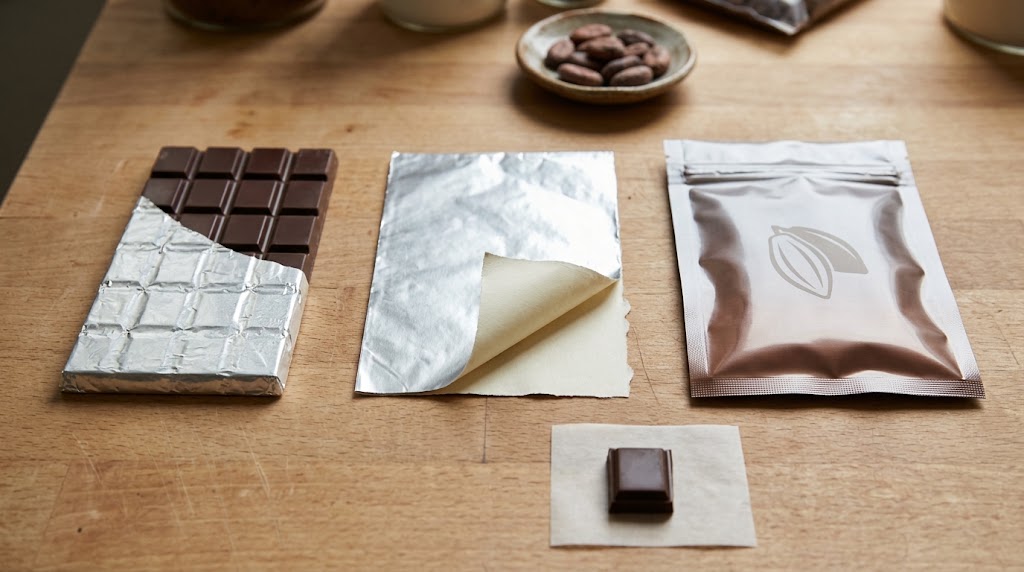
An exterior metallic effect can be made in other ways. Foil stamping transfers a decorative mark to an outer surface. It is relevant to a logo or small highlight, but it does not turn the entire carton or pouch into a direct-contact foil wrap. A paper sleeve printed with metallic ink is another graphic treatment. For a buyer, the practical question is whether the metallic feature is structural, part of the print finish, or simply a color name in the product listing.
Use the vendor's written structure, not a marketing noun, to compare quotes. For a foil/paper item, request the foil gauge or thickness, paper basis weight, bonding method and contact orientation. For a pouch, request the full layer order, sealant side, finished format and suitability evidence for the intended chocolate and use. Avoid assuming either option is more recyclable or gives a longer shelf life in every market; those questions depend on the complete material and local collection, and are outside the scope of this purchasing guide.
Where to buy foil for chocolate: match the source to the job
The shortest path depends on whether you need a handful of hand-wrapping sheets or a printed reel for a machine. Supplier websites are useful for identifying product categories, not for assuming that every color, size and delivery location is in stock. The examples below come from the suppliers' own pages and are starting points for a quote, sample request or current availability check; they are not a ranking, endorsement or a verified price comparison.
| Buying route | A documented example | Best starting request | Check before ordering |
|---|---|---|---|
| Stock or cut sheets for hand trials | Alufoil Products Co. confectionery sheets and rolls | Actual piece dimensions, desired color, sheet quantity and direct-contact side | The exact item's food-contact statement, dimensions, backing and current stock |
| Custom slit or paper-backed supply | Alufoil Products Co. confectionery range | Target cut sheet or reel width, paper backing, quantity and wrapping method | Backing/adhesive specification, reel core, winding and sample |
| Industrial unsupported or foil/paper reel | Symetal chocolate aluminium foil | Machine and wrapper drawing, material proposal, print and estimated annual volume | Feasibility, actual gauge, contact face, coatings and delivery market |
| Converter print or heat-sealable foil | ProAmpac confectionery aluminium foil | Artwork, registration, seal/fold method, line speed and reel specification | Proof, sample run, coating and sealing compatibility |
| Custom flexible pouch, if a pouch is the intended finished pack | Mylarbag chocolate packaging bags | Chocolate type, portion/bar dimensions, pouch format, contact and distribution needs | Current drawing, complete structure and physical sample; this is not evidence of traditional inner-foil supply |
For “where to buy chocolate foil wrappers near me,” look first for a confectionery packaging distributor or specialist store that can identify the manufacturer and precise item. Call before traveling: ask about pickup, sheet size, plain versus paper-backed stock, colors, current quantities and a product-specific food-contact statement. A local craft or gift foil may be sold for decoration rather than direct food contact. If the store cannot tell you what contacts the chocolate, use it only as an external display prototype until you obtain suitable material evidence.
Online sellers can help when a test batch needs a modest quantity quickly. A catalog image is a starting point, but open the item details: is it loose foil, wax-mounted, paper-backed or a metallized paper? Is the quoted dimension before or after cutting? Is the pack sold as individual sheets, a roll or both? Is there a minimum that changes by color? Recheck all current specifications at checkout and request a small physical sample when the product will be repeated.
For production, send the brief to a supplier who actually converts confectionery foil. In addition to cost, ask about sample lead time, repeatability, registration for printed art, reel length and winding direction, tooling or setup, quantity by variant, and the response if your line rejects a sample. These are questions, not implied promises from any named supplier. A quote should identify the item sufficiently that a second sample and eventual production order can be compared with the same assumptions.
Order a true-size sample before buying a full run
The size of a foil sheet is not simply the face size of a bar. The wrapper needs to turn around thickness, overlap at the back or edge, and accommodate the particular fold used by the person or machine. A molded coin, an uneven bar and a flat tablet will use different fold patterns. There is no safe universal “add one inch” rule. Start with the actual chocolate or a dimensionally faithful food-safe dummy, test an oversized blank and reduce it systematically while preserving a reliable closure.
For hand wrapping, cut several tentative rectangles from plain sample material. Mark the contact face and the orientation so everyone repeats the same method. Wrap multiple pieces, not just the easiest one. Look for uncovered corners, tearing over sharp inclusions, excess bunching on the back and a fold that pops open during ordinary handling. If an outer paper sleeve is planned, add it to the trial: the combined thickness may alter fit or the printed face visible after assembly.
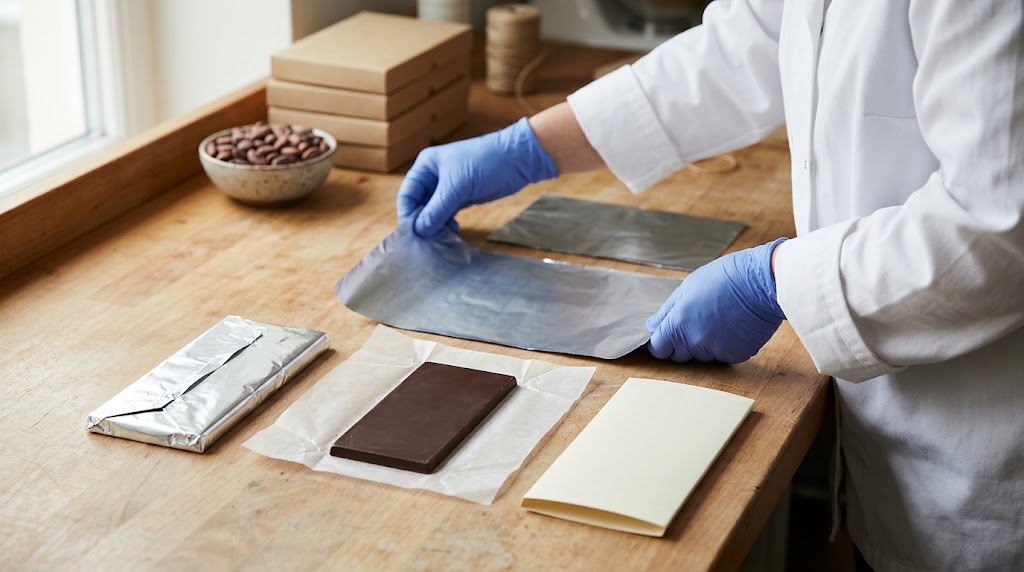
For a machine-fed roll, a visually pleasing hand fold says little about line performance. Share the equipment model or operating constraints with the converter and agree on a sample that can actually be run. Confirm reel width, core, winding direction, print registration, coating side, web handling, and how the machine makes the final fold or seal. Record rejects and why they occurred rather than declaring a material “good” after a few photogenic packs. A printed proof should be evaluated separately for artwork and the finished wrapped unit.
Keep a sample log with the exact supplier item, date, material version, paper or coating version, sheet/reel dimensions, chocolate size and observed result. If the chocolate changes shape or inclusions, repeat the wrap test. If the outer sleeve changes, inspect the full product again. This is much faster than diagnosing a poorly folding run from a product photograph after a production order has arrived.
| Trial question | Check on the actual unit | Useful record |
|---|---|---|
| Contact face | Which side is against the chocolate throughout the fold? | Supplier specification matched to sample label |
| Coverage | Are corners and back protected by the intended overlap? | Photos of front, back and opened wrapper |
| Handling | Does the wrapper tear, shift, catch or stain in routine packing? | Number and type of observed defects |
| Paper layer | Does a sleeve fit and stay oriented without crushing the piece? | Sample assembly and artwork revision |
| Production method | Can the hand or machine repeat the same wrap? | Line or workbench conditions and approved version |
Ask for evidence about the exact food-contact construction
“Food grade” is too imprecise as a purchasing specification. An unprinted bare foil, a coated foil, a printed foil and a foil/paper laminate can have different substances and different contact faces. In the United States, the FDA explains that the regulatory status of components of a food-contact material must be evaluated for their intended use. Its food types and conditions of use resource helps frame the question. Do not treat a generic company certificate or the word “FDA” in a storefront description as approval of every coating, ink, adhesive and use condition.
Ask the vendor to identify the exact commercial product and version, each component that matters to the contact surface, the intended food-contact side, the food type and the temperature/duration conditions covered by its statement. If an ink or lacquer is on the food-facing side, ask specifically how that configuration is supported. For laminated paper, ask whether an adhesive or wax is part of the supplied construction and which layer faces chocolate. The buyer's own quality or regulatory reviewer should judge whether the documentation matches the product and destination market.
One supplier may publish a statement covering a defined range. For instance, Alufoil Products Co. describes certain specified confectionery foil gauges as suitable for direct food contact and links a compliance statement. That statement belongs to the named vendor's stated items and conditions. It does not transfer to a visually similar sheet from another retailer, to custom printing that changes the construction, or to every proposed chocolate use. Request the current statement for the actual quote and save it with the approved sample.
Documentation and physical review solve different problems. A statement does not show that a sheet folds cleanly over a sharp-edged inclusion. A good wrap photograph does not establish the regulatory status of a print layer. Use both. When the project includes a paper sleeve, label, carton or flexible outer pouch, identify which component touches the food and which merely protects or communicates; obtain appropriate evidence for every material that serves as the primary pack.
How a foil inner wrap relates to a custom chocolate pouch
A foil-wrapped bar can be placed in an outer pouch, but that is a two-component system: the foil and the pouch need their own specifications. A producer may instead pack an unwrapped item directly in a suitably specified pouch. Some printed pouches include metallized film; that does not mean a folded aluminium foil inner sheet is present. Begin with the intended finished unit and ask who is responsible for each component. Avoid asking a pouch maker for “foil wrappers” if you really need the cut sheet that contacts each bar.
Mylarbag's published 3 oz artisan chocolate project lists a MATT OPP/white kraft/VMPET/PE construction and digital printing. The listed VMPET is a metallized film layer within a flexible package; the page does not establish that this project included a separate aluminium-foil sheet around each bar. Its title and format field also disagree on whether the pouch is stand-up or three-side-seal flat, so a current drawing is needed before treating its shape as a template. The photo demonstrates a published chocolate-pouch appearance, not an inner-foil capability.

The bean-to-bar flat-pouch case gives a different construction: BOPP/PMP822/CPP, with gravure and Spot UV listed on the product page. Its flat-pouch photo is useful evidence of printed outer chocolate packaging, but not of foil-sheet manufacture. The product URL's “100 recyclable” wording is the title of a public record; it is not a substantiated recycling conclusion for every market, nor a material specification for a different order.

The published 12 g single-serve dark chocolate sachet lists a MATOPP/VMPET/PE structure and a small three-side-seal format. This is another example of the word “metallized” belonging to a pouch laminate rather than to the confectionery foil sheet wrapped around an individual molded shape. The supplier page cannot prove a universal shelf life, melt resistance or suitability for a new formula; make those decisions with a defined sample and validation plan.

If an inner foil is already specified, tell a pouch vendor the wrapped bar's finished dimensions rather than only the bare chocolate dimensions. Include the protruding back fold, any paper sleeve and how the unit will be inserted and removed. If the pouch directly contacts chocolate, identify that use instead and ask for the complete structure and documentation. A useful quote should describe the pack the customer will actually receive, not a generic “foil bag” inferred from a silver sample.
Send a brief that lets suppliers quote the same thing
Before comparing prices, write a one-page request with the chocolate's shape, dimensions, mass and any inclusions or fragile protrusions. Describe whether the wrapper touches bare chocolate, whether a separate paper layer is needed, and whether the final unit is a hand-folded piece, a machine-wrapped bar or a sealed pouch. Include the approximate yearly and first-run quantities per variant, desired plain or printed appearance, destination market, expected storage and distribution conditions, and the date a tested sample is needed. These inputs give suppliers a basis for saying what they can actually supply.
Attach three views: the bare piece or true-size dummy, the desired folded unit, and the intended outer pack. Ask a direct-foil supplier for a named structure, contact face, food-contact documentation, sheet or reel drawing, coating/print options, sample availability, lead time and quote assumptions. Ask a pouch supplier for a separate quote only if a pouch belongs in the system. If the component is outside a vendor's range, keep the foil and pouch suppliers as separate workstreams with one shared finished-unit specification.
Evaluate the physical samples and paperwork against the same checklist. A low unit price can conceal an incompatible reel, too-large sheet, unquoted print setup or missing document; an expensive sample does not establish fit either. Compare like with like: material and contact side, finished dimensions, backing, print, supplied quantity, waste expectations, delivery and terms. Never publish a universal minimum order, price or production timeline based on one vendor's temporary catalog listing.
| Decision | If the answer is yes | Supplier to approach first |
|---|---|---|
| Will a sheet be folded directly around the chocolate? | Identify the food-contact face and tested fold. | Confectionery foil sheet seller or foil converter. |
| Is an attached paper/foil construction needed? | Define bond, contact face and wrapping method. | Foil/paper converter. |
| Does a machine require printed or sealable reel stock? | Provide equipment and reel specification. | Industrial confectionery foil converter. |
| Is the unit a heat-sealed flexible pouch? | Define actual product contact and pouch format. | Flexible packaging supplier. |
| Is the metallic detail only an outer graphic? | Define the underlying primary pack separately. | Printer or outer-pack supplier, with primary-pack vendor. |
For the flexible-pouch portion of a project, explore Mylarbag's custom chocolate packaging bags and contact the team with the wrapped or unwrapped item, target pouch dimensions, quantity, artwork and market. Request a current structure, drawing and physical sample. For a direct-contact folding foil or foil/paper inner wrap, seek a specialist able to quote that exact component and provide its own documentation. Bring both samples together before approving the final pack.
Frequently asked questions
Where can I buy foil for chocolate in small quantities?
Check specialist confectionery packaging suppliers for stock rolls or cut sheets and confirm the precise item is intended for your chocolate's food-contact use. Alufoil Products Co. is one documented example with sheets, rolls and backing options. Request a sample and its current specification; a colored craft foil or metallic gift wrap is not a substitute merely because the photograph looks similar.
Where can I buy chocolate foil wrappers near me?
Ask a local confectionery packaging distributor or specialty store whether it has confectionery foil sheets available for pickup. Confirm exact size, color, backing, contact face and current stock by phone, then ask for the manufacturer's documentation. If a local source offers only decorative foil, use it for an external visual mock-up and source appropriate direct-contact material separately.
Why is chocolate wrapped in foil and paper?
Foil can supply a foldable protective layer, while paper may add strength, a printable exterior or an independent sleeve for brand and product information. The two materials might be bonded together or supplied as separate wraps. Confirm which face actually touches the chocolate and test the complete folded unit. The combination does not keep chocolate from melting in heat.
What kind of foil is used for chocolate bars?
Confectionery suppliers offer unsupported aluminium foil and foil/paper constructions in different gauges, surfaces, coatings and delivery formats. The right specification depends on the piece shape, contact conditions and whether it is hand or machine wrapped. Symetal's product range is an example of both categories, not a universal thickness prescription.
Are metallized chocolate pouches the same as aluminium foil wrappers?
No. A metallized pouch is a multilayer flexible package with a thin deposited metallic layer; a confectionery foil wrapper is a separate aluminium sheet or foil/paper construction intended to fold around a piece. Either may have a role in a complete chocolate pack, but their contact face, making process and format differ. Request the full written structure for a pouch and the exact foil specification for an inner wrap.
Can I order custom printed foil wrappers for chocolate?
Yes, some confectionery foil converters offer printing, embossing or lacquering. Ask for the artwork and registration requirements, minimum practical run, sample process, reel or sheet format, and documentation for the printed construction and intended contact conditions. Do not assume a plain foil's statement automatically covers a changed ink or coating arrangement.
Does foil stop chocolate from melting or guarantee a shelf life?
No. Foil contributes to a package's protection when correctly specified and kept intact, but it does not control ambient temperature. Finished-pack performance depends on the wrap, closures, other components, storage, handling and the actual chocolate. Use product-specific quality and distribution trials for any shelf-life or warm-weather claim.