

Chocolate packaging can be a single suitable wrap or a system of several parts. A commercial chocolate bar might have a food-contact inner wrap, a printed paper sleeve and a carton for display. Another product might use one printed flexible pouch whose laminate combines an exterior print surface, a barrier component and an interior sealable food-contact surface. Those parts do different jobs. The precise answer to “what is chocolate packaging made of?” depends on what touches the chocolate, the product's storage conditions, the intended retail format and how the package will be filled and closed.
For a buyer, the useful question is not whether “paper,” “plastic,” “foil” or “Mylar” sounds best. Ask for the complete material structure of each component, identify the food-contact face, and decide what the package must actually do for your chocolate. A metallic appearance does not prove a particular oxygen or moisture transmission rate. A kraft appearance does not mean a pouch consists only of paper. A layer list cannot establish a shelf life, food-contact authorization for every intended use, or local recycling acceptance.
This guide is written for chocolate makers and packaging buyers choosing primary retail materials for solid bars, pieces and similar confectionery. Filled chocolates can require additional product-specific evaluation. The emphasis here is material identification and its evidence. Bar dimensions, sealing parameters, printing production, shipping temperature control and disposal claims deserve their own specifications.
First separate the parts of the finished package
Start with a physical sample of the sales unit and take it apart on a clean workbench. Record the surface that touches the chocolate first. Then record any sleeve, film, pouch, board, tray or outer carton in the order a customer would remove them. A decorative outer package can look like the “wrapper” in a photograph even though a separate inner layer is the true primary package.
A molded bar can sit in an inner film wrap with a paperboard sleeve that supplies brand space and some handling stiffness. A small chocolate portion can instead be enclosed in a printed three-side-seal sachet. A box of delicate pieces may need individual cups, a fitted insert and a lidded carton. A gift assortment can add a corrugated shipping carton later. The presence of one component does not make the other roles disappear.
| Component or role | What the buyer should identify | What its appearance alone cannot prove |
|---|---|---|
| Direct-contact surface | Exact material and side facing the chocolate, including coatings or sealant | Suitability for the actual food and use conditions |
| Printed exterior | Film, paper, ink position, finish and legible information area | Protection performance of the complete closed pack |
| Barrier component | Proposed layer or coating and the relevant oxygen, water-vapor, light or aroma question | A guaranteed shelf life or complete absence of transfer |
| Closure | Heat-seal surface, seal design or a separate folded/adhesive closure | Integrity of a finished filled unit without testing |
| Sleeve, insert or carton | Its handling, shape, presentation or grouping role | The food-contact or barrier status of the inner wrap |
“Primary” and “secondary” are useful distinctions only when the actual contact path is clear. If the bar is already fully wrapped, an outer pouch may not touch food during normal use. If chocolate is put directly into the pouch, its inner surface has a different responsibility. If a customer removes a sleeve and finds unwrapped chocolate inside, the sleeve or liner may be the contact article. Write down the real sequence instead of assuming that a marketing photograph tells you.
One flexible pouch may combine several roles through lamination or coating. This is why a materials conversation should begin with the complete structure and finished use, not a single adjective. The printed surface can be matte while the actual product-facing face is a different polymer; the paper layer can be buried between films; the metal-looking layer can be a thin deposited coating on plastic.
Identify the food-contact face before choosing a look
The face touching chocolate needs assessment for the intended food and conditions, not just a generic “food grade” sentence on a brochure. Ask the supplier to identify that face, the complete construction, relevant adhesives or coatings, and the basis for any food-contact statement in the destination market. Record whether the item is a direct-contact wrap, a pouch containing a separately wrapped bar, or a non-contact sleeve. Those are different use cases even if the package photographs look similar.
The FDA's guidance on food-contact material components explains that the status of an article depends on its constituent substances and applicable intended uses. Its food types and conditions-of-use tables distinguish foods with surface fat or oil from other dry solids and distinguish room-temperature, refrigerated and other conditions. Those categories are a reason to describe the actual chocolate and storage process when requesting documentation. They do not mean that every chocolate automatically falls into a single regulatory category or that a US answer covers other markets.
Chocolate recipes differ. An unfilled dark bar, a nut-studded bar, an oily inclusion and a filled praline present different surfaces and potential contact situations. Time and temperature matter as well: room-temperature retail storage is not interchangeable with hot filling, freezing or reheating. Send the supplier the product description and intended conditions rather than asking for an undifferentiated “FDA certificate.” A regulator, qualified packaging specialist or the brand's compliance team should evaluate the specific market and evidence when claims matter.
The published 12 g dark chocolate sachet project lists MATOPP/VMPET/PE and an 8 × 8.5 cm printed format. That is a real structure and visual reference, but its product page is not the food-contact file for another chocolate. In a new direct-contact order, ask which side faces the chocolate, whether the proposed PE grade and entire construction have appropriate support for the actual use, and which production revision the documents describe.

If a package supplier offers a stock pouch, ask for the same construction and intended-use information as for a custom print. A plain outer pouch can be an appropriate secondary part, but “unprinted” does not itself make a material suitable for direct chocolate contact. Conversely, a layer that never touches food is not automatically irrelevant: components reasonably expected to migrate under intended use may still matter in the regulatory assessment. Keep the real article construction and contact route together in the approval record.
Understand the print surface and what it can do
An outer film or paper surface carries branding, product information and visual finish. Common oriented plastic films used in flexible packaging include BOPP or OPP, meaning oriented polypropylene, and PET or BOPET, meaning polyester film. Their available grades differ. They can supply a printable surface, clarity, stiffness or a matte presentation, depending on how they are specified and combined. They are not automatically the food-contact face simply because they are the first abbreviation in a listed structure.
Printing may be on a surface or arranged so inks are protected within a laminate. The buyer should ask where the print and coating sit relative to the chocolate and to the seals. A reverse-printed pouch can show deep color through an outer film; a surface-printed or overcoated paper-look structure may feel different in hand. Neither choice is a substitute for confirming print adhesion, legibility, abrasion and the appropriate migration review for the finished construction. A printed organic badge, origin claim or ingredients panel also needs the brand's own substantiation and artwork approval.
Finish words are particularly easy to overread. Matte, glossy, soft-touch, metallic and kraft describe a visual or tactile direction. They do not identify the package's entire barrier structure or its food-contact authorization. Ask to see the actual production-like print sample under retail light, not only a screen render. Check whether the nutrition panel, lot code area, small text and barcode remain legible after filling and handling.
A single design can also contain areas with different visual treatment: a transparent window, a paper-colored panel or a localized gloss effect. Every added feature changes something practical about artwork, material, print registration, the view of the contents or the needed barrier review. For a chocolate bar with a high-value decorated face, a window may help display the product; for a product where light exposure is a concern, that same opening should be considered against the product's tested requirements. The material proposal should show the final artwork and window location.
Ask what the barrier is meant to address
A barrier layer is chosen to help limit specified transfers under stated conditions. For chocolate, buyers commonly discuss moisture, oxygen, light and unwanted odor or aroma transfer. The right priority depends on the recipe, inner wrap, expected storage and product-quality study. A thick-looking film is not necessarily the strongest barrier for every gas or vapor. A shiny package is not automatically an aluminum-foil laminate.
Metallized plastic is one possible barrier component. Cosmo Films describes a metallized BOPET product as polyester film with a thin deposited metal layer and a functional coating. This supports the basic distinction between metallized film and a separate solid metal foil. The manufacturer describes its own film's properties; it does not establish the performance of an unrelated finished chocolate pouch. In a laminate, the other films, adhesives, seals, folds, windows and handling damage also belong in the evaluation.
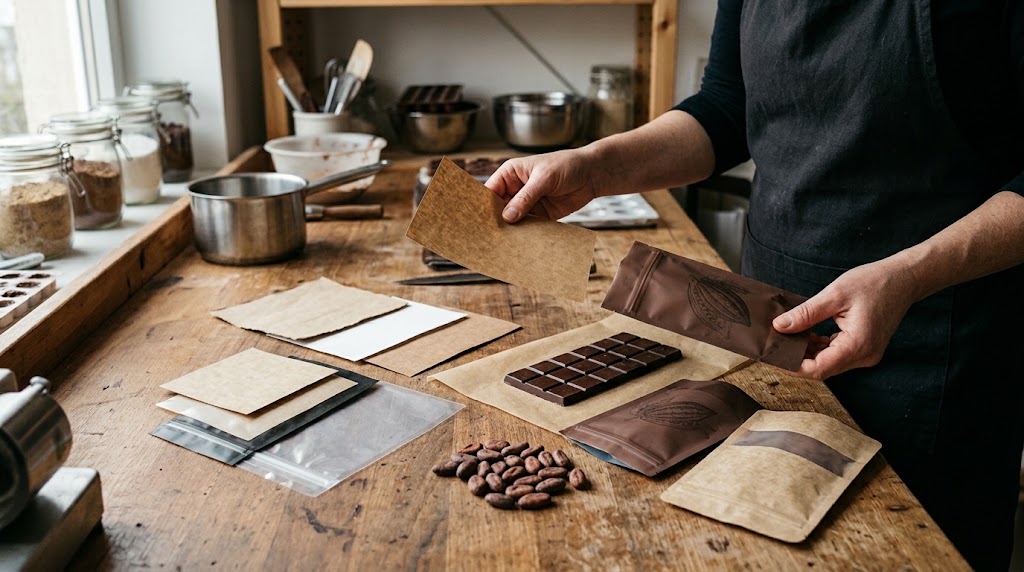
If a proposed film is described as “high barrier,” ask high barrier to what, measured how and on which material. ASTM D3985 addresses oxygen gas transmission through plastic film and sheeting. ASTM F1249 addresses water-vapor transmission through plastic film and sheeting. A supplier can state OTR and WVTR for a specified film or laminate, with units, method, temperature, humidity and sample description. Compare reports on the same basis. A bare number without those conditions is difficult to use.
A flat-film result is not identical to a completed pouch's performance. Creasing, edge seals, zipper construction, pinholes, windows and the actual closure may affect the finished unit. Ask for the evidence relevant to the finished package and your quality goal. A chocolate maker still has to validate the product in its chosen pack over its intended storage period. The package's barrier designation by itself is not a shelf-life study.
Barrier to moisture also does not mean insulation from heat. If a bar sits in a hot vehicle, a metallized layer or a foil-like appearance does not keep it below its softening conditions. Shipping protection requires a separately designed and tested thermal assembly. Treat that as a distribution question rather than a promised property of the retail pouch.
Paper packaging for chocolate: distinguish sleeve, wrap and laminate
Paper can be a separate decorative sleeve around a sealed inner wrap, the basis of a specifically engineered primary wrap, or a component inside a multilayer pouch. These are materially different packages. A sleeve may provide print area, rigidity and a warm tactile look while another component supplies contact and barrier functions. A paper-based primary wrap needs its own demonstrated contact, grease, moisture, sealing and packing suitability. A kraft-look pouch can include plastic film and a metallized component beneath or around its paper.
The published 3 oz artisan chocolate packaging project lists MATT OPP/white kraft/VMPET/PE. Its visible printed packaging is a good example of how “paper packaging for chocolate” can actually mean a four-component laminate rather than paper alone. The source title calls the project a stand-up zipper pouch, while its feature field describes three-side-seal flat pouches. Do not select a format from either phrase alone; request the current construction drawing and physical sample for your own order.

Some purpose-built paper-based materials can serve as primary chocolate packaging. For example, Amcor describes a specific paper-based chocolate wrap developed with Alter Eco to replace a prior sleeve-plus-inner-foil arrangement for selected 200 g products, with a barrier specification and a defined French market context. That does not establish that an ordinary uncoated kraft sheet will perform like that engineered product. It also does not turn every paper-looking pouch into a paper recycling item.
Ask a paper proposal to identify the actual fiber, coating, dispersion, plastic film, adhesive and sealant components where relevant. Ask which side faces the chocolate, how grease resistance is achieved, whether the format folds or seals as the packing operation requires, and what happens to the graphic finish during handling. If the outer sleeve is only secondary, say so explicitly so the supplier is not asked to solve a primary-pack problem with a decorative board.
Plastic packaging for chocolate: read the whole structure
Plastic packaging for chocolate includes clear wraps, oriented print films, sealant webs, coated films and multilayer laminates. There is no single “chocolate plastic.” The exact grade, thickness, coating and side orientation matter. In a common flexible-pouch discussion, a printed outer web and a heat-sealable inner web may be combined with a barrier component, but the order and job of each component must come from the supplier's drawing and specification.
PE is polyethylene; it can be selected as an inner sealant in a particular laminate. CPP is cast polypropylene, with grades made for sealing and conversion. Cosmo Films lists a heat-sealable CPP film and its intended properties, illustrating that even within one polymer family a grade and treated side matter. BOPP and CPP can both be polypropylene while doing different jobs in a given construction. The phrase “mono-PP” may describe a design family, but it does not tell you the barrier component, closure behavior or acceptance in a local recycling system.
| Short name in a proposal | Plain-language reading | Ask the supplier before treating it as a specification |
|---|---|---|
| OPP or BOPP | Oriented polypropylene film | Which grade, treatment, thickness, print side and role? |
| PET or BOPET | Polyester film | Is it an outer print web, a support or another component? |
| PE | Polyethylene | Which product-facing grade, thickness, seal window and contact basis? |
| CPP | Cast polypropylene | Which face seals and how does the grade fit the packing process? |
| VMPET | Metallized polyester film | What is the actual barrier result for the proposed laminate? |
| Kraft paper | Paper component or visual surface | Is it a loose sleeve, engineered primary wrap or layer in a laminate? |
| Aluminum foil | Separate metal foil, if actually specified | What thickness and laminate construction are proposed? |
The material string may omit critical detail. It often does not tell you adhesive chemistry, ink position, coatings, thickness of each ply, whether the surface is matte by film or varnish, or which side forms the heat seal. Do not infer those from a short website label. Request a cross-sectional construction schedule or equivalent specification that maps outer to inner. On the approved production sample, mark the chocolate-facing side so the receiving team and packer can check it.
Plastic film can be a practical choice for a compact sachet or printed pouch, but the decision is always tied to the product and route to market. A pouch for an individually wrapped bar has different contact duties than one containing loose chocolate pieces. A bag meant to stand on a shelf may need different stiffness, panel layout and closure details from a sachet dispensed one piece at a time. The label “plastic” is too broad to settle those decisions.
Do not confuse metallized film, foil and a metallic finish
There are three easy-to-confuse ideas in chocolate packaging. A metallized film is a polymer substrate with a thin deposited metal layer. An aluminum-foil laminate contains a separate foil ply. A metallic-looking print or stamping effect can be primarily decorative. They may appear similar from the front of a pouch yet differ in construction and in the performance that must be measured for a specific application.
Request the literal layer list and a sample instead of “silver inside” as a technical description. If a quote says VMPET, ask for its specified laminate performance and finish. If it says AL or aluminum foil, ask where the foil is placed and how the sealant and outer web complete the structure. If only the artwork is metallic, confirm whether any barrier component is also present. Do not convert visual language into a claimed “absolute barrier.”
The same discipline applies to light protection. An opaque printed surface may reduce visibility of the chocolate while a clear window exposes part of it; exact transmission and product effects need evidence if they are important to the brief. Foil and metallized choices also have implications for cost, flex cracking, converting and downstream waste questions, but no isolated layer name establishes the best overall answer. Compare proposed finished packs against one product brief.
Boxes, trays and board have their own jobs
When buyers ask “what type of packaging is used for chocolate,” the answer often includes components beyond the flexible material. A paperboard sleeve carries artwork and can add handling stiffness. A folded carton or rigid gift box groups products and protects presentation. A molded tray or divider helps stop pieces from colliding. Cups and liners may separate individual pieces. None automatically supplies a sealed primary barrier merely because it surrounds the product.
This distinction matters when ordering from a flexible-pouch supplier. Mylarbag can be asked about a custom printed pouch or film; the separate rigid tray, gift box, inner card or cold-chain shipper should be sourced and validated with the appropriate partner unless a specific quote confirms otherwise. Give every supplier the dimensions of the assembled sales unit so that a pouch is not designed around the naked bar while a tray or sleeve is added later.
For a seasonal assortment, map the stack from chocolate outward. A piece may touch a cup; a cup may sit in a tray; a tray may sit in a box; the finished box may go into a shipper. If the piece moves, a bigger outer box is not always the solution. If aroma or moisture ingress is the concern, a stiffer display sleeve may not address it. The failure you are trying to prevent should point to the part you change.
| Sales-unit idea | Material question to solve first | Separate support or presentation question |
|---|---|---|
| One solid bar in a printed wrap | Which material faces the bar, and how is the wrap closed? | Does a paper sleeve add the desired brand space or stiffness? |
| Wrapped bar inside a printed pouch | Is the pouch secondary, or can the wrapped product contact its inner face? | Does the finished wrapped bar fit without bending or excess void? |
| Loose solid pieces in a pouch | Is the inner surface suitable for the actual pieces and intended storage? | Will pieces abrade one another or need an insert outside the pouch? |
| Assorted delicate chocolates in a box | Which cup or liner touches each piece? | Does the tray restrain pieces while the outer box stays presentable? |
Three real chocolate projects, three different material conversations
Published Mylarbag chocolate projects show the range of listed constructions, not a universal hierarchy of “better” packages. The 12 g sachet lists a matte oriented-PP exterior, metallized polyester component and PE. The 3 oz project adds white kraft within a listed four-component structure. The artisan bean-to-bar project lists BOPP/PMP822/CPP and a three-side-seal pouch. These records identify configurations and visual directions; they do not provide your product's food-contact documents, shelf-life study, finished-pouch transmission results or local disposal assessment.
| Published chocolate project | Listed construction and format clue | Decision it helps frame | What still needs confirmation |
|---|---|---|---|
| 12 g dark chocolate sachet | MATOPP/VMPET/PE; 8 × 8.5 cm printed three-side seal | Compact matte sachet with metallized film component | Actual contact side, final laminate evidence and filled-sample fit |
| 3 oz artisan bar packaging | MATT OPP/white kraft/VMPET/PE; 13 × 21 cm listed | Paper-led visual direction within a laminate | Current drawing, contact face and conflicting source format descriptions |
| Artisan bean-to-bar pouch | BOPP/PMP822/CPP; 12.7 × 15.3 cm three-side seal | A PP-family proposal with a named intermediate layer | PMP822 specification, relevant performance, intended use and any market-specific disposal claim |
The bean-to-bar project page names BOPP/PMP822/CPP and describes a 12.7 × 15.3 cm pouch. Do not treat the page title's “100% recyclable” wording as proof that a particular collection program accepts the finished item. The visible design and listed structure make a useful question for a supplier: what exactly is PMP822 in the proposed build, what performance is documented, and which component will touch the food?

Copying a project specification without comparing the chocolate itself is a poor shortcut. A small single-serve square, a full bar in an existing wrap and loose chocolate drops have different geometry, contact, sealing and handling needs. Even two bars of equal net weight may differ in thickness, corners, inclusions or sleeve construction. Use these examples to ask more precise questions, then test the proposed finished pack with the actual product.
Turn the material question into a supplier brief
A good brief separates facts you already know from material choices that remain open. State the chocolate form and recipe features relevant to packaging, whether an inner wrap already exists, which surface will touch the food, approximate sales-unit dimensions, expected storage and destination markets. State the desired appearance: visible product, matte printed pouch, kraft-look surface or separate sleeve. Tell the supplier how the package will be filled, closed and handled. Request two or three structures only if each answers a meaningful tradeoff.
Ask for a layer-by-layer drawing from outside to inside, with each material's exact grade and thickness, any metallization or coating, ink location, adhesive system and intended food-contact face. Ask for the finished pouch format, closure, usable seal area and a production-like physical sample. A zipper for consumer resealing and the initial tamper-evident heat seal are separate parts of a pouch plan; do not let a photo of a zipper substitute for the closure drawing.
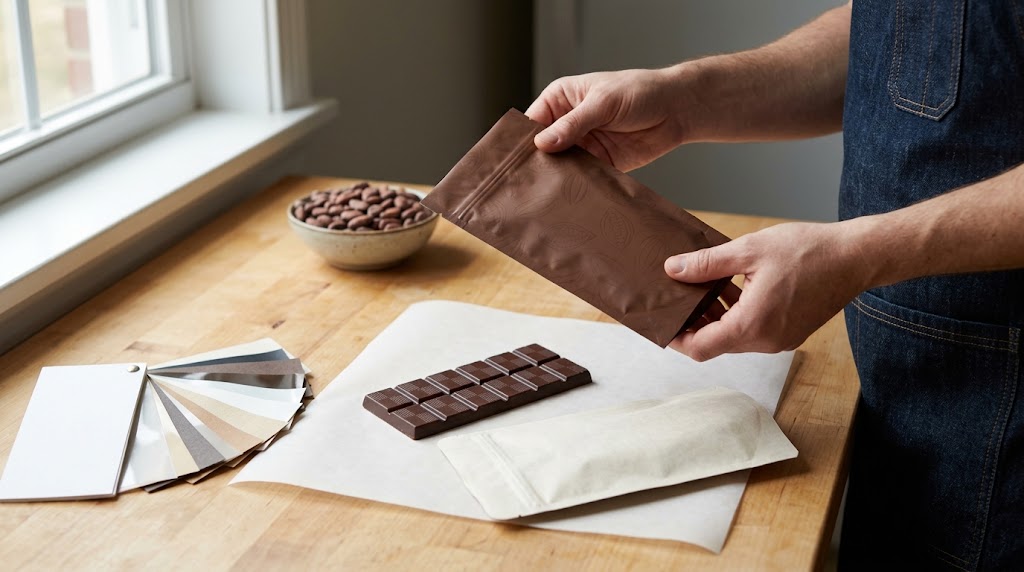
| Question to put in an RFQ | Useful answer or record | Why the distinction matters |
|---|---|---|
| What is the full outside-to-inside structure? | Grades, gauges, coatings, metallization, inks and adhesives | “Kraft” or “Mylar” alone cannot identify the build |
| Which surface touches the chocolate? | Marked contact face and intended-use documentation | Contact status depends on the actual article and use |
| What barrier result is proposed? | Metric, units, test method, conditions and tested material | Comparisons require like-for-like measurements |
| How will the unit close? | Pouch drawing, sealant specification and sample sealing plan | A film sample is not a sealed filled pack |
| Does the sample fit the product? | Filled and sealed samples, artwork proof and handling review | Empty flat size does not show real fit or scuffing |
| What can the brand say about end of life? | Scope of any tested claim and destination-market route | Construction name alone is not collection acceptance |
Send the same brief to each shortlisted supplier and ask them to state assumptions in their replies. A quote for a clear unprinted flat bag is not comparable to a printed metallized kraft-look stand-up pouch simply because both are “chocolate packaging.” Normalize the format, dimensions, print coverage, sample status, material structure, quantity and shipping terms before comparing price. Keep the approved version of the structure with the artwork and purchase order.
When reviewing samples, bring a real chocolate bar or the actual piece count. Check how corners meet seals and whether the chocolate rubs against a print-facing wall. Fill and close the sample using the planned equipment or hand process, then inspect it after the intended handling. Record a failure as specifically as possible: cracked bar, visible grease mark, unacceptable scuff, weak seal, odor concern or excessive empty space. Those observations tell the supplier which variable to change.
Match the evidence to the decision
A material sample helps with feel and appearance. A printed proof helps with artwork. A film transmission report addresses a defined barrier metric. A food-contact statement relates to a specified substance or article under stated use conditions. A filled, closed pack can be assessed for seal integrity and product quality. These are complementary records, not interchangeable certificates.
For barrier comparisons, request the test standard, sample construction and conditions. For heat-sealed packs, ASTM F88/F88M is a method for measuring seal strength in flexible barrier materials; a method name without your agreed acceptance criterion or actual sample result is not a pass. Where a package will experience distribution, inspect the final pack after representative handling. Where shelf life is important, use product-specific storage work with actual sealed production-like samples.
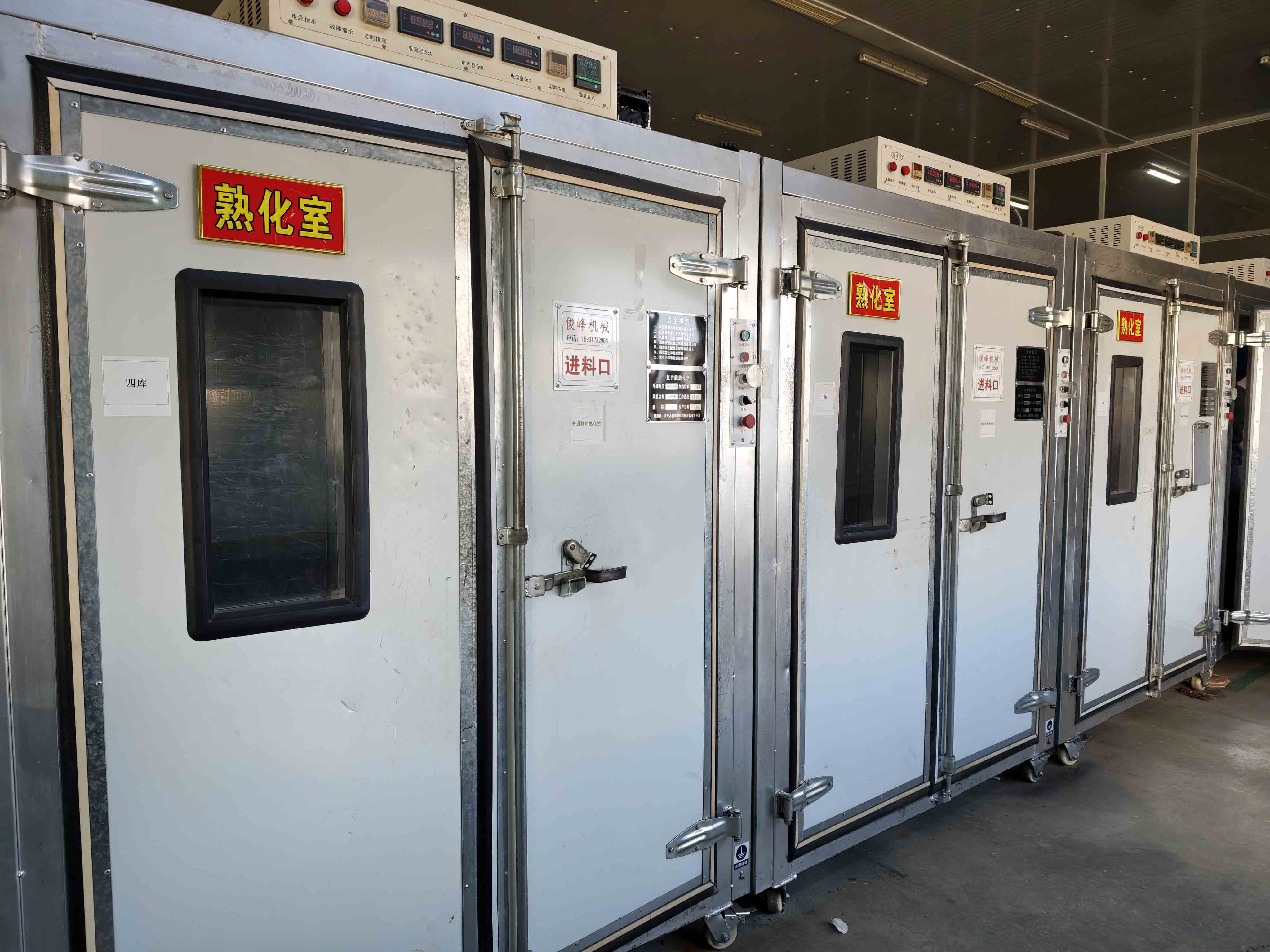
The real factory photograph below shows a lamination curing room, a production-context illustration of why multiple materials are combined before pouch conversion. It is not a record of a particular chocolate pouch's test or food-contact status. Request the material and batch documentation for the construction actually quoted to you.
Watch the wording of marketing claims while approving materials. The FTC's Green Guides summary cautions against broad environmental claims without substantiation and calls for qualification of recycling claims where suitable facilities are not widely available. That is a US marketing reference, not an assessment of any example on this page or a substitute for the destination market's rules. “Paper-look,” “PP-family” and “metallized” are construction descriptions; none authorizes a blanket “eco-friendly” claim.
The same evidence discipline applies to “keeps fresh for 12 months,” “blocks all oxygen,” “prevents bloom” or “keeps chocolate cool.” Such statements need a defined product, package, conditions, measurement and appropriate support. Moisture management may matter to quality, but fat bloom and sugar bloom have different mechanisms; a laminate label does not diagnose or eliminate them. Discuss the actual quality target with the chocolate maker and define an acceptance check for the sealed pack.
A practical selection path
First draw the sales unit as the customer opens it. Mark the contact surface and every separate sleeve, insert and box. Then specify the food, filling process, intended storage and market. Decide which property needs proof before ranking candidate materials: visual presentation, a transmission target, contact suitability, closure performance or mechanical support. Ask suppliers for complete structures and comparable evidence. Finally, review finished physical samples with the actual chocolate and record what passed and what still needs work.
This approach avoids two common mistakes. One is choosing a beautiful outer paper look and assuming it solves all inner-pack functions. The other is choosing a technical-looking metallized pouch and assuming that a named layer solves product quality, transport heat, all regulatory questions and end-of-life claims at once. A good material choice is the one whose assigned role, test basis and finished-use performance fit the actual chocolate.
For a project-specific printed flexible pouch, discuss your chocolate packaging brief with Mylarbag. Send the chocolate format, direct-contact status, preferred visual direction, target pouch format, dimensions and process details. Ask for the complete proposed structure and samples. Source any separate board sleeve, rigid tray, gift carton or temperature-controlled shipper as its own component of the finished package.
Frequently asked questions
What is chocolate packaging made of?
It may be an inner food-contact wrap plus a paper sleeve or a printed flexible pouch whose outer, barrier and sealant elements are combined in a laminate. Other products add cups, trays or boxes. Ask for the full outside-to-inside structure and identify what directly touches the chocolate rather than using the visible outer material as the whole answer.
What type of packaging is used for chocolate bars?
Bars can use a suitable film wrap, an engineered paper-based wrap, a sleeve over an inner wrap, or a pouch sized for the finished bar. The choice depends on contact, protection, handling, branding and packing method. A decorative sleeve and a heat-sealed pouch serve different roles even if both carry the main artwork.
Is paper packaging for chocolate always plastic-free?
No. Paper might be a loose outer sleeve, one component in a plastic-and-metallized laminate, or a specifically engineered primary wrap with functional coatings. A paper texture alone tells you little about the full construction. Request the layer list and the basis of any plastic-free or recycling claim for the finished article and market.
Is plastic packaging for chocolate safe for direct contact?
It can be suitable when the particular construction and contact face meet the requirements for the actual chocolate and intended conditions. “Plastic” or “food grade” is too general to settle that question. Ask for the supplier's intended-use documentation, the exact material revision and the relevant market review before approving direct contact.
Is VMPET the same as aluminum foil?
No. VMPET denotes metallized polyester film: a polymer film with a thin deposited metal layer. An aluminum-foil laminate includes a distinct foil ply. A gold or silver printed finish can be decorative only. Ask for the complete structure and measured properties of the proposed finished laminate rather than judging it by shine.
Can the material name tell me shelf life or recyclability?
No. Shelf life is a product-and-package result under specified storage conditions; it requires product-specific validation. Recycling claims depend on the complete finished article and available collection and processing in the target market. The layer name is a useful starting point for evidence requests, not an approved claim by itself.
Sources and project references
- FDA: regulatory status of food-contact material components and FDA: food types and conditions of use.
- Cosmo Films: metallized BOPET film construction and Cosmo Films: heat-sealable CPP grade.
- ASTM D3985 for OTR, ASTM F1249 for WVTR and ASTM F88/F88M for seal strength.
- Amcor and Alter Eco: paper-based chocolate wrap project; FTC: Green Guides summary.
- Mylarbag published projects: 12 g dark chocolate sachet, 3 oz artisan bar packaging and bean-to-bar pouch.