
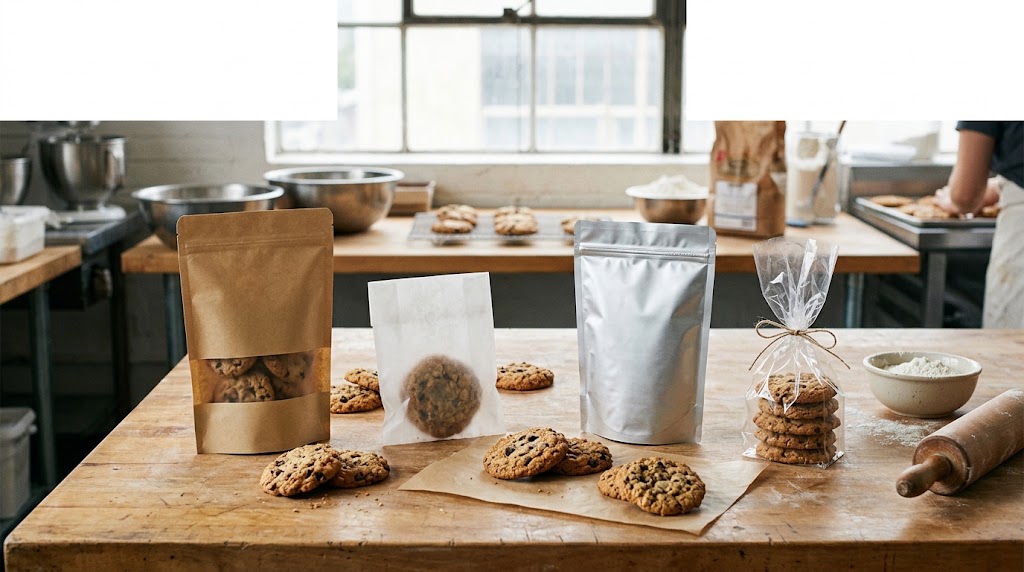
Put five empty cookie bags on a table: brown kraft, white paper, translucent glassine, a silver pouch and a clear film sleeve. The surfaces tell you how they will look on a shelf. They do not tell you what touches the cookies, which layer stops water vapor, whether the bag can be heat sealed or how a butter-rich recipe will behave against its inner face.
The short answer: specify the complete bag, not a single material word. Paper can provide texture and print space; a dense glassine sheet can help with oil handling in a suitable short-use format; a functional coating or film may add the moisture barrier and sealing surface; an intact aluminum-foil layer is a different component from a thin metallized coating on PET. Ask for the layer order, food-contact face, barrier data with test conditions and a matching production sample. Fill, close and store that sample with your actual cookies before approving it.
This guide covers flexible bags for cookies people eat. It is for bakers, food brands, co-packers and packaging buyers comparing a single-cookie sleeve, a retail pouch or a bag used inside another display format. The right construction depends on the finished recipe, intended market, packing equipment and required product-quality period. No material name alone guarantees food safety, freshness or a particular end-of-life claim.
Start With the Jobs Each Layer Must Do
People often ask, “What is cookie packaging made of?” The most useful answer begins with the finished pack's jobs. A cookie bag may need to keep the food separate from handling, retain a chosen texture, limit grease marks, carry a readable brand and product label, survive sealing and distribution, and look good when the customer opens it. One material can perform several jobs, or several layers can divide them.
| Part of the finished bag | Typical job | What a buyer should verify |
|---|---|---|
| Outside web or paper face | Appearance, print surface, scuff resistance, stiffness | Exact grade, artwork method, abrasion and converting trial |
| Intermediate coating or barrier web | Control water vapor, oxygen, aroma or light as required | Complete structure, test method, conditions, effect of folds and windows |
| Food-contact face | Contact with the actual finished cookie | Documentation for composition, food type, contact time and temperature |
| Sealant surface | Form the required seam on the chosen equipment | Sealable side, sample orientation, seal window and finished-seam test |
| Adhesive, tie, zipper or other closure | Join layers or close the bag | Intended function, compatibility and integrity after filling |
An unlined paper sleeve may be one sheet with a folded or glued closure. A printed kraft-look retail pouch may have a paper face, adhesive, barrier film and inner sealing web. A silver pouch may contain an aluminum-foil web or a vacuum-metallized plastic film. Those constructions are materially different even if their product photographs look similar.
It helps to describe a proposed bag from outside to inside. The order matters because the outer surface might never touch the cookie, while the inner face does. A material described only as “kraft” or “foil” leaves the most important food-contact and heat-seal questions unanswered. The following sections explain what the common terms usually mean and where each can fit. They are starting points for a trial, not universal recipes.
Paper Cookie Packaging: Appearance, Contact and Limitations
Paper can make a bakery pack feel familiar and give a printed design a warm, tactile surface. An uncoated sheet also has pores and responds to moisture. Its useful performance depends on fiber, refining, basis weight, surface treatment, coating and any liner. For a cookie expected to retain its crunch through a long retail route, ordinary paper should not be assumed to supply the necessary water-vapor barrier or a heat-sealable top seam.
Sappi's barrier-paper guidance distinguishes ordinary paper and glassine from engineered barrier papers and describes testing oxygen and water-vapor transmission and seam strength on suitable grades. Ahlstrom likewise discusses how fiber processing and surface treatments can change grease and moisture behavior. The practical lesson is to ask which paper grade and which treatment are in the actual bag. A statement about one manufacturer’s barrier paper cannot be transferred to a plain kraft sack or another coating.
Unlined paper bags
An unlined paper bag can serve a short-use counter sale when its food-contact suitability and closure are appropriate and the product-quality window is deliberately short. It gives a bakery a simple way to hand over a cookie without necessarily promising a sealed retail life. Oil may mark the sheet, crumbs may collect in folds, and a folded opening may offer limited resistance to humid storage. Test the actual recipe, especially one with a buttery surface or chocolate contact. “Dry cookie” is not a precise description of surface fat.
A folded paper bag is also a format decision. How far can the top be folded before it presses on the cookie? Does a label cover a fold, and does the label adhesive belong near exposed food? Can the customer open the bag without tearing the only product information? A first sample should answer these handling questions before anyone debates a more complex coating.
Coated paper and paper-film laminates
Functional paper can add grease resistance, moisture resistance or heat-seal behavior through controlled papermaking and coatings. Another route is a paper face laminated to a separate film that carries some of those functions. These are not interchangeable simply because both show a paper exterior. Ask for the paper grade, coating or film identity, coated side, adhesive if present, food-contact face and data for the complete proposed construction.
For example, a paper/PE laminate might place paper outside for print and an identified PE-based layer inside for sealing. The exact formulation, thickness and allowed use remain to be specified. A high-barrier paper may instead use a functional coating whose performance has to be checked under its own grade data. Neither example establishes that a delivered pouch is recyclable as paper, compostable, or suitable for every cookie. Those claims require separate evidence and are developed in the sustainability article of this series.
The existing paper packaging page shows paper-look pouch options. Use it to start a discussion of appearance and possible structures, then ask for the precise film or coating selected for your cookie. A kraft look is an exterior design choice; the product-facing layer and closure are specified separately.
Kraft Paper Is a Paper Type, Not a Barrier Rating
“Kraft” can describe a paper made by a particular pulping route and is often used in packaging to describe a brown, natural-looking exterior. The word does not tell you whether the bag is uncoated, coated, lined or laminated. Nor does a brown color prove fiber source or end-of-life performance. Ask whether the cookie actually touches the kraft surface or an inner film. Examine both sides of a physical cut sample and request the supplier's written layer order.
Kraft can be useful when a brand wants a paper feel and a generous print panel. If the product contains butter or nut oils, trial for staining and contact suitability. If the product must stay crisp during a humid distribution route, compare candidate constructions using the whole filled bag rather than assuming a thicker brown sheet is a moisture barrier. If the pack is intended for heat sealing, confirm what surface seals and whether its paper edges, gusset folds and top geometry run consistently on the chosen line.
The most common buying confusion is between a kraft bag and a kraft-look laminated pouch. They can have very different costs, stiffness, sealing methods and disposal routes. Ask for a cross-section or complete construction schedule; a brown swatch photographed from the front will not settle the question. This is also why the basis weight of the paper, expressed in g/m², should not be treated as the thickness of every layer in the finished pouch.
Glassine Cookie Packaging: Where a Dense Sheet Helps
Glassine is a dense, smooth, often translucent paper. It is useful to consider for individual presentation where some grease handling and a softly visible cookie are desired. It should not be confused with a fully transparent plastic film, wax-coated paper or a guaranteed moisture-barrier package. A paper maker can offer grades with different coatings and uses; confirm the exact sheet and food-contact documentation.
Sappi describes ordinary glassine as largely grease-resistant but without a useful moisture barrier, and says ordinary glassine is not heat-sealable in the context it discusses. That is an important distinction for a crisp retail cookie. A glassine sleeve may look clean in a short counter-sale trial yet allow quality to change during longer humid storage. A heat-sealable coating or separate liner changes the construction and requires its own specification. Avoid applying a claim about plain glassine to a coated sheet, or vice versa.
Ask practical questions about the proposed bag. Does oil show through after the real cookie contacts it for the expected time? Does it scuff or wrinkle during filling? Is the intended closure a fold, adhesive, label, glue seam or a proven heat-seal layer? What happens when several filled bags are stacked? Are the cookies fully cooled and at the product condition approved by the bakery before insertion? These observations determine whether glassine is appropriate for that SKU; a generic photograph of a bakery treat bag does not.
Foil Cookie Packaging: Identify the Metal Layer
“Foil” is used for several different things in packaging sales copy. An aluminum-foil web is a thin metal sheet that may be laminated with other materials for a pouch. A metallized film begins with a polymer web, such as PET, onto which a very thin metallic layer is deposited; Cosmo Films describes metallized BOPET this way. Foil stamping can be a decorative surface effect on artwork. The third option is not an inner barrier layer merely because it looks gold or silver on a logo.
The European Aluminium Foil Association describes intact aluminum foil as a strong barrier to light, gases and moisture. That statement addresses the foil material. A finished cookie pouch can still fail at a seal, a pinhole, a damaged crease, an unprotected window or a handling defect. Ask for the foil thickness, total structure, sealing face and test results on the proposed finished format. If the supplier proposes VMPET instead, request its own measured performance rather than using an aluminum-foil data sheet as a substitute.
An opaque structure may be useful when light exposure or a sensitive ingredient makes visibility a lower priority. It can also hide broken pieces and remove the customer’s direct view of the product. A clear window restores some visibility, but its own film and joining area must be reviewed. Product display, label space, ingredient sensitivity and the actual filled-pack trial decide how much opacity the cookie needs. The bag with the most impressive theoretical barrier is not automatically the best presentation or cheapest viable format.
Aluminum foil, metallized PET and a silver-looking pouch
| Term | Physical description | Questions for a cookie project |
|---|---|---|
| Aluminum foil laminate | Separate metal foil web combined with other webs | Foil gauge, flex or pinhole risk, sealant, full-pack barrier and cost |
| VMPET or metallized PET | PET film carrying a deposited metal layer | Film grade, coating quality, measured OTR/WVTR and conversion durability |
| Silver ink or decorative foil stamp | Visual finish on a limited area | Which underlying layer actually protects the cookie? |
This table describes construction, not a universal performance order. Very thin metal layers and completed pouches can behave differently after repeated flexing, making or filling. Compare data under stated conditions, then check the filled pack. Treat “Mylar” as a trade or market label that still needs its actual polymer and barrier stack identified.
Plastic Films and Clear Windows in Paper-Look Packs
Many paper cookie bags contain plastic film for a practical reason: one web can print or give texture while another supplies a controlled seal or additional barrier. PET, BOPP/OPP, PE and other polymers come in multiple grades. PET often appears as a printable outer web, and PE often serves as a product-facing sealing layer in a laminate; those are common roles, not mandatory placements or proof of food-contact suitability. BOPP grades also differ in heat-seal and barrier behavior. Ask for the exact grade and complete structure.
The plastic films and rollstock page is a useful starting point for available material families. In the quote, replace a vague statement such as “plastic liner” with the inner polymer, thickness, coatings and applicable documents. A buyer planning an all-clear bag can consult the separate Blog 7 material guide; this article focuses on how film works with paper, foil and windowed constructions.
For a windowed kraft pouch, ask how the window is created. Does a clear web sit behind a cutout, or is one laminate panel left unprinted? What is the window film, what contacts the cookie behind it, and how is the perimeter protected? A single large window can alter the effective barrier area and make crumbs, oil marks or scuffing more visible. A barrier value from an opaque panel cannot describe an entire pouch with a different clear section. Trial the exact artwork, window geometry and filled cookie.
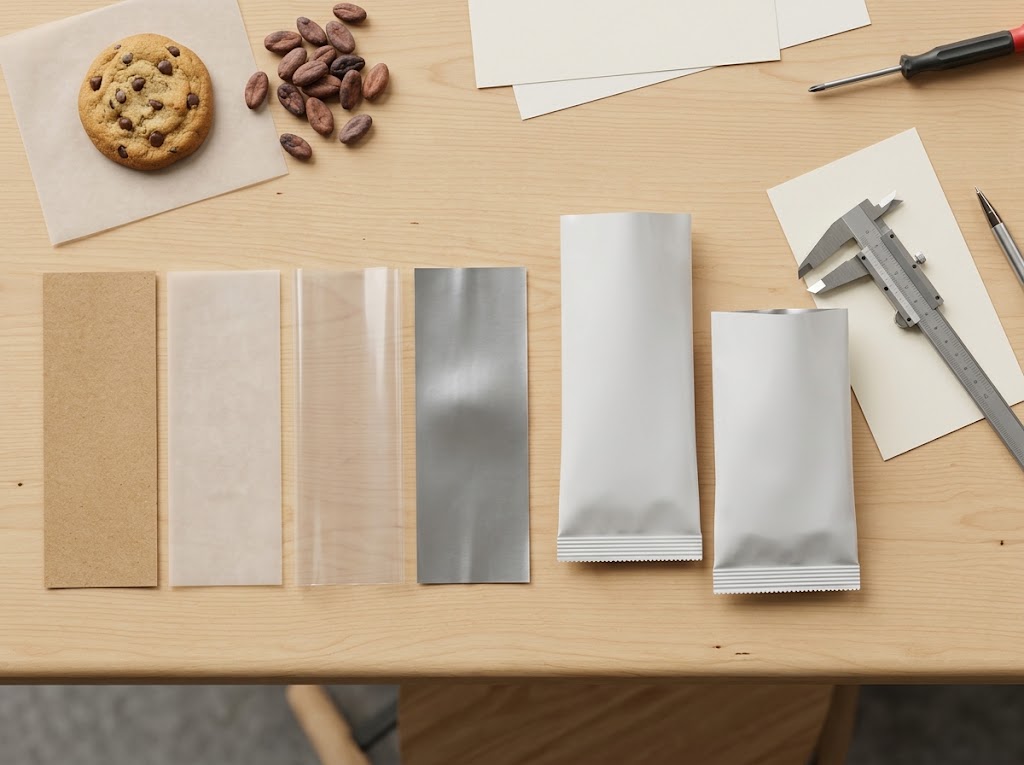
Compare Materials Against the Cookie and Selling Format
A material matrix is useful only when the axes reflect the product. “Cookie” can mean a dry crisp biscuit, a soft filled piece, a high-fat shortbread or a chocolate-dipped item. Each exposes a different failure. A material may reduce one risk while creating another: a beautiful unlined paper sleeve can stain, while a heavily protected opaque pouch may sacrifice the intended product view. Treat the choices below as trial starting points, not approved specifications.
| Cookie and selling situation | Material direction to trial | Check before approving |
|---|---|---|
| Single plain cookie for a short counter sale | Suitable paper or glassine sleeve, or clear film | Food-contact face, oil mark, fold or other closure, intended holding time |
| Butter-rich shortbread in a retail pouch | Identified grease-resistant contact surface; test coated paper or lined structure | Fat transfer, WVTR, seal and appearance through the whole intended period |
| Crisp assortment on a humid retail route | Candidate barrier film or functional paper structure with validated closure | Cookie texture, matched WVTR conditions, folds, windows and finished seam |
| Soft or filled cookie | Construction matched to the actual recipe and storage controls | Water loss or gain, filling contact, required temperature and product safety |
| Chocolate-dipped or nut-containing cookie | Film or lined structure suited to contact and expected light/temperature exposure | Surface marks, odor, light exposure, food-contact documents, seal |
| Decorated individual cookie | Food-contact sleeve with adequate geometry and any needed separate support | Decoration abrasion, fit, labeling, transport and recipe-specific storage |
Do not infer a precise shelf life from this matrix. A soft cookie and a crisp cookie can have opposite texture goals. Initial product condition, recipe, package area, top closure and storage conditions all matter. The cookie-freshness article in this series will cover the full shelf-life protocol; here the materials exercise narrows which constructions should enter that study.
Food-Contact Review: “Dry” Is Not the Whole Description
Food-contact documentation belongs to the exact proposed components and intended conditions of use. The FDA explains that a food-contact article's regulatory status depends on the individual substances in it, subject to their identity and permitted conditions. An outer kraft surface, a coating, an adhesive and an inner film cannot be waved through with a single unexplained “FDA approved” badge. Ask the supplier to identify what supports its claim for the proposed article and intended market.
There is a particularly useful distinction in U.S. paper-and-paperboard rules. 21 CFR 176.180 addresses components of paper and paperboard contacting a defined Type VIII dry food. The food-type table in 21 CFR 176.170 distinguishes Type VIII dry solids with no free fat or oil on the surface from Type IX dry solids with free fat or oil on the surface, and separately identifies some moist bakery products. A butter-rich cookie cannot be assigned a category from its name alone; the food business and its qualified compliance team should examine the actual finished surface and use conditions. These U.S. provisions are an example of why a document for one food category must not be copied into another market or product without review.
For the supplier brief, state whether the inner face touches a high-fat surface, chocolate, icing, a moist filling or only a dry low-oil face. Include planned contact time and temperature, target market, any heating or chilling and whether printing or adhesive can transfer through the structure. Ask for documentation for the finished bag and any relevant components, plus a change-control process if the inner film or coating is substituted. Do not infer food-contact clearance from the word kraft, glassine, foil, compostable or food grade on a sample envelope.
The Tests That Separate a Swatch From a Cookie Bag
Material samples let a team assess feel and appearance. A decision about a retail cookie bag needs evidence tied to the completed structure and real product. Request test conditions and methods beside every number. A transmission value measured on a flat film web is informative, but it does not include a finished bag's top seam, zipper, glued edge or possible window.
| Question | Evidence to request | Limit of that evidence |
|---|---|---|
| Will the cookie pick up or lose moisture? | WVTR for the proposed grade/structure, conditions and filled-cookie storage comparison | Bare-film WVTR does not set a shelf life |
| Does oxygen exposure matter for this recipe? | OTR under a stated method and conditions, product-quality observations | OTR does not measure water vapor or a damaged seam |
| Will butter or oil mark the material? | Grade-specific grease/oil test and direct trial with the actual cookie | A paper-family label does not report the contact result |
| Can the pack be sealed reliably? | Sealable-face identity, process trial, sampled seal-strength and integrity checks | A single good seam is not process capability |
| Will the bag survive distribution? | Filled-pack handling trial, edge/flex inspection, retained controls | A roll's data sheet is not a shipping result |
| Can the customer see the cookie as intended? | Filled display sample under planned light, print and window design | An empty swatch can hide wrinkles or grease spots |
ASTM F1249-25 describes a method for water-vapor transmission through flexible barrier materials, and ASTM D3985-24 addresses oxygen transmission through plastic film and sheeting. Ask what method was actually used; do not label a supplier's different test as an ASTM result. If comparing candidates, align units, film thickness, temperature, humidity and sample preparation. A decimal without those conditions can be more misleading than a clear explanation of what remains unknown.
For an oily cookie, place approved representative product against the intended contact face and inspect after meaningful holding periods for staining, tack, odor, transfer and the cookie's own quality. For a printed or laminated paper pouch, also inspect edges, delamination, ink appearance and product information after handling. Record which observations are cosmetic, which threaten sealing and which require a food-safety review. Do not treat one pass at room temperature as evidence for all seasonal conditions.
A Real Cookie Case: PET/VMPET/PE Is a Structure, Not “Foil”
Mylarbag's 3.5 oz organic cookies and bakery-bites project lists a digitally printed stand-up pouch, zipper, a nominal 12 × 18.5 + 3 cm size and PET/VMPET/PE layers; the case page further describes an anti-static PE component. This is a genuine packaged-cookie example. It gives a buyer an actual named stack to discuss. It does not provide measured film transmission, a filled-cookie shelf-life study or a comparison against plain paper and glassine.

Read the shorthand carefully. PET is the polyester component named in the stack; VMPET means metallized PET; PE names the polyethylene component. The case demonstrates a material-layer description rather than a generic promise that “foil keeps cookies fresh.” It should not be rewritten as PET/AL/PE: AL foil would identify a different metal web. The zipper is a feature for access and reclosure, and its presence does not establish what initial top seal the finished pack uses. The dimension is specific to that assortment, not a size prescription for a single cookie.
If a brand wants a kraft exterior with similar cookie portions, changing the outer appearance may also change the laminate, print process, stiffness and recycling assessment. If it wants a clear window, the structure changes again. Ask for new samples and data rather than claiming that the real case's dimensions or unreported barrier results transfer intact. The case is valuable precisely because it makes the questions concrete without pretending to answer the tests that have not been published.
Turn the Material Choice Into an Approve-or-Revise Trial
Before requesting quotes, make a one-page brief that each material candidate must satisfy. Record the cookie's recipe family and any exposed fat or filling, target count, largest dimensions, expected crumb load, desired pack appearance, packing speed or hand method, intended closure, storage and distribution conditions, target market and planned quality period. Include a drawing with the finished outside size, usable inside size, seal areas, folds and any window. A photograph and an ounce label cannot replace those dimensions.
Then run the candidates through the same decision sequence:
- Confirm identity. Match the sample to its complete layer or coating schedule, grade, thickness, contact side and lot. Keep an unused control.
- Check documents. Review the food-contact basis for the actual cookie and market. Resolve any missing coating, adhesive or substituted inner layer before proceeding.
- Trial the pack. Fill with representative cookies, including the largest and oiliest accepted variation when relevant. Watch for abrasion, breakage, grease transfer, curling, powder or crumb contamination and poor fit.
- Close on the real equipment. Trial the designated sealing or closure method, record settings and inspect seams. ASTM F88/F88M-23 provides a method for measuring sampled flexible-barrier seal strength; the bakery's team still needs an integrity plan and acceptance limits for its pack.
- Store and handle matched packs. Compare intended presentation and product quality at preplanned time points under relevant storage and transport conditions. Retain the same cookie lot in agreed control packaging where useful.
- Approve a named construction. Document the winning grade, layer order, closure, artwork, bag drawing, critical tests and change-control triggers. Reassess when the recipe or inner material changes.
Do not optimize the unit price before identifying a critical failure. A cheap sleeve that leaves a greasy imprint, a premium foil pouch with a weak top seam, or a sturdy kraft laminate that damages a decorated surface all miss the specific product brief. Compare quote price only after the food-contact, quality and production gates are met.
Copyable questions for a supplier
We pack [finished cookie description] at [quantity and size range] for [display and distribution conditions] in [target market]. The product-facing material may contact [butter/oil, chocolate, icing or filling as applicable]. Please quote the complete proposed bag structure from outside to inside, including paper grade or film grade, coatings, adhesives, any aluminum foil or metallized web, and the food-contact face. Show the finished drawing, sealable side and closure plan. Provide relevant food-contact documentation, WVTR/OTR and grease data with test methods and conditions where available, production-representative samples, tolerances and a description of changes that would require reapproval. Please separate measured results from illustrative performance claims.
This request does not dictate one universal winner. It makes comparisons possible. A suitable supplier can propose a plain sleeve for an appropriate short-use job, an engineered paper construction, a transparent or windowed film, or an opaque barrier pouch, then help the bakery test the options. The custom cookie bags page is the main starting point for a tailored bag inquiry; the trial brief keeps the conversation tied to the actual food.
Frequently Asked Questions
What is cookie packaging made of?
It can be a single identified sheet, such as a suitable paper or plastic film, or a structure combining paper, coatings, adhesive, polymer films, metallized film or aluminum foil. The outside appearance does not reveal the inside. Ask for a written construction from outer face to food-contact face, including sealant and window details.
Is paper cookie packaging enough to keep cookies fresh?
Paper alone cannot be assigned a universal freshness period. A short-use bakery sleeve and a sealed retail pouch face different requirements. If a crisp cookie must withstand humid storage, review a grade with documented moisture-barrier performance or another suitable structure, then validate the filled pack and product under its intended conditions.
Is a kraft cookie bag made entirely of paper?
Sometimes a bag is unlined kraft; sometimes a paper-looking exterior is coated or laminated to film. Ask for the exact cross-section. The texture and color of the outside cannot prove the material of the inner face, the closure type or how the complete bag should be disposed of.
Is glassine the same as wax paper or cellophane?
No. Glassine is a dense paper. Wax paper has an added wax treatment, while 21 CFR 177.1200 defines cellophane with a regenerated-cellulose base sheet. Market labels can be loose, so confirm the specific grade and coatings. A translucent appearance is not a material identification test.
Can glassine cookie bags be heat sealed?
Do not assume that ordinary glassine is heat-sealable. A supplier may offer a coated or combined construction with a sealing surface, which needs to be identified and trialed. If the bag closes with a fold, adhesive or label instead, qualify that closure against the actual use and product-quality target.
Is foil cookie packaging always better than clear film?
No material wins every cookie project. An intact aluminum-foil web can offer strong light and transmission barrier, while a clear film supports visibility. The finished bag's seam, handling and window geometry matter, as do product sensitivity, presentation and cost. Compare named structures and filled packs, not broad families in isolation.
Does VMPET mean a cookie bag contains aluminum foil?
VMPET means metallized PET, a plastic film bearing a deposited metal layer. It is different from a separate aluminum-foil web identified in a structure such as PET/AL/PE. Request the actual layer schedule and data. A metallic appearance or decorative foil stamp is not enough to identify the barrier layer.
Will a glassine or paper bag stop butter stains?
Some dense or engineered paper grades can resist oil under specified conditions, but contact with a real cookie, duration and temperature matter. Trial the intended inner face with representative butter-rich cookies and inspect for marks, transfer and product quality. The word paper or glassine by itself is not a test result.
Are all dry cookies in the same food-contact category?
No. The U.S. paper-and-paperboard food-type table distinguishes dry solids with no free surface fat or oil from dry solids with free surface fat or oil, and also lists moist bakery products. A qualified review should identify the finished cookie and intended conditions before applying a supplier's document. Other markets use their own applicable requirements.
What should I ask for before ordering paper cookie bags wholesale?
Request the outside-to-inside construction, paper basis weight, coating or liner identity, food-contact face and documentation, finished bag dimensions and tolerances, closure method, relevant barrier and grease results with conditions, and samples that match the proposed production material. Supply the actual cookies for a fill, seal and storage trial. A bulk price alone cannot resolve suitability.
Is a paper-looking pouch automatically recyclable or compostable?
No. Coatings, liners, adhesives, inks and mixed layers affect the finished package and the claims that can be made about it. Obtain evidence for the exact construction and the collection or processing route in the target market. This article chooses a material for cookie use; the separate sustainability guide addresses disposal and claims in detail.
Choose the Named Structure, Then Test the Filled Cookie Bag
Paper, kraft, glassine, foil and film are useful material terms when they lead to a specific grade and complete bag construction. Match the product-facing layer and closure to the actual cookie. Use measured film or paper data to narrow candidates, and use the filled-pack trial to decide whether the finished product, appearance and process meet the brief. That sequence turns a material preference into a reviewable packaging decision.