
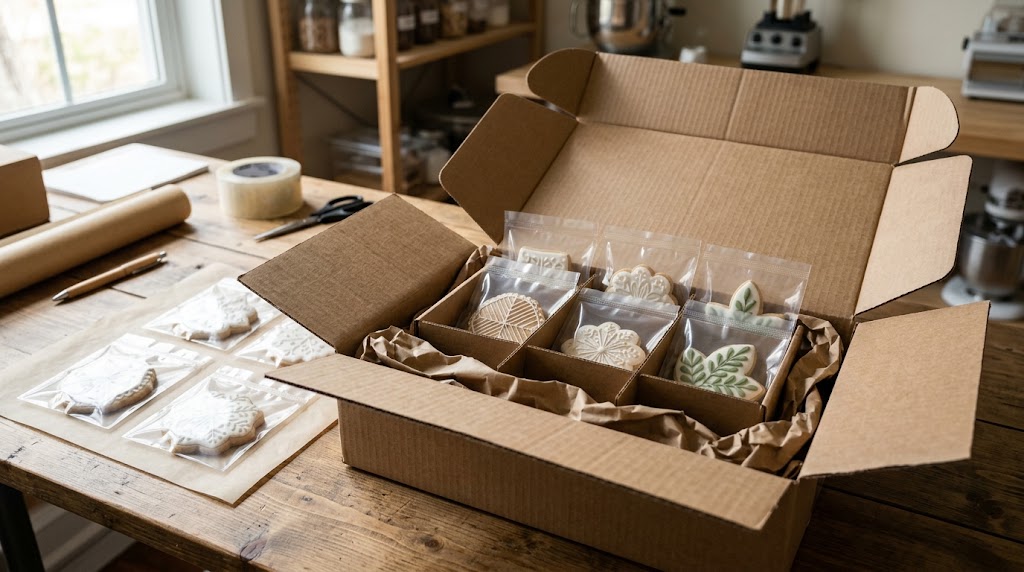
A decorated cookie can reach the customer in one piece and still be unacceptable. A crisp edge may survive while a fine icing line rubs off against the bag. A macaron can arrive with an intact carton but a cracked shell or displaced filling. These are different failures, and adding more plastic around the food does not automatically prevent either one.
The short answer: release the baked and decorated product for packing under its own process criteria; measure the largest cookie and the highest decoration; trial a suitable food-contact bag with a clean first seal; prevent the bag or its neighbors from pressing on the vulnerable face; then fix the individually packed pieces in a supported inner assembly and an outer shipping carton. Inspect real filled samples after the intended handling and route. Treat a filled macaron as a separate product from a dry royal-icing sugar cookie.
This guide is for cookies people eat and the flexible bags used as their food-contact packs. It covers decorated sugar cookies, royal-icing cookies and macarons because all can suffer visible surface damage, while making their different storage needs explicit. A bag is a food-contact and barrier component; a divider, tray or insert can carry mechanical loads; the outer carton is the shipping container. The bakery or food business must approve the finished recipe, storage conditions, distribution route and acceptance limits. A film description cannot certify a particular cookie safe at room temperature.
Start With the Finished Cookie, Not a Bag Catalog
The same pouch size can be generous for a plain round biscuit and damaging for a decorated star. Record the product after baking, cooling, icing, filling and any intended maturation. Include the largest accepted dimensions, uneven edges, protruding sprinkles and the height of piped details. A photograph of the prettiest sample does not describe the worst product the packing station will see.
Separate the release decision into three questions. Is the food appropriate for the planned storage and route? Can the decoration tolerate the packing motion and contact it will experience? Can the full parcel hold it in position through handling? A favorable answer to one question cannot stand in for the other two. Moist fillings, dairy-based frostings and unpasteurized egg ingredients demand review under the actual formulation and market's food-safety rules. Do not copy an ambient shipping claim from a dry, unfrosted cookie.
| Product | First visible failure to watch | First packaging trial | Separate storage question |
|---|---|---|---|
| Flat royal-icing sugar cookie | Smudged image, transferred color, broken pointed edge | Single-piece food bag with face clearance and a supported position | Has the actual icing reached its packing release criterion? |
| Cookie with raised piping or sugar pieces | Crushed relief, detached details, film rubbing high points | Standoff or suitable protective support outside the sealed food bag | Are the decoration materials stable under the planned temperature and humidity? |
| Chocolate-coated or filled decorated cookie | Scuff, bloom-like appearance, smear or filling movement | Trial the real formulation and temperature exposure | Does the product require temperature control? |
| Filled macaron | Cracked shell, shifted sandwich, distorted filling | A supported individual position and a separate route trial | What do the exact filling and finished-product validation require? |
For each SKU, retain a pre-pack image and record existing cracks or decoration defects. If a parcel arrives with a chipped edge, you need to know whether it chipped in production, during insertion, during heat sealing or during transport. That baseline is the beginning of an honest arrival assessment.
Release Royal Icing Before It Enters the Bag
A surface that feels dry at one edge may still deform where the flood icing is thickest. Layered designs, dense color, edible paint and raised outlines can set at different rates. The bakery should define its own release checks for the actual recipe, icing thickness, room conditions and handling method. An operator can inspect a representative sacrificial sample from the lot for marking or transfer under a controlled touch. The saleable artwork should not become the test surface.
The University of Notre Dame's pastry-chef royal-icing shortbread recipe says to dry its cookies at room temperature for 6–8 hours until the icing is completely firm before adding layers or stacking for transport. That is a documented recipe example, not a universal minimum drying time or a food-safety validation for another icing. Time can be one recorded process variable; the finished condition and the bakery's release criteria decide whether to pack. A thin crust does not justify sealing a still-tacky decoration into a film pouch.
Do not press a clear film over the design to discover whether the icing is ready. First test readiness by the product process, then trial insertion and movement in the proposed bag. Look for transferred pigment on the inside panel, shiny flattened spots, stuck sprinkles and film imprint on high details. If these appear, identify whether the cause is early packing, insufficient clearance, trapped movement or compression from outside the bag. Changing to a thicker film without that diagnosis may leave the contact point exactly where it was.
Icing Ingredients Are a Separate Safety Decision
Some royal-icing methods use meringue powder or pasteurized egg product; recipes and commercial ingredients vary. Where egg is left raw or undercooked, the FDA's egg-safety guidance calls for pasteurized eggs or egg products in recipes served without thorough cooking. Packaging cannot make an unreviewed icing process safe. Ask the food team to document the ingredient, preparation, handling and shelf-life basis for the finished decorated cookie, including any market-specific requirements. This article cannot set a universal storage life or clearance temperature.
Measure the Decoration and the Usable Bag Space
The relevant product dimension is the occupied envelope, not just the cookie-cutter size. Put finished samples on a flat surface. Measure maximum length and width across the real baked edges. Measure body thickness and the tallest decoration from the same datum. Note which side should face the customer, whether there is a point or protrusion, and how much batch variation appears. A 3.5 oz weight printed on a sample bag says nothing about this geometry.
Then ask the bag maker for a drawing with finished outside dimensions, usable opening, side and bottom seal widths, top seal location, tolerances, any gusset and any feature above the seal. A nominal 100 mm flat width is not automatically 100 mm of usable internal width. Film bends around the thickness of a cookie and any support. The filled geometry, not only the empty drawing, must be checked by inserting real cookies.
| Measurement or observation | Record on the trial sheet | Why it matters |
|---|---|---|
| Maximum cookie length and width | Across accepted baked samples, including tips | Determines insertion and edge clearance |
| Body thickness and highest relief | Measured at the actual icing peak | Shows whether a film panel can rub or press the artwork |
| Planned orientation | Front face, back face and edge positions | A design can survive in one orientation and fail in another |
| Empty bag opening and usable cavity | Supplier drawing plus physical measurement | Nominal flat size omits seal and fold effects |
| Product-to-top-seal distance | At the final filled position | Keeps icing, crumbs and edges out of the first seal |
| Filled bag thickness and corner shape | After closure and handling | Determines the support cavity, not the flat artwork |
| Observed film-to-decoration contact | Before and after a handling trial | Makes a vague “snug fit” criterion inspectable |
Avoid publishing a universal “add 10 mm on every side” rule. A loose pouch may let a pointed cookie rotate, while a tight pouch can flatten raised icing. A candidate must be wide enough for insertion and for seals, yet positioned so the cookie does not travel inside it. If the relief needs a defined space, design a protective element that keeps an external load off the film panel over that relief. Trial its real thickness and its interaction with the food-contact bag. Any part that directly touches exposed food needs appropriate food-contact review.
Single Piece, Small Stack or Multi-Serving Pouch?
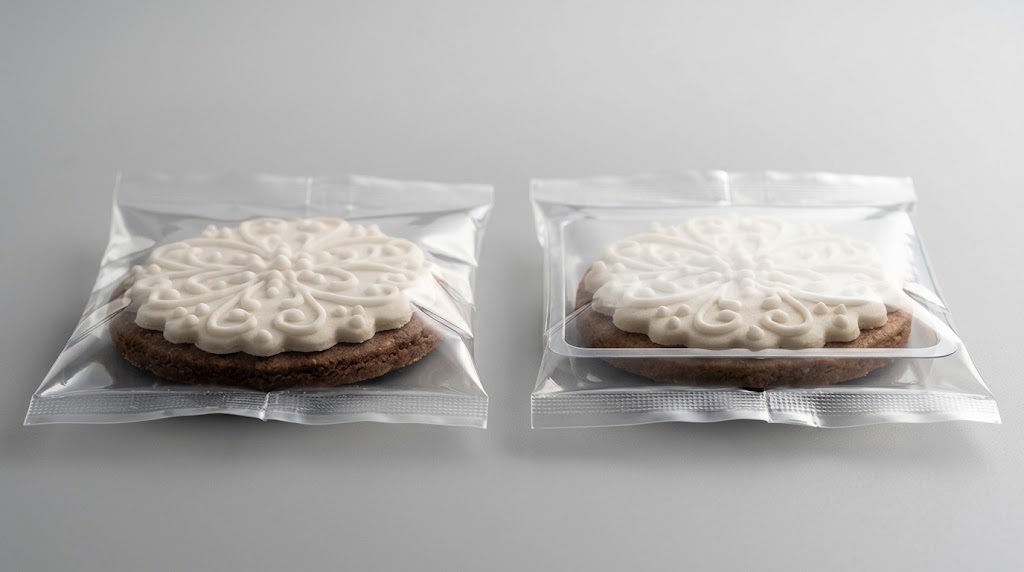
A single-cookie flat pouch can isolate a detailed image and make an arrival defect easy to trace. A small stack may be workable for plain, robust sugar cookies, but it increases the chance of design-to-design pressure unless the items are separated and supported. A multi-serving stand-up pouch can suit bakery bites for retail, yet it does not turn an intricate iced cookie into a loose-fill snack. Make this a SKU decision rather than a blanket recommendation.
For a fragile decorated item, begin with one cookie per food-contact bag and test a separate rigid position. If the design is low and durable, test a supported arrangement with more than one piece. Change only one factor at a time: count, orientation, support or bag size. Otherwise, if the next shipment fares better, the team will not know what fixed it. The flat pouch format is a useful starting shape to discuss, while the final bag dimensions and seal must be approved with filled samples.
Choose Film for Contact, Visibility and the Actual Storage Goal
Clear packaging shows the artwork, but clarity alone does not establish moisture control, resistance to grease appearance or a suitable seal. Ask the supplier to identify every layer, the food-contact side, proposed thickness, printing location, closure and any coating or window. Ask for documents that match the finished construction and the food, time, temperature and storage conditions in the intended market. The FDA's food-contact component guidance explains why each component and its authorized conditions of use matter; its food-type and conditions tables distinguish bakery products and dry foods with or without free surface fat. Other markets need their own applicable review.
If a crisp cookie needs a defined moisture target, compare candidate film WVTR values with their test conditions and units. ASTM F1249 is a method for measuring water-vapor transmission through flexible barrier material. A flat-film number can help compare structures. It does not account for an imperfect top seal, a window substitution, the finished cookie's recipe, or the actual humidity history of a parcel. Oxygen barrier may matter for certain fat-containing products, but determine that from the product's deterioration mechanism rather than from an all-purpose “high barrier” claim.
Film stiffness and slip also affect practical packing. A very soft panel may drape onto tall piping. A stiffer panel may still bow inward when other packs press on it. A highly slippery exterior can change how bags move against a divider, while a rough contact can abrade print or corners. Test the assembled bag and support; do not infer an icing outcome from film data alone. The site's plastic film options can help frame a material request, but no listed structure has been proven for every decorated cookie.
Protect the First Seal From Crumbs and Decoration
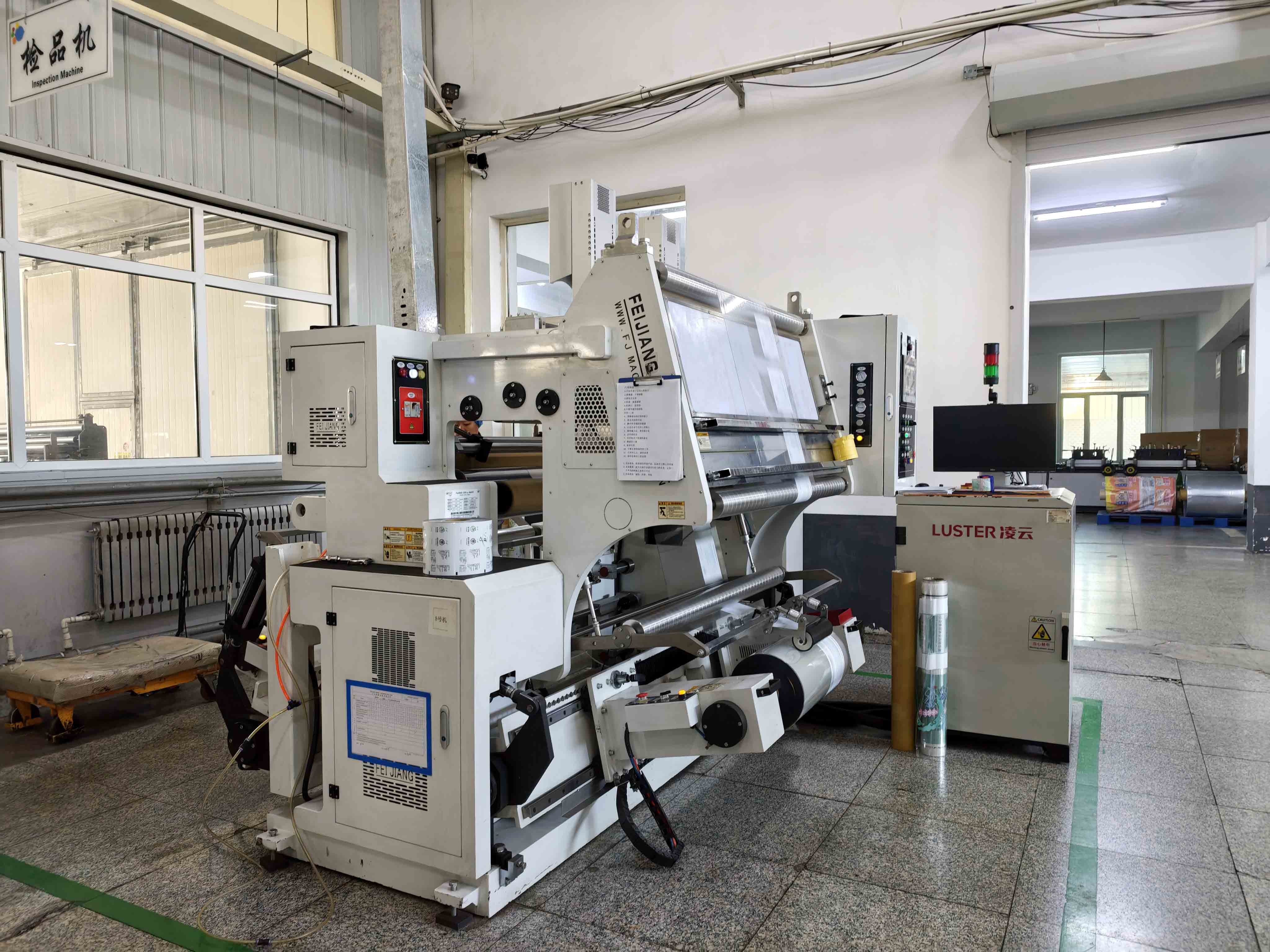
The seal area should be free of cookie, icing, crumbs, grease and film folds when the first closure is made. Specify a loading orientation that leaves accessible top clearance, then validate the actual heat-sealing method on filled samples. Confirm the sealant side, target seal width, equipment settings and acceptable visual appearance for the selected construction. Look at the whole width of the seam, both corners and samples from different points in the run.
A consumer zipper may be useful for a multi-serving pack after opening. It does not replace the initial hermetic or otherwise specified top closure when that closure is part of the product's approved design. A twist tie, sticker or decorative ribbon may help presentation, but it does not automatically provide the moisture barrier expected from a validated heat seal. Conversely, do not promise that every heat-sealed bag is airtight without testing its actual integrity.
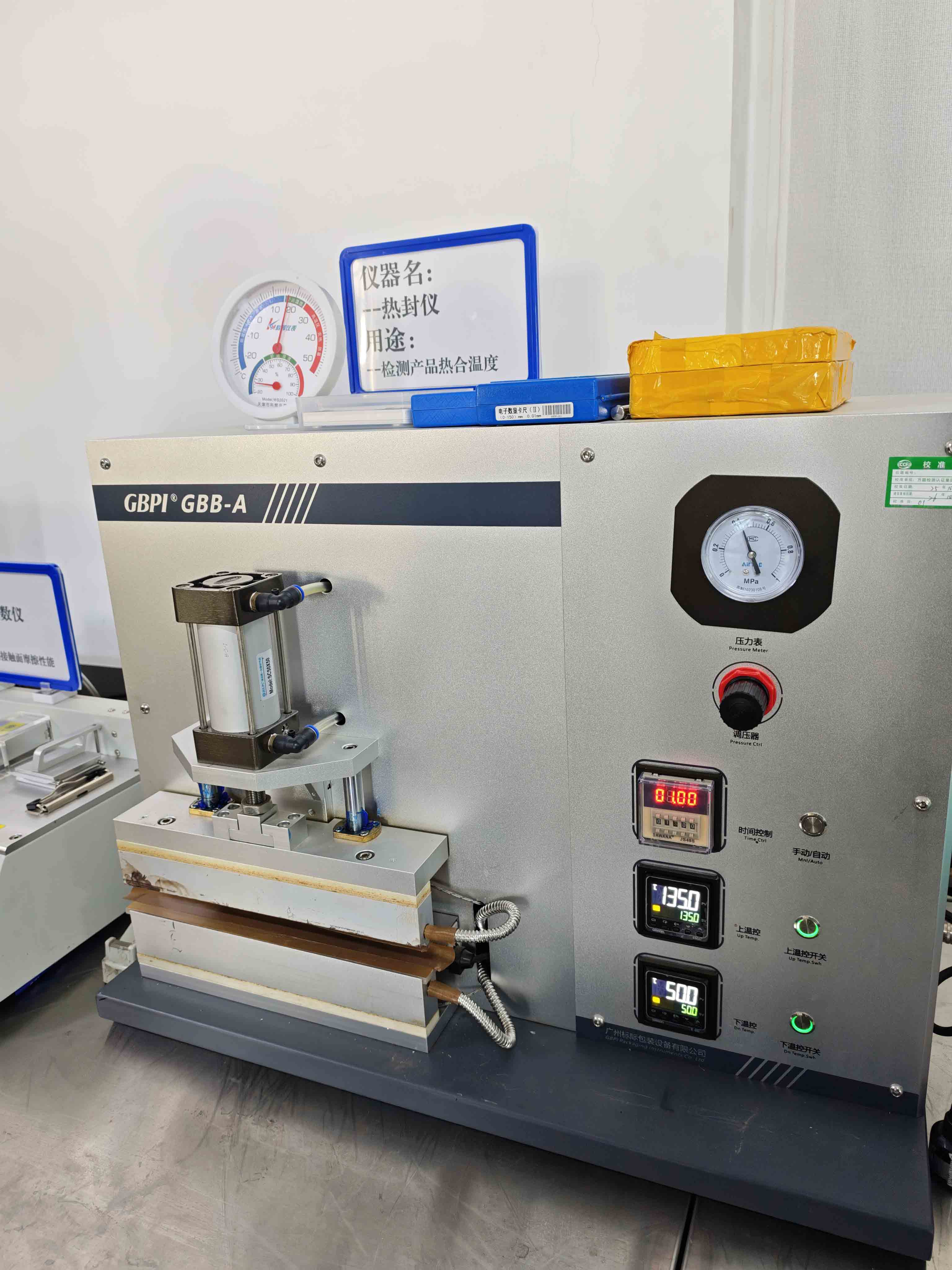
ASTM F88/F88M measures the force required to separate a sampled seal strip and identifies failure mode. It supports process control; it does not prove the entire finished seam has no local channel, wrinkle or cookie crumb. Use a suitable finished-pack inspection and integrity method alongside any strip testing. Establish acceptance limits for the chosen film and equipment, rather than copying a peel-strength number from another product.
Use a Real Cookie Case Without Stretching Its Claims
Mylarbag's published 3.5 oz organic cookies and bakery-bites case lists digital printing, a stand-up pouch with a zipper, PET/VMPET/PE and nominal 12 × 18.5 + 3 cm dimensions. Those are concrete discussion points for a food bag: the pouch format, material family, graphics and reclosure. They are not an iced-sugar-cookie or macaron shipping trial. The case gives no measured decoration clearance, no supported-carton design, no arrival damage rate and no validation for a different filling.
The case gallery can start a useful supplier conversation: “Our finished sugar cookie measures this much across its points and this high over the icing. Can you supply a sample flat bag and a drawing that preserves the top-seal area? What data can you provide for the exact film?” For macarons, send the shell diameter, assembled height, filling type and intended storage conditions. Do not specify a bag by copying the 3.5 oz case size. Even within one bakery, volume and fragility can differ at the same net weight.

Let a Support Carry the Load Around the Bag
An individual food bag separates the cookie from ordinary shipping materials. It can limit contamination and provide the selected barrier. It is still flexible. When another pack bears on its front panel, the panel can transmit that force to a raised decoration. A divider, cavity, tray or small inner carton should hold the filled bag in a repeatable position and carry loads around vulnerable surfaces. Then the outer carton and cushioning restrain the supported assembly through transport.
The support must match the real filled pack. A cavity sized to an empty pouch drawing may crumple the bag or pinch a cookie. A deep cavity that permits a bag to slide may allow the cookie to strike a hard partition. Sample both extremes in the product's approved dimensional range. Photograph the closed, loaded layout and the opened layout after a trial. If any insert contacts an unpackaged cookie, specify its direct food-contact suitability rather than assuming ordinary printed board is acceptable.
| Layer | Main job | Failure if it is asked to do too much |
|---|---|---|
| Food-contact bag | Isolate food, hold the chosen closure and film barrier | Film can press icing or allow internal movement |
| Individual position or divider | Limit face contact, bending and sideways travel | A wrong-sized cavity can press or abrade the filled bag |
| Small inner support or rigid tray | Carry local top and edge loads around the product | It cannot repair an open bag seal |
| Cushioning and shipping carton | Reduce movement of the supported group and take external handling | An intact outer box cannot prove every design survived |
Do not place loose non-food-contact filler against an exposed cookie. Cushion the protected assembly, and keep it separate from food through the qualified food bag or suitable direct-contact component. For a low-count order, fill the unused support positions or use a matching smaller assembly so the remaining cookies do not rattle across the carton. For a large order, verify that stacking the supports does not transmit pressure to the top row of decorations.
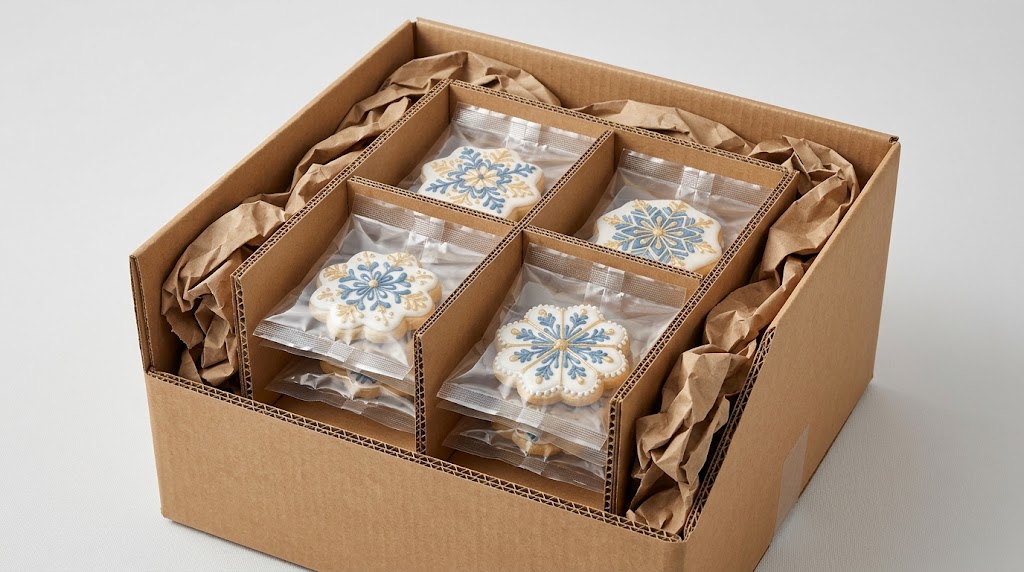
Avoid Pressure on the Picture Side
Face-up orientation is easy to display, but it may leave the decorated side beneath a compressible panel. Face-down packing may protect the image from a top load only if the contact surface is approved and the relief is supported appropriately. There is no universal safe orientation. Test the same design in the candidate orientations, with a baseline photo of fine lines and protrusions, then compare where new marks appear after handling. Record the location of a transferred color spot on the bag as well as the mark on the cookie.
Gift presentation can coexist with technical protection. Put printed graphics on the bag or on a non-contact outer element, but do not let a printed card scrape icing or rest on the cookie. A window shows the product only when the bag stays clear and the cookie does not rub it. If a ribbon compresses a stack of filled bags, it may undo the clearance achieved by the internal support. Finish the appearance with the product in place and the carton closed, not on an empty sample.
Give Macarons Their Own Release and Route Decision
“Macaron cookie packaging” is not simply a smaller version of a sugar-cookie bag. The shell has a curved, delicate face and a defined seam or foot. A filled sandwich also has an interface that can slip under acceleration or heat. A tight film panel may crack the crown; a very loose bag may let the macaron flip. A separate supported position can prevent contact with its neighbors, but the correct cavity geometry depends on the finished shell and filling.
The published macaron storage study compared refrigeration and two freeze/thaw conditions for its test product and reported changes in moisture and texture after storage. It is evidence that storage conditions affect a macaron's quality, not a shipping shelf-life claim for every recipe. Filling composition, water activity, portion size and the route need their own evaluation. Do not turn the study's treatment temperatures or three-week observation into a blanket instruction to freeze, thaw or ship all macarons the same way.
Separate physical damage from food safety and quality over time. The first is observed through cracked shells, displaced filling and scuffing after handling. The second depends on the actual ingredients and approved temperature and shelf-life program. If a filling is perishable, a high-barrier pouch does not maintain cold-chain temperature. FoodSafety.gov's food-gift guidance addresses cold sources and arrival temperatures for perishable shipments; the bakery must qualify the right service and thermal package for its particular product. A dry royal-icing cookie and a chilled cream-filled macaron should not share one ambient-route assumption.
For trial lots, log shell diameter, assembled height, filling offset, shell cracks before packing, insertion damage, position in the support and the arrival result. Include the least stable flavor or filling, not just the most robust photographic sample. If a chilled or frozen route is chosen, check condensation and bag appearance through the intended temperature transitions. A clear bag that fogs at arrival may hide a physically intact macaron and can signal a separate quality-control question.
Make the Packing Procedure Repeatable
A beautiful one-off sample made by the packaging designer is not a production specification. The shift team needs a short, observable sequence and an approved sample for each format. A process change can be as small as a new operator rotating cookies to speed filling or pulling the top seal closer to a tall decoration.
- Release the SKU. Confirm the bakery's bake, cooling, icing or filling, storage and visual criteria. Record the recipe and packaging revision.
- Check representative extremes. Include largest, highest and most fragile approved pieces, plus a normal production sample.
- Match bag and support. Verify material, dimensions, print version and cavity layout against the approved bill of materials.
- Load without touching the design. Hold a supported edge or approved handling point; inspect the cookie immediately after insertion to separate insertion damage from transit damage.
- Clear the first-seal area. Remove crumbs and folds, make the closure with the approved equipment and inspect the complete seam. Do not stop at closing a zipper.
- Place the filled bag in its position. Check the visible face and the bag's corners for contact or bending. Use the approved orientation.
- Build the inner and outer assembly. Add the exact supports and cushioning used in the tested configuration, including the low-count order configuration.
- Close and record. Capture the carton revision, gross weight, route, dispatch date, pack operator and sample photographs.
- Check arrival. Open trial parcels promptly under the agreed plan and score product, bag, inner support and carton separately.
If hand packing is the only method, the same principles apply. If a machine places cookies into formed pouches, trial actual feeding, placement, sealing and stop/start conditions. An empty-film qualification cannot reveal a piped decoration contacting the seal jaw or a macaron rotating in a tray. Keep the trial method close to the intended production method.
Test the Finished Parcel and Inspect the Artwork
Establish the product baseline before the transport trial. Photograph designs with a consistent angle and light. Count whole cookies, pre-existing chips and any existing icing marks. Use production cookies, final food bags, the specified supports and the closed shipping carton. Test plausible worst-case order counts and the routes actually intended. A hand shake may reveal obvious movement, but it is only a screening observation.
For a formal parcel simulation, ISTA lists Procedure 3A for individual packaged products shipped through a parcel delivery system up to 70 kg. A qualified packaging team should select the applicable procedure and perform it correctly. A photo of a dropped carton, an improvised shake, a film impact test or an AI diagram does not establish ISTA certification. Follow the chosen procedure's constraints; do not open a specimen partway through a certification test. Inspect the food when the planned sequence is complete, and then compare with real-route observations as appropriate.
Use separate outcomes because they answer separate questions:
| Outcome | What to count or score | Typical next action |
|---|---|---|
| Art failure | Color transfer, smeared line, dented relief, detached decoration | Compare release condition, film clearance and contact point |
| Cookie breakage | Newly chipped or broken bodies among intact pre-pack samples | Map edge/corner impact and support movement |
| Macaron damage | Crown crack, foot damage, shell separation, filling shift | Revise cavity geometry, orientation or temperature plan |
| Bag failure | Open seal, local channel, abrasion, puncture, unacceptable fogging | Review film, sealing process and route exposure |
| Parcel failure | Crushed carton, shifted inner support, missing cushion | Revise the assembled system and repeat a controlled trial |
If you calculate a damage rate, state the denominator. Newly unacceptable cookies divided by inspected cookies differs from parcels that fail an all-intact acceptance rule divided by parcels inspected. For example, in a purely hypothetical trial, 3 newly damaged decorations among 60 inspected cookies equal 5% at cookie level. If two of 12 parcels fail a one-flaw-is-a-fail rule, the parcel failure rate is about 16.7%. These are arithmetic illustrations, not data from Mylarbag, a validated limit or a sample size sufficient for a guarantee. Retain route, batch and pack revision with every result.
A coefficient-of-friction measurement can help describe how two film surfaces slide under specified lab conditions. It does not measure an iced design scraping against its bag, so the filled-cookie inspection remains essential. Likewise, seal-strength and WVTR data answer different material and closure questions; neither alone predicts decoration survival.

Diagnose Damage Before Ordering a Different Bag
Keep one sample of the failed pack and open it carefully. The location of the mark often tells more than a request for “stronger packaging.” If the bag face carries a mirror image of the icing, check release and contact. If the cookie edge chips while the front face stays pristine, review the cavity and the way the support arrests sideways movement. If the top seal has crumbs, review insertion and clearance rather than only raising sealing temperature.
| Arrival evidence | First hypothesis to investigate | Controlled comparison |
|---|---|---|
| Icing color printed on inner film | Tacky icing or recurring face contact | Hold bag and support constant while testing release condition; then vary face clearance |
| Raised piping flattened, no transfer | External compression through the bag panel | Trial a support that carries the load around the relief |
| Fine points chip in intact bag | Product rotates or strikes a partition | Change the filled-bag fit and position, not only film gauge |
| Seal opens near one corner | Fold, contamination or inconsistent jaw contact | Examine that area on multiple filled packs and adjust the validated seal process |
| Macaron shells crack but filling stays centered | Local shell load or insufficient cavity clearance | Compare orientation and cavity geometry with the same recipe |
| Filling shifts but shells are whole | Product or temperature-dependent flow | Review formulation and route exposure with the food team |
| Outer box looks sound but artwork fails | Damage within the food bag or inner support | Open a controlled test pack and map contact surfaces |
Some combinations need two changes. An iced cookie could be too wet at packing and too free to move later. Do not declare the packaging fixed after a single lucky parcel. Repeat with the intended production variation, hold the versioned bill of materials and communicate the acceptance rule to the receiving team.
Send a Specific Brief to the Cookie Bag Supplier
A useful inquiry states the cookie and the operation, rather than “I need the best bag for shipping.” Give the supplier finished dimensions and variation, decoration height, whether pieces are wrapped individually, required visibility, the intended filling and sealing method, food-contact market, storage plan, support type, order count and expected annual volumes. Ask for a drawing and physically representative samples. Request the layer structure, food-contact information and barrier data with methods, units and conditions relevant to the SKU.
| Brief field | Example of a useful answer |
|---|---|
| Product | Royal-icing sugar cookie with pointed edge and raised border; or filled macaron with specified shell and filling |
| Finished size range | Maximum length, width, body thickness and highest relief from actual production |
| Pack count and orientation | One per flat bag, design facing a specified panel, then placed in a numbered support cavity |
| Closure and equipment | Intended first heat seal, target clean-zone drawing and manual or automated equipment |
| Material and contact | Proposed complete structure, direct-contact side, printing, documents for market and use |
| Storage and distribution | Approved ambient or controlled-temperature plan, route length and realistic handling |
| Acceptance evidence | No unacceptable art transfer, breakage, seal defect or temperature deviation under defined trial criteria |
If the product is a detailed single decorated cookie, ask about a sample custom cookie bag with a correctly sized opening and top-seal zone, then trial it with an independently designed support. If the product is a small robust retail portion, a stand-up pouch may be worth comparing with a flat pouch. If it is a filled macaron, begin with the food team's storage decision and the physical support before deciding which film properties matter most. A clear material, a metallized laminate and a gusset are options to evaluate, not a universal ranking.
The supplier can propose bag geometry and film. The bakery and packaging team approve the finished cookie, closure, support, carton, procedure and route together. Request revisions to the sample when the filled trial shows a contact point. This is more productive than treating one stock size or one attractive photograph as proof of performance.
Frequently Asked Questions
How do you package royal icing cookies for shipping without smudging them?
Use the bakery's demonstrated icing-release criterion before bagging, then test a single-cookie food-contact bag and a support that keeps outside pressure off the decorated face. Inspect for color transfer and relief dents after inserting, sealing and shipping trial samples. The Notre Dame recipe's drying period is specific to that recipe; another formula needs its own release checks.
Can I bag decorated cookies as soon as the icing feels dry to a light touch?
That touch is only one observation. Thick flood areas or raised details can behave differently from an edge. Use a representative sample and the bakery's established process criteria. Trial the real bag for imprint, sticking and transfer before release. Do not equate an icing touch test with finished-product food safety.
What size bag should I use for one decorated sugar cookie?
Measure the largest baked outline, thickest body and tallest decoration, then compare those measurements with the supplier's usable bag cavity and first-seal zone. Test physical samples across normal product variation. No weight label or universal clearance increment determines the final width and height.
Is a clear flat pouch enough to protect a decorated cookie?
A clear flat pouch can provide a direct-contact bag and attractive display when its material and closure are suitable. It does not independently support a fragile cookie against bending, a compressed icing surface or carton movement. Test a separate divider or support and the complete parcel.
Should the decorated face point up or down in the box?
Choose by trial. Check where the bag panel and support touch under the expected load, not only how the cookie looks before closing the carton. One orientation can protect an edge while damaging a raised image. Photograph the same details before and after the selected test.
Can several iced cookies share one bag?
They can only if the finished cookies and arrangement survive a validated trial without design contact, movement, seal contamination or unacceptable damage. For elaborate artwork, individual bags provide a clearer first comparison. If a stack is proposed, specify suitable food-contact separators wherever surfaces may touch exposed food.
Will a thicker or metallized bag stop royal icing from breaking?
Film thickness and barrier influence film handling and storage properties, but they do not prove mechanical clearance around a relief or stop a cookie from moving inside a parcel. Diagnose the contact path and trial an appropriate support. Ask for measured film data when selecting a barrier; do not use a material name as a shelf-life guarantee.
Is a zipper sufficient to seal cookie bags for mailing?
Not when the approved first closure requires a heat seal. A zipper can help a multi-serving pouch after opening, but inspect and validate the initial top closure under the actual filled process. Avoid generalizing from a zipper-equipped bakery-bite case to a single decorated cookie.
Can macarons go in the same packaging as royal-icing cookies?
The food-contact materials may overlap after a specific review, but the mechanical fit and storage decisions are different. A curved shell, foot and filling demand their own support and temperature trial. Do not mix the products in one unsupported position or assume a dry iced-cookie ambient plan is suitable for a perishable filling.
Should I freeze macarons before shipping?
That depends on the exact filling, product-quality target, food-safety plan and qualified shipping service. A published study observed changes under its refrigeration and freeze/thaw conditions, but it did not validate every macaron recipe or shipping route. If a cold route is selected, evaluate the full thermal system and condensation at arrival.
Does an ISTA 3A test prove every decorated cookie will arrive intact?
No. It is a defined laboratory procedure for an applicable parcel system. The result belongs to the tested product, sample, configuration and acceptance criteria. Keep field feedback and retest when the product, materials, support, carton or route changes. Do not call an informal shake or film test an ISTA certification.
What should I record after a shipment trial?
Keep the pre-pack condition, cookie lot, bag and support revisions, carton layout, route, temperature plan, inspected counts and the location of each new defect. Report cookie-level art and fracture rates separately from parcel-level failure. Those observations tell the next controlled design change.
Final Packing Decision
Approve a decorated-cookie shipment only when the food business has released the recipe and the actual filled pack has met its appearance, seal and distribution criteria. For royal icing, look at the highest detail and its contact with the bag. For macarons, check the shell, filling and temperature history as separate outcomes. Use the flexible bag for its specified contact, closure and barrier role, then let the inner support and shipping carton carry the mechanical load around the food.