
If you expect to revise the artwork or order a small quantity of each flavor, get a digital printing quote first. If one design is settled and likely to run again, get a gravure quote for that design. For either quote, use the same finished pouch specification and the quantity for each artwork version. Compare what you would pay for the first order, an unchanged repeat and a repeat where one back panel changes.
What changes on press when the artwork changes?
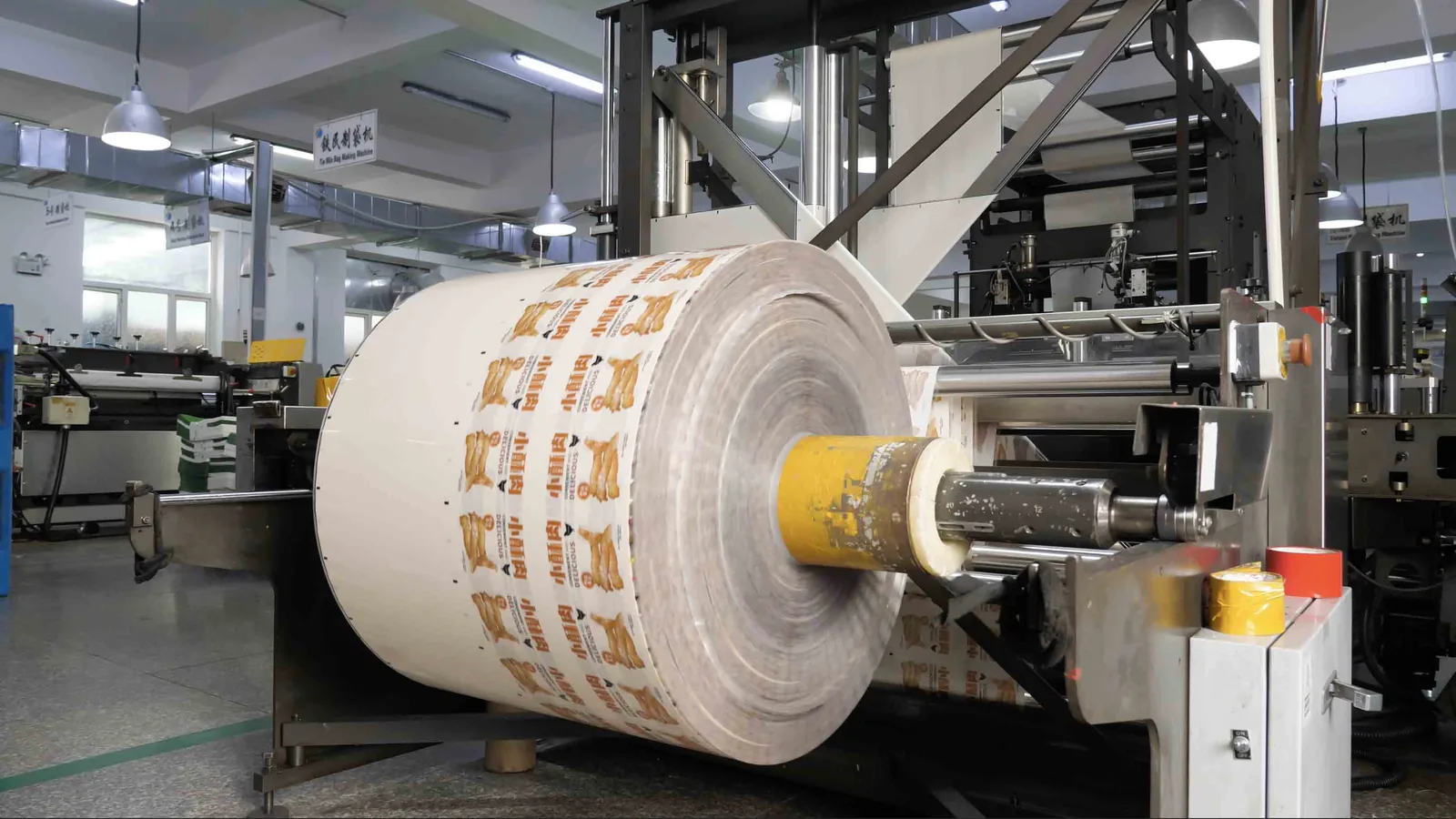
Suppose the cranberry flavor of a snack needs a revised back panel. The pouch dimensions, front design and three other flavors stay the same. On a digital press, the operator can print the cranberry pouch from a revised file. On a gravure press, the printer checks the revised artwork against the images already engraved on the cylinders. How much work that one change creates depends partly on how the designer built the lettering.
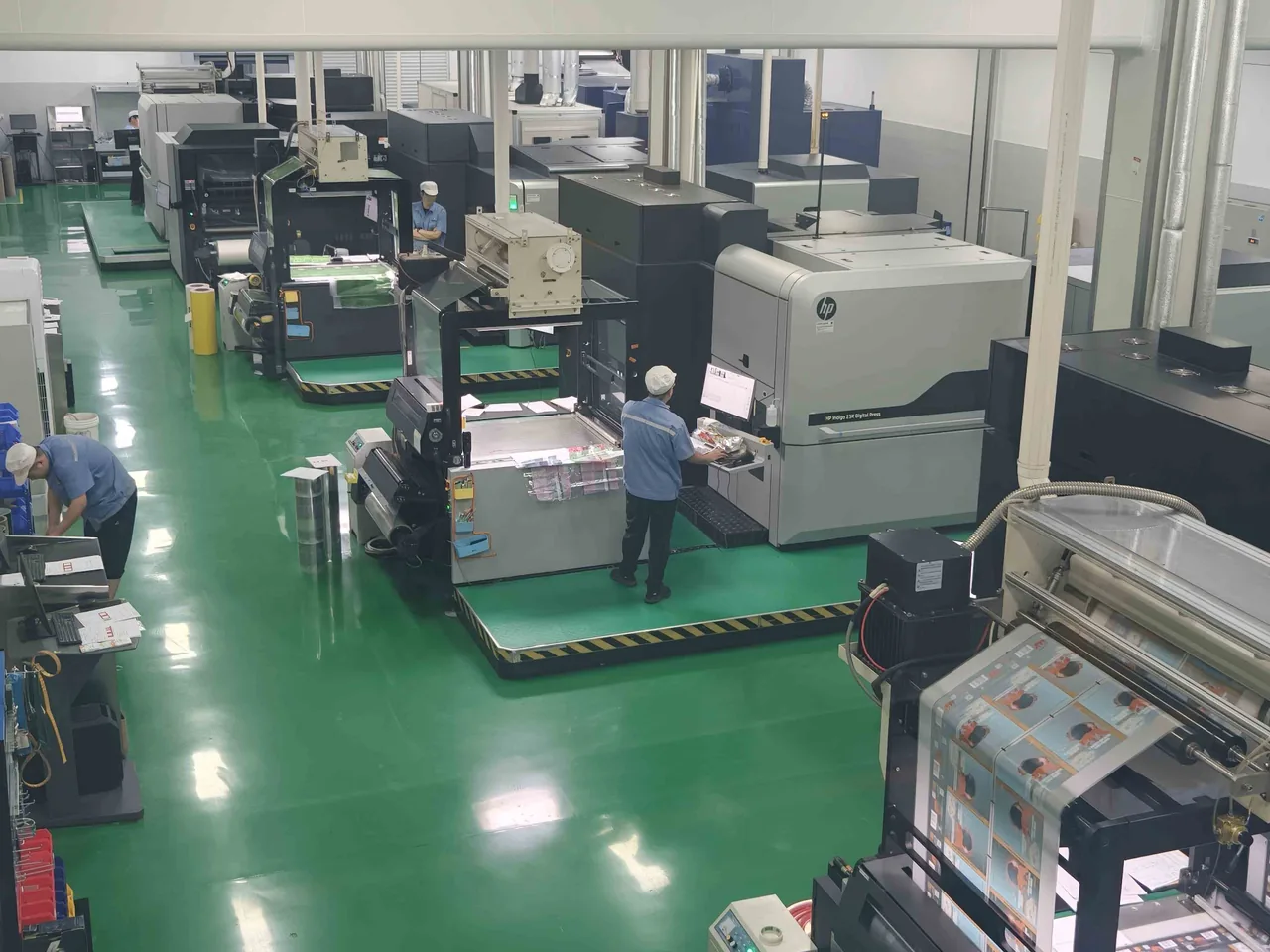
Digital presses create the image from electronic data. One flexible packaging press, the HP Indigo 25K, uses a process called liquid electrophotography. Other digital presses use inkjet. When white ink or a particular brand color matters, ask which press and inks the supplier plans to use for your job. HP lists white and spot-color capabilities for its model in the Indigo 25K technical overview.
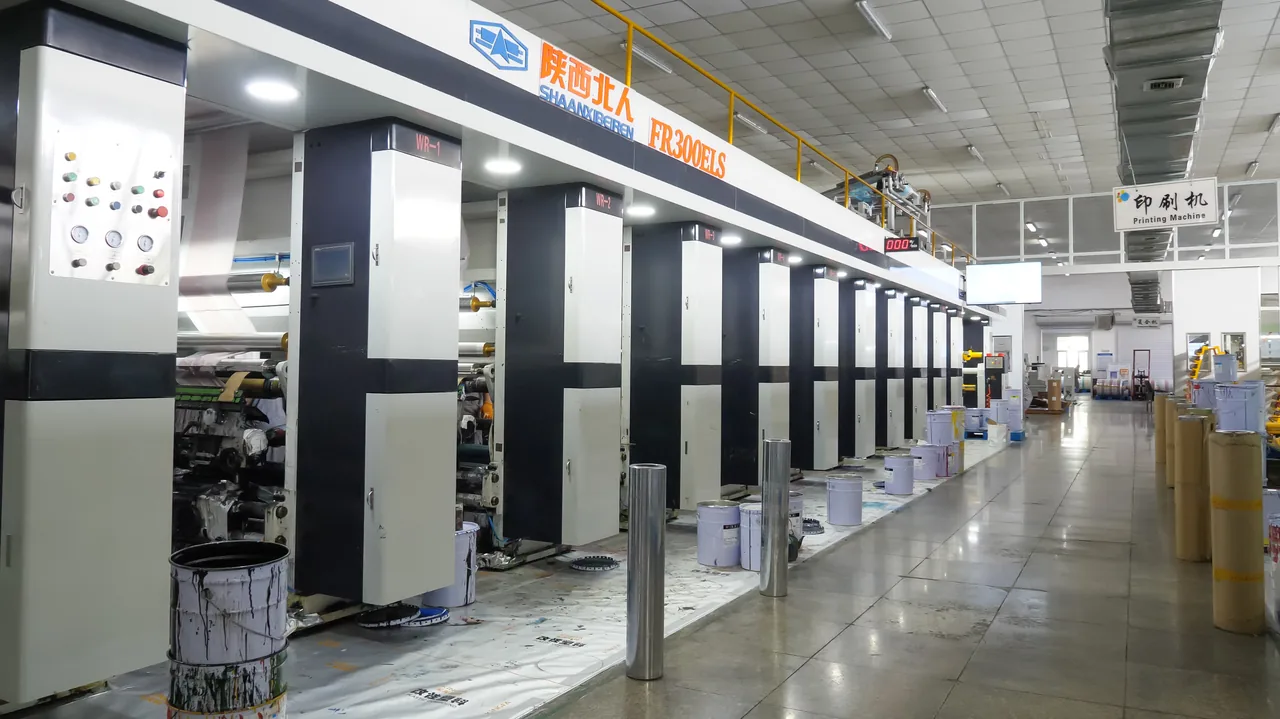
Gravure puts the image into tiny recesses called cells on a rotating cylinder. The cells fill with ink, a doctor blade wipes excess ink off the surface, and an impression roller brings the moving film against the cylinder to pick up the image. Successive printing units apply the separations, the parts of the design assigned to each ink. The equipment photograph shows how those units follow one another along the line. The Global Rotogravure Association explains how the cells transfer ink.
Now return to the cranberry file. Black letters printed over a solid field may affect a different set of separations from pale letters formed by leaving gaps in background inks. A white layer beneath part of the design can also have its own outline. Ask the person preparing the press files to mark the affected separations on the revised artwork. If the supplier can reuse some cylinders, have them identify which ones correspond to this layout and which the new version requires. A logo may look the same on both pouches even though its position has moved to fit a different panel. Give the printer both the drawing and the artwork revision when asking about reuse.
The film itself belongs in this discussion. On a reverse-printed clear outer film, the image is viewed through the film from the outside of the pouch. On a surface-printed structure, the image is printed on the outward-facing side, and the specification may call for a protective coating. Ask the printer to identify the ink side and viewing side on a sample. When reviewing a transparent window, for example, point to the edge where you expect the printed color and any backing white to stop.
Both routes still involve approving the artwork, choosing a compatible film and ink system, and converting the printed material into pouches. Depending on the structure, the converter may laminate the printed film to another layer before making the bags. Ask what leaves the printer at the quoted price. A roll of printed film and a carton of finished, counted pouches are different deliveries, even when the artwork and print quantity on the two quotes appear identical.
How many pouches will run with each design?
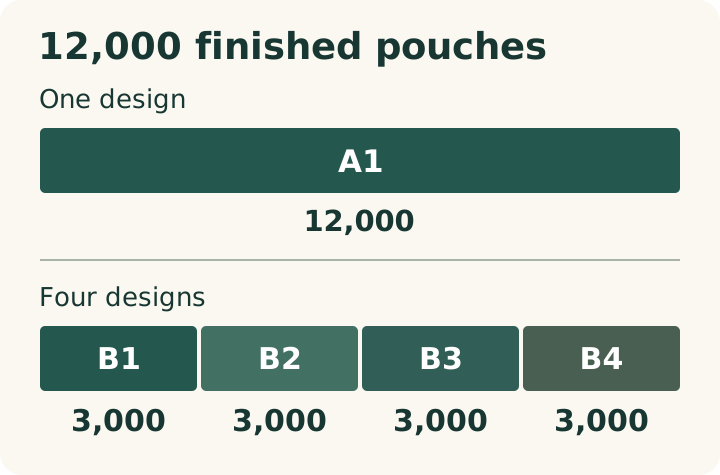
Imagine asking for 12,000 snack pouches. One plan uses a single design. The other divides the order across four flavors. For this example, hold the pouch dimensions, film structure, finish and delivery address constant. Send both plans to each supplier. If you ask for digital on the four-flavor plan and gravure on the single design, the quotes give you no way to separate the effect of the print method from the effect of dividing the order.
| Order plan | Finished quantity and artwork | What to ask the supplier |
|---|---|---|
| A · Single design | 12,000 finished pouches of A1; supply the A1 filename and revision. | Confirm the minimum quantity for A1 and the permitted delivery range. |
| B · Four flavors | 3,000 finished pouches each for B1, B2, B3 and B4; supply the filename and revision for each. | Confirm the minimum and delivery range for each version, and which versions can run together. |
For a possible second order, try the same exercise with an uneven split. Suppose B2 now needs 7,500 bags and each of the other three needs 1,500. You still need 12,000 altogether. Ask the converter whether the layout and schedule it priced for four equal runs can deliver this mix. If it proposes printing extra film for one flavor, find out who would pay for that film, who would hold it and what happens if the artwork changes before the film is made into bags.
A flavor name alone can conceal a second artwork version. If the front design is identical but one retailer needs a different back panel, list the two front-and-back combinations separately. Attach the corresponding file to each row. If a version is still awaiting approval, mark it pending and ask whether holding it back would delay the other three. That answer matters if a filling line is already booked for the approved flavors.
There are two quantities to settle with the supplier. One is the minimum the plant will schedule or bill, which may be expressed in film length. The other is the number of finished bags you need to receive for each flavor. If the quote uses meters, ask the converter to show how its layout translates that length into finished quantities and what allowance it made for setup and converting losses. Also ask how each version will be counted and identified on the carton label. An extra carton of one flavor cannot fill a shortage of another on packing day.
What changes the price of the first order and the reorder?
Ask the supplier to quote the four-flavor order three ways. In each case you want 3,000 finished pouches per flavor at the same delivery address. The first purchase has four new files. On the next purchase you might run them just as they are, or you might change one line on the back of B3. Those are two possible futures for the same order. Comparing them shows what that change would cost you.
| Pricing scenario | What to request from both suppliers | Charges and terms to compare |
|---|---|---|
| First order, B1 through B4 | Request a total and currency for 3,000 finished pouches of each design. | Itemize unit prices, proofs, any cylinder charges, press setup, pouch making and delivery; identify which are included or extra. |
| Repeat with all four approved files | Request a separate total for the same four versions and quantities. | Confirm file revisions, cylinder availability and storage where applicable, plus any setup or checking fees. |
| Repeat with B3 back copy revised | Request a separate total for revised B3 while B1, B2 and B4 remain unchanged. | Identify the B3 file revision, affected separations, any cylinder work and new proof; carry forward the other approved versions. |
Look at the basis of each charge before comparing totals. A proof might be priced per design, freight per shipment and engraving per cylinder. One quote may spread the first engraving charge across the pouch price. If the supplier does that, request a separate unit price for the unchanged reorder so you can see what you will pay after that first run. Write down who holds the cylinders, for how long and what happens if you reorder after the storage period.
For the B3 revision, mark the changed words on a copy of the approved artwork and attach the new file. Ask for a marked comparison of the old and new separations. Beside each affected cylinder, have the converter write whether it can use the one in storage, re-engrave it or needs a new one. Check that the quote charges for the work marked against this revision. Linking the fee to the B3 file also gives you a way to spot an old engraving charge that has accidentally been carried into all four repeat prices. On a digital reorder, ask who will check the revised file and whether the price includes a new proof. Our sister site pairs a photograph of stored gravure cylinders with a checklist for a coffee range whose wording or panel size has changed.
To compare one row, multiply each design’s finished-pouch unit price by its quoted quantity. Add the four amounts, then add any separately payable charges once. Compare totals in the same currency with freight, duty and taxes treated the same way. Dividing that total by the number of finished pouches gives the average price per pouch for this order. If the supplier can deliver or bill within a range, ask for the amount payable at both ends and how the allowance applies to each flavor. If the low and high ends of the range fall into different price tiers, ask which unit price applies at each end.
To see why the length of a run matters, circle the setup charges attributable to one design. A fixed cylinder charge spread over 12,000 identical pouches contributes one quarter as much per pouch as the same charge spread over 3,000. That arithmetic applies only to that fee. The supplier still has to quote the film, ink, number of cylinders actually needed and cost of changing versions before you can judge the whole job.
Check the dates on any two prices you intend to use together. If a reorder price assumes that the printer still holds the cylinders in six months, record that beside the forecast. If the supplier will confirm its film price only when the reorder is placed, mark the number as an estimate and keep the written cylinder terms alongside it.
Suppose B2 sells through while the other flavors still have several cases in stock. Get a separate quote for the quantity of B2 you expect to replenish, with price breaks around that quantity. Buying all four again to secure a lower average price ties up money in the other three designs. Estimate how much stock you could use before their artwork changes. Keep that inventory decision separate from the amount on the supplier’s invoice.
Which proof can approve color, small type and white ink?
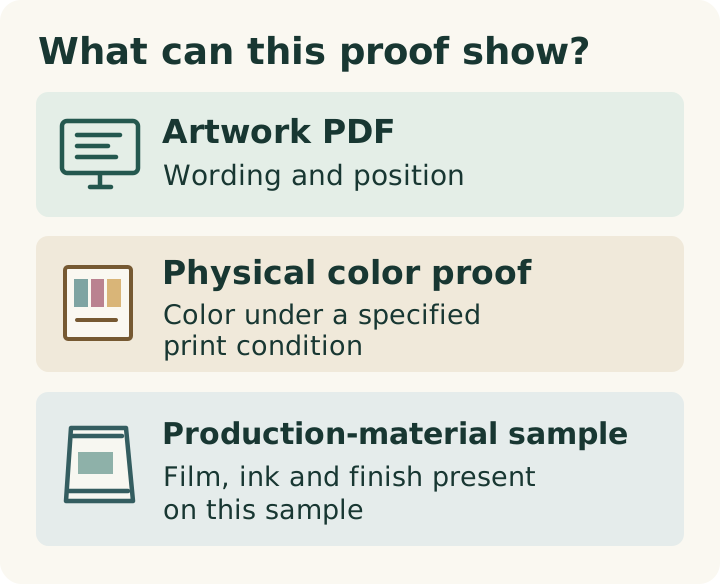
Take one detail from B3 through the approval process. Imagine the revised line sits in pale lettering on a dark back panel. Start with the full-size PDF and the approved pouch outline. Read the new words, check they appear on the right flavor and locate the line against the nearby seal or fold. Mark the file revision and page you checked. That gives the printer an unambiguous wording approval while the physical appearance is still under review.
For a brand color, ask what printing condition the supplier’s physical color proof simulates and which reference you should compare it with. The ISO 12647-7 summary describes hard-copy digital proofs made to simulate a defined printing condition. A proof can be useful for an agreed color target even when it is printed on another material. If the decision depends on the silver film showing through the design or on the opacity of a white underprint, request a sample that represents those particular features.
| Proof in hand | What you can review | What to record and leave open |
|---|---|---|
| PDF with the pouch outline | Wording, version and position relative to the outline. | Record the file revision and panel; leave final appearance on film open. |
| Physical color proof | The agreed color target under the stated proofing condition. | Record the proof ID, target and viewing condition; leave differences caused by production film, white backing or finish open. |
| Identified film sample or finished pouch | The detail reproduced on that sample, through any finishing steps it has undergone. | Record the sample ID, process, material and finish; list remaining checks and the next sample due. |
If that pale line is difficult to read on the pouch, put the approved file and the sample side by side and locate the same letters. Ask the printer to show the color and white separations for that spot. Is the lettering printed in an ink, left clear to reveal the layer underneath, or backed with white where the background has been cut away? Inspect the letter edges on the physical sample. Then tilt the pouch under the same light. A letter edge that stays soft and a reflection that moves across otherwise crisp lettering give the printer different things to investigate. Record what you see and request a sample with the proposed correction.
For the recheck, ask for the smallest sample that will settle the open question. A strip carrying the revised lettering and its dark background lets you examine the letter edges. If the concern is where that line falls once the pouch is formed, request the finished sample. Mark the same letters on both records so the next reviewer can repeat the inspection.
Finally, identify how far the sample went through production. A loose piece of printed film lets you examine the printed area while it lies flat. A finished pouch in the proposed structure lets you find that same area after lamination, cutting and sealing, including any lettering that now lies close to a seam. If you use a digital sample to plan a gravure run, name the specific details you approve on it and agree how the remaining ones will be checked on the production route. Keep the reference sample and its approval note together so the team handling the reorder knows which version and conditions it represents.
Two snack pouches made with different print methods
Look at the three upright energy-bar pouches in the photograph. Each has a black wordmark on a white front. Lower down, purple, red and orange fruit illustrations distinguish the varieties. Even the small band above the artwork changes color. The 55 g energy-bar pouch record identifies the method as digital printing and gives the size as 9 × 13 cm. The photo shows which elements vary. You would need a production record to establish whether those designs went through the press together.
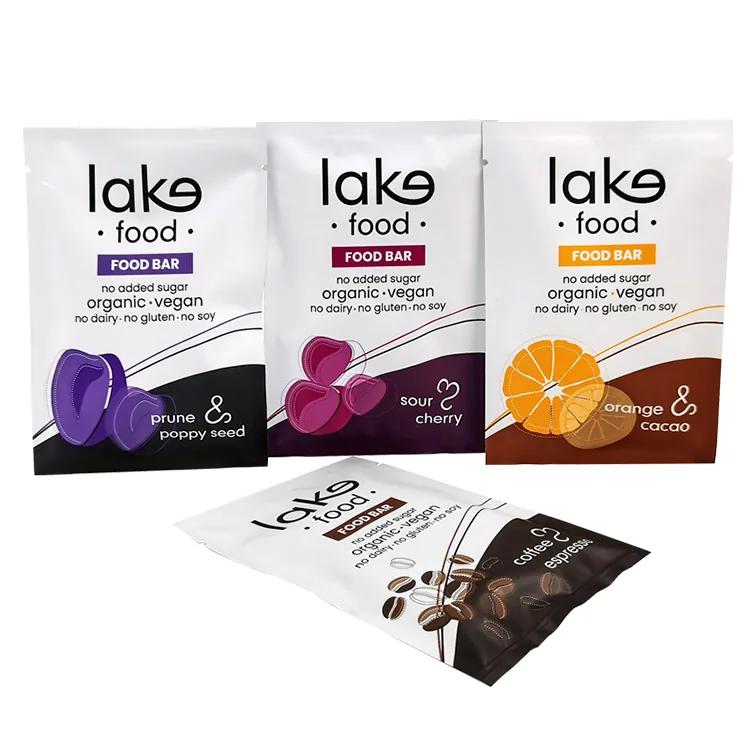
If your own range looks like this, send the converter the complete front and back of each variety. The common wordmark gives the printer a reference to keep consistent. The different fruit drawings, names and colored bands identify areas to check version by version. Pair each front with its corresponding back before signing. A neatly printed cherry front attached to the artwork for the orange back would still be the wrong bag.
The 12 g dark-chocolate sachet record identifies gravure printing on an 8 × 8.5 cm pouch. In the photograph, the percentage of cocoa sits inside a dark rectangle. The small net-weight line sits just below it on the pink background. A buyer reviewing a similar layout could circle those two lines and ask for an actual-size print sample. That gives the reviewer two specific places to inspect, each with different surrounding artwork.
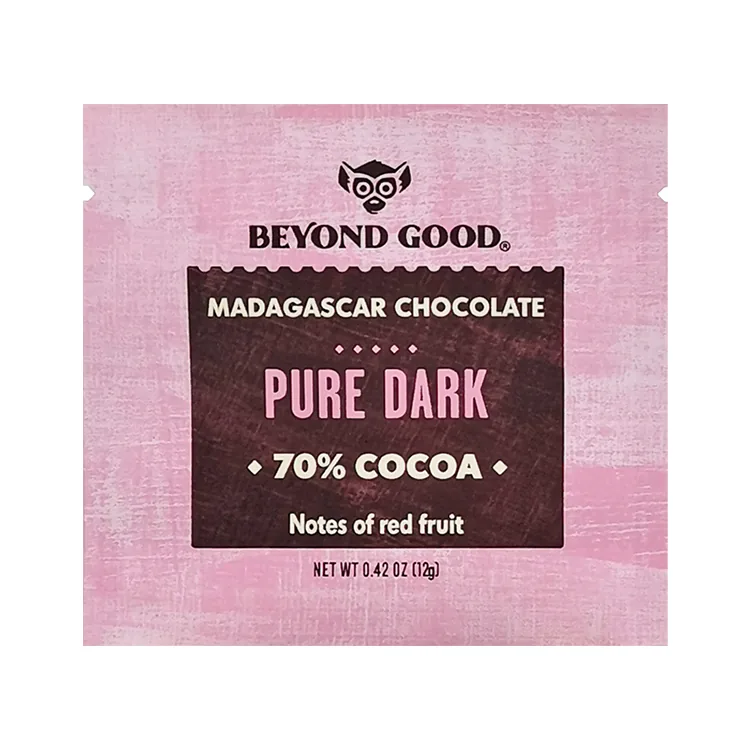
Both records describe three-side-seal pouches and list MATOPP / VMPET / PE. The two specifications tell you that a similar film structure can carry either print method. To compare the jobs commercially, you would also need the quantity of each design and the prices actually quoted. To judge the color, you would need the approved target and samples printed to it. For your own range, send each printer the same file with one brand color and one line of type marked. Ask each to identify the film and finish on the sample it returns. If those differ between the samples, agree how to check the print process itself before signing.
What to send for a comparable printing quote
For a trial in which the flavor names are still being edited, attach the current version list to the digital printing brief. Give a date for final copy and ask when the printer needs the approved files. This separates the time your team needs to finish the wording from the time the supplier needs to print, convert and deliver the pouches.
For a steady seller, use the gravure printing brief to request prices at quantities you could actually replenish in one order. If one variety sells every week and the other three are seasonal, give the steady seller its own forecast. Ask for a separate price for the seasonal designs. If the range would use two print methods, identify any colors that must match when the packs sit together and ask to review samples from both routes before committing.
For the four-flavor order, the email can be short.
Please quote finished three-side-seal snack pouches in the size, film structure and finish on the attached specification. We need four designs, 3,000 finished pouches of each, delivered to the destination shown. The file list pairs each front with its back. Please identify the print method, what the physical proof will show and which costs are included in the delivered total. Quote an unchanged repeat separately. For a second repeat scenario, assume that only the wording on B3 changes and show any revised preparation and proof charges.
If the final dimensions are still open, send the product dimensions or a filled sample and label the pouch dimensions as provisional. Ask the supplier to identify the assumption used. Once you settle the size, have both quotes updated against the same dated drawing before choosing a print route.
Keep a copy of the accepted quote beside the file list. A purchasing description such as “mixed snack bags” gives the receiving team little to check against the cartons. A line for each design, revision and agreed quantity lets the team spot a shortage of one flavor even when the total count on the delivery slip looks right.
Frequently asked questions
Is rotogravure the same as gravure printing on a pouch quote?
For a roll of packaging film printed with engraved cylinders, the terms usually refer to the same process. Check what the supplier will deliver. A price for printed rollstock still leaves slitting or pouch making to whoever has agreed to perform those operations. A price for finished pouches should identify the finished dimensions and delivery quantity.
Can different flavors share one print run?
They may be able to share a run if the converter can arrange the designs on compatible film and produce the quantities you need. Submit the desired count for each flavor. If a supplier proposes a combined run, ask how many finished units of each design it will deliver and how it will identify each version on the cartons.
Do I pay for all the gravure cylinders again if I change one line?
Have the printer mark the affected color separations on the revised file and match them to the cylinders it still holds. One visible line can involve more than one separation, particularly if the artwork includes a white backing. Match the listed cylinder IDs to the line items on the new quote.
Can digital printing reproduce a brand color or white ink?
Ask which ink set the proposed press will run. For a brand color, specify whether a process-color simulation is acceptable or a dedicated spot ink is required. For white, identify where the artwork needs an opaque backing and where the film should show through. Supply a physical reference for the appearance you want.
Can a digitally printed sample approve a gravure production run?
You can approve the wording or layout on an identified digital sample. Color approval depends on how well that proof represents the agreed gravure printing condition. Record which attributes you approved, keep the sample ID, and specify what still needs review on the production material.
When should a growing food brand ask for a gravure quote?
Request the comparison when you can identify a design likely to return in its current form and estimate its next order size. Use that design's sales forecast and the packaging stock you can carry through the next artwork change. Request a printing comparison with those figures and the feature you need the proof to demonstrate.