
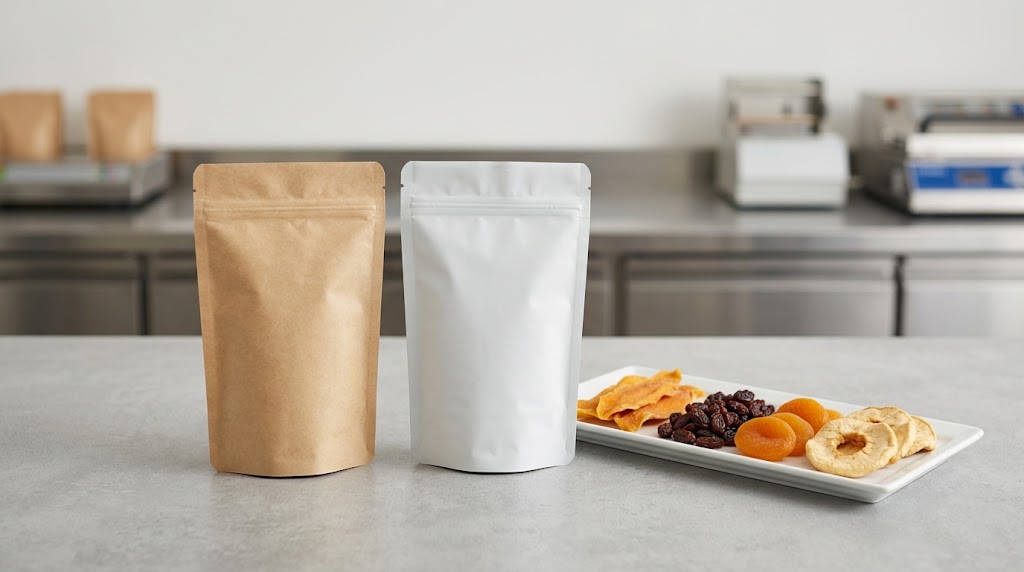
How long does dried fruit last? There is no reliable number for every dried mango strip, raisin, date, cranberry or apple slice. The answer depends on the finished recipe and drying process, the product's condition when packed, its packaging and seal, the storage route, and the quality and safety criteria set by the food business. A specified pouch can help limit moisture or oxygen exchange; the word “Mylar,” a silver appearance, or a zipper cannot establish a date. For a commercial product, compare representative, initially heat-sealed packs from identified batches at planned intervals under the conditions in which they will actually be sold and stored. The responsible food business must approve the product's safety, date and label instructions from its own evidence.
This article addresses human-edible, conventionally dried or dehydrated fruit in retail flexible bags. Some products are chewy, some leathery, and some are deliberately crisp. Freeze-dried fruit has a different physical structure and usually a different texture target; it deserves a separate package and shelf-life study. Here, “dry fruits” means dried fruit, not a mixed category of nuts, beans or other dry goods. Household dehydration instructions and a supplier's bag advertisement do not provide a validated commercial shelf life.
Decide What “Last” Means for the Actual Product
Before deciding whether a fruit “lasts,” ask what endpoint matters. A food can remain visually appealing yet need a food-safety review. Another lot can pass its safety controls while no longer meeting the brand's promised texture, color or flavor. A torn package raises a separate question about exposure and disposition. Treat these as different decisions with different owners.
| Decision | What the team defines before testing | Evidence that can help | What it does not prove |
|---|---|---|---|
| Food-safety acceptability | Hazards and limits for the actual fruit, process and route | Approved process controls, appropriate product tests, sanitation and handling records | An attractive cut face or a pleasant smell is not a safety test |
| Quality or best-eating period | Acceptable texture, color, aroma, surface and usability | Baseline and periodic comparisons of representative lots | A quality score cannot replace the safety decision |
| Package performance | Required protection and integrity of the finished bag | Specified film data, filled-pack seal and leak checks, storage and transport trials | One film number does not describe every converted pouch |
| Label and date decision | Which date and instructions are justified for the selling market | Combined food, package and distribution evidence with an accountable approver | A pouch supplier cannot assign a universal date to a customer's food |
For example, a soft dried mango that becomes firmer may fail a brand's quality criterion even when no visible mold is present. A bag with droplets, a broken top seam or unexpected off-odor needs a controlled investigation, not a quick taste test. One observation does not identify the cause. The same symptoms can start before packing, at a contact layer, across a film, at a seam, or during storage.
The format matters too. A whole date, a cut date filled with another ingredient, a sweetened cranberry, a dried apple ring and a coated fruit piece are not interchangeable trial units. Ingredients and pretreatments can change water binding, acidity, color behavior and what touches the inner film. The pack's portion size and the ratio of product to headspace also change. A study on one SKU should not silently approve a mixed assortment or a new cut thickness.
Separate unopened, opened and distributed packs
An unopened retail bag begins with its initial heat seal intact. A multi-serving pouch after opening has a different barrier and handling history, even if its zipper closes neatly. A pack that has ridden in a parcel, sat near a sunny display or moved through a temperature transition has another history again. Record which state a sample represents. “How long will it last?” without that context is not a usable specification.
If a producer already requires a particular storage route, follow it until a different route has been assessed and approved. A converter can propose films and closures for a stated route; it cannot make a temperature-sensitive formula safe at room temperature by changing a bag. Product instructions should come from the food business's assessment of the actual food.
Establish the Fruit's Condition Before Closing the Bag
Shelf-life work starts before the pouch. Write a concise product brief for each intended selling unit: fruit variety and source, size range, pretreatment, recipe and ingredient version, drying method, finish and cool-down conditions, target mass, any contact wrap or coating, and the production lot. Photograph ordinary pieces as well as the best-looking pieces. A sample that begins with a wet patch, damaged skin, unusually thick section or visible syrup is not a fair test of two candidate bags.
The FDA's water-activity technical guide explains that water activity affects stability and needs to reach a suitable level at the end of drying and remain within an acceptable range in storage. Water activity, commonly written a_w, describes the availability of water in the food system at a specified measurement condition. Moisture content describes the total amount of water. They are related, but the same moisture percentage need not produce the same water activity in two different fruit formulations. Sugar, acids, other ingredients and process history affect the relationship.
In its draft, nonbinding preventive-controls guidance, the FDA specifically notes that dried fruit can have a range of moisture levels while still looking like “dried fruit,” so the relevant products need careful water-activity control for food safety. The draft also discusses preventing rehydration during expected storage and distribution. Those points support measuring and managing a real product; they do not give every fruit one safe percentage or authorize copying a number onto a label. See the FDA draft guidance, Chapter 4.
Low water activity must not be confused with sterilization. An FDA-listed study of dehydrated apple slices examined Salmonella survival after a particular inoculation and drying experiment. It is not a claim that an ordinary apple slice has those numbers. It illustrates why the food business needs appropriate raw-material, process and sanitation controls before a pouch is sealed. A stronger barrier cannot eliminate contamination already present in a finished food.
Control variation within a batch
Different pieces may leave a dryer in different states. Cut thickness, size, position and syrup or coating distribution deserve attention. The University of Georgia's National Center for Home Food Preservation guidance explains the principle of uneven moisture in home-dried fruit and warns that apparently dry food can spoil after it reabsorbs moisture. Its home “conditioning” instructions and household storage times are not a commercial production recipe or a retail shelf-life claim. A commercial processor should use its own validated process, product limits and documented lot release.
For a trial, retain a same-batch reference, a record of the product's initial condition and enough sealed units to sample without reopening the same pouch at every checkpoint. If one batch varies widely at baseline, improve the product or process control before comparing two films. Otherwise a difference blamed on a pouch may simply reflect different starting pieces.
| Record at packing | Why it matters later | Practical evidence |
|---|---|---|
| Fruit and ingredient version | A new source, sweetener or pretreatment changes the product | Formula and supplier lot |
| Piece geometry and distribution | Thick and thin pieces may not have the same surface or drying state | Size range and photographs from several positions |
| Product measurements | The initial state anchors later comparisons | Method, instrument, temperature, representative sampling and results |
| Cooling and pack-room exposure | Warm or exposed fruit can alter headspace and moisture state | Time, room conditions and approved pack-before-seal procedure |
| Pouch and contact materials | A material substitution invalidates a simple comparison | Full construction, lot, window and inner-layer specification |
| Filling and seal settings | Crumbs, folds or sticky fruit near a seam can make a local path | Filled samples, rejected samples and setup record |
| Storage and distribution plan | A cool warehouse and a hot parcel route are not the same exposure | Intended route and monitoring plan |
Watch for Several Different Failure Pathways
Moisture moves for several reasons. A dried fruit can take up water from humid air before filling, through a permeable material over time, through a compromised seal, or after the consumer opens the bag. Some products may lose moisture and become firmer under a different set of conditions. Local moisture can also redistribute between pieces. Do not infer the direction of moisture movement from the word “hard” or “sticky” alone; compare the starting product with measurements and pack history.
Color and flavor can change for reasons beyond water. Ingredients, exposure to light and oxygen, temperature, pretreatment, and initial fruit condition all matter. An oxygen-transmission figure can be relevant to a product whose quality is oxygen-sensitive, but that figure does not establish the chemical mechanism of a particular dark spot. A clear window can aid display and inspection while introducing a different material and possible light exposure. Assess the actual window, its joint and the filled bag rather than applying the opaque panel's specification to the entire pack.
Insects or visible mold are not ordinary “staleness.” Investigate incoming fruit, processing environment, storage and package integrity, and follow the food business's hold and disposition procedure. The National Center's home guidance says moldy dried food should be discarded; a commercial complaint still requires lot-level investigation. Do not recommend trimming a visibly suspect piece or tasting an abnormal sample to make a safety decision.
| Observation | Possible paths to investigate | First useful comparison |
|---|---|---|
| Chewy pieces become excessively firm | Starting drying state, moisture loss, storage temperature or formulation | Same-batch reference, product trend and sealed-pack history |
| Pieces stick or clump | Initial syrup/coating state, pressure, moisture redistribution or ingress | Baseline photos, pack positions, a_w and seal inspection |
| Surface darkens or aroma shifts | Fruit and pretreatment variation, light, oxygen, heat or contact material | Same-batch control, film structure, display exposure and sensory plan |
| Droplets are visible | Pack-before-seal condition, temperature change, ingress or an opening event | Locate inside/outside water, inspect unopened seal and review timeline |
| Localized change near a seam | Fold, trapped piece, seal contamination or abrasion | Photograph seam location and examine comparable rejected bags |
| One layer shows transfer or marks | Contact compatibility or pressure pattern | Identify the contact face, compare alternative approved material |
| Mold, insects or an unexpected odor | Product, facility, storage, damage or contamination | Quarantine per food-business procedure and preserve lot evidence |
These are hypotheses, not diagnoses. A visible condition may have more than one cause. The most useful complaint record states when the change was first seen, whether the package was still unopened, which lot and position were involved, and what an unaffected same-batch sample looks like.
Read Packaging Data at the Level It Was Measured
Choose a pouch construction for the fruit's actual concerns. Ask what each layer does: print and appearance outside, structural support, any moisture or oxygen barrier, and the inner food-contact and sealing layer. A kraft-paper appearance, reflective coating, “foil look” or thickness alone cannot tell a buyer the performance of the finished bag. The exact laminate and tested conditions matter.
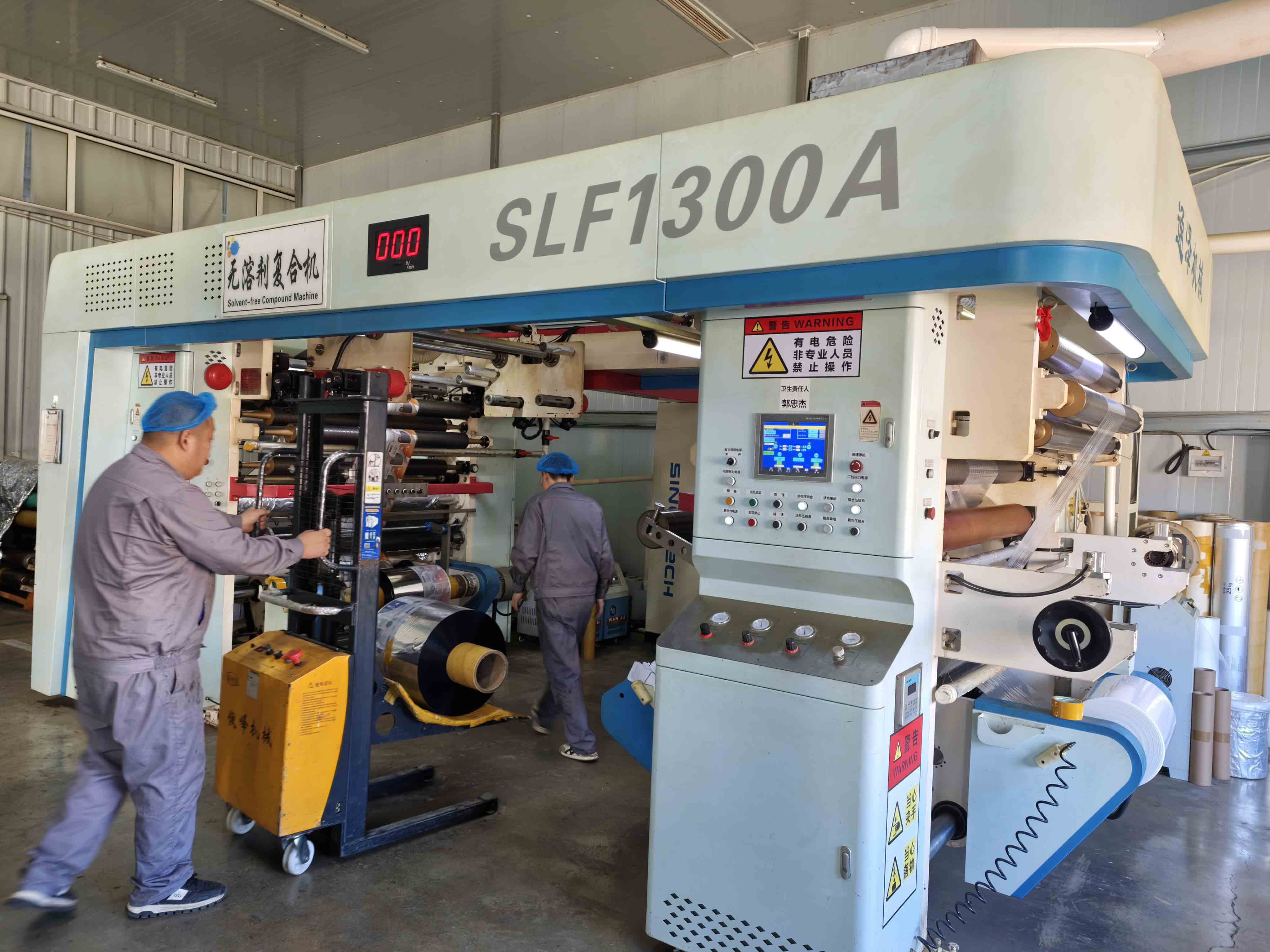
Water-vapor transmission rate (WVTR) describes water vapor moving through a specified film or sheet under stated test conditions, often reported as mass per area per day. ASTM F1249-25 is a method for measuring WVTR through plastic film and sheeting with a modulated infrared sensor. Oxygen transmission rate (OTR) is another measurement, often reported as gas volume per area per day: ASTM F1927-20 determines oxygen-gas transmission at a given temperature and controlled relative humidity. The two rates are not interchangeable. Keep their exact units, temperature, relative humidity, method, specimen structure and sample lot beside any supplier number. A result measured at one humidity cannot be compared casually with a result from a different condition.
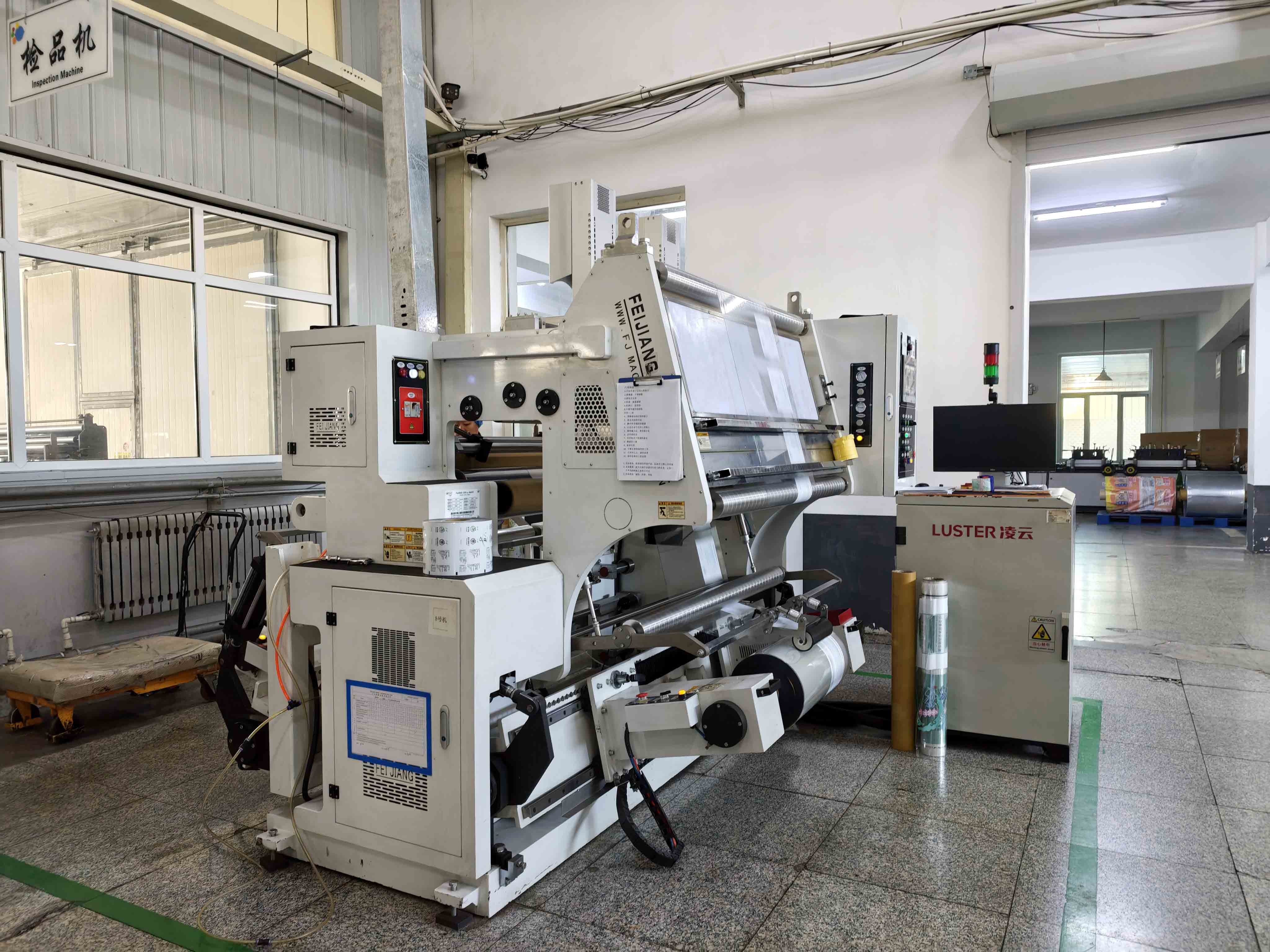
Film data is a useful screening tool. Converting adds side seams, bottom gussets, notches, a possible window and a top heat seal. A filled package adds pressure from the fruit, a sealing process, handling and distribution. None of those can be read from an unconverted film coupon. Ask what was tested, whether it was a flat specimen or an actual pouch, and what acceptance criterion the food team uses for the complete pack.
| Packaging statement | What to request | What it cannot establish by itself |
|---|---|---|
| “High barrier” | Complete material structure and relevant WVTR/OTR reports with conditions | A guaranteed date or performance at an untested window and seam |
| “Food grade” | Documentation for the actual contact layer, food type, use conditions and destination market | Safety approval for every similar-looking polymer or every recipe |
| “Foil” or “metallized” | Identify aluminum foil, metallized film, printed effect or another layer | A barrier number based on appearance alone |
| “Resealable” | Zipper position, first heat-seal design and consumer-use trial | An unopened-pack barrier after the initial seal is broken |
| “Fits 200 g” | Filled sample with actual fruit, size range and seal clearance | Capacity for a different fruit density or piece shape |
The FDA's food types and conditions-of-use tables are a reminder that food-contact suitability is tied to the intended food and use. The supplier should identify the actual contact surface and provide applicable documentation for the target market. An outer print film and an inner food-contact layer have different roles. Do not convert a general “food safe” badge into an approval for any untested structure or storage condition.
Keep the first heat seal separate from a zipper
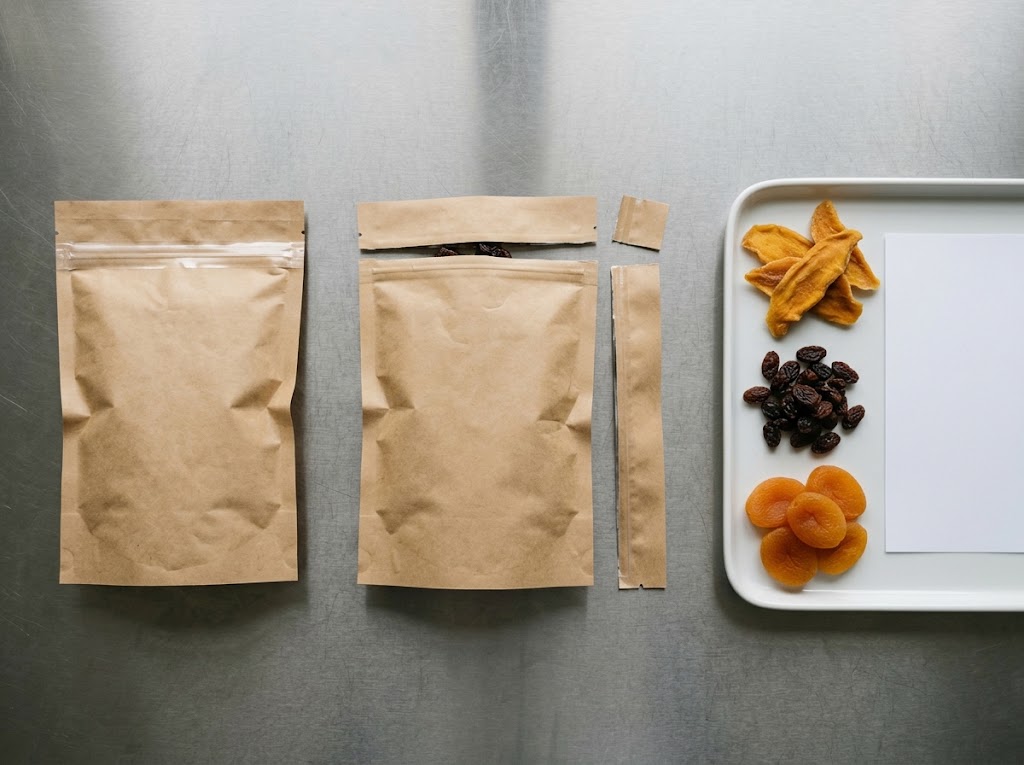
For an unopened retail pouch designed with a top heat seal, the zipper sits below the tear or cut zone. The packer fills to the approved level, leaves the seal area free of pieces, syrup and folds, then applies the specified heat-seal process. A zipper may help a consumer close a multi-serving bag after opening. It does not replace a required first heat seal and does not restore the conditions of an unopened shelf-life study.
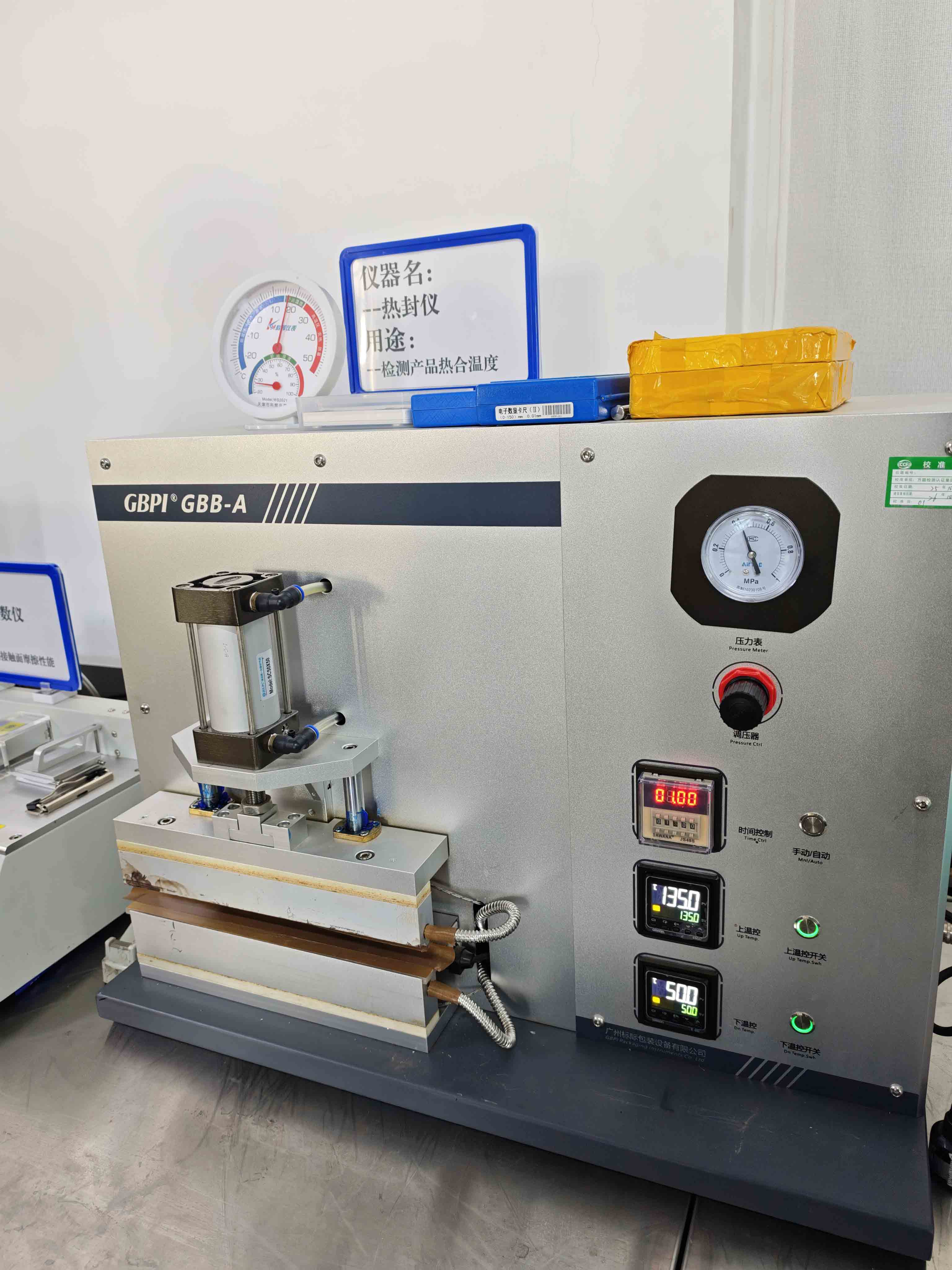
Confirm sealing settings on the actual construction and equipment. Check the seal's width, location, continuity, opening behavior and sample performance. ASTM F88/F88M-23 measures the strength of a sampled seal. A strength value can help monitor a process, but a strip from one location is not proof that every filled bag has no leak or channel. Use an appropriate whole-package integrity and handling plan as well.
A related pouch case, with a clear boundary
A published 200 g kraft-look stand-up pouch project for superfoods lists Australia, digital printing and a MATOPP/kraft-paper/VMPET/PE structure. It is a concrete example of an outer appearance, a metallized layer, an inner sealing layer and a retail stand-up format. The public project discusses superfoods and berry powders; it does not identify a particular dried-fruit SKU or provide a measured shelf-life result for one. Its 200 g label and dimensions are project-specific and must not be copied as the capacity or performance of a bag for another fruit.

That distinction makes the example useful. A buyer can ask for the same kinds of facts—full structure, fill and seal drawings, contact-layer documentation, and relevant barrier reports—without assuming that a powder bag automatically suits whole dried fruit. Long, stiff slices and irregular pieces may demand a different opening, puncture tolerance or handling test. The correct filled sample is the one with the actual food.
Compare Storage Routes Rather Than Borrowing a Date
The University of Georgia household guidance recommends cool, dry, dark storage and explains that heat and repeated opening can lower the quality of home-dried foods. It provides household time ranges, but a commercial brand should not print those numbers on a retail bag without product-specific validation. A manufacturer's own pretreatment, recipe, package construction, distribution and target market may be different. A bag supplier's “months longer” statement is equally insufficient without the comparison design and results.
Map the intended journey. Identify the time between drying and filling, the pack-room environment, warehouse conditions, transport route, retail display, and how the customer opens the bag. Record actual exposures where feasible. If a chilled route is prescribed for the product, do not promote ambient storage based on a stronger-looking film. If an ambient route is under consideration, the food business must determine whether the actual product and process support it.
| Route or state | What may change | Sample or record to keep |
|---|---|---|
| Product waiting before packing | Moisture uptake, surface condition or physical damage | Time, room conditions and pre-pack product sample |
| Initially sealed warehouse pack | Product and package trend in the approved storage environment | Sealed lot units, location and conditions |
| Transport and retail | Heat, humidity, compression, abrasion or display light | Representative shipped units, route notes and arrival photographs |
| Opened and reclosed multi-serving bag | Repeated air exposure, handling and closure use | Separate use trial and realistic consumer instruction |
| Excursion or complaint | A departure from the intended route, potentially localized | Unopened return, retained control, time and lot history |
Opening the same test bag every week destroys the clean distinction between unopened and opened states. Use separate units for planned destructive checks. Keep another group of unopened retained packs for an unexpected complaint or later examination. A control held in a different environment should be labeled as such; it is a comparison, not a substitute for the actual selling route.
What does “go bad” mean when a bag looks fine?
A bag can look intact while its contents no longer meet a texture or aroma standard. Conversely, a fruit piece can have a natural color variation that requires comparison with baseline rather than an automatic packaging diagnosis. A sealed pouch cannot certify freedom from a hazard introduced before packaging. For a suspect lot, follow the food business's hold, testing, traceability and disposition procedure; do not rely on a consumer taste test or the absence of a visible defect.
Build a Study Around the Proposed Date
Write the question before collecting samples: “Under the defined distribution and storage route, does this exact fruit in this exact finished pack meet our written safety and quality criteria through the date we propose?” Name the recipe and process revision, fruit size distribution, pouch structure and lot, contact surface, fill weight, seal process and storage conditions. Specify whether the result applies to an unopened bag, a single-serving pack, or a bag repeatedly opened after sale.
Set checkpoint timing, sample count and batch coverage with the food and quality teams. At minimum, distinguish baseline, one or more intermediate observations and a proposed end point. The number and spacing depend on the risk, product variability and intended date; one bag at the end cannot establish the range of manufacturing behavior. Define acceptable changes before seeing the results so a deteriorated sample is not reclassified after the fact.
| Planned checkpoint | Package check before opening | Product check after controlled opening | Decision owner |
|---|---|---|---|
| Baseline | Identity, fill, first seal, folds, window and visible marks | Representative appearance, texture, measurements selected for the product | Food and packaging teams set the starting reference |
| Intermediate | Position-specific marks, seam condition, distortion or droplets | Trend against baseline and same-batch control | Food team reviews quality and safety signals |
| Proposed end | Complete pack condition and exposure record | Prewritten quality criteria and product-specific safety assessment | Responsible food business approves or rejects the proposed date |
| After-opening trial | Initial seal documented before first opening, then closure wear | Realistic handling and remaining-product quality | Food business sets any after-opening instruction |
| Failure or excursion | Photograph the unopened state and preserve the pack | Investigate under approved procedure; do not taste a suspect unit | Quality and food-safety personnel decide lot disposition |
For each unit, record a sample ID, production and pouch lot, date, condition, shelf or carton position, package state, measurements and method, photograph view, and assessor. Use comparable lighting for product photos. If a fruit has several natural shades, define the accepted range with a reference rather than judging from an edited product shot. Texture can use a consistent sensory scale or an appropriate instrument method. A water-activity reading belongs to a defined sample procedure and measurement temperature, not to a detached bag-material chart.
Safety criteria depend on the actual food and process; quality criteria depend on the brand promise. Do not use a single a_w result to conclude that an entire sanitation program was successful. Do not treat a favorable WVTR result as a completed food trial. If accelerated exposure is used to compare candidates, show how that exposure relates to the intended route. Extra heat can create changes unlike ordinary storage, so a quick accelerated test is not automatically a calendar-date conversion.
Investigate a Failed Sample in the Right Order
When a planned sample fails, preserve the evidence before changing material. Photograph the unopened bag, identify the affected location, and compare it with a same-batch retained unit and with bags from other positions. Ask whether the symptom was present at baseline, follows a fruit batch, follows a pouch lot, appears only near a seam, or appears only after a storage excursion. A change shared by every sample, including a reference under its defined condition, points to a different investigation than a change confined to one damaged corner.
| Reported issue | First comparison | Next controlled question |
|---|---|---|
| A few pieces are unusually wet | Initial piece variation and position in the bag | Does the problem follow product size, pretreatment or a local pack path? |
| Every bag becomes hard at a similar time | Same-batch reference and product measurements | Does the trend follow the food, route, or a specified film change? |
| One top seam has a visible channel | Filled-pack photographs and sealing rejects | Did product, a fold or setup affect that location? |
| A window area changes color | Opaque side, display-light exposure and window construction | Is the observation location-specific and reproducible? |
| Only shipped packs show marks | Retained warehouse packs and carton positions | Did handling, compression or a temperature transition create the change? |
| Only opened packs deteriorate | Still-unopened controls and opening count | Are consumer instructions, serving size or reclosure design appropriate? |
Do not assume the pouch alone caused the failure, and do not assume a visible food problem can be fixed with a thicker pouch. Assign tests to the right team. The food producer investigates recipe, drying, process hygiene and product safety. The packer reviews filling, sealing and rejects. The converter supplies the complete material specification and relevant film or seal evidence. The distributor contributes route history. The quality team brings the records together and decides what can be claimed.
The same discipline prevents a misleading “improvement.” A new foil-containing material may look more protective, but it must fit the filling and sealing process and meet the intended food-contact conditions. A smaller bag may reduce headspace but compress fruit and put pieces into the seal zone. A clear window may help consumers see the product but change the protection profile. Approve the whole system, not an isolated adjective.
Turn the Evidence Into a Useful Pouch Brief
When discussing customized dried-fruit packaging, send a representative finished fruit sample and a short written brief: fruit and ingredient versions, piece-size distribution, fill mass and volume, initial condition, target market, approved storage route, proposed date to investigate, filling method, initial seal process, single- or multi-serving use, window and zipper needs, and the problem the current package has to solve. Ask for the full construction, contact-layer documentation and test reports with methods, units and conditions. The supplier can help compare candidate film structures and provide filled-pouch samples.
If two candidate bags look alike, run them with the same fruit lot and packing conditions. Document the difference you hope to see: less moisture uptake, less unacceptable hardening, better seam consistency, fewer scuffed pieces, or a clearer product view within the necessary protection. Establish a test and acceptance rule for each. The food business then decides whether the complete evidence supports its intended date and instructions. This is a more useful inquiry than asking a converter, “How many months does this bag add?”
Frequently Asked Questions
How long do dried fruits last in an unopened bag?
No one duration fits every product. Identify the fruit, treatment and process, starting product condition, complete pouch and seal, and storage and distribution route. Test representative sealed units through the proposed period against criteria written by the food business. A general household time range or another brand's printed date is not a substitute.
Does dried fruit go bad if it looks dry?
Yes, it can. Dried food can reabsorb moisture, change quality or be affected by a hazard that appearance does not reveal. The National Center for Home Food Preservation warns that apparently dry foods can spoil if moisture returns. A commercial producer should investigate suspect lots under its own safety plan.
Is a hardened piece automatically unsafe?
No single texture observation establishes safety or the reason for change. Compare the same-batch reference and initial measurements, packaging and exposure history. A hardened piece may fail a quality target even when the safety assessment is separate. Do not treat a soft piece as automatically safe either.
Can dried mango and raisins use the same shelf-life date?
Only if the responsible food business has evidence that the chosen products, processes, packs and routes are covered by the same validated decision. Their piece geometry, formula, pretreatment, initial condition and quality targets can differ. A shared “dried fruit” category is not enough.
How long is dehydrated fruit good for after opening?
An opened pack has a different exposure and handling history from a heat-sealed one. The appropriate after-opening period and storage instructions need a product-specific use study and label review. A zipper helps reclose a bag; it cannot restore the unopened trial conditions.
Does vacuum sealing or a high-barrier Mylar pouch guarantee years of storage?
No. A material name or tight-looking bag does not prove food safety, an effective first seal, the product's initial state, or a calendar date. Evaluate the complete, filled, sealed package with the actual food under intended conditions. Any vacuum or gas process also needs product and pack validation.
Should every dried-fruit pouch contain an oxygen absorber or desiccant?
No universal packet requirement follows from the fruit name. Define whether oxygen or water vapor is the actual quality concern, review compatibility and intended contact conditions with the relevant suppliers, and test the finished pack. An insert does not repair a wet product, a contaminated seam or an unsuitable pouch.
Is the “best before” date the same as a safety deadline?
Date terminology and obligations depend on the selling market and product. Do not use one phrase as a universal legal rule. The food business should distinguish its quality target from its safety assessment and approve the actual label with its responsible regulatory team.
What if I see condensation inside a sealed dried-fruit bag?
Keep the unopened bag and lot details for investigation. Note where water appears, when the product was packed, and whether the pack moved between temperatures. Compare other units and the initial product state. Visible droplets do not by themselves reveal whether the cause was filling, storage, a seam or product variation.
Does a low WVTR number tell me how long the fruit will stay fresh?
It describes water-vapor transport through a specified test specimen under stated conditions. It does not by itself measure fruit quality, a zipper after opening, a damaged window or each finished pouch's seal. Ask for the method, units, conditions and whole-pack evidence relevant to the intended route.
Can I use the same result for freeze-dried fruit?
Not automatically. Freeze-dried fruit is typically assessed against a different texture and moisture-pickup target, and its physical fragility can change filling and transport outcomes. Design a separate finished-product and filled-pack study for that SKU.
Who sets the shelf life: the fruit producer or the bag supplier?
The food business is responsible for its product, process, safety assessment, quality criteria, date and instructions. A pouch supplier can document materials, contact-layer information, samples and package-related tests. Those inputs help the food business make a decision; they do not transfer the decision to the supplier.