

An “eco-friendly” supplement pouch is not a single material. A useful choice begins with the supplement's protection and filling requirements, then compares ways to reduce material or support a verified end-of-life route without creating more damaged product. Ask for the complete bag structure, filled-pack trial results, and evidence for each environmental claim in the market where the pouch will be sold. The word “green” on a sample is not that evidence.
This guide addresses flexible bags for human dietary supplements sold in the United States: capsules, powders and outer retail pouches for individually wrapped servings. It is a purchasing framework, not a certification of a Mylarbag material or a lifecycle assessment of particular competing bags. Packaging contact, product quality, label approval and any environmental claim require evaluation for the final structure and use. The FTC Green Guides caution against broad, unqualified general environmental-benefit claims. A brand should state a precise attribute only when it can support it.
Define what “better” means before comparing sample bags
One team may want a lighter bag per selling unit. Another may prioritize an established collection route in its sales region. A third may want less waste from excess empty space, fewer rejected fills or a package that keeps its supplement acceptable for the intended period. Those are different objectives. Put them in order for the specific SKU before asking for a “sustainable” material. Otherwise a supplier can show a striking kraft-look finish or an attractive green logo while the actual pouch uses a structure the team has not evaluated.
Describe the product and channel first. Is this a small powder refill used several times a week, a capsule bag opened daily, or an outer sleeve of sealed stick packs? Will it be stored at ambient conditions defined by the product owner, sent by parcel, or displayed under retail lights? Which part of the package touches the contents? What minimum or maximum filled size must the bag tolerate? If the brand already has a stable, tested package, make that the baseline for comparison. Replacing it with an untested material and then discarding spoiled supplements would defeat the project's stated waste goal.
| Decision to make | Evidence to request | Why the answer matters |
|---|---|---|
| Contact and storage | Final layer structure, intended contact and conditions; product's storage program | A material name or “food grade” slogan does not cover every supplement use |
| Protection | Comparable film data and a trial of the finished bag with the product | Seals, zipper, window and package geometry can alter the result |
| Material use | Mass per finished selling unit at an acceptable fill range | A thinner film may require a larger bag or lead to more rejects |
| End of life | Complete bag components and a supported collection/processing route | A PE layer alone does not establish consumer recyclability |
| Claim | Exact proposed wording and evidence for target market | “Eco-friendly,” “recyclable” and “compostable” are different claims |

A practical baseline sheet can use the existing bag's material mass, dimensions, filled capacity, reject causes and customer complaints. The brand's own stability and distribution data belong beside it. Without a baseline, a statement such as “uses less plastic” may refer to a film sample, not the finished retail package. Count the zipper, label, window or added inner wrap when the objective is the complete packaging system. A material reduction that forces a second protective bag may not reduce the total amount used.
Compare candidate structures without assuming an environmental winner
A multi-material pouch may combine a printable outer layer, a barrier layer and a sealing inner layer. It can be a useful baseline when the product has demanding, validated protection needs, but its layers may complicate common recycling routes. A PE-family pouch may simplify the main polymer structure and support a particular recovery path if the complete bag, additives, closures and local systems qualify. Paper appearance can provide a brand texture; it does not establish that a pouch with polymer film, adhesive and zipper can be recycled as ordinary paper. A compostable material claim needs its own evidence and a realistic destination. These are candidate design paths, not interchangeably “eco” materials.
Mylarbag's published mushroom powder pouch project lists a PE/PE stand-up bag for a US project, with 12.5 × 20.5 + 3 cm on its page. That is a useful structure example, not evidence that every retailer, local program or printed version can recycle the finished bag. Its page uses the phrase “100% recyclable”; this article does not adopt that unqualified claim. A different capsule pouch project lists MATOPP/VMPET/PE. It illustrates a different published laminate rather than a direct environmental ranking. The formulations and proof requirements of the two projects are not interchangeable.

When a supplier proposes a new structure, obtain its complete layer description and how it is intended to be sealed and printed. Ask whether the zipper, tear feature, window, adhesive, inks, label and any coating are part of the claim evidence. Compare the proposal with the actual product's required period of acceptable quality. The FDA food-contact overview makes the intended use important; a “virgin,” “paper” or “recycled” descriptor is not a substitute for the applicable documentation. The brand should request evidence for the final contact side and actual use conditions.
Test the filled pack before discussing a new front-panel claim
Film transmission data often come from a flat specimen under specified conditions. The finished pouch also has heat seals, folds, an opening system, possible windows and variable headspace. A capsule bag might need a different opening motion from a powder pouch. A moisture-sensitive formula could require a validated storage plan, while a wrapped stick-pack outer bag has a different direct-contact status. Ask the product team what change it will measure; do not simply request “maximum barrier.” Then run a comparable filled trial with the incumbent and proposed designs.
The trial should cover the extremes of expected fill, a clean top seal, intended storage, shipping handling and consumer opening. Record which failures belong to the package and which may come from the formulation or packing process. A PE-family candidate that shows a good flat-film number but sheds powder from a dirty top seal has not solved the complete problem. A slightly lighter pouch that punctures on inner stick-pack corners may create rejects and additional replacement shipments. Do not publish an environmental benefit from an empty-bag specification while the product trial is still in progress.
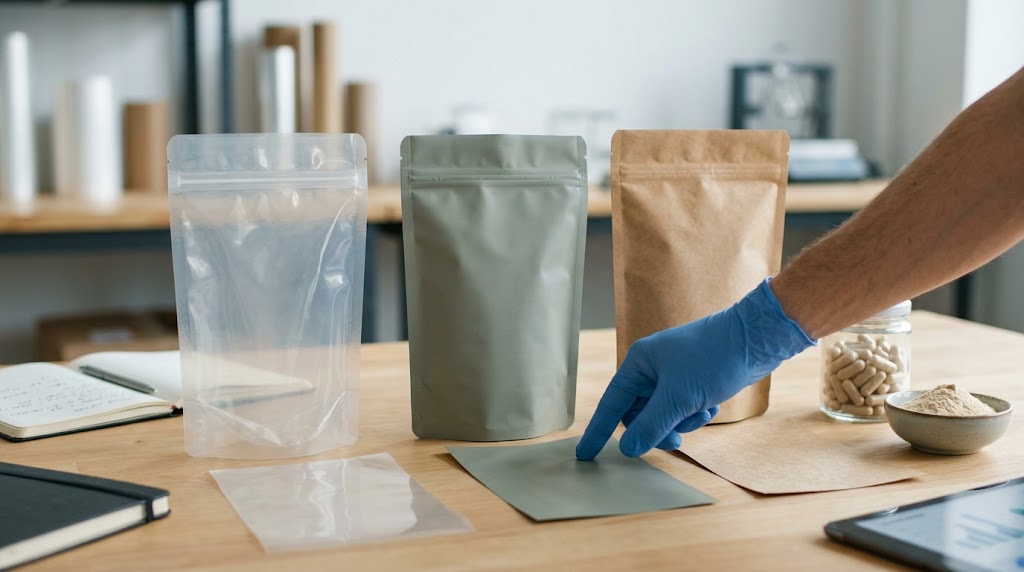
If the goal is material reduction, calculate with the whole selling unit. Record empty-bag mass, the number of bags needed for the target product quantity, any added wrappers or labels, and measured rejects during the trial. A smaller bag can lower material use only if it can still be filled, sealed and used properly. A thinner film may be appropriate after a puncture and handling trial; it may not be appropriate merely because a calculator produces a smaller gram figure. The environmental comparison should be attributed to the tested assumptions and product, not advertised as a universal percentage saving.
Separate material design from a recycling or composting claim
A pouch described as mono-PE gives a starting point for investigating a PE recovery route. The actual printed package may also contain a zipper, inks, coatings, adhesive or a label. Consumers in one city may have access to a particular collection program while consumers elsewhere do not. The FTC guidance on recyclable claims asks marketers to qualify claims when appropriate facilities are not available to a substantial majority of consumers or communities where the item is sold. The material choice alone cannot establish what the complete bag's local collection route will be.
Compostability is a different path. A paper-look pouch can be plastic laminated. A bio-based film can have different disposal requirements from a compostable finished bag. Industrial composting access, household composting, inks, zippers and local acceptance matter to the final claim. The FTC likewise advises qualification when a composting route is limited. Do not print a blanket compostable logo because a sample's contact film has a plant-based ingredient, and do not treat “biodegradable” as another word for recyclable. Ask the brand's claim reviewer what exact wording could be supported by the final package and intended disposal route.

Avoid turning one attribute into a total-impact story. A recyclable candidate is not automatically the lowest-carbon candidate; a lighter candidate is not necessarily collected; a compostable candidate does not guarantee suitable local facilities. If the brand wants a formal impact comparison, define a functional unit such as packaging that delivers a specified number of acceptable doses under a stated distribution program, then commission an analysis suited to that question. Without those data, limit claims to what has been measured, such as the mass difference of two tested bags, and explain what is outside the comparison.
Design around realistic manufacturing and artwork constraints
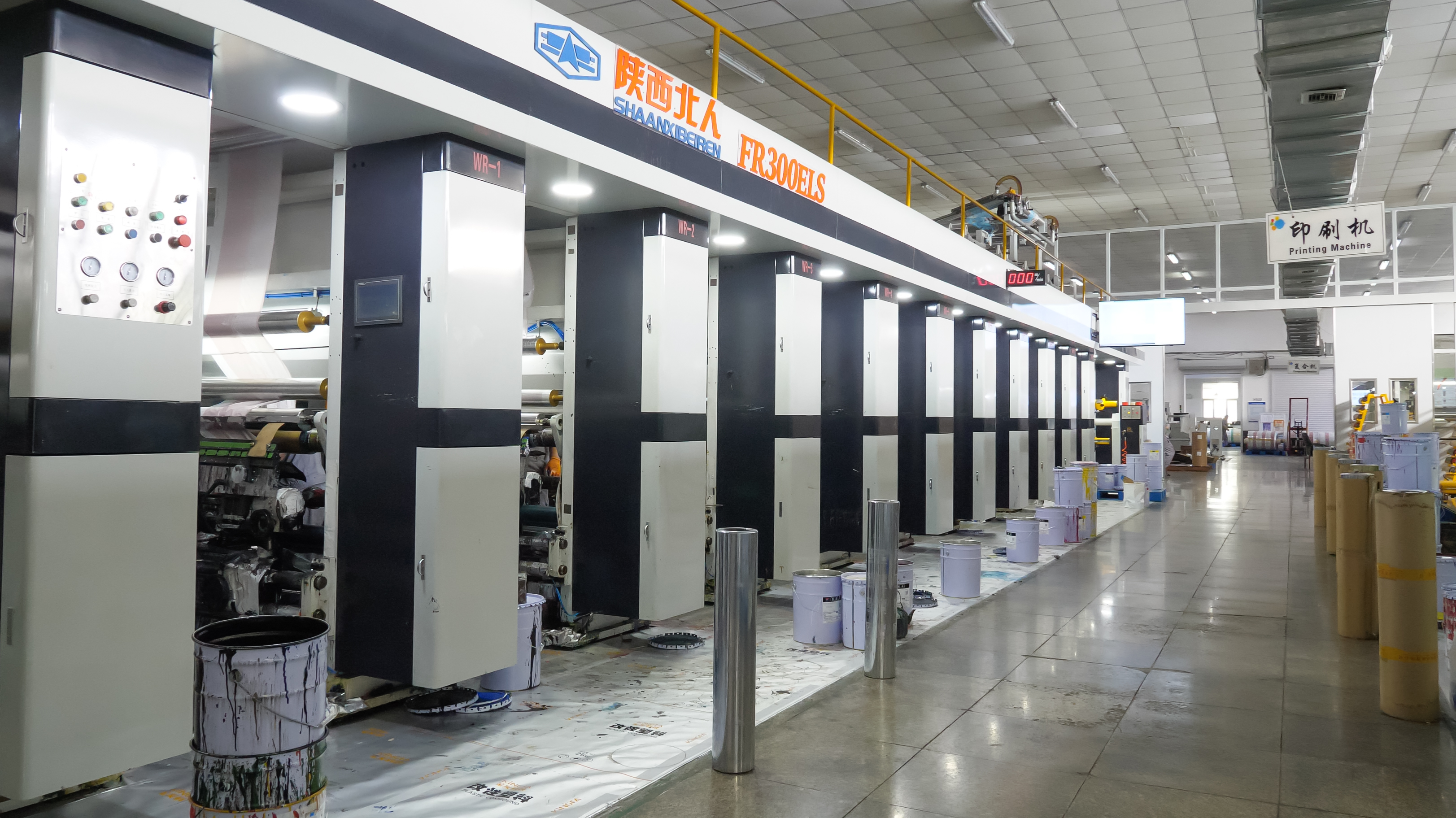
Print coverage, color layers, windows and surface finishes can affect both the bag production process and the evidence needed for a material claim. Ask the supplier whether the proposed structure works with its chosen print route and converting equipment. A film compatible with a laboratory test may not run at the packer's planned speed or form a clean seal with the selected zipper. Review a physical printed proof and fill it. Look at the back panel after the bag expands: did the material change reduce available area for the brand's approved Supplement Facts panel or lot coding?
If the brand sells many flavors, ask whether one approved bag structure and a manageable artwork program can reduce obsolete inventory. That does not mean every SKU may share the same printed bag: the identity, ingredients and nutrition information must match the actual product. A generic over-label might be useful during a controlled pilot, but it adds another component and a labeling operation. Record how many old printed bags are discarded when a label changes. A digital or other short-run print approach may reduce obsolete inventory for a particular project, but the result needs the brand's real order and revision data, not a blanket process claim.
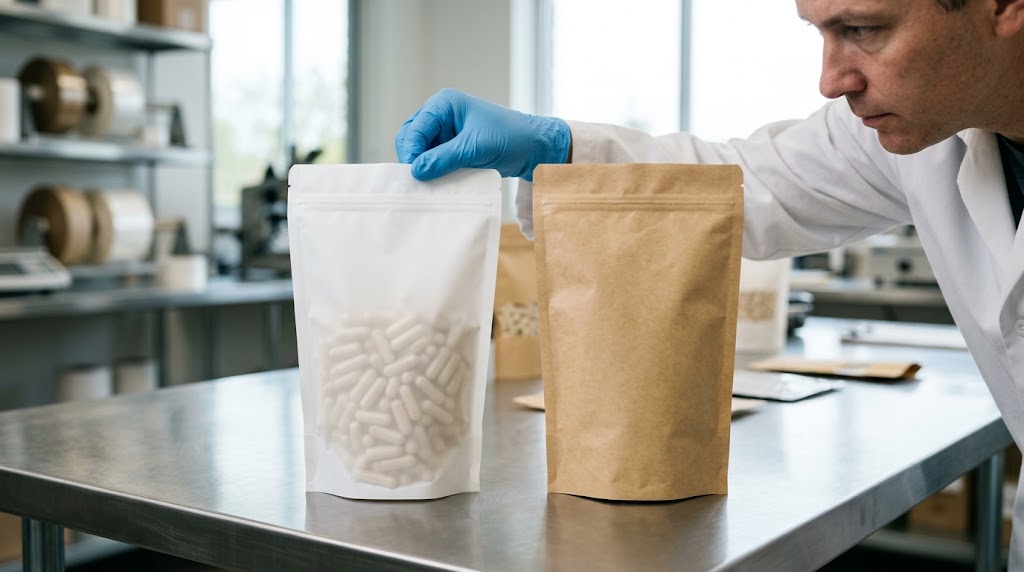
An environmental choice can also fail when marketing approval runs ahead of production change control. A label might say “recyclable” while the purchasing team has substituted an unreviewed zipper or changed the sealant layer. Freeze the versioned final construction before claim artwork is released. Keep the supplier's component list, test reports and decision about claim wording with the approved proof. When the package changes, recheck both product performance and the claim. The work is less glamorous than a new color palette, but it prevents the bag and its printed promise from drifting apart.
Work through the differences among capsules, powder and wrapped doses
A capsule brand may be tempted to switch from a multi-layer pouch to a simpler structure on the assumption that a hard capsule is protected by its shell. The actual product may still have ingredients, moisture sensitivity and a defined stability program. Begin with the product owner's unacceptable-change criteria and the current pack's results. Load the proposed bag at the minimum and maximum count, inspect how units contact a zipper or side seam, and review the initial seal after normal handling. If the candidate passes the physical trial, the brand can continue with product-specific storage evaluation. The capsule shell is not an automatic waiver of that work.
Loose powder makes bag choice especially visible to the end user. A low-mass pouch may be flexible enough to collapse around a scoop and spill; an oversized gusset may consume material without adding usable capacity. A different film can change static behavior, powder transfer at the seal, print appearance and repeat access. Measure the filled volume after settling, test the actual bag mouth at the packer, and ask consumers or staff to remove several realistic servings. A trial that evaluates only the unopened appearance misses the use phase that determines whether the material change is practical.
An outer pouch for wrapped stick packs has another opportunity: review whether the outer bag needs the same contact layer and barrier as a bag containing loose contents. The inner packs may already supply the direct contact layer and much of the protective function, but that must be established from the actual construction. The outer bag still needs to retain the count, resist puncture from wrapper edges, present accurate label information and survive distribution. Reducing material in one layer is useful only when the complete system remains acceptable. Never remove an inner wrap or change the label solely because the new outer bag looks substantial.
Translate a sustainability brief into testable supplier questions
Instead of “quote an eco pouch,” try a two-part request. Part one describes the current selling unit and the performance it must continue to deliver: product, fill, contact, storage, filling line, initial closure, distribution and artwork. Part two states the improvement being explored: a lower complete-package mass, a candidate PE-family structure for a target recovery route, or reduced obsolete print inventory. Ask suppliers to return a baseline-matching option and an alternative with each changed component marked. That makes the trial a comparison rather than a race to apply a broad adjective.
For every candidate, request what can be measured and what remains unknown. Can the same zipper be used? Is a barrier coating needed, and would it affect the proposed end-of-life route? Does the printer have a proof on the final material, or only a color simulation? What is the minimum run by artwork version? How much trim or set-up waste does the supplier expect under the actual order? These are proposal questions, not facts to lift into consumer copy. A buyer should also ask which documents may be shared with the brand's claim reviewer and whether a component substitution would be reported before production.
The comparison should avoid a misleading “one material equals one score” chart. A PE-family bag may support a collection option but require different printing or an additional label. A familiar laminate may have an established product-stability record but a less straightforward recovery route. A kraft-look bag may have excellent marketing appeal but contain an inner plastic film; it might be heavier than a simpler printed film. None of those observations establishes total environmental impact. Record the actual mass, pack yield, product loss and verified route for each approved design so a later claim can identify which attribute improved.
Pilot the new bag without discarding the working one too early
Keep the approved incumbent pack as the control during a limited production-equivalent trial. Run the candidate on the same equipment with comparable fill and planned inspection. Check the first, middle and last filled units and retain samples from the product's normal range. If a zipper misaligns or the print scuffs, fix those problems before a claim is placed on a full commercial run. The team should decide in advance who may approve a material or artwork change and what evidence triggers a return to the old design.
Do not use all the old printed inventory as a reason to ignore a promising alternative, but do count it. If the launch date can be coordinated with a normal label revision or reorder, fewer approved bags may be discarded. On the other hand, holding an extra season's worth of an untested new pouch because it has a favorable unit price can create the very waste the project was meant to avoid. Order size should follow the product's stable specification and realistic demand, not a supplier's promotional claim about greener materials.
At the end of the pilot, write two conclusions. One is technical: which bag meets the product and packing criteria? The other is communicative: what, if anything, can the brand truthfully tell consumers about the change? Those may not be identical. The team may choose the new pouch for material reduction while deciding that a broad “eco-friendly” front-panel claim would overstate the available evidence. A narrow, documented comparison may be more useful to a buyer than an unqualified environmental badge.
Make the review repeatable. Record the supplier, date, bag lot, artwork revision, product batch, storage conditions and the people who approved the technical and claim decisions. If a future order changes the coating, zipper or printed area, the team can reopen the exact affected question rather than guessing what the original “green” approval covered. The value of the record is not paperwork for its own sake; it prevents a later, visibly similar bag from inheriting evidence that belonged to a different construction.
Use a decision record instead of a single green score
Build a short record for each candidate: the problem it is meant to solve, baseline bag, target supplement and storage conditions, final structure, filled trial, complete-system material mass, access to the proposed end-of-life route, claim evidence, supplier change control and remaining unknowns. Put a date on the evidence and state the target markets. If a route is not established, record “unverified” rather than forcing a pass/fail claim. Buyers can then compare a multi-layer structure, a PE-family candidate and a paper-look alternative without pretending that the word “sustainable” is one measurable test.
| Candidate question | Pass only when | If the answer is missing |
|---|---|---|
| Does it protect the supplement as sold? | Product owner accepts the filled-pack and storage evidence | Run a controlled comparison before changing material |
| Can the packer fill and close it? | Actual equipment trial meets agreed rejects and usability criteria | Adjust geometry or closure and retest |
| Does it use less material? | Complete comparable units and yields are measured | Keep the objective as a hypothesis, not a claim |
| Is the end-of-life statement supported? | Finished components and target-market route are documented | Use a narrower, substantiated statement or none |
| Can it be reproduced? | Construction, artwork and change rules are versioned | Hold print approval until the supply specification is stable |
Recommended packaging configuration to discuss
For a brand considering an alternative to its current supplement pouch, request two production-feasible physical candidates: an agreed baseline or equivalent, and one structure aimed at the chosen material or end-of-life objective. Keep the intended contact side, usable opening, fill range and artwork panel comparable, then validate the filled product and the exact claim. Mylarbag's supplement pouch options and the published PE/PE and multi-layer project configurations are starting points for a sample conversation, not a determination that one bag is “eco-friendly” for every product.
Frequently asked questions
Is a mono-PE supplement pouch automatically recyclable?
No. PE-family structure may make a recovery path worth investigating, but the finished printed bag, closures, coatings, labels and local collection/processing must be reviewed. A material description alone does not substantiate a consumer-facing claim in every market.
Is kraft-looking packaging paper recyclable?
Not necessarily. The visible paper may be combined with barrier film, adhesive or a plastic inner layer. Ask for the complete structure and local acceptance evidence. A natural color or paper texture is a presentation choice, not a disposal instruction.
Does a compostable film protect every supplement as well as a laminate?
No such general conclusion follows from its material name. The brand must test the final filled pack under its own storage and use conditions and document any compostability claim for the complete bag and destination. Film, seam, zipper and print all matter.
Should I pick the pouch with the lowest film weight?
Only after checking the complete selling unit and product performance. A lighter film that creates more rejected seals or requires another wrapper may not reduce total material per acceptable unit. Compare measured filled bags, not just film swatches.
Can a supplier approve our “eco-friendly” label claim?
A supplier can provide documented facts about the proposed bag and its components. The brand's claim reviewer should decide what wording is supportable in each sales market. Broad environmental-benefit claims require especially careful qualification under FTC guidance.
Can I reuse my existing shelf-life claim after changing pouch material?
Do not assume so. A new structure, seal or opening can change the finished product's protection. The supplement owner should evaluate the new pack against its stability and distribution criteria before carrying over a product claim or best-by program.
Ask for evidence that matches the actual supplement bag
Send your current bag, supplement form, fill range, storage and sales markets, packing method, proposed environmental objective and any draft claim to the supplier. Request complete structures and physical samples rather than a green color or an unsupported badge. Mylarbag can review a supplement pouch material brief and quote feasible candidates; the product owner should approve the filled bag and any consumer-facing claim from the relevant evidence. A defensible improvement is the one that works for the product and can be described accurately.