
Candy wrappers and bags are made by converting selected paper, film, or combined materials into a package that fits the candy and the packing equipment. The work may include printing, coating or lamination, slitting, and forming. Individual twist wraps, machine-formed packs, and premade pouches follow different routes. The right specification identifies the material, closure, and supplied format together, rather than asking for a generic candy wrapper.
A wrapper can look simple while carrying several separate requirements. It must feed or fold correctly, present the intended artwork, and work with the product where the two meet. A retail pouch also needs usable space, sound seams, and an opening that suits filling and consumption.
This guide explains industrial packaging manufacture for confectionery buyers. It does not describe making decorative party favors with a home printer. Supplier and equipment references were checked in September 2026; the examples explain manufacturing choices, not a fixed recipe for every candy package.
Start by identifying which kind of package is being made
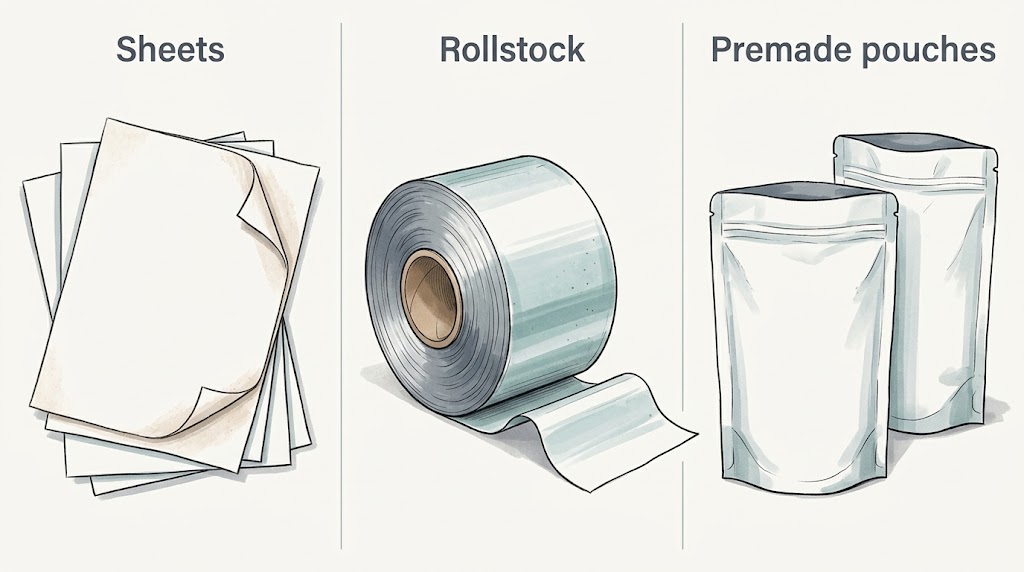
The word wrapper can mean a small sheet folded around one sweet, a sealed pack formed on a filling line, or even the outer pouch holding several individually wrapped pieces. These are different products to manufacture and different items to purchase.
A packaging converter processes materials into printed reels, cut sheets, or empty bags. The confectionery producer or packing contractor then puts candy into or around that packaging. Sometimes these operations share a site, but that should not be assumed when placing an order.
For example, a roll of printed film is not a supply of finished bags. The buyer needs compatible forming and sealing equipment to turn it into filled packs. A premade pouch arrives with much of its shape already established and an opening left for filling. A twist wrapper depends on a material and wrapping action that can hold the ends in place.
When discussing candy packaging bags for your filling process, state which of these formats you need. Include a photograph of the finished candy and, where relevant, the packing machine specification. That prevents an attractive pouch sample from being mistaken for a material that will run on an individual wrapping line.
What are candy bags made of?
Candy bags may use polypropylene, polyethylene, polyester, paper, regenerated cellulose film, or combinations selected for a particular job. The outer appearance does not reveal the complete construction. A paper-looking bag may contain plastic layers, while a transparent film can have coatings that are difficult to identify by sight.
Start with material families, then ask for the actual grade and finished structure. A material name helps organize the discussion; it does not settle the required thickness, barrier performance, sealing conditions, or food-contact suitability.
Polypropylene, polyethylene, and polyester
PP means polypropylene. BOPP identifies biaxially oriented polypropylene, while CPP identifies cast polypropylene. These names describe related material families and processing routes, not interchangeable films. Orientation, coatings, and sealable surfaces affect how a particular grade can be converted and used.
PE means polyethylene. In many flexible structures, a suitable PE layer provides the inner sealing surface. That does not mean every PE film is suitable for the same candy or equipment. The grade, surface, thickness, and finished construction still need to be specified.
PET means polyethylene terephthalate, a polyester used in packaging films. A PET-containing pouch may combine it with other layers rather than relying on PET alone to provide every required function. Ask which side is printed, which side meets the food, and where the seal is formed.
Toray's packaging-film ranges illustrate why grade matters: its polypropylene portfolio includes clear, white, metallized, sealable, and nonsealable options, while its polyester portfolio covers distinct packaging grades. These are examples of upstream material choices, not a statement that Mylarbag uses a particular Toray grade. Toray polypropylene films, Toray polyester films.
Paper and regenerated cellulose film
Paper can serve as a wrapper or as one part of a composite bag. A waxed or coated paper should be identified by its specific treatment and intended use. Neither the brown color of a pouch nor the word paper establishes what touches the candy.
Genuine cellophane is regenerated cellulose film. It is different from polypropylene film, although sellers sometimes use “cello” loosely for clear bags. Futamura describes coated and uncoated cellulose-film options with different properties. Confirm the supplied grade instead of treating all clear, crisp-feeling films as the same material. Futamura Cellophane films.
Material origin and disposal instructions are separate questions. A cellulose component does not, by itself, describe the finished package's coatings, inks, adhesives, or end-of-life route. Obtain the evidence for the complete packaging construction before adding a recycling or composting claim to the artwork.
Foil and metallized film
Aluminum foil is a metal layer; metallized film has a deposited metal coating on a film substrate. They should not be substituted in a specification simply because both can look silver. Ask whether the quoted structure contains foil, a metallized film, or neither.
Toray's MPOTM product, for example, is described as a polypropylene film with vacuum-deposited aluminum on one side and a sealable surface on the other. That specific construction illustrates the meaning of metallized film without establishing the properties of a different supplier's material. Toray metallized BOPP example.
Read a structure as a sequence, not a performance claim
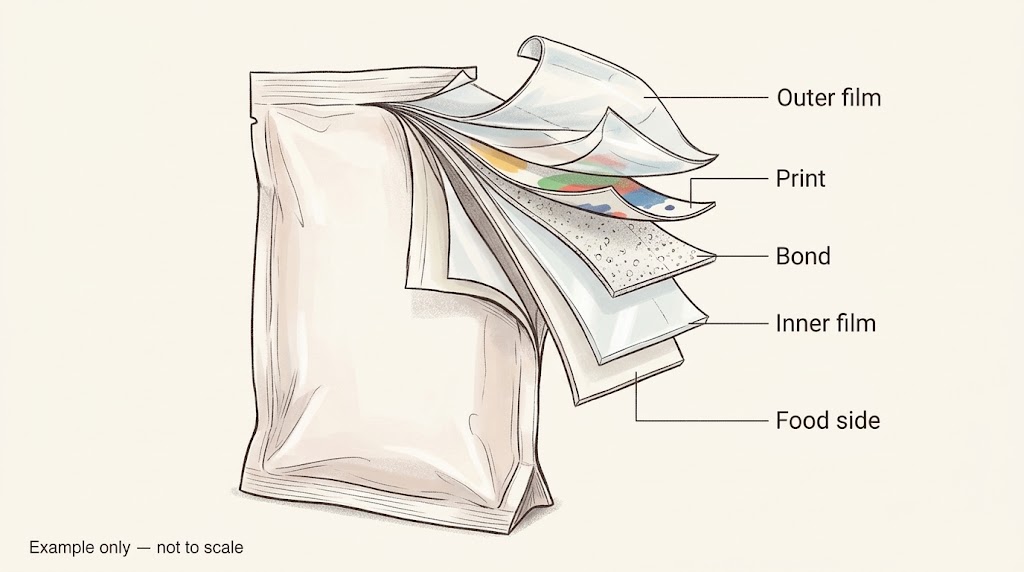
A notation such as PET/PE names major components. It does not provide a complete manufacturing specification. The buyer also needs layer order, grades, thicknesses, print position, any bonding system, and the applicable finished-pack requirements. Confirm whether the supplier writes its sequence from outside to inside.
A useful way to read a proposed laminate is to assign a job to each part. One part may carry the printing or contribute stiffness; another may contribute barrier; the inner surface may be selected for contact and sealing. Some films perform more than one of those functions, so a package does not necessarily need a separate layer for each job.
Do not infer layer thicknesses by dividing the total equally. Two structures with the same total thickness can distribute material differently and behave differently during folding, sealing, and handling. Likewise, a shiny surface or a stiff feel is not a measurement of moisture or oxygen transmission.
If barrier data are important to your candy, request results with the test conditions and material identification attached. Make sure the sample tested corresponds to the proposed construction. A value copied from an unrelated film brochure cannot establish the performance of a finished pouch, its seams, or its storage life.
Printing puts the design onto a moving material web
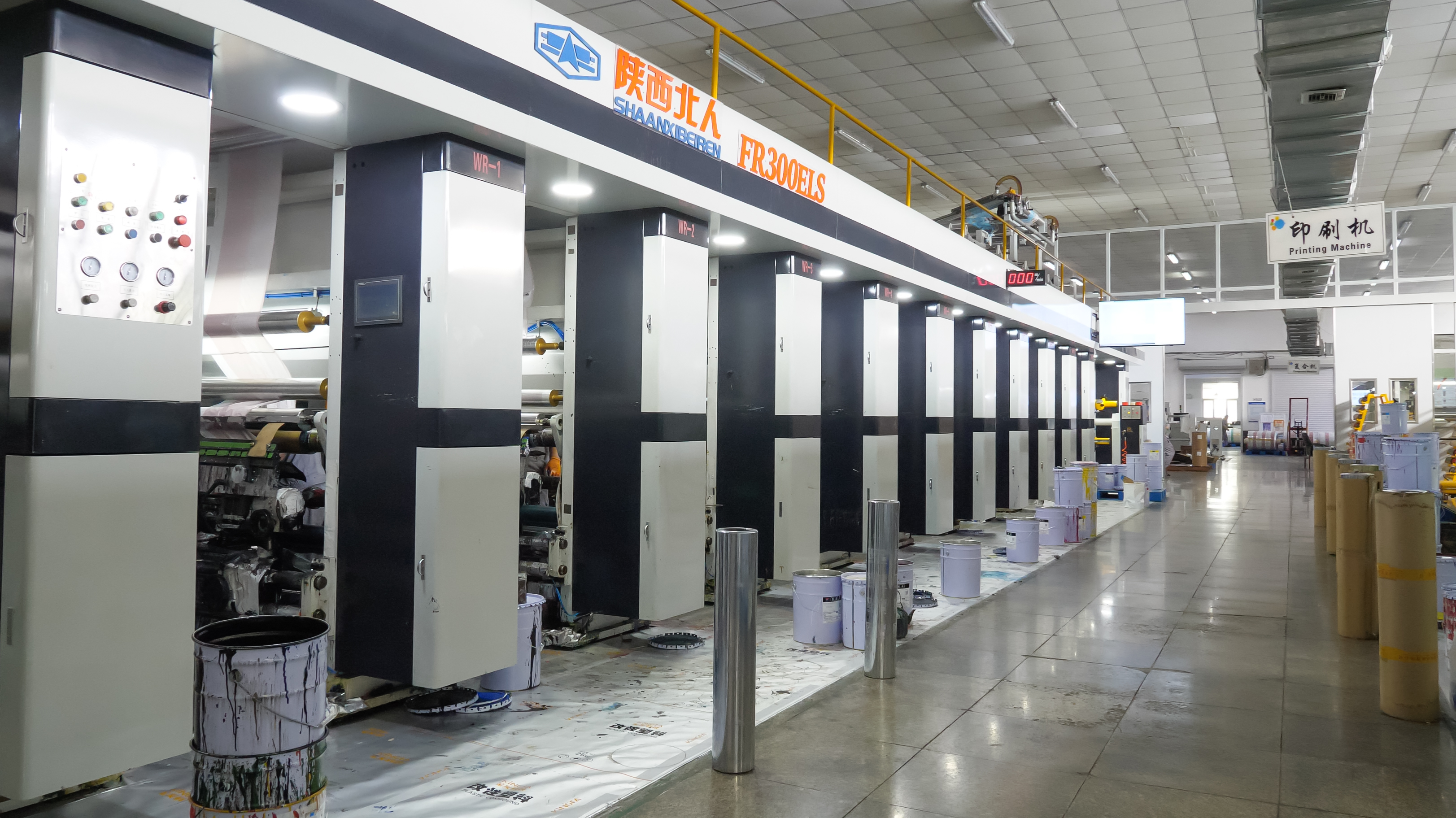
Industrial flexible-packaging printing commonly handles material as a continuous web: a long strip unwound from one reel and collected after processing. The print must be positioned consistently relative to the later folds, seals, and cuts. A design that looks centered on a flat sample can become misplaced if the converting layout is wrong.
Gravure printing uses an engraved cylinder to carry the image. Digital printing creates the image from digital job data without engraving a separate image cylinder for each design. Other printing methods also exist, but the choice for an order should be discussed with the converter around its actual production route.
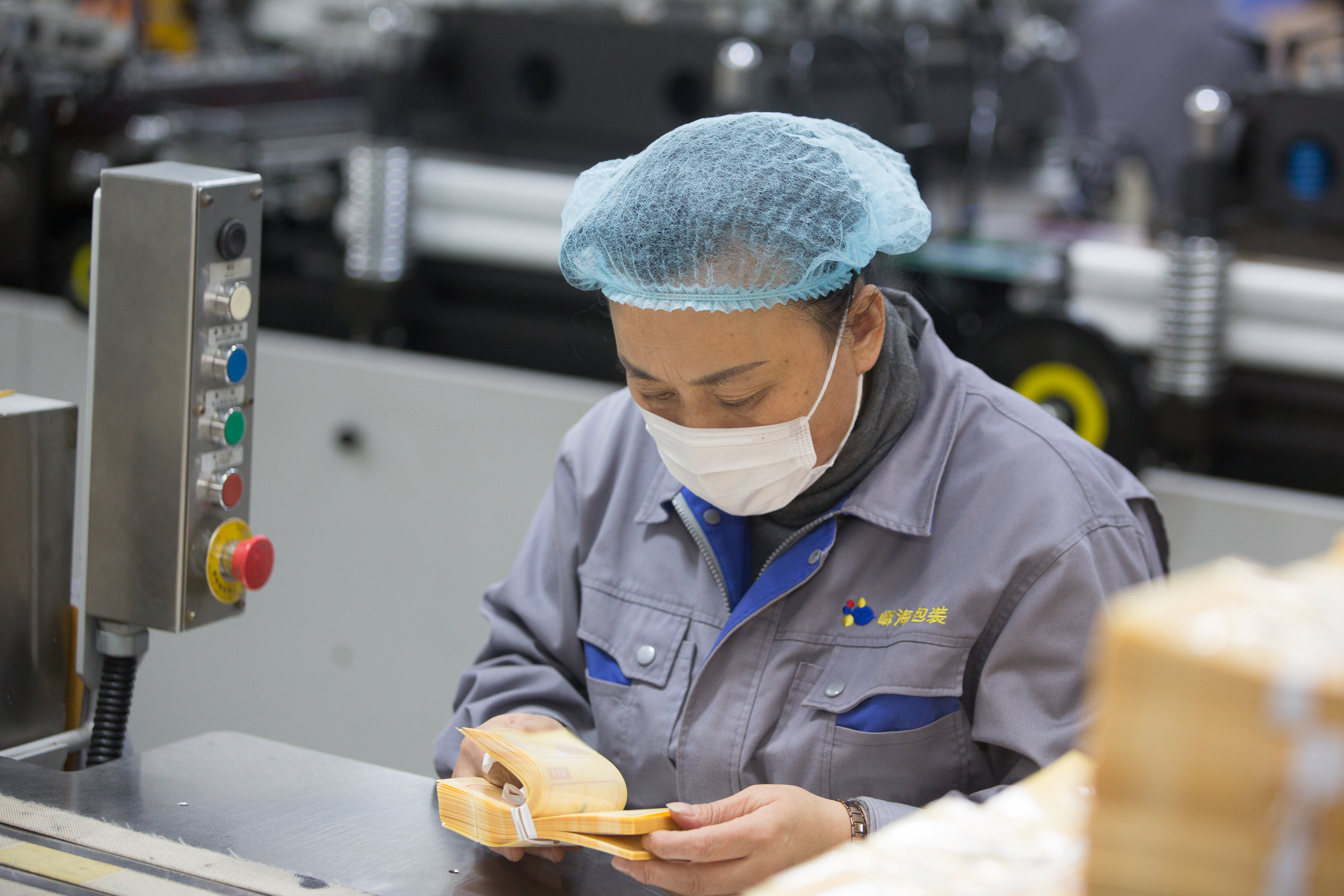
Mylarbag lists both gravure and digital printing in its manufacturing overview. The equipment photograph below provides a view of the gravure area; it does not identify the ink formula or prove that a particular candy order was produced on that line.
There is also a distinction between surface printing and reverse printing. Surface printing places the image on an outward-facing surface. In a suitable reverse-printed laminate, the image is viewed through a transparent outer film and enclosed within the construction. The intended print position must be coordinated with the film and converting process.
HP's Indigo 200K documentation describes liquid electrophotographic printing and both surface and reverse-print applications. It also makes clear that food-packaging compliance requires an assessment of the finished construction and intended use. A press brand or an ink description does not replace that assessment. HP Indigo flexible-packaging documentation.
For a manufacturing brief, establish the approved artwork version, number of designs, printing method, and viewing side. Keep detailed artwork preparation and color approval in the design workflow. At this stage, the important question is whether the print layout can be carried through to the correct finished package.
Lamination joins materials when the structure calls for it
Lamination combines webs into a bonded structure. An adhesive-laminated construction brings the selected materials together using the specified adhesive system and controlled web handling. Printing, coating, and lamination are related operations, but they are not interchangeable words.
Equipment suppliers offer different lamination technologies. Comexi, for example, lists solventless, solvent-based, and water-based options. The applicable route depends on the materials and job requirements; a candy pouch does not automatically require every process available on a laminator. Comexi lamination technologies.
Ask the converter how it controls bonding and releases the laminate for subsequent work. Where an adhesive system needs curing, its instructions and the specified structure determine the relevant conditions. Do not shorten a stated release period because the outside feels dry, or assume that “solventless” means there is no adhesive or further process control.
Some packaging films can be used without adhesive lamination. Other films are themselves made with several coextruded layers before they reach the converter. Counting visible sheets or asking whether a pack is “single film” does not necessarily reveal how many functional layers it contains.
The practical purchasing question is which operations are included in the approved construction. If the supplier changes the film, adhesive, coating, or process, ask whether the existing approval still applies. A visually similar replacement can require further checks even when the printed design stays unchanged.
Slitting prepares reels for the next machine
Slitting divides a wider web into the narrower widths required downstream, and rewinding collects those lanes onto reels. The output may go to a pouch-making line or to a customer's packing machine. The final width must match that next operation, not merely the width of the visible front panel.
Comexi's slitting documentation treats cutting and reel handling as controlled converting operations. For a buyer, the useful consequence is that a rollstock order needs a reel specification as well as a material specification. Comexi slitting equipment.
Confirm web width, core size, maximum reel diameter, print repeat where applicable, and unwind direction with the receiving equipment supplier. Identify the food-contact side clearly. A roll with the correct graphics can still be unsuitable if its orientation presents the wrong surface to the forming or sealing equipment.
Use an agreed unwind sketch rather than instructions such as “logo facing out,” which may mean different things to two people looking at opposite sides of a reel. Also agree how splices and reel identification will be handled. These details help the packing team distinguish a setup problem from a material problem.
Do not derive finished pack count from reel weight alone. Width, construction, length, repeat, and production allowances affect the relationship. When comparing quotations, ask whether the sale unit is kilograms, meters, reels, or a specified number of finished pouches, and make sure both offers describe the same deliverable.
How are candy bags made from the converted material?
For a premade pouch, the converting line brings the required panels or folded web into position, forms the specified seams, and separates individual bags. The construction determines the exact sequence. A flat pouch, a bottom-gusset stand-up pouch, and a flat-bottom bag do not share one universal folding pattern.
A gusset is a folded section that expands when the bag is filled. Its depth and sealing arrangement affect the finished shape. Those details belong on the bag drawing, alongside the filling opening and usable dimensions. The quantity of candy that fits still needs to be checked with the actual product.
Zippers, tear notches, and hang holes are additional converting features. A zipper provides a reclosure function when correctly specified and installed. A tear notch is an opening aid; a hang hole supports display. None of these features should be mistaken for the seal that the packer completes after filling.
Totani's machine range distinguishes pouch-making configurations with standing-pouch and zipper units. That is useful evidence that these features require the corresponding machine configuration; it does not establish which equipment made a particular Mylarbag project. Totani pouch-making equipment.
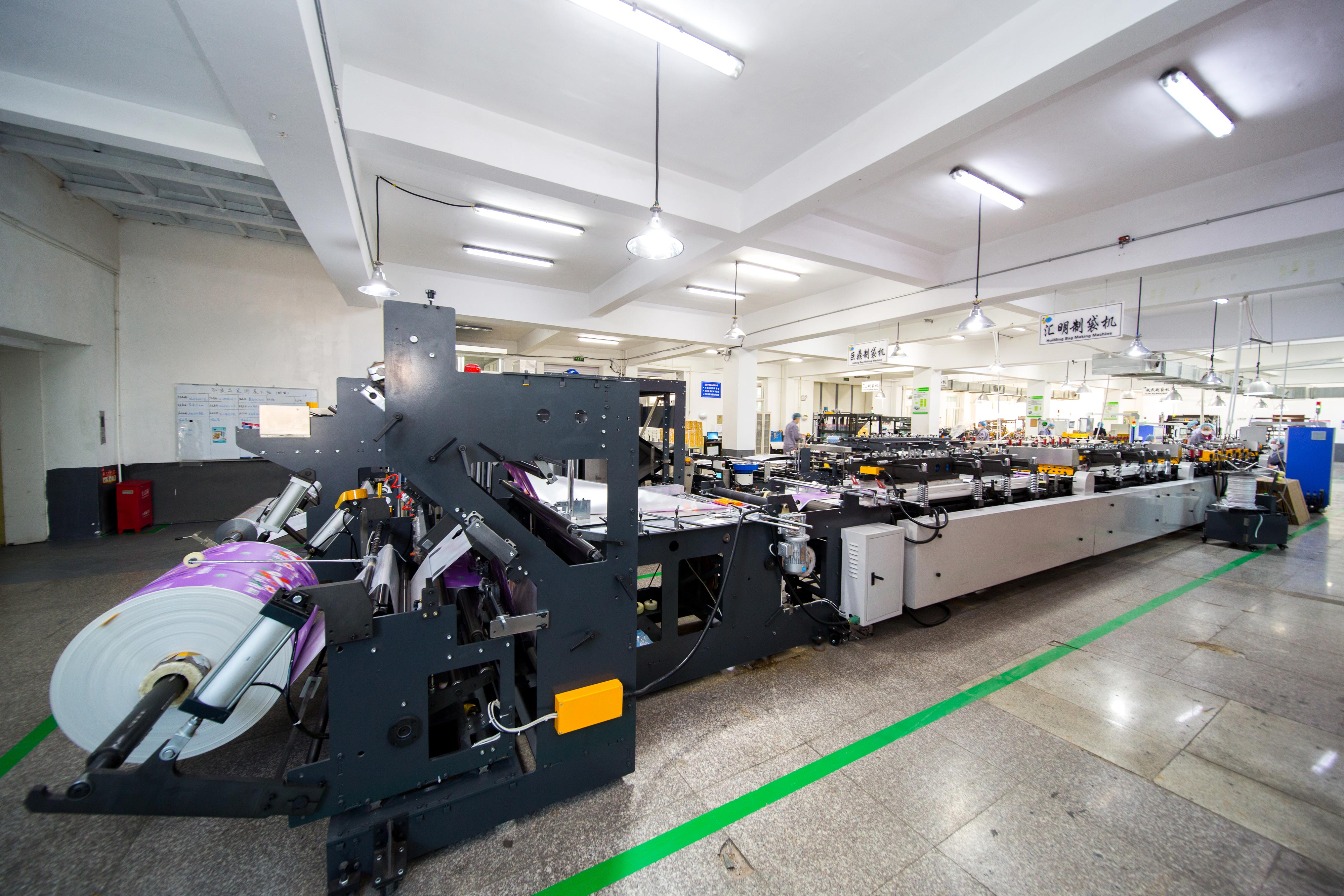
Ask where the delivered pouch will remain open for filling. On a resealable retail bag, the top area may also need space for the final seal and an opening feature above the zipper. Review the entire top layout so the packer can load and close the bag without placing candy in that area.
Check the first samples in use, not only laid flat. Open the pouch, insert the intended portion, operate the zipper if supplied, and examine the presentation. If the pack includes individually wrapped sweets, their wrapper ends are part of the volume and handling requirement.
How are candy wrappers made for individual pieces?
An individual wrapper has to work around a particular piece rather than simply hold a measured bulk portion. Piece length, thickness, shape variation, and surface condition influence the material and wrapping route. A material that forms a good retail bag is not automatically a suitable twist film.
For twist wrapping, the material must retain the intended closure after the wrapping action. Futamura identifies twist retention, slip control, and antistatic behavior among the considerations for its cellulose-based twist-wrap grades. Those properties are grade-specific; the description does not apply to every clear film. Futamura wrapping applications.
A sealed individual pack follows another route. Horizontal flow wrapping draws suitable material around products and forms the package seams and ends. The choice of material and sealing system must be coordinated with the equipment. Syntegon describes both heat-seal and cold-seal applications in its flow-wrapping portfolio. Syntegon horizontal flow wrapping.
Cold sealing uses a purpose-designed coating system and pressure under its specified operating conditions. It is not a name for any film pressed closed without heat. Similarly, heat sealing depends on compatible surfaces and an appropriate process. A printed roll cannot be assumed to work with either method merely because it fits the machine.
For cut sheets used by hand, clarify dimensions, material treatment, and which surface contacts the candy. A decorative printed sleeve may need a separate suitable food-contact wrap. Confirm the supply of cut sheets, twist films, or machine rollstock independently; a supplier's ability to make retail pouches does not establish all of those capabilities.
Inspect the features that changed during manufacture
An approval sample is most useful when it represents the construction and process being ordered. A sample made only to demonstrate artwork cannot also confirm the final material, sealing behavior, or production consistency unless those elements match the specification.
Separate the review into what can be observed and what needs a measurement or document. You can see an off-center hang hole or a folded seam. You cannot establish food-contact suitability, barrier properties, or adhesive release status just by holding the sample up to the light.
Keep a record of the sample version reviewed and the changes requested. If a supplier sends a revised pouch with a different film structure, do not label it simply “new sample.” Identify what changed so the next trial answers the right question.
FDA's food-contact guidance links regulatory status to the components and applicable uses of the material. Ask for documentation that corresponds to the proposed package and its intended food contact, rather than accepting a broad claim attached only to the word plastic. FDA guidance on food-contact components.
For a repeat order, retain the approved material, drawing, artwork, and sample references together. If complaints arise later, this makes it possible to compare the delivered lot with the agreement. A photograph of the front design alone leaves too many parts of the order unidentified.
Related project: printed pouches for nougats and energy bites
The published nougat and energy-bite packaging project lists Canada, digital printing, a MATOPP/PET/PE structure, and dimensions of 14 × 21 + 4 cm. Its description identifies a matte stand-up format, shaped window, and hang hole. These are configuration details from the project record.
The photograph below shows the finished presentation, including the window and top display opening. It cannot show the separate material layers or the adhesive system. The written structure and the visible bag therefore answer different questions and should be reviewed together.
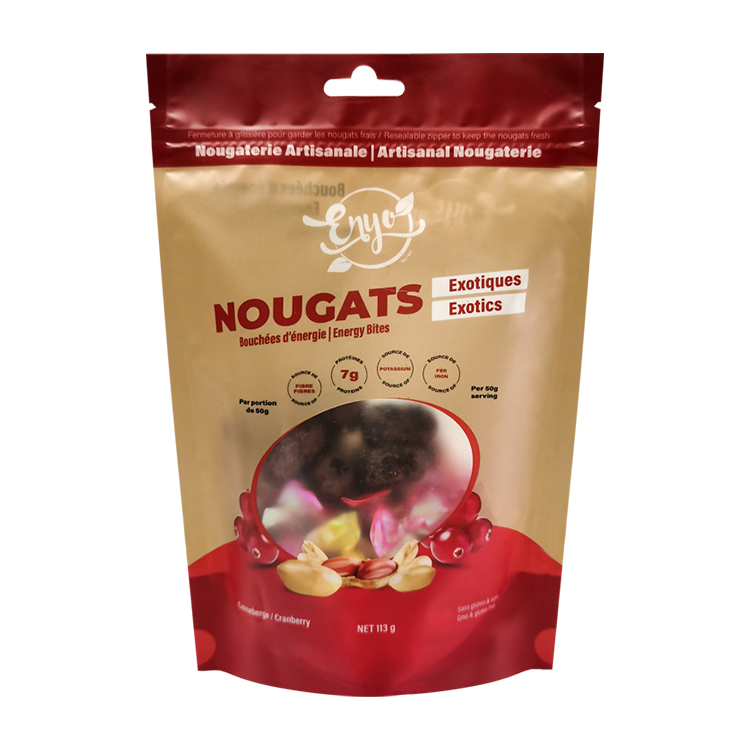
For a new order, confirm what the supplier means by MATOPP, the layer specifications, and how the stated gusset dimension is measured. Also confirm that a sample has the same construction as the quotation. The public project is a starting point for a configuration discussion, not a complete production drawing or evidence of a particular shelf life.
This example also separates retail pouch manufacture from wrapping individual pieces. Producing the outer bag does not establish the material or method used around each nougat inside it. If both layers of packaging are needed, put them on separate lines in the enquiry.
Recommended packaging configuration
For candy sold as multiple pieces in one retail pack, evaluate a premade stand-up or flat pouch with an identified food-contact construction, suitable filling opening, and space for the intended final closure. Add a zipper only when reopening is part of the intended use. Select the material and dimensions around the candy and packing process.
Mylarbag's custom candy pouch options provide a starting point for that discussion. Request the proposed structure, bag drawing, printing route, and relevant sample together. If your operation instead requires rollstock for individual wrapping, provide the machine requirements and confirm that supply separately.
Frequently asked questions
What kind of plastic are candy wrappers made of?
Polypropylene, polyethylene, and polyester appear in confectionery packaging, either as specific film grades or as parts of combined structures. A clear wrapper cannot be identified reliably by appearance. Ask for the material specification, supplied format, and compatibility with the intended wrapping or sealing method.
Are all candy bags made from Mylar?
No. Candy bags can use several material families and structures. A commercial description using the word Mylar is not a complete specification. Request the actual construction, including the inner sealing surface, rather than assuming that every shiny or barrier-labelled pouch has the same composition.
Is cellophane the same as a polypropylene candy bag?
No. Genuine cellophane is regenerated cellulose film, while polypropylene is a different polymer. Both may be clear, and coatings can change their behavior. Check the actual grade and applicable sealing or twisting properties instead of relying on an informal “cello bag” product name.
Does every candy wrapper need lamination?
No. Some applications use a suitable single film or treated paper, while others require a combined construction. Lamination is one way of joining materials. Select it because the proposed structure needs it, not because more layers automatically mean a better wrapper.
Are the candy bags filled at the bag factory?
Empty pouch manufacture and candy filling are separate operations unless the supplier explicitly offers both. Confirm the deliverable: cut sheets, printed rollstock, or premade empty bags. The confectionery producer or packing contractor must have the process needed to use that format.
Can I make commercial candy packaging with a home printer?
A printed decoration or outer sleeve does not establish a suitable primary food pack. Industrial packaging requires the relevant material, contact, closure, and manufacturing controls. If you make decorative sleeves, keep the food in an appropriate approved pack and confirm how the added decoration will be used.
Specify what must arrive at your packing line
A useful enquiry names the candy, portion, packaging format, and filling method before discussing appearance. Include the dimensions or sample you want to develop, the number of artwork versions, and the market where the filled product will be sold. For machine rollstock, attach the equipment's reel and sealing requirements.
Discuss your candy packaging specification with Mylarbag and ask which manufacturing route fits that brief. Agree the supplied format, material structure, drawing, and approval records together so the delivered packaging can be checked against a clear specification.