

There is no universal answer to “How many bags of cat food fit on a pallet?” The result changes with the retail bag’s filled dimensions and weight, the number of bags per shipping case, case dimensions, pallet footprint, permitted height, stacking pattern, load-stability method and maximum gross weight. A pallet of filled 16 lb retail bags is a different calculation from a pallet of small pouches in cases, and both are different from a pallet of empty custom pouches delivered to a co-packer.
The reliable method is to calculate from the finished shipping unit, then validate the proposed pattern under the actual warehouse and carrier limits. This guide supplies the formulas, a clearly hypothetical worked example and a specification checklist. It is an operations guide, not a freight quotation or a guarantee that a calculated stack is safe for a particular route.

First define what “bag” means
The word “bag” can describe at least three different units in a cat-food supply chain:
Before asking a supplier for a pallet count, state which unit you mean. The most common mistake is to calculate individual retail bags directly on a pallet when the real supply chain ships cases. In most B2B situations, cases—not loose filled pouches—are the transport unit that should be planned first.
The five inputs that determine pallet quantity
A valid calculation needs real inputs. If one is unknown, report a range or wait for a sample measurement; do not fill the blank with an internet average.
- Pallet footprint: length and width of the actual pallet, in one consistent unit.
- Shipping-case dimensions: outer length, width and height of the sealed case, including any overhang restrictions.
- Cases per layer: the best approved case orientation/pattern on the pallet footprint.
- Maximum layers: limited by the permitted load height and, separately, by maximum gross weight and stability.
- Retail bags per case: the verified pack-out quantity for the finished SKU.
The core calculation is:
Retail bags per pallet = cases per layer × approved layers × retail bags per case
The formula is easy. Determining the three terms honestly is the work.
Why weight, height and stability can all cap the same pallet
People often calculate layers from height alone. That is only a starting point. A pallet can reach its allowable height before it reaches its allowable weight, or reach its gross-weight limit before it reaches the proposed height. A stack can also be mathematically within both limits and still be inappropriate because cases are unstable, cartons deform, overhang, or the route demands another pattern.
Use the smallest approved result:
Approved layers = the lowest limit among height, gross weight, and stability
The stability term is not a universal equation. It must come from the case design, the actual product, the selected pallet, wrapping/strapping approach, warehouse equipment, carrier conditions and any retailer specification. Never assume that a higher stack is acceptable because it fits under a nominal ceiling.
Height-based layer calculation
Layers allowed by height = (maximum loaded height - pallet height) ÷ case height (rounded down)
Use the complete loaded-height rule for the route. Do not forget the pallet’s own height, top protection, slip sheets or load-securing materials if they are included in the limit.
Weight-based layer calculation
Maximum cases by weight = (maximum gross pallet weight - empty pallet weight) ÷ gross case weight (rounded down)
Then compare that number with cases per layer to determine how many complete layers are possible. Use actual gross case weight, including food, retail packaging, corrugated case, inserts and any relevant consumables—not only the net food weight.
Step 1: Measure the finished shipping case correctly
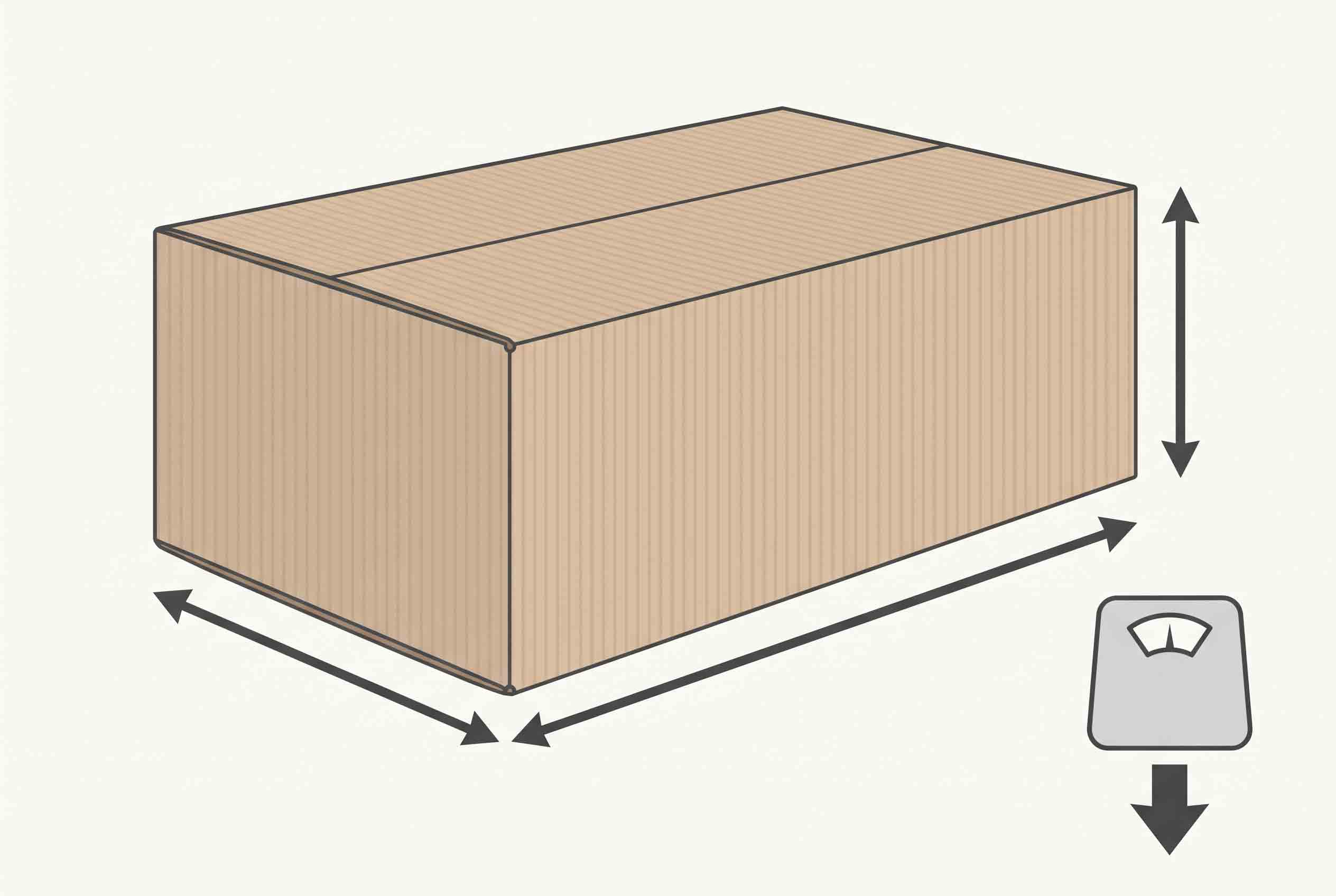
Do not use an internal carton dimension when a transport calculation needs an external one. Do not use a flat, unfilled prototype dimension when the product will bulge a case or require a different closure. Record the finished, sealed case.
For each SKU, collect:
- outer length, width and height;
- gross case weight;
- number of sellable units in the case;
- intended case orientation on the pallet;
- whether cases may be rotated between layers;
- case compression/stacking limits supplied by the responsible packaging and logistics teams;
- requirements for slip sheets, corner boards, wrapping, straps or top caps;
- allowable overhang, if any;
- route, retailer or warehouse maximum dimensions and weight.
GS1’s package and product measurement work is a useful reference for the discipline of using consistent dimensions and gross weight for trade items and load units. Use the current GS1 Package and Product Measurement Standard together with the requirements of the actual trading partner and carrier.
Step 2: Find cases per layer from the pallet footprint
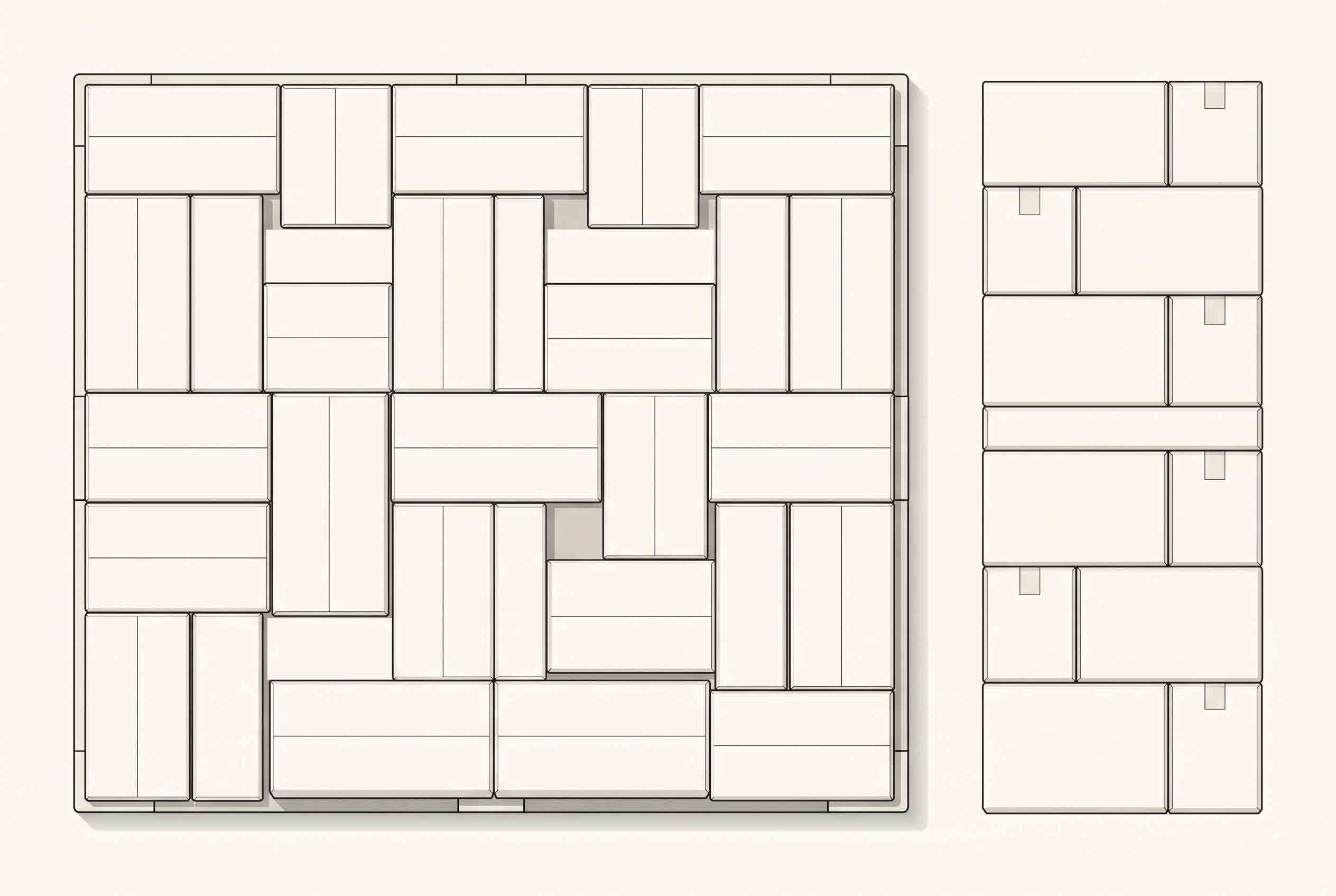
Start by testing the case in both 90-degree orientations, provided the case and product are approved for either orientation. The simplest theoretical counts are:
Cases along pallet length = pallet length ÷ case length (rounded down)
Cases along pallet width = pallet width ÷ case width (rounded down)
Theoretical cases per layer = length count × width count
Repeat with case length and width swapped. But do not stop there. Real pallet patterns can use interlocking orientations, column patterns, partial layers or different arrangements to improve stability. The best pattern must be verified rather than inferred from floor arithmetic.
Do not silently allow overhang
Overhang can damage cases, create handling risk or violate retailer/carrier requirements. A pattern that fits only by letting cartons extend beyond the pallet is not a valid default. If overhang is specifically allowed, record the amount and the approving party.
Do not assume all cases are stackable in every orientation
Some products need a particular upright orientation. Some cases carry direction arrows. Some patterns create unsupported voids. A rotation that gives one additional case per layer is not an improvement if it violates product or case constraints.
Step 3: Set the number of layers
Use actual limits, then confirm with a physical or approved digital pallet pattern. The principal constraints are:
The final answer may be lower than the number that looks most efficient in a spreadsheet. That is normal. A stable, compliant load is more valuable than a theoretical maximum that arrives damaged or is refused by a warehouse.
Worked example: filled retail bags packed in cases
The following is hypothetical. It is not a recommended pack-out, pallet type, case size, load limit or freight quote.
Assume:
- a retailer sells one cat-food bag per unit;
- each sealed shipping case contains 6 retail bags;
- the actual case outer dimensions are 400 mm long × 300 mm wide × 250 mm high;
- the actual gross case weight is 8.0 kg;
- the actual pallet footprint is 1,200 mm × 1,000 mm;
- maximum loaded height is 1,500 mm;
- pallet height is 150 mm;
- maximum gross pallet weight is 500 kg;
- the case/product team has approved a stable pattern of 10 cases per layer after a physical review.
Height limit
(1,500 - 150) ÷ 250 = 5.4 (rounded down to 5 layers)
Five layers produce 50 cases.
Weight check
Fifty cases at 8.0 kg each equal 400 kg of cases. Add a hypothetical 20 kg pallet and modest load-securing materials; the result is still below the hypothetical 500 kg maximum. In this example, height is the limiting factor, not gross weight.
Retail-bag count
10 cases/layer × 5 layers × 6 bags/case = 300 retail bags per pallet
The answer in this hypothetical example is 300 retail bags, not because cat food has a standard pallet count, but because the case pack, footprint, layer count and constraint set produce that result. Change any input and the answer changes.
Example: why a heavier bag can reduce the count
Now imagine the same case footprint and layer pattern, but a different SKU has a gross case weight of 12 kg. Five layers would still create 50 cases by height, or 600 kg of cases before the pallet. If the route’s maximum gross pallet weight is 500 kg, the weight limit becomes controlling.
(500 - 20) ÷ 12 = 40 cases by weight (rounded down)
With 10 cases per layer, that is four full layers. At six retail bags per case:
10 × 4 × 6 = 240 retail bags
The “same pallet” now holds 240 retail bags under the stated hypothetical rules. This is why a single universal figure is not trustworthy.
How to calculate a pallet of loose filled bags
Loose retail bags are sometimes used in internal handling or unusual distribution models, but they need a separate plan. The bag’s filled width, depth, height, product settling, load-bearing behaviour and required outer protection matter. A flexible bag often does not create the regular geometry that a corrugated case provides.
Before calculating loose bags, define:
- whether loose palletisation is permitted by the customer and carrier;
- the exact filled bag dimensions and gross weight;
- whether bags may be laid flat, stood upright or alternated;
- whether an outer tray, divider, slip sheet or top cap is required;
- how bags are protected from puncture, compression and shifting;
- whether retail-facing artwork or closures can be damaged by load securement;
- how units are counted and scanned.
If the business normally ships in cases, use the case calculation. It produces a clearer, more repeatable specification and protects against treating a flexible product as a rigid block.
How to calculate a pallet of empty cat-food pouches
Empty pouches are a third scenario. They have no food weight, can be bundled in high counts and may be delivered to a filling location. A pallet count for empty pouches should not be converted from a filled-retail calculation.
Ask for:
- pouches per bundle;
- bundles per inner carton;
- cartons per pallet pattern;
- carton dimensions and gross weight;
- whether the pouch film or pre-made feature has a permitted stacking/compression condition;
- humidity, temperature and warehouse requirements from the responsible supplier;
- whether cartons must remain upright or protected from crushing.
The formula is:
Empty pouches per pallet = pouches per bundle × bundles per carton × approved cartons per pallet
The key word is approved. An empty pouch carton may be light enough to stack high by weight but still have a compression or handling limit. A pallet of empty pouches is not automatically more forgiving simply because it weighs less.
Pallet planning and custom cat-food packaging
Pallet efficiency is a packaging-development topic, not an afterthought for freight. A small change in pouch dimensions can change case count; a small change in case count can change cases per layer; and a new pallet pattern can change unit cost, warehouse handling and retailer acceptance.
That does not mean a package should be designed around pallet density alone. The product still needs appropriate fill, sealing, label area, consumer use and validation. It means that logistics belongs in the same early brief as pouch format and artwork.
For a custom pouch inquiry, prepare:
- product and target net weight;
- expected filled pouch dimensions;
- proposed units per case;
- target case dimensions and gross weight;
- pallet type and destination requirements;
- maximum height/gross-weight rules;
- expected annual or shipment volume;
- whether you need filled retail pack planning, empty pouch supply planning, or both.
Once those facts are available, a custom cat food pouch specification can be evaluated in the context of the full supply chain. The web page is a commercial starting point; it does not establish your pallet count or logistics performance.
A data sheet to send to a converter, co-packer or freight team
Do not leave “pallet count” as the only question. This sheet makes it possible for different teams to reach the same answer and identify which input changed when the answer changes.
Recalculate after a package or case change
Pallet data should be treated as a controlled specification, not a number copied from an old quotation. Recalculate when the retail pouch dimensions, net fill, pouch construction, units per case, corrugated grade, case dimensions, pallet type, destination or maximum-height rule changes. A small adjustment can have a cascading effect: one fewer unit per case changes case gross weight; a case-width change can reduce cases per layer; a new retailer can impose a different height limit.
Keep the calculation with its assumptions, date, source measurements and approver. That way, the team can distinguish a verified load pattern from an early estimate. It also avoids a frequent supply-chain error: a production team uses a pallet total from an earlier SKU even though the latest artwork, pouch feature or case pack has altered the physical shipping unit.
The discipline is simple: measure the final case again, rerun height and weight limits, verify the pattern, and obtain the approval required for the actual route.


Additionally, evaluating pallet configurations requires understanding the dynamic forces experienced during transit. Whether utilizing less-than-truckload (LTL) services or full dedicated loads, the vibrational stresses and potential for abrupt stops necessitate a robust, well-secured unitized load. Packaging engineers must frequently recalibrate these assumptions whenever a new distribution channel or international shipping route is introduced to the supply chain.
Moreover, the increasing adoption of automated storage and retrieval systems (ASRS) in modern warehouses imposes even stricter tolerances on pallet footprints and load deflection. A pallet that leans slightly out of plumb may safely ride in a standard trailer but could trigger safety sensors and cause expensive delays in a highly automated facility. This underscores why physical testing, including stretch-wrap tension optimization and transit simulation, is replacing theoretical math as the final validation step. Even the highest-quality corrugated cases and flexible pouches will fail if the integrated packaging system ignores these environmental constraints.
Common calculation errors
Giving a number without defining the unit
“500 bags per pallet” is meaningless unless the reader knows whether the bags are filled, loose, case-packed or empty.
Using net food weight as gross case weight
The case, retail package, inserts and other components add weight. Gross weight is the relevant transport input.
Ignoring the pallet height
The loaded-height limit includes the pallet. Subtract it before dividing by case height.
Counting partial layers as full layers
If the weight limit permits 43 cases but the pattern is 10 cases per layer, the approved full-layer result may be four layers unless a partial layer is specifically approved.
Allowing overhang without approval
An overhanging carton is not free capacity. It can conflict with warehouse, retailer and carrier rules.
Treating shrink wrap as a repair for a poor pattern
Load securement is part of the system, but it cannot turn an unsupported, weak or unsuitable case/pallet pattern into a validated one.
Reusing an empty-pouch count for filled food
The units, weights, case configuration and risks are different. Calculate each logistics stage separately.
Frequently asked questions
How many bags of cat food fit on a pallet?
There is no standard number. Calculate from the finished shipping case, cases per layer, approved layers and retail bags per case. Height, gross weight and stability can each limit the result.
How do I calculate bags per pallet?
Use: cases per layer × approved layers × bags per case. Determine approved layers from the lower of the height, gross-weight and stability limits.
Do I calculate retail bags or cases?
Usually calculate cases first, then multiply by the verified number of retail bags in each case. If you are shipping loose filled bags or empty pouches, define those units separately.
How many 16 lb cat-food bags fit on a pallet?
The 16 lb net weight alone is not enough. You need the actual gross case weight, retail bags per case, case dimensions, pallet footprint, height limit, weight limit and approved pattern.
Can I use a standard pallet calculation online?
Only as a rough planning exercise. A production/logistics decision should use the actual finished case, destination requirements and a verified stable load pattern.
What is the most important number: pallet height or weight?
Neither always wins. Calculate both, then use the more restrictive approved limit. Stability and customer requirements can reduce the result further.
Sources and scope
- GS1 Package and Product Measurement Standard
- GS1 Reference: Package and Product Measurement Standard
- Mylarbag: Custom Cat Food Pouches
- Mylarbag: Pet Food & Treats Projects
Scope note: This article is current as of September 2026. All examples are hypothetical and are not pallet, case, freight, compression, handling or safety approvals. Use actual finished-package data and the current rules of the relevant warehouse, retailer, carrier and destination.