
There is no fixed number of dog food bags on a pallet. The count depends on whether the shipment contains filled food bags or empty packaging, plus the bag’s finished dimensions, weight, pallet footprint, allowed height, layer pattern, and carrier requirements. A 30 lb bag from one brand may pack very differently from a 30 lb bag from another.
The first question is therefore: are you shipping finished dog food, or are you shipping empty custom pouches to a filling operation? They require different calculations.
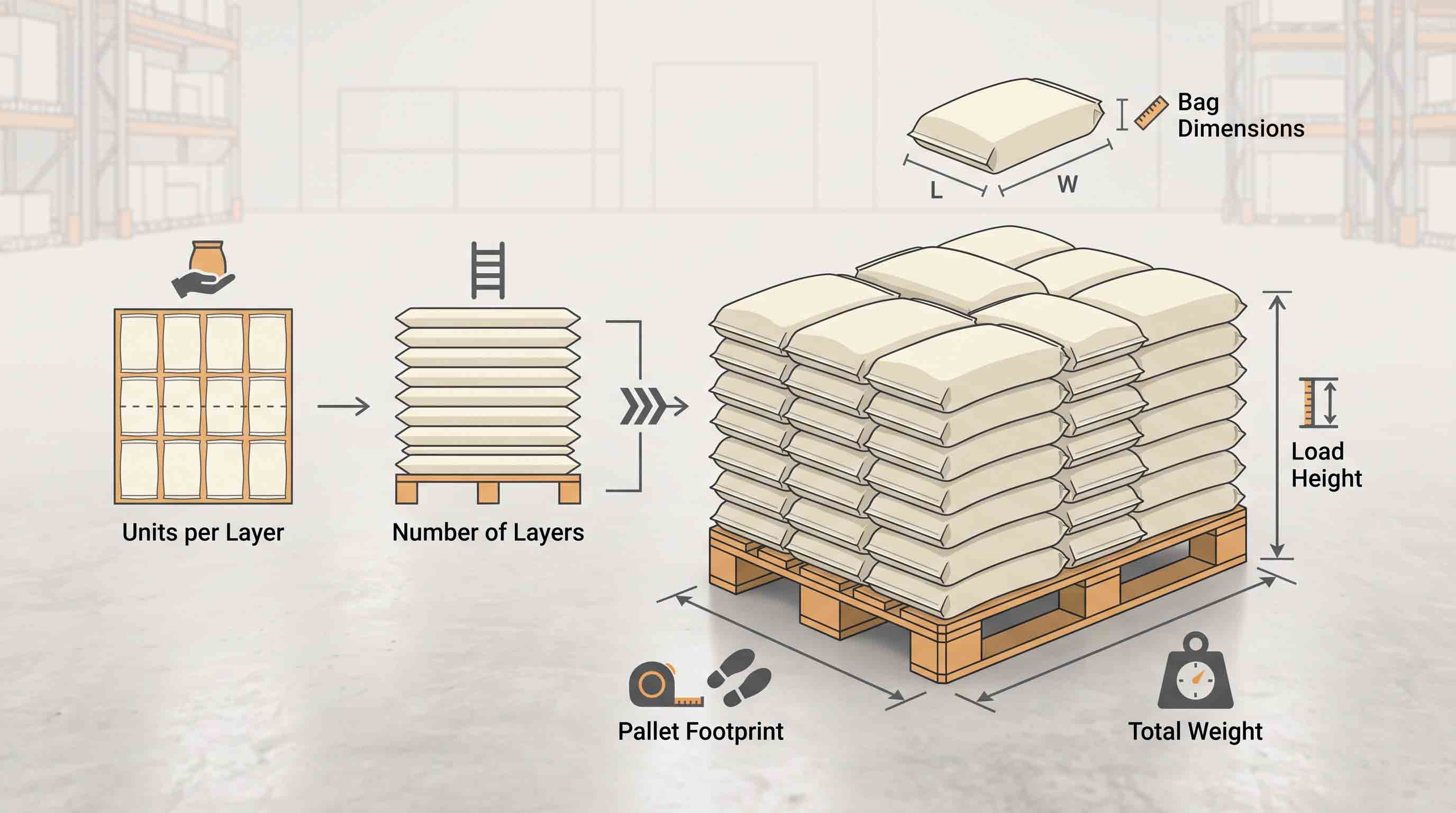
Short answer: calculate the actual shipping unit
There is no universal “how many dog food bags per pallet” answer. Shipping filled retail bags, retail bags in shipping cases, and empty custom pouches require entirely different calculations. A final count always depends on the finished bag dimensions, gross weight, pallet footprint, maximum allowed layers, and destination handling limits. Any early number is only an estimate and must be validated with the actual packed unit before booking freight.
Start with a definition of the unit
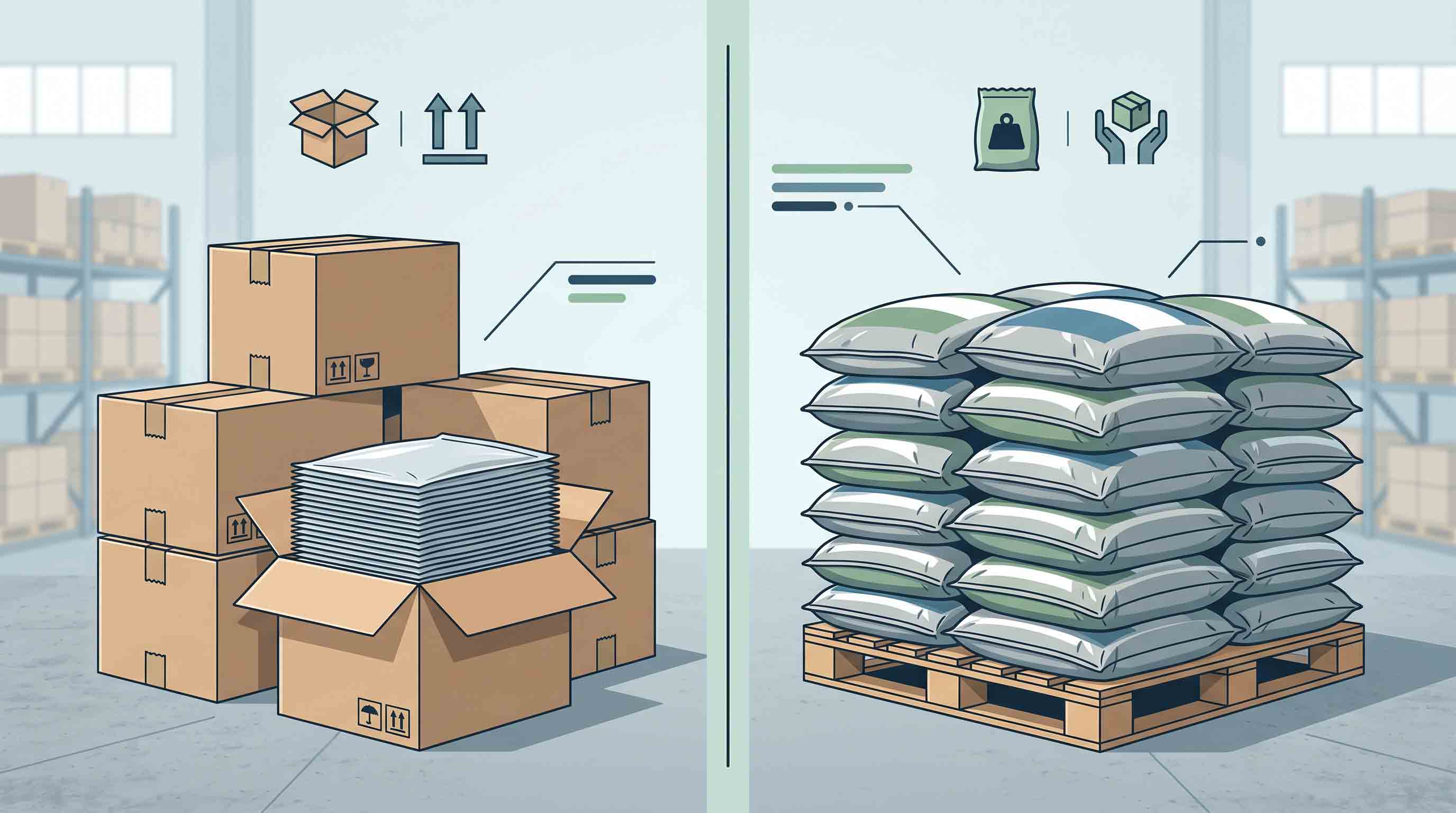
For filled dog food, the unit is the finished, sealed retail bag. Record its actual length, width, depth, weight, and the way it behaves once filled. For empty pouches, the unit is normally a carton of flat bags, not an individual retail pouch. Carton dimensions, carton weight, and protective packing details are the relevant data.
Mixing the two calculations is a common planning error. A pallet count for empty pouch cartons does not predict how many finished food bags a retailer can receive.
First distinguish three pallet scenarios
The phrase “dog food bags on a pallet” can describe three different situations. They should not be calculated in the same way.
For a manufacturer of empty custom pouches, the third scenario is usually the quotation task. A dog-food brand or co-packer may later use the first or second scenario for its own product distribution. A useful freight conversation makes this boundary clear rather than providing a single pallet number that is correct for none of the parties involved.
The pallet calculation
Use a basic sequence rather than a generic bag count:
- Confirm the pallet footprint required by the destination or carrier.
- Measure the real bag or shipping carton in its shipped orientation.
- Test a layer pattern that keeps the load stable and respects the permitted overhang rules.
- Decide the number of layers within the allowed height and weight limits.
- Calculate: units per layer × number of layers = units per pallet.
- Confirm total pallet weight and height with the carrier, warehouse, or receiving party.
A calculation worksheet that can be checked
Use this sequence for filled retail bags: first measure the filled bag; next determine the stable number of bags per shipping case if cases are used; then establish cases per layer and approved layers per pallet. The final count is cases per layer × layers × bags per case. For loose filled bags, substitute bags per layer × layers, but only after the load pattern, height, and restraint method have been reviewed for that specific route.
For empty custom pouches, calculate from cartons, not individual bags: cartons per layer × layers × pouches per carton. Record the carton dimensions and gross weight actually used in the quote. A different pouch size, material thickness, packing method, or quantity can change the cartons, so a previous count should never be copied forward without checking.
GS1’s package-measurement guidance treats product, case, and pallet dimensions and gross weight as distinct logistics data. That distinction is exactly what a reliable dog-food pallet plan needs: retail-unit data, shipping-case data, and final logistics-unit data must each be measured and controlled separately.
Source: GS1 Package and Product Measurement Standard.
Palletising guidance commonly starts from unit dimensions, unit weight, pallet dimensions, layer configuration, and total load height. That is why online answers ranging from 45 to 65 bags can both be true for particular brands without becoming a standard for every dog-food bag.
A planning example without pretending it is universal
Imagine a finished bag that can be laid in a stable pattern at eight bags per layer. If the approved load height allows five layers and the resulting pallet weight is accepted, the count is 40 bags. Change the bag footprint, filled thickness, product weight, or allowed height and the answer changes. The calculation is useful precisely because it exposes those variables instead of hiding them.
Do not publish a pallet count as a permanent product claim unless the exact bag, pallet, pattern, and destination conditions are fixed and recorded.
Build packaging and logistics together

Pallet efficiency is not only a warehouse problem. A pack format affects retail dimensions, carton fit, empty-pouch freight, filled-product freight, and the handling experience of the people moving the product. At the planning stage, ask the brand, co-packer, and freight team for the same unit data. If one team is working from a flat pouch drawing while another is working from a filled-bag measurement, the freight estimate will be unreliable.
For a custom project, document the following after sample approval:
Discussing custom dog food and treat packaging options helps establish the pouch format and project specifications, but it should not be treated as a fixed promise of pallet counts, freight, or final logistics results.
Work from a stable pallet specification

The pallet itself is part of the specification. A shipment may use a different footprint, maximum height, load restraint method, or receiving rule depending on the destination. Before designing a carton or promising a pallet count, ask the receiving warehouse or freight partner for its requirements. Do not assume that a pallet commonly used in one market will be accepted in another.
These are logistics constraints, not visual details. A neatly stacked mock-up can still be unsuitable if it exceeds a carrier or warehouse limit.
Calculate from the outside in
For filled products, begin with the retail bag after it has been sealed and allowed to settle naturally. Then determine how many bags make one shipping case, and use the shipping case for most pallet work. This protects the bags, makes layers more repeatable, and gives warehouses a unit they can count. Some projects may use bags directly on a pallet, but that should be planned around stable unitisation and the receiving method rather than assumed because it appears space-efficient.
For empty pouches, begin with the approved pouch size and packing method, then confirm the cartons. The number of flat pouches in a carton can change with pouch dimensions, material thickness, print configuration, protective packing, and the practical weight a warehouse can handle. The carton—not a loose pouch—is the decision unit for freight.
A simple worksheet for a real project

For a real project, label each input as measured, destination-supplied, or assumed, and record its source and check date. This makes it clear which figures can support a shipping instruction and which still need validation.
The worksheet does not eliminate the need for a logistics review. It makes that review concrete. A carrier or warehouse can confirm a defined load much more easily than a sentence such as “about 50 bags should fit.”
Separate measured values from planning assumptions
A logistics worksheet only works when the status of every number is clear. Measured values are the actual filled bag dimensions, verified gross product weight, or weighed carton data. Destination-supplied values include the required pallet footprint, maximum allowed load height, and receiving constraints set by the warehouse. Planning assumptions are the untested variables: a provisional carton count, a preliminary layer pattern, or a stretch-wrap method that has not yet been confirmed by the receiving party.
Record every line item with its source, the date it was checked, and its current status (measured, confirmed, or assumption). This distinction prevents a provisional carton footprint from becoming a fixed shipping instruction without verification. While an early quote or estimate can freely use assumptions to test different packaging ideas, a final shipping instruction cannot. Before a shipment moves, the project team must convert all planning assumptions into confirmed data to protect the load and prevent handling disputes.
Do not optimise one metric at the expense of the load
More units per pallet is not always better. A very dense arrangement can make individual cases hard to remove, create unstable edges, exceed a handling limit, or increase damage risk in normal transport. Packaging, warehouse, and freight teams should compare at least three outcomes: usable pallet count, stable load pattern, and acceptable total weight and height. The preferred pattern is the one that satisfies all three for the planned route.
For example, rotating alternate layers may improve interlocking in a particular case pattern, but it should not be copied mechanically. The actual carton dimensions, weight distribution, and load restraint method determine whether that approach is suitable. Document the approved pattern only after it is tested or reviewed for the real project.
When a custom pouch decision affects freight
Changes to a retail pouch can alter far more than its shelf appearance. A wider gusset may change the filled bag thickness; a different closure may affect the top profile; a different fill can alter case count; a new pack format may require a new carton. When a project changes its pouch, product, or pack size, recheck the carton and pallet plan. Do not keep an old freight assumption merely because the new bag has the same net fill weight.
This is one reason to include logistics information in a custom-pouch inquiry. Mylarbag can quote empty packaging and discuss its shipped cartons once the pouch specification and destination are known. The dog-food brand, co-packer, or retailer remains responsible for confirming its finished-product pallet pattern and receiving requirements.
Use the pallet calculation as a collaboration tool
A pallet calculation is most valuable when it is shared early with the teams that will make, fill, transport, and receive the product. The brand may know the retail presentation; a co-packer may know the finished bag; the packaging supplier may know how empty pouches are carton-packed; and the warehouse may have the final height or footprint rule. One person rarely owns all of those facts.
Make the unknowns visible. A provisional quote can state that carton count or pallet height must be confirmed after samples are approved. Once the project reaches that stage, replace the assumptions with measured units and preserve the final load plan alongside the pack specification. This helps prevent a familiar operational mistake: a product changes slightly, but an old freight estimate is reused without review.
The useful outcome is not the highest possible count. It is a stable, measurable, destination-appropriate load that the next shipment can reproduce. That is what turns a blog query about bags per pallet into a workable B2B planning process.
The difference between an estimate and a shipping instruction
An estimate is an early calculation based on provisional dimensions, expected carton count, and an assumed pallet rule. It is useful for budgeting and comparing format directions. A shipping instruction is different: it is based on confirmed units, a defined load pattern, destination requirements, and a named approval. Confusing the two creates risk because a number that was reasonable during sourcing can be wrong once the real pouch, carton, or carrier is selected.
Keep both records, but label them clearly. Update the estimate when a pouch or carton changes. Issue the shipping instruction only when the project team has the final measurements and the destination has confirmed the relevant rules. This is a modest control that helps avoid rework, misquoted freight, and avoidable receiving problems.
For a brand, this is also an internal-linking opportunity: packaging decisions, carton design, and freight planning should be connected in the project brief rather than handled as separate emails. The resulting information is more useful to Mylarbag, a co-packer, and the warehouse because everyone can see which assumptions still need confirmation.
When the next order is planned, start with that record rather than a remembered pallet count. Confirm the current pouch, carton, destination, and carrier needs, then revise only what changed. This turns logistics from an end-stage surprise into an ordinary part of repeatable packaging operations.
A small review before booking protects the shipment, the warehouse workflow, and the credibility of the freight quote.
It is a practical habit for every new launch, revised pack, or destination change.
Documented assumptions make the next review quicker, clearer, and less likely to rely on memory.
This record should travel with the project rather than remain in a single email thread. When sales, operations, and freight teams can all refer to the same approved data, a change in one part of the supply chain is easier to detect before it reaches the loading dock.
A pre-shipment conversation that avoids surprises
Before freight is booked, review the final shipment record with the relevant parties. Confirm what is being shipped; the number of units per carton; carton gross weight and dimensions; pallets required; pallet footprint; planned total height; delivery address; site access considerations; and any appointment, lift-gate, or warehouse receiving rules. A missing detail can be more expensive than a slightly less dense pallet pattern.
For international packaging shipments, the commercial terms and destination processes should be quoted for the actual order, not repeated as a generic promise in a blog. Freight conditions vary by destination, order configuration, and current carrier requirements. The right article contribution is a clear list of information that enables an accurate quote.
What a stable load looks like in practice
A stable pallet has a clear footprint, predictable layers, controlled weight distribution, and appropriate restraint for the selected shipping route. Cases should not be allowed to hang over in a way that creates a vulnerable edge merely to increase the count. A pattern should also be practical for the warehouse that must receive, store, and pick it. When a retailer specifies a preferred pattern or label position, treat that as part of the packaging brief.
Keep the project record current
Once a custom pouch is approved, retain its matching carton and pallet information as part of the formal packaging specification. If an early project quote uses estimated carton or pouch data, mark it clearly as an estimate and identify what must be confirmed before freight is booked.
Treat changes to the pouch dimensions, net fill weight, carton format, case count, pallet footprint, or destination receiving requirements as triggers for a new pallet review. When a physical or logistics change occurs, replace assumptions with measured units and update the operational record.
Share the final approved shipment record with the brand, co-packer, warehouse, freight partner, and receiving location. The load only remains repeatable when every team uses the same verified configuration.
A minimal revision record
Whenever a packaging or logistics variable changes, document the update rather than relying on memory or disconnected emails. A practical revision log should record the exact revision date and the specific changed item—whether that is the pouch size, the net fill, carton dimensions, destination requirements, or a new pallet rule.
Include the old and new measured values to show exactly what was altered. Note the direct effect on the units per layer, the number of layers, the total height, or the total weight. Finally, identify the reviewer or approver and state whether the resulting load plan remains an estimate or is officially approved for shipment.
This record is not a complex bureaucratic system. It is a concise, transparent handover tool. It ensures that the brand, co-packer, warehouse team, and freight contacts are all using the exact same version of the data, making any logistics disruption far easier to prevent or trace.
Recommended packaging configuration
For a dog-food project where freight planning matters, choose the pouch format only after the target fill, carton plan, destination pallet standard, and product-handling needs are known. A flat-bottom pouch or other format may be evaluated for the particular project, but no bag count should be assumed from a website example. Start the specification through Mylarbag’s dog treat packaging page and include pallet requirements in the brief.
Format reference note
The public Mylarbag dog-treat page shows several retail pouch styles and links to real pet packaging projects. Those examples can help a brand discuss appearance and format direction. They do not show a universal carton count, pallet height, or freight result. A pallet calculation must be built from the new project’s filled samples or approved shipping cartons.
FAQ
How many 30 lb bags of dog food fit on a pallet?
There is no universal count. Measure the finished bag, confirm units per layer and allowed layers, then validate the total weight and height with the destination or carrier.
Why do different suppliers list different bag counts per pallet?
Their bag dimensions, product weight, pallet size, load pattern, and shipping rules may differ. A published count describes that supplier’s specific configuration.
How should I prepare an empty custom dog-food pouch freight quote?
Ask for the finished pouch format and dimensions, material or print direction, target quantity, packing method, bags per carton, carton dimensions and weight, destination, and any pallet limits. That information allows a packaging freight quote to be made on the actual shipped unit.
Can I estimate dog-food bags per pallet from bag weight alone?
No. Bag weight does not tell you the filled footprint, thickness, pallet footprint, permitted height, or load pattern.
Should filled dog food be palletised loose or in cartons?
That depends on the product, channel, warehouse, and load plan. Evaluate the stable shipping unit with the parties that will pack, transport, and receive it.
Why does a pallet count change after a packaging redesign?
A redesigned pouch can change filled dimensions, carton fit, product orientation, or load height. Recalculate with the approved new unit.
CTA: Need a dog-food pouch quote that includes carton or pallet planning? Send Mylarbag your fill, pouch direction, destination, and logistics requirements.