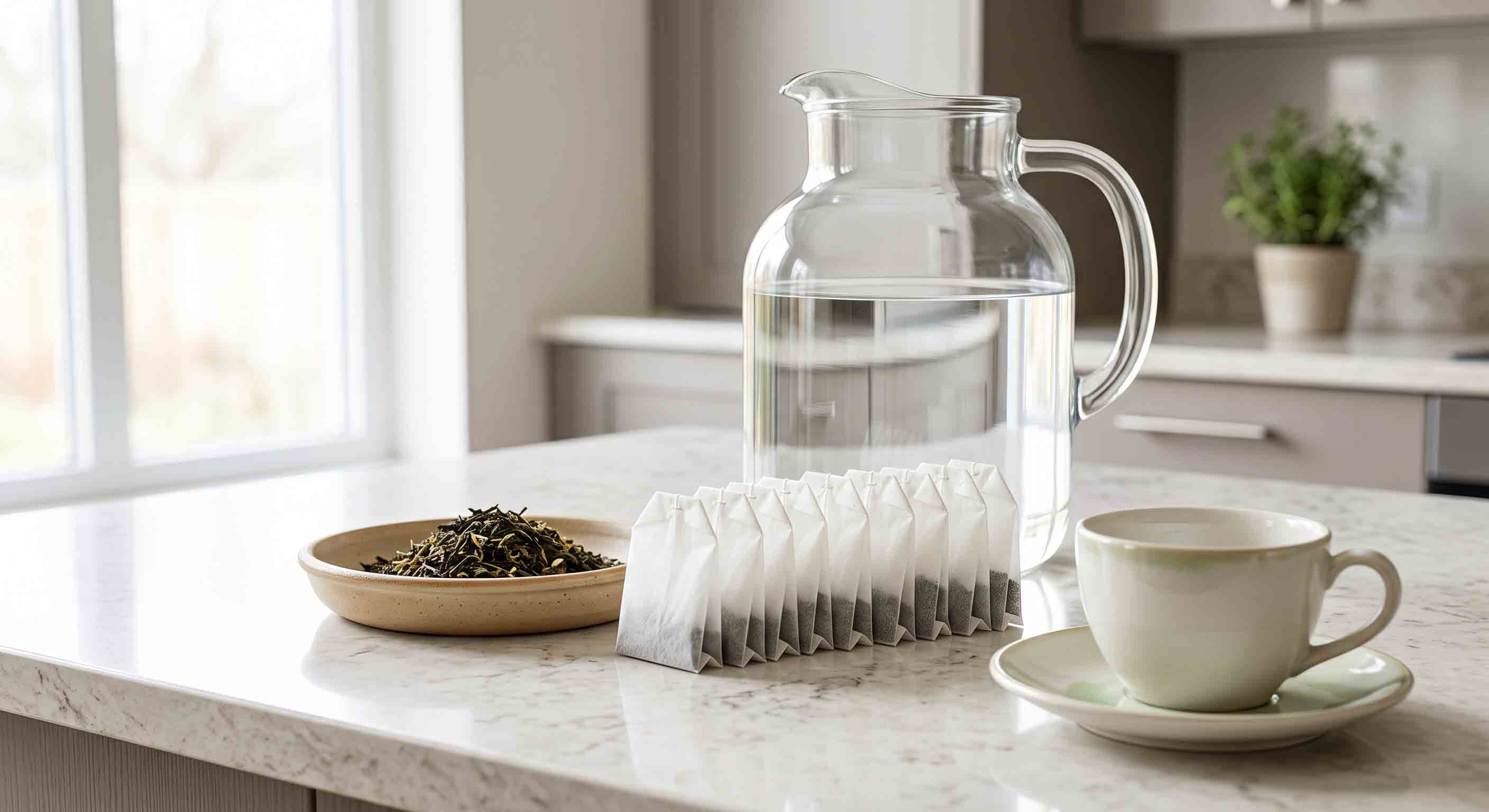
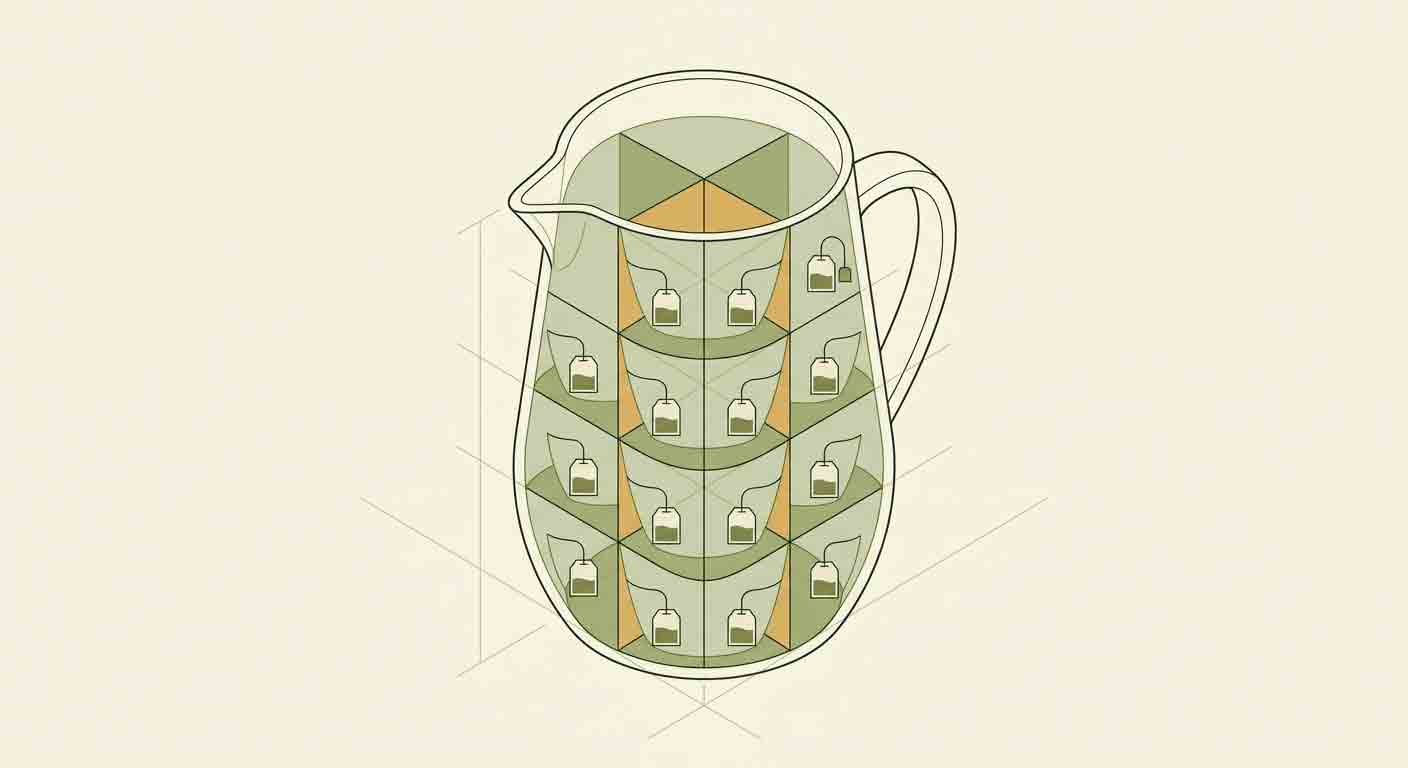
For a U.S. gallon, start with 16 tea bags if one bag is intended for an 8-fluid-ounce cup. A U.S. gallon contains 128 fluid ounces, and 128 ÷ 8 = 16. That is a useful starting calculation, not a rule for every tea. Bag size, tea type, desired strength, brewing method, and the product label can all change the best amount.
Read the tea brand’s preparation directions first, then scale them to the water volume you are making. The rest of this article shows the math, explains when to adjust, and separates ordinary brewed tea from product-specific recipes or food-safety questions that need their own instructions.
The one-gallon calculation
In the United States, one liquid gallon equals 128 fluid ounces, or 16 cups of 8 fluid ounces. If the label says one tea bag makes one 8-ounce cup, multiply one bag by 16 cups:
[ \text{Tea bags needed} = \frac{\text{total water volume}}{\text{label serving volume per bag}} ]
[ \frac{128\ \text{fl oz}}{8\ \text{fl oz per bag}} = 16\ \text{tea bags} ]
The National Institute of Standards and Technology lists a U.S. gallon as 128 fluid ounces and 16 cups. The calculation is exact; the tea strength is not. A product label may use a different cup size, different steeping directions, or a more concentrated method. Follow the product-specific directions when they are available.
The table illustrates scaling. It does not override directions from the tea brand, and it should not be used to give children’s, medical, caffeine, or dietary advice.
Check whether you mean a U.S. gallon or an Imperial gallon
Search queries often use “gallon” without naming the measurement system. A U.S. gallon is 128 U.S. fluid ounces (about 3.785 liters). A British Imperial gallon is larger: 160 Imperial fluid ounces (about 4.546 liters). The same number of tea bags will not yield the same tea-to-water ratio in both volumes.
If a recipe comes from another country, inspect the original unit before scaling it. Do not assume that “one gallon” in a UK source means the U.S. gallon used by many U.S. pitchers and beverage containers. When practical, use milliliters or liters alongside local measures to reduce ambiguity.
Read the tea bag’s own directions before scaling
Tea bags are not all filled or blended the same way. Some labels are written for a cup, a teapot, an iced-tea pitcher, a cold-brew recipe, or a concentrate. The specific label is the best first source because the manufacturer may have tested its product for a particular preparation method.
Check:
- the stated water volume per bag;
- whether the label calls for one bag or more per serving;
- the water temperature and steeping time it specifies;
- whether it has separate directions for hot tea, iced tea, or a larger pitcher;
- whether it instructs the user to brew a concentrate and then dilute it;
- any ingredient-specific or product-specific caution supplied on the package.
Do not assume that a darker tea, an herbal blend, a flavored tea, or a large “family-size” bag follows the standard one-bag-per-cup ratio. A large bag may be intended for a pot or pitcher, while a single-serve bag may be intended only for a cup.
Use a small test batch to adjust strength
Once you have scaled the label’s ratio, make a smaller test volume before committing to a full gallon. A quart is a convenient test because it is one-quarter of a U.S. gallon. If the label suggests one bag per 8 fluid ounces, four bags in one quart uses the same starting ratio as 16 bags in a gallon.
Taste the tea after following the package instructions. If the result is not what you want, change one variable at a time. You might adjust the number of bags, steeping time, water temperature, or dilution according to the product directions. Avoid multiplying every variable at once, because that makes it hard to know why the next batch tastes different.
This article does not prescribe a “stronger is better” method or make a caffeine claim. Different tea products and individual preferences vary. The goal is to use a clear starting ratio and then follow the product’s own guidance.
Family-size tea bags and pitcher instructions
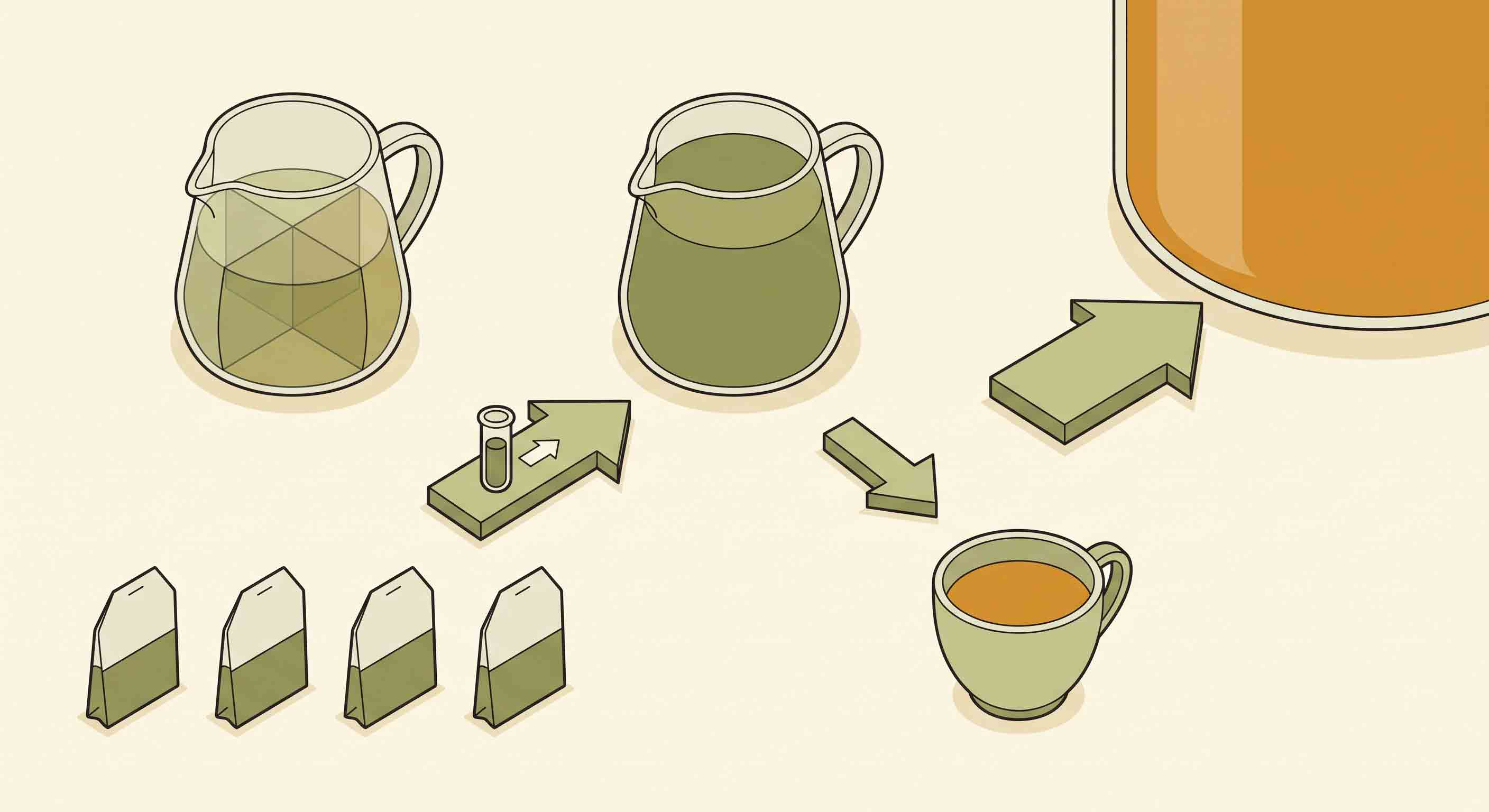
Some products are sold as large tea bags intended for a larger pot or pitcher. In that situation, a single-bag-per-cup formula may be wrong. Use the family-size product’s label as the source of truth. If it says a bag is designed for a stated pitcher volume, multiply that design volume to reach your target batch.
For example, if a label explicitly says that one large bag makes one quart, four of those bags would make one U.S. gallon at the manufacturer’s stated ratio. This is a mathematical example, not a recommendation for a specific product. If the label calls for a concentrate, ice, dilution, or a particular pitcher size, preserve that method when scaling.
Be careful with a package that says “makes a gallon.” It may refer to the final diluted beverage rather than the initial hot-water volume, or it may define the serving size differently. Read the complete instructions before counting bags.
Hot tea, iced tea, and cold preparation are not automatically interchangeable
The amount of tea can stay the same while the method changes, or the label may specify a different ratio for an iced drink, a concentrate, or a cold preparation. Ice, dilution, and extraction conditions can change the final taste. The correct approach is to use the method printed for that product and scale its water volume accurately.
Sun tea and kombucha require their own product-specific food-safety and sanitation guidance. Do not derive preparation methods for either from this gallon calculation.
Convert the formula for any container
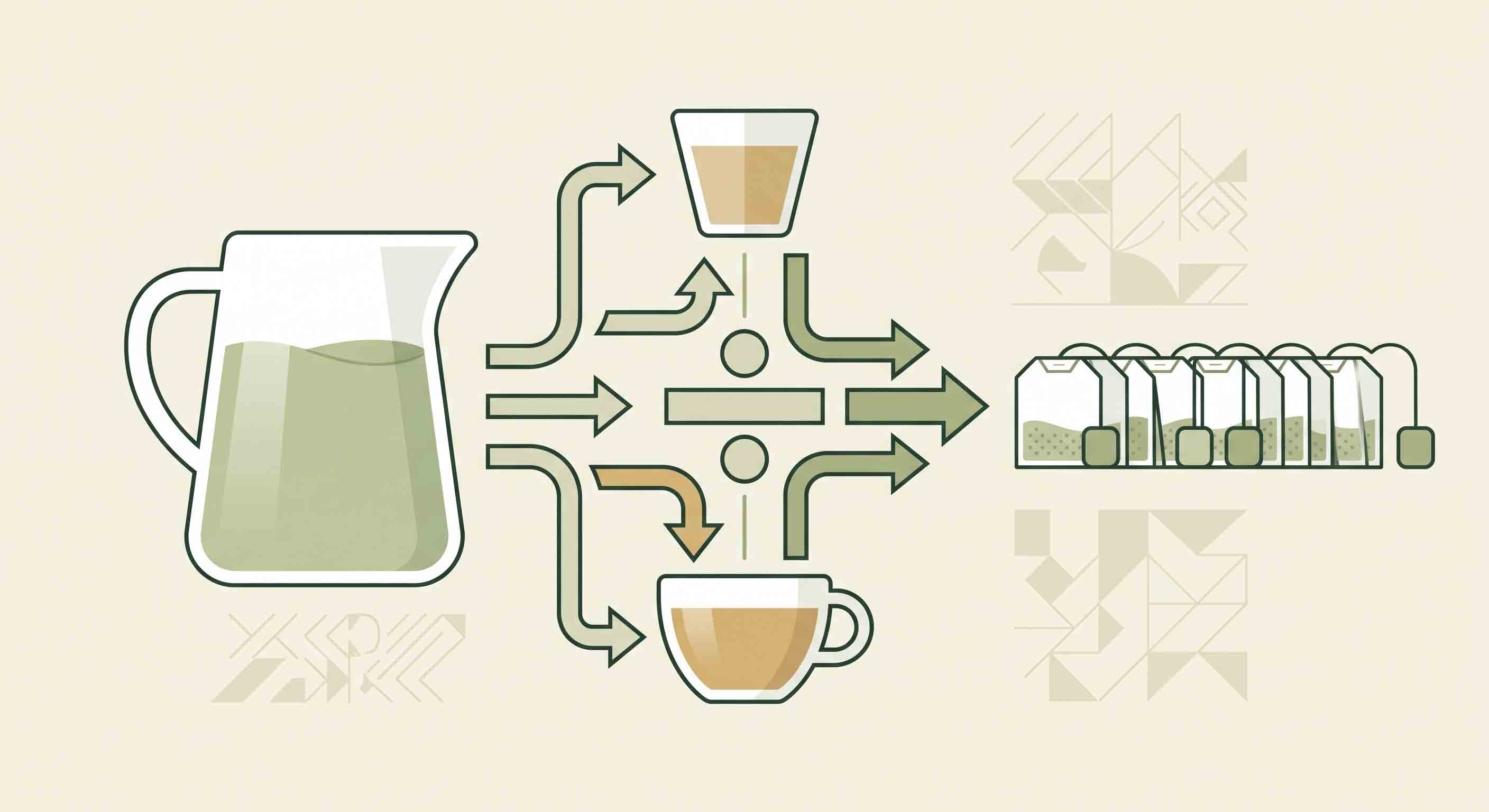
You can use the same formula for a kettle, jug, dispenser, or foodservice container. First identify the total water volume in the same unit as the label. Then divide by the label’s stated water amount per bag.
Examples using a label ratio of one bag per 8 U.S. fluid ounces:
The decimal results are useful reminders that the starting ratio may not map neatly to a container. Do not randomly cut open a tea bag just to force an exact decimal. A product-specific large-batch recipe or a small adjustment in the next batch may be more practical.
Avoid common scaling mistakes
The basic math is simple, but several mistakes are common:
- Mixing fluid ounces with weight ounces. The gallon formula uses fluid ounces, a measure of volume. Tea-bag fill weight is a different measure.
- Using an Imperial recipe with a U.S. container. Check the source’s gallon definition.
- Ignoring the package directions. A family-size or concentrate recipe may not use one bag per cup.
- Changing bags, steep time, temperature, and dilution all at once. Test one adjustment at a time.
- Counting ice as brewing water. If the product directs you to brew a concentrate over ice or dilute later, follow those instructions rather than treating the final glass volume as the initial brew water.
- Assuming every tea bag is a single serving. Large bags and specialty formats may be intended for another volume.
The most useful record for a household or café is a simple note: brand and product, water volume, bag count, method used from the label, and whether the result should be adjusted next time. That produces consistent batches without an unsupported universal rule.
When serving instructions affect a packaging project
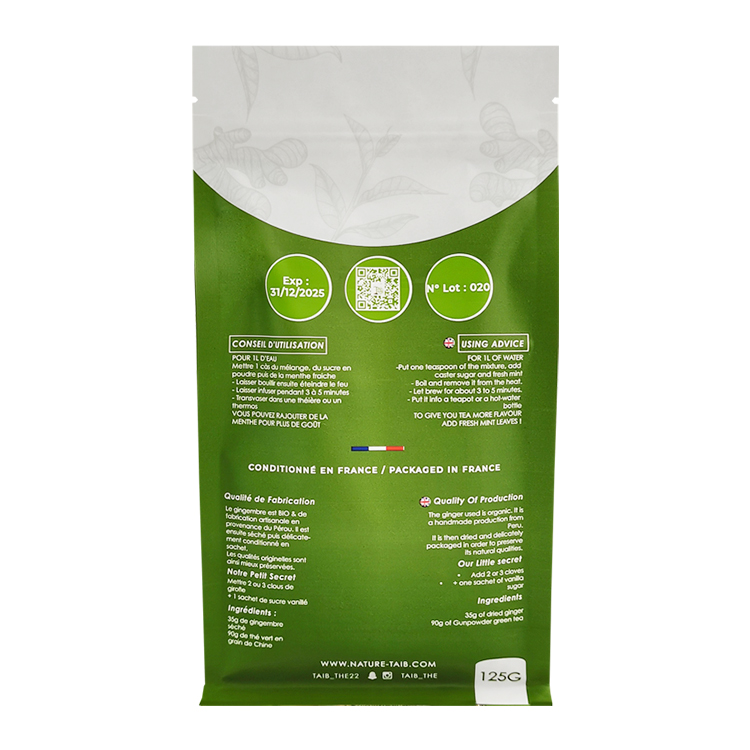
For a tea brand planning a gallon-size product, family-size filter bag, or retail pack count, serving instructions should be defined alongside the product and packaging system. Once the tea format, target batch size, product specification, and packaging requirements are defined, custom tea bags can be discussed as a project.
A clear label makes gallon math easier
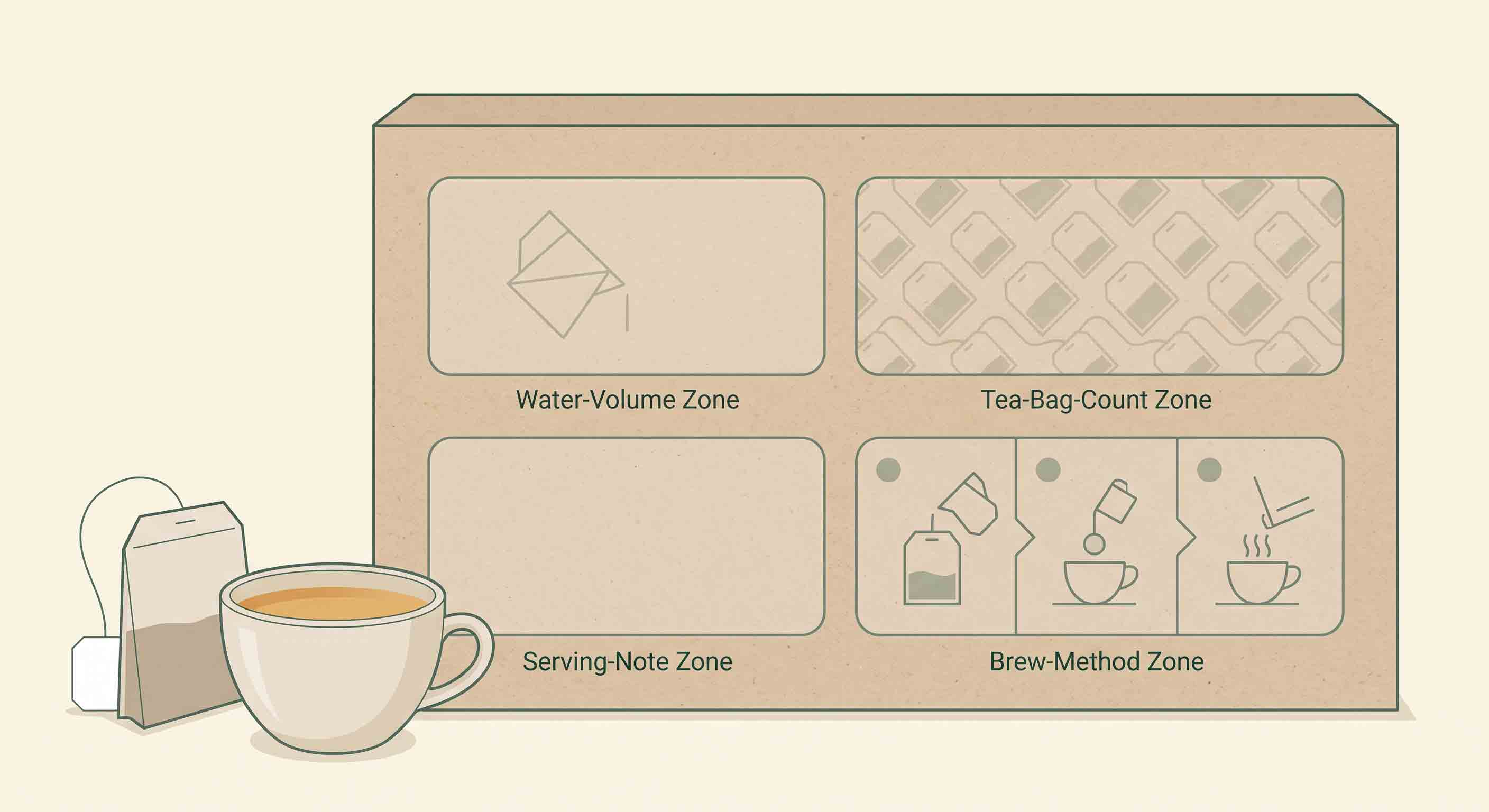
For tea brands, simple, tested preparation instructions reduce customer confusion. A responsible consumer-facing instruction should state the recommended water volume, number of bags, method, and any dilution step in a way that can be scaled. The responsible team should confirm the product directions and market requirements before printing them.
For a proposed family-size tea product, validate the directions with the actual product and packaging format. Make sure the on-pack wording distinguishes water volume from product weight and makes clear whether “gallon” means a U.S. gallon, a final beverage volume, or another defined measure. If the product will be sold internationally, consider showing a metric volume as well after the proper product and market review.
Keep a repeatable batch note instead of relying on memory
When a household, café, or event team makes larger batches regularly, a short batch note is more useful than a generic rule remembered from a search result. Record the exact tea product, the label ratio used, the water volume, whether the batch began as a concentrate, and the final adjustment that the responsible preparer preferred. This makes the next gallon easier to reproduce without pretending that one tea’s method fits every other tea.
The note is not a health, nutritional, or food-safety record. It is a simple way to preserve the product-specific preparation decision. It is especially helpful when a household switches products or when a café needs staff to use the same approved product directions.
Start with the label, then scale the batch
For a tea product intended for one 8-fluid-ounce cup, 16 bags is the starting calculation for one U.S. gallon. The label may specify a different serving size, a family-size format, a concentrate, ice, or dilution, so follow it before scaling.
Use the product label to identify the serving volume, confirm which gallon system applies, and make a smaller test batch when the product uses a different format or preparation method. This keeps the calculation useful without turning one tea product’s directions into a universal recipe.
Frequently asked questions
How many regular tea bags make a gallon of tea?
If one regular tea bag is intended for an 8-fluid-ounce cup, use 16 bags for one U.S. gallon (128 fluid ounces). Follow the product label first, because bag size and preparation directions vary.
How many tea bags make a half gallon of tea?
With a one-bag-per-8-fluid-ounce starting ratio, use 8 bags for a U.S. half gallon (64 fluid ounces). Use the product’s own directions if they specify a different ratio or a concentrate method.
Is a gallon always 16 cups?
A U.S. liquid gallon is 16 U.S. cups of 8 fluid ounces. A British Imperial gallon is larger, so recipes from different countries need to be converted before scaling.
Can I use fewer tea bags and steep longer?
Check the label first. Time and bag count affect preparation differently, and some products provide specific brewing directions. Make a small test batch and change one variable at a time rather than assuming a longer steep gives the same result.
How many family-size tea bags make a gallon?
Use the family-size product’s label. If it explicitly states the water volume one bag is designed to make, divide one gallon by that stated volume. Do not use the single-serve 16-bag rule unless the label calls for one bag per 8 fluid ounces.
Can I use the same formula for iced tea?
Not automatically. Some tea products use a concentrate, ice, or a different water volume for iced preparation. Follow the product’s iced-tea directions first, then scale the water and tea-bag ratio stated on that label.
Sources
- NIST Metric Kitchen: https://www.nist.gov/pml/owm/metric-si/metric-kitchen/metric-kitchen-cooking-measurement-equivalencies
- NIST Handbook 44 general unit tables: https://www.nist.gov/document/nist-hb-44-2024-appendix-c-general-tables-units-measurement