
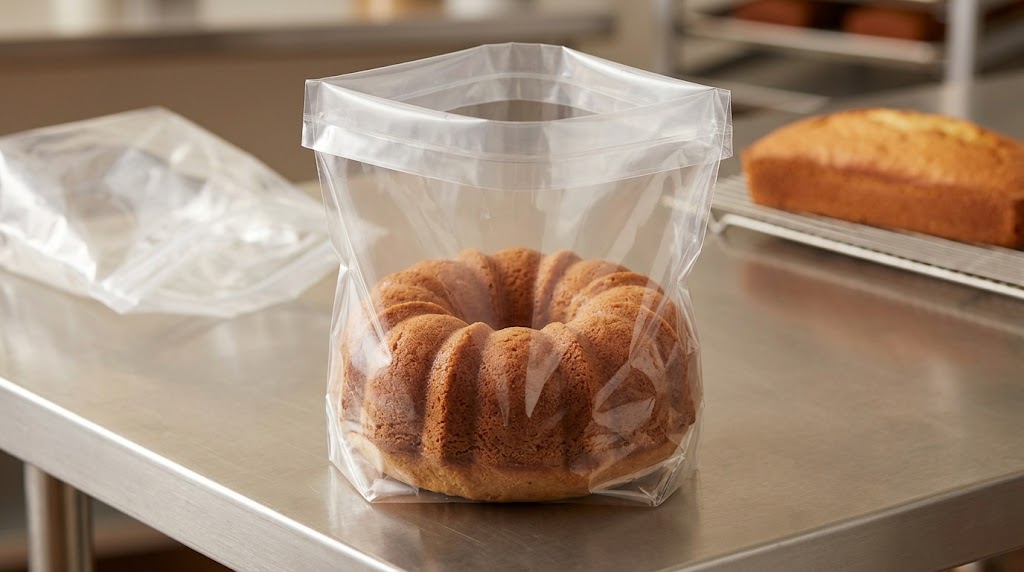
To package a whole cake in a food bag, first check that the finished cake can tolerate the planned film contact and loading motion. A firm, low-profile pound cake or plain Bundt may suit a correctly sized food-contact bag after a physical trial; a tall frosted cake often will not. Cool and prepare the cake under your recipe's handling rules, leave clearance at the bag opening and closure, then validate the filled pack. Shipping adds separate support, impact protection and, where needed, temperature control.
This is a guide to flexible food bags for whole cakes in the US market. It answers both “how to package a cake” for sale or local handoff and “how to package a cake for shipping” without confusing those two decisions. It also covers the distinctive fit questions of a Bundt cake. The cake producer must establish the product's food safety, storage, quality limits and shipping suitability. A bag manufacturer can discuss bag construction and samples; neither a photograph nor an empty-pouch specification proves that a particular cake has passed those checks.
First decide whether the whole cake belongs in a flexible bag
A bag bends around the product placed in it. That is useful for a compact cake with a stable surface, but it can be the wrong primary presentation for a high piped border, soft glaze, projecting fruit or multiple unsupported layers. Ask a practical question before discussing film thickness: Where will the film touch when a worker loads, closes, lifts, displays and removes the cake? If an unacceptable mark appears during any ordinary motion, changing the printed design will not solve the packaging problem.
Think about the top, sides and underside separately. A firm crust may tolerate gentle film contact that fresh buttercream cannot. A plain loaf or pound cake may have enough structural integrity to retain its shape when lifted in a bag, while a crumbly cake might shed pieces into the closure. An unglazed Bundt has a broad ring footprint and raised shoulders; its decorative ridges may still catch a tight bag opening. A glazed Bundt is a different finished product for packaging purposes. Test the actual glaze after setting and at the temperature at which the customer will receive it.
| Finished cake | First bag-fit judgment | Main trial to run | Avoid assuming |
|---|---|---|---|
| Plain, firm loaf or pound cake | A reasonable candidate for a flexible primary bag | Lift and loading, side contact, crumb transfer, closure space | A snug fit preserves appearance under a load |
| Firm unglazed Bundt | Possible candidate if the mouth clears the full ring and ridges | Widened opening, side gusset or base geometry, top clearance | The central hole makes the cake immune to bending or impact |
| Thin set glaze or dusted finish | Depends on whether film contact changes the intended appearance | Pack and remove at the actual storage and serving condition | The finish will remain dry or unstuck in every environment |
| Tall layer cake with soft frosting, fruit or fragile decoration | Usually needs a no-contact arrangement beyond a flexible bag | Confirm whether the film can avoid the decoration at all | A larger bag provides impact protection or stays off the icing |
| Cream-filled or otherwise perishable cake | Food handling decision precedes bag selection | Recipe-specific storage and time-temperature program, then bag trial | A sealed bag makes room-temperature transport safe |
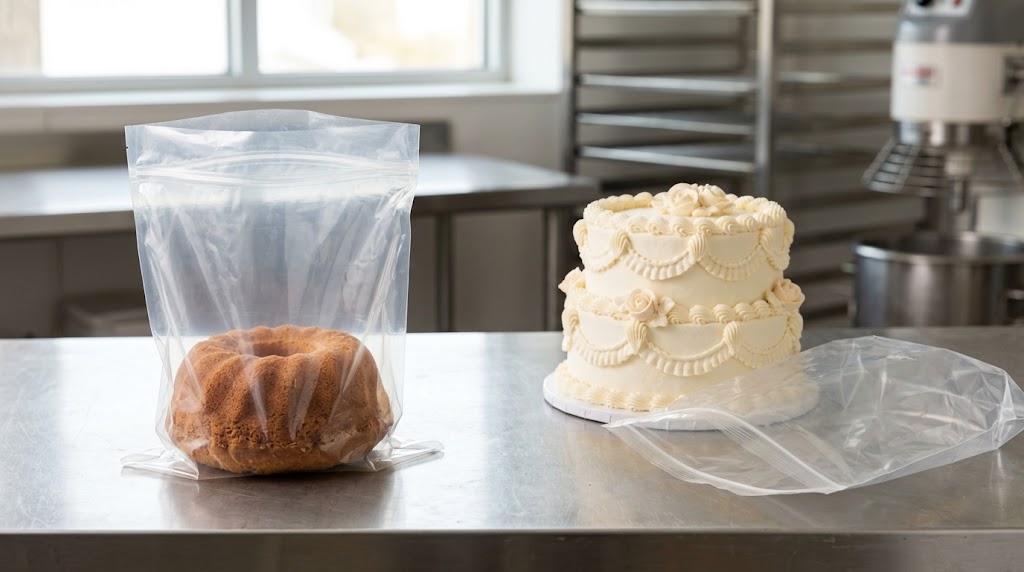
This screening is particularly important for a wide search such as “how to package a cake.” The answer changes with the exact cake. If a bag cannot be applied and removed without altering the product, a bag-only presentation is not the right promise. The bakery may choose another primary arrangement for that SKU; this article does not turn into a shopping guide for cake boxes or boards. For a suitable cake, the next task is measuring the finished unit and choosing a workable bag opening.
Choose the bag around the finished cake and the filling motion
The label “cake bag” covers many formats. A flat or three-side-seal pouch can suit a low-profile, stable product when its opening and usable internal space work. A side-gusseted or wide-bottom flexible bag can create more volume around a taller or broader whole cake. A stand-up pouch makes sense only if the actual filled unit can be loaded, positioned and displayed without compressing the cake. A gusset is flexible extra material, not a structural platform that suspends the cake against shocks. Ask for a physical sample rather than choosing from a front-view mockup.
Measure the maximum length, width and height after the cake has cooled and any finish has reached the handling state defined by the bakery. Record the highest point, widest protrusion and base footprint. For a Bundt, note its maximum outer diameter, raised shoulder height, and whether its central opening or uneven ring makes the cake vulnerable during lifting. The hole in the center is not free bag capacity: film can dip into it and contact an inner glazed edge, while the bag mouth still must pass over the full outer diameter. For an oblong cake, check both orientations before selecting a printed front panel.
| Dimension or handling observation | What to record from the real sample | Why the bag drawing alone may miss it |
|---|---|---|
| Finished footprint | Maximum outer diameter or length × width, including finish | Unfinished cake measurements omit icing, glaze or decoration |
| Peak height | Highest crown, shoulder or topping above the resting surface | A nominal bag height includes gussets and closure area |
| Useful mouth | Opening width in the actual loading motion, including seam restrictions | A flat outside width may not admit a round Bundt without contact |
| Filled shape | Where bottom, side panels and top fold sit after loading | The same flat bag can behave differently around an irregular cake |
| Closure zone | Clean area above the product and any zipper/heat-seal positions | A cake may fit the body but reach into the place that must close |
| Removal | How the customer withdraws the cake intact | Tight film can peel glaze or break ridges on the way out |
Ask the supplier whether a stated width is external flat width or usable internal width. The physical opening may be more restrictive than either number once the person holds the sides apart. Try several finished cakes at the natural production range, including the largest and a decorated one. Photograph the bag open, half loaded, fully loaded and closed. If the cake has to be squeezed to get past the top seam, enlarging the bag body without widening the mouth is not enough. If a much larger bag collapses against the top anyway, extra slack has not created reliable no-contact space.

Related project, with a clear boundary: Mylarbag's published white kraft baking-ingredient stand-up pouch lists Israel, a MATOPP / white kraft / CPP structure, gravure printing, a stand-up format, and 17 × 24 + 4 cm. Those are a record of an actual flexible pouch project. The project is for baking ingredients; neither its listed dimensions nor its window photo demonstrate that it fits or safely carries a whole cake. For this article, it illustrates what a published bag specification looks like and what still has to be tested with the bakery's cake.
Match the food-contact structure to the cake and its storage plan
The film side that touches a plain sponge may face a different food from the side touching an oily crust, chocolate coating or glaze. In the US, the FDA's food-contact use tables distinguish moist bakery foods with or without free fat or oil at the surface and distinguish room-temperature, refrigerated and frozen conditions of use. That is a reason to request documents for the final proposed structure and intended conditions, not a reason to call every film “FDA approved.” The material supplier and bakery should review the actual contact side, duration, temperature program, adhesives/inks where relevant, and any inner wrap used.
No material name alone gives a cake a universal shelf life. The cake's ingredients, moisture, surface finish, filling, process, sanitation, storage and distribution all matter. A high-barrier laminate may be appropriate for one tested product and unnecessary or problematic for another. A clear window can show the cake, but it also needs to be considered in the final bag design and food-contact documentation. Avoid copying the barrier language from a project for dry baking ingredients into a finished moist cake specification. Ask for evidence suited to the proposed product, rather than for a generic “freshness” adjective.
The same caution applies to temperature. FoodSafety.gov's general food-safety guidance calls for prompt refrigeration of perishable foods and identifies its usual cold-holding guidance. The food business must decide whether its particular cream, custard, fruit or dairy-containing cake is perishable under its applicable requirements. A bag cannot turn that decision into room-temperature permission. If the product is packed cold or frozen, trial the chosen film and seal across the real handling cycle, including any condensation on return to ambient conditions, print/label legibility, and release of the cake from the bag.
Plan print and retail information on a made-up bag
Whole cakes need more panel area than a slice, but that area changes once the bag expands around the cake. Identify the front panel and the area occupied by the gusset, folds, seams and opening. Keep important retail information and artwork away from the final seal, any tear path and a window that may distort small text over an uneven cake. Review a physical printed or label-applied sample in its filled state; a flat proof is not the buyer's view on a shelf. The cake producer is responsible for checking ingredients, allergens and market-specific labeling for the actual selling unit.
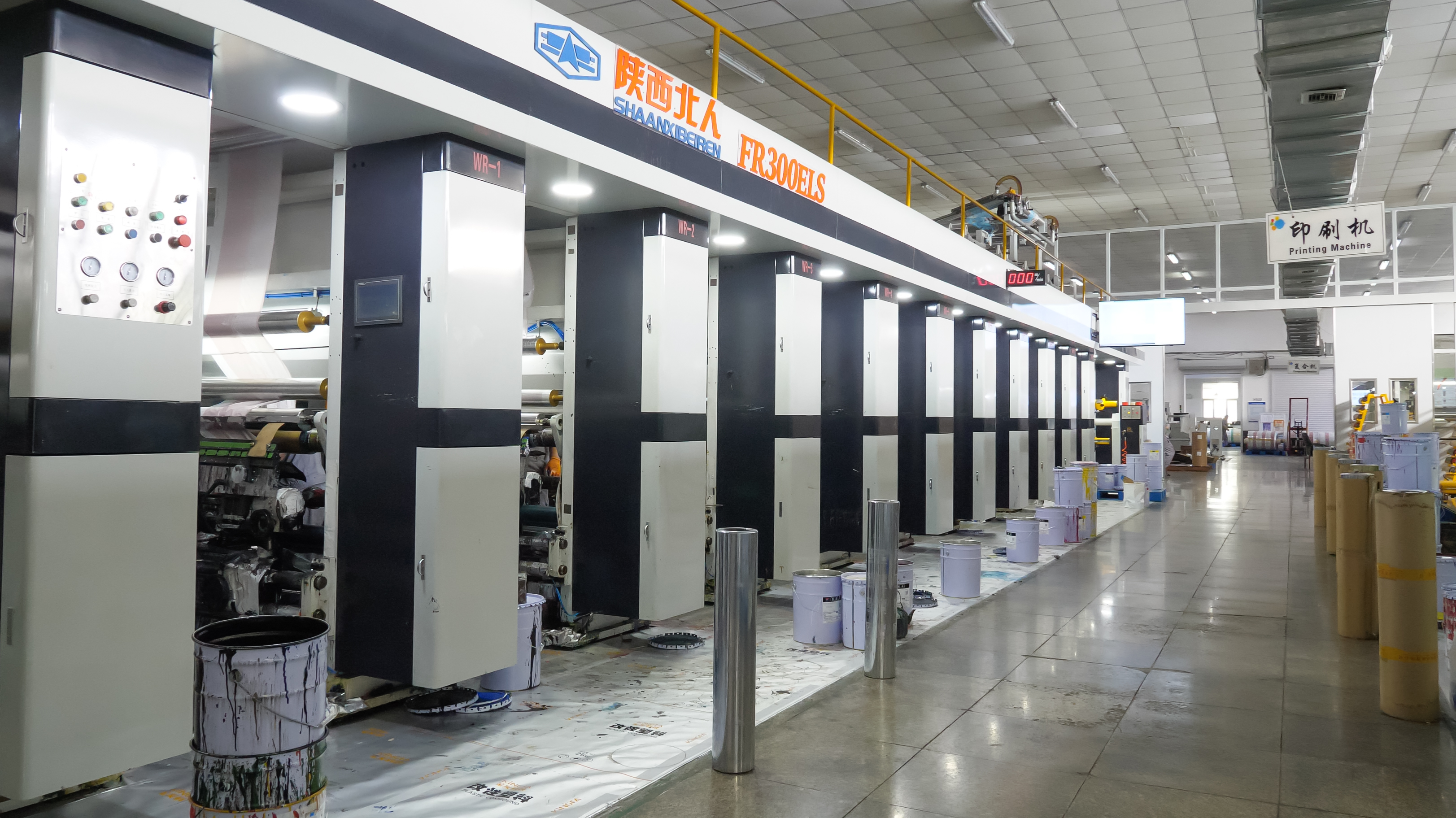
If a bakery wants a custom printed whole-cake pouch, send an outline of the filled cake and the proposed orientation before artwork is locked. Ask whether the candidate bag is made from rollstock or premade pouches, where the sealing faces are, how the chosen print process affects layout and sample approval, and whether the requested dimensions are feasible. Mylarbag's cake packaging range offers examples of flexible formats for a conditional conversation. A product description does not establish that a specific Bundt size, delicate finish or shipping route has already been qualified.
How to put a whole cake into a bag and close it
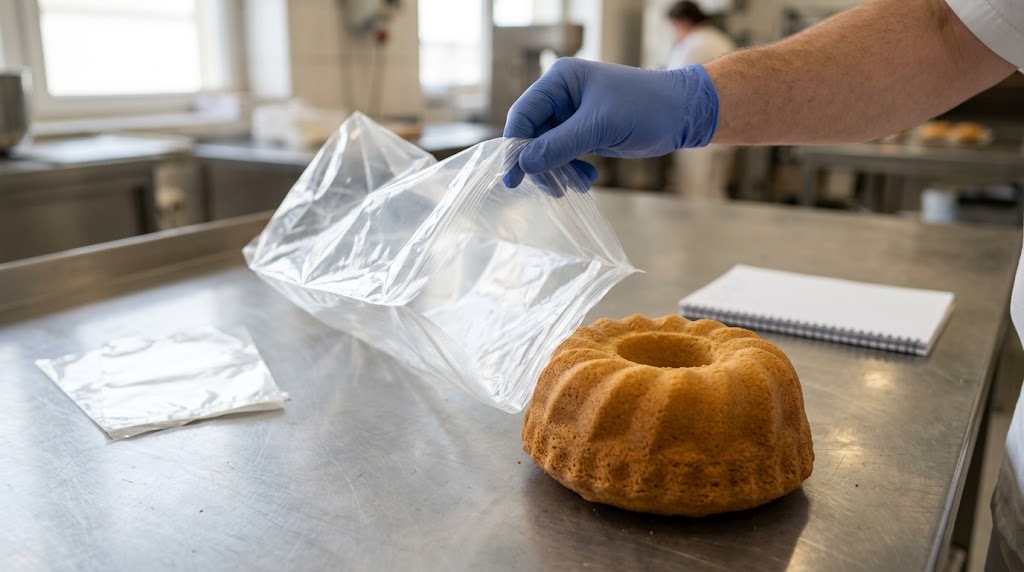
Follow a reproducible pack sequence. First, bring the baked cake to the state specified by the producer's validated cooling and handling procedure. Packing a warm cake can introduce trapped moisture; a cake with soft icing can transfer finish to the film. “Cool completely” is an operational instruction only in the context of a particular recipe and process, not a substitute for its food-safety controls. Keep bags clean and protected before filling, and check the opening, seams and closure for damage or foreign material. Set the cake on a clean food-contact handling surface that does not tear the underside when moved.
Open the bag fully and decide how the cake will pass through it. For a wide, squat Bundt, opening the gussets before the cake arrives is easier to evaluate than trying to force the ring past a flattened mouth. Support the cake underneath during insertion; do not pull a bag down over a delicate crown by grabbing only the top corners. Make sure the resting face is where the bag was designed to carry the load. If the cake has a paper liner or another food-contact layer in the final unit, include that exact component in the test and confirm its intended use. A photograph of the cake halfway inside is often the most revealing point of the trial: it shows whether the ridges scrape, the base flexes, or the mouth creases the finish.
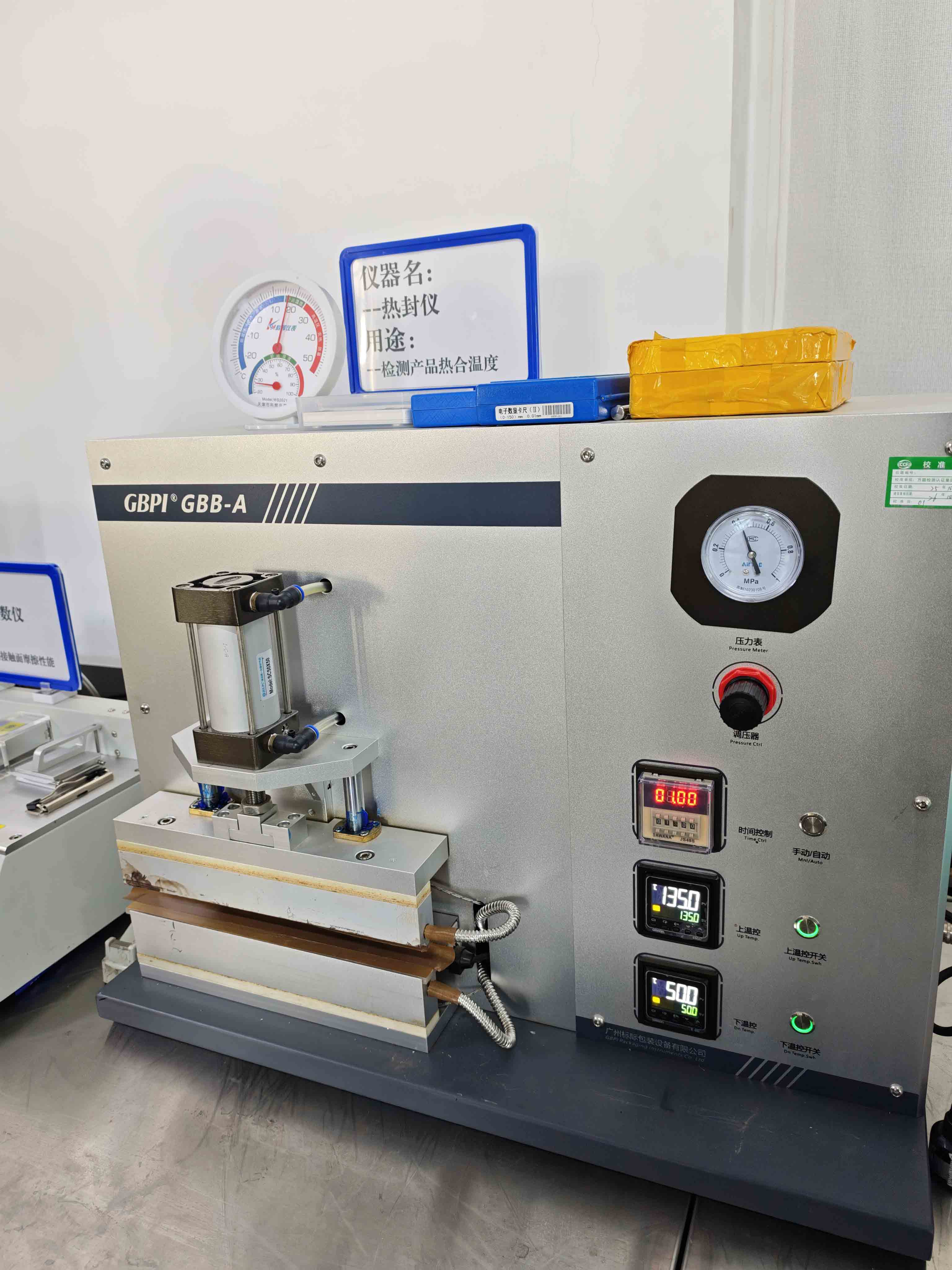
Once filled, look all around the pack. Does the front panel lie where intended? Is there film pressed against the highest ridge, glaze or decoration? Has the cake shifted against a side seam? Is the bag upright or meant to lie flat in its selling display? Then close only the designated closure zone. Crumbs, oil or glaze in that zone can interfere with a heat seal. A zipper, if present, may help the consumer reclose after opening, but it is not automatically the producer's initial finished-package seal. The exact film, equipment and closure design require a documented trial; do not lift a heat-seal temperature or dwell time from an unrelated food pouch.
Inspect the closed sample from front and back. The seal should be continuous under the approved inspection method, and the cake should remain below it without distorted film stretching over a peak. A visual check is useful but does not alone establish seal strength or storage performance. Train staff in the actual loading path and the rejects to look for. Trial what happens when a customer opens the pack: if a tight film peels glaze from a Bundt or pulls crumbs from a loaf, a bag that looks attractive while closed still fails the product presentation.
How to package a Bundt cake in a food bag
A Bundt deserves its own trial even if a similarly weighted loaf fits a particular pouch. Its outer diameter determines the minimum useful mouth, its ridges create local contact points, and its center ring can allow an unsupported portion of film to sag inward. A cake with a smooth, firm finish may be tolerant of that contact; a glossy glaze or delicate powdered surface may not be. Measure the outer ring, widest ridge, highest shoulder and underside resting area after finishing. Do not size the bag only from the pan's nominal diameter or the cake's weight.
Choose a bag orientation that makes sense for the cake. Placing a ring cake upright on its natural base inside a gusseted pouch can make for a clear shelf presentation if the footprint and top fold work in a real sample. Laying it on its side may concentrate load on a decorated ridge and change the intended front-panel view. A thin film cannot support the gap beneath a raised ring, and excess top film can drift onto the inner edge. The filled bag needs to be lifted and set down as a unit without causing a new contact pattern. Watch both the outer curve and the center opening when a worker closes the top.
If the recipe is glazed after baking, test the glaze at the actual set time and planned distribution temperature. A set-looking glaze may still mark under light pressure or condensation. A bakery might choose to apply a finish after the cake is unbagged, or use another presentation when the finish must remain untouched; those are product decisions to test, not features supplied by the bag. For a gift or retail line with several Bundt flavors, do a separate fit check for each meaningful finish and size rather than assuming one passed plain cake approves them all.
How to package a cake or Bundt for shipping
Shipping is a second qualification. A whole cake in a suitable primary bag has a food-contact cover, but the bag does not hold a heavy cake immobile, carry an impact load or regulate temperature. The size and mass of a whole cake also make it different from mailing individually wrapped small portions. The food producer must decide which SKU can be offered by parcel service, under what storage program, and whether the finish will remain acceptable after handling in different orientations. Do not advertise shippability from a counter-sale bag trial.
FedEx's baked-goods guide describes separate stability, cushioning and insulated-shipping functions for cakes, and notes that some delicate or cream-filled desserts may not be ideal to ship. UPS's food-shipping guidance discusses wrapping sturdy Bundt cakes, insulation when needed, limiting movement and fast service. These sources inform a whole shipment review; they do not certify a Mylarbag cake bag, and their examples cannot be used as a universal prescription for every recipe. Check the current carrier requirements for the route, product and chosen refrigerant.
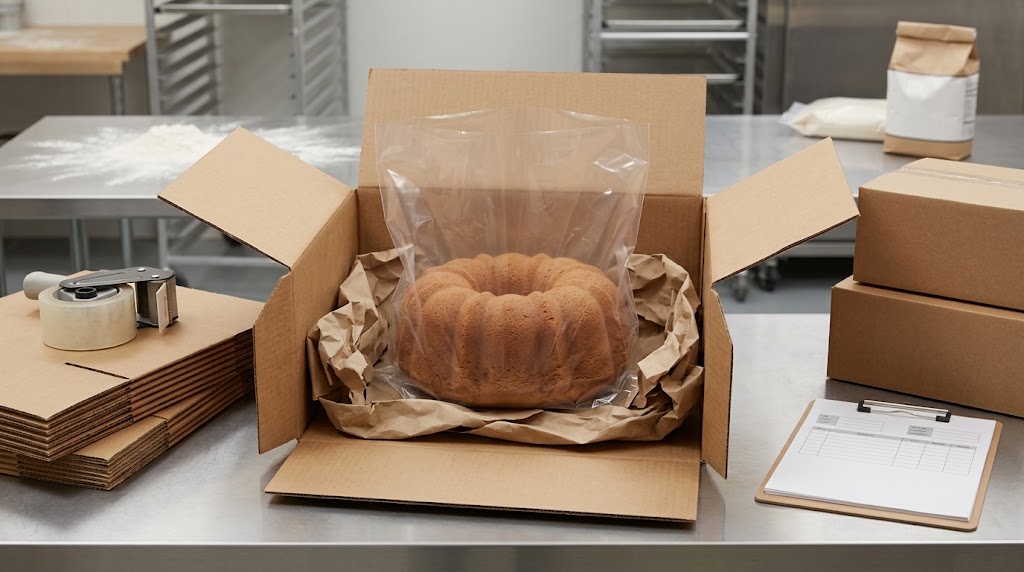
For a candidate whole cake, specify the inner bag first: how it is closed, whether film touches the cake, and what happens as the cake is lifted into the next layer. Then design the separate support so the cake cannot skid, invert into an unprotected top surface, or lean against a hard edge. Add the protective outer shipper and cushioning needed for the actual mass and route. If the recipe requires chilled or frozen transport, validate insulation, refrigerant placement, transit time and temperature under realistic delay and destination conditions. Keep coolant from pressing directly on the cake bag or wetting paper and label components. Do not assume a “perishable” sticker or an overnight service prevents all mishandling.
Run an arrival trial with the final contents, pack density and shipping route. Define the acceptance criteria before the test: no structural collapse, unacceptable film contact, broken ridges, glaze transfer, seal damage or label loss; for a temperature-sensitive recipe, include its own required temperature and quality limits. Inspect the pack as a recipient would, documenting the opening motion and cake removal as well as the closed condition. If only the bottom of a Bundt is bruised, improve its positioning and support; if only the glaze marks, revisit the finish, film contact and handling temperature. Do not confuse an undamaged outer carton with an acceptable cake.
FedEx's perishable-shipping guidance explicitly discusses testing the chosen materials and thermal arrangement and cautions that proper packing remains the shipper's responsibility. For cakes with fragile decorations or controls the shipper cannot maintain, the right outcome of the trial may be not to offer that SKU for parcel shipment. That decision protects the customer more honestly than treating additional film as structural reinforcement.
Approve the bag specification and the finished pack
Keep a concise record for the supplier and the packing team. It should name the finished cake SKU, recipe-related contact and storage conditions, external cake dimensions, finish, target orientation, bag mouth and filled geometry, closure, artwork/label plan, quantity, and whether the pack is for local sale or a qualified shipping route. Keep a real filled sample and photos of the loading step, not just a blank pouch and a flat dieline. Request the relevant food-contact documents for the final material and destination market. Before changing the bag, identify which failure it should solve.
| Decision gate | Keep this evidence | Recheck if this changes |
|---|---|---|
| Cake suitability | Finished sample and contact/handling notes | Recipe, finish, size, cake structure |
| Bag fit | Open-mouth and filled photos, internal dimensions, approved drawing | Pouch size, gusset, filling direction, production range |
| Food contact and storage | Final structure and use-condition documents; product's storage program | Film supplier, food surface, duration or temperature |
| Closure and artwork | Made-up pack, approved method, inspection record, visible label | Sealer, print layout, selling unit or market |
| Parcel shipment, if offered | Complete arrival and temperature trial as applicable | Route, season, cake mass, outer support or refrigerant |
Recommended packaging configuration to discuss
For a firm, uniced whole cake, a wide-opening flexible food bag or gusseted pouch may be worth trialing at the finished footprint and closure height. For a plain Bundt, prioritize useful mouth width, ring clearance and a filled-bag sample over a generic size chart. A clear window and custom printing are presentation options only after the cake survives the loading and removal trial. The published Mylarbag cake packaging page is a starting point for asking which bag format, film and sample process can be quoted for the specific cake. Confirm availability and terms in the actual project response; no listed pouch size or material stack here is an endorsement of an untested cake or shipping system.
Frequently asked questions
Can I put any whole cake directly in a food bag?
No. First evaluate the finished cake's structure, surface and normal handling temperature. A firm plain cake may pass a physical trial, while soft frosting, cream, fruit or projecting decorations may touch and mark on flexible film. A larger bag does not guarantee a no-contact space when it is lifted or laid down. If the ordinary loading and removal motion damages the cake, use a different primary arrangement for that SKU.
What bag size should I use for a Bundt cake?
Measure the finished cake's maximum outer ring diameter, highest ridge and actual resting footprint, then trial the bag's useful mouth, filled shape and closure space. Nominal pan diameter and outside flat bag width are not enough. Check the inner ring and glazed areas for unwanted film contact, and make sure the cake can be removed without peeling its finish. The right size is confirmed by a physical filled sample, not one universal Bundt chart.
Do I have to cool a cake before sealing it in a bag?
Follow the producer's recipe-specific cooling and food-safety procedure. Bagging a warm cake can trap moisture and change surface or crumb quality; a cold cake may encounter condensation during handling. Assess the actual product and distribution temperature, and keep crumbs or glaze out of the closure area. The bag cannot correct an unsafe process or define the cake's shelf life.
Is a zipper enough to seal a retail cake pouch?
A zipper can offer reclosure after a consumer opens a suitable pouch, but it is not automatically the same as the producer's finished initial seal. The chosen bag drawing should show the zipper, heat-seal zone, tear path and product clearance. Validate the actual film and equipment with filled packs; do not borrow a temperature or pressure setting from another pouch.
Can I ship a cake or Bundt in only a bag?
The bag can serve as the food-contact inner covering of a qualified shipment, but it does not restrain the whole cake against impact or keep a perishable recipe at the required temperature. The shipment needs separate positioning and protective packaging, plus validated temperature management where appropriate. Test the final route and inspect the cake at arrival, including what happens when the recipient removes it from the bag.
Does Mylarbag have a proven whole-cake or Bundt shipping bag?
The public cake page shows several flexible packaging formats, and a related published pouch is for baking ingredients. Neither establishes a completed whole-cake or Bundt parcel trial. Send a finished sample or measured photos, the cake's finish and storage program, target bag geometry, filling method and quantity through Mylarbag's contact page. Ask which construction and samples are feasible, and validate the cake and complete shipment yourself before making performance claims.
Start with the finished cake, not a catalogue size
For an inquiry, send photos from the top and side of the largest finished cake, its measured footprint and height, the planned retail orientation, the ingredients or finish that may touch film, the intended storage conditions and the expected bag quantity. Add a short clip of the loading motion if one exists, and state clearly whether shipping is part of the project. Mylarbag can discuss custom cake bags and review your bag brief against those facts. A production-ready choice follows a successful physical bag trial and, for parcel orders, a separate whole-shipment trial.