
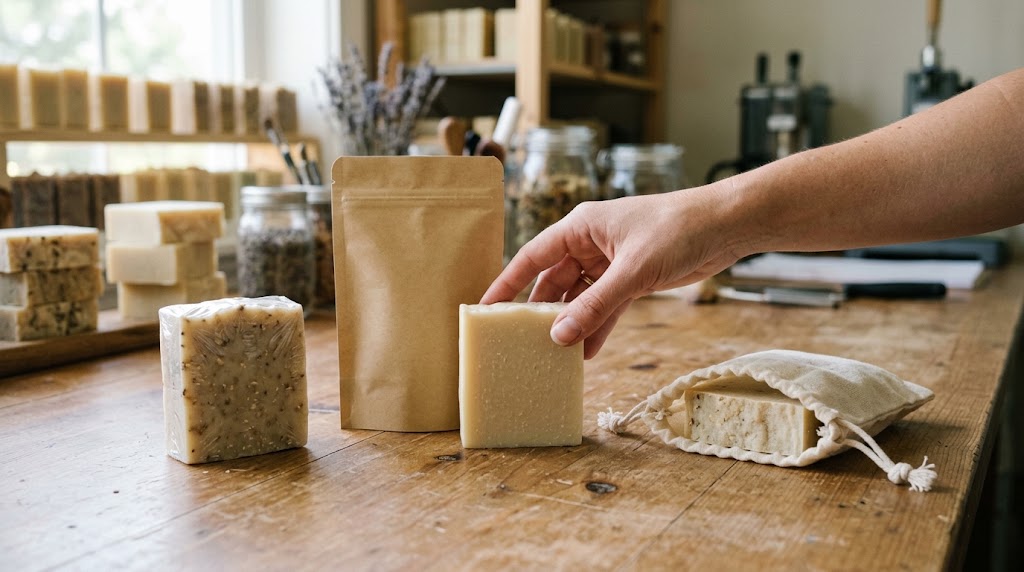
Package a bar only after it reaches the right condition for its soap type. Melt-and-pour soap should be fully cool and firm before prompt, close-fitting wrapping; cold-process soap generally needs its recipe-specific cure before final enclosure. Choose shrink film for a close display wrap, a sealed pouch when the complete package needs a defined protective structure, or muslin for a breathable presentation rather than moisture control. Trial the actual bar, bag, closure and storage conditions before ordering a run. Bramble Berry explains the different storage needs of melt-and-pour and cold-process soap.
The most useful packaging question is not simply, “Which bag looks best?” It is, “What condition will this particular bar be in when the bag closes, and what job must the package do afterward?” A decorative cotton bag, a perforated shrink sleeve and a heat-sealed laminate pouch can all be sold as “soap bags,” yet they leave the soap exposed to very different amounts of air, handling and moisture. This guide is for brands and makers specifying retail packaging for individual or grouped bar soaps. It focuses on the bag and its packing process; it does not treat a bath-time soap saver as retail packaging or suggest that a bag fixes a formulation problem.

First, identify the soap you are packing
A package cannot undo decisions made before the bar reaches the packing bench. Record the production method, finished dimensions, fragrance and additions, date and condition at packing, and whether the product will sit in a dry stockroom, travel through humid weather or be handled repeatedly at retail. If those answers differ by SKU, do not approve one material simply because it worked for another scent or shape.
Melt-and-pour bars tend to need particularly prompt surface protection after they have cooled and hardened. The glycerin in these bases can attract moisture from surrounding air, producing the droplets often called glycerin dew. Bramble Berry advises wrapping completely hard, cool melt-and-pour soap promptly; its glycerin dew guide also identifies humidity and base selection as variables. “Promptly” does not mean trapping a warm bar in a sealed bag: let the bar reach the condition specified by the soap maker or base supplier, then pack it without leaving it exposed unnecessarily.
Cold-process soap follows another schedule. It normally needs ventilation during its cure, so enclosing it immediately after unmolding is the wrong shortcut. Cure duration depends on the formulation and the producer's release criteria; Bramble Berry's beginner cold-process project, for example, calls for four to six weeks. That example is not a universal release rule for every recipe. Confirm the cure and condition of your bar before you choose a final bag and sealing date. Even a cured bar can show surface moisture under humid conditions, as Bramble Berry's cold-process discussion explains.
Other products sold as “soap,” including some cleansing bars with different ingredients or claims, should be assessed against their own formulation and label. The packaging team needs the actual product specification; a generic promise that any food pouch is automatically compatible with every fragrance or active ingredient would be unfounded.
| Bar or situation | Condition to confirm before packing | First packaging question |
|---|---|---|
| Melt-and-pour bar | Fully hardened and cool; inspect the surface in the expected humidity | How closely must the wrap contact the bar, and how soon can it be applied? |
| Cold-process bar | Completed the maker's cure and release checks; no visible surface moisture at packing | Will the proposed enclosure suit the already cured bar and its distribution conditions? |
| Sculpted or topped bar | Projections, soft details and the widest cross-section | Can the bar enter without scraping, and will shrinking or bag movement damage the top? |
| Multi-bar retail pack | Count, orientation, combined mass and contact between bars | Is a gusset, divider or larger pouch needed to keep the intended presentation? |
Shrink bag, sealed pouch or muslin: what each format actually does
These options are not interchangeable merely because each surrounds a bar. A shrink bag or film is a close-fitting overwrap once it is properly applied. A custom pouch has its own body, seam and closure to specify, with room for printing and possibly several bars. Muslin is a fabric presentation bag. It can keep a bar together with a tag and reduce bare-hand contact, but the open weave and drawstring opening do not make it a sealed humidity barrier.
| Format | Useful when | Main limitation to test | Ask the supplier for |
|---|---|---|---|
| Soap-sized shrink bag or film | Individual bars need a close, visible wrap and a repeatable wrapping workflow | Heat can mark a sensitive bar or distorted label; perforations and open areas affect moisture exposure | Actual film type, thickness, shrink behavior, perforations, sealing method, bag dimensions and a production sample |
| Three-side-seal or flat laminate pouch | A flat retail pack, printed face or controlled top seal is wanted | The opening and seal area may be too tight for a thick or textured bar | Finished internal opening, seal layout, structure, print area and a filled sample |
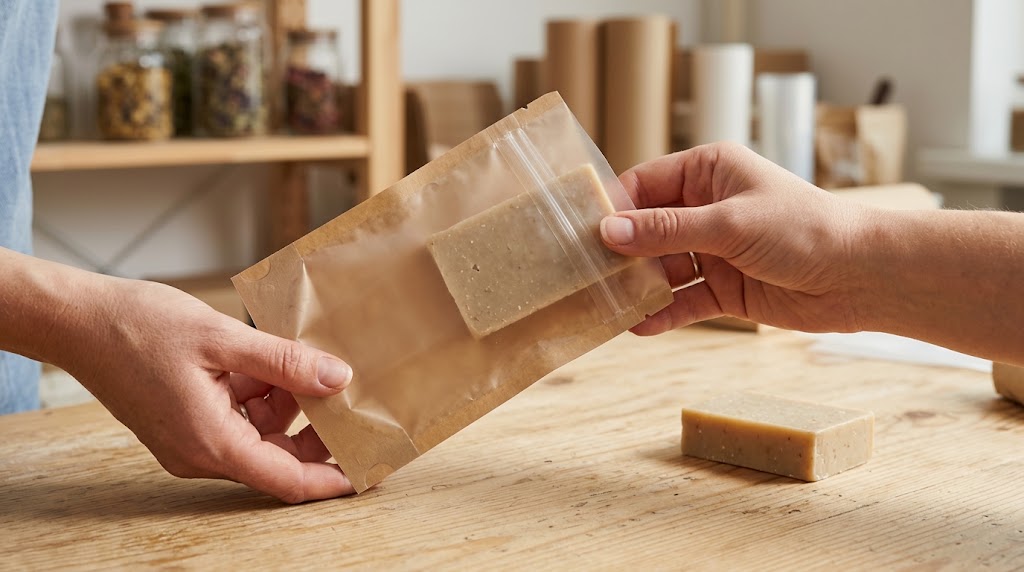
| Stand-up zipper pouch | One or more bars need shelf display, a gusset or resealable access | A zipper is not proof that the unopened pack has an intact primary seal | Gusset geometry, zipper position, optional seal above zipper and filled standing trial |
| Muslin drawstring bag | Gift presentation or a breathable outer layer is the intended role | Humid air can reach the bar; fabric can become stained or pick up scent | Fabric and stitching sample, laundering/handling expectations and whether a separate inner wrap is needed |
The right comparison is between complete proposed packs, not between marketing names. A narrow, poorly sealed laminate pouch can be less useful than a well-applied close wrap for a particular bar. A muslin outer bag can still be attractive if the soap has a separate suitable inner wrap. A plain shrink band that leaves large ends open should not be described as equivalent to a fully enclosed wrap. Describe the actual openings, seams and materials whenever you compare protection.
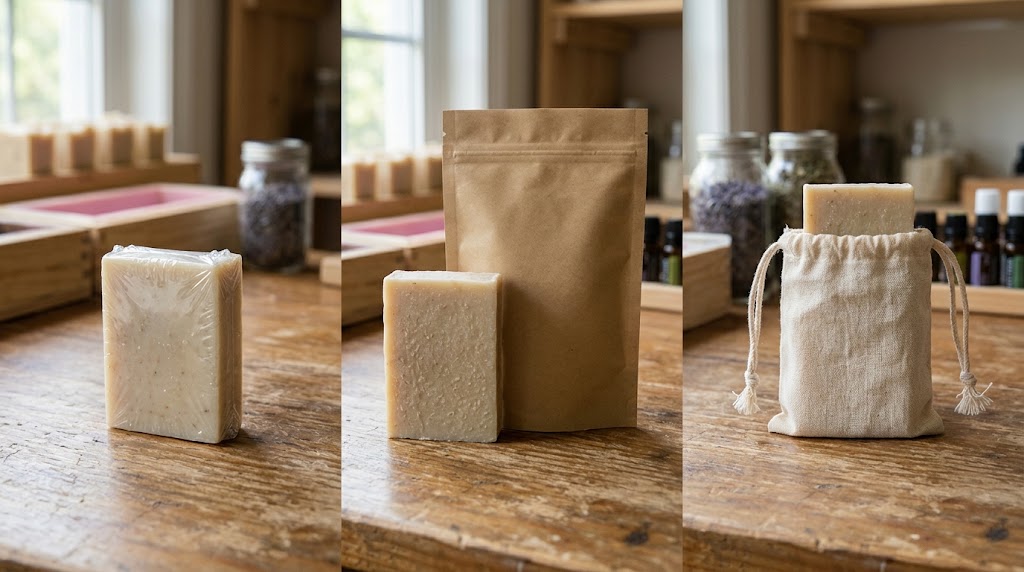
Will a muslin bag protect soap from sweating?
On its own, a muslin bag is not a reliable solution for glycerin dew. The drawstring opening and woven fabric let surrounding air reach the soap. If a glycerin-rich bar sits in humid air, changing the presentation to muslin does not remove the humidity or change the bar's formula. A cloth bag can serve as an outer gift layer or a place for a tag, while an appropriately selected inner wrap performs the close-enclosure job. That is a packaging-role distinction, not a rule that every soap must be sealed in plastic.
First establish what “sweating” means in your batch. Bramble Berry describes glycerin dew as atmospheric moisture attracted to the bar; its separate guidance for melt-and-pour and cold-process bars shows why a single wrapping tip does not fit every recipe. Other visible marks may have other causes. If the bar was packed while warm, visibly damp or before its prescribed cure, even a more enclosing package deserves investigation rather than a “moisture-proof” label.
Test the presentation you plan to sell. Pack a sample of the actual formulation in muslin alone, another in the proposed inner wrap plus muslin, and an unpacked control if appropriate. Put them through representative storage and handling conditions. Record the starting condition, dates, ambient conditions, visible droplets, marks on the fabric, changes in fragrance presentation and customer opening experience. These observations are specific to your trial; they are not a supplier-wide claim that any particular bag eliminates sweating. If the bar repeatedly develops dew, ask the soap formulator about the base and the handling environment as well as the packaging.
How to shrink wrap soap in a shrink bag
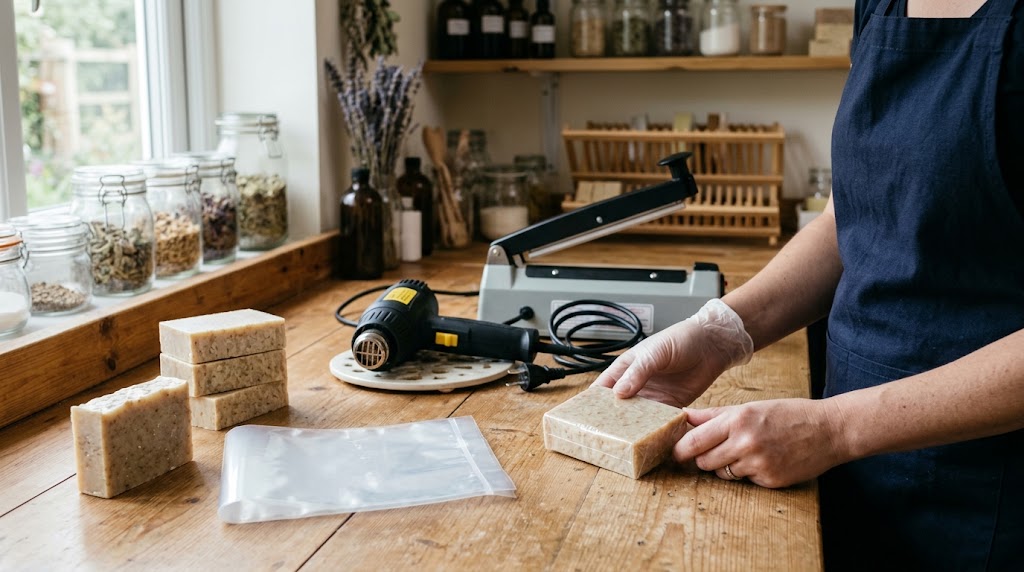
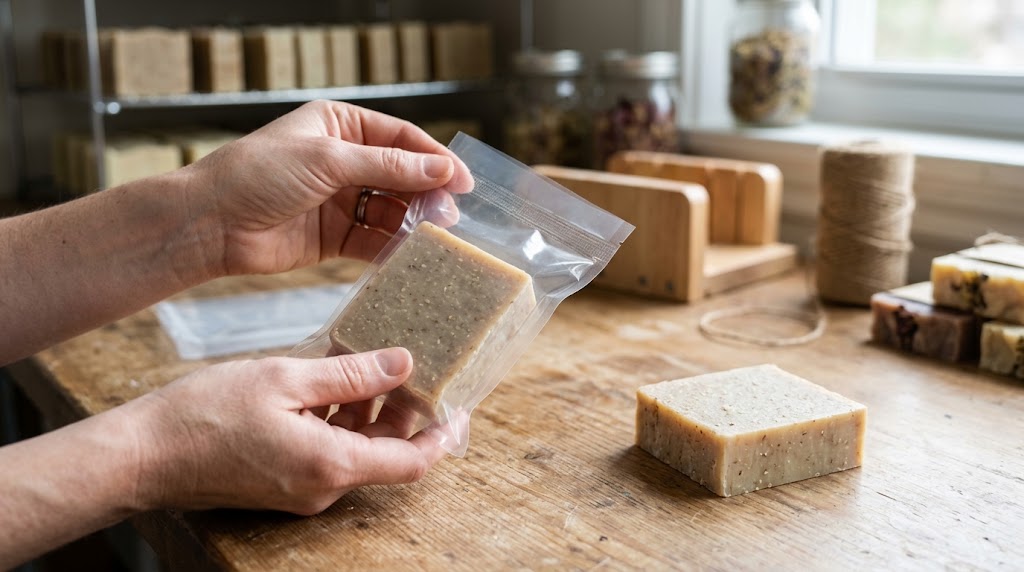
Shrink wrapping is a sensible option to evaluate for individual bars, including irregular shapes. Wholesale Supplies Plus's melt-and-pour packaging tutorial describes placing a bar in a shrink bag and moving the heat source rather than dwelling on one spot; it notes that small holes in some shrink bags let air escape during shrinking. That tutorial is a starting reference, not a heat setting for every film or soap. Bag supplier instructions, equipment instructions and a production trial control the actual process.
- Prepare a released bar. For melt-and-pour, wait until it is completely firm and cool. For cold-process, follow the maker's cure and release criteria. Remove loose crumbs and check the edges and decorative top for features that could snag or soften.
- Measure the bar in its selling condition. Include the widest point, highest decoration and any band or label that will sit inside the wrap. Do not pick a bag from the nominal weight alone. Request several candidate sizes and the actual film specification.
- Run a small fit trial. Slide the bar into the candidate bag without dragging a soft face across the opening. Identify where the seam, overlap and any perforations will fall after shrinking. If the bar strains the mouth or excess film obscures the display face, change the bag size rather than forcing the process.
- Close it as the film supplier instructs. Some systems require a seal and trimming; others use a different closure arrangement. Verify that the equipment and film are compatible before setting up a run. A drawstring, a small fold and a heat-sealed edge are not equivalent closures.
- Apply heat in a controlled trial. Keep the heat source moving and observe how the film and the actual soap respond. Never borrow a temperature or dwell time from a different product; an embellished or melt-and-pour bar may be especially sensitive. Allow the pack to cool before stacking or judging its finished appearance.
- Inspect the result. Look for holes, weak closures, excessive tension at corners, scuffs on the bar, distortions in a printed band and any moisture visible inside. Open several trial packs to assess the customer experience and see whether the wrap damages the product on removal.
- Repeat with the full label and route. A trial without its retail label, handling and shipping conditions has not tested the finished sale unit. Photograph an approved sample from all sides and retain the film and process settings with the batch record.
Where should a buyer source shrink bags for soap?
Look for a supplier that actually lists shrink film or soap-sized shrink bags and can provide a physical sample, film identity, dimensions, sealing instructions, and guidance for the heat equipment you use. A seller of custom stand-up pouches may be able to quote pouches without offering shrink bags; “soap packaging supplier” is too broad a phrase to settle that question. Mylarbag's published soap packaging page and the projects discussed below show custom flexible pouches, but the reviewed public material does not establish a shrink-bag product line. Confirm availability directly before placing a shrink-film request. If you need shrink film now, compare vendors that publish that exact format and trial it on your bar.
Buying only by a listing such as “4 × 6” is risky because sellers can report flat dimensions and closures differently. Request a sample and confirm how width and length are measured, whether holes are present, and whether the bar plus label fits before heat. In a quotation, separate film/bag cost from sealer equipment, operator time, label handling and reject rate observed in your own trial; there is no defensible universal “cheapest” format without those variables.
When does a custom soap pouch make more sense?
Choose a custom pouch for a packaging task that a close shrink wrap does not easily perform: a broad print face, a standing retail presentation, a group of bars, or a specified heat-sealed opening. Compare a flat pouch with a stand-up pouch only after deciding how the bar should sit on the shelf. A zipper can make a multi-bar pack easier to reopen, while an intact seal above it may be needed for the unopened retail unit. Those are design options to specify and test, not automatic properties of every zipper pouch. Conversely, a single small bar that only needs a close display wrap may not benefit from a roomy stand-up pouch.
Mylarbag's published soap projects include both a stand-up zipper pouch and a flatter three-side-seal pouch. Their listed configurations appear in the Related Projects section below. Neither project record proves that its dimensions fit another maker's bar or that its structure prevents a particular formula from sweating. The actual bar, inside opening, zipper position and top seal need a physical trial.

Size the bag around the real bar and the packing motion
There is no reliable conversion from “135 g soap” to a universal pouch size. Two bars of identical weight may differ in width, thickness, beveled edges and toppings. Finished bag dimensions can also describe external dimensions, while usable opening is affected by side seams, zipper placement and manufacturing tolerance. Make a simple specification sheet with the largest acceptable bar from production, then test that bar in an actual sample of the proposed package.
| Record on the sample sheet | Why it matters | What to test physically |
|---|---|---|
| Bar width, height and maximum thickness | Identifies the largest cross-section, not just the front face | Insertion without scraping or bending the mouth |
| Raised decoration, edges and fragility | A nominal rectangular measurement misses the vulnerable feature | Whether the bar rubs against the film, zipper or seam |
| Bag's usable mouth and body cavity | External listed size may overstate usable space | Repeat loading with several bars from normal production variation |
| Bottom gusset, if present | A stand-up pack must open and carry its actual contents | Filled stance, tilt, bar position and display face |
| Closure, tear notch and intended top seal | Contents must stay clear of the closing area | Closing method, seal cleanliness, opening and reclosing |
| Label or printed panel | Printing must remain legible and properly oriented after filling | Front/back visibility, seams, zipper and any planned hang display |
For an initial pouch inquiry, send a few actual bars or a dimensioned physical sample where possible. Record measurements in millimeters or inches, identify which is width versus thickness, and show a photo from the side as well as the front. Tell the supplier if one bar is presented upright, flat or diagonally; those orientations can change the bag decision. Ask for a filled, closed sample made with the intended closure, rather than approving only a flat, empty mock-up. If buying multiple scents in one bag size, test the largest and most fragile variants, not only the easiest sample.
Materials and seals need product-specific validation
Do not treat “foil,” “metallized” or “kraft look” as complete specifications. A multilayer pouch is a combination of the print surface, barrier or appearance layers, sealant, seams and optional zipper. The cited Mylarbag project records name MOPP/VMPET/PE and PET/AL/PE as different constructions. They tell you what those example bags are made from; they do not supply measured water-vapor transmission values, scent-retention results, consumer recycling eligibility or compatibility data for every soap formula.
Ask which surface touches the bar, whether the pack is intended for direct contact or for an already wrapped bar, and what the supplier can document about the proposed structure. Fragrance oils, colorants and other additions vary. A sample made from the actual film should be filled with the intended soap and observed over the proposed storage period and conditions. If a decorative window, hang hole or opening is added, check the complete design rather than assuming the body film alone describes the pack's performance.
The seal deserves its own trial. Keep flakes, dust, loose botanicals and raised parts out of the closing area; check that the finished top seam is continuous, suitably placed and opens as intended. A zipper may be useful after opening, but it does not replace evaluation of the original retail closure. If the pack is deliberately vented or has holes, say so in the specification. If it is intended to be closed, confirm where every opening is and what actually closes it.
Build a packing and inspection routine that staff can repeat
The best sample is not the one an expert can make once. It is the one the team can repeat with normal variation in bars, operators and packing speed. Put a reference sample at the station and define the order of operations: release the bar, inspect the surface, orient it, load without scraping, position the printed face, close, inspect, and place in its outer transport pack. Keep a small record of rejected units and their reason. A high reject count at the mouth may indicate that the bag is undersized or the loading method needs changing; marks at the top may indicate that the seal area needs more clearance.
Inspect at three useful points. Before loading, look for dampness, crumbling, soft decorations and variation from the approved bar. After closing, look at the entire seam or shrink closure, corners, print and surface. After a realistic holding and handling trial, open samples and inspect the bar itself, not only the bag. Photograph faults against an approved sample. These checks turn “looks good” into specific observations; they still do not establish a shelf life or chemical compatibility certificate.
If the bar is sold online, the retail bag and the outer shipping pack have different jobs. The primary package presents the soap and manages its immediate contact with the surroundings; the shipper limits crushing, movement and abrasion during transport. Put the finished retail unit through a representative shipping trial, including how the customer opens it. A beautiful pouch should not be used as evidence that a delicate raised bar can travel without appropriate outer support.
Plan the label and printed face with the actual product
Reserve printable area after seams, zipper, tear notch and any hang feature are fixed. A label that appears centered on an empty bag may shift or wrinkle once a thick bar is inside. Set the main product name and essential information where a shopper can actually read it on the filled package. Test contrasting colors under real shop lighting; inspect whether translucent film reveals the back of a label or whether a dark print hides the soap you wanted to show.
The legal classification and mandatory label details depend on the product and the market. In the United States, the FDA explains that “soap,” cosmetic and drug status depends on composition and intended claims, not just the word on the front. The CPSC's soap business guidance similarly points businesses to that distinction. Have the brand's responsible regulatory or labeling adviser check the exact label for each selling market before approving print; a packaging supplier's sample art is not a product-label approval. Do not add unsupported “sweat-proof,” “medical-grade,” “fully recyclable” or therapeutic claims to make the pouch look more convincing.
Related published pouch projects: what the records can tell you
The 135 g kojic acid beauty-soap pouch is an example of a printed stand-up zipper format with a listed MOPP/VMPET/PE structure and 11 × 16.5 + 3.5 cm size. It is useful when discussing the positioning of a zipper, gusset and printable front face. The public page does not provide a general fit rule for all 135 g bars, nor does its project photograph measure glycerin dew under every climate.
The PET/AL/PE three-side-seal pouch demonstrates a flatter printed configuration, with a listed 11.7 × 16.5 cm size and spot UV finish. Its record can guide a buyer's questions about print, opening and bar orientation. These are Related Projects, not controlled comparisons of shrink wrap, muslin and laminate; no customer sales outcome, loss rate, shelf-life result or compatibility certificate should be inferred from the galleries.
Recommended packaging configuration: match it to the task
For a single firm bar that needs a close transparent display wrap, start by testing a soap-sized shrink bag from a supplier that confirms that product. For a bar that needs a custom printed flat retail unit, request a physical sample of a three-side-seal pouch with the proposed material, clear opening and top closure. For a multi-bar pack or one that needs to stand on a shelf, compare a stand-up pouch with a gusset and any needed zipper or unopened-pack seal. Muslin may be specified as an outer presentation layer if the product and inner protection call for it; do not describe the cloth as a substitute for a tested moisture-control package.
Mylarbag can discuss custom flexible soap pouches documented in its published range. The projects above are examples of formats to review, not preapproved recipes. Ask for a quote using the actual soap type, cured or cooled condition, bar size range, pack count, desired appearance, closure, target markets and packing method. If the buyer specifically needs shrink bags, availability and specification need a separate explicit confirmation; the documented pouch projects do not establish that offering.
A practical purchase brief for your first sample request
Send a one-page brief before asking “How much is a soap bag?” Include a photograph of the exact bar front, side and top; finished dimensions at the largest expected variation; production method; whether the bar is already individually wrapped; intended one-bar or multi-bar count; target sales and storage conditions; preferred flat, stand-up or close-wrap look; artwork status; filling and sealing equipment; and the address or market for the final goods. State whether you want to evaluate moisture appearance, scent presentation, print, fit, handling or all of them. The supplier can then propose samples to test, not claim that a structure is validated before seeing the product.
Use the same trial record for every candidate. Note the bag material and construction as supplied, sample dimensions, batch identification, loading difficulty, bar condition at packing, closure result, changes after holding, and observations after transport simulation. Compare complete packed units. If a supplier suggests a change in material, zipper or printing, rerun the part of the trial affected by that change. A photo of an unfilled prototype is useful for artwork, but it cannot settle bar fit or post-fill appearance.
Cost comparisons should include more than the unit price of an empty bag. Count the material used per sale unit, label or printing steps, packing time, equipment, observed rejects and the outer protection the product still needs. There is no honest universal calculation that makes shrink film, muslin or a printed pouch cheapest for every bar. Choose the least complicated format that passes your product, presentation and process checks rather than paying for features you will not use.
Frequently asked questions
Should melt-and-pour soap be wrapped as soon as it comes out of the mold?
Wrap it after it is fully hard and cool, following the base maker's guidance. Leaving a glycerin-rich bar exposed in humid air can encourage glycerin dew, but sealing a still-warm bar is not the intended shortcut. Test the actual base and workflow in the expected environment. Bramble Berry's storage guidance distinguishes this from cold-process curing.
Can I put cold-process soap in a sealed pouch before it has cured?
Do not use a pouch to bypass the maker's cure. Cold-process bars generally need ventilation during the curing period, and a recipe's release criteria should be met before final enclosure. The four-to-six-week interval in some example recipes is an example, not a substitute for the producer's own checks.
Will a muslin bag prevent soap sweating?
No reliable conclusion follows from muslin alone. Fabric and a drawstring opening expose the bar to ambient air, while glycerin dew depends on the soap and surrounding humidity. Use muslin for presentation where it suits the product; compare an appropriate inner wrap if moisture exposure is a concern. Record what happens to the actual bar and fabric during storage.
How do I choose a shrink bag size for an irregular bar?
Measure the largest finished bar, including toppings or any label placed inside the wrap, and request several physical samples. Check how the bar enters, where the seam or perforations land, and how the material behaves after the supplier's prescribed closing and shrinking process. A flat bag measurement or soap weight by itself does not establish finished fit.
Does a zipper make a soap pouch airtight or sweat-proof?
The presence of a zipper alone does not establish either claim. Review the complete pouch structure, any separate unopened-pack seal, the actual soap's condition and the closing process. Trial the packed unit under representative conditions, then describe only the results you actually observed for that configuration.
What should I send when requesting custom soap pouches?
Send the actual soap type and finished condition, dimensions and size variation, a physical bar or photos, pack count, target market, preferred display, closure, artwork status and packing method. Ask for a sample made from the proposed structure and check it filled and closed. Confirm shrink-bag supply separately if that is the format you need.
Next step
Start with one released bar and two or three realistic packaging candidates. Make the retail unit exactly as it would leave your packing bench, inspect it after representative storage and handling, and give the supplier a written record of what passed and what failed. If a custom flat or stand-up pouch is among the candidates, share that record and the bar dimensions through Mylarbag's soap packaging inquiry or contact page. A useful quotation is built around a product and process that can actually be sampled, not an unsupported claim that one material solves every soap problem.