
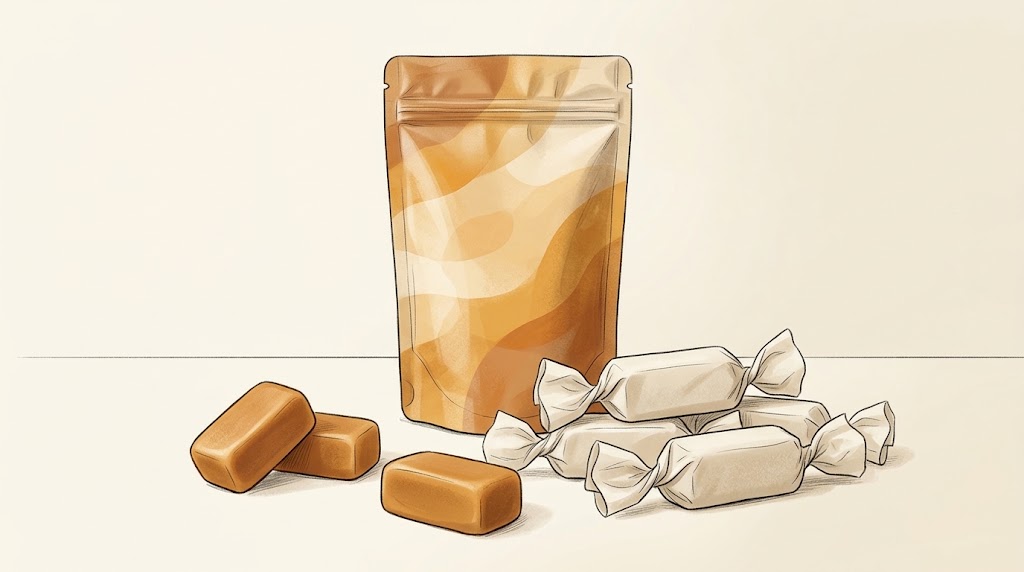
Package soft caramels individually in a food-contact wrapper that releases cleanly from your recipe and stays closed during handling. Size the sheet around the finished piece, wrap without squeezing the candy, and place the wrapped portions in a suitable retail pouch or box. Evaluate the complete pack through its intended storage and delivery conditions; attractive folds and a clean first unwrap do not establish long-term suitability.
This guide covers cut, soft caramel candy, including products sold in small retail assortments. It does not cover caramel sauce, and it does not treat fudge as another name for caramel. The focus is selecting and checking packaging around an established product, rather than changing the recipe to make an unsuitable wrapper work.
Begin with the caramel you will actually sell
Describe the finished piece before asking for wrapper samples. Include its usual length, width, thickness, weight range, surface condition, and any exposed additions such as salt or nut fragments. Explain whether the piece is cut from a slab or formed another way. A smooth rectangle and a piece with uneven edges may handle differently in the same sheet.
Define the condition at which wrapping should take place. The candy should have reached the appropriate state for your recipe and process, so it can be handled without unwanted distortion. Do not wrap a warm, flowing piece simply because the packaging station is ready, or assume that the same waiting time suits every batch.
King Arthur Baking's published Mom's Caramels recipe illustrates the sequence for one specific product: the slab is cooled, cut into pieces, and wrapped in waxed paper. Its storage directions are also specific to that recipe. This is a useful example of individual wrapping, not proof that every soft caramel should use the same material or storage regime. King Arthur Baking caramel recipe.
Provide representative samples, including normal variation. If a salted version and a plain version share an outer bag, check both against the proposed wrapper. If a seasonal flavor changes the candy's surface or firmness, record it as a separate product to assess rather than assuming that matching dimensions make it equivalent.
Keep the original product specification with the packaging record. When a later batch becomes difficult to unwrap, you need to know whether the candy, the wrapper, the packing conditions, or several things changed together.
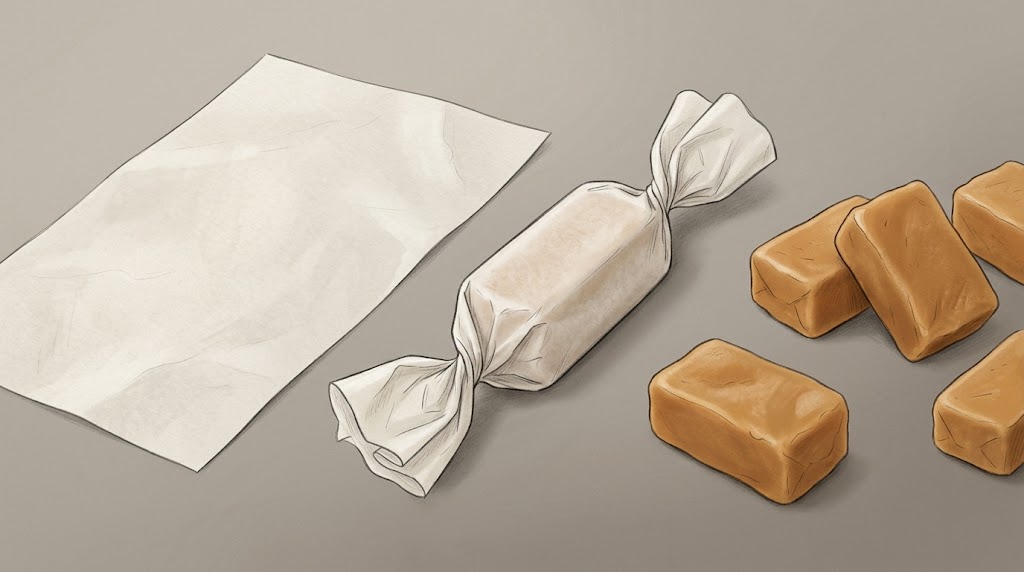
Give the individual wrapper and the outer pack separate jobs
The first package the customer touches may be the retail pouch, but the first material touching the caramel is usually the individual wrapper. Approve those two parts as a system. A well-made pouch cannot correct a sheet that tears or leaves material on the candy when opened.
Likewise, an individual twist wrap should not automatically be treated as a fully sealed storage package. Establish what protection each component provides and what the product needs between production and consumption. The outer pack may be important to the overall storage plan even when every piece appears neatly enclosed.
For the outer pouch, Mylarbag's custom candy packaging options can support a discussion about format, printing, windows, and sample fit. Keep the individual-wrapper requirement explicit in the inquiry. Do not assume that a supplier of printed retail pouches also manufactures cut twist sheets or operates a caramel-wrapping service.
Choose a wrapper grade, not just a familiar material name
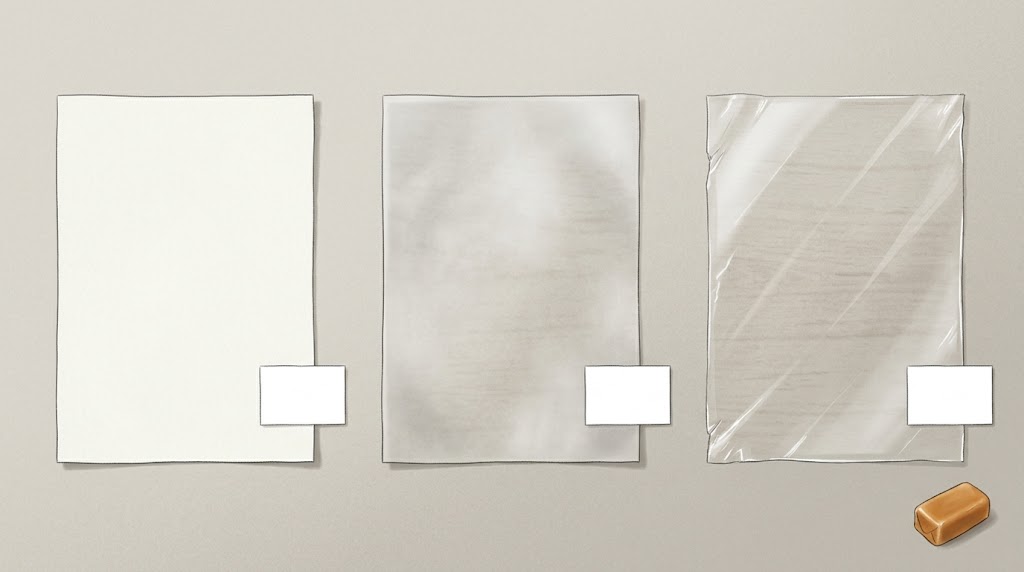
Waxed paper and coated paper
Food-contact waxed paper is a candidate for hand wrapping, as the recipe example above shows. Ask which specific paper and coating are proposed, what contact conditions they are intended for, and whether both sides are equivalent. A change in coating or paper grade should not be hidden behind an unchanged product name.
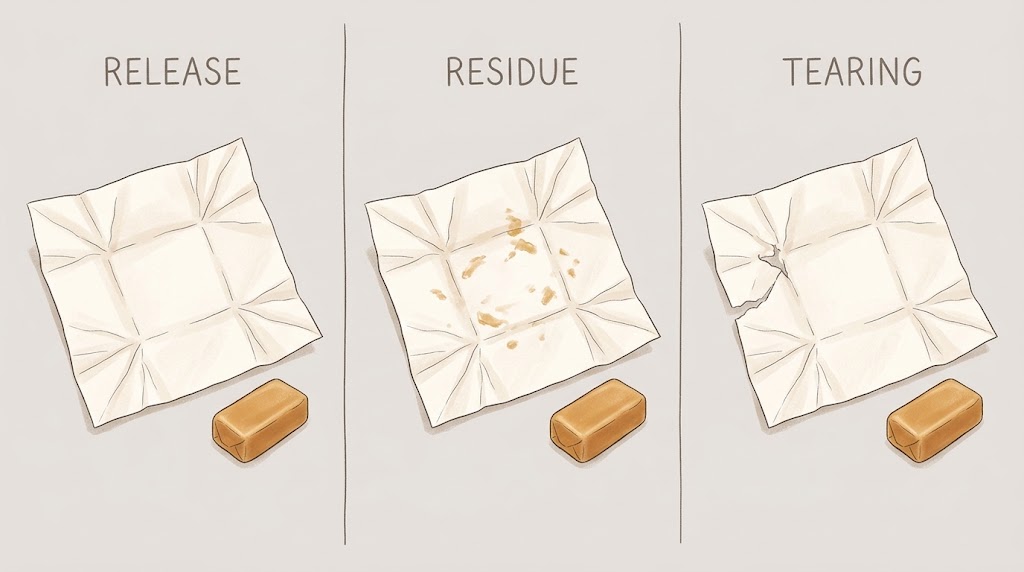
Assess release and grease appearance separately. Release means the wrapper comes away from the caramel as intended. Grease resistance concerns how the material behaves in contact with fat. A paper can look clean on the outside while being difficult to remove, so an attractive exterior is not enough to approve it.
Parchment or another coated paper may also be proposed. Evaluate the actual grade rather than treating a baking application as proof of prolonged suitability around your candy. Check how the sheet bends, holds a fold, and opens after storage. A material that releases well but repeatedly springs open creates a different packaging problem.
Cellulose and other twist films
For a transparent or machine-applied wrapper, ask specifically about the film's suitability for the intended wrapping format. Futamura describes twist-wrap applications separately from flow-wrap applications and identifies twist retention, slip, and machine performance among the relevant characteristics. Those distinctions help explain why an arbitrary clear film is not a substitute for a selected twist grade. Futamura packaging applications.
Ask the supplier how the proposed grade should be evaluated with your caramel. If the plan is to heat seal individual packs, confirm sealability and equipment compatibility. If the plan is to twist the ends, establish whether the material retains that shape. Heat-seal performance and twist retention should not be used interchangeably in the specification.
Food-contact documentation
Give the material supplier the actual intended contact: the type of confection, the relevant storage conditions, and the expected duration. Request documentation that applies to the supplied product and its use, including any relevant coatings or other components. For US applications, FDA guidance explains that compliance involves the identity of a substance, its specifications, and limitations on its conditions of use. FDA food-contact guidance.
Decorative papers should stay outside the food-contact package unless their suitability is established. Do not turn a gift-wrap sheet into a candy wrapper just because its print looks appropriate. For printed contact wrappers, confirm which face touches the food and have the supplier address the complete construction rather than only the base paper or film.
Size an individual wrapper around the finished piece
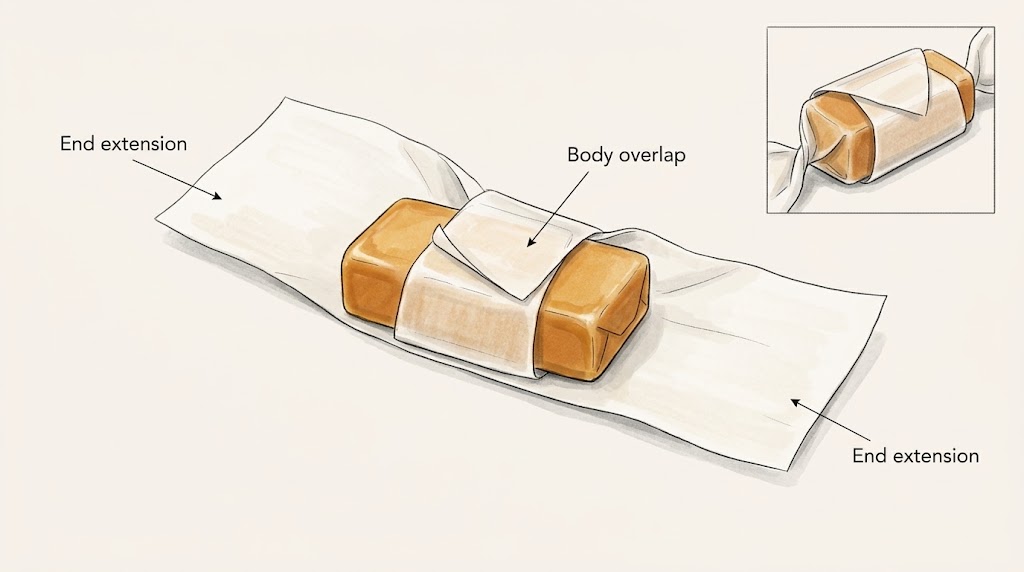
For a simple rectangular caramel with two twisted ends, separate two dimensions: the sheet length running along the candy and the sheet width going around it. This prevents a common sampling mistake in which more end material is added when the real shortage is overlap around the body.
A geometric estimate can help prepare a first mock-up. Let the caramel's length be L, width W, and height H. Let O be the chosen overlap around its body, and E the extra sheet length beyond each end. For an ideal rectangular piece, a starting estimate is:
Sheet width around the body = 2 × (W + H) + O.
Sheet length along the candy = L + 2 × E.
This assumes a simple wrap around a rectangular cross-section. It does not account fully for rounded corners, material thickness, stiffness, gathering, or the way an operator forms the ends. The end extension is a trial choice that must be adjusted to the actual material and candy.
The following dimensions are invented to demonstrate the arithmetic. They are not a factory specification or a recommended size for all caramels.
Use the resulting 80 × 64 mm rectangle only as a starting mock-up. Trial it with an approved food-contact sample material. Check that the body remains covered when the ends are formed, that the ends can be handled without pulling into the candy, and that the sheet does not tear at the gathering point.
Mark the two directions on a sample drawing. If ordering rollstock, have the converter and equipment supplier confirm orientation, repeat length, web width, and other required machine details. A hand-cut rectangle should not be sent directly into production as though it were a validated machine specification.
How to wrap caramel candy by hand
Prepare cut sheets, receiving trays, and the outer packing area before beginning. Use the approved handling and sanitation procedure for your operation. Keep the working batch manageable so finished pieces do not sit unprotected while someone cuts a new stack of paper.
Place one piece on the intended contact face of the sheet, centered in the selected orientation. Bring the wrapper around the body so the edges overlap as planned. Aim for full coverage without pressing the caramel into a different shape. If the material needs considerable tension to stay in place, reconsider the sheet size or grade before continuing.
For a two-ended twist wrap, support the center while forming each end beyond the candy. The closure should be made in the extra material, not by twisting the caramel itself. Use a technique appropriate to the selected wrapper, with enough retention for handling but without tearing or drawing the sheet into the product. There is no universal number of turns that works for every paper and film.
If using folded ends instead, assess the fold pattern with the same attention to coverage and opening. A neat fold that unfolds when pieces are placed together has not met the practical requirement. Do not add household adhesive or decorative tape to the contact package as an improvised repair.
Set wrapped pieces down in a way that preserves their shape. Check several through the run, including the first pieces and those made after the operator has been working for a while. Look for exposed corners, uneven overlap, torn ends, and a technique that changes as speed increases.
When a piece falls outside the agreed standard, follow a defined rework or rejection procedure. Repeatedly unwrapping and squeezing the same caramel to rescue its appearance can make the trial misleading. The purpose is to establish a method the team can repeat, not to produce one perfect sample with exceptional effort.
Check release after holding, not only immediately after wrapping
An immediate unwrap is useful for finding an obviously unsuitable material, but it is only the beginning. Prepare separately identified samples for the holding conditions and observation intervals relevant to the product. Keep the recipe, piece size, wrapper grade, contact face, and wrapping method traceable.
Open samples as a customer would. Observe whether the wrapper comes away intact, whether pieces of it remain on the candy, and whether the caramel loses its intended shape during removal. Record the candy's condition at the time of opening. A sample opened directly from a different storage environment may not answer the same question as one opened under the expected serving conditions.
Use simple, agreed observations rather than an undefined score such as “good packaging.” Photographs can help document residue or tearing, but they should be accompanied by the material reference and sample history. Do not convert a visual check into a claim that a package passed a migration or food-safety test.
Choose the next trial from the evidence. If only one flavor releases poorly, assess that product instead of declaring the whole wrapper range unsuitable. If one operator's samples have exposed corners, compare technique before changing the material. Several causes can coexist, so keep conclusions narrower than the observations.
Fill the retail pouch with wrapped pieces
Choose the outer bag using completed individual packs. Bare caramel pieces leave out the space occupied by overlaps, folds, and twisted ends. Even when the candy weight is unchanged, a different wrapper or longer tails can change how the assortment sits inside the pouch.
Test the proposed count or weight with the normal range of finished pieces. Allow the wraps to settle without forcing the tails into the top closure area. Look at the filled pouch from several sides and check whether the bottom opens as intended. Confirm that the display appearance can be achieved during ordinary filling, without arranging every piece by hand for a photograph.
Separate piece count from net candy weight. If a pack contains a stated number of caramels, verify the count through your packing procedure. If it carries a net-weight declaration, use a suitable method that accounts for the outer pouch and every individual wrapper. A count based on an average piece weight is not a substitute for the applicable quantity-control procedure.
For assortments, define how flavors are identified and distributed. A mixed pack should not depend on staff remembering which unmarked wrapper belongs to which recipe. Keep the product identity, ingredient and allergen information, and final label consistent with what is packed. Review the requirements for the market and sales format, particularly if individual pieces may later be sold separately. FDA food-business guidance.
Keep wrapper tails out of the outer seal
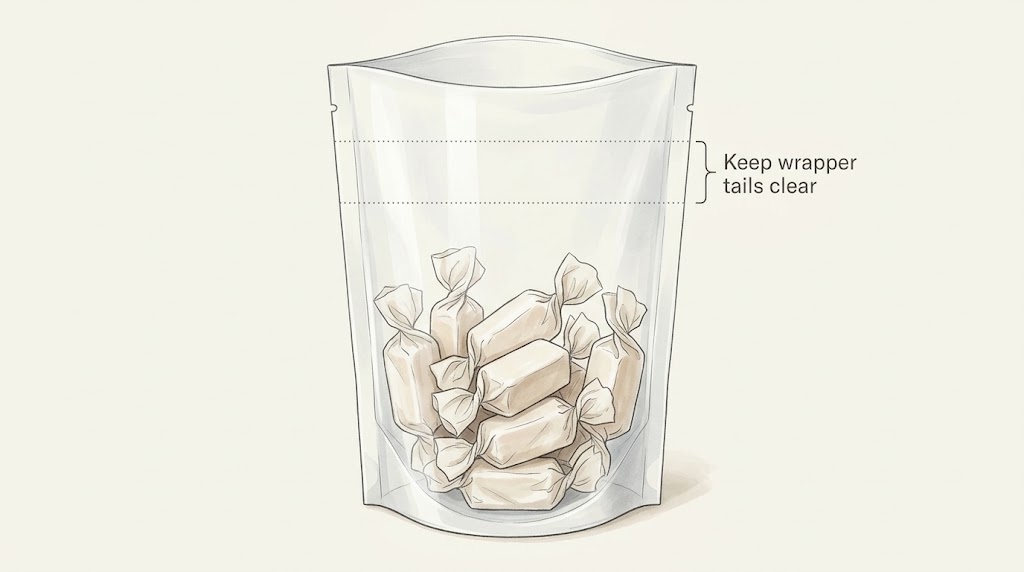
Inspect the pouch mouth after filling. A light sheet end can sit across the sealing area even when the heavier caramel body is well below it. Make clearing that area a deliberate step, rather than relying on the sealer to push stray material aside.
Use the pouch supplier's guidance to establish a suitable sealing process on the equipment being used. The closure needs clean contact between the intended sealing surfaces. Confirm the location against the pouch design so the seal, tear feature, and any zipper can function together.
Check completed packs using the quality procedure agreed for the application. A visible trapped wrapper, fold, or damaged area should prompt investigation. A straight seal line alone does not establish package integrity, and a zipper closing smoothly does not prove the initial seal was effective.
Include an opening check as well. Can the customer open the pouch, remove a wrapped caramel, and close the remaining pack if it is designed for reclosure? Do the twisted ends catch on a narrow opening or become awkwardly tangled? The retail pack should make the individual portions easy to use, not merely fit them into the smallest possible space.
Establish storage and delivery requirements for the complete pack
Do not assign a shelf life from the wrapper name, the presence of an outer pouch, or a recipe found online. Set the product's storage and selling requirements with the appropriate food professional and assess the actual configuration. Individual wrappers and the outer package both belong in that assessment.
Include the customer experience of opening. A pack can look presentable from the outside while the wrappers become difficult to remove. Depending on the product, quality checks may need to consider texture, shape, flavor, wrapper release, grease appearance, closure condition, and the relevant food-safety criteria. These are separate observations; passing one does not automatically resolve the others.
Follow the storage regime established for the recipe and product. Where chilled or frozen stages are used, include the transitions and opening conditions in the plan. Do not take the cold-storage directions from one published caramel recipe and apply them to every commercial assortment, or assume an ambient display is appropriate without evidence.
During delivery, look for pressure from neighboring packs, tight outer cartons, or heavy items sharing the same shipment. Check the arrangement with the intended order size. Soft pieces can change shape under an unsuitable load, so a pack that fits a carton when empty still needs a filled trial.
Record what changed between dispatch and arrival, including the condition of the inner wraps. If a proposed route introduces different conditions, decide whether additional evaluation or a revised delivery arrangement is needed. Adding a pouch or insulated box is not itself proof that the complete product can tolerate the route.
Moving from hand wrapping to a machine
Treat the move to machinery as another packaging development step. A hand-wrapped sample can demonstrate a desired appearance, but it does not establish that the same material will feed, cut, fold, or twist correctly on a particular machine.
First identify the format: a twist wrapper, a folded wrapper, and a heat-sealed flow pack use different arrangements. Ask the machinery and material suppliers to work from the same product dimensions and material reference. Confirm the required roll presentation and film orientation before ordering printed material.
Use trials to observe what happens at practical operating conditions. Look for feeding problems, misplaced pieces, inconsistent coverage, and closures that loosen during subsequent handling. Compare start-up samples with those produced after the line has been running, and keep the product condition consistent enough to make the comparison useful.
Record the material lot and the machine setup associated with an acceptable result. If a substitute grade is proposed, review the change rather than relying on a similar thickness or appearance. A film selected for machine behavior must still meet contact, release, and finished-pack requirements.
This applies to supplier responsibilities as well. Confirm who supplies the individual wrap, who provides the outer pouch, and who approves the packed product. Clear boundaries prevent an outer-pouch quotation from being mistaken for a complete caramel-wrapping solution.
Related project: an outer pouch for nougats and energy bites
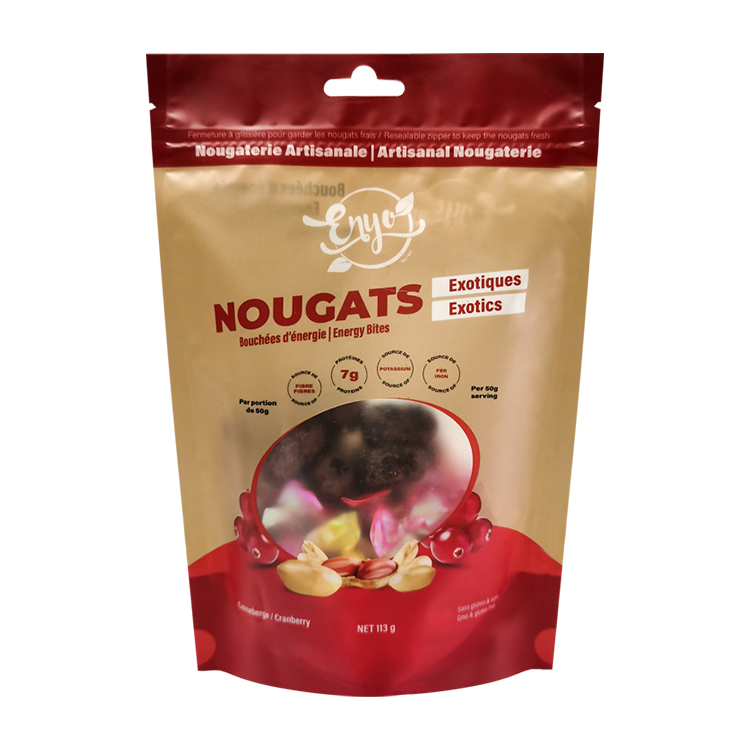
Mylarbag's published nougat and energy-bite pouch project records Canada, MATOPP/PET/PE, digital printing, and dimensions of “14*21+4cm.” Its description identifies a matte stand-up pouch with a shaped window and hang hole.
This is a reference for confectionery outer-pack presentation. It is not a caramel-wrapper project, and the listed construction does not prove clean release from soft caramel. The window and hanging option can inform a retail design discussion, while the individual contact wrapper needs its own approval.
The recorded dimensions also do not establish a caramel count. Trial the proposed pouch with fully wrapped pieces, and obtain the supplier's drawing before interpreting the size notation. Keep the project's public configuration separate from any performance claim about a new product.
Recommended packaging configuration
For a small retail assortment of soft caramels, start by evaluating individual wrappers around the finished pieces, then select a pouch that accommodates the resulting shape. A stand-up pouch may suit shelf display, while a flat pouch may suit a smaller assortment. Choose the format from fill trials and how the customer will handle the pack.
If the outer pouch uses a heat seal, leave enough clear space to keep wrapper ends out of it. A zipper may be useful for a multi-serving assortment when the opening allows easy removal. If using a window, check what the customer actually sees: opaque individual papers may hide the candy even when the outer film is transparent.
Review Mylarbag's printed retail pouches for candy with the individual wrap already identified or clearly marked as still under evaluation. The outer-pouch proposal can then reflect the real packed volume, display needs, and closure process. Confirm any separate requirement for cut wrapping sheets or twist film directly; it should not be inferred from the pouch offering.
Frequently asked questions
What should I wrap homemade caramels in?
Choose a food-contact material suited to the recipe, handling, and storage conditions. Waxed paper is used in some published caramel recipes, while other papers or films may be candidates for a specific application. Check clean release, coverage, and how the ends stay closed. For products sold commercially, retain the relevant material documentation and packaging approval record.
Can I use parchment paper instead of waxed paper?
It may be a candidate, but the two names are not a guarantee of equivalent performance. Identify the grade and any coating, then test it with the caramel. A useful sheet must release appropriately and hold the chosen wrap without tearing or opening. Its performance as a baking liner alone does not answer those questions.
How large should a caramel wrapper be?
Start with the finished piece and the intended closure. A rectangular twist wrap needs enough material around the body for coverage and overlap, plus extra length at both ends. The worked example above is a geometric starting point, not a production size. Adjust a physical sample for the material, piece variation, and wrapping method.
Can I put unwrapped caramels straight into a resealable bag?
That is a different packaging configuration and should be evaluated separately. Consider whether pieces stick to one another or to the bag, whether their shape changes, and how customers remove a portion. A zipper does not solve those contact issues. For a product intended to be individually portioned, establish the inner wrapper before approving the outer bag.
Does twisting the ends make a caramel wrapper airtight?
A twist closure should not be treated as evidence of an airtight individual pack. It can hold a selected wrapping material around the candy, but storage performance depends on the complete configuration and conditions. Define the protection required and evaluate the wrapper together with any outer pouch rather than judging by the appearance of the twisted ends.
Why does caramel stick to the wrapper after storage?
Investigate the product and packaging history before assigning a single cause. Compare the material grade, contact face, caramel condition, holding conditions, and length of contact with an acceptable reference. Record what remains on each surface when opened. If the outer pack looks unchanged, that still does not show that the contact wrapper is performing as required.
Bring the wrapped piece to the pouch discussion
When you contact Mylarbag about caramel retail packaging, include a finished piece and, if available, the individually wrapped version. Share the proposed count or net candy weight, flavor range, display format, target market, and storage requirements. State whether the inner wrapper is already approved. That makes it possible to discuss an outer pouch around the product customers will receive and identify any remaining sample or documentation needs.