

To package chocolate for shipping, start with a finished, sealed food-contact retail pack. Support bars or delicate pieces so they cannot bend or strike one another. Put that protected unit in an insulated shipping assembly when the route needs thermal protection, choose and separate any coolant according to a tested arrangement, and book a service that gets the parcel to a receiving person within the validated window. Test the actual packed order across representative time and temperature conditions before promising that it will arrive in saleable shape.
No bag material can guarantee that chocolate will not melt in a hot delivery vehicle. A foil-looking or metallized flexible pouch may serve a product's moisture, aroma, light or presentation specification, but it is not an insulated box or an active cooler. Insulation slows heat transfer for a limited journey; it does not make every duration or weather condition acceptable. If the tested arrangement cannot cover the forecast and a plausible delay, hold the order or use a validated temperature-controlled service.
This guide is primarily for solid bars, tablets and small solid chocolate pieces sold by a brand or chocolatier. Homemade chocolates with a filling need their own approved storage and shipping requirements; a cream-filled center cannot be assumed to behave like a solid bar. Fresh chocolate-covered strawberries and hollow hot chocolate bombs have different safety and structural issues and are separate projects. Here the focus is what happens from finished retail pack to delivery at the customer's door.
Write down what “arrived well” means for this chocolate
Before shopping for ice packs, define the product and the failure you are trying to prevent. A thin molded bar can snap while still cool. A bar with exposed inclusions can scuff its wrapper or rub against a hard edge. A chocolate shell can lose gloss, soften, develop bloom or pick up an odor even when the outer carton remains intact. A paper sleeve can be stained by moisture from a cold pack without the chocolate itself melting. Those outcomes need different changes to the pack.
Ask the maker for the product's established storage and handling conditions. Callebaut's guidance for pure chocolate gives an example storage range of 12–18°C (54–64°F), notes softening and lost gloss at higher temperatures, and cautions about condensation when a cold package returns to room temperature. That is guidance for pure chocolate, not a universal transit guarantee for every bar, filling or formulation. The manufacturer should set the actual product acceptance limits and shelf-life basis.
The distinction between heat and moisture matters. Guittard's chocolate-bloom troubleshooting describes fat bloom associated with factors including storage conditions and sugar bloom associated with moisture and temperature shocks. A white mark on arrival is not enough to diagnose the cause from a photograph. Record whether the bar is distorted, the wrapper is wet, the surface feels grainy or the finish changes after warming in its sealed pack. Do not promise that a moisture-barrier pouch by itself stops heat-driven softening or every form of bloom.
| Product and order | Main shipment concern | Start the trial with |
|---|---|---|
| Solid molded bar or tablet | Heat exposure, bending, edge impacts and sleeve scuffing | Approved sealed primary pack, rigid support as needed and a representative route |
| Thin bar with nuts or protruding inclusions | Point pressure, film rubbing or corner breakage | Full-dimension sample including the highest inclusion |
| Individually packed solid chocolate pieces | Pieces striking one another, crushed retail pack and temperature swings | Divider or tray arrangement with the actual piece count |
| Assorted handmade chocolates with fillings | Recipe-specific storage needs plus movement and appearance | Maker-approved product specification and a separate filled-piece trial |
For a business shipment, set the receiving criterion in advance: acceptable shape, intact seal, readable label, no wet sleeve, surface appearance after acclimation, and any measured temperature exposure limit chosen by the product team. Without an acceptance rule, a single successful-looking parcel can create false confidence.
Make the retail pack suitable before building the shipper
Start with a food-contact inner package approved for the actual chocolate and filling process. It might be a sealed sachet, a wrapped bar within a sleeve or a suitable pouch around the finished sales unit. Check the filled pack, its closure, code and back-panel information. A zipper is not automatically the initial seal, and a loose decorative sleeve is not a substitute for a primary wrap. The material and contact face should be documented for the food and intended use.
The FDA's food-contact component guidance explains that component status depends on constituent substances and intended use. If the bar directly touches a film, request documentation for that film and the actual contact conditions. If the bar is first wrapped and a pouch is only an outer retail layer, name both parts in the packing specification. The shipper's cushion, insulation and coolant belong outside the protected food, with their roles defined separately.
Mylarbag's published 12 g single-serve chocolate sachet project lists a matte MATOPP/VMPET/PE construction and an 8 × 8.5 cm format. The image shows the printed retail component; the listed structure and size describe this particular project. They do not show that it kept a parcel cool, and the project's marketing language should not be read as transport-test evidence. A new product still needs a filled sample and a separate shipment trial.

Inspect several finished units before loading them into any shipper. A faintly open seam, chocolate caught in the seal, punctured corner or contaminated closure is a retail-pack problem. Adding more bubble wrap or a colder gel pack will not repair it. Keep the approved sample and packing lot separate from rejected units.
Give fragile chocolate mechanical support
Plan the physical restraint around the actual packaged product, not the bare chocolate alone. Measure the external height and footprint with all sleeves, folded ends or boards attached. A rigid backing card, shaped tray, compartment or fitted inner carton can keep a thin bar from flexing or pieces from colliding. The correct choice depends on the product and order configuration; none of these parts should be presumed to come from the flexible-pouch supplier.
Place the protected retail unit where it cannot carry the weight of a coolant or another heavy item. Separate hard cold packs from paper sleeves and brittle edges. Fill the designed gaps around the inner assembly so the goods do not rattle, while leaving room for the insulating components to close as designed. An overfilled shipper that requires forcing down the lid can crack a bar before the courier sees the box. A nearly empty shipper can let the retail pack accelerate into a wall when its orientation changes.
When shipping several bars, consider whether the packed units can slide against one another. Printed pouches may look fine in a static photo but show scuffing after vibration. A gift carton may look protective yet allow a narrow bar to bend across an unsupported span. Make a photograph of the loaded arrangement from above and the side before closing the insulation; that gives the packer an exact pattern to repeat.
The published 3 oz artisan chocolate packaging project shows multiple flavor designs and lists a 13 × 21 cm package with MATT OPP/white kraft/VMPET/PE. Its title and feature field disagree about the finished bag format, so request the current drawing and physical sample before designing an inner support around it. Weight and a photograph alone cannot establish the completed pack's dimensions or resistance to breakage.

Do a basic movement check with a trial parcel, then use the carrier or a packaging laboratory for a more formal distribution evaluation when the order risk warrants it. The FedEx Packaging Lab describes distribution and advanced testing for account holders. A kitchen-table shake is useful to catch a visibly loose layout, but it is not a certified drop or vibration test.
Build a thermal assembly for the route
An insulated shipper is an assembly, not a special name for a retail pouch. It can include a sturdy outer corrugated box, a fitted insulated insert or liner, a protected inner product area, moisture management and a coolant selected for the product's required conditions. FedEx's guide for temperature-sensitive shipments discusses coolant, insulated container and outer corrugated box as separate elements. Use your actual carrier's current conditions for the service and destination.
The carton needs enough room for every selected part while holding the product stable. Test a completed assembly; an insulation thickness, reflective-looking liner or number of gel packs is not a universal recipe. Heat can enter over time, through closures and through the handling journey. The parcel may wait at a pickup point, pass through transfers, sit before a delivery attempt, or be left at the destination. Advertised travel time is only part of that exposure window.
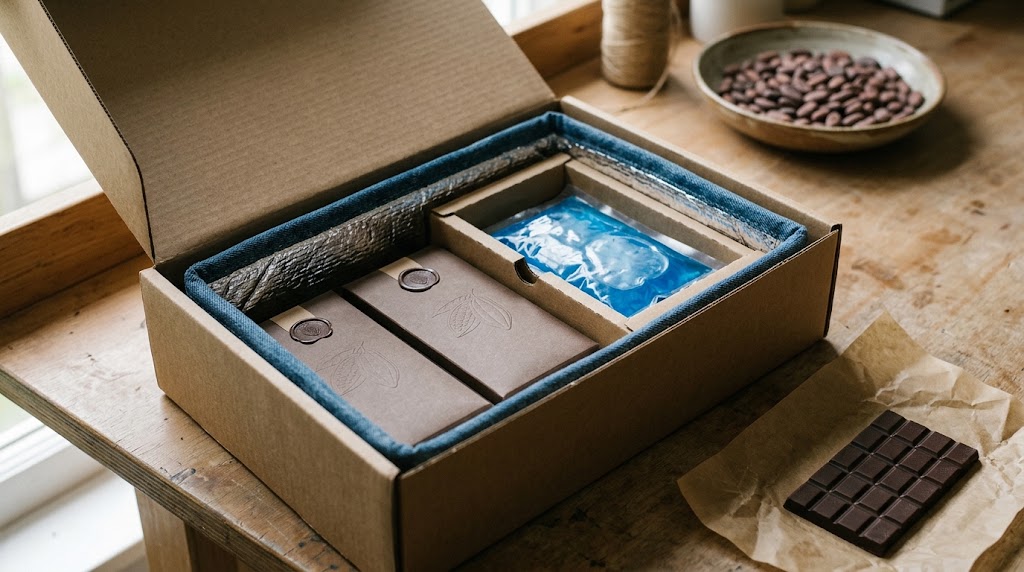
| Layer | The job it can do | What it does not establish |
|---|---|---|
| Food-contact wrap or flexible retail pouch | Contain the chocolate and meet the approved material/closure specification | A safe temperature throughout shipment |
| Card, tray or compartment | Support bars or prevent pieces from striking one another | Moisture or heat control |
| Insulated insert or liner | Slow heat exchange for a finite, tested period | An unlimited hold time |
| Conditioned coolant with separation | Influence the temperature profile in a designed assembly | A correct profile by simply adding more packs |
| Outer corrugated carton | Contain and protect the assembled shipment for carrier handling | Product quality if the inside layout or route fails |
A small order and a large assortment may need different configurations. Adding three more retail units changes thermal mass, available airspace and the pressure on delicate chocolate. Treat order size and layout as test variables. If you change the carton, insulation supplier, coolant placement or pack count, the prior trial is no longer a complete description of the new shipper.
Use coolant without creating a condensation or freezing problem
Chocolate is vulnerable to both excessive heat and abrupt cold-to-warm transitions. A cold pack set directly against a thin bar, printed sleeve or unsupported pouch can create a cold spot, wet paper or a pressure point. Use a physical separation designed into the shipper and check for condensation and leaks at the end of the trial. Keep the food in its approved sealed pack; do not let a coolant or absorbent pad become an unintended food-contact surface.
Choose the coolant and its starting condition for the product's target range and the tested journey. FedEx describes gel packs for items that need to be kept cold and dry ice for frozen items, with separate requirements for the latter. Do not infer that a frozen gel pack is automatically the right starting condition for a chocolate bar whose maker wants cool, stable storage rather than freezing. Test interior and product-adjacent temperatures, then adjust the arrangement with the thermal-packaging supplier or carrier.
Avoid turning dry ice into a casual chocolate-shipping trick. FedEx's dry-ice instructions treat it as a dangerous good requiring trained preparation and packaging that can release pressure. It is primarily a frozen-shipment tool in its perishable guide. If a product really requires that approach, use the current carrier rules and a qualified shipper; the normal solid-bar workflow here is not an authorization to add dry ice.
Condensation also matters at delivery. Callebaut's sugar-bloom guidance advises allowing cold packaged chocolate to acclimate before unpacking to reduce condensation on the chocolate surface. The brand should give the recipient handling instructions that match its tested pack, especially if the order arrives chilled. A wet exterior sleeve, damp label or water inside the insulated box should be logged as a problem even if the chocolate still looks shaped.
Choose dispatch time and delivery service from the whole exposure window
Check weather and service alerts for origin and destination. A mild afternoon at the point of shipment does not describe the transfer hub or the time a parcel will wait at the recipient's door. For a route with a warm forecast, a long commitment, weekend hold or no one available to receive, the decision may be to hold the order, change service, use a tested temperature-controlled option or arrange pickup. A “fragile” sticker alone does not change the thermal exposure.
FedEx's temperature-sensitive shipping guidance calls attention to weekends, holidays, delivery margin and receiving options such as Hold at Location or signature service. Those are carrier-specific examples, not a promise from every carrier. Check the actual service commitment, cutoff, acceptance rules, route and recipient instructions when buying the label. For an international order, also check import and product restrictions; a successful domestic test does not cover a border delay.
Write a dispatch rule that a packer can follow: approved product and configuration, maximum planned time out of controlled storage, route/weather review, selected service, confirmed recipient, and who has authority to pause the shipment. Put the rule beside the packing station. A hurried last-minute substitution from a tested two-day service to an unknown economy route can consume the reserve time before the box leaves the facility.
| Route situation | Sensible next decision | Evidence needed |
|---|---|---|
| Short mild-weather route with a tested no-coolant pack | Use the approved layout and service if current conditions remain within the trial | Product limits, test record and recipient plan |
| Warm route or uncertain doorstep exposure | Evaluate a tested insulated/coolant assembly and a shorter, suitable service | Thermal profile and arrival inspection for that configuration |
| Forecast or possible delay exceeds the validated profile | Hold, reroute or use qualified temperature-control service | Updated service and pack validation |
| Filled or otherwise perishable confection | Follow the maker's food-safety and temperature requirements first | Recipe-specific validation and carrier acceptance |
The table is a decision framework, not a forecast threshold. No one outside your product and route trial can promise that a specified number of ice packs will protect every chocolate box for a specified number of days.
Pack one order in a repeatable sequence
Begin with chocolate that has reached its maker-approved condition for packing. Check the retail pack revision, seal, label, flavor and count. Keep the working area and finished units away from direct sun, hot equipment and strong odors. If the packer has just made a bar, confirm it is fully set and ready for its approved wrap; sealing in a rush can trap a different starting condition from the one used in your trial.
Lay out the exact tested carton, liner, supports and coolant. Put the supported retail units in their assigned positions. Fit the divider or inner carton so chocolate does not touch a rigid coolant or sit under a heavy component. Add the conditioned coolant in its designated separate position, with the moisture protection used in the trial. Close the liner and carton as specified, without forcing the lid. Photograph the assembly if this is an early run or a new route.
Before handing it to the carrier, record the pack time, product lot, shipper configuration revision, coolant condition, service and tracking number. The recipient should know when to expect delivery and what to do with a chilled closed package. A temperature logger can be included in a trial or qualified program, but place it where its reading is meaningful and note its position; a logger at the outside wall of the carton does not necessarily record the chocolate's temperature.
Do not move an untested layout into production because the open box “looks cold enough.” The room temperature at packing, starting product condition, time to pickup and courier delays all count. An operational checklist is useful precisely because it catches differences between a successful trial and the parcel being packed today.
Validate both thermal exposure and arrival quality
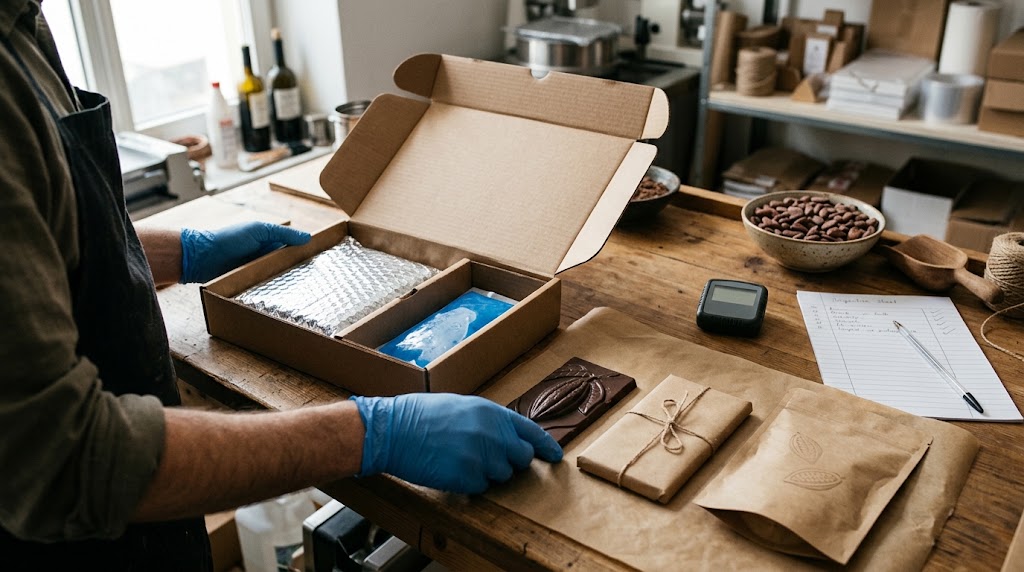
Ship a representative test unit before using the setup widely. Include the real chocolate and completed retail pack, normal inner supports, selected outer carton, exact insulation and coolant, and the service you expect to use. A dummy carton with only a thermometer will not reveal bar breakage, sleeve scuffing or seal problems. For seasonal sales, test an appropriate warm route and a realistic delay scenario as well as a shorter baseline route.
Record the starting product and coolant conditions, packing time, box configuration, service events, logger position, temperature profile, arrival time and whether the parcel was received promptly. Inspect the box and the closed retail packs, then examine a product sample after the maker's acclimation procedure. Separate a melted or deformed bar from a snapped bar, a wet sleeve, a cracked seal and a cosmetic bloom observation. Those failures suggest different next changes.
| Trial record | What to capture | Why it matters |
|---|---|---|
| Product and pack | Bar recipe/SKU, pack lot, seal and filled dimensions | A different filling or pack can behave differently |
| Shipper configuration | Carton, insulation, divider, coolant type/condition and position | Reproduces the exact tested arrangement |
| Journey | Origin, destination, service, pickup, transfer/delivery events and recipient wait | Explains the exposure beyond the advertised transit time |
| Measurements | Product-adjacent logger position, time profile and any outside reference | Connects the outcome to the temperature actually experienced |
| Arrival condition | Shape, breakage, bloom/condensation observations, labels, seal and wet materials | Distinguishes thermal and mechanical problems |
| Decision | Accept, revise and retest, change service or suspend that route | Keeps a failed trial from becoming an undocumented live order |
If a test arrives warm but unbroken, strengthen or shorten the thermal part of the system. If it arrives cool but cracked, change the mechanical support and test again. If a sleeve is wet next to a coolant, revise the separation and moisture management. If the logger looks acceptable yet the bars show bloom, review the starting temper, storage history, condensation and logger location before declaring the temperature target proven. A single clean parcel is evidence for that configuration and route, not a year-round guarantee.
The FedEx Packaging Lab offers distribution and material testing for eligible business account holders. A professional thermal-packaging provider can also help design a controlled test. For a small chocolatier, a carefully documented pilot shipment is a practical start; for recurring wholesale shipments, specify a repeatable acceptance plan and revisit it after material or service changes.
Use real retail-pack cases without claiming shipping results
Three published Mylarbag chocolate projects show that the retail unit can vary substantially. The 12 g sachet above is a compact matte print sample. The 3 oz artisan project uses a paper-look laminate and several flavor artworks. The bean-to-bar flexible pouch project lists BOPP/PMP822/CPP and a 12.7 × 15.3 cm format with gravure and spot UV. These are visible packaging examples and site-listed project fields. None of the case pages supplies a verified chocolate parcel temperature profile or an impact-test result for the shipping layouts in this article.

The distinction is useful when buying components. Mylarbag can discuss the custom chocolate flexible pouch: food-contact construction, finished dimensions, print, closing method and samples for the chocolate's intended retail pack. The carton, shaped support, insulated insert, gel pack, carrier service and thermal qualification require their own suppliers or partners. Ask each supplier to name the component and performance evidence it is actually quoting.
For a new pouch brief, include the product form, actual filled dimensions, number of sales units in the inner box, contact conditions, fill and sealing equipment, and any observed shipping damage. Share photographs of the broken corner or wet sleeve rather than asking for a “heat-proof chocolate bag.” The pouch maker can then help with the part it controls; the shipping team can evaluate the complete parcel.
Compare cost only after the package passes
A cheap retail bag in an oversized box may incur extra freight and damaged-bar replacements. A very heavy insulated assembly may reduce damage yet make a low-price order uneconomic. Compare the whole delivered system: retail package, support, carton, insulation, coolant, labor, service, dimensional weight, returns and expected seasonal changes. Do not choose a lower pouch quote as though it settles the full shipping bill.
| Cost or operational line | Include in the comparison | Avoid this shortcut |
|---|---|---|
| Retail pack and support | Pouch/wrap, card or tray, assembly time and rejects | Comparing pouch price alone |
| Thermal shipper | Carton, liner, coolant, moisture protection and packing labor | Counting coolant but omitting liner size/weight |
| Carrier and receiving | Service, billable dimensions, pickup and delivery arrangements | Using a nominal transit quote as the entire exposure window |
| Failure and seasonal change | Replacements, discarded product, retests and different summer configuration | Assuming one pilot parcel proves every season |
Keep at least two approved scenarios if your business has distinct seasons or routes. An ambient mild-weather configuration may be acceptable for a tested short journey; a warm-weather configuration may use a different insert, coolant or service. Mark the scenarios clearly at the packing station. Do not silently remove a coolant to save freight from a configuration whose validation depended on it.
The final go/no-go decision belongs to the brand and its packing/logistics team. When the route exceeds the tested limits, “ship anyway with a stronger bag” is not a packaging specification. Change the time, temperature-control system or receiving plan, and retest the affected scenario.
Frequently asked questions
How do I mail homemade chocolates without them melting?
Start with the recipe's established storage and shipping conditions, fully set pieces and an appropriate sealed food-contact pack. Support each piece or compartment, then test a complete insulated shipping arrangement, coolant and suitable service for the actual route. A fresh dairy or other perishable filling may need a different validated cold-chain and food-safety plan from a solid bar; do not borrow a solid chocolate trial.
Will a Mylar or foil-lined bag keep chocolate from melting?
No retail pouch alone demonstrates temperature control. A chosen film may address the intended contact, moisture, odor or light exposure, but insulation, coolant where appropriate, a suitable service and a representative test address the heat journey. A shiny appearance is not thermal-performance data.
How many ice packs should I put with chocolate?
There is no universal count. Coolant type, starting condition, insulation, product amount, carton size, outside exposure and transit time all affect the result. Build a separated arrangement and measure a representative trial. Too much or poorly placed cooling can create cold spots, condensation or damage to paper components.
How do I stop chocolate bars from breaking in transit?
Start with a sound sealed retail pack, then support the full bar with an appropriate board, tray or fitted inner carton if the trial shows bending or edge damage. Keep units from colliding and prevent a hard coolant or another heavy item from bearing on the bar. Inspect after a realistic handling trial rather than judging the empty carton alone.
Should I use dry ice to ship chocolate?
Not as a routine substitution for a tested chocolate shipper. FedEx describes dry ice for frozen shipments and applies dangerous-goods preparation and packaging requirements. Follow the actual carrier's current rules with qualified staff if a product genuinely requires it; many solid-bar projects instead need a controlled, product-specific cool range and careful management of condensation.
What should a customer do when chilled chocolate arrives?
Follow the brand's product-specific receiving instructions and inspect the outer box for damage or wet materials. For chocolate that has been kept cold, let the still-sealed product acclimate as directed before exposing its surface to warm humid air; Callebaut links sudden cold-to-warm exposure and condensation with sugar bloom. Report visible damage, wet packaging or suspect product to the seller with photographs and the delivery time.