
Package cotton candy in a suitable food-contact bag that accommodates its fluffy shape without squeezing it. Keep the packing area dry, minimize exposure before closing, and use a closure appropriate to the intended selling period. For retail stock, evaluate the complete filled package under realistic storage conditions. A bag's appearance or material name cannot tell you how long the cotton candy will remain acceptable.
Here, cotton candy means spun sugar, also called candy floss or fairy floss. It does not mean marshmallows. This guide concerns bags for event sales, takeaway portions, and packaged retail products. The right choice depends on how the candy is made, how it is handled, and what happens between packing and opening.
Why cotton candy loses its fluffy shape
Cotton candy's appeal depends on fine sugar strands holding an airy structure. Moisture can change that structure even when the product has not been exposed to the heat used to make it. Calling every change “melting” makes the packaging problem harder to investigate.
In a published study, Theodore and Peter Labuza investigated the physical state of cotton candy under controlled conditions. Their abstract describes moisture uptake making the amorphous sugar rubbery, followed by collapse and crystallization. At 25°C and 33% relative humidity, the studied samples collapsed and crystallized within three days; at the higher humidity levels tested, the change occurred in less than a day. These are laboratory observations, not shelf-life claims for a filled retail bag. Labuza and Labuza, 2004.
For a packer, the useful lesson is to record both the product's condition and its surroundings. Do not turn one research result into a universal humidity limit for every recipe or facility. Your formulation and the complete package need their own assessment.
Describe what you actually see before assigning a cause. “The lower section looks flattened” is a more useful starting note than “the bag failed.” Compare the affected packs with their filling records and with other packs from the same production run.

Choose the package around the sale you intend to make
An event operator serving a freshly made portion and a brand placing stock in shops are making different promises to the customer. Write down yours before ordering bags. Will the customer open the pack near the point of sale, carry it home, or store it unopened? Does a retailer expect to hold stock before selling it?
Gold Medal's cotton candy guidance describes collecting spun candy on a cone and packaging it in a bag or container. That confirms several presentation options exist; it does not establish that they have the same storage performance. Gold Medal cotton candy overview.
Treat the intended use as a requirement to investigate. “For an event” is still incomplete if the packs are made well before the event and transported through several locations. Include preparation, holding, delivery, display, and the expected time before opening in the plan.
Also decide whether the candy will remain on a cone. A cone changes the space required, the way the product enters the bag, and the point where the closure sits. A loose portion needs a different handling method. Avoid approving the bag with loose candy and then changing to a cone without another fit check.
For a branded retail pack, Mylarbag's custom bags for candy products provide a place to discuss format, appearance, and sample requirements. Bring the actual selling scenario to that discussion so the proposed pouch can be assessed against a clear purpose.
Set up the packing station before spinning
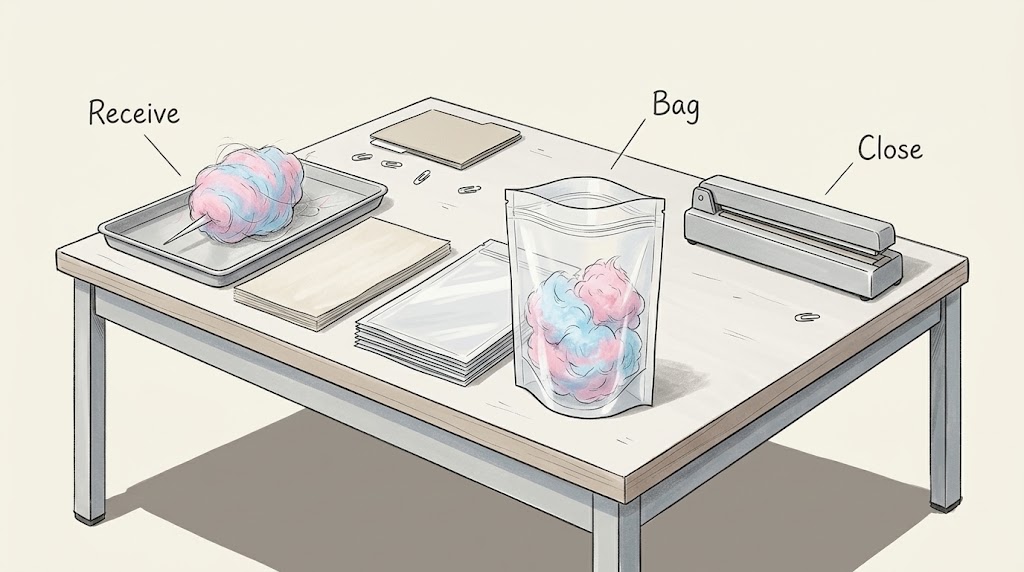
Put bags, closures, weighing equipment, and any labels within the packing team's normal reach before production begins. Work out where finished candy will go immediately after collection. A station that leaves the operator holding a portion while searching for a bag creates unnecessary exposure and handling.
Position the station away from avoidable sources of moisture such as active washing, splashes, and steam from neighboring operations. Coordinate cleaning with the production schedule so food-contact tools and surfaces are properly prepared and dry when used. A bag cannot undo moisture picked up before it is closed.
Measure conditions near the packing operation if temperature and humidity are part of your process controls. A reading at a distant office or doorway may describe a different environment. Use instruments suitable for the purpose, follow their checking requirements, and record where they were placed. Do not assume a comfortable room automatically provides consistent packing conditions.
Watch the workload through a complete run. The person spinning candy, the person portioning, and the person closing bags may work at different speeds. If an uncovered queue develops, reduce the working batch or adjust staffing and sequence. Keep finished portions moving through the planned process instead of building a display of unclosed bags at the table.
Treat tools and technique as part of the approved setup. Repeatedly lifting, stretching, or pressing a portion to fit it can change its appearance before storage begins. Use clean food-contact utensils and handling practices appropriate to your operation. Training should show the intended shape and the amount of handling needed to get there, rather than simply telling staff to work carefully.
Select a bag that holds the portion without compressing it
Weigh the proposed portion, then examine how it occupies space. Cotton candy's apparent volume can vary with how it is collected and placed in the bag. A weight target alone does not define a bag size, and a bag's printed capacity for another food is not a cotton candy specification.
Prepare samples that represent your normal product. If you sell layered colors, test the layers as they will actually be assembled. If staff gather the candy differently during a busy shift, include that ordinary variation. Do not base the order on a single carefully shaped sample that the packing team cannot reproduce.
Look at the opening first. The portion must enter without dragging repeatedly against a narrow mouth. Then check the available body space and the area reserved for closure. The bag should accommodate the intended shape before it is tied, zipped, or heat sealed; closing should not require pushing the candy farther down.
Ask the supplier to distinguish external dimensions from usable space. Side seals, bottom construction, and closure features can reduce the area available to the product. A flat bag width also does not describe a rigid circular opening. Use physical samples and the supplier's drawing to resolve those details.
Inspect the filled sample from the front and side. Does the product look naturally full, or has it been pressed into a block? Is there clear film where the closure must be made? Does the pouch support the display you intend, without requiring the candy itself to hold the packaging upright?
Record the chosen portion and method alongside the approved bag. If you later increase the serving or add a cone, revisit the fit. Keeping the same artwork does not mean the physical package still suits the changed product.

Look beyond clear plastic, thickness, or the word Mylar
Ask what the bag is made from and whether the proposed construction is suitable for direct contact with your food under its intended conditions. A trade description such as “cello,” “plastic,” or “Mylar” leaves important questions unanswered. A glossy finish or a silver appearance does not establish a moisture-barrier value.
For a product that will be held as stock, request relevant material data with the test conditions. Water-vapor transmission results are meaningful only with the method, units, and conditions attached. ASTM F1249 is one method used for flexible barrier materials; its published scope is about evaluating materials, not assigning a shelf life to your finished candy. ASTM F1249 public description.
Discuss the full proposed design, including any window. A transparent area may help customers see the product, but its specification belongs in the technical review. Do not compare one supplier's opaque film result with another supplier's windowed finished pouch as though they were equivalent evidence.
Thickness matters to handling and construction, but it is not a shortcut to choosing the right package. Ask the supplier which data apply to the actual samples you receive. If a stock sample uses another structure, note what it can demonstrate, such as dimensions or printing, and what remains unconfirmed.
For cotton candy, the practical decision joins several questions: can the bag be filled gently, can it be closed consistently, will it hold its intended presentation, and does the completed package support the proposed selling period? A useful specification answers those together instead of relying on one impressive material term.
How to package cotton candy in bags
Begin with cotton candy that meets your own production and quality requirements. Packaging is a continuation of that process. If portions are already sticky, visibly compressed, or otherwise outside the agreed standard, investigate before making them into saleable packs.
Prepare and open the bag
Inspect the bag for obvious damage and confirm it is the approved version. Open it using the normal clean handling procedure. Keep the mouth accessible so the portion can enter without repeated contact or pressure. If the product is collected on a cone, confirm the cone and candy can move into position together without catching the film.
Transfer and check the portion
Use the selected method to place the candy inside. Avoid packing extra material into gaps simply to make the bag look fuller. A layered design should be built consistently, with no pressing between colors unless that is deliberately part of the product you have evaluated.
Check the portion using a method that accounts for non-food components such as the bag and cone. For commercial sales, confirm the applicable net-quantity requirements rather than treating visual fullness as a weight measurement. Keep any product used for destructive or repeated handling checks separate from saleable stock.
Close without drawing candy into the closure
Bring the bag into its intended closing position while keeping strands out of the closure area. With a gathered top, check the neck before applying the chosen tie or clip. With a heat-sealed pouch, leave the specified sealing band clear and flat. Do not force an overfilled bag into the sealer to save a sample that is the wrong size.
Identify and hold the finished pack
Apply the correct product identification and lot information without crushing the contents. Move the pack to the defined holding area and record any unusual delay or handling event. Inspect a few completed packs from the same run for consistency in portion shape and closure position. That gives you a practical reference when assessing stored stock later.
Match the closure to the intended use
A twist tie, clip, zipper, and heat seal do different jobs. Choose the closure as part of the full package and selling plan. A gathered and tied top used for event service does not, by itself, establish how the product will behave as advance-packed retail stock.
For a heat-sealable pouch, confirm the equipment and settings with the bag supplier and establish the process using actual samples. Keep fine strands out of the contact area. Wrinkles, trapped product, and visible damage deserve attention, but a neat-looking seal still needs the appropriate integrity checks for the application.
A zipper may be convenient for a portion intended to be opened more than once. If the design includes a separate initial heat seal, make both features work together: the consumer must be able to open the top and access the zipper. Check that loose strands do not make reclosure awkward. Reclosing a pack does not restore the conditions that existed before it was first opened.
Be careful with claims such as “airtight.” Ask what the supplier means and what evidence applies to the complete pack. Closing the opening and resisting water-vapor transmission through the package are related requirements, but one word should not replace both evaluations.
For an event bag, verify the closure stays secure during the intended handling. For retail stock, include it in the storage assessment. Neither a decorative ribbon nor a particular sealing method should become a shelf-life claim without supporting work.
How to keep cotton candy fresh in bags during storage
Use a defined storage location with conditions appropriate to the product and supported by your assessment. Keep packs protected from avoidable moisture, direct sunlight, and physical pressure. Record the actual holding conditions when evaluating performance; “stored indoors” does not explain whether the bags were beside a sunny window, a steamy kitchen, or a frequently opened loading door.
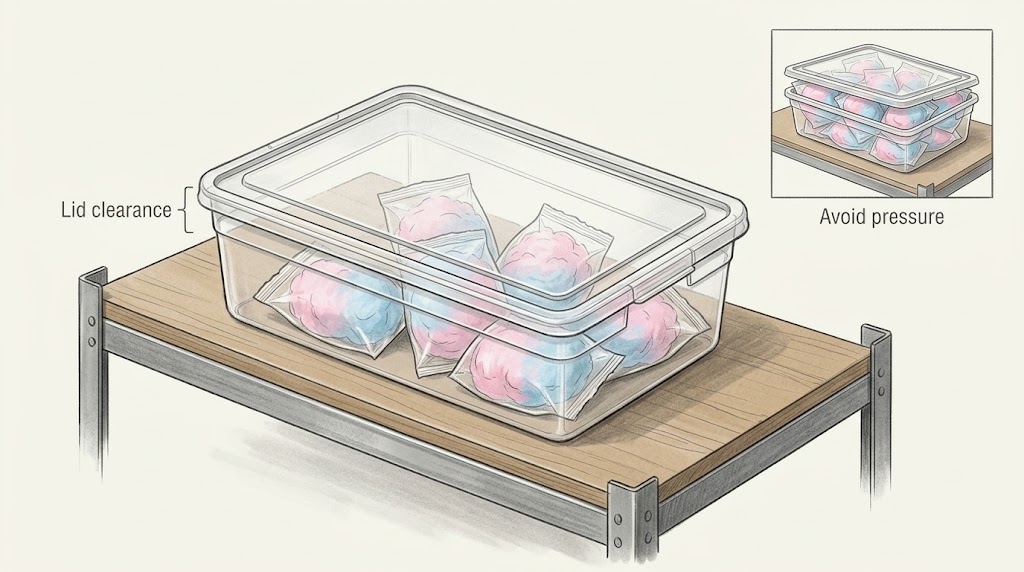
Avoid squeezing bags together to make them fit a shelf or storage tote. Specify a practical arrangement that holds them without forcing the product against the film. If a tote has a lid, check the clearance when it is closed. Assess the bottom and corner packs, where loading may differ from the sample sitting visibly on top.
A rigid outer container can help organize and support sealed bags. It should not be used to justify an untested retail bag or closure. If bags are only satisfactory while inside a special outer container, consider what happens when a retailer removes them or a customer carries one away.
Do not add refrigeration or freezing as an automatic preservation step. If a cold-storage stage is proposed, evaluate the complete transition to the next environment, including when the pack is opened. The National Weather Service explains the relationship between temperature, humidity, and condensation through dew point. Applying that principle here means considering moisture during temperature changes, not assuming that a colder location always improves this product. NWS explanation of dew point.
Keep the stock record simple enough to use. Identify when each batch was packed, where it has been held, and which packs are still within the period established for that product. A different storage location, damaged closure, or undocumented interruption should prompt review rather than an automatic extension of the date.
How long does cotton candy last in a bag?
There is no dependable number of days that follows from the phrase “a plastic bag.” For a purchased product, use the manufacturer's storage and date instructions for that exact pack. For a business creating a new pack, establish the intended period with the finished candy, specified bag, closure, and conditions that customers will encounter.
Count from the point defined in your own assessment, not from the moment the product reaches the sales table. Advance preparation, transport, and retailer holding all consume part of the available period. Writing those stages down often reveals that a “one-day event product” is expected to remain acceptable for considerably longer than the event itself.
Define acceptability before checking samples. For cotton candy, useful quality observations include the visibility of separate strands, the intended cloud shape, surface stickiness, and the experience of removing a portion. Agree on the criteria with the people responsible for product quality, and address food-safety questions separately with appropriate expertise. A photograph of fluffy candy is not a safety assessment.
Choose observation intervals that can reveal changes across the proposed period. Keep enough individual packs so that opening a sample does not disturb all the remaining samples. Include more than one representative production run when developing confidence in the result; one unusually favorable batch is a weak basis for a recurring sales promise.
Decide in advance how the results will be reviewed and how uncertainty will be handled. Do not adopt the last acceptable observation as a label claim without considering the full evidence and suitable margin. If the recipe, flavor system, bag, closure, or packing conditions change, review whether the earlier assessment still describes the product being sold.
Build a record that explains what changed
Use one consistent record from packing through assessment. A long list of photographs without times or package identification is difficult to interpret. Conversely, a short record with the right fields can show whether an apparent storage issue was already visible when the bag was filled.
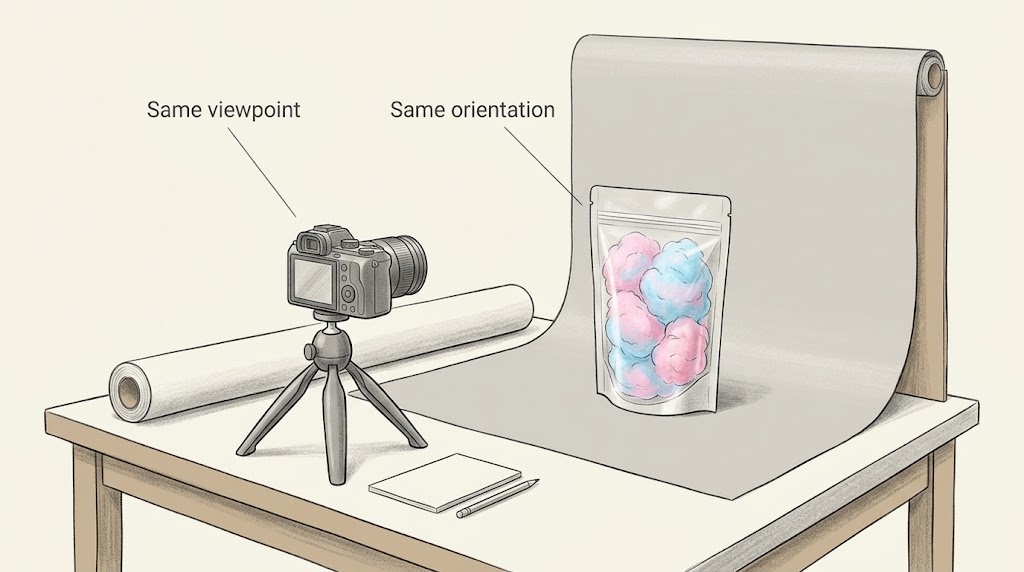
Take comparison photographs from a consistent viewpoint with the pack in the same orientation. Use a plain background and similar lighting. Keep the original image of the filled pack alongside later images. An attractive close-up cannot replace a view that shows the whole portion and its position inside the bag.
Avoid using a single height measurement as a complete measure of quality. Cotton candy can sit differently inside a flexible bag, and the film may move independently of the product. If a measurement is useful for your own development work, define exactly what is measured and how the sample is positioned. Combine it with the agreed appearance and handling observations.
When comparing alternatives, change one clearly identified feature where practical. If both the bag construction and the closing method change, the comparison may help choose a complete configuration, but it cannot show which change caused the difference. Record that limitation instead of presenting the result as proof of one material's performance.
If samples become unacceptable, use the record to narrow the next question. Were they already compressed at packing? Did only one storage location show a change? Did affected bags share a particular closure run? This is a more useful basis for the next trial than ordering a thicker bag without investigating the circumstances.
Protect the presentation at display and handover
The storage assessment should reflect how the product is sold. A pack kept flat in a protected room may behave differently when hung, stacked, or repeatedly handled at a busy counter. Evaluate the display with filled bags, including the opening feature and any hang hole actually specified.
Keep display stock away from avoidable steam, splashes, and direct heat exposure. At an outdoor event, plan how packs will be held before sale and what will happen if conditions differ from those assessed. A clear bag is useful for seeing the candy, but it should not become a reason to leave every portion exposed on a large display for the entire event.
Check labels and decorations on filled samples. Applying a large adhesive label can involve flattening the bag; placing it earlier in the process may be more practical if the operation allows it. A tie-on tag should not require tightening the neck into the candy. The final appearance needs to be achievable without undoing the care taken during filling.
For transport to a venue or shop, define how many packs fit the outer container without pressure from its lid or other goods. Give staff a reproducible arrangement. A soft bag protects no particular shape if the delivery process depends on compressing it to fit more units into a box.
Before selling, confirm the label and business requirements for the destination market. US sellers can begin with the FDA's overview and the relevant state and local authorities. Packaging advice does not determine whether a particular home or commercial operation is authorized to sell the product. FDA food-business guidance.
Related project: a windowed pouch for gourmet popcorn
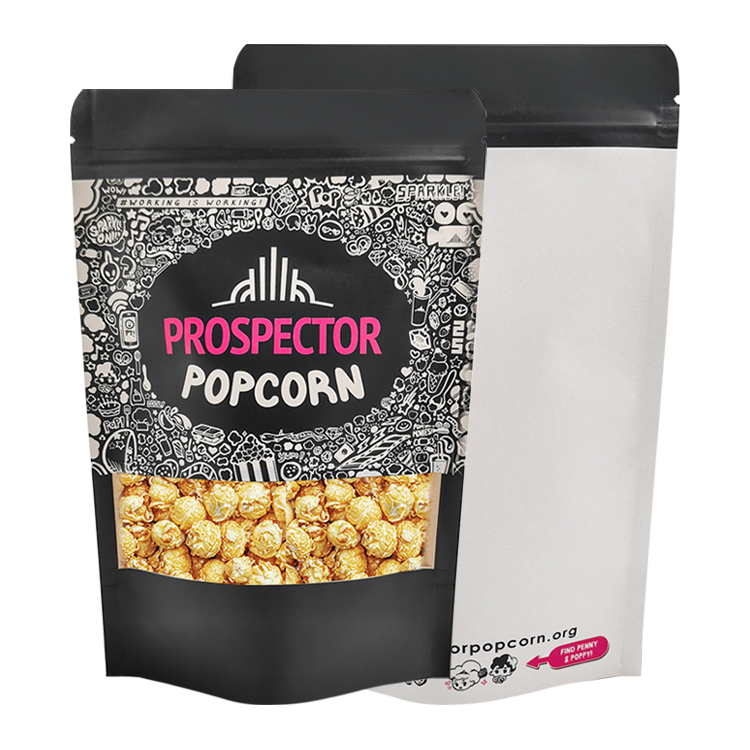
Mylarbag's published matte black kraft pouch project for gourmet popcorn lists a US destination, a stand-up format, gravure printing, and a MATOPP/kraft paper/PE material field. Its recorded size is “15*22+4 cm,” and the page describes a windowed design.
This is a popcorn project, not evidence of a cotton candy application. Its relevance is the combination of a printed exterior, product visibility, and a standing display format. Those are features a cotton candy brand may want to discuss, but the record does not establish suitable cotton candy capacity or storage performance.
Do not copy the listed dimensions or construction into an order solely because the presentation looks appropriate. Use the project as a reference for the design conversation, then select and assess a specification around your own spun-sugar product.
Recommended packaging configuration
For cotton candy intended as retail stock, consider a roomy pouch that can be filled without pressing the portion and closed through a controlled process. Evaluate a heat-sealable construction with supporting moisture-barrier information. A stand-up format may be useful if it displays properly with such a light product; confirm that with filled samples instead of assuming the base will open and stand as desired.
A window or clear area can support product visibility if the complete construction meets the project's requirements. A zipper is worth discussing when there is a credible use for reclosure, but it adds no value if the portion is intended to be eaten at once or if the opening is awkward for the product.
For short-use event service, a simpler bag and closure may be appropriate to evaluate under the planned conditions. Keep that approval specific to its use. It should not automatically become the specification for a separate retail line with longer holding and different distribution.
Explore printed candy pouch options with a representative portion, your preferred presentation, and the actual sequence from production to sale. That gives the supplier a clear basis for proposing samples while leaving performance decisions tied to the product assessment.
Frequently asked questions
Can I use an ordinary plastic bag for cotton candy?
Only after confirming that the specific bag is suitable for food contact and the intended use. “Plastic bag” does not identify its construction, usable size, closure, or storage performance. A bag that works for handing over a fresh portion may not support advance-packed stock. Assess the actual filled package through the conditions you expect.
How do I keep cotton candy from melting in bags?
Start by describing the change: stickiness, collapsed strands, visible moisture, and physical flattening need different observations. Limit avoidable exposure during packing, preserve the intended shape, and evaluate the selected package and storage conditions. Do not assume that moving the product somewhere colder addresses the cause, or that a closed-looking top proves the whole package is suitable.
How long will cotton candy last in a plastic bag?
The bag name cannot provide a reliable duration. Follow the instructions for an existing branded product. For your own product, assess representative packs through the full intended preparation, holding, delivery, and sales period. Use the resulting evidence to establish an appropriate selling period rather than adopting a number from a different recipe or package.
Are twist ties enough to preserve cotton candy?
A twist tie secures a gathered bag opening, but its presence alone does not demonstrate storage performance. Evaluate the actual bag and closing technique for the intended use. If moving from fresh event service to retail stock, reassess the closure with the new holding conditions and duration instead of carrying the earlier assumption forward.
Should cotton candy be refrigerated after packaging?
Use the storage instructions established for the specific product. Refrigeration is not an automatic improvement to an ambient-storage plan. If a cold stage is proposed, include removal, handling, and opening in the assessment because conditions change along that route. Do not introduce a new storage method just because an unrelated confection uses it.
Will resealing restore cotton candy that has already collapsed?
Resealing does not recreate the spun structure or establish that the product still meets its specification. It also does not resolve the reason for the original change. For commercial stock, follow the quality procedure for affected packs and investigate their history. Do not reset the date or sell altered product on the assumption that a new closure repairs it.
Start with a portion and a selling plan
To discuss cotton candy packaging with Mylarbag, send a representative product photograph or sample, the intended portion, and whether it is loose or on a cone. Describe when it will be packed, how it will be displayed, and what holding period you need to assess. Add your preferred visibility, closure method, and market. These details help turn a general bag request into a practical sample proposal.