
Dog treats are not one packaging category. A soft chew, a brittle biscuit, freeze-dried pieces, and a single jerky strip may all be sold as treats, but they create different questions about fill, opening, crumbs, oil, visibility, and repeat use. The best starting point is to identify the product and the buying moment, then build the pack around both.
If you are selling in the United States, remember that product packaging does not replace pet-food compliance. FDA explains that animal food must be safe, produced under sanitary conditions, and truthfully labeled; labels are regulated federally and may also be subject to state rules. Confirm the final label with the appropriate adviser for the market before approving print.
Step 1: describe the treat as a physical product
Start with a retained product sample, not only a recipe description. Record whether the treats are dry, soft, oily, powdery, fragile, sharp-edged, individually wrapped, or likely to be eaten soon after opening. Note the net fill, approximate piece count, and the practical volume of a filled pack. A pack for three large dental chews is a different project from a pouch of 150 g small training pieces.
This simple record keeps the team from choosing a bag because it is fashionable or inexpensive, then discovering that it is too narrow, too shallow, or awkward to use.
Treat categories create different pack questions
It is tempting to put every product sold as a treat into one packaging brief. That usually produces a bland request and an even blander pack. A better approach is to write down the physical and commercial facts that distinguish the product.
These are questions for package development, not promises about what a particular film will achieve. The useful evidence comes from the actual treat, the selected configuration, and the intended production and distribution process.
Step 2: match the format to the selling job
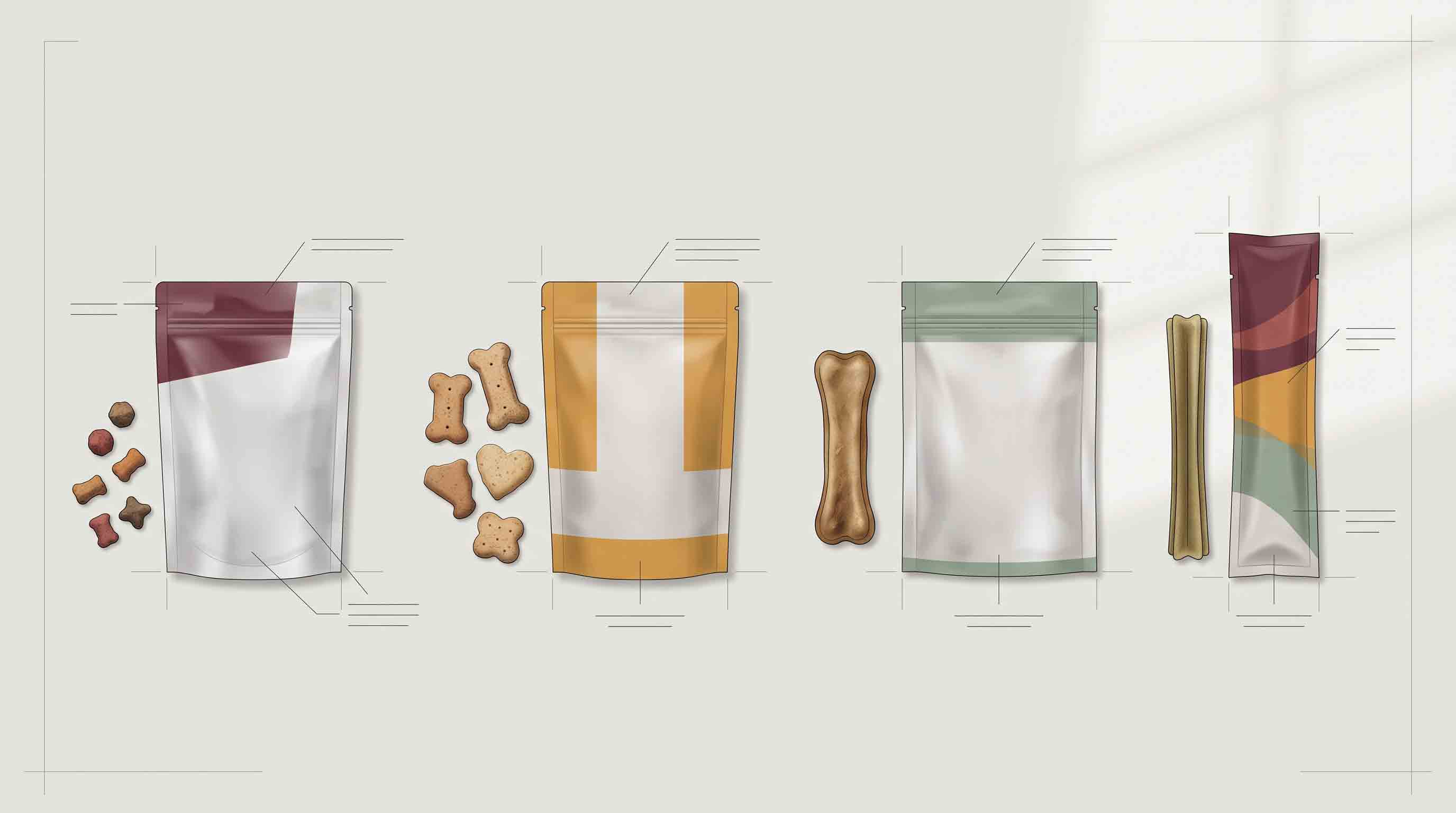
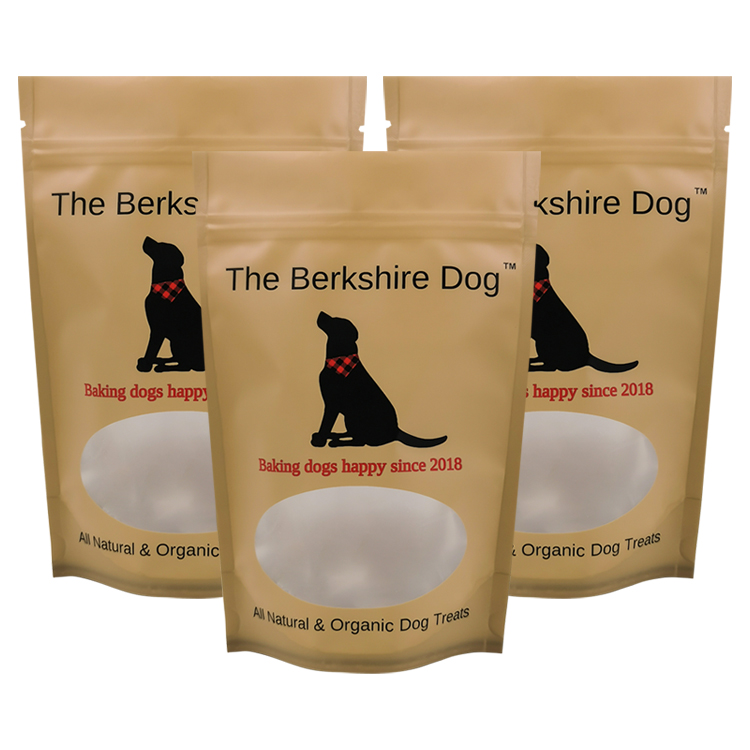
The existing custom dog treat packaging page is the primary destination for these choices because it shows the relevant bag formats and published dog-treat projects. Use it to start a project discussion; do not treat displayed examples as guaranteed specifications for a new product.
Step 3: decide whether a window actually helps
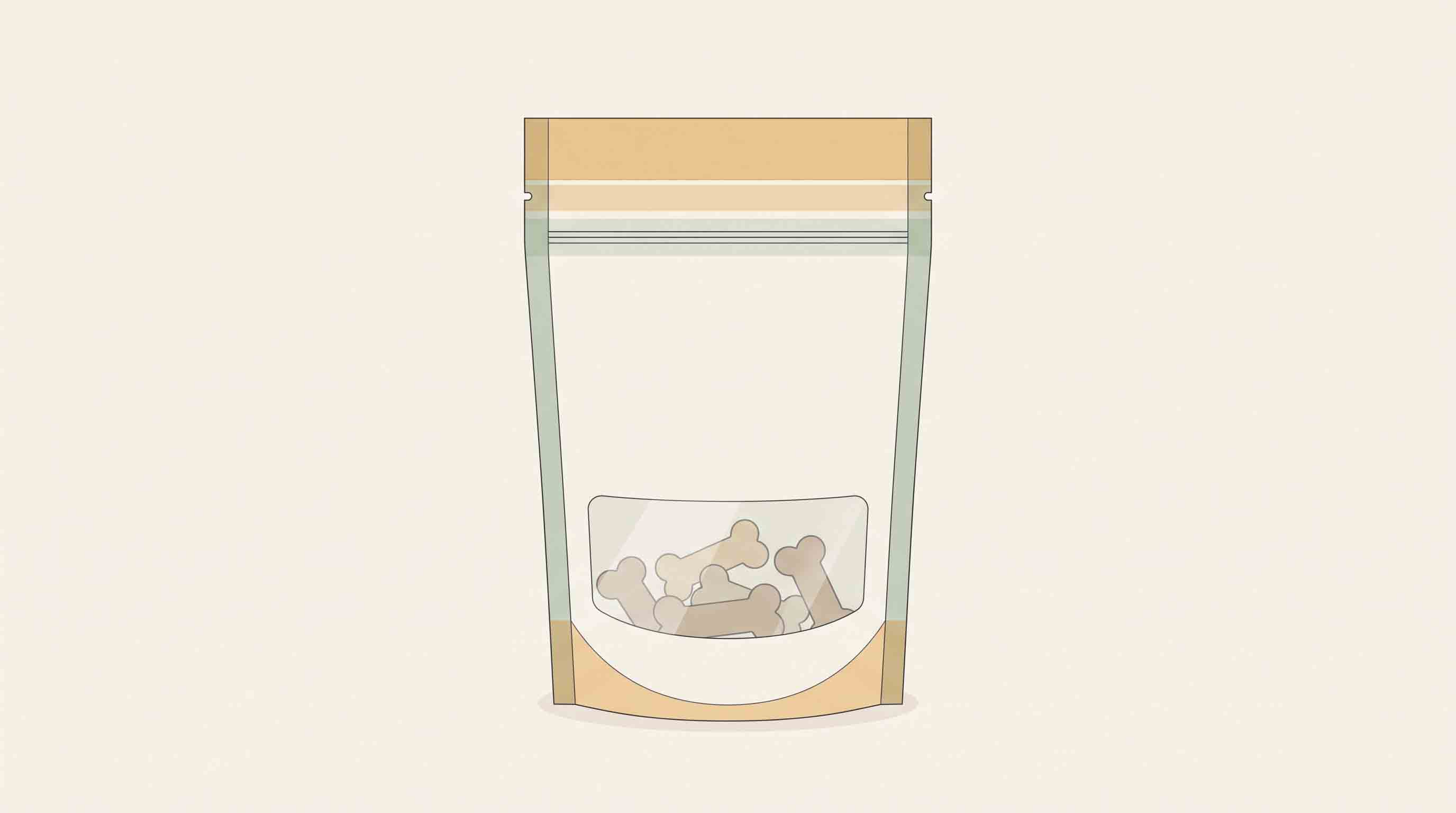
A window can show the product, which may be useful for recognisable biscuits or attractive dehydrated pieces. It can also reduce available print space and create a more demanding material/layout decision. Before specifying one, ask whether the window supports the product story, whether the product needs protection from the retail environment, and whether the front panel still has room for the information the buyer needs.
The window should be drawn on the final dieline, not improvised after the artwork is complete. Keep small text, barcodes, and essential claims away from its edge and from seal areas.
Step 4: choose a closure based on real use
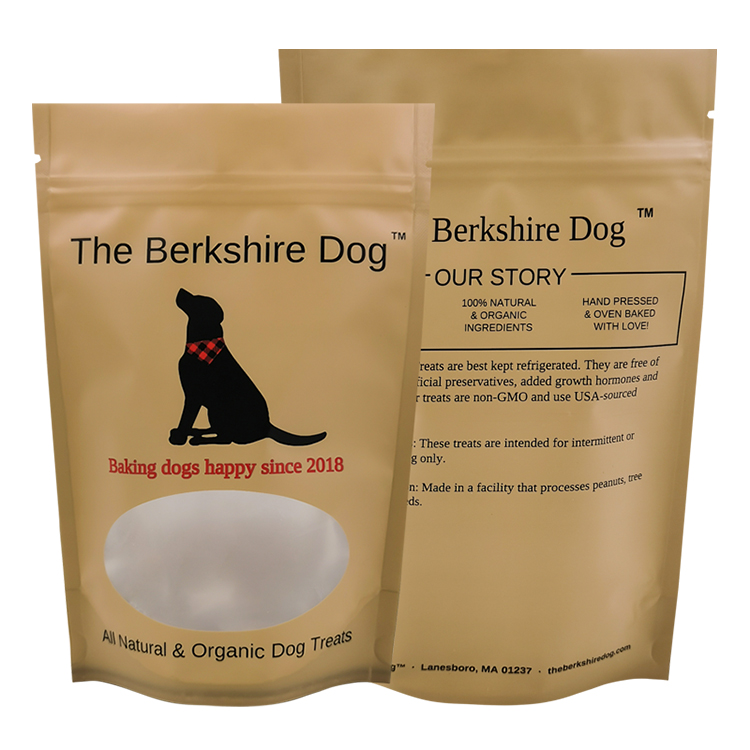
For a pack that will be opened repeatedly, a reclose feature may be worth evaluating. For a sample pack expected to be used once, it may add cost without helping the customer. The right decision comes from the projected use occasion, not from a universal rule that every dog-treat pouch needs a zipper.
If the customer has to remove a full-width top seal before using the zipper, make that opening action clear in the design. Review the first-open experience with a filled sample. The customer should not have to guess which edge to tear or whether the reclose feature remains usable.
Step 5: build the label in parallel with the pack
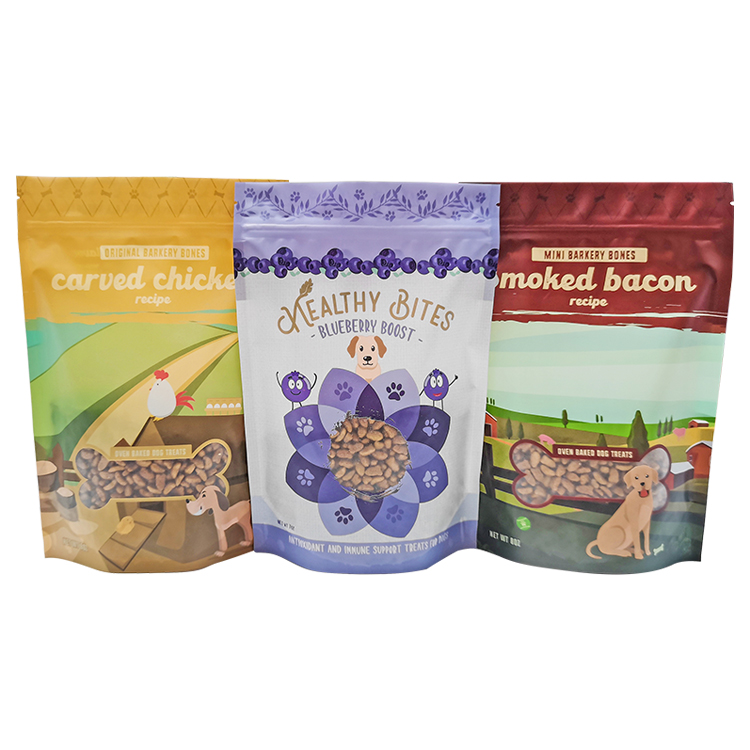
The label should be written and reviewed before the print file is final. Keep product name, net quantity, ingredient and company information, barcodes, feeding guidance, and any market-specific statements legible on the filled pouch. Do not add medical, nutrition, shelf-life, recyclability, or performance claims until they have been substantiated for the product and market.
For homemade dog treats, the same principle applies. A small-batch product can still require a disciplined pack plan: clear identity, traceable batch information where required, correct label content, and packaging that matches the product’s validated storage conditions.
U.S. label check: treats and complete diets are not the same claim
Dog treats are pet food, but a treat is not automatically a complete and balanced daily diet. This distinction matters before copy is designed. AAFCO’s label guidance explains that pet-food and pet-treat labels have required information, while feeding directions apply in defined circumstances—for example, complete-and-balanced products require feeding directions. A treat brand should not borrow a “complete and balanced” statement, feeding table, or nutrition claim from another product type without confirming that the product and target market support it.
For a U.S. project, reserve usable pouch panels for the product name, species, net quantity, ingredient information, business identity, and any other required or substantiated statements. The exact label review belongs with the brand’s appropriate regulatory adviser and the applicable state rules. The packaging designer’s job is to make approved information readable on the finished pack, not to decide what may legally be claimed.
Treat-label handover questions
- Is this product marketed as a treat, a supplement, or a complete-and-balanced food?
- Which approved statements must appear, and which are marketing language only?
- Does the product need feeding directions for its stated use?
- Who signs off on the final U.S. and state-market label before print?
Sources: AAFCO: Labeling & Labeling Requirements; AAFCO: Reading Labels; FDA: How Do I Start an Animal Food Business?.
Artwork preparation: give the designer the right starting file
Treat packaging often begins with a beautiful front-panel concept. Production succeeds when that concept is placed on an approved dieline and reviewed as a filled pouch. The design team should receive the confirmed pouch outline, non-print/seal areas, position of any window and closure, and the actual label content. It should also know how variants will be distinguished.
Use an artwork checklist before final approval:
- The primary product identity appears once and is easy to see from the intended shelf view.
- Variable product information has a controlled position across every SKU.
- Barcodes have quiet space and are not placed on a moving gusset or near a fold.
- Required statements are kept away from seals, windows, and zipper paths.
- All images, illustrations, and claims are owned or approved for commercial print.
- The supplied file uses the printer’s required specifications and includes a final version reference.
This approach prevents a common revision cycle: the artwork is approved for its appearance, then later changes because the barcode does not scan, the window covers a key line, or one flavour name does not fit the pack family.
Step 6: sample before you order at scale
A product sample can expose issues that an artwork PDF cannot: loose pieces settling below a window, an overfilled pouch, a zipper that is hard to reach, printed copy hidden by a fold, or a carton that does not hold the filled pouches neatly. Review the pack after filling, sealing, ordinary handling, and opening. Record what needs to change before production.
Mylarbag’s published Pet Food & Treats collection includes real projects such as an 8 oz stand-up pouch with a shaped clear window and a 150 g digitally printed stand-up pouch. Those are useful references for visible construction and format only; they are not evidence of a particular product’s shelf life, sales result, or material performance. See the published pet packaging cases for the recorded project details.
Review the filled pack across the customer journey
After a filled sample has been reviewed, assess the actual prototype through four customer moments: how it is found, understood, opened, and used. This checks whether the decisions made in Steps 2–5 work together on a real pack.
Found: the shelf-facing decision
Choose the primary panel based on how the product will be displayed. A small pack on a crowded shelf needs an immediate hierarchy: product name, product type, and the visual cue that helps the buyer recognise it. A more premium pack may need space for a fuller brand story, but it should not hide the essential product identity in a side gusset or below a fold.
Understood: the information decision
The back and side panels are working surfaces. Reserve them for the information the product needs to carry and keep it distinct from optional design elements. Essential copy should not be placed too close to heat seals, a zipper, a window edge, or a curved base. The final label review must be completed by the person responsible for the target market; a packaging manufacturer cannot make a food-label claim correct simply by printing it clearly.
Opened: the first-use decision
The first opening needs to be obvious. If a tamper-evident top seal is removed before a zipper is used, make that sequence clear in the artwork and sample review. A tear notch has to sit where it can be reached; a zipper needs to leave enough usable opening for the treat pieces. Check this with different users rather than assuming the person who designed the pouch will open it in the same way as a customer.
Used: the repeat-use decision
Ask how long the customer is likely to keep the pack after opening. For a small training-treat pouch, repeated access may be central to the product experience. For a single larger chew, a reclose feature might not add value. The pack should reflect the intended use rather than copy a feature from another category.
What a sample review should record
Sample review becomes genuinely useful when it produces a record the team can refer to at the next order. Use the actual treat, not a substitute product, and capture the following points:
If the sample does not fit the brief, do not simply describe it as poor quality. Identify the mismatch: perhaps the pouch is too short for the product, the window is in the wrong place, the fill needs more headspace, or the artwork needs a different hierarchy. That gives the next sample a purposeful revision.
A real-project reference without invented outcome claims
The published Pet Food & Treats case collection records real Mylarbag projects, including dog-treat stand-up pouches with a shaped clear window and a digitally printed 150 g pouch. In a post like this, those cases can be used to illustrate visible features such as a stand-up format, a window direction, or a printed pouch surface. Do not extrapolate from those photos to customer sales, shelf life, environmental performance, or a reason the client chose a material; those facts are not established by the visible project record.
When a treat business is not ready to order custom bags
A young business may have a recipe idea but no final product, no market decision, and no approved label. That is not a failure; it simply means the next task is packaging discovery, not an immediate bulk order. Start by defining the product and sales route, then assemble a representative sample and draft label content. Once those inputs are in place, a supplier can help compare format directions and plan a sample.
The worst time to discover a missing decision is after a large production quantity is printed. Treat the first project as a learning system that produces reusable facts: filled dimensions, pouch format, artwork rules, and the specific questions the brand will ask again when it launches a second flavour.
A short pre-production handover
Before a first production run, bring the product, design, purchasing, and filling contacts back to the same approved document. The handover should name the exact artwork revision, pouch format, selected dimensions, closure direction, target fill, approved sample observations, and the remaining open questions. If a project has a target market-specific label review or a material claim review, record who owns that decision and whether it is complete.
This final meeting is not bureaucracy for its own sake. It is how a small brand prevents an outdated logo file, an unapproved flavour colour, or a different product weight from reaching a packaging run. A clear handover also makes the next order easier: it creates a record that can be checked before a supplier quotes a repeat run or a new SKU.
Useful first-order records
- One approved packaging brief with the current product and market details.
- One final artwork file and a dated proof approval.
- Photos or notes from the filled-sample review.
- The pouch dimensions and closure location used for that sample.
- The intended carton and sales-channel assumptions.
- A named contact for changes to the recipe, label, or target market.
If any of these inputs change, review whether the pouch specification also needs to change. A new recipe, larger inclusion, or different selling country is not automatically a simple artwork update.
Final pre-order question: can every person involved point to the same product, pouch, artwork, and market assumptions? If not, pause the approval and reconcile those records first.
Recommended packaging configuration
For small or repeat-use dog treats, evaluate a custom stand-up pouch with a reclose feature and, where it fits the product story, a carefully placed window. For heavier or more premium retail packs, evaluate a flat-bottom format with adequate label area. The material, dimensions, and closure should be quoted only after the brand shares real treats, target market, and pack-use requirements. Begin with Mylarbag’s dog treat packaging options.
FAQ
How do I package homemade dog treats to sell?
First confirm the selling and labeling requirements for your market and the product’s validated storage conditions. Then select a pack based on the treat’s shape, fill, opening use, and retail presentation, and test it with the actual product.
Where can I buy custom dog-treat bags?
A manufacturer or packaging supplier can quote a custom project when you provide the treat type, fill, dimensions or sample, desired format, artwork status, market, and order volume. Avoid choosing a bag solely from a photo without checking fit and use.
Are brown paper treat bags with a window suitable for every product?
No. They are a visual and material direction to evaluate, not a universal answer. The product, expected storage conditions, label needs, and intended sales channel must all be considered first.
What packaging format is best for dog treats?
There is no single best format. Small, repeat-use treats often suit a stand-up pouch with a reclose feature, while premium or larger products may benefit from a flat-bottom pouch. The right choice depends on the specific treat's shape, volume, and how the customer will use it.
Should dog treat packaging include a clear window?
A window can help display the product, but it also reduces available print space. Before adding a window, confirm that it supports the product story without hiding necessary label information or compromising the required protection for the treat.
What should a brand test before ordering custom dog treat bags?
Always test the packaging with actual product samples. Review the net fill volume, how easily the pouch can be opened and reclosed, whether the printed text remains legible when filled, and how the pouches fit into your shipping cartons.
Final decision: choose the next action, not a generic bag
At the end of the planning process, a treat brand should be able to name its immediate next action. It may be to finish label content, send a representative sample, compare two pouch directions, or approve a proof. That is more useful than declaring that it needs “custom dog-treat bags” without any product context.
The resulting brief should be short enough to use: product type and shape; target net fill; market; sales channel; intended opening and reclose use; preferred visual direction; artwork stage; and desired first order. Add any evidence or testing request as a separate line. A supplier can then respond to an actual project rather than infer requirements from a mood board.
As the brand grows, preserve the decisions that worked. Keep approved filled samples, final artwork versions, and notes about where a pouch fit the customer journey. When a new flavour or pack size is added, use those records as a starting point but repeat the fit review. A pack family should be consistent in purpose as well as appearance.
An intentional pack does not need to be overloaded with features. It needs a clear reason for its format, opening, panel layout, and visual presentation. A small pouch can be well designed because it gives a customer easy access to training pieces and carries the necessary product information. A larger pouch can be well designed because it stands reliably, has space for a clear product hierarchy, and suits the expected retail shelf. Neither is automatically better.
This is also why a brand should avoid copying a competitor’s dimensions or material description from a photograph. The visible pack does not reveal its complete specification, its product fit, or the commercial decisions behind it. Use competitor research to understand the market language, then build a pack around your own treat and selling plan.
Once the product is selling, gather feedback about real questions customers ask: Is the opening clear? Does the pack fit the display? Is the size family understandable? Do buyers ask where to store the treats? Use that feedback to identify a specific improvement. Do not rewrite the whole package or change several variables at once without a reason. A controlled revision process preserves the information the brand has already learned.
Keep the first project record available when reviewing feedback. A complaint about opening may indicate an artwork cue, an opening direction, a product piece size, or a different consumer expectation. The useful response is to identify the actual cause before changing the next run. This makes the pack better over time without turning every customer comment into a redesign.
It also gives the brand a clearer basis for deciding which questions belong to packaging, which belong to product development, and which are simply requests for better consumer instructions.
CTA: Have a dog-treat project in development? Send the product type, fill size, market, and artwork stage to Mylarbag for a packaging discussion.