
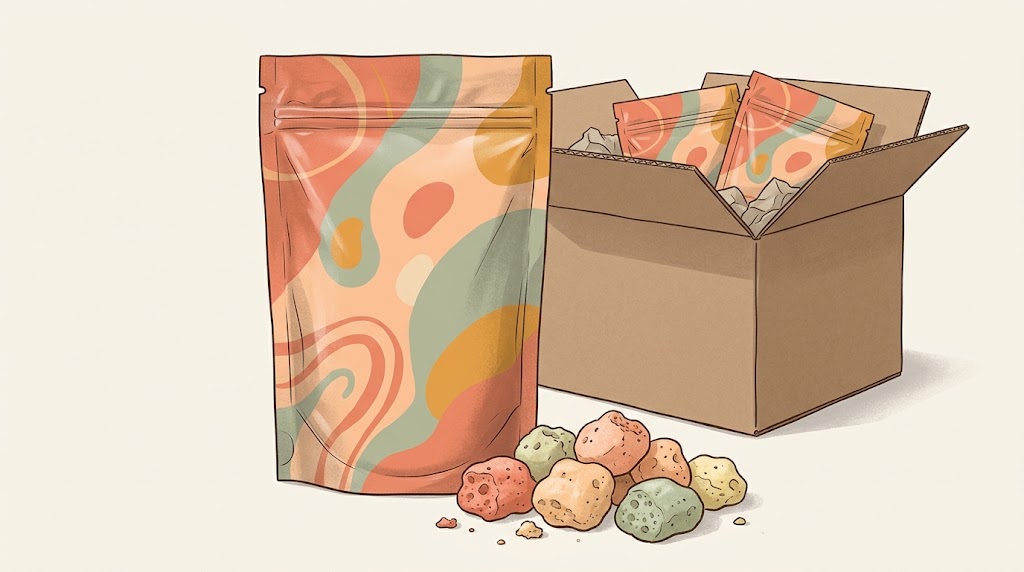
Package freeze-dried candy in a food-contact pouch with moisture-barrier performance suited to your product and selling period. Fill gently, keep the sealing area clear, and apply a verified heat seal before storage or dispatch. For shipping, support the sealed pouches inside an appropriate outer carton. Check moisture pickup and breakage separately: a bag can remain closed while the candy inside loses its intended texture or shape.
This guide covers finished freeze-dried candy sold in retail pouches and sent through parcel networks. It does not set a drying recipe, a universal shelf life, or a single bag specification. Your candy formulation, equipment, portion size, storage conditions, and delivery route all affect the decisions below. Begin with a product you can make consistently, then evaluate the package around it.
Define the finished candy before choosing its package
The candy that enters a machine is a poor guide to how much room the finished product needs. Expansion and texture vary with formulation. Harvest Right's candy guidance also distinguishes candy processing from the cycles used for many high-moisture foods. Follow the instructions for your machine and product rather than copying a general fruit-drying routine. Harvest Right candy guide.
Describe the finished product in terms a packer can use. Record the usual piece size, the larger pieces that occur during normal production, the intended texture, and the amount of loose material already present before filling. Photograph a representative batch. A pouch sample filled only with the smallest pieces will tell you little about a batch that regularly contains much larger ones.
Check readiness before moving product to the packing table. Harvest Right recommends checking representative pieces, including thicker ones, because an apparently dry exterior can hide a different condition inside. That equipment guidance is a starting point for observation, not a complete commercial release procedure. Checking dryness.
Agree on release criteria appropriate to the candy and process with a qualified food professional. A crisp bite alone is not a food-safety assessment. Utah State University Extension explains that freeze-drying can preserve microorganisms and should not be treated as a kill step. Packaging cannot correct an inadequately controlled production process. USU freeze-drying guidance.
These records also give later packaging trials a useful baseline. If texture or breakage varies widely before filling, a comparison between two bags may reflect different starting candy rather than different packaging.
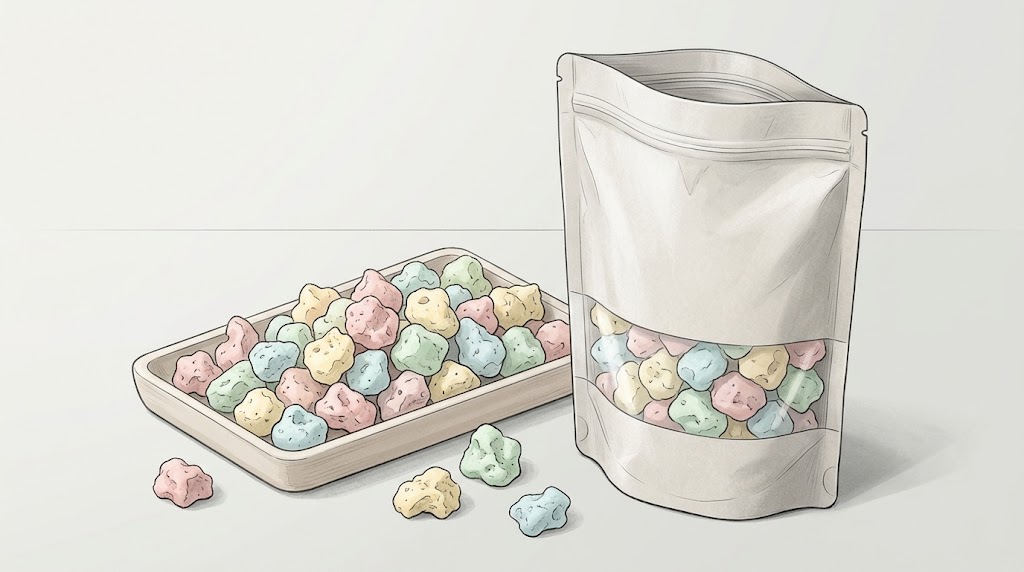
What kind of bags should you use for freeze-dried candy?
Start with a heat-sealable food-contact pouch and ask for the complete proposed construction. The name “Mylar bag,” a silver interior, or a thickness figure is not a complete specification. You need to know what the supplier is offering, how it seals, and what evidence supports its suitability for your intended use.
Ask for water-vapor transmission data, commonly reported as WVTR, with the test method, units, temperature, and humidity conditions. Compare results obtained under comparable conditions. ASTM F1249, for example, measures transmission through flexible barrier materials, and its public description identifies agreed test conditions as part of a buyer–seller comparison. A film result helps you assess a material; it does not establish the performance of a finished pouch with seals, folds, and an opening feature. ASTM F1249 public scope.
The following options are candidates for evaluation, not a ranking that applies to every product sold under these names.
A clear front can help shoppers see an unfamiliar candy. It still needs a technical review. Do not assume that every transparent pouch performs alike, or that a small window has no effect on the package. Conversely, opacity alone is not evidence that a bag will meet your storage target.
Request sample pouches in the intended construction before committing to printed stock. Fill them with your actual finished candy, using the normal range of piece sizes. Check that the mouth accommodates filling without forcing pieces through it and that the selected portion leaves enough clear film for sealing.
Use Mylarbag's custom candy bag options to discuss pouch format and printing alongside these requirements. The useful starting point is your product sample and distribution plan, followed by a proposed construction that can be evaluated.
Move from the machine to sealed packs with fewer handling steps
Prepare the packing station before the candy is ready. Have clean receiving containers, approved pouches, weighing equipment, labels, and the sealer available. Harvest Right notes that finished freeze-dried food can take up moisture from room air and advises prompt packaging after readiness has been confirmed. Freeze-drying and packing tips.
Organize work so only the quantity being handled is exposed. If one operator weighs portions much faster than another seals them, open bags will accumulate. Adjust the sequence or batch size instead of measuring efficiency only by how quickly the first tray is emptied. Record delays when investigating a later texture problem.
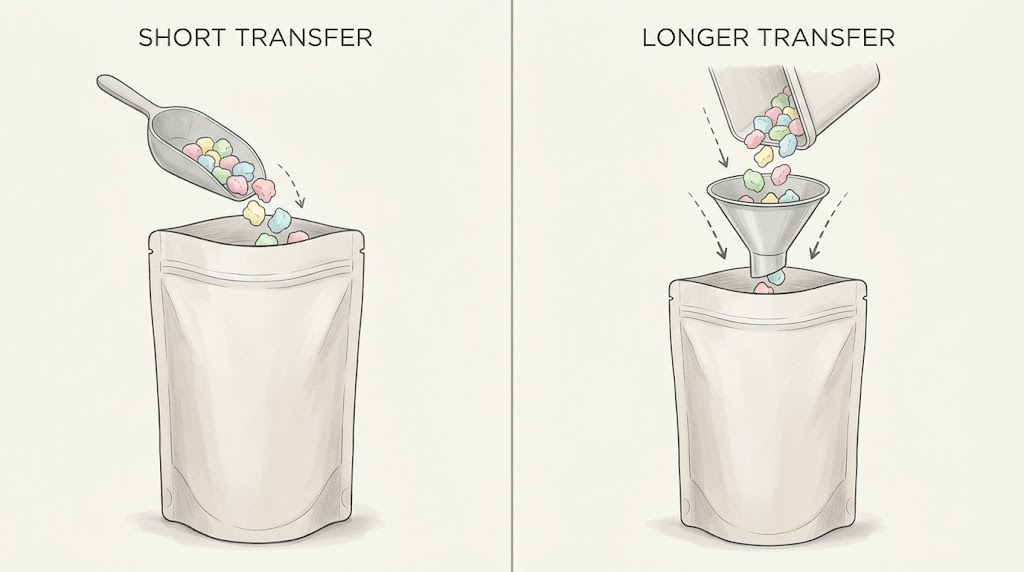
For candy that breaks easily, examine each transfer. A tall drop into a narrow funnel, repeated scooping, or pushing large pieces through a small opening may create damage before the pouch reaches the carton. Try a shorter transfer path and a wider opening, then compare the amount of loose material. Select food-contact tools that suit the product and your sanitation procedure.
Determine the portion from the finished candy. Do not carry over a portion estimate based on the product before processing. Account for the empty bag and any other non-food components when checking net contents, and review the applicable net-quantity rules for your market.
Look at the filled bag without squeezing it into a preferred shape. The product should not have to be compressed to close the top. At the other extreme, a pouch with excessive unused space may be awkward to display and pack. Evaluate several practical sizes with actual product, and keep the selected size tied to the sample and portion used for approval.
How to seal Mylar bags with freeze-dried candy
Use equipment suitable for the pouch's sealant layer and construction. Get the supplier's recommended starting conditions, then establish settings on your actual sealer. A setting copied from another machine, or from a pouch with a similar appearance, is not a reliable production instruction.
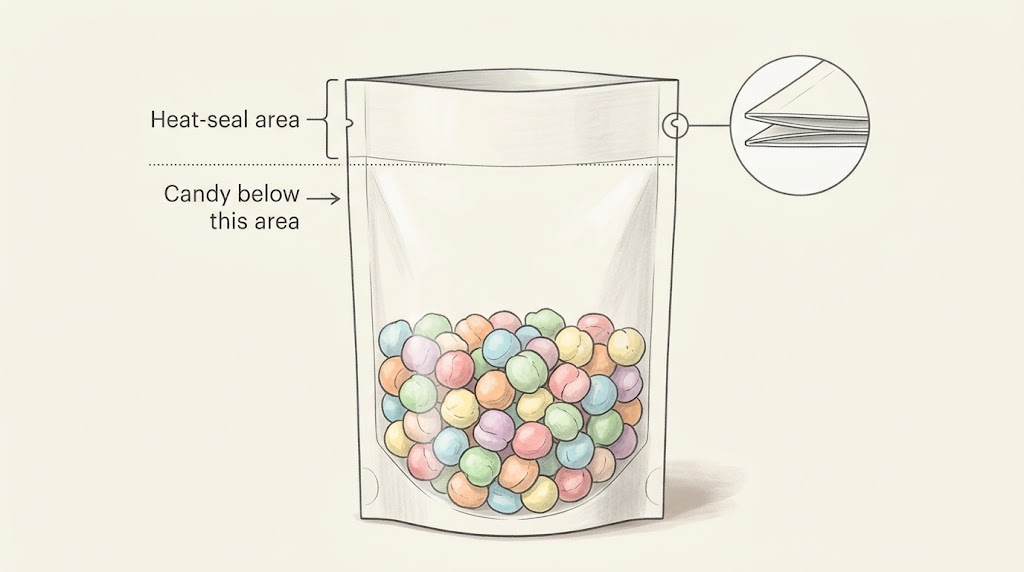
Before sealing, inspect the area where the two inner surfaces must meet. Keep pieces, sugar dust, and loose fragments out of that band. Arrange filling so product stays below it. If the pouch design includes a zipper, distinguish that reclosure feature from the separate initial heat seal specified for the unopened retail pack.
Position the mouth according to the approved pouch drawing. Avoid trapping wrinkles or forcing an overfilled bag flat beneath the jaws. Give the seal the handling or cooling time required by the material and equipment procedure before pulling or loading it. Do not add an extra seal automatically if it interferes with the tear feature or leaves the consumer unable to open the pouch as intended.
Inspect samples at startup and during the run using an agreed checking procedure. Visible folds, product trapped in the seal, scorching, or inconsistent bonding require investigation. Appearance is only part of the assessment: a straight-looking seal does not by itself prove that a package is leak-free. Agree on suitable seal-strength and package-integrity checks with the supplier or testing provider.
Keep a short record of the pouch lot, machine, settings, operator, and checks. If a stored sample changes texture, that record lets you investigate the actual run instead of guessing whether the material or the sealing process changed. Keep any destructive test packs separate from saleable stock.
Decide separately on oxygen absorbers, desiccants, and vacuum
These are different packaging tools. An oxygen absorber is intended to remove oxygen; a desiccant manages moisture. Do not treat an oxygen absorber as the complete moisture-control plan, or add either packet simply because it appears in another seller's bag.
Selection depends on the product and package. Mitsubishi Gas Chemical lists different AGELESS oxygen-absorber types for different conditions, including product water activity. Its instructions also address handling after the master package is opened. Those distinctions matter more than choosing a packet by pouch dimensions alone. Absorber types, handling instructions.
Give the packet supplier the information it requests about the candy, residual package atmosphere, pouch construction, and intended storage. Ask whether the proposed grade is suitable, how its capacity should be selected, and how the packing team should control exposure before sealing. If considering both an absorber and a desiccant, have the combination reviewed rather than assuming the two products can be chosen independently.
Include packet placement and identification in your packing procedure. Check that it does not enter the seal area or become confused with the candy. A packet that is hard to distinguish from the contents creates an avoidable problem for the person opening the bag.
Vacuum is another separate decision. Drawing film tightly around expanded pieces may put pressure on them. Evaluate whether your product tolerates the proposed process before selecting it. Neither a visibly tight pouch nor a loose one is, by itself, evidence that the desired storage conditions have been achieved. Assess the candy and the complete package after processing.
How to package freeze-dried candy for sale
The customer needs to understand what is inside before opening the bag. For an opaque pouch, use an accurate photograph or an appropriately described illustration of the finished candy. A picture of the original unprocessed product can set the wrong expectation when the sold product has a different size and appearance.
Reserve space for the information required in the destination market and have the label reviewed before printing. This may include product identity, ingredients, allergens, net quantity, responsible business information, and nutrition information as applicable. The FDA's food-business guidance is a starting point for US sellers; it is not approval of a particular product or label.
Provide room for the lot identification and date information used in your own system. Check that they remain legible on the finished surface. If one base design serves several flavors, build a verification step into filling so the candy, ingredient information, and flavor identification agree.
Assess display using filled samples. Does the pouch stand as intended? Can a shopper read the label without flattening the contents? Can staff load a display tray without forcing the upper packs onto those below? These checks connect the packaging design to the way the candy will actually be handled in a shop.
How to package freeze-dried candy for shipping
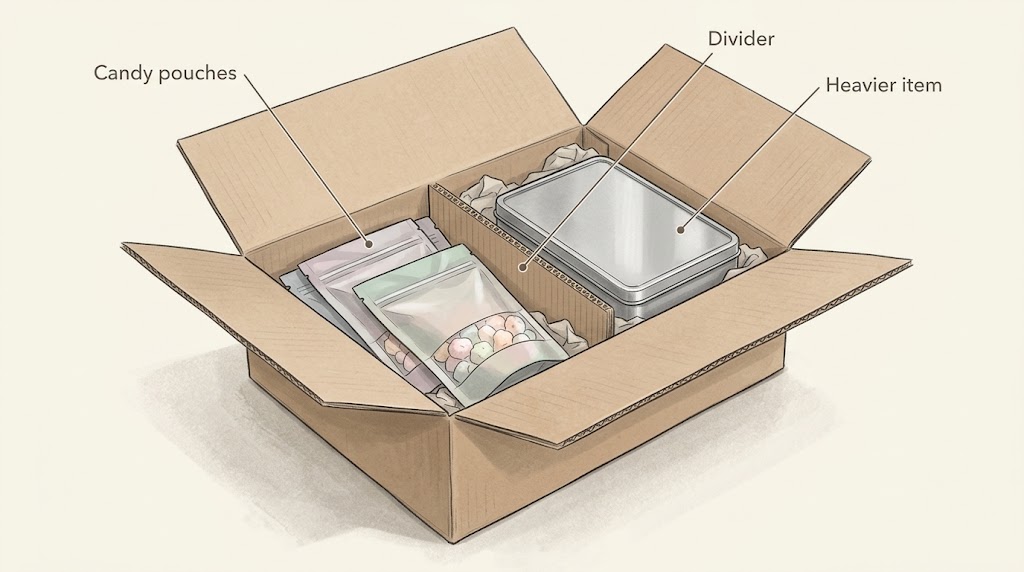
For a brittle product, begin a shipping trial with the sealed retail pouches inside an appropriately sized carton. The pouch handles direct product containment; the outer packaging must also address the parcel's handling conditions. A retail bag that looks good on a shelf has not necessarily been evaluated for that job.
Choose the carton from the filled arrangement. Lay out the number of pouches that will actually ship, including any divider or cushioning, and check the fit without pushing the lid down against the candy. Do not assume a box described by external dimensions has that much usable space inside.
Control movement without packing so tightly that the cushioning itself presses on the product. FedEx's general packing instructions emphasize a suitable box and cushioning that limits movement. The appropriate arrangement for your candy still needs to be evaluated with the filled packs. FedEx packing instructions.
Mixed orders deserve a separate review. A rigid gift item or a dense product can move against a light candy pouch. Consider a divider or separate compartment that holds the other item in place. Adding loose filler above everything may leave the more damaging contact point unchanged.
Trial the order configurations you expect to sell. A single pouch, a small assortment, and a full carton can need different arrangements. Packing instructions should identify the box and layout for each approved configuration, rather than telling every operator to “add enough padding.” Include how the pouches are oriented and where heavier items belong.
Choose trial routes and timing that reflect actual deliveries. Record the packing date, dispatch date, arrival date, configuration, and any known delay. An undamaged box exterior does not prove that the candy arrived intact. Ask the recipient to photograph the unopened parcel, the internal arrangement, and the sealed pouches before opening samples for assessment.
Do not infer a cold-chain requirement from the word “freeze-dried.” Set transport and storage conditions from the finished product's requirements. If considering insulated packaging or a different transport temperature, evaluate the consequences for the whole pack instead of adding it as a default accessory.
Keep the results specific. A successful local delivery of one small box does not establish how a larger mixed order will behave on a longer route. Use early trials to find weak points, revise one relevant feature, and repeat with enough samples to see whether the change is consistently useful.
Separate moisture checks from breakage checks
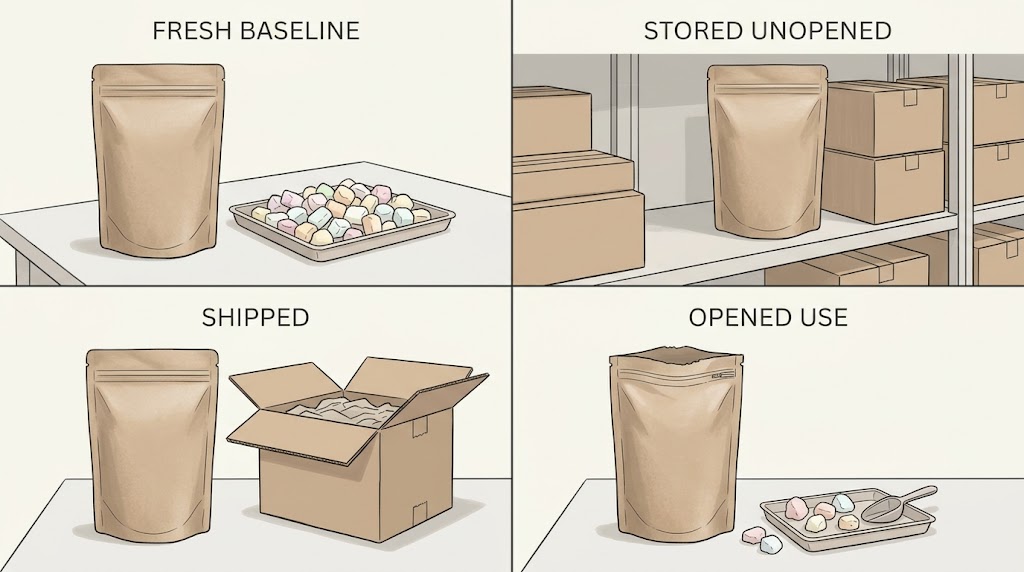
Plan the comparison before filling the trial packs. Otherwise, a soft piece found after shipping may be blamed on the carton when the problem began before dispatch. Use matched packs from the same production lot, portion range, and packing process. Set aside separate samples for the different observations.
Use a consistent observation sheet. Record texture using an agreed description, inspect the pouch and seals, and note whether the contents remain acceptable under your product specification. Where measurements such as water activity are needed, use suitable methods and competent interpretation. A single reading should not replace the broader product and shelf-life assessment.
For breakage, define what counts as a fragment before looking at the results. Some candies naturally contain pieces of different sizes, so the smallest piece is not automatically damage. Choose a practical cutoff and a gentle, repeatable separation method that does not create more breakage during assessment.
A simple comparison can use fragment mass as a percentage of all recovered candy:
Fragment share (%) = mass of fragments below the agreed cutoff ÷ total recovered candy mass × 100.
The numbers below are invented only to explain the calculation. They are not Mylarbag test results or an acceptance standard. The baseline and shipped samples are separate matched packs; the baseline pack is not opened, resealed, and then shipped as though it were untouched.
Record product lost during opening or separation, since missing material can distort the comparison. One pair of packs cannot establish that shipping caused the whole difference. Repeat the comparison across representative packs and document variation before deciding whether a new carton or filling method helped.
Match the next change to the evidence. If fragments are already present at the fresh baseline, examine production and filling before buying more padding. If sealed samples change texture during controlled storage, investigate readiness, exposure before sealing, package construction, and seal integrity. A shipping problem may coexist with a storage problem.
For more formal transport evaluation, ask a qualified laboratory which procedure matches the distribution system. ISTA describes different test categories, including parcel-distribution simulation under Procedure 3A. An informal shake or delivery trial is useful development work, but it is not evidence that a package passed an ISTA procedure. ISTA test procedures.
Establish the selling period with the actual product
Do not borrow a storage duration from another freeze-dried food, a bag listing, or an oxygen-absorber advertisement. Establish the period for your candy, its package, and the conditions under which it will be sold and stored.
Agree on the assessment with an appropriate laboratory or food professional. Define what will be evaluated, when samples will be examined, and what constitutes an unacceptable change. The plan may need to address food safety as well as flavor, texture, appearance, seal condition, and the amount of breakage customers will accept. Keep unopened and opened-pack expectations separate.
Retain enough sealed samples to examine each planned interval without repeatedly opening the same pack. Record the storage conditions and retain the pouch specification and lot details with the results. When a recipe, process, portion, construction, or distribution condition changes, review whether the earlier evidence still applies.
Choose consumer storage wording that matches the conditions you have evaluated. A zipper can make reclosure convenient, but opening changes the package environment. Avoid giving the impression that closing it again restores the original unopened condition or starts the same selling period over again.
Related project: a foil pouch for another dry-food application
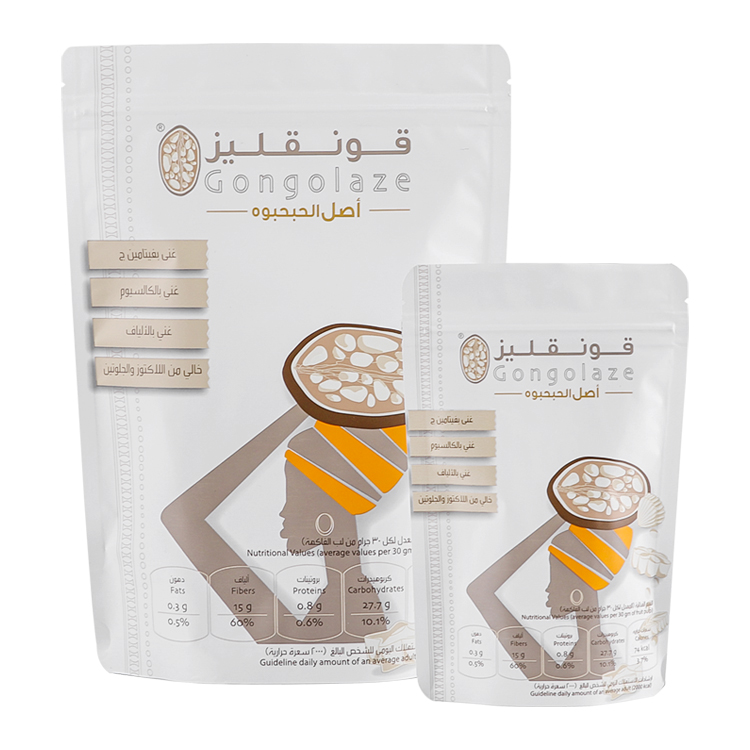
Mylarbag's published baobab fruit pulp and superfood powder pouch project lists Saudi Arabia as the destination, a MATOPP/AL/PE construction, gravure printing, and a stand-up format. The listed dimensions are “17*24+4 cm.”
This is a powder-packaging reference, not a freeze-dried candy case. It provides a concrete example of a listed foil-containing pouch construction and print format. It does not establish a suitable portion, shelf life, or breakage result for expanded candy. Nor should the size notation be converted into a candy capacity without a drawing and a fill trial.
Use the project to make a configuration discussion more specific. A freeze-dried candy application still needs its own filling, sealing, storage, and shipping assessment.
Recommended packaging configuration
For a brand selling expanded candy on a shelf and through parcel delivery, a stand-up pouch with an initial heat seal is a reasonable configuration to evaluate. A reclosable zipper may be useful for a multi-serving portion if the opening and reclosure work well with the actual pieces. Select the construction from the required storage evidence and the packing equipment's capabilities.
Keep the printed design subordinate to the approved physical sample. Confirm the product fits, the top can be sealed cleanly, and the filled pouches fit the proposed shipping carton before finalizing artwork placement. If a window is wanted, include that exact feature in the construction being evaluated.
For a fragile product, document the outer carton and internal arrangement along with the retail pouch. Ordering the bag without that context leaves an important part of the delivery problem unresolved. Review Mylarbag's printed pouch configurations for candy with your representative finished product, intended portion, and sales channels. Those details make a proposed specification and sample request more useful than a request for the “best” bag.
Frequently asked questions
What kind of bags are suitable for freeze-dried candy?
Evaluate heat-sealable food-contact pouches with documented moisture-barrier properties relevant to your intended conditions. Foil, metallized, and transparent constructions need to be assessed as specific products. The material name or thickness alone cannot determine suitability. Test filled, sealed samples and check both the intended selling period and the way the packs will be delivered.
Is a zipper enough to seal a bag of freeze-dried candy for sale?
For the pouch configuration discussed here, the zipper is a consumer reclosure feature and the initial heat seal is a separate part of the unopened pack. Use the approved seal location and a process suited to the material. Check that the finished opening arrangement lets customers tear or cut the top and use the zipper as intended.
Does every bag need an oxygen absorber or desiccant?
No universal packet requirement follows from the product name. Assess the reason for using each tool, then confirm suitability and handling with its supplier. Absorber type, capacity, placement, and exposure before sealing need consideration. A packet does not excuse an unsuitable pouch, an ineffective seal, or candy that has not met its release criteria.
Should freeze-dried candy be vacuum packed?
Decide through product and package trials. Some expanded pieces may be damaged when film is drawn tightly around them. Check the actual candy under the proposed process rather than using package tightness as a quality indicator. Vacuum should solve a defined requirement; it should not be added solely to make the pouch look more tightly sealed.
Can freeze-dried candy be shipped in a padded mailer?
That depends on the candy and the complete pack's demonstrated performance. A mailer does not provide the same structure as a carton. For a brittle product without supporting trial results, begin by evaluating a suitable carton and controlled internal movement. Include the actual order quantity in trials before approving any lighter shipping format.
How long will freeze-dried candy last in a sealed Mylar bag?
There is no reliable single duration from those words alone. The answer depends on the finished candy, pouch construction, seal integrity, packaging conditions, and storage. Establish a selling period using representative samples and an appropriate assessment plan. General long-term storage claims for other freeze-dried foods should not be transferred to a retail candy product.
Discuss a pouch around your finished candy
When you contact Mylarbag about freeze-dried candy packaging, include photographs or a representative finished sample, the proposed portion, and the normal range of piece sizes. Describe whether the product will sell locally, sit on retail shelves, or travel in mixed parcel orders. Include your filling and sealing method and the evidence you need from a supplier. This gives the packaging discussion a practical starting point and identifies what should be checked before a printed order is approved.