
A fresh chèvre log, a whipped spread, and a small surface-ripened round can all be called goat cheese. They should not automatically share a retail pack. One needs support against flattening. Another may release whey into a seal. A third may change character if its wrapping changes gas and moisture exchange during maturation.
The short answer: define the goat cheese by style, condition at packing, intended ripening, liquid release, storage route, and how the shopper will use it. Then compare a wrap or formed pack for a log, a lidded cup or suitable pouch for a spread, and a cheese-specific wrap or validated vacuum/MAP format for an aged style. Trial the actual cheese in the actual finished pack for shape, purge, seals, microbiological and sensory quality, cold-chain handling, labeling and consumer opening. No single barrier film or gas mix safely covers every goat cheese.
This guide is for small dairies, co-packers and B2B packaging buyers who need a supplier brief rather than a decorative mock-up. It focuses on the differences between goat-cheese styles. General cheese pouch selection, shredded-cheese filling, swollen packs, condensation and zipper troubleshooting belong to the other articles in the cluster.
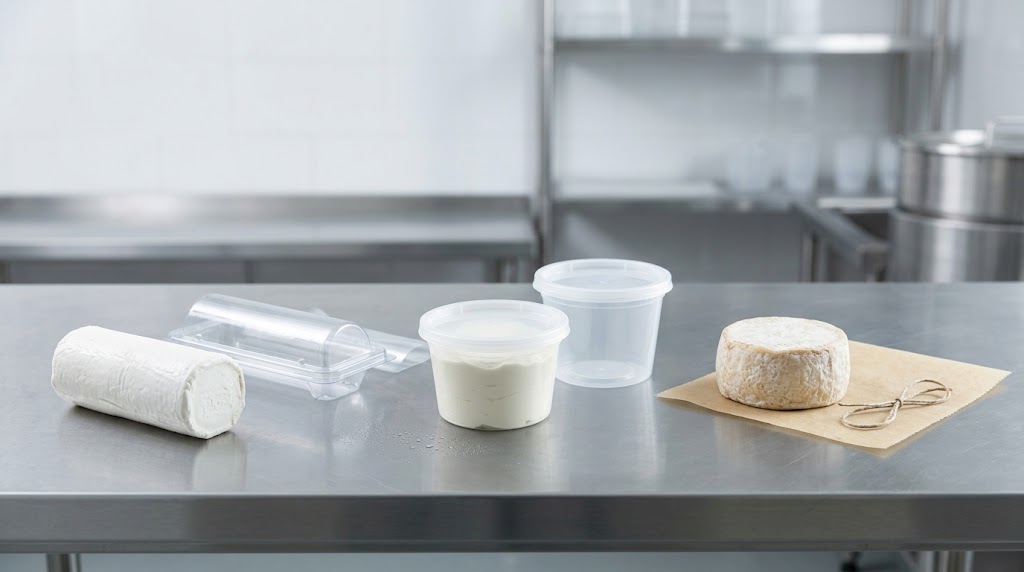
Conceptual hero image: three product styles with distinct packaging options; it does not imply a single package fits all three.
Start With the Cheese the Customer Will Actually Receive
Before asking for a “goat cheese bag,” document what leaves the cheese room. Is the product a fresh, moist, unaged log? Is it a soft spread with herbs or oil? Is it a firm, dried or surface-ripened style? Has it finished ripening before packing, or must it continue to change inside the wrap? Is it sold by the piece, by weight, or as a spoonable portion? These facts drive the pack.
Write a one-page product profile for each SKU:
- Milk source and processing description supplied by the dairy; recipe changes and added herbs, oils or toppings.
- Shape, portion weight, tolerance, surface condition, rind or coating, and the worst-case piece for sharpness or fragility.
- Temperature at packing, free liquid or whey, drainage step, salt, moisture behavior, and any contact with brine.
- Whether ripening or surface activity should continue after packing.
- Planned unopened life, retailer display condition, actual distribution route and how quickly the customer is expected to use an opened pack.
- Food-safety and labeling review owned by the dairy, including the intended market and any special population or channel requirements.
Avoid translating a label like “artisan,” “fresh” or “natural” into an assumed shelf life. The same nominal 100 g can behave differently when one log is freshly cut, another is coated in herbs, and a third has been drained longer. Fill a few real production pieces into candidate packs before approving the dimensions.
This is a screening tool. A cup may be right for a spoonable spread even when the packaging supplier specializes in flexible pouches. Conversely, a flat pouch may efficiently protect a firm goat-cheese wedge if its cut edge, atmosphere and seal can be validated. The buyer's task is to select the system that serves the food.
Fresh Logs: Support the Shape and Manage Whey
A fresh log often has a soft surface and a defined shape the shopper expects to see intact. Vacuum can pull flexible film tightly against the log and alter its appearance; a loose wrap can let the log move and crack. The “best” pressure is therefore a product trial outcome. Photograph the piece before wrapping, immediately after packing, after cold storage and after a distribution simulation. Compare deformation, surface cracks, liquid pooling and ease of opening.
If the dairy uses a wrap, specify the food-contact side, overlap and closure method, whether a tray or board provides structural support, and how the wrapped product is contained in the retail sleeve. If using a formed tray, confirm lid-to-tray compatibility, peel, headspace and support under stacked cartons. If considering a flexible flat pouch, check whether the log's shape is protected by the pack or an insert, whether wet cheese touches the first heat-seal land, and whether the consumer can remove the log without scraping away its surface.
Fresh cheese may release whey after packing. Separate a small expected purge from a defect that obscures the label, contaminates the seal or creates unacceptable texture. The dairy needs its own sensory and safety limits. Record purge mass or a consistent visual grade in a controlled trial; do not promise that a “high barrier” will dry out a wet cheese. A low water-vapor transmission route may retain water already in the pack.
Keep the opening useful
The shopper may want to cut portions from a log over more than one occasion. An easy-open seal, peelable lid or well-designed overwrap can affect how much product is damaged at first opening. A zipper may be useful in a larger pouch, but it cannot stand in for the original unopened seal. If the product is sold in a small single-use portion, a zipper may add complexity with no clear consumer benefit.
Test opening after refrigeration, not only on an empty room-temperature prototype. Note whether fingers can grip the panel, whether the tear line runs through a printed date code, and whether a soft log remains in place while the pack opens. The package must protect what the customer thinks they are buying, not merely look attractive before the first handling event.
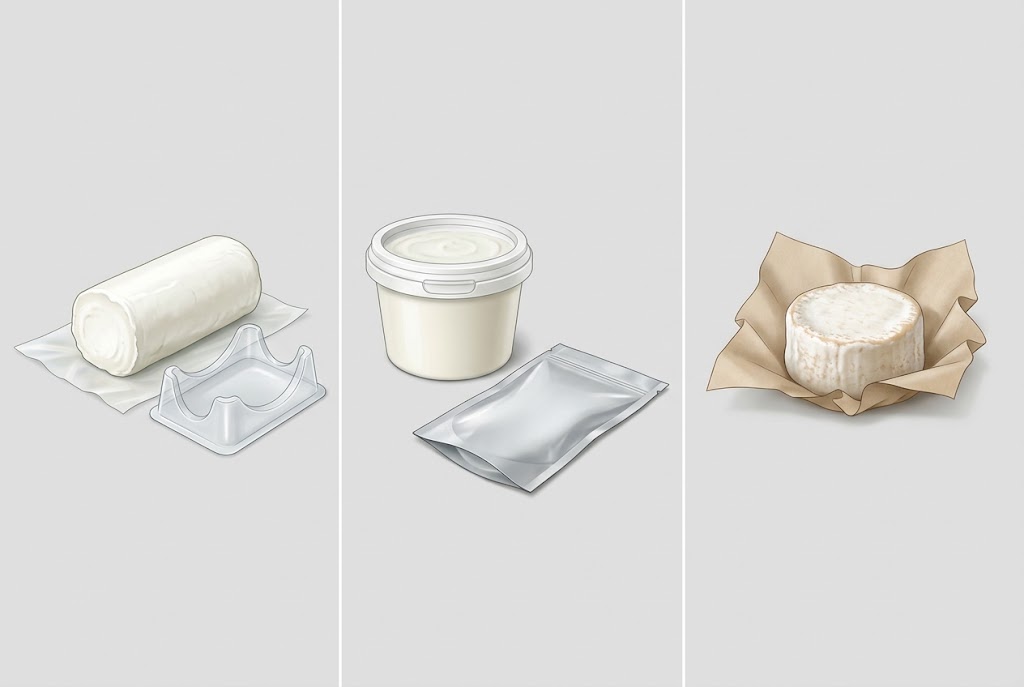
Conceptual format illustration: separate examples of log support, a spread cup or pouch, and style-specific aged-cheese wrap. It is a buyer's screening aid, not a shelf-life claim.
Spreads: Test the Filling System Before Choosing a Pouch
A spoonable goat-cheese spread introduces different equipment and hygiene questions. It may be filled into a cup or tub and sealed with a compatible lid. That format can support portioning and let the customer scoop without cutting a flexible bag. A pouch may be worth testing for a specific dispensing experience, but it must handle the actual viscosity, inclusions, temperature and fill sequence.
Ask what happens at the filling nozzle. Does product smear across a future seal? Do herb pieces lodge in the seam? Is free liquid present at the top after the pack stands? Can the bag remain upright without squeezing the spread into its zipper or seal? Will the material flex at refrigeration temperature and survive handling without creasing the seal? If a spout is proposed, assess the fitment as another food-contact and integrity component; do not assume a dry-food zipper solves a wet-spread problem.
For a lidded cup, trial the actual cup flange and lidding film, seal temperature and peel performance, leak behavior after a tilt or shipping test, and lid clarity. For a pouch, trial the food-contact sealant, filled geometry, top-seal cleanliness, opening path and post-opening handling. In either format, the dairy's sanitation and product controls remain decisive.
The FDA's resources for soft fresh queso fresco-type cheese manufacturers discuss environmental and preventive controls relevant to that category. It is not a goat-cheese-specific recipe or a substitute for the dairy's hazard analysis. It does illustrate why a new package does not correct contamination introduced before sealing. For a ready-to-eat soft goat cheese, the processor must assess its own hazards, environment and controls.
A real adjacent pouch example: Mexico mole paste
Mylarbag's Mexican 8 oz mole-paste stand-up pouch lists Mexico, an MATOPP/VMPET/liquid-PE construction, a stand-up format and gravure printing. It is a real example of a converter specifying a pouch for a moist, oil-bearing paste. It provides a useful engineering prompt: when a filling product is soft and may smear at the seam, ask which sealant, fill path and finished-pack leak tests are appropriate.
This is not a dairy or goat-cheese case. Mole paste and a goat-cheese spread differ in composition, microbiology, cold-chain requirements, acidity, viscosity and filling process. The case page's marketing statements about complete protection, sales results and shelf life are not evidence for this article. Do not copy its structure into a cheese quote without food-contact review and tests using the actual spread. In some projects, a rigid cup will be the better answer.

Real factory image: flexible pouch conversion. The fresh-cheese filling and sealing operation must be validated separately by the food producer.
Aged and Surface-Ripened Styles: Packaging Is Part of the Product
An aged goat cheese may have a developed rind, a firmer body or a continuing ripening process. Its pack influences moisture loss, oxygen exposure, carbon-dioxide buildup, surface appearance and flavor development. The right wrap can be intentionally different from a sealed high-barrier retail pouch. Decide whether the cheese should be stable when packed or should continue to ripen during the intended storage period.
A study of Crottin de Chavignol-type goat cheese compared modified-atmosphere and vacuum packaging with an air-packed control. It reported differences in microbiological, sensory and texture outcomes under its defined study conditions, including changes in vacuum-packed cheese. The result is a reason to test the intended style, not proof that vacuum or a particular gas mix is best for a fresh chèvre log or another producer's aged cheese.
For a firm wedge, a vacuum-capable pouch may keep film close to the cut face, but sharp edges and surface crystals can stress the film. For a ripening round, an impermeable laminate might alter the rind and moisture balance. If a gas-flushed format is proposed, define the target product, headspace and storage study with a qualified food team; do not prescribe a gas percentage from another study. Monitor how the pack looks at day zero and later, including whether it becomes unexpectedly inflated or collapses.
The packaging supplier can discuss cheese-bag structures and material samples. The cheesemaker must decide whether a wrap, cup, formed tray or pouch maintains the desired cheese over its own distribution period. A supplier's lowest OTR or WVTR number is not a cheese-style specification.

Real factory image: film lamination capability. No goat-cheese gas or moisture performance is inferred from the equipment photograph.
Vacuum, MAP, Air or a Style-Specific Wrap?
Do not choose an atmosphere before the style and pack are settled. Vacuum, modified atmosphere packaging (MAP), ordinary air and permeable wrapping have different physical effects. The same gas mixture can behave differently with a soft wet log, a firm wedge and an active rind. The headspace-to-product ratio, gas solubility, film area, package temperature and sealing integrity all change the result.
A published fresh-cheese atmosphere study compared air, vacuum and MAP in its specific acid-coagulated cow-milk cheese. It found quality differences across storage conditions. It is useful context for designing comparative trials, but it is not a goat-cheese result. The Crottin study above is more directly relevant to a particular goat-cheese style, and neither study sets a universal gas mix or use-by date for your SKU.
If the cheese is intended to continue ripening after packaging, the dairy should involve its cheese technologist before switching to a higher barrier. If the cheese is fresh and ready to eat, the dairy should evaluate microbiological risk, temperature and product quality as well as appearance. A packaging supplier should supply relevant construction and barrier data; it should not claim that a gas mixture makes an inadequately controlled process safe.
Specify Film and Seals as Parts of a Finished Pack
A buyer may ask for “foil,” “EVOH,” “paper” or “plastic.” Those names are incomplete. Request a full layer sequence, coating or adhesive system where relevant, food-contact side, thickness, window design and sealant. OTR describes oxygen transmission through a tested material; WVTR describes water-vapor transmission. Both need units, method and test conditions. Neither tells you how a soft goat-cheese log will look after vacuum or how much whey a spread will release.
The plastic-films page provides examples of flexible material options. A metallized or foil layer may restrict light or gas but prevents a full transparent view. A clear window may create a different local barrier path. A very low moisture-transfer structure may keep a cheese from drying yet retain unwanted liquid. Get values for the actual proposed construction and compare it to filled-pack results. Avoid copying a dry-food bag specification to a wet cheese.
The first seal must work with the filling method. Fresh cheese or herb inclusions can smear across the seal area. Purge can reach a seam after the package is tilted. Vacuum can pull liquid toward the top. Ask the packer to show filled samples from startup, steady operation and restarts, including both corners and gussets. If the choice is a cup, evaluate flange cleanliness and lidding peel; if it is a pouch, evaluate the top and converted seams, zipper ends if used, and handling through cartons.
ASTM F88/F88M is a method for measuring seal strength in flexible barrier materials, while ASTM F3039 addresses dye-penetration leak detection in nonporous packaging or flexible barrier materials. They answer different questions. A strong strip can coexist with a local leak; a sound seal cannot repair a damaged product or unsafe handling. The dairy and converter should agree on methods, locations and acceptance criteria for the actual commercial pack.

Real factory image: seal-test equipment. No test result or specification for a goat-cheese SKU is implied.
Check the food-contact use
Request documentation for every material that contacts the intended cheese under the actual time and temperature conditions. A label such as “food-grade PE” is not enough to describe the complete pouch, lidding system, ink, adhesive or coating. The FDA explains that the regulatory status of a food-contact article depends on the status of its components and conditions of use. For destinations outside the US, obtain the market-specific review rather than treating US documentation as globally interchangeable.
If a cheese surface is coated with herbs, oil or another ingredient, include that actual contact condition in the specification and shelf-life trial. Do not assume an oil-resistant lining described for a non-dairy paste has been assessed for a high-moisture dairy spread. Ask whether a window, coating, paper wrap or absorbent component changes the documentation needed for the proposed structure.
Validate the Whole Product-Package System
The first trial should compare realistic choices, not only samples that look good empty. Define a control pack the dairy already understands, plus perhaps two candidates for the same cheese lot. If the comparison involves a fresh log, use pieces at the bounds of normal size and softness. If it involves a spread, test the lowest and highest practical fill weights and the actual inclusions. If it involves an aged round, record its stage of ripening.
Write the acceptance questions before the pack test:
- Does the filled pack retain the required shape immediately and after chilled storage?
- How much liquid appears, where does it collect, and does it touch or compromise a seam?
- Are headspace and gas behavior, if used, within the product team’s targets over time?
- Do package seals and walls remain intact after packing, case compression and distribution simulation?
- Do the cheese's microbiological, sensory and texture results support the planned shelf life?
- Can a shopper see, open, portion and store the product as the brand intends?
- Are the artwork, label, date code and traceability details readable after wet refrigerated display?
These are separate endpoints. A package that passes a drop test but makes a soft log look crushed is not a good retail result. A clear window that shows pooled whey may be commercially worse than a protective opaque wrap. A gorgeous pack with an incomplete seal cannot be approved because the design team likes it.
Record purge and deformation separately
For a log, photograph the same side of each retained piece and compare length, diameter and surface damage after packing and transport. For a spread, weigh or grade any free liquid and observe whether it migrates into a lid or zipper. For a firm aged style, check cut-edge abrasion, rind appearance and weight change. Use the dairy's product-specific limits rather than a single arbitrary gram or percentage for all cheeses.
Temperature history matters. Put a logger with representative shipping cases, note time at staging and dock, and compare traveled packs to retained controls. A trial from a cool room directly into a marketing photo studio may produce outside condensation that says little about the unopened pack. Conversely, a stable laboratory refrigerator cannot prove a bag survives the real delivery route.
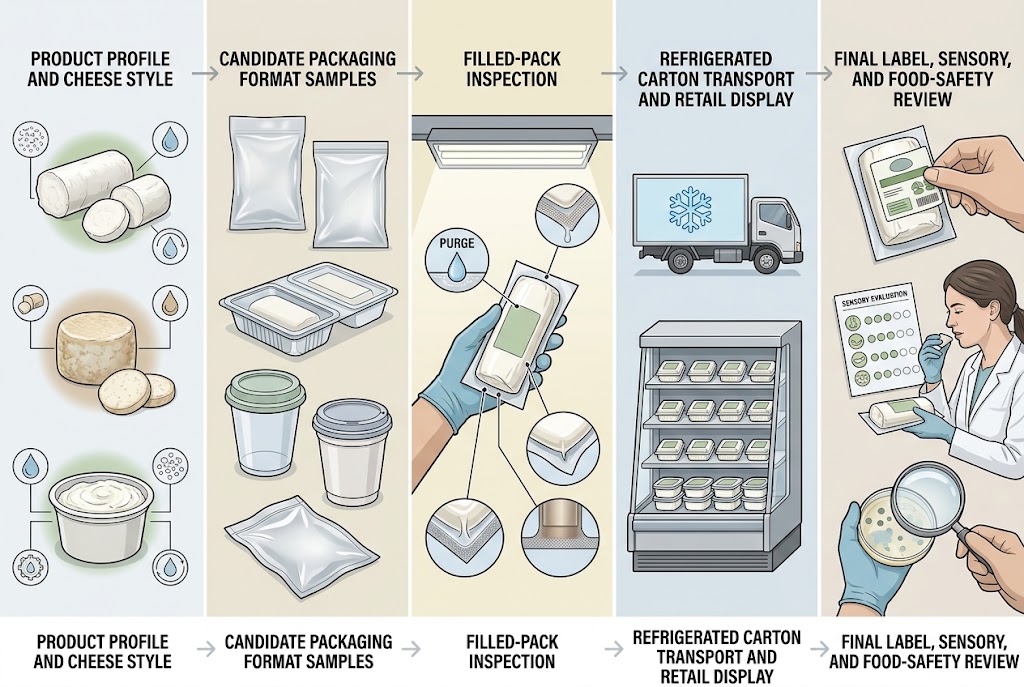
Conceptual validation illustration: compare real product, sample formats, filled-pack tests, distribution and label review before approval. No test outcome is implied.
Separate food safety from packaging performance
Soft ready-to-eat cheese deserves a product-specific hazard analysis and sanitation program. The FDA's soft fresh cheese manufacturing resources address the queso fresco-type category and highlight environmental and packaging-stage controls. That page is not a rule saying every goat cheese has the same hazard profile. It is a reminder to review exposure before packaging, hygiene, preventive controls and verification for the actual operation.
Changing vacuum, atmosphere or barrier can change spoilage patterns without eliminating pathogens. The FDA notes that Listeria can grow at refrigeration temperatures. The dairy should use its own validated time-temperature plan, environmental monitoring where appropriate, product testing strategy and release decision. A pouch converter cannot declare the cheese safe because its film has a low OTR or its seam passed a pull test.
Plan for Cartons, Refrigerated Display and Opening
Retail performance extends beyond the primary pack. A delicate log may need a formed tray or carton that prevents other units from pressing on its surface. A lidded cup needs stable stacking and a lid that survives side impacts. A flexible pouch can be packed flat or upright, but a heavy or wet fill may stress its gusset and seals. Test the number of units per case and the worst position in the stack.
At the display, look at the actual retailer's shelf depth, orientation, humidity and lighting. A clear window helps only if it stays sufficiently visible under the real conditions; an opaque pack may protect light-sensitive products but makes the label and product photography more important. Date codes should remain legible even when the outside of a cold pack collects moisture. Avoid placing an important statement along a fold, tear area or seam.
After opening, ask whether the product is one serving or several. A peelable lidding film may be convenient for a spread but may need a separate reclosure plan. A fresh log in a wrap may require an outer package that protects the remainder. An added zipper on a pouch helps only when the product can be accessed without contaminating the track. Label instructions about refrigeration and after-opening use should be written from the dairy's approved shelf-life work, not from the packaging supplier's generic promise.

Real factory image: converter-side film inspection. Retail appearance and finished cheese-pack performance require separate checks.
Label the Goat-Milk Product for Its Actual Market
Packaging artwork is a food-labeling task as well as a design task. The dairy should supply the reviewed product name, ingredients, net quantity, responsible business information, lot and date coding, storage instructions and any other statements required for its target market. Keep a panel large and flat enough for required information. A sleeve, sticker or outer carton can carry some content where the complete labeling scheme permits it; the brand's label reviewer decides the final arrangement.
For the US, the FDA's food-allergen labeling guidance explains that the major-allergen category “milk” includes milk from goats and provides guidance on identifying the animal source in labeling. Review the actual formula and destination-market requirements. Do not imply goat milk is automatically free of milk-allergen concerns, and do not let a pretty “goat cheese” front panel replace the required ingredient and allergen review.
A date printed through a seal can become hard to read; a label placed where whey collects can peel. Include the final artwork and coding method in the cold-display trial. If a multipack has individual units, define which pack bears which information and whether a retailer might sell units separately. The same applies to claims about pasteurization, organic status, geographical names or shelf life: obtain the dairy's evidence and legal review before printing them.
The Small Cheesemaker's Supplier Specification
A good enquiry asks for samples and data tied to one SKU. It does not need to pick a polymer by instinct. Send the supplier a short table with the following information:
The output should be a specification with alternatives and a validation plan, not an unsupported “best goat cheese pouch.” Ask for dimensions on the filled pack, exact film or wrap structure, sealing sides, test conditions for OTR/WVTR if relevant, the intended food-contact documents and actual samples. Compare total project cost, including waste, line speed, cartons, artwork changes, shelf-life validation and rejected packs—not only price per empty unit.
If the trials show a flexible pouch is appropriate, request a custom cheese packaging proposal with the product profile and sample plan. If a cup or cheese-specific wrap protects the product better, choose that format. The packaging decision should make the cheese easier to sell and safer to handle because it works in the real process, not because one format can be printed quickly.
Frequently Asked Questions
How do you package goat cheese for sale?
First classify the product as a fresh log, spread, aged wedge or ripening style. Select a pack that supports its shape and intended moisture and gas behavior, then validate the filled product through sealing, cold storage, distribution, sensory and safety checks.
Is a pouch suitable for fresh goat cheese logs?
It can be, if the log retains its shape, liquid does not reach the seal, and opening is acceptable. A supported wrap or formed tray may be better for a delicate log. Trial the real cheese at its softest normal condition.
Should spreadable goat cheese go in a cup or a pouch?
A lidded cup often suits scooping and structural support; a purpose-designed pouch may suit a different dispensing brief. Compare the actual fill line, hygienic control, seals, purge, convenience and transport before choosing.
Can goat cheese be vacuum packaged?
Some goat cheeses can be tested under vacuum, but a soft log may deform or release liquid and an aged style may change sensory character. Research on Crottin de Chavignol-type cheese cannot set a universal vacuum shelf life. Validate the specific SKU.
Is MAP better than vacuum for goat cheese?
There is no universal answer. The cheese style, desired texture, gas composition, headspace, film and cold-chain route all matter. Compare finished packs under the dairy's microbiological and sensory plan rather than copying a published gas ratio.
Does high-barrier film stop fresh goat cheese from releasing whey?
No. Film permeability affects exchange with the environment; it does not stop a cheese from releasing its own liquid. Product process, drainage, pack geometry, temperature and seal placement all matter.
Do aged goat cheeses need a breathable wrap?
Some styles rely on controlled gas and moisture exchange during ripening, but the correct wrap depends on the cheese and stage of maturation. A cheese technologist should confirm the intended process before changing to an impermeable format.
How do I prevent a fresh log from flattening in shipping?
Trial a supportive primary format and case pack with the softest production log. Check compression, movement and opening after the actual distribution simulation. A thicker film alone may not hold the product's shape.
What seal tests should I request for a goat-cheese pouch?
Ask for methods and acceptance criteria that address both seal strength and leak continuity on the finished, filled format, including corners and any wet-seal challenge. The dairy and packer should agree on sample locations and frequency.
Does a pouch supplier decide the cheese's use-by date?
No. It can provide construction and test information, but the dairy must establish the date from the actual cheese, process, package, storage and food-safety evidence.
Does goat milk need an allergen statement in the United States?
US FDA guidance treats goat milk within the “milk” major-allergen category and discusses how the animal source should be identified. Have the actual formula and artwork reviewed under current requirements before sale.
Is a clear window necessary for artisan goat cheese?
Only if seeing the product helps the retail presentation and the window meets performance and food-contact needs. It may highlight surface change or pooled liquid. Compare it with an opaque format under the real display condition.
Can the Mexican mole-paste pouch be used unchanged for goat-cheese spread?
No. It is an adjacent non-dairy project, not a goat-cheese validation. Its structure may suggest questions about paste filling and sealant, but the dairy product requires its own food-contact, filling, safety and shelf-life checks.
What should I give a packaging supplier for a first quote?
Provide the cheese style, net weight, shape, liquid behavior, process and equipment, target market, display and transport conditions, desired opening, annual volume and a request for samples with complete specifications.
Is refrigeration enough to make soft goat cheese safe?
Refrigeration is an important control, but it cannot replace sanitation, hazard analysis and product-specific verification. FDA notes that Listeria can grow at refrigeration temperatures. The cheese producer owns the safety program.