
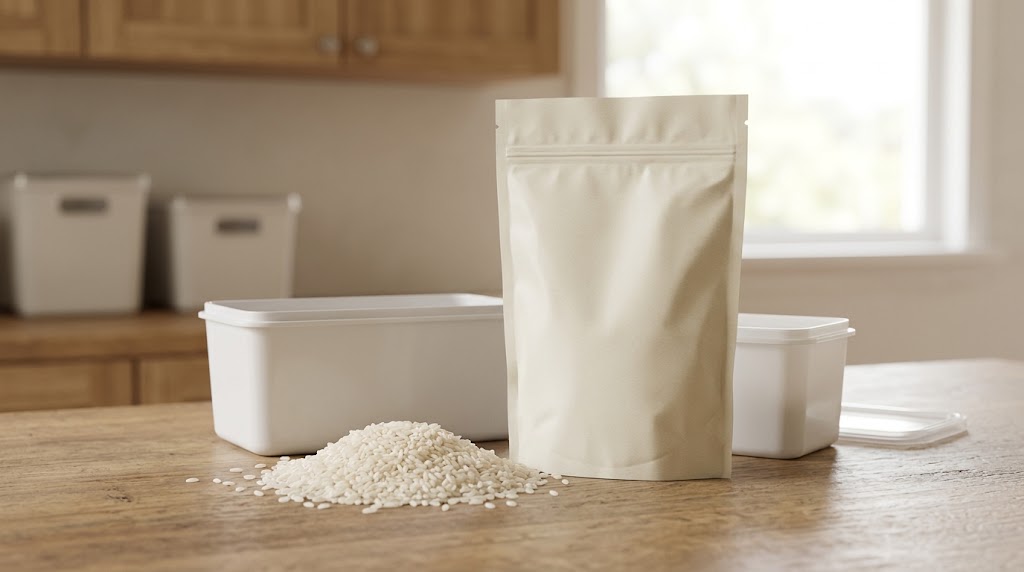
If you want to package rice for long-term storage, begin with sound, dry white rice. Choose a food-contact-appropriate pouch with a documented barrier structure and compatible heat-seal layer, make a clean continuous heat seal, and keep the closed pouch in a cool, dry, pest-managed place. A rigid outer container helps with handling and rodent exposure. A “Mylar” label alone does not verify any of those conditions. Brown rice needs a shorter, validated rotation plan because its retained bran contains oil.
That answer works for a household filling a few small bags and for a rice brand designing a repeatable line, but the controls differ. A household can inspect each seal; a brand needs specifications, samples, process settings, release criteria, and a dated shelf-life study. Neither can turn a damp ingredient into a safe shelf-stable one by adding an oxygen absorber. This guide covers uncooked, commercially dried rice at ambient storage conditions. It does not cover cooked rice, wet foods, retort processing, or a guarantee of a particular number of years.
Can you store rice in Mylar bags?
Yes, suitably dry rice can be stored in an appropriate, tightly sealed Mylar-type pouch. Utah State University Extension includes Mylar-type bags among the container options for long-term white-rice storage. The word “appropriate” does real work here. It refers to the finished package, not just a shiny sheet of film or a product listing that uses the word Mylar.
In packaging conversations, “Mylar” is often shorthand for polyester film or a multilayer foil-style pouch. It is not one universal recipe. A pouch may combine polyester, aluminum foil or metallized film, an adhesive, and a food-contact sealant. Another may have a clear window or a zipper. These details change the oxygen and water-vapor paths. The USU packaging-methods guide describes why a foil laminate can reduce transmission through the film, while its broader food-packaging guide expressly cautions that rodents can chew through such pouches. “Mylar” is therefore a request to inspect a construction, not evidence that the whole storage system is airtight, waterproof, or rodent-proof.
Ask what the pouch is made of from outside to food-contact side. Ask whether the specific laminate is intended for the food and market involved. Ask how the top closes after filling and whether the vendor can supply oxygen-transmission rate (OTR) and water-vapor-transmission rate (WVTR) data with test method, temperature, relative humidity, and units. A film data sheet describes a tested sample under stated conditions. It does not describe a pouch whose seal was contaminated with rice dust, a puncture in a gusset, or months of rough handling. For a commercial project, compare the finished filled pouch after sealing and distribution simulation as well as the flat-film data.
The first decision is not “foil or no foil.” It is whether the rice is white or brown, how dry it is, how long it must stay saleable under the real storage conditions, what kind of fill and seal equipment will be used, and whether the pouch needs physical protection outside the bag. The more ambitious the storage claim, the more evidence the seller needs.
Start with the rice, not the bag
Packaging protects an acceptable ingredient; it does not repair one. Check the supplier's rice lot, its intended use, and any available moisture and quality records before packing. Reject rice with a musty odor, visible moisture, mold, obvious insects, damaged source sacks, or unexplained staining. Investigate a suspect lot under the applicable food-safety procedure instead of trying to isolate it in a better pouch. A home packer who cannot establish whether rice is suitably dry should not assume that an oxygen absorber makes it safe.
USU advises buying quality rice from a trusted source and inspecting it for insects or discoloration before storage. Its guidance for oxygen-absorber containers is directed at dry, low-oil foods; USU also warns that moist foods in reduced-oxygen packaging can create a botulism hazard. That is why this article does not prescribe an absorber for rice of unknown moisture condition or for prepared rice. If the food is wet, cooked, or outside a validated shelf-stable specification, use the food's applicable refrigerated, frozen, or professionally validated process instead.
White rice has had the bran and germ removed. Brown rice retains them. That difference is more important to long-term flavor quality than a fashionable bag name. Light, heat, oxygen, moisture ingress, and initial ingredient condition can all affect quality. A barrier pouch can reduce certain exposure routes when properly specified and sealed; it cannot remove already developed rancidity or turn brown rice into polished white rice.
What does “long term” mean for a buyer?
For a household, it might mean keeping dry staples in an emergency reserve and rotating them periodically. For a brand, it means an unopened product must meet a defined quality and safety specification at a stated storage condition through the declared date. The two projects cannot share an unsupported “lasts 25 years” headline. USU discusses very long periods for properly sealed polished white rice, but those are conditional examples tied to rice type and storage, not a warranty for any retail pouch, any absorber, or a tropical warehouse. A seller should establish its own shelf-life claim with the ingredient, package, sealing process, shipping exposures, and target market in view.
Choose a package system: pouch, closure, and outer container
Think in layers of responsibility. The rice lot has to be suitable. The film slows relevant environmental transmission. The converted pouch has seams, folds, and possibly a window or zipper. The top seal closes the final opening. A secondary bucket, bin, carton, or protected pallet space addresses handling and some pest exposure. A failure in any one layer can undermine the intended storage plan.
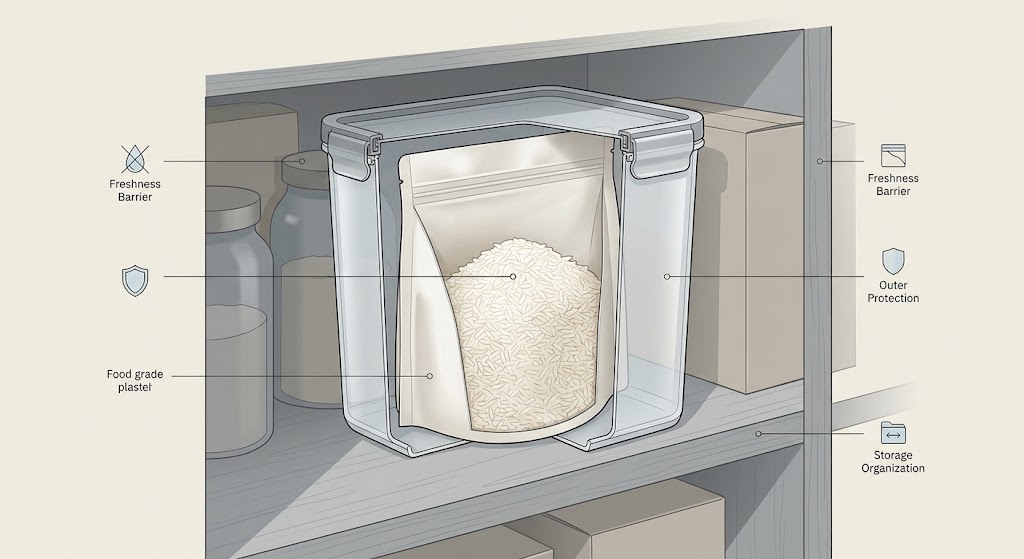
For an unopened reserve of dry polished rice, a high-barrier, heat-sealable pouch may be a reasonable inner package. A food-grade bucket or other suitable rigid container can keep individual pouches organized and reduce abrasion and exposure to rodents. It is not enough to place an open or weakly closed liner in a bucket and assume the system is hermetic. Conversely, a fully sealed pouch standing alone on the warehouse floor is vulnerable to pallet damage and animals. USU's food-storage packaging discussion makes both the moisture and rodent/insect issue explicit.
Does a zipper count as the storage seal?
Treat a reclose zipper as an access feature unless the chosen product has been validated for a different purpose. Small grains or powder can lodge in the tracks. The consumer may not close it uniformly. The initial manufacturer-applied heat seal above the zipper is the critical unopened-package boundary in many retail designs. After opening, the original unopened condition is gone even if the zipper closes. For a long-term reserve, portioning rice into several smaller, individually sealed pouches often makes more sense than repeatedly opening one enormous bag. Choose portions that can be used within a practical period after opening.
What should the barrier data tell you?
OTR concerns oxygen passing through the tested material; WVTR concerns water vapor. Lower values can matter, but only if you compare values measured under the same relevant method and conditions. A metallized layer, foil layer, clear window, thin sealant, puncture, and poorly sealed edge can lead to different results. No single material number establishes a shelf life. Ask the supplier which construction was tested, whether it includes the window or closure, and what is known about the converted package. Ask what happens to the laminate when folded and filled, not simply how a flat test coupon performs.
How to store bags of rice long term in Mylar bags: a practical sequence
The order matters. Filling an unknown rice lot and then trying to solve every risk with a thicker bag is backward. Use the following sequence as a planning framework, and follow the actual rice, absorber, pouch, sealer, and local food-safety instructions for the project.
1. Define the food and its intended conditions
Record the rice type, lot, initial quality, applicable moisture specification, fill weight, expected turnover, geographic market, and realistic storage temperature and humidity. Decide whether the user is building a household reserve, a retail SKU, or an institutional pack. If the lot is wet or suspect, stop. If a brand wants a date claim, define the quality attributes and how they will be measured at the end of the period. Packaging selection follows the requirement rather than creating it.
2. Select a food-contact-appropriate finished pouch
Request the complete layer stack, thicknesses, food-contact documentation applicable to the intended use and jurisdiction, and the closure design. Identify which side is the sealant. Decide whether a window, zipper, tear notch, hanging hole, or unusual gusset introduces a boundary that needs extra validation. For an unprinted household stock pouch, buy from a reputable supplier with clear product instructions. For a brand, request a drawing and physical samples and fill them with the actual rice. A dimension that looks generous when flat can leave no clean top-seal area after the pack bulges.
3. Keep the fill and seal zone clean
The final top seal needs compatible inner surfaces in contact with each other. Leave the supplier-specified unfilled clearance; avoid grains, bran dust, label adhesive, folds, and creases in the seal path. Do not copy a universal heat/time/pressure setting from a blog. Those settings depend on laminate, sealant, layer thickness, equipment, dwell, pressure, cooling, and the actual line speed. Verify the setting on trial pouches with the intended rice and sealer. A home sealer's instructions and bag vendor's instructions take precedence over generic advice.
4. Decide whether an oxygen absorber belongs in the system
For suitably dry, low-oil white rice in a compatible airtight package, a food-safe oxygen absorber can help reduce headspace oxygen and discourage insects already present in the grain. USU describes that use for dry stored rice. Follow the absorber supplier's instructions for the package volume and application; there is no responsible universal cc-per-pound prescription that works for every headspace and bag. Keep sachets intact, account for the amount of time they are exposed before sealing, and ensure the finished pouch is actually closed. An absorber cannot dry damp rice, correct a hole, prevent rodents, or reverse rancidity. Do not add it to cooked or moist rice on the strength of this article.
5. Seal, inspect, and protect each pouch
Inspect the entire top seam, corners, side seams, gussets, and any spout/window/zipper interfaces where relevant. Look for rice caught in the seal, channels, wrinkles, burn-through, delamination, puncture, and underfilled or overfilled bags. A firm or drawn-in bag after absorber use is not proof of a sound seal; appearance alone cannot establish a lasting barrier. Set aside damaged packs rather than obscuring the issue with a second label. Add a lot and packing date so a failed bag can be traced and rotation is possible.
6. Put sealed pouches into a managed storage environment
Use a clean, dry, cool space away from direct sunlight, leaks, chemicals, and pest activity. Keep packages off potentially wet floors, inspect the outer container and storage area, and rotate by the product's validated or practical schedule. A rigid container is especially useful where mice are a concern, but no common consumer plastic bucket should be marketed as an absolute rodent barrier. Choose a container and pest-control program appropriate to the setting. If packages become wet, chewed, punctured, or contaminated, investigate and follow the applicable food-safety disposal rules rather than assuming the internal rice stayed acceptable.
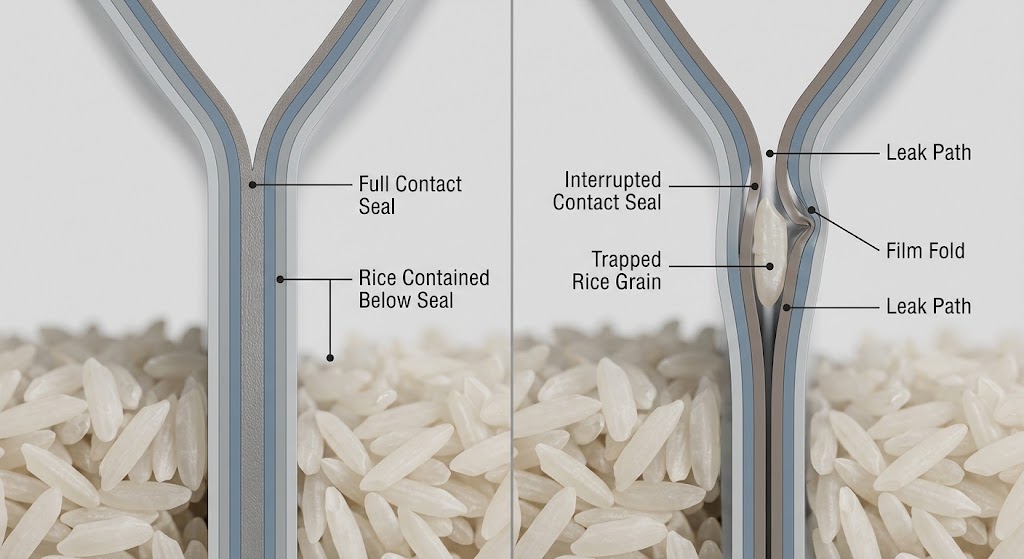
Seals are a process, not a line drawn on the pouch
For brands, seal quality is where a storage concept becomes a manufacturing control. Start with a seal-window trial. Use the intended film, pouch format, actual rice, fill speed, and equipment. Map temperature, dwell, pressure, and cooling across the operating range. Inspect at startup, after adjustments, at defined production intervals, and after a stoppage or film-lot change. Document the settings and rejection criteria. Seal integrity can vary near corners and gussets; do not sample only the easiest straight section.
An ASTM F88/F88M seal-strength test measures the force needed to separate a seal specimen under the method's conditions. It is useful for process capability and consistency, but it is not, by itself, a test that every production pouch is leak-free. Visual checks and an agreed package-integrity method address different questions. Agree on the test, sampling, acceptance limit, specimen location, and who records the result before comparing suppliers. Do not invent a pass/fail number from an unrelated pouch.
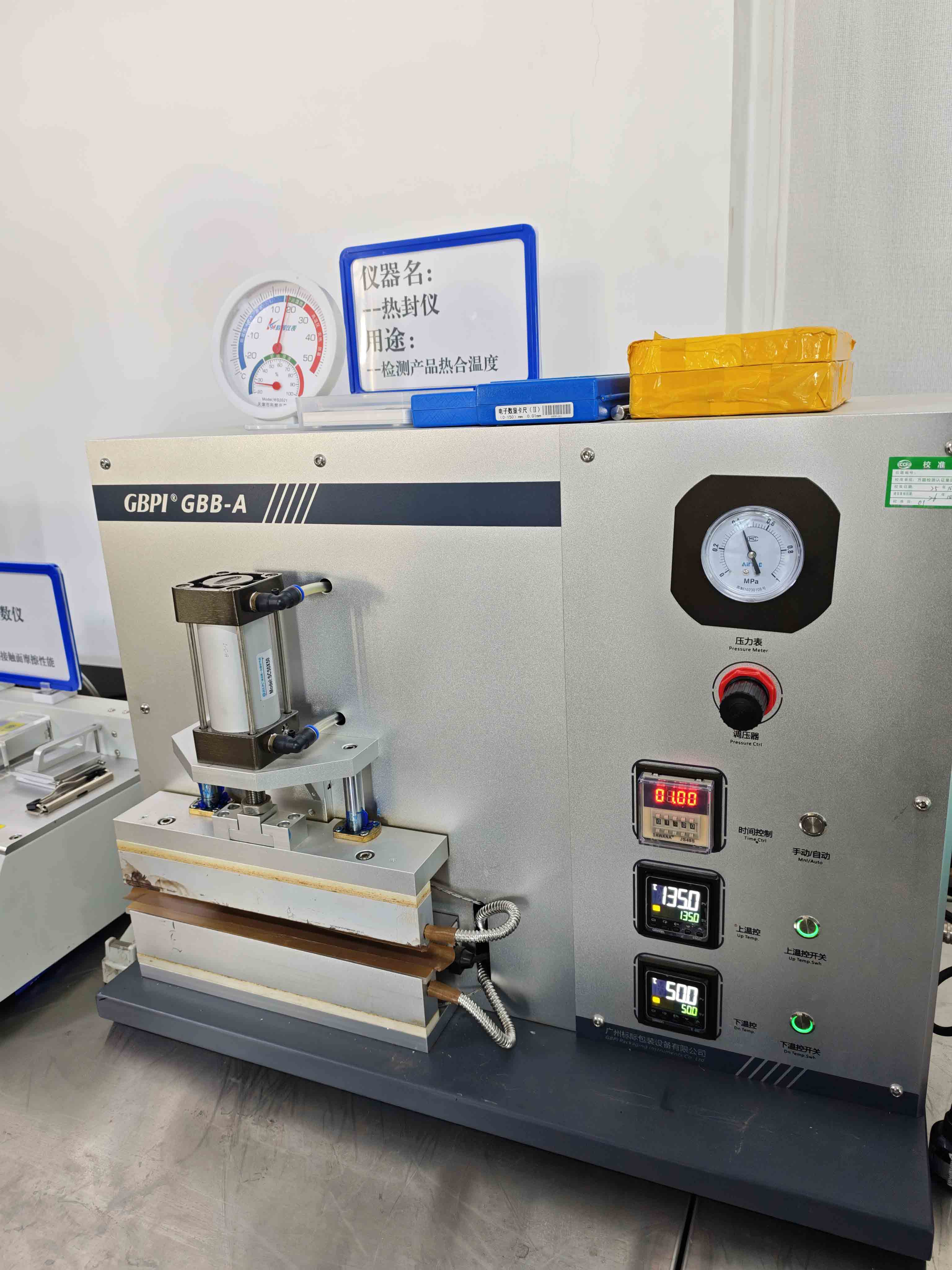
A simple receiving or line checklist should capture the details below. The values are to be filled by the project team from its own specification and validation; a blank is not a pass.
How long can you store brown rice in Mylar bags?
Do not take a duration reported for polished white rice and apply it to brown rice. Brown rice retains the bran and germ, including oils that can develop rancid off-flavors. USU's Food Storage Booklet identifies the bran-oil issue, and its brown-rice packaging advice still calls for moisture and pest protection. Those statements are compatible: a better package can protect against external exposure while the intrinsic oil-related quality limit remains.
The responsible answer to “how long” is a condition-specific one. The rice's age when packed, degree of milling, initial oil quality, oxygen at filling, package barrier, seal integrity, storage temperature, and acceptable sensory endpoint all matter. An absorber may reduce headspace oxygen in an appropriate dry-food system; it does not erase oxidation that occurred earlier or guarantee decades of good flavor. Brown rice is better treated as a managed, faster-rotating product. For consumers, follow the rice producer's stated storage instructions and date, watch for stale or rancid odor, and do not treat an unopened shiny bag as a reason to ignore them. For brands, run shelf-life validation with the actual product and package before printing a claim.

Should a brand print a multiyear number?
Only if the business has defensible evidence for the declared product, storage conditions, and market. Define what constitutes failure: sensory change, insect evidence, moisture, package leak, or another applicable product criterion. Include the weakest plausible supply-chain exposures, not only a perfect laboratory shelf. Test representative production material and a filled-pack process. Store retention samples with traceable lots and inspect them at planned intervals. If a change is made to the rice supplier, film, zipper, seal process, fill weight, or distribution route, review whether the evidence still applies.
This is not merely cautious wording. A “25-year Mylar rice bag” claim can conflate a conditional finding for polished rice with an untested brown-rice retail pouch. It also hides whether the bag was heat-sealed, whether the rice was dry, and whether pests could reach it. A useful product page says exactly what was measured and what remains for the customer's own packed-product validation.
Do rice bags attract bugs or mice?
Rice and grain storage can attract or harbor pests, but the routes are different. Insects may arrive with grain, migrate through an imperfect closure, or exploit damaged packaging. Mice and other rodents seek food and can chew through many flexible films. A good film barrier is not the same thing as a rodent barrier. USU specifically warns that rodents can chew into foil-style flexible food packs and says long-term rice storage must prevent moisture and rodent/insect damage. A clean, dry, inspected storage area and intact external protection therefore matter as much as the inner pouch selection.
For an existing insect risk, inspect the incoming rice. Use a supplier and handling procedure that controls infestation. In an appropriate dry, sealed package, reduced oxygen may help control insects, as USU notes. Do not use the absence of visible holes or an absorber sachet as proof that a previously infested lot is safe or marketable. For rodents, keep the space clean, eliminate access points, use an appropriate rigid outer container and established pest-management practices, and inspect regularly. Do not advertise an ordinary plastic pouch as “mouse-proof.” A chewed or contaminated pack should be treated as a food-safety incident under the relevant procedure, not sold because the inside looks dry.
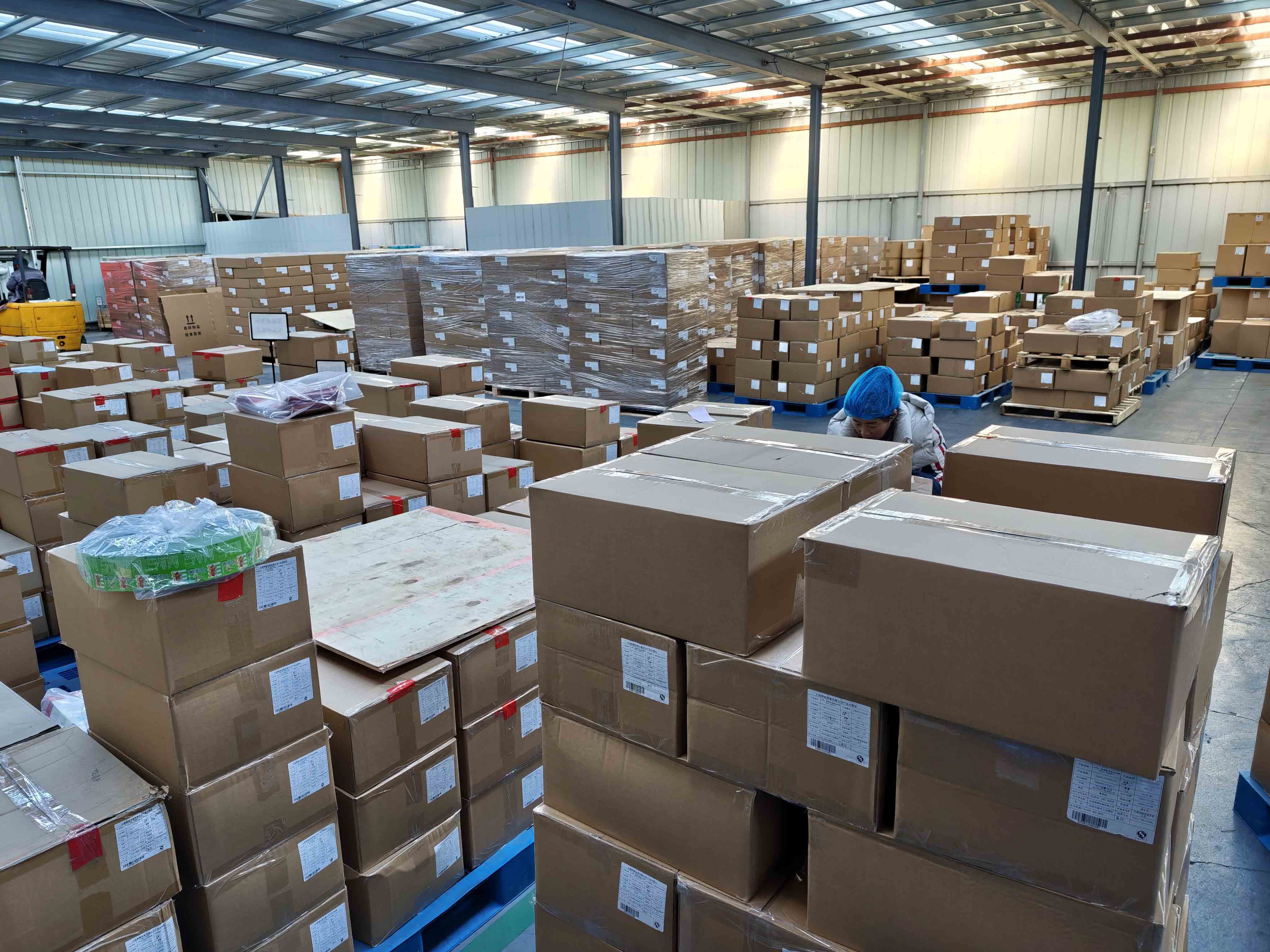
Damage prevention also includes pallets, knives, sharp grains at the seam, and compression in stacked cartons. A tear created in handling may look like a material failure when the root cause was an oversized pack in a tight carton. Test a representative distribution configuration rather than testing film only.
A real rice-pouch project, and what it does not prove
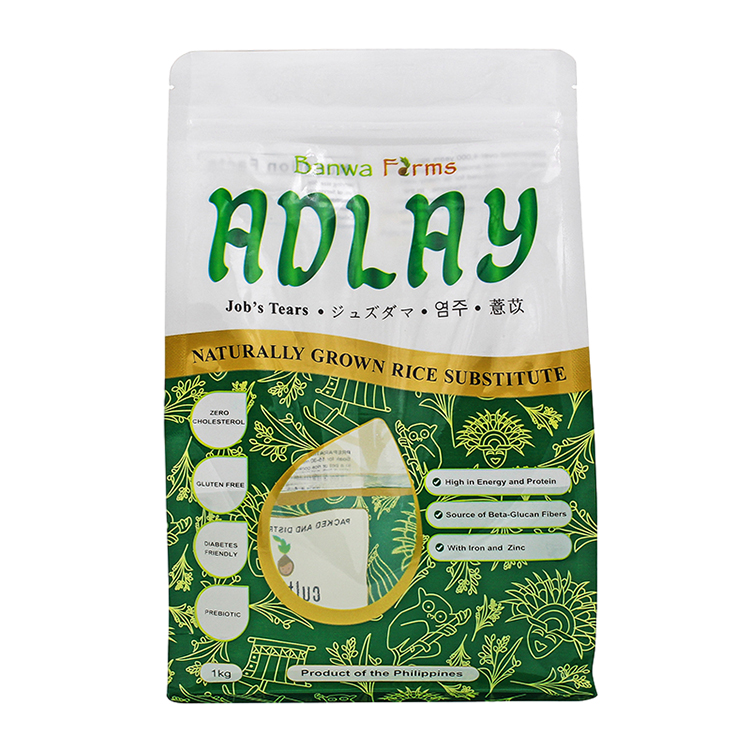
Mylarbag's published rice and ancient-grain packaging project lists a 1 kg flat-bottom pouch for the Philippines, a PET/NY/PE structure, gravure printing, a teardrop window, and a 15 × 24 + 6 cm size. Those are useful, concrete facts for discussing retail structure. The flat bottom provides a display format; the window gives a view of the grains. Neither feature tells us the project's measured OTR, WVTR, seal integrity, ingredient moisture, shelf life, absorber use, or warehouse history. The project does not claim to be a hermetic emergency-rice storage test.
That distinction helps a buyer ask a better question. If the new brief is a visible 1 kg retail pack with near-term stock rotation, a windowed format may be relevant, subject to an approved target shelf life. If the brief is an opaque long-term dry-white-rice reserve, the buyer should instead ask for a construction, closure, and container system designed and validated for that use. Copying a photographed bag merely because both hold rice would be a specification error. If a brand wants both product visibility and an ambitious long-term claim, it must validate the window area and all seams in the complete pack; there is no free pass from a material name.
The broader rice packaging options page is the right commercial starting point for a custom project. A concise inquiry can state rice type, fill weight, target market, desired storage and distribution conditions, whether a window or zipper is required, fill/seal equipment, annual volume, and which barrier and shelf-life evidence is needed. That is far more actionable than asking for the “best Mylar thickness” in isolation.
How should a rice brand validate a long-storage pouch?
Begin with a written use-case. Then request comparable samples of the finished construction, not just a list of film acronyms. Fill with the actual rice, test the proposed size on the actual line, and close it at an established process setting. Record the seal and visual results by sample lot. Evaluate the package after the expected handling and storage exposure. Establish what is a food-safety requirement, what is an appearance criterion, and what is a supplier commercial guarantee. Do not blend those into a single vague “quality passed” checkbox.
If a brand is assessing an oxygen absorber, have the rice and absorber suppliers confirm that the product is suitable and the package configuration is compatible. Define the headspace and closure process, and decide how residual oxygen or package integrity will be evaluated if the claim depends on it. An absorber pouch opened too early on the line, or a sachet placed inside a pack with a bad seal, is not a controlled process. If the project uses a clear window, zipper, or film change, test the finished version. Keep test conditions and acceptance limits with the approved sample so a repeat order can be compared to the original.
Before launch, check artwork wording. “Food-contact appropriate for this specified use” is not the same as “approved in every country.” “High-barrier film” is not “airtight forever.” “Helps protect dry rice when properly sealed and stored” is a different claim from “guaranteed 30 years.” A buyer should know exactly which of these statements has evidence and which does not. Include lot coding, storage instructions, the declaration of rice type, and any legally required label information through the brand's regulatory review for its sales market.
After launch, keep retained samples and track actual complaints: pinholes, insect findings, seal channels, rancid odor, or moisture pickup. Match each complaint to lot, pouch material, filling date, storage history, and transport route. A packaging supplier can help troubleshoot a film or sealing issue, but cannot determine the complete rice shelf life from a photograph. A feedback loop is what makes a storage claim more reliable over time.
Frequently asked questions
Can you store rice in Mylar bags without an oxygen absorber?
Yes, a suitable sealed pouch can still help protect suitably dry rice, but the role of an oxygen absorber is separate from the film and seal. For a long-term white-rice program, decide whether to use one based on the dry-food application, the compatible package, supplier instructions, and the intended quality objective. Do not interpret “no absorber” or “has absorber” as a shelf-life guarantee.
How do you seal a Mylar bag of rice for long-term storage?
Use the compatible heat-seal surface and equipment specified for that pouch. Leave the required clean top-seal clearance, keep rice and dust out of the seal area, establish a validated heat/pressure/dwell/cooling setting, and inspect the completed seam and corners. A zipper reclosure alone should not be assumed to replace the unopened-package heat seal.
How long can brown rice be stored in Mylar bags?
There is no universal duration. Brown rice retains bran and germ oils that can become rancid, so it needs a shorter, product-specific rotation or shelf-life plan than polished white rice. Packaging and cool storage can help manage exposure, but they do not remove the inherent oil-related limit. Follow the producer's date and instructions; brands should validate their own claim.
Do rice bags attract bugs?
Rice can contain or encounter storage insects. Inspect the incoming lot and protect it in a sound closed package within a clean pest-managed area. In suitable dry, sealed systems, reduced oxygen can help against insects, but it cannot make a contaminated or damaged food lot acceptable by itself.
Do rice bags attract mice, and will Mylar stop them?
Rodents seek stored food and can chew through flexible foil-style pouches. Use a suitable rigid outer container and a pest-management plan, inspect for damage, and do not claim the pouch is rodent-proof. A chewed or contaminated pack requires food-safety assessment, not a cosmetic repair.
Is a retail rice pouch the same as a long-term storage pouch?
Not necessarily. Both can be well made, but the retail pouch's window, zipper, laminate, seal, fill process, and intended stock rotation may be different. Approve the finished package against the actual rice and storage requirement. A real printed 1 kg project demonstrates format and construction, not a multiyear storage performance result.
The next specification to request
For dry white rice, ask for a full laminate and food-contact description, film barrier data under stated conditions, a sample pouch sized around actual filled rice, a compatible top-seal process, and a practical outer-container and pest plan. For brown rice, add a realistic rotation schedule and product-specific sensory shelf-life validation. For either, define how failed packs will be recognized and traced. A supplier should be able to discuss each of those decisions without promising a universal number of years.
If you are specifying a new branded rice pack, send the brief to a custom rice packaging supplier. State your rice type, fill weight, pouch features, fill equipment, market, storage and distribution conditions, and evidence required. Then use filled, sealed samples to decide whether the proposed package meets that particular project—not a generic “Mylar bag” description.