

To package your own supplements in pouches, start with the finished product and its selling unit: capsules, tablets, powders, gummies and stick packs do not load or behave alike. Define the fill, intended storage, contact surface and label before choosing a bag. Then test the actual filling motion, top seal, opening, printed layout and finished pack under your distribution conditions. A pouch specification alone cannot establish a supplement's shelf life or regulatory status.
This guide is for brands preparing human dietary supplements for sale in the United States. It focuses on flexible bags and pouches, including a larger retail pouch holding individually packed servings. The supplement company and its packer must determine the product's classification, manufacturing controls, label and finished-package acceptance criteria. An empty-pouch supplier can provide material and construction information, samples and an agreed bag specification; it cannot approve the brand's formula, label or finished product. The FDA's dietary supplement overview and current good manufacturing practice guide explain why the roles matter.
Start with the supplement's actual selling unit
Before requesting a quote, place one production-equivalent unit on the table. Is the pouch filled directly with capsules? Is a powder poured into a bag and later scooped by the consumer? Are individually sealed stick packs being collected inside an outer pouch? Those are three different product-contact and filling arrangements, even when the same artwork could be printed on all three bags. Record the contents, target count or net quantity, expected variation, fill temperature, handling conditions and intended consumer opening. Do not size a bag from the front label's nominal quantity alone.
Capsules and tablets can bridge across a narrow opening, chip during an aggressive drop or rattle into a top seal. A fine powder may dust the sealing area, cling to film and settle after filling. Gummies can be sticky, oily or temperature sensitive, depending on the actual formulation. A pouch holding wrapped stick packs may touch only their wrappers; its performance questions shift toward count, edge abrasion, pack movement and the strength of the outer bag. Treat these as trial questions, not categorical claims that one ingredient always needs a particular barrier structure.
| Selling unit | First pouch-fit trial | Closure or use question | Information the bag supplier needs |
|---|---|---|---|
| Loose capsules or tablets | Load the maximum count without bridging or damaging units | Is the initial seal protected from stray units? | Unit dimensions, count range, target orientation and empty headspace |
| Loose powder | Fill at production speed and inspect dust on the seal land | Will the consumer's scoop and repeat opening work? | Bulk density range, fill volume, settling behavior and equipment path |
| Gummies or soft pieces | Observe product contact and transfer at actual storage condition | Does the finish mark the film or closure? | Surface condition, storage program and physical sample |
| Individually wrapped stick packs | Load the exact count and inspect wrapper corners | Can a consumer remove one without tearing the outer bag? | Inner pack size, count, stack orientation and retail display |

If the product has several flavors or counts, choose the highest and lowest physical fill for the first trials. The largest count can crowd the seal; the smallest can look underfilled or let the printed front panel fold unpredictably. Ask the packing team for a short video of the actual loading motion. An empty sample that stands attractively on a shelf says little about whether the product can be filled without contamination or damage.
Choose a pouch format from the fill path, not a catalogue photograph
A flat pouch can work for a single dose or a low-profile pack. A stand-up pouch can give loose capsules, gummies or smaller powder portions a practical front panel and a bottom gusset. A flat-bottom format may suit a broader display face or an outer pack of multiple stick packs. None of those format names settles usable opening width, load capacity, scoop access or stability. The choice must be tested in the filled state and at the real production range.
Measure the width at the opening inside the seams, the depth created by gussets when open, the usable height below the zipper or intended top seal, and the filled depth after the product settles. Ask whether a quoted size is external flat width or usable internal space. Include the zipper, tear path and top-trim area in the drawing. A pack can hold the stated mass and still leave too little clean film above the product to close reliably.
For a brand using a contract packer, obtain the packer's equipment envelope before approving a dieline. Does the line handle premade pouches or rollstock? How is a pouch gripped and opened? Will it run with the selected gusset, zipper and finish? Are the top corners held during filling, or will a broad mouth collapse and collect powder? The packer should evaluate the proposed bag with a product-equivalent fill. A bag factory's sample and a brand's flat artwork proof are necessary inputs, but they are not a line trial.

Mylarbag's published capsule pouch project lists a stand-up format, MATOPP/VMPET/PE and 12 × 20 + 3.5 cm for a US project. A separate collagen powder and stick-pack project lists a flat-bottom pouch, MATOPP/PET/PE and 14 × 24 + 6 cm for the Philippines. These are records of two different printed bag configurations. Neither dimension is a recommended size for an unmeasured supplement, and neither project establishes a shelf-life or filling result for the reader's formula.
Specify contact materials and protection against the real product
Ask what will actually touch the contents. Loose capsules, powder and gummies contact the inner face of the primary pouch; stick packs inside an outer bag generally contact their own inner wrappers, while the outer pouch contacts the wrapped packs. Identify any scoop, desiccant or other component as a separate item to be evaluated by the responsible product business. A photograph of a metallic-looking bag does not identify its entire structure or authorize every intended use.
For the US, the FDA describes food-contact substances in terms of an authorized substance and intended use. Its food-type and condition-of-use tables distinguish relevant food and temperature conditions. Request the proposed final structure, its contact layer and documentation appropriate to the brand's product, contact time and conditions. Do not reduce that review to a general “FDA approved bag” badge. If a structure, supplier or intended use changes, review the documentation again.
Protection needs the same specificity. The brand should define which change would make its product unacceptable: clumping, capsule discoloration, texture change, wrapper damage, off-odor or a measured ingredient specification, for example. The proposed film's oxygen and water-vapor transmission data can help screen candidates only when test conditions and the whole finished bag are considered. A metallized layer, transparent window, zipper and seal may each affect the pack differently. No value for OTR or WVTR by itself proves a particular formula will remain acceptable for a chosen number of months.
If a supplier proposes more than one construction, ask for a comparison on the same assumptions: contact layer, target fill, intended temperature, light exposure, opening frequency and material tests. A lower-barrier structure could be entirely suitable for one product after validation; a more complex structure may still fail if the top seal is contaminated. Do not claim the biggest barrier number is automatically the best economic or environmental decision. The supplement owner must establish its own finished-product storage period and labeling from appropriate evidence.
Build and test the filling and closing sequence
Write the fill sequence down before producing decorated sample bags. Receive clean, protected empty bags; inspect damage and lot identity; open the mouth in the way the machine or worker will; load the product without overfilling; then clear the intended seal land. For powder, record whether airborne fines or static make the upper film dirty. For capsules, watch whether a stray unit reaches the jaw area. For stick packs, inspect sharp wrapper corners near side seams and the top. A brief real-time trial is more valuable than a still photo of an ideal finished pouch.
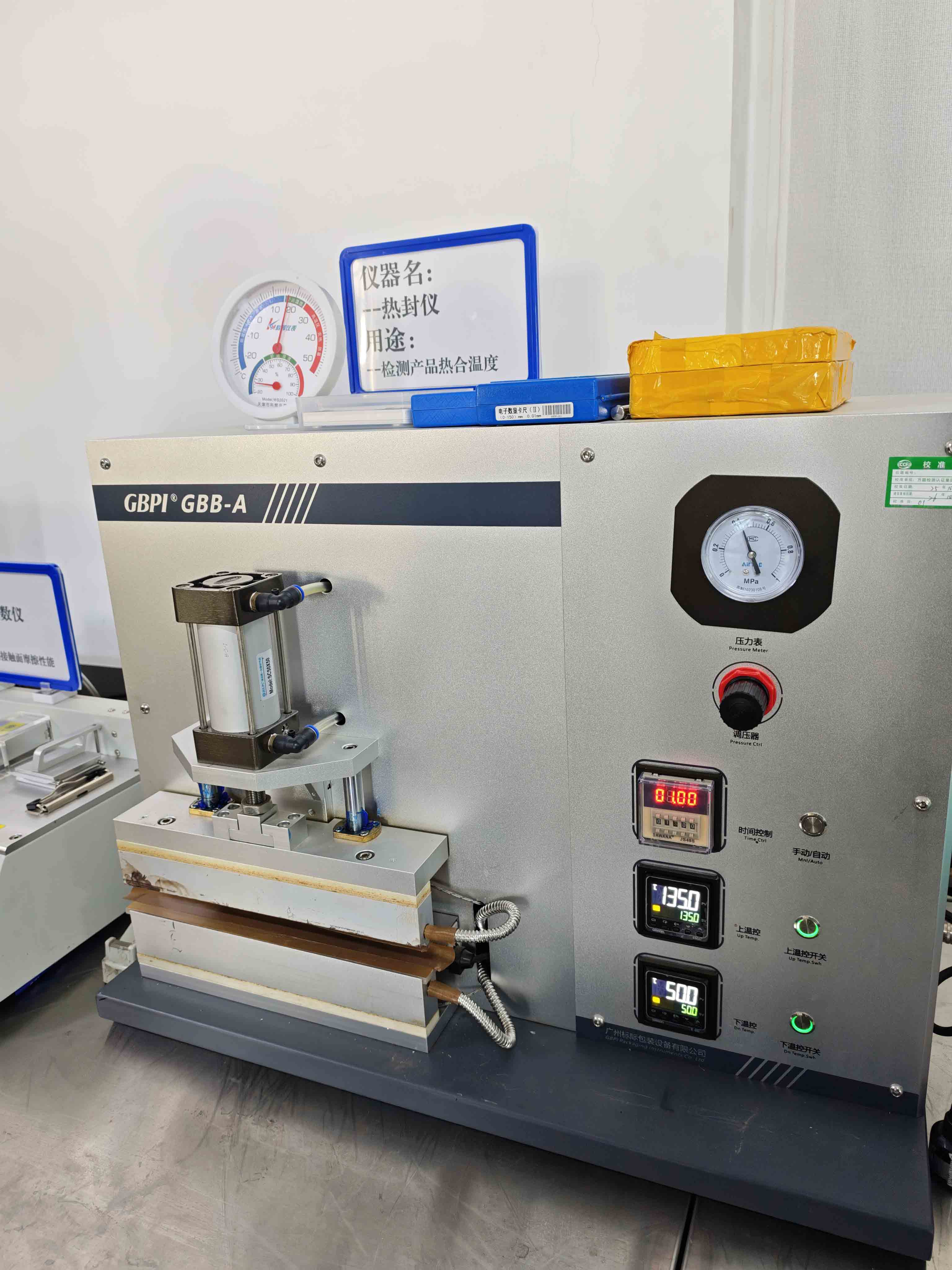
Run the chosen initial closure with the actual film, equipment and product. A press-to-close zipper can offer consumer reclosure after first opening; it does not replace a properly specified first closure merely because it clicks shut. Keep the seal zone above the product and away from powder, oil, pieces or inner pack corners. Inspect seal continuity and appearance, then use the packer's approved methods for strength, leak or other performance testing appropriate to that construction. There is no transferable heat-seal temperature or dwell time for every supplement pouch.
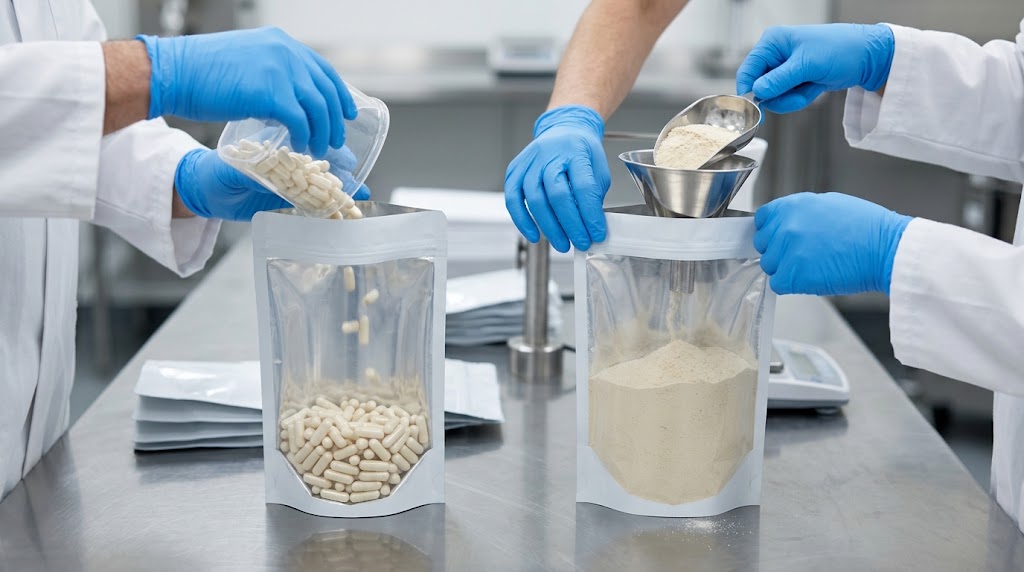
The first filled sample should be handled as a consumer would: pick it up, set it down, open it using the planned tear path, reseal it if applicable, and remove several servings. A zipper that looks broad in a drawing can be difficult to grip after the tear strip is removed. A powder pouch can be clean at dispatch and become inconvenient after repeated scooping. These are usability and handling observations, not substitutes for product stability testing. Document the failure mode and change one variable at a time.
If the brand plans to distribute through multiple channels, test the final retail unit under each practical handling arrangement. A retail shelf, a single parcel order and a tightly packed fulfillment carton expose the bag to different compression and orientation. The primary bag protects and contains the supplement within its validated use; it is not a replacement for a complete shipping system. Establish shipping acceptance criteria and inspect arrivals with the exact product and packaging combination.
Give the approved label a workable place on the filled bag
The artwork needs to work on a three-dimensional pouch, not just a flat rectangle. On a stand-up bag, the gusset consumes height, the side seams reduce useful width, a zipper and tear notch occupy the top, and a highly filled powder pack can bow across the information panel. Ask the printer for the final dieline with panel, seal, fold and trim positions; review a made-up sample at the expected fill. Leave sufficient room for the brand's approved identity, net quantity, ingredients, statements and any lot or date marking without asking the bag manufacturer to decide the text.
The FDA's dietary supplement labeling guide explains the required label information, and its nutrition-label chapter distinguishes a Supplement Facts panel from a conventional food's Nutrition Facts panel. For a product marketed as a dietary supplement, do not simply borrow a conventional food panel from another SKU. Product classification, content, any applicable exemptions and claims are the brand's regulatory decisions. The bag supplier can make space and produce an accurate approved print; it should not certify the supplement's label.

Plan version control for artwork. A single ingredient or serving change can affect the panel, net quantity, ingredient list or other copy. Give the packer a way to distinguish an approved old bag from a revised bag before production. Compare the proof against the final approved label text, then examine a filled and sealed sample under normal shelf lighting. Retain the approved version and the actual bag lot. A supplier can print exactly what it receives and still deliver a commercially unusable bag if the wrong label revision was supplied.
Keep an Amazon prep bag separate from the brand's retail pouch
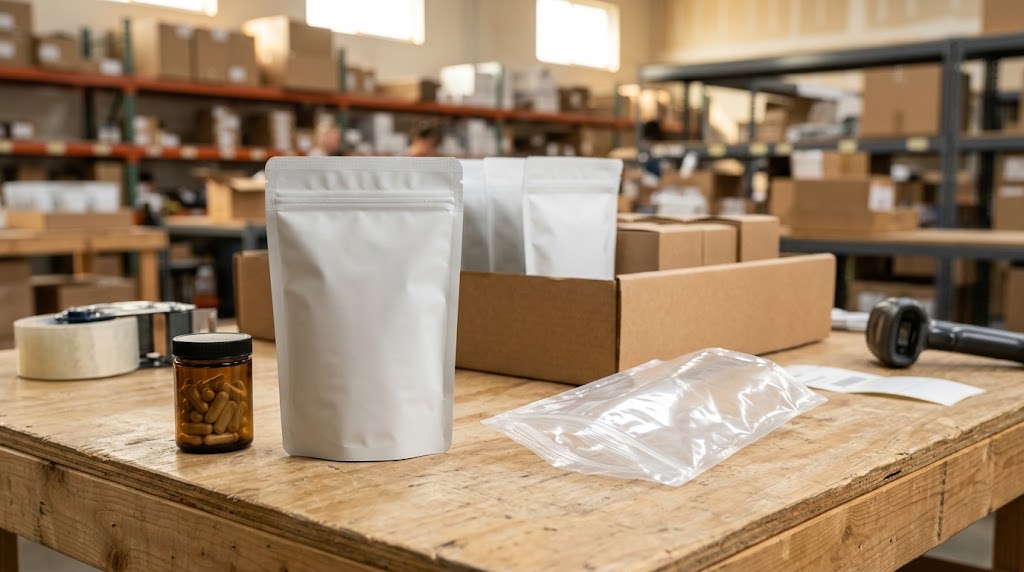
For a brand selling through Amazon, the question of an extra poly bag concerns an additional fulfillment preparation step, not the material of the supplement's primary pouch. A sealed retail pouch, an exposed group of units and a bottle with a removable cap present different prep questions. Do not assume that all supplements require an extra transparent bag or that none do. Amazon's product packaging requirements and the seller-account instructions for the actual SKU should be checked immediately before sending inventory; the public help page may require a signed-in session for complete details.
When a separate prep bag is required, review it as an additional layer: can identifiers and any required information still be read, is the retail pouch protected without distorting its artwork, and is the prep closure appropriate for that order? The prep bag cannot repair a leaking or unqualified primary pouch. Likewise, a custom printed supplement pouch should not be described as “FBA approved” simply because it can be delivered to an Amazon facility. The brand and its fulfillment team remain responsible for the current listing and inbound requirements.
Approve the specification with the packer and the brand owner
The specification should identify more than a bag size. Record the supplement SKU and selling unit, product-contact status, final structure, intended storage conditions, dimensions and tolerances, filling equipment, fill range, closure drawing, artwork revision, print approval, sample trial and inspection method. Define who holds each piece of evidence. The brand or contract packer needs the product and batch records; the bag supplier should be able to identify its material construction, bag lot and agreed manufacturing criteria. The FDA CGMP guide addresses supplement packaging and labeling operations; buying empty printed pouches is not the same activity as approving the finished supplement.
| Approval gate | Evidence to keep | What triggers a new trial |
|---|---|---|
| Product and contact | Actual contents, storage program and relevant final-material documents | Formula, contact layer, time or temperature change |
| Physical fit | Minimum and maximum filled samples, opening and filled dimensions | Count, bulk density, scoop, pouch or zipper change |
| Seal and use | Approved filled-run inspection and opening/reclosure observations | Film, equipment, closure or fill behavior change |
| Artwork | Approved dieline, label text version and filled proof | Serving, claims, markets or panel geometry change |
| Distribution | Actual shipment and arrival acceptance records as needed | Route, season, case pack or fulfillment method change |
Run the sample review in three distinct rounds
Begin with a blank construction sample before paying to print a full design. Put the minimum and maximum anticipated fill into the candidate bag and make the packing team repeat the proposed opening, loading and closing motion. A clear prototype can reveal whether the gusset opens as expected, whether the fill rises into the seal zone and whether a worker can hold the mouth wide enough without rubbing capsules or wrappers along a seam. Mark the points where film contacts the product. If the first bag is too tight, describe the actual failure rather than merely asking for “one size bigger.” A wider body, a wider mouth and a taller clean top are different changes.
Next review a printed physical proof or the closest feasible approved mockup at the same fill. Inspect the front and back while the bag stands, lies in a case and is held in one hand. Read the information panel without flattening the product. Check whether a barcode, lot/date area or required information is hidden by the gusset, distorted around the product or crossed by the tear line. For a line with several supplement flavors, set filled versions side by side. Are they distinguishable to the operator and consumer after the cases have been opened? The designer's on-screen comparison does not simulate a packed production shelf.
Finally, run a controlled production-equivalent batch. Track empty-bag lot and artwork version, fill variation, top-seal appearance, product damage and rejects, and inspect the first, middle and last bags rather than the prettiest one. Select samples from the edges of the acceptable fill range. The brand and packer should decide which inspections demonstrate that their approved specification was met and what makes a bag a reject. Keep the resulting sample pack and record with the version of the drawing and material structure. If the packer changes the line or if a supplier changes the contact side, return to the relevant parts of this review instead of treating the previous result as universal.
Make failure notes specific enough to solve
“The pouch failed” does not tell the supplier which part to change. A powder leak can originate at an incomplete heat seal, a corner, a puncture or a consumer opening. Clumping can be caused by the formula, storage exposure, a weak or dirty closure, or a mismatch between the planned and actual distribution conditions. A capsule found near the top seal may point to a filling-height problem rather than film strength. Ask for a photograph of the intact bag and failure point, the bag lot, filling date, storage and route, then compare it with a retained control. Isolate the affected stage before specifying more film or a stronger zipper.
Consumer complaints also need careful separation. A bag may remain sealed but be hard to open; the remedy could involve the tear notch, strip height or opening grip. A zipper may close once in a factory trial but become dusty during repeated use. A bottom gusset can stand when freshly filled and tip after the powder settles. A beautiful matte surface can scuff where shipping cases rub. None of these observations proves that the supplement itself is unstable. Each deserves a defined handling trial and a record of what changed in the next prototype.
When the team compares two bags, write the decision criteria before looking at the new artwork. Include acceptable fill range, proportion of clean top seals, ease of first opening, repeat closure if specified, standing behavior, print legibility, observed damage and the product's own stability requirements. A supplier might offer two materials with different cost and barrier data, but only the finished product owner can judge which candidate satisfies the product and business brief. The selection becomes defensible when the criteria and observations are kept together, rather than when a pouch is called “premium.”
Recommended packaging configuration to discuss
For a capsule or tablet line, start by asking for a stand-up or flat pouch sample sized around the actual count and opening motion. For a loose powder, prioritize clean filling, seal-land control and repeat access before artwork. For wrapped stick packs, compare an outer stand-up or flat-bottom pouch using the real inner pack count and edge profile. These are candidate formats, not stock specifications proven for a formula. Mylarbag's custom supplement packaging range can be used to discuss bag format, print and samples; the brand and packer must validate the final filled unit.
Frequently asked questions
Can I put capsules and powder in the same type of pouch?
Possibly, but the format name does not make the filling process identical. Capsules may bridge or reach the top seal, while fine powder can dust the sealing faces and settle after filling. Test the useful mouth, target fill, final structure, initial seal and consumer opening with each actual product before reusing a bag specification.
What pouch size should I order for my supplement?
Measure the real minimum and maximum fill after considering count or bulk-density variation, then check usable internal dimensions below the zipper and top seal. Request physical samples and a filled trial. A listed external flat size or another customer's capacity is not a reliable size conversion for your product.
Is a resealable zipper enough for the initial retail closure?
Do not assume so. A zipper may support consumer reclosure, while the finished retail unit can require a separate specified initial seal. The chosen film, product, line and closure geometry should be validated together; reject crumbs, capsules or powder in the approved seal zone according to the packer's procedure.
Does a supplement pouch need Nutrition Facts or Supplement Facts?
The answer depends on the product's regulatory classification. A product marketed as a US dietary supplement generally uses a Supplement Facts panel, subject to the applicable requirements and possible exceptions described by FDA. The brand's qualified label reviewer should approve the content; the bag supplier should provide a dieline and an accurate printed sample.
Does Amazon FBA always require another poly bag around a supplement pouch?
No universal answer is established by the pouch type alone. The seller should check the current Amazon preparation instructions for its exact SKU and selling unit. If a separate prep bag is required, keep its function and labeling distinct from the finished retail pouch.
Is a printed supplement bag automatically FDA approved?
No general label on the bag can establish that. Ask for relevant information about the proposed food-contact structure and intended use, and have the supplement business review its packaging, labeling and CGMP responsibilities. A published project photo or material name is not approval of your finished supplement.
Send a usable pouch brief before asking for a price
Send a production-equivalent sample or clear dimensions, the supplement form and count or fill weight, intended market, storage program, desired bag orientation, packer and filling method, closure choice, approved or draft artwork, target quantity and the documents you need to review. State whether the pouch contacts the supplement directly or holds individually wrapped units, and whether Amazon or another fulfillment program adds a separate prep step. Mylarbag can review a custom supplement pouch brief against those inputs and discuss samples. Approve the bag after a real filled trial, with the product business retaining responsibility for the formula, final label and distribution claims.