

To seal chocolate packaging, first identify the package and the joining surfaces. A premade three-side-seal pouch is filled through its open edge and closed with a material-compatible top seal. A zipper pouch may still need a separate initial seal above the zipper. A machine-wrapped chocolate bar uses a film and a wrapper designed for its longitudinal and end seals; some lines use heat seal and others use a pressure-activated cold-seal coating. A folded foil-and-paper bar wrap is a different closure again. Keep chocolate, crumbs and grease out of the intended joining area, run production-like trials on the actual equipment, and inspect the finished packs against an agreed standard.
There is no useful universal sealer temperature for all “chocolate bags.” The film, coating, jaw design, pressure, dwell, line speed, filled-pack shape and chocolate's position all affect the result. A seal can look closed yet be weak or have a channel. More heat can distort film or expose a nearby bar to unnecessary heat without correcting a dirty or misaligned seal. Start with the material and machine suppliers' guidance, then validate the specific filled package and record the approved process window.
This is a guide for makers sealing solid chocolate bars, tablets, pieces and similar retail units. A moist or perishable center may require a separate product-specific food-safety and shelf-life plan. Here “seal” means the initial package closure created at packing; it does not promise a fixed shelf life, sterile contents, temperature control in shipping, or a food-contact authorization. The focus is the meeting point between a chocolate product, its flexible package and the packing line.
Draw the closure before turning on a sealer
Lay the empty package and a real piece of chocolate beside the proposed drawing. Mark every area already closed by the pouch converter and every area the packer must close. Mark where the bar will sit, how it enters, where it could press against the package, and how the customer will open it. This simple map prevents a common confusion: a supplier's three factory-made sides are not the same operation as the final top seal made after filling.
For a small premade flat sachet, the open edge is usually the packer's task. For a stand-up pouch, the bottom and sides may be made by the converter while the product goes in through the top; a zipper, if specified, sits below or within a planned opening arrangement. For a horizontal flow wrap, rollstock is formed around the bar and closed along a lengthwise seam and at the ends. For a folded inner wrap plus paper sleeve, a fold, adhesive or mechanical closure may be what holds the pieces together. Do not apply heat to an unidentified foil, paper or printed sleeve and assume it was designed to fuse.
| Chocolate sales unit | Which closure the packer usually creates | What to clarify before trials |
|---|---|---|
| Premade three-side-seal sachet for one small bar | The remaining open edge | Sealable inner faces, bar clearance, notch position and whether the supplied sides have been checked |
| Premade flat pouch around a larger wrapped bar | Its open filling edge | Whether the bar is already wrapped, usable opening, folds near corners and how the complete unit fits |
| Stand-up pouch with zipper for pieces or an already wrapped bar | A defined top seal if the retail design requires one; zipper for later reclosure | Distance between mouth, top seal, tear feature and zipper; opening sequence on the actual drawing |
| Rollstock flow wrap around an individual bar | Lengthwise seam and end seals on the wrapper | Film/coating, heat- or cold-seal method, product registration and finished end-seal clearance |
| Folded foil or paper inner wrap plus sleeve | Folds, tabs or separately specified adhesive/closure | Whether there is any true sealed primary barrier and which supplier owns each component |
Mylarbag's published 12 g single-serve dark chocolate sachet lists a three-side-seal format, 8 × 8.5 cm and MATOPP/VMPET/PE. Its photo helps show the small printed sales unit. The project page does not disclose the customer's top-seal settings, a seal-strength result or whether the chocolate shown elsewhere on the page was used in a specific packing trial. For a new order, verify the final open edge and actual seal land on a physical sample.

Do the same map for any package with a tear notch. The customer may tear away material above the zipper and then use the zipper to reclose the remaining pack. A top seal that cuts across the zipper or leaves no safe opening strip may make that sequence unusable. Conversely, snapping the zipper closed while omitting a required initial seal leaves a different retail pack from the one approved. These features belong in one drawing, not in separate conversations with the designer and the filling operator.
Choose a method that fits the bar and package
Heat sealing joins specified sealable surfaces by applying heat and pressure for a controlled time, followed by suitable release and cooling. Bench impulse sealers, constant-heat jaws and automated wrapping machines do not deliver identical thermal histories even when a dial shows a similar number. The bar's distance from the jaw and the time it spends near warm equipment matter. A thin bar or decorated surface deserves a physical trial, not an assurance based on an empty film coupon.
Cold sealing is a different process. A supplier applies a pressure-sensitive cold-seal coating in the specified pattern to rollstock; compatible areas bond under pressure on the wrapper. Syntegon's Pack 103 information lists cold-seal compatibility for heat-sensitive chocolate and heat-seal compatibility for other applications. ProAmpac's cold-seal film description similarly presents a dedicated coated rollstock route for chocolate. These are examples of equipment and material possibilities. An ordinary heat-seal pouch does not become cold-sealable because an operator lowers the jaw temperature.
PAC Machinery's published chocolate-bar flow-wrapper application describes a customer choosing cold-seal film so the fin and end-seal jaws operate without heat near its bars. This does not mean every bar must be cold sealed, that no heat is ever acceptable, or that cold-seal film is an off-the-shelf feature of Mylarbag's documented premade pouches. The chosen film, pattern, equipment, contact surfaces and actual bar must be assessed together.
| Method | Where it can make sense | What must be present | Wrong assumption to avoid |
|---|---|---|---|
| Heat sealing a premade pouch | Finishing an open flat or stand-up pouch on a bench or line | Identified heat-sealable faces and compatible equipment | Any matte, kraft-looking or metallized bag will seal at one shared setting |
| Heat-seal flow wrap | Wrapping a bar on compatible rollstock and machine | Sealing film, suitable longitudinal/end jaws and a validated product position | A hand-pouch specification automatically works on a flow wrapper |
| Cold-seal flow wrap | A heat-sensitive bar and machine/rollstock designed for pressure sealing | Correct patterned cold-seal coating and compatible line | An uncoated pouch can cold seal just by pressing it |
| Folded inner wrap with sleeve | A bar design intentionally using folds and a separate sleeve | Approved contact wrap and designed fold or attachment | A tight-looking fold is necessarily a tested hermetic seal |
A 3 oz printed chocolate package can illustrate another procurement question. The published white-kraft-look artisan bar project lists MATT OPP/white kraft/VMPET/PE and 13 × 21 cm. Its page title calls it a stand-up zipper pouch, while its feature field describes three-side-seal flat pouches. That conflict matters when assigning the seal task. Request the current drawing and actual sample rather than silently deciding which version to program into a sealer.

Match the sealable web to the machine
A material list such as MATOPP/VMPET/PE may suggest an inner PE-based sealant in a particular laminate, but a short string does not identify its exact grade, gauge, treatment or approved operating window. The supplier should state the outside-to-inside construction, which faces are intended to join, and whether the pouch is intended for hot-bar, impulse or another method. If a bar already has its own inner wrap, also identify whether that wrap, rather than the outer pouch, is the primary contact and closure component.
The FDA's component guidance explains that food-contact status depends on individual substances and intended use. This article does not assess a particular package's authorization. Identify the chocolate-facing surface and use conditions in the purchasing brief. Heating the exterior of a laminate does not make an unspecified inner surface suitable for direct contact.
Set up the equipment with a sample from the actual material revision. Inspect jaw length, width, parallelism, clean surfaces, release material and access around the filled package. A sealer that looks wide enough for an empty pouch may leave uneven pressure when the bar bulges into the land or the gusset introduces a step. On a flow wrapper, product pitch and registration determine where the bar sits when the end jaws close. On a small sachet, the margin between the product and the edge can be the limiting factor.
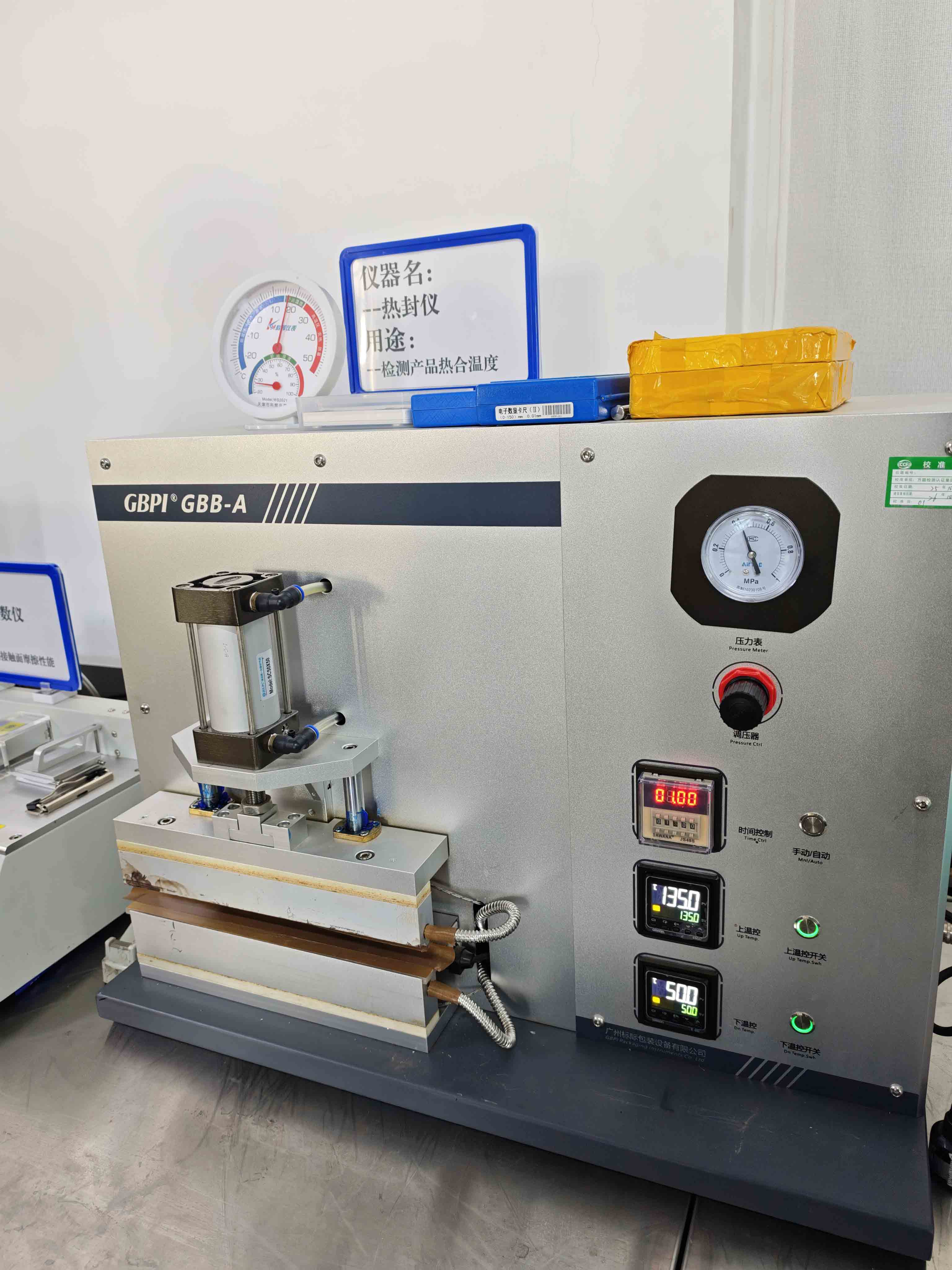
ASTM F2029 describes laboratory preparation of heat seals and cautions that laboratory equipment and production machinery can give different results. Its heat-seal curve is a starting point, not production validation. Temperature, dwell and pressure are useful controlled variables, but the setting shown by one machine cannot be transferred to another without considering the actual sealing interface and motion. Record machine model, jaw or strip type, sample lot and the observations at each trial condition.
Do not use extra heat as the first fix for a channel. Check whether the seal surfaces are compatible, the top edge is aligned, the entire width lies flat, the sealing tool is clean and the product is below the jaws. If a test changes the film structure, jaw, line speed, fill or cooling practice, treat it as a new condition rather than relying on a previous approval.
Keep chocolate, grease and crumbs below the seal land
The bar should be completely set and in its maker-approved condition before it enters the package. A warm, smeared surface can mark the film or transfer fat to a sealing strip; brittle inclusions or loose flakes can fall into the top edge during filling. In a premade pouch, the operator needs enough usable opening to load the real product without dragging a corner through the seal area. A narrow mouth that works with an empty bar-shaped block may fail with a bar that has protruding nuts, an inner wrap or a sleeve.
Draw a keep-clear band at the actual seal location and train against that drawing. Control fill height, product orientation and the path from filling to jaws. For loose solid pieces, funnel geometry and settling can affect how often debris reaches the mouth. For bars, a guide or support may help keep the wrapper flat and prevent the bar from entering an end-seal zone. The exact method belongs to the packing line; it should not be guessed from a website photograph.
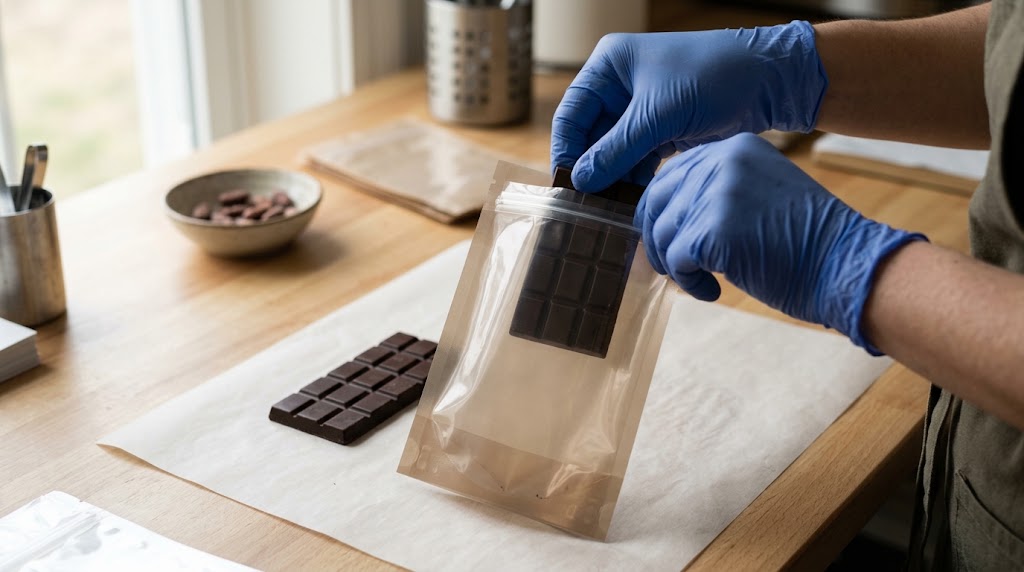
The illustration below is a placement check, not a ready-to-seal example. The bar appears close to the zipper and upper closure area. On the actual filled sample, confirm where the final top seal belongs and move the product lower if it intrudes into that zone; leave both mating film faces clear before sealing.
Why insist on a clean area rather than a magical “seals through crumbs” claim? An original study of LDPE-based food-packaging films found that the effect of ground coffee and powdered sugar at a seal interface depended on the contaminant and amount under its stated laboratory conditions. Those measured thresholds are not thresholds for chocolate crumbs, cocoa butter, your laminate or your jaws. The practical lesson is to control what reaches the seal and test the actual likely contamination scenario, not to promise that every speck automatically breaks a seal or that a particular pouch tolerates a fixed amount.
Do not “clean” an exposed food-contact surface with an unapproved solvent or random cloth during production. Establish a hygienic packing method and a written response to visible contamination. A contaminated empty sample can be discarded; a filled unit may need to be rejected or handled under a documented rework procedure. Record what happened, not merely that the top edge looked better after a second squeeze.
Build a first-off trial around actual filled units
Start with the current approved film or pouch sample, the actual chocolate, the intended equipment and a written drawing showing the sealing location. Note the product state, room conditions that matter to the operation, machine setup and operator. Ask the material and machine suppliers for a starting range, then plan a small, controlled trial that changes one factor at a time. Never publish a machine dial value as a universal “chocolate sealing temperature.”
Make enough samples to inspect the beginning, middle and end of a trial; a single attractive packet is not a process window. Look at pouch distortion, scuffing, bar condition, the width and continuity of the seam, and whether the package can be opened as intended. Give hot seals their specified cooling time before stressing them. For a flow wrapper, observe product tracking and both the longitudinal and end-seal areas. For a premade bag, distinguish factory seams from the packer's new top seal when noting a failure.
| Trial record field | What to write down | Why a blank field causes trouble |
|---|---|---|
| Product and pack revision | Bar or piece description, whether already wrapped, pouch/film lot and drawing version | A later run may use a different product surface or film |
| Equipment setup | Machine, jaw or strip, pressure setting if controllable, speed/cycle and cooling arrangement | A dial number without equipment context is not reproducible |
| Seal location | Top edge, longitudinal seam, each end, or factory-made edge under inspection | A defect can be blamed on the wrong party or operation |
| Visible observations | Alignment, wrinkles, contamination, product clearance and appearance after handling | “Looks fine” is too vague for a corrective action |
| Test and sample record | Agreed test, sample positions, conditioning and result | A demonstration cannot substitute for a documented acceptance criterion |
| Decision | Approved range, rejects, action owner and date | A trial has no controlled release point |
The goal is a workable window, not simply the strongest possible bond. A pouch that tears randomly on opening or scorches the package is not a good result. A chocolate bar that softens or rubs through the film during processing is also a failed trial even if the seam survives a pull. The package must be fillable, closable, inspectable and usable by the customer.
For teams using a contract packer, share the same drawing and trial record with the pouch supplier and packer. The supplier may know the sealant film; the packer sees the real jaw, line speed and product feed. Neither can validate the other's unknown setup from a layer code alone. Require a production-like sample before committing artwork placement or ordering a full pouch run.
Inspect the seal, then choose the right test question
Begin with systematic visual examination of sampled finished packs: continuous seam, expected width, aligned layers, no obvious folds, embedded crumbs, grease trace, burn-through, thin corner or trapped product. ASTM F1886/F1886M-25 describes visual evaluation of primary packaging and notes that suspect visual features can point to material, equipment or process variables. Visual inspection is useful for finding problems and trends; a good-looking seam alone is not proof of a gas-tight pack or a quantified strength.
If you need a strength measure, ASTM F88/F88M measures the force required to separate a strip containing the seal and reports failure mode. It can support process validation and control when the sampling, technique and acceptance range are defined for this project. A number from another film or different test setup should not be copied onto a new chocolate pouch. Strength and continuity are distinct: a strong strip in one location does not rule out a channel elsewhere.
If a nonporous pack needs a targeted leak investigation, ASTM F3039 describes dye penetration as a destructive go/no-go leak-location method, not a quantitative leak-size measurement. Select a method suited to the actual construction and question with a qualified packaging lab or QA team. Never return a dye-tested sample to saleable stock or apply a laboratory result to every untested unit. Food safety, product quality and declared shelf life require their own appropriate evidence as well.
Agree on when to sample: start-up, after a film-roll or pouch-lot change, after a jaw adjustment, at defined intervals, and after a stoppage that may affect registration or temperature. The plan should identify the person authorized to stop the line. Keep rejected and test-destroyed units apart from saleable stock. A note that “several packages were checked” is not a substitute for recording which pack revision, time, seam and criterion were checked.
Diagnose the location before changing the setting
When a seal fails, photograph the finished unit and note where and how it failed. Was the top edge of a premade pouch open while the factory side seam was intact? Did a flow wrapper miss an end while its longitudinal seam held? Was there chocolate residue inside the seal, a film wrinkle, a displaced bar, or a damaged corner? These details narrow the possible cause more effectively than immediately increasing time or heat.
| Observation on a chocolate pack | Check first | Trial or action after identifying the cause |
|---|---|---|
| Weak top seal across most of a pouch | Correct film faces, machine setup, contact, dwell and cooling | Repeat a controlled trial using supplier guidance; do not simply turn the dial up |
| Narrow channel at one point | Crumb, grease, fold, jaw damage or pressure gap at that location | Remove the source, reject affected units and inspect a new sample |
| Film distorted or bar surface affected | Jaw energy, bar clearance, dwell, transfer and product starting condition | Rework equipment/pack layout or evaluate a compatible alternative method |
| Inconsistent flow-wrap end seals | Bar pitch, film tracking, coating registration and end-jaw timing | Observe the moving line and trial corrected registration |
| Zipper closes but pack is not initially sealed | Missing or mispositioned top-seal operation | Check drawing and opening sequence before release |
| Strong seam but leak elsewhere | Factory pouch seam, pinhole, corner, fold or handling damage | Locate the leak with an appropriate method; do not assume the top jaw caused it |
If a warm jaw has transferred heat near the chocolate, note both the package defect and product condition. If a cold-seal line has a missing bond, inspect the actual adhesive/coating pattern and pressure path. If a folded foil wrap opens, investigate its fold and secondary restraint; a pouch heat-seal setting is irrelevant. The correct corrective action follows the closure type and failure location.
A visible crease across a pouch top can be a handling or alignment problem. A sealed surface that peels too easily can involve film, contamination, jaw or process settings. A seal that is too hard to open can also be a design problem. Document the failure mode and the revised sample result so the fix can be evaluated rather than remembered as “we changed the heat a little.”
Use real projects to ask better questions, not copy settings
Three published Mylarbag chocolate projects give concrete materials and formats for a supplier conversation. They do not contain validated packer settings or proof of seal performance in your chocolate operation. The 12 g sachet is a compact single-serve case. The white-kraft-look 3 oz package is a larger bar presentation with conflicting source format fields. The artisan bean-to-bar project lists BOPP/PMP822/CPP and 12.7 × 15.3 cm for a flat three-side-seal pouch. In each case, the next question is where the product goes and which closure the packer actually makes.
| Published project | Listed specification | Seal-planning question it raises | What the record does not prove |
|---|---|---|---|
| 12 g Madagascar dark chocolate sachet | MATOPP/VMPET/PE; 8 × 8.5 cm three-side seal | Is there enough clean margin after the actual square is loaded? | Top-seal setting, tested leak rate or shelf life |
| 3 oz artisan chocolate package | MATT OPP/white kraft/VMPET/PE; 13 × 21 cm listed | Is the current product a zipper stand-up or a flat pouch, and where is its open edge? | Resolution of conflicting format fields or a machine recipe |
| Artisan bean-to-bar pouch | BOPP/PMP822/CPP; 12.7 × 15.3 cm flat pouch | Which face is the sealant, and how does the bar or wrapped bar clear the top edge? | Universal recyclability, heat-seal conditions or a customer result |

Do not read the bean-to-bar project's “100% recyclable” title as evidence that a particular destination accepts the finished pack. It is unrelated to whether a given sealing line can close the actual structure. A polymer-family label also does not disclose the detailed grade, seal initiation behavior or allowable settings. Request the current construction, samples and sealing guidance for your order.
These three examples belong to premade flexible-pouch procurement. A brand using a high-speed flow wrapper may need an entirely different rollstock, coating and machine trial. Mylarbag's visible chocolate projects are not evidence that it supplies every kind of direct-contact foil wrap or cold-seal film. Keep the claim and purchase order tied to the component actually quoted.
Keep a repeatable chocolate packing routine
At the start of each run, verify the chocolate is ready to pack under the maker's own criteria, the right printed pouch or film revision is at the station, and the material is oriented as approved. Confirm the packer's drawing shows the correct closure. The bar or pieces must fit without touching the jaw area. Check that the equipment and work surface are clean and the product transfer does not bring crumbs into the seal land.
Produce a first-off set, inspect all intended seams and record the relevant results. Keep a signed or otherwise traceable reference pack at the line. During the run, check at planned intervals and after stoppages or roll changes. If a defect appears, stop, segregate potentially affected packages and find the earliest good verified point; do not simply reseal the top of every unit and assume the problem has disappeared. Rework, if permitted, needs its own product and closure criteria.
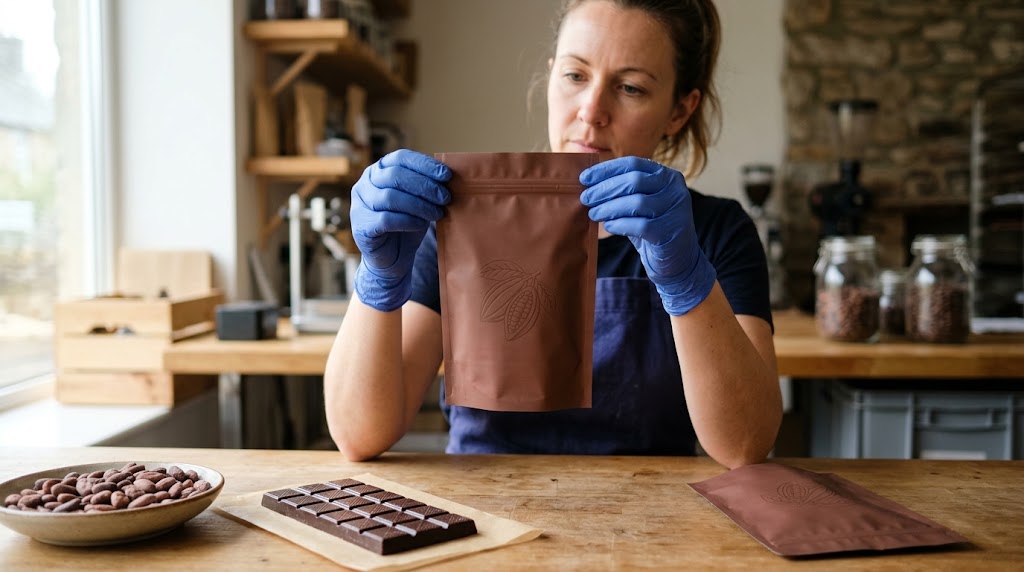
The final check should include user experience. Can the customer find the opening feature without cutting through the zipper? Does a bar slide around enough to abrade the inside of its wrap? Is an unwrapped piece trapped near a fold? Does the seal remain in the specified area after the pouch is filled to its planned count? Those questions turn a technically plausible seam into a workable retail pack.
For a custom flexible pouch enquiry, send Mylarbag your chocolate, pouch and line details: product form, any existing inner wrap, target sales-unit size, direct-contact condition, pouch format, current sealing machine, fill and closure sequence, and the sample or test evidence you need. Ask for a production-like drawing and material proposal. If your project is a separate cold-seal flow wrap, folded foil wrapper, paper sleeve or rigid gift box, specify and source those components with the appropriate supplier; do not assume a premade pouch quote covers them.
Frequently asked questions
How do you seal a chocolate pouch after filling?
Identify its intended inner sealant faces and open edge, leave the specified top area clean and flat, then seal representative filled samples on compatible equipment using supplier starting guidance. Inspect and test the resulting seal against your approved acceptance criteria before routine packing. The pouch material, equipment and product determine the process.
What temperature should I use to heat seal chocolate packaging?
There is no reliable single number for every pouch or bar wrap. The film grade, thickness, jaws, pressure, time, cooling and product clearance all matter. Obtain the material and equipment suppliers' guidance, run a documented trial on the production setup, and approve a window for the actual finished pack rather than copying an online setting.
Can I heat seal chocolate bar packaging without melting the bar?
Sometimes, if the specified film, jaw layout and process keep the bar away from damaging heat and the filled trial passes. A heat-sensitive bar may instead be suited to a compatible cold-seal flow-wrap system. Cold sealing requires coated rollstock and equipment designed for it; neither method guarantees that a bar will stay cool during later shipping.
Does a zipper on a chocolate pouch replace the top heat seal?
Only if the approved package design truly calls for zipper closure as its initial retail closure. Many designs place a separate first-use top seal above a zipper intended for reclosure after opening. Check the actual drawing and customer opening sequence; a visibly closed zipper does not prove that the intended initial seal exists.
Why does a chocolate package look sealed but still leak?
A channel, fold, trapped crumb or grease, unsuitable surfaces, poor jaw contact, a damaged factory seam or a pinhole elsewhere can all be candidates. Locate the problem before adjusting heat. Visual review can identify suspect features, while the chosen strength or leak method should answer the specific acceptance question. Do not return destructive test samples to saleable stock.
Can I seal foil or paper around a chocolate bar with a pouch sealer?
Do not assume so. A folded foil wrap or decorative paper sleeve may rely on folding or a separate adhesive and may not have any heat-sealable layer. An engineered heat-seal paper or coated foil laminate is a different specified material. Obtain the exact construction and manufacturer process instructions before applying a sealer or promising a sealed barrier.
Sources and project references
- ASTM F2029 laboratory heat-seal practices, ASTM F88/F88M seal strength, ASTM F1886/F1886M-25 visual inspection and ASTM F3039 dye-penetration leak location.
- Syntegon Pack 103 flow-wrapper options, ProAmpac cold-seal film and PAC Machinery's chocolate-bar flow-wrap application.
- Original research on seal-interface particles in LDPE-based films; FDA food-contact component guidance.
- Mylarbag published projects: 12 g single-serve chocolate sachet, 3 oz artisan chocolate packaging and artisan bean-to-bar pouch.