
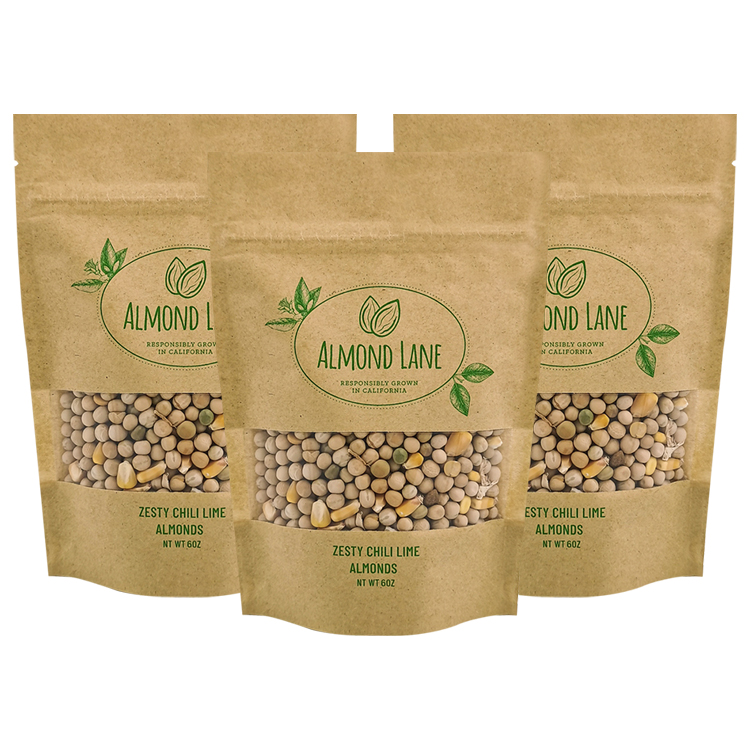
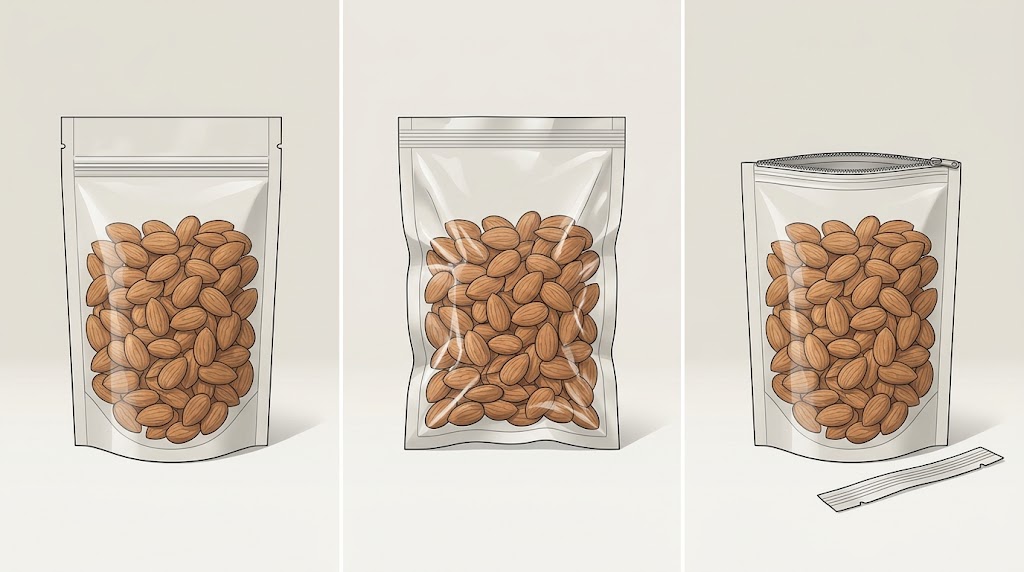
Yes, dry nuts can be vacuum packed, but vacuum is a process choice, not the definition of a sealed nut bag. A compatible pouch can instead receive a conventional heat seal with some headspace, while a zipper lets the buyer reclose it after opening. For a sound first closure, match the pouch's inner sealant to the machine, keep nut pieces, seasoning and oil out of the sealing band, run trials with the actual filled product, and check seals after normal handling. A tight-looking vacuum pack alone does not establish food safety, an oxygen specification or a particular shelf life.
That answers both “can you vacuum seal nuts?” and “how to seal nut bags,” but the right production route depends on the product. Whole almonds, brittle pecan halves and heavily seasoned mixed nuts do not behave alike under evacuation, in a filling chute or against a heated jaw. Nor does the word Mylar tell an operator whether an external-suction vacuum sealer, a chamber machine or an ordinary heat sealer will work with the bag in hand. This guide covers dry retail nuts and nut mixes and the first closure on their flexible pouches. Wet boiled peanuts require their own product-specific food-safety process and package validation.
A brand can use the questions below to brief its packaging supplier and co-packer. A small seller can use the same sequence to reject an incompatible pouch before ordering thousands. The examples are published nut pouch projects; their photos show physical designs, not evidence that those customers vacuum packed their products or passed the tests discussed here.
What exactly closes the bag?
The phrase “sealed bag” often mixes four separate decisions. The first top heat seal joins the compatible inner surfaces across the opening. Vacuum packing removes some air before that closure; it needs an appropriate evacuation route and a final seal. A zipper is an after-opening convenience and may sit below an intact first seal. A gas-flushed pack is a different controlled packing operation that displaces air with a specified gas and still needs a sound first seal. None of these terms identifies the film's measured barrier or the finished pack's proven shelf life.
Vacuum and gas flush may both manage the atmosphere around nuts, but they are not interchangeable settings. This article focuses on how the top closure is achieved and verified. For a separate explanation of why a peanut bag looks partly empty, when headspace protects a product and what nitrogen claims require, see the planned headspace article when it is published; do not add an unpublished link here. A visible cushion of air does not automatically mean a pack is poorly sealed, just as a pouch pulled tightly around the product does not automatically mean it is sound.
The US 6 oz nuts-and-seeds project shows a kraft-look stand-up pouch with a horizontal window and lists kraft paper/PET/PE. That stack name is a starting point for discussing the food-contact sealing layer. It is not a machine setting, a heat-seal strength value or proof of a vacuum packing step. The customer's actual fill and closing process is not published. For a similar new pack, ask for the approved drawing and trial it on your equipment with your nuts.
Can you vacuum seal nuts? Match the product and the equipment
The University of California Cooperative Extension's vacuum-packaging guidance includes dry nuts among non-perishable foods that can be stored in vacuum bags, and explicitly cautions against crushing the contents. It also says vacuum packaging does not substitute for safe handling and storage. This supports a conditional yes for appropriately handled dry nuts, not a claim that any oily, coated or wet product becomes room-temperature safe when air is removed.
Start with the actual SKU. A controlled vacuum may help a manufacturer pursue a lower-oxygen packing condition, but a very tight pack can press whole kernels against each other and against the film. Fragile pecan halves, thin almond slices and cashew pieces deserve a breakage comparison before a brand specifies maximum draw. Salt, sugar or spice dust can travel toward the opening when the bag is moved or evacuated. A sharp edge or hard cluster may load the same corner repeatedly in cartons. These are trial risks, not a prediction that every nut will fail a vacuum process.
The visual outcome also matters. A stand-up pouch designed to show whole nuts through a window may look crumpled under vacuum, and a printed front panel may warp around uneven pieces. Some brands prefer a pouch with controlled headspace because the presentation and handling work better for that SKU. Decide the target appearance, acceptable breakage, required storage conditions and quality criteria before buying vacuum equipment or describing a bag as “vacuum ready.” Those decisions belong in a filled-sample trial with the food business and its packing partner.
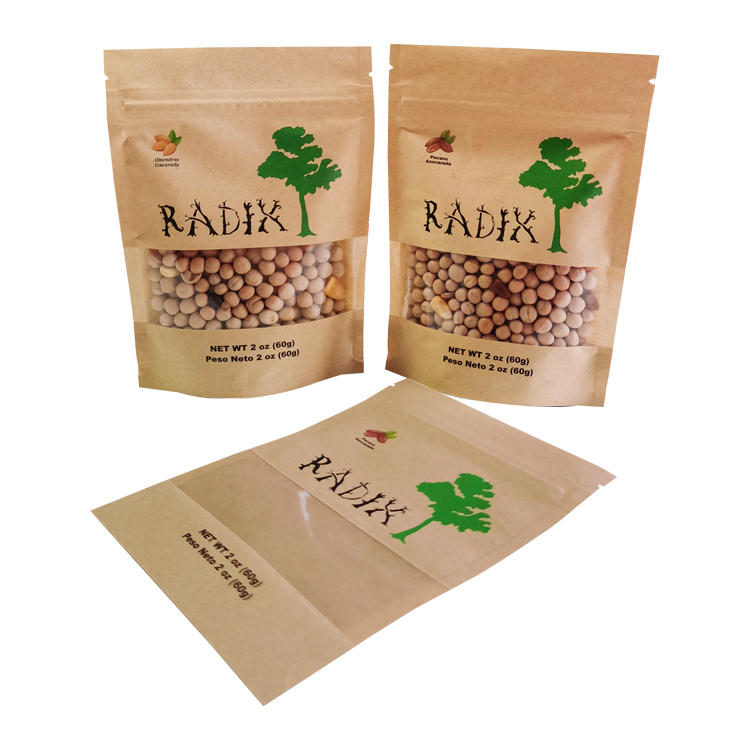
The Puerto Rico candied-nut pouch project lists a windowed stand-up format and kraft paper/PET/CPP. It offers a useful physical example for considering product visibility and top-band room in a sweet-nut SKU. The public page does not say whether its customer used vacuum, a gas flush or an ordinary seal, so none of those process details should be copied into a case study as fact.
Can an ordinary vacuum sealer seal a Mylar nut bag?
First define which operation you want the device to perform: heat sealing only, or air removal and heat sealing. Many smooth, heavy pouches can be heat sealed with a suitable bar, but an external-suction vacuum machine may need channels in the bag to remove air while its opening is clamped. A chamber machine evacuates its entire chamber and may use a smooth pouch specified for that equipment. A so-called Mylar bag is not automatically rated for either vacuum route merely because it has a reflective layer or a flat top.
FoodSaver's own FAQ illustrates the distinction: for that manufacturer's suction system, vacuum packing calls for its patterned bags or rolls; the company separately describes using its appliance to reseal without vacuum certain Mylar-type or stiff plastic bags. It also warns that another appliance's sealing bar may be too hot or too cool for its bags. These are equipment-specific statements, not a universal ban on other compatible equipment or a guarantee for arbitrary bags. VacMaster explains that a chamber machine removes air from the chamber before sealing and uses chamber-specific pouch arrangements.
How to seal Mylar nut bags therefore begins with a material specification, not a temperature copied from another blog or video. “Mylar” may refer to different polyester-based constructions in everyday sales language. Request the entire laminate, the inner food-contact sealant, its qualified sealing range as applicable, finished bag drawing and intended conditions of use. Verify those against the maker's sealing instructions and the actual machine. A pouch vendor's general food-contact statement is useful documentation, but the filled product, equipment and distribution route still need their own approval.
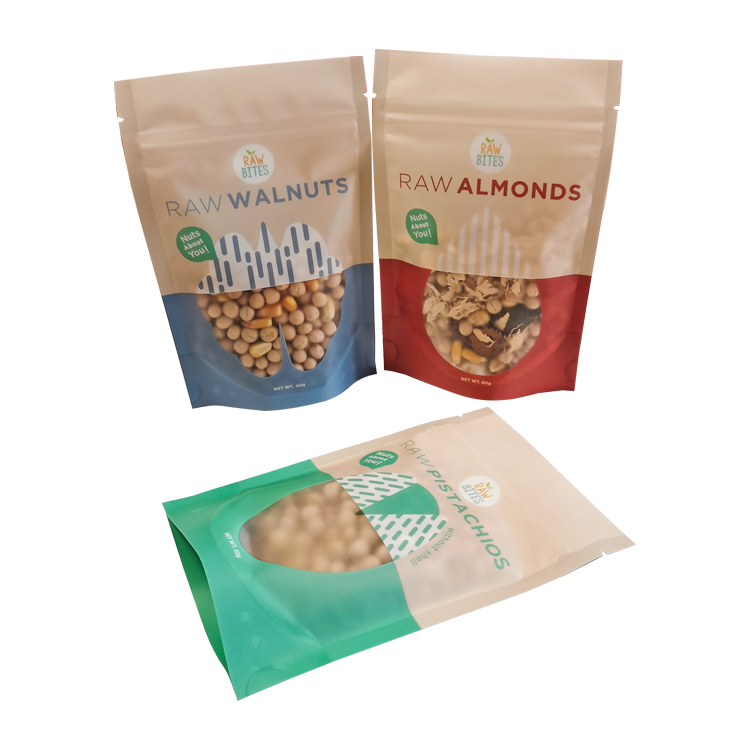
The Philippines nut pouch project shows several printed nut SKUs and shaped windows. Its publicly displayed material shorthand is ambiguous; it does not establish a compatible heat-sealing program or vacuum capability. The visible differences between products are a reminder to conduct trials for each filling behavior and pack appearance, even if the artwork family is shared.
Set up a clean first seal on a filled nut pouch
A premade empty bag can leave the pouch factory with its side and bottom seams already formed. The food packer still has to fill it and create the final top seal on the correct sealing band. If the pouch has a zipper, the first-seal position, zipper and tear notch have different jobs. The top seal keeps the unopened contents enclosed; after the buyer removes that top, the zipper offers convenient reclosure. Zipping a pouch shut before sale is not automatically equivalent to the specified first seal.
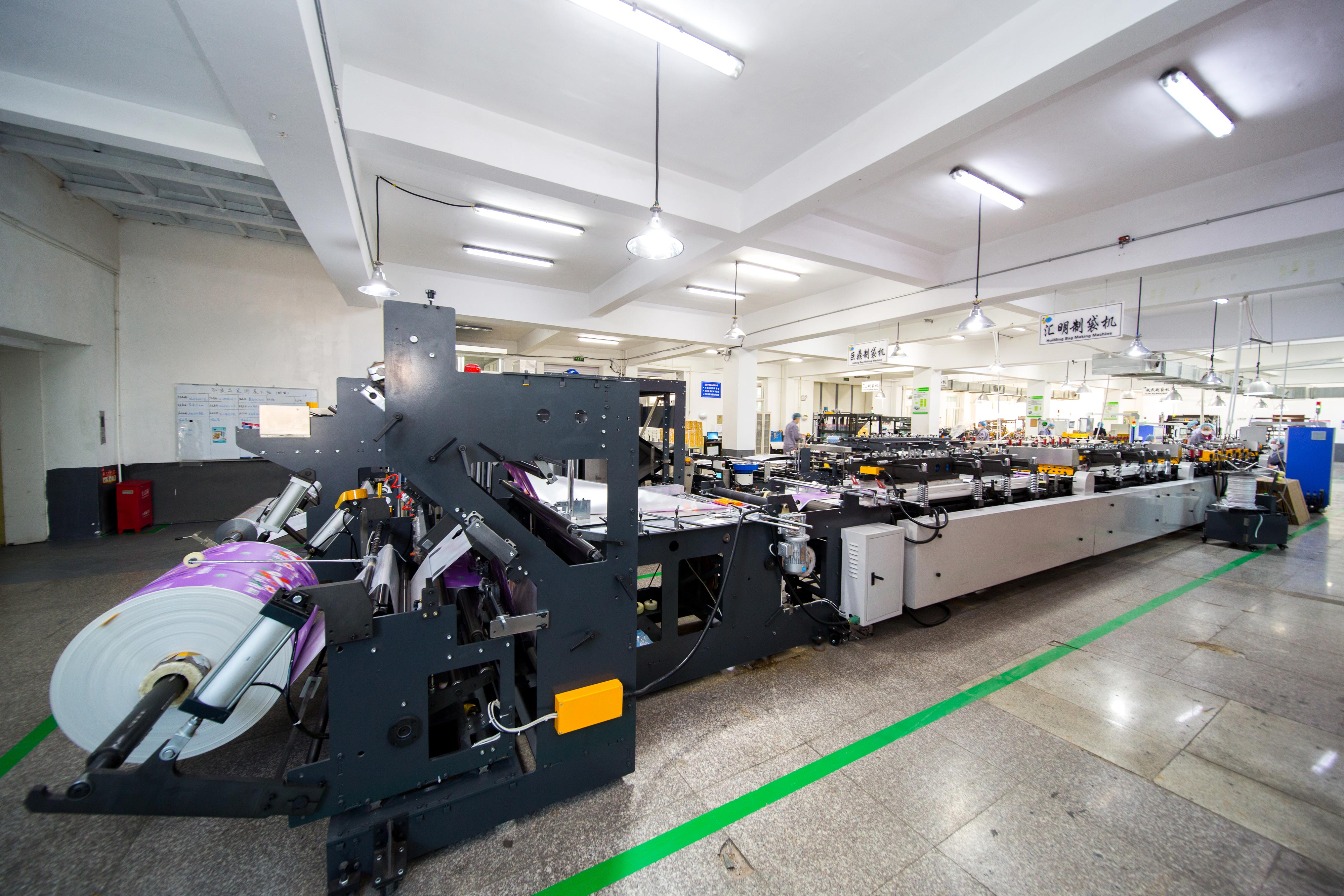
The factory pouch-converting photograph below gives manufacturing context, not a view of a customer's nut-packing line. It helps distinguish a supplier's premade side and bottom seams from the food brand's later top closure. Clarify in the order whether a supplier is delivering finished empty pouches, rollstock, or an already filled and sealed product through a co-packer. The party that creates each seam should be named in the specification and quality records.
For a first-run setup, follow this sequence rather than guessing one universal temperature, dwell time or vacuum level:
- Confirm the job packet. Identify the nut SKU, state after roasting and cooling, fill weight, seasoning, pouch revision, full laminate, sealant, zipper or tear feature, equipment model and intended distribution conditions. Ask the packaging supplier where the top sealing land is on the approved drawing.
- Fill representative pouches. Use production-sized pieces and the normal amount of fines, not only a perfect handful for photography. Observe settling, rebound into the opening and whether the tallest pieces approach the sealing band. Fill and machine orientation both matter.
- Clear and present the seal area. Keep product below the defined fill line. Remove loose nut fragments, spice, sugar or oil from the surfaces to be joined using an approved food-production method. Straighten folds and align the two inner faces before the jaws close.
- Run within the qualified machine–material window. Use the bag and machine suppliers' instructions to establish heat, dwell, pressure and cooling; record the setup actually used. For a vacuum route, add the correct evacuation program and watch for fractured kernels, material draw and loss of alignment.
- Examine the first cooled samples. Look at the full width, transitions near gussets, zipper ends and corners. Record wrinkles, product entrapment, burn-through, weak areas or an unusually distorted front. A smooth-looking seam is a screening result, not a whole-bag leak test.
- Test and handle the packs. Sample the finished bags under a defined plan, measure seal strength or leak performance using methods suitable for that construction, then repeat checks after simulated cartoning, drops and expected storage conditions. Save representative retain samples and link results to the pouch lot, machine settings and food lot.
This is a trial framework, not an instruction to apply an unverified setting to a production line. Machine controls, film gauges, sealants and ambient conditions vary. Changes to a zipper position, inner ply, seasoning dust, fill weight or jaw face can change the seal outcome even when the printed artwork looks identical. Agree with the co-packer who is authorized to set limits, take samples and release a run.
What causes a nut bag to leak after sealing?
Troubleshoot by the failure location and evidence. A leak found at the top can arise from a trapped almond sliver, salt crystal, sugar coating, oil film or folded inner web. A side seam complaint may trace to the premade pouch, impact at a carton edge, or damage during filling. “The sealer was hot enough” does not explain a path through a particle or a punctured corner. Nor does a pouch that initially holds vacuum guarantee that every later unit survives distribution.
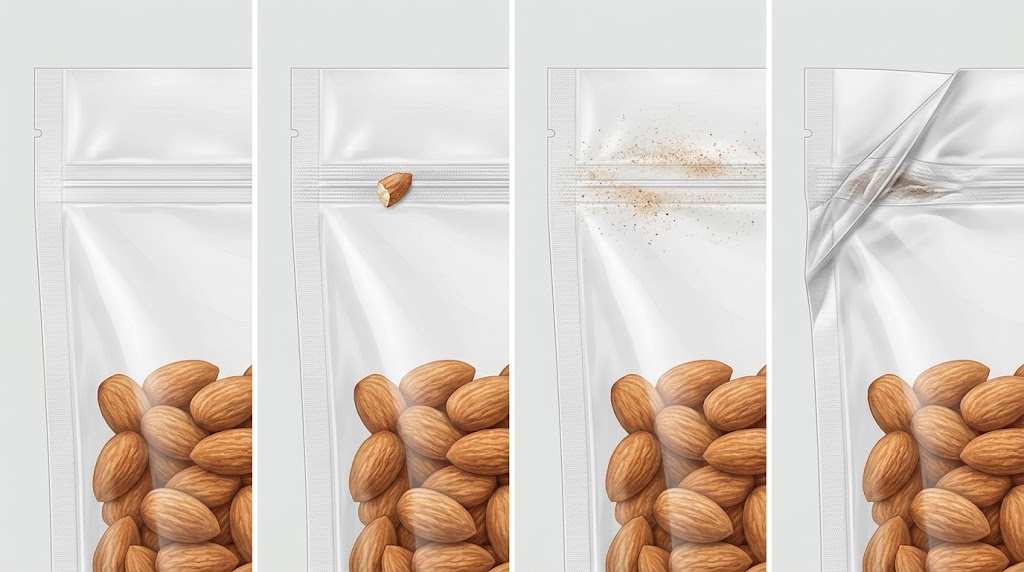
In this illustration, the fragment and fine particles are visible near the upper band. An operator must inspect the actual opposing seal surfaces and test suspect packs before concluding that material is trapped in the seam. The folded corner likewise identifies a place to check, not a measured channel through the pouch.
Avoid putting an adhesive label over a suspected leak and releasing the batch. Segregate affected samples, retain neighboring units and identify whether failures cluster by time, machine lane, film roll, operator adjustment or product condition. A cluster after a material change points to a different investigation from isolated abrasion during shipping. Document the hypothesis, test it, make one controlled correction and resample. The goal is a cause that can be prevented and verified, not a better-looking photo of one sealed bag.
Use seal-strength and integrity tests for different questions
Seal strength asks how much force is needed to separate a sampled seam under a defined method. ASTM F88/F88M is a method for seal strength of flexible barrier materials and can support process validation and control. The number from one cut strip does not prove that the entire package is leak-free. Samples need agreed positions, orientation, conditioning and acceptance criteria for the actual job; an operator should not compare two unlabeled force readings as if they measured the same construction.
An integrity method asks whether there is a leak path under its own test conditions. ASTM D3078, for example, covers gross-leak detection by bubble emission in flexible packs containing headspace gas. ASTM cautions that small leaks may escape detection and that the food, material and test parameters affect sensitivity. A tightly evacuated pouch with little useful headspace is not automatically an appropriate D3078 specimen. Have the quality team choose a suitable method for that pack and agree whether the test is destructive, what a failure looks like and how many units are sampled. Do not describe a visual check or a single dunk test as universal proof of an airtight nut pouch.
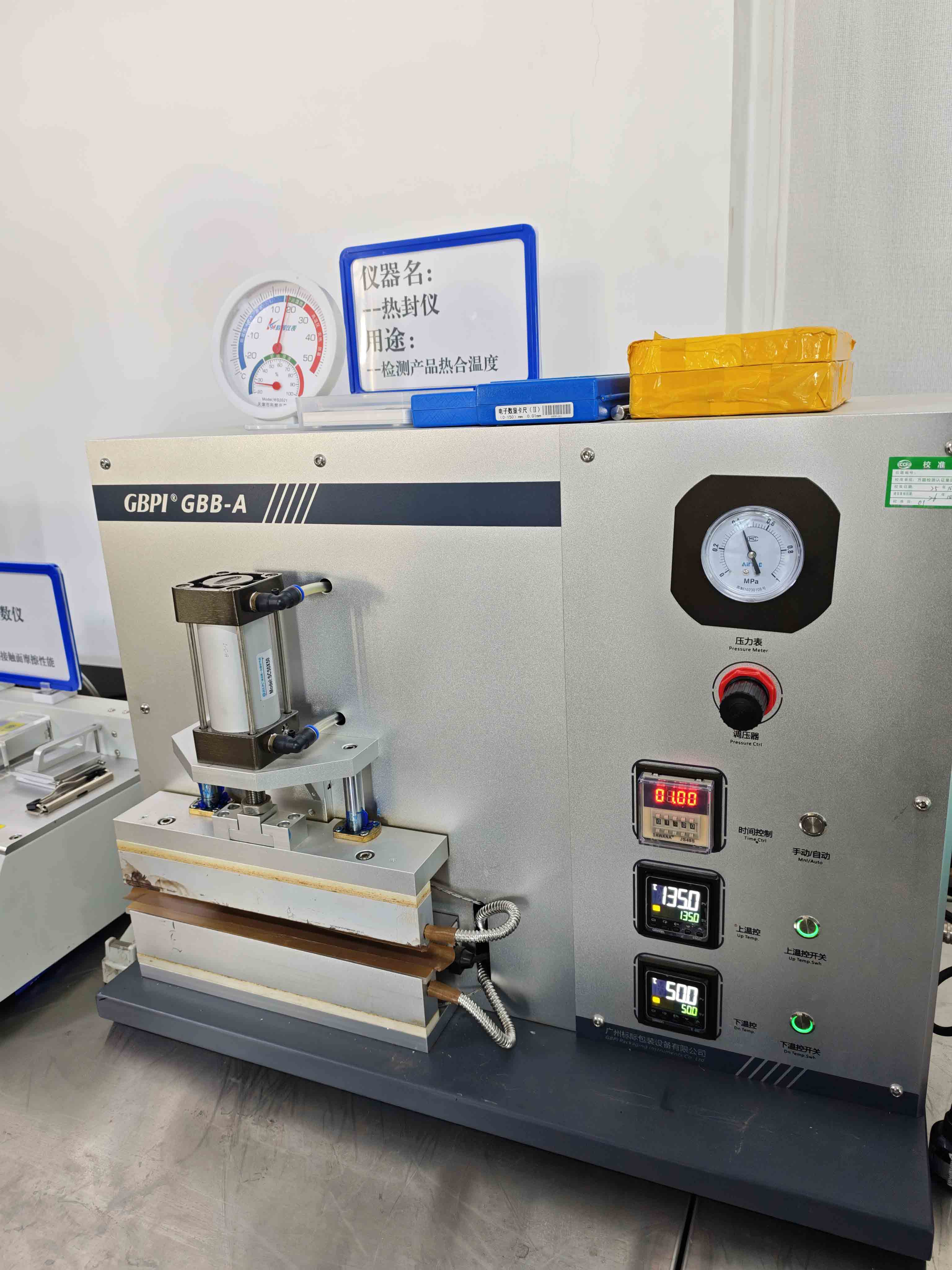
The real bench heat-sealing equipment photograph below shows why a supplier can discuss seal-process trials, but it does not display a passing nut-bag test or publish settings. A seller should ask for documented results on its own filled pouches: seam strength where relevant, integrity, after-carton handling, and any oxygen or quality measurements required for the intended claim. The brand is responsible for validating the actual food and proposed storage period. This article does not assign a shelf-life number.
Quality also means looking beyond the first minute off the sealer. A filled pouch can flex against its case, and a small hard piece can rub a corner across a long route. Compare representative packages just after filling with samples after the intended handling simulation. If the bag has a window or unusual notch, include those transitions in the inspection plan. Keep photographs of actual faults with the lot and operating conditions. A useful acceptance plan tells the line when to stop, who decides the disposition and what evidence permits a restart.
Recommended packaging configuration to request
For a dry retail nut launch, request a premade pouch or rollstock that has a documented food-contact inner sealing layer, an approved drawing with a usable clean top band, and a structure chosen for the product's oxygen, moisture, light and handling needs. Then select the closure route through trials. A conventional first top heat seal plus a zipper for after opening may suit one display-oriented SKU; another SKU may justify a compatible vacuum process after comparing breakage, appearance and quality. Gas flush is a separate qualified option. The recommended configuration is conditional, because a project photo and a generic material name cannot replace a filled-pack test.
Send the nut packaging team a short handoff packet: nut type and roast, whether the product is whole or broken, coatings and free oil, target fill weight, intended pouch dimensions and shelf presentation, expected storage and shipment, existing machine model, desired first closure, zipper requirement and target validation criteria. Include photos of the actual fill and any known leak complaints. If you need a quote or sample, use the contact page and ask for the applicable material drawing and representative empty pouches before approving a production run.
Compare candidates using a recorded trial sheet: pouch revision → food lot → equipment/settings → appearance and breakage → seal tests → carton/handling tests → quality result. This prevents an attractive empty sample from being mistaken for an approved production system. Do not ask the pouch supplier to promise a universal vacuum level, shelf-life month count or food-safety outcome without the food business's product-specific work.
FAQs
Can you vacuum seal nuts for retail sale?
Dry nuts can be vacuum packed with a compatible pouch and machine, as the UC Extension guidance recognizes for dry, non-perishable foods. A retailer still needs to validate its own product, first seal, breakage, handling and intended storage. Vacuum does not turn wet boiled peanuts or another perishable food into a room-temperature shelf-stable product.
How do you seal a Mylar nut bag without a vacuum machine?
Confirm the pouch's actual inner sealant and its supplier's qualified sealing guidance, then use a compatible heat-sealing machine to make a continuous first seal across a clean, correctly aligned top band. Test the filled pouch on that exact setup. “Mylar” alone does not establish a temperature, dwell time or whether the finished bag has a foil layer. A zipper below the seal can provide reclosure after opening.
Will a household external-suction vacuum sealer work with a smooth nut pouch?
Not automatically. Many external-suction systems depend on an air channel in a compatible textured bag; a smooth pouch can block evacuation when clamped. Some equipment may still perform a heat-seal-only operation on an approved material. Follow the specific machine and pouch makers' compatibility instructions and test actual filled units. A chamber machine has a different evacuation arrangement and its own approved pouch requirements.
Does a zipper count as the first seal on a nut bag?
A zipper serves reclosure once the consumer has opened the pouch. For a retail pack whose specification calls for an intact first top seal, closing the zipper is a separate action and does not demonstrate that the first seal exists or is sound. Ask for the drawing showing the top seal, tear feature and zipper positions; verify the filled first seal before shipment.
Does vacuum packing give all nuts a longer shelf life?
Removing air can be one part of a quality-control design, but it does not supply a universal shelf-life extension. Nut type, roast, oil oxidation, starting quality, oxygen in the pack, barrier, seam integrity, light, temperature and distribution all matter. Establish the date or period from the actual product and packaging validation. A pouch holding its tight shape is not a substitute for those measurements.
What should we check before approving the first production run?
Check the complete pouch specification and machine match; fill real nuts with their normal pieces and seasoning; verify clean top-seal clearance; record sealing and any vacuum conditions; inspect position-specific seams; run suitable strength and package-integrity tests; then examine packs after representative carton handling. Agree sampling and acceptance criteria with the quality team, retain labeled samples, and link findings to pouch and food lots.