
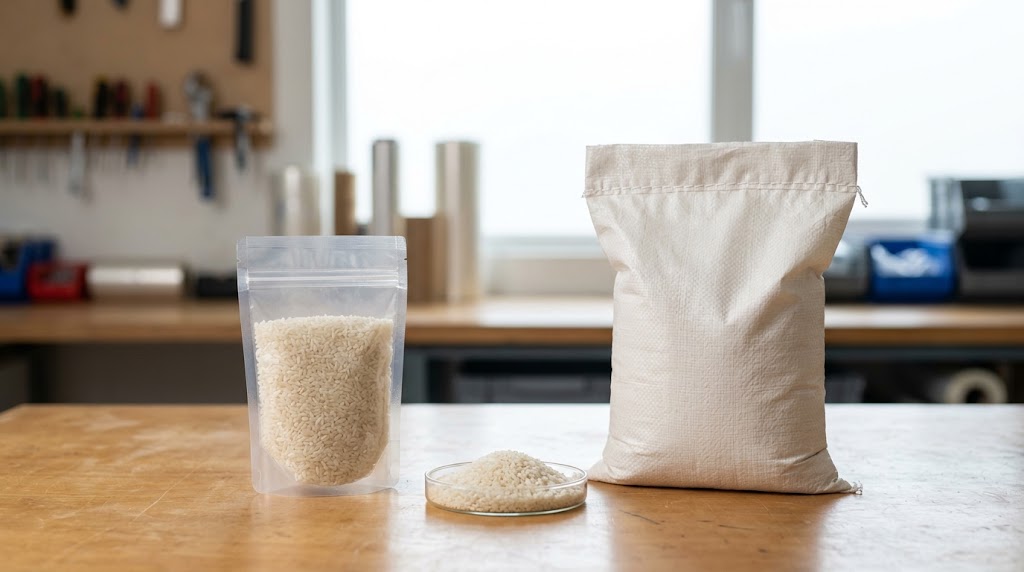
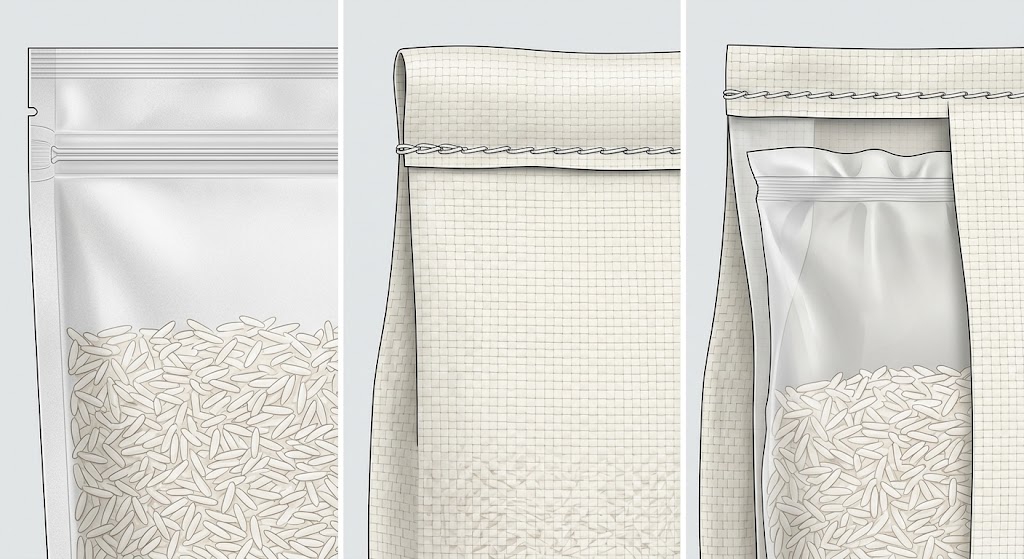
To seal a rice bag, identify the bag construction first. A flexible retail pouch normally needs a compatible, clean heat seal across its fill opening. A woven polypropylene sack is usually closed with a specified sewn top or another closure designed for that fabric. If the sack contains a barrier liner, close the inner liner independently before closing the outer sack. A zipper helps the buyer reclose an opened pouch; it should not be mistaken for the original unopened-package seal.
That is the short answer. The useful answer for a rice brand is how to make the closure repeatable on its own filling line and how to tell when it has failed. A sturdy film and an attractive print do little if a kernel sits across the top seal, if a woven sack frays along the stitch line, or if an inner liner remains open under a well-sewn outer bag. This guide focuses on dry, uncooked rice packs for retail or bulk distribution. It does not provide a universal machine setting, a validated shelf life, or a procedure for cooked or wet rice.
What does “seal the rice bag” actually mean?
Three different operations are often called sealing. A bag maker converts film or woven fabric into an empty package with side and bottom seams. A rice packer fills that package and closes the remaining mouth. The consumer may later open it and use a zipper or another feature for reclosure. Each operation has a different acceptance question.
On a retail pouch, the bag maker might have already formed the bottom and side seals, installed a zipper, and left a clean top opening for the rice packer. The packer has to fill below that opening and form the final top heat seal. On a bulk woven sack, the packer folds or prepares the filled mouth and runs it through a bag-closing sewing process. On a woven outer sack with a separate inner barrier liner, the liner has its own closure sequence. Sewing only the outer fabric does not automatically close the liner.
The Codex Standard for Rice says rice packaging should safeguard the food's qualities and that sacks should be clean, sturdy, and strongly sewn or sealed. That is a useful starting principle. It does not supply the line setting, stitch recipe, or acceptance limit for every brand. A project specification must do that work for the actual bag, rice, equipment, and route to market.
Choose the closure from the bag's structure and job
You cannot select a closing machine from the word “rice bag.” First, identify the exact substrate and which part of the bag will contact the closure. A continuous-film pouch needs a sealant layer that can bond at the intended interface. Woven PP tapes and a laminated print surface present a different closing problem. A side-gusseted or flat-bottom pouch can fold into several layers at a corner. A large sack will change shape as the rice settles. Those physical details govern equipment clearance, handling, and inspection.
Write down the finished construction: outer printing layer, barrier layer if any, inner food-contact layer, zipper or window, side and bottom seam geometry, and the open-mouth width. For a woven sack, record the fabric, coating or laminate if present, mouth finish, fold method, stitch or tape system, and whether there is an independent liner. Then record what the closure is expected to do. Contain grains in distribution? Resist dust ingress? Support an approved shelf life? Allow clean consumer opening? A closure that meets one job may not meet another.
Heat-sealable retail pouch
For a plain film pouch, the top seal usually joins two inner sealant surfaces. The sealer must be compatible with the actual laminate and reach a controlled portion of the mouth without catching artwork, the zipper profile, or a gusset fold. The bag maker should identify the intended seal zone and sample construction. The rice packer should prove that its filler leaves enough clearance when the pouch contains its real target weight, not just when an empty pouch lies flat on a desk.
A clear window may help the shopper identify rice, but it can change local thickness or film behavior. A zipper can create an uneven area near the jaws. A tear notch and top seal must be placed so the consumer can open the pack without cutting through the reclosure feature. These are design decisions to review on a filled sample, not assumptions that follow from the nominal pouch dimensions.
Sewn woven sack
A woven sack can be a sound choice for a bulk route when the fabric and closure are specified for that route. The sewing operation has to capture the prepared mouth consistently, keep stitches from skipping, leave a secure end treatment, and avoid a fold that releases grains during handling. The buyer should approve how the top is turned or creased and what happens to loose thread ends. If a coated or laminated woven sack needs an additional tape or other finish, that detail belongs on the written drawing and trial record.
One USDA milled-rice commodity specification describes a particular 50 kg woven-PP bag with sewn seams, product-containment and impact-test requirements. It is an example of how a procurement specification can define the filled bag. Its stitch count and test parameters belong to that contract; they are not a universal rule for a 5 kg retail pouch or every export sack. The general lesson is to test the filled, closed bag under the intended handling conditions.
Woven outer sack with a liner
The inner and outer closures perform different tasks. The liner may be selected to restrict exchange with the environment; the woven sack supplies handling support. Fold or seal the liner according to the liner supplier's approved design, keep it clear of the outer stitching path unless the construction specifically calls for joining them, then close the outer sack. Inspect the two closures separately. A neat sewn top can hide an unclosed inner liner; an intact liner can still be punctured by careless handling of the outer fabric.
The FAO discussion of the IRRI rice storage liner describes an inner bag used within existing jute or polypropylene sacks and warns that incorrect use, including twisting or overfilling, can defeat the intended system. That research design is not evidence that every liner is hermetic. It is a reminder to name the specific liner and its closing method in the project brief.
How to heat-seal a rice pouch on a filling line
Begin with the real empty pouch and actual rice, not a generic sealing-temperature chart. Confirm the mouth is wide enough for the filler and the target fill does not push grains into the intended seal zone. For a semi-automatic operation, watch how the operator transfers the filled pouch to the jaws. For an automated operation, watch pickup, opening, filling, settling, alignment, sealing, coding, and reject handling. A sample that works at low speed may produce folds or stray rice at normal speed.
Keep the seal area clear
Rice grains are large enough to create a visible channel if trapped across the top seam. Fine rice dust and bran particles can be less obvious. After filling, let the product settle as the process requires, keep the mouth edges aligned, and inspect for product in the jaw path. Do not brush contaminants into the pouch or accept a compromised pack because the outside looks clean. If contamination recurs, examine the filler, drop height, static, bag opening, dust extraction, and unused top margin. Changing the temperature cannot reliably fix a grain caught between two sealing surfaces.
The pouch supplier and packer should agree where the top of the product may reach at maximum allowed fill variation. That boundary is different from the nominal fill mark on a flat sample. The filled panel bulges; rice can settle into a gusset; the zipper and top edge consume vertical space. Run a high-fill and a low-fill sample with the actual rice to see both extremes.
Establish a process window rather than one borrowed setting
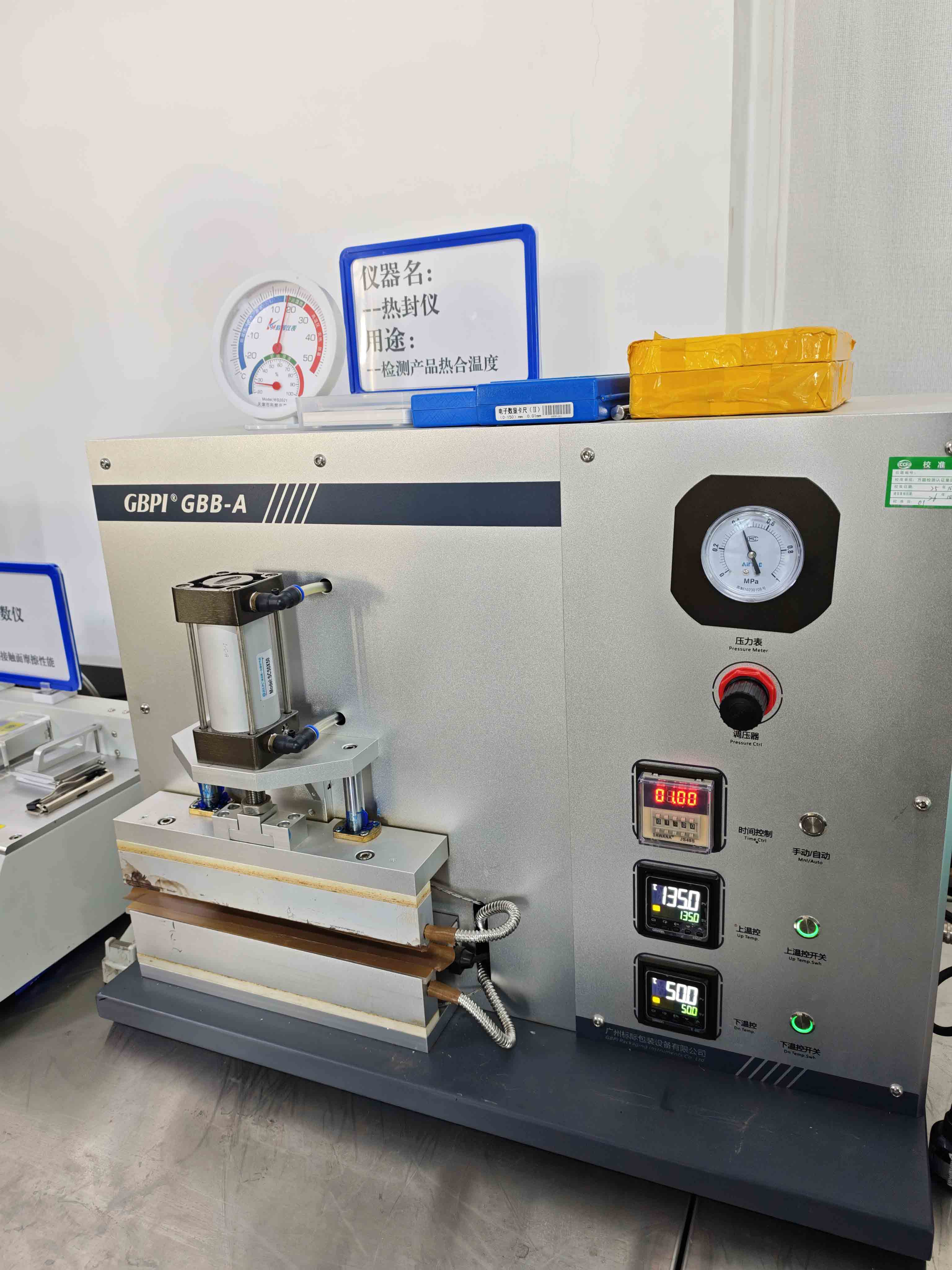
Heat, contact pressure, dwell time, jaw shape and condition, material thickness, alignment, and cooling all influence the result. ASTM F2029 describes laboratory heat-sealability work and explicitly cautions that laboratory results may differ from a manufacturing line. Its seal curve is a starting point, not a production validation. Ask the pouch supplier for its material guidance; then establish an acceptable range on the installed sealer with filled production-format packs.
Trial settings near the lower and upper practical edges of the proposed range, not just an ideal middle setting. Look for weak fusion, excessive heat damage, film distortion, adhesive disturbance, wrinkling at gussets, or a seam that changes after cooling. Record the pouch lot, jaw setup, line speed, operator, temperature indication, dwell, pressure setting where controlled, and result. Do not publish a temperature or number of seconds without the material, machine, and test conditions. Even two bags labeled PET/PE can differ in layer thickness and sealant formulation.
Cool, inspect, and handle the closed pack
A freshly made seal can be stressed if the pouch is immediately squeezed, dropped, or stacked before it reaches the condition used for acceptance. Set a handling interval based on the actual process. Examine the full top width and intersections with side seams or gussets. A straight section that looks sound does not clear a wrinkled corner. Confirm lot code legibility and location, but do not use a code stamp or label to conceal a defect.
If the design includes an initial peel seal and a zipper beneath it, trial consumer opening too. The consumer should be able to reach the zipper after opening without destroying it. A seal that is strong in a strip test but tears the package body or makes opening unreasonable may need a different design or acceptance range.
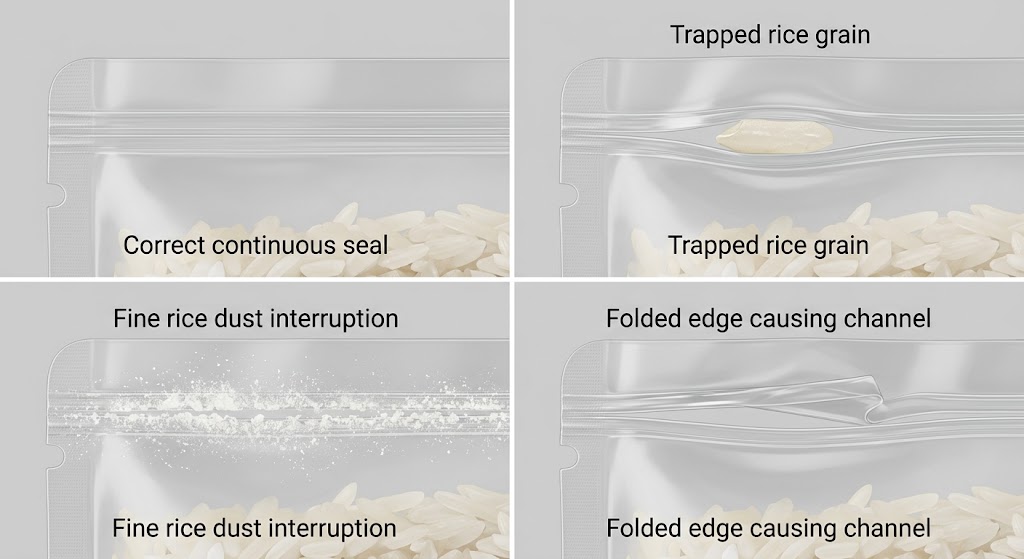
What should be tested after sealing?
Separate three questions: does the seal resist the required separating force, is it continuous, and does the finished filled pack survive its route? One test does not answer all three. A strip taken from an easy straight section may give a strong reading while a channel remains in a gusset corner. A pouch may appear closed at the line but split after it is compressed in a carton.
ASTM F88/F88M measures seal strength on a sampled flexible-barrier seal and identifies the failure mode. It is useful for process validation and control. It is not, by itself, a whole-pouch leak test. The F2029 description also distinguishes heat-seal strength from continuity checks such as visual examination or suitable leak methods. Choose an appropriate integrity method for the actual pouch, product, and claim; record the sample locations and acceptance limits. Avoid presenting one test method as a certificate of rice freshness.
For a woven sack, test the actual filled and closed construction. Observe grain leakage through the mouth or seam, thread breakage, fraying, top-edge tearing, and performance after normal palletizing or representative handling. If there is a liner, inspect it before and after the outer sack handling trial. Define whether a defect requires rework, rejection, or investigation. A result that only says “passed” is hard to compare if the fill weight, sample count, conditioning, and handling method were never written down.
For a buyer comparing two pouch suppliers, request the method and conditions along with the result. Was the sample an empty pouch or a filled one? Was it taken from the middle of a straight top seam or a difficult corner? Was the result generated in a lab or on the intended production line? What happened after a normal carton handling trial? These details make two quotations comparable. They also prevent the misleading claim that a strong seal test automatically means a moisture-proof product.
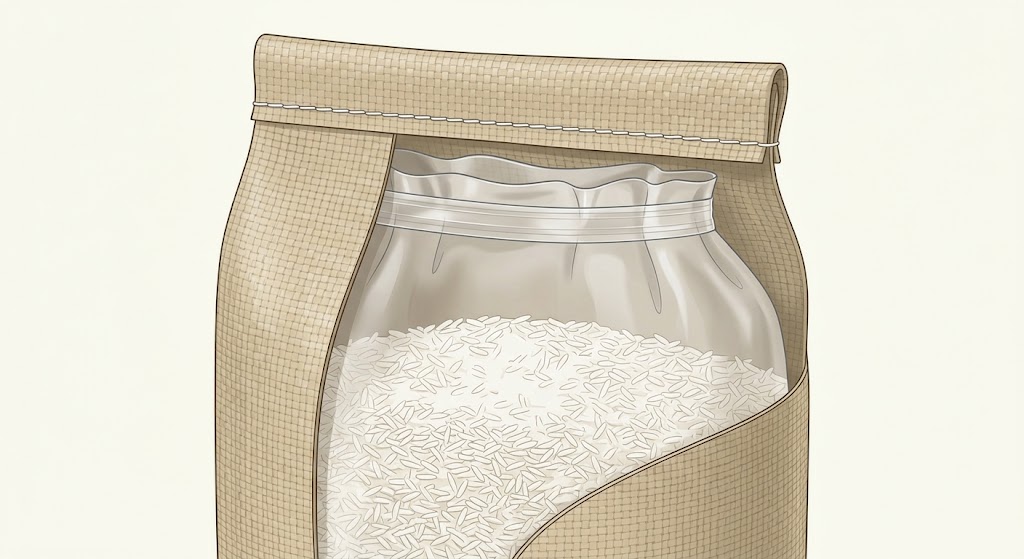
How to close a woven rice sack and its inner liner
The sack mouth must reach the closing station in a consistent shape. Rice level, vibration, and settlement affect how much clean fabric is left for folding or sewing. Keep the sack supported so its weight does not pull the mouth out of alignment. Specify the top finish, fold or turnover, stitch path, thread, end treatment, and any closure tape as a system. Inspect the first, middle, and last bags of a representative run, then set an interval for production checks.
Watch for skipped stitches, a seam too close to a fraying edge, thread tails that loosen, and grain trapped where the mouth folds. A double row or more thread is not a substitute for a properly placed and tested closure. If a liner is present, identify its mouth and close it by its own approved method first. A generic twist or loose fold should not be assumed to deliver a gas barrier simply because the outer sack is stitched shut. Confirm the liner remains intact after the sack passes through the closing equipment.
Do not claim that sewn PP sacks are all moisture-tight or insect-proof. Some designs are deliberately permeable or vented for a specific grain-handling route. If a buyer needs a controlled barrier, that is a specification for the complete system, including a suitable liner or another package, not a promise from the stitch line. This article addresses closure mechanics; the separate materials and storage decisions still need their own evidence.
Does a zipper seal a rice pouch for sale?
A zipper is valuable when a household opens a larger rice pack over several meals. It can reduce spills after opening and makes the pouch convenient to handle. But the unopened retail condition usually relies on an initial factory heat seal at the designed location. A zipper may contain residual grains from the filling operation, may be incompletely pressed shut, and may not be specified as the sole barrier boundary. The bag maker should state its intended function and the top-seal placement.
Trial the actual opening sequence: where does the shopper tear or cut, how much film remains to grasp, and can the zipper still close afterward? For a flat-bottom pouch, the finished bag's weight may put more stress on the upper body when carried. For a small stand-up pouch, a zipper placed too high can leave too little clear area for the initial seal. A hanger hole, tear notch, or label may also compete for that space. Evaluate the whole top layout on a filled sample before the artwork is approved.
After first opening, a reclosed zipper is not the same as the unopened heat-sealed pack. Any product-date and storage claims should reflect the intended use, and the brand's instructions should tell consumers how to store opened rice. An oxygen absorber, if used in a suitably dry approved system, also does not restore an original seal after the pack has been opened. Avoid implying that pressing a zipper shut recreates the unopened-package quality period.
How to open a rice bag string or woven rice bag
Many sewn sacks can be opened by identifying a free chain-stitch end and pulling the correct thread, but not all sacks use the same stitch direction or end treatment. Set the bag on a stable, clean surface. Look at both ends of the top seam for a loose loop or thread tail. Gently test whether a stitch releases without tearing the fabric. If it does, continue along that seam while keeping loose thread away from the rice. If the thread is locked, glued, taped, or sewn in a different pattern, stop pulling rather than tearing the sack; use a clean tool to open the designated top area according to the packer's instructions, taking care not to cut an inner liner or spill its contents.
That is the honest answer to “which string do I pull?”: the visible end and stitch construction decide. A single online left-side/right-side trick does not fit every sewn sack. For a brand designing a bag, opening is part of the closure trial. Give a consumer a representative filled sack, ask them to open it, and note whether they find the thread, whether fragments fall into the rice, and whether the liner remains clean. If clean opening matters to the market, document an opening instruction or choose a suitable closure design. Do not add a decorative “easy open” icon before the trial confirms it.
This opening subsection is deliberately short. The procurement lesson is that a closure has two users: the packer who must apply it repeatably and the buyer who must open it without compromising the food. A sack that holds up perfectly in distribution but sheds loose threads into the product is not a finished user experience.
Troubleshooting: what failed, and what to change?
Start with the observed defect, not a reflexive increase in temperature or stitch density. A rice kernel in the top seam points toward fill control; an inconsistent bond may point toward jaw contact, film variation, or cooling; a sack that leaks after a drop may point toward mouth preparation, seam position, bag size, or impact conditions. Keep failed examples with their lot and settings while investigating. Otherwise the next shift may be forced to rediscover the same fault.
These are diagnostic starting points, not universal causes. If a pouch delaminates near a seal, a film supplier may need to assess adhesive cure, layer compatibility, or heat exposure. If only the heaviest bag fails, check actual fill distribution and carton compression. If defects begin after a shift change, inspect setup records and training. Write the corrective action against a repeat test so a cosmetic improvement is not mistaken for a reliable fix.
A real rice-packaging case: what we know and what we would test
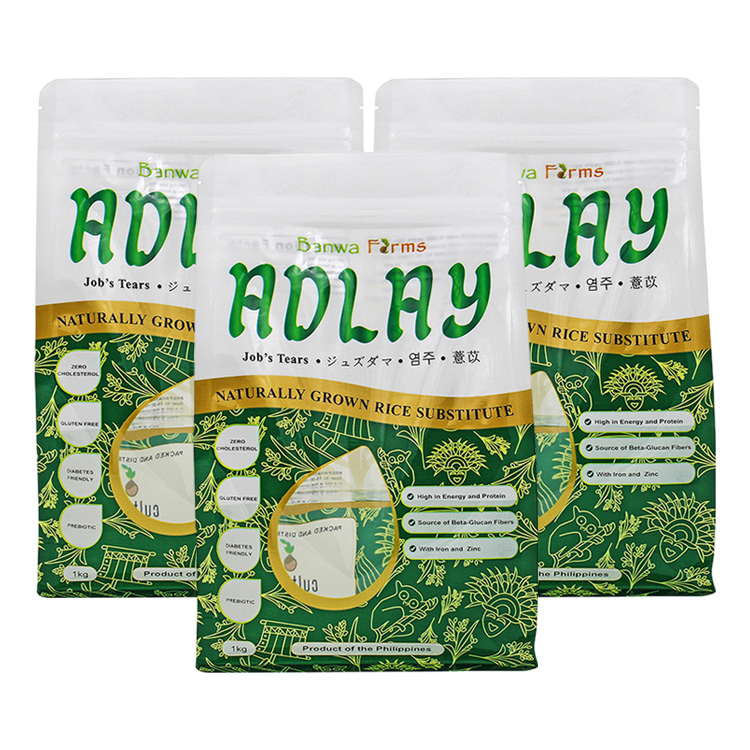
Mylarbag's published 1 kg rice and ancient-grain pouch project lists the Philippines as the target country, PET/NY/PE as the material structure, gravure printing, a flat-bottom format, a teardrop window, and a 15 × 24 + 6 cm size. Those are real project attributes. The public record does not provide its packing-line temperature, seal strength, liner closure, headspace, defect rate, or customer shelf-life outcome. We should not manufacture those facts.
What can a buyer learn from the case? Its 1 kg size and flat-bottom format suggest a retail handling task, so a new project with a similar format should trial the filled pouch upright, inspect the bottom folds and top clearance, and decide where the consumer will open it. The PET/NY/PE notation identifies a material family, but the complete layer specifications and actual sealant details are needed for a closing process. The window makes it especially important to inspect the finished converted pouch rather than assume every panel and seam behaves like a flat film sample.
Now contrast a new 5 kg woven PP order. It is not a scaled-up version of this 1 kg pouch. The closing equipment, mouth construction, finished-bag weight, distribution stresses, and opening experience differ. A supplier who can discuss both routes should quote them as separate specifications. For the printed retail option, send the actual filler, target rice weight, top-seal location, zipper need, and handling route. For the woven option, send fabric and liner requirements, intended stitching/closing method, pallet pattern, and filled-bag test requirement.
The commercial discussion belongs at custom rice packaging. Ask for a physical sample and the finished closure drawing, then have the rice packer approve a trial on its own line. A case photograph is useful for bag format and graphic execution. The seal decision still belongs to testing on your exact rice pack.
A short approval brief for the packaging supplier
Before ordering production quantities, send one page containing: rice variety and condition, fill weight and tolerance, pouch or sack construction, dimensions at the intended fill, zipper/window/liner requirements, filling and closing machines, the position of the top seal or sewn seam, code and artwork clearances, carton and pallet conditions, and the sales market. Attach a photo or drawing of the current process if it helps the supplier place the open mouth correctly. Avoid sending only a flat dimension and an image of a competitor's bag.
Ask the supplier to identify which seams arrive already made and which closure remains for the packer. Request material and food-contact documentation suited to the intended market, physical samples, guidance for the proposed sealant or sack closure, and a test plan. The packer then uses those samples to establish the line settings and acceptance criteria. Supplier and packer should sign off on the same filled reference bag and revision. If a zipper, liner, film layer, or bag size changes, the closure trial needs review.
At launch, retain a practical record: approved sample and drawing, film or sack lot, rice lot, equipment setup, representative first/middle/last checks, chosen seal or seam test, visual defects, rejected quantities, and corrective actions. Define who may release product after a stoppage. This is more useful than a broad claim that every bag is “industrial strength.” The aim is not paperwork for its own sake; it is to know whether the next bag was made like the one you approved.
Frequently asked questions
Can I heat-seal any rice bag?
No. A flexible pouch needs compatible sealant surfaces and a validated process for its actual laminate. A woven PP sack typically calls for a specified sewn or other fabric-compatible closure. A lined woven sack may need both a separately closed liner and an outer closure. Ask for the finished construction before choosing equipment.
What temperature should I use to seal a rice pouch?
There is no universal temperature. Film construction, sealant, thickness, jaw design, dwell, pressure, line speed, and cooling all affect the result. Start with the pouch supplier's guidance and establish a tested process window using filled pouches on the intended machine. Record the settings and acceptance results rather than copying a number from another product.
Is a zipper enough to seal a retail rice bag?
Usually the zipper is for reclosure after opening, while a separate initial heat seal closes the unopened pack. Confirm the design with the pouch supplier and trial the opening path. A reclosed zipper does not restore the original unopened-package state.
How do I seal a woven rice bag with an inner liner?
Close the inner liner using its specified method, verify that closure, and then close the outer woven mouth with the approved stitching or other sack-closing process. Inspect both closures after representative handling. A neat outer seam does not prove the inner liner is shut.
How do I open a rice bag string?
Inspect both ends for a free chain-stitch loop, gently test the end that releases, and pull along the seam while keeping thread away from the rice. Stitch patterns and end treatments vary. If the seam does not release, use the packer's designated opening method and avoid cutting an inner liner or contaminating the product.
How do I know whether a sealed rice bag will survive shipping?
Test representative filled and closed packs in the intended carton or sack-handling configuration. Combine visual inspection with agreed seal or seam checks and a suitable handling trial. Record the method, sample locations, acceptance limits, and failures. A flat-film data sheet or one seal-strength strip cannot establish the performance of every finished bag.
Next step: approve the filled closure, not just the empty bag
Decide whether the rice will travel in a heat-sealed retail pouch, a sewn bulk sack, or a closed liner inside an outer sack. Give the supplier the closure sequence and the packer the same approved sample. Run the rice through the intended filling, closing, coding, packing, and handling steps. Reject a design that only looks good empty.
For a custom project, send the specification and trial requirements to Mylarbag's rice packaging team. Ask for a pouch or sack proposal that names the final closing method and the evidence you need to accept it. The best closure is the one your actual line can apply consistently and your finished-pack checks can defend.