
A kraft paper food pouch can contain paper, plastic films, a metallized barrier and a heat-sealing layer, or use a specified coated-paper construction. The word “kraft” identifies only part of that description. Ask for the complete structure, with the outside and food-contact side identified, before deciding what the pouch can protect, how it seals or which disposal claim applies. Begin with the material record for the actual sample you are considering.
Start with the surface you can see and touch
A brown pouch provides an appearance reference. To turn that reference into a material request, first describe which surface matters: directly exposed paper, paper covered by an outer film, or a film printed with a paper-like design. These can lead to different quotations even when the product photographs look similar.
Use the sample to communicate what you mean by “paper feel.” Handle its front and back, examine the surface under ordinary light, and compare it with the proposed specification. If direct contact with paper is important, say so explicitly. A supplier needs that requirement before selecting a construction with an outer film.
The same care applies to white kraft. Specify the actual paper or sample reference and the appearance you want for the printed design. “White” alone does not identify a particular grade, brightness or finished color result. Compare the agreed artwork on the proposed surface before treating two paper options as visually interchangeable.
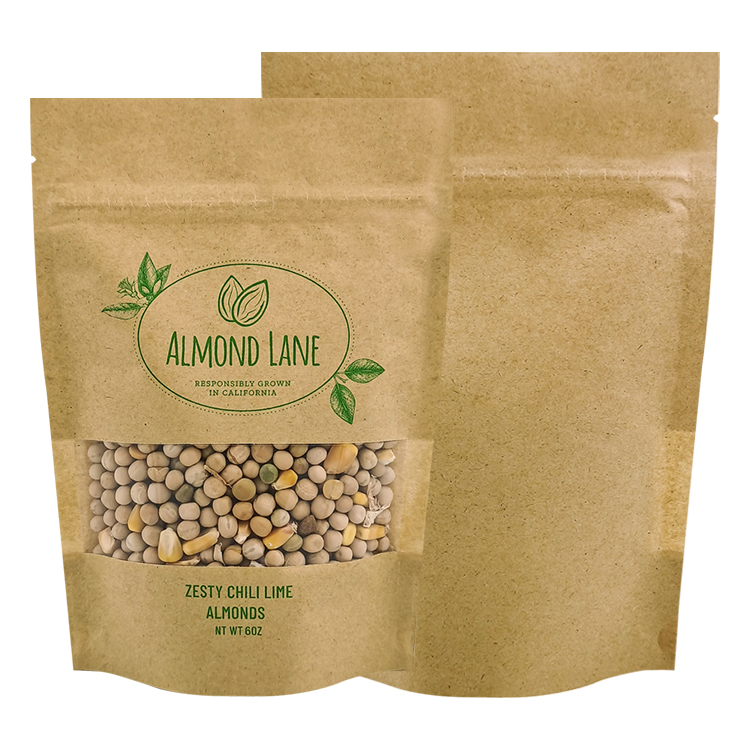
Figure 1 shows a brown printed front with a horizontal window. It is useful for discussing the balance between visible paper, artwork and product display. The photograph cannot reveal the thickness of the transparent layers or the material against the food.
Start with the surface and format options on our paper packaging page, then request the full material structure for the option you are considering. Keep the appearance reference attached to that request so the surface you approve stays identifiable.
Read two published kraft-pouch structures
A kraft stand-up pouch with a horizontal window
The published record for this kraft stand-up pouch with a horizontal window lists Kraft paper/PET/PE. It is a stand-up pouch project for a 6 oz nuts-and-seeds presentation, with digital printing recorded on the product page.
That material string provides a starting distinction: the project includes paper and named films. PET refers to polyethylene terephthalate; PE refers to polyethylene. The abbreviations identify material families. A production specification still needs the particular grades, dimensions and other relevant construction details.
A kraft flat-bottom coffee pouch with an outer film
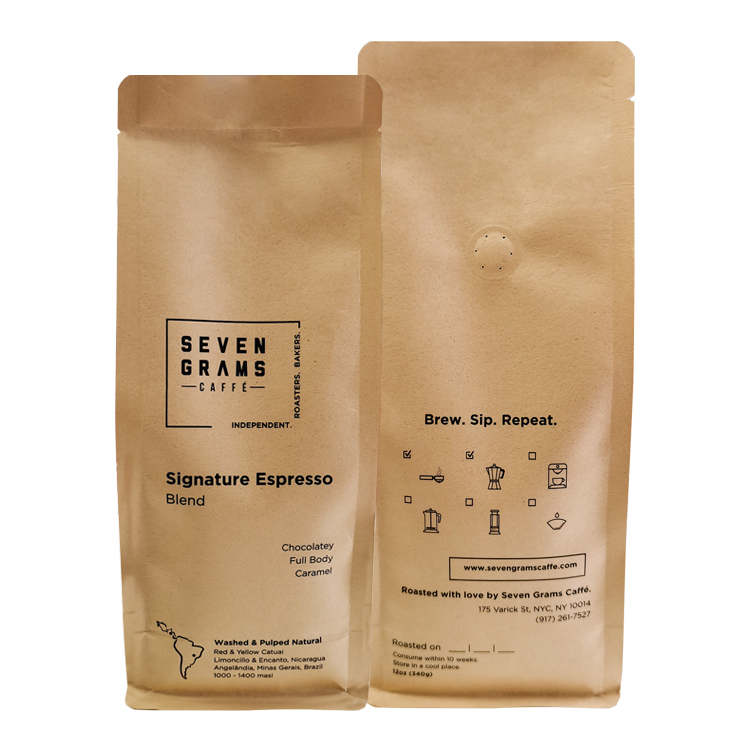
This 12oz kraft flat-bottom coffee pouch records MATOPP/kraft paper/VMPET/PE. Its published features include a degassing valve and gravure printing. MATOPP identifies a matte oriented polypropylene film in this description; VMPET identifies metallized PET.
The paper is therefore one component within a longer sequence. Mylarbag’s paper-material guidance identifies the outer MATOPP as the touch surface for this construction. Confirm the proposed sample if you want direct paper texture.
Scroll horizontally to view the full table.
| Published project | Recorded material string | What it helps you identify | What still needs evidence |
|---|---|---|---|
| 6 oz nuts-and-seeds stand-up pouch | Kraft paper/PET/PE | Paper combined with named films; a visible horizontal window | Complete grades, thicknesses, window specification and performance for your food |
| 12 oz flat-bottom coffee pouch | MATOPP/kraft paper/VMPET/PE | An outer film, paper and a separate metallized-film component | The proposed production version, sealing requirements and relevant test results |
Use these records to ask more precise questions. They are not a controlled performance comparison, and the stated fills belong to the individual projects. A similar-looking bag for another food requires its own size and material review.
Ask for the complete layer specification
Confirm the outside-to-food-side order
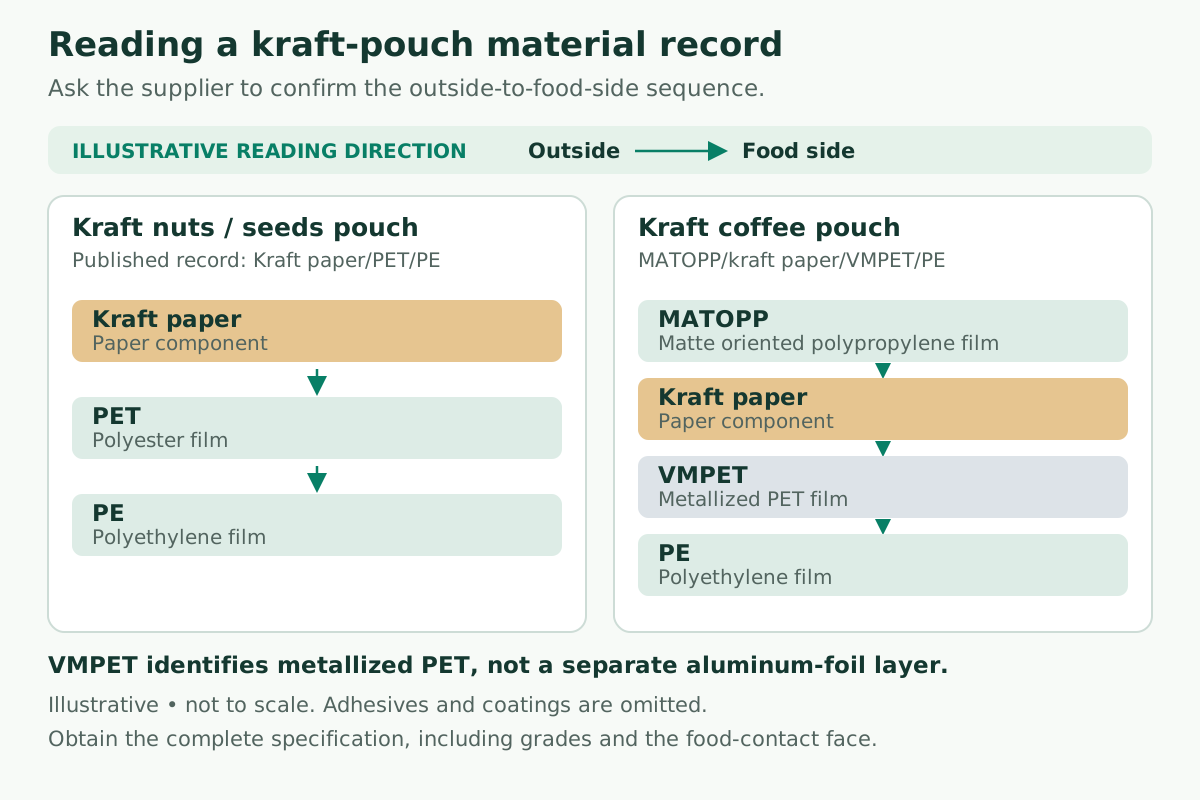
Request a structure drawing or written specification that labels both sides. Ask the supplier to confirm that the sequence reads from the outside toward the food, rather than assuming every quotation uses the same convention. Then identify the exposed surface, the paper component, the functional films or coatings, and the intended sealing face.
Figure 3 illustrates how to read the two published sequences. It is a reading aid: its blocks do not represent measured thicknesses, and the simplified sequences do not show every adhesive or coating that a complete specification may include.
Scroll horizontally to view the full diagram.
The slash-separated string may be too brief to answer every question. Ask which adhesives, coatings and other components are covered by the complete material declaration. Likewise, a named inner film does not by itself establish suitability for every food and use temperature. Keep the intended use with the specification when requesting the relevant documentation.
Keep paper weight and film thickness separate
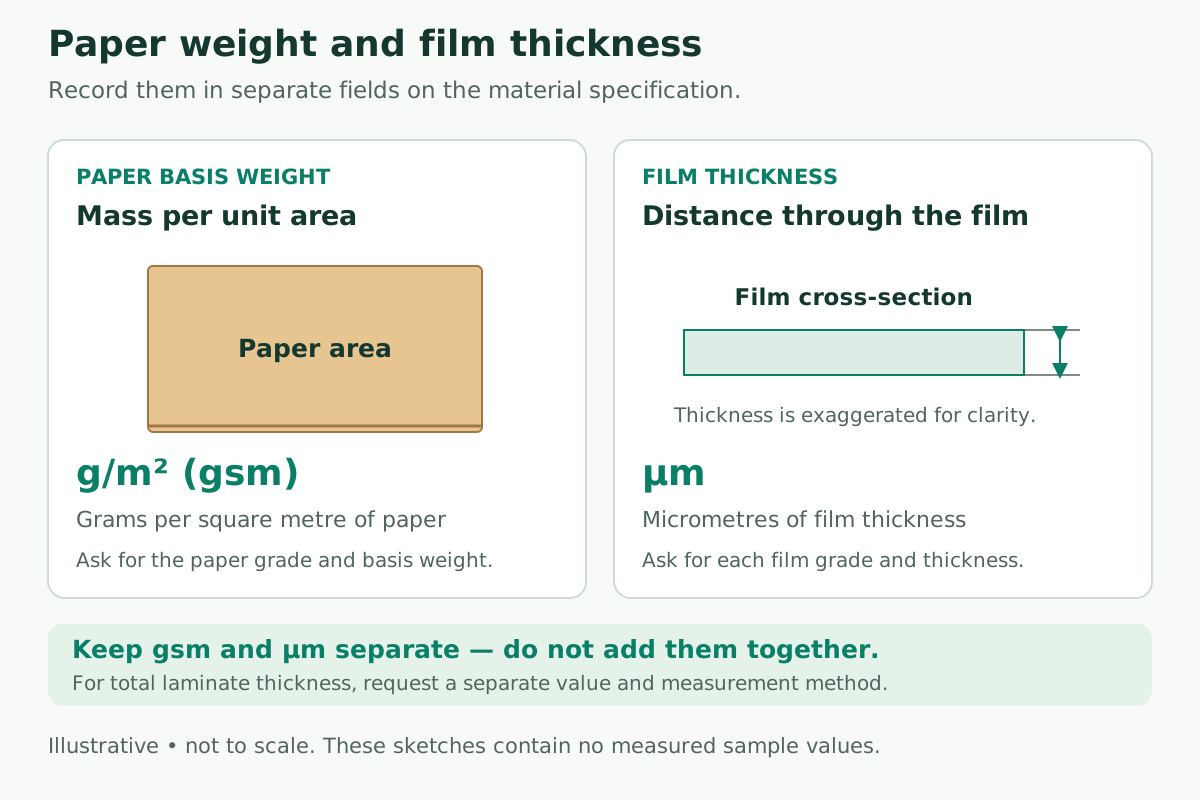
Paper basis weight describes mass per unit area, commonly in grams per square meter, written g/m² or gsm. Film thickness describes a distance, commonly in micrometers, written μm. Adding a paper’s gsm value to film thickness values produces no meaningful total thickness.
The Flexible Pouches KraftPoly data sheet is a useful example of recording paper basis weight separately within a film-and-paper construction. Its particular recipe belongs to that supplier’s sheet; it is not the specification for either Mylarbag project above.
Ask separately for the paper’s basis weight, each film thickness and the finished laminate thickness with its measurement convention and tolerance. If two quotations use “total thickness,” establish whether both describe one finished laminate wall and how they were measured. Do not compare one wall with a measurement taken through both sides of a flattened pouch.
Scroll horizontally to view the full diagram.
Allow for coated-paper constructions
Some paper-based packaging obtains functions through coatings rather than the particular film sequences above. Mondi’s functional barrier paper range describes several coating technologies, including extrusion and aqueous coatings. This is a reason to ask for the exact product system when a quotation says “coated paper.” The phrase alone leaves its composition and intended use unresolved.
Scroll horizontally to view the full table.
| Specification field | Information to obtain | Decision it supports |
|---|---|---|
| Direction and surfaces | Outside-to-food-side order and the exposed face | Whether the proposed surface matches your appearance brief |
| Paper | Grade, basis weight and surface treatment | Comparison of the actual paper component |
| Films | Material grades, individual thicknesses and tolerances | Comparison of like-for-like film specifications |
| Adhesives and coatings | Their inclusion in the complete construction record | Review of components omitted from shorthand |
| Functional-layer data | Structure version, test method, units and conditions | Meaningful comparison of the supplied results |
| Contact and sealing face | Intended-use documentation and proposed process checks | Suitability review for the food and packing method |
| Window and components | Local structure, closure and valve details where fitted | Review of the finished pouch beyond its main wall |
Match the barrier evidence to the food and the route
Describe the food before requesting a barrier recommendation. State its form, whether its surface carries oil, the intended fill, the desired selling period and the storage and delivery conditions you expect. A material name cannot supply those project requirements for you.
Ask what a supplied result measures. Oxygen transmission rate, or OTR, and water-vapor transmission rate, or WVTR, should travel with the tested material description, units, method and environmental conditions. Check whether the report concerns a particular film, the proposed laminate or another construction. Compare values only after resolving those differences with the supplier.
If a quotation gives one attractive number without its test conditions, request the missing information before using it to choose between candidates. Record the requirement that matters to your food separately from the value the supplier happens to have available. This prevents a convenient data sheet from silently becoming the acceptance specification.
A metallized-film description also needs careful reading. VMPET and aluminum foil identify different components. A silver-looking interior does not settle which is present, and either name still leaves the finished construction and its measured performance to confirm. When oxygen, moisture or light protection matters, discuss the proposed structure through our barrier layer options.
Material testing, package integrity and food storage evaluation answer different questions. A laminate result does not establish how a particular filled pouch will behave at its seals, folds or window. A successful filling trial does not establish a shelf life. Agree what additional evidence is needed for the actual product before approving a selling-period claim.
Food-contact review follows the same attention to conditions. The FDA’s food types and conditions-of-use tables distinguish dry solids with surface oil from those without it, and distinguish different use conditions. Tell the supplier your actual food and process, and request applicable documentation for the target market and complete construction. “Dry food” and an inner-film abbreviation are too little information for that review.
Review the window, folds and final seal together
Identify what remains across the window
Ask the supplier to describe the viewing area itself: which materials remain across it, where the paper stops and how that area relates to the surrounding wall. A window is a local construction detail, not just a shape to draw on the artwork.
Compare its agreed position with a filled sample. Check whether the product sits where you intended and whether the display area remains useful as the pouch changes shape. If you enlarge or move the window, ask which material or performance checks need repeating. Neither equal protection nor reduced protection should be assumed from transparency alone.
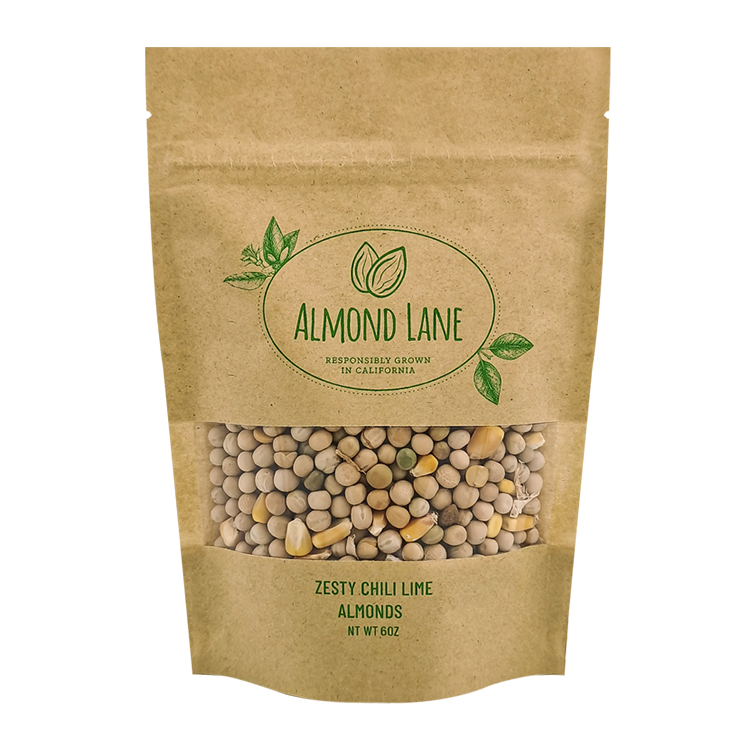
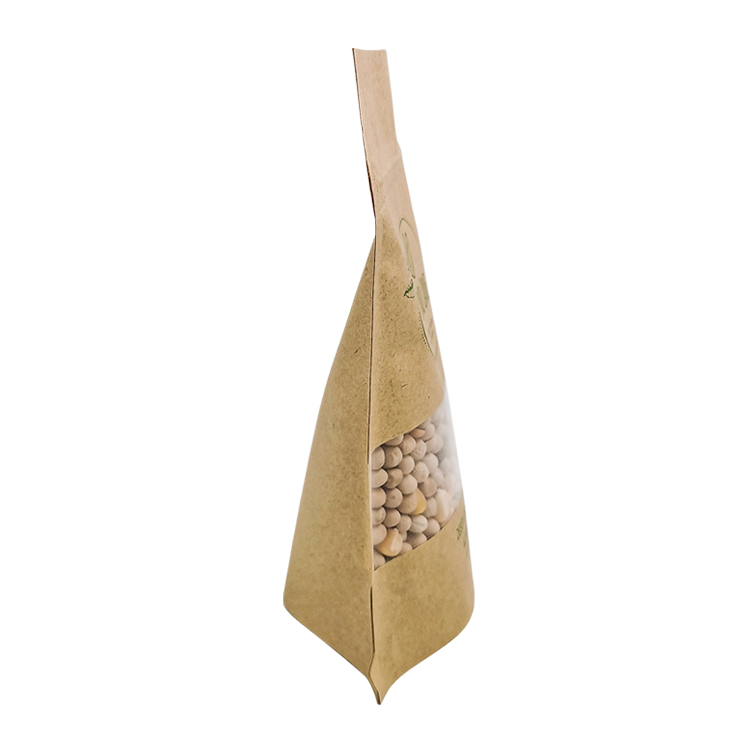
Figure 5 shows the nuts pouch from the side. The folded base helps explain why a flat front photograph cannot show every region of the formed bag. Include the base and side transitions when reviewing the filled sample, particularly where you observe creasing or damage.
Establish a sealing process for the actual laminate
Heat sealing requires compatible sealing surfaces and an appropriate process for the complete construction. Start with the supplier’s guidance for the named material and your equipment. Record the sample version, machine, settings, filling method and observed result. Avoid carrying a remembered temperature from another brown pouch into the new trial without checking it.
ASTM F2029’s public scope explains that overall construction affects heat sealability and that laboratory sealing work does not replace production-equipment validation. It also distinguishes the seal-strength criterion from seal continuity. A strong portion of a seal does not establish the absence of a channel elsewhere.
If a sample seal looks uneven, record where and under what settings it occurred. Check for food in the sealing area, wrinkles, alignment and the actual material version. Treat these as possible contributors to investigate, rather than declaring one cause from a photograph. If a sealing change appears to help, repeat the review under the agreed process and retain the record.

Where a self-sealing strip is fitted, review reopening separately from the initial heat seal. Check product clearance and the intended closing sequence. A convenient reclosure does not answer the questions about the initial sealed package.
For a coffee-specific review, our related site EcoCoffeeBag provides a coffee bag sample checklist covering the sample reference, valve clearance and closing process. Use it to organize observations; agree laboratory or storage validation separately where required.
Check the claim for the complete pouch
Write down the disposal statement you intend to print before approving artwork. Then identify the complete construction and the market in which that statement will be used. Paper appearance, paper content, recyclability and compostability each describe different things.
For a paper-recycling claim, examine the applicable collection, sorting and processing route as well as the package. 4evergreen’s Circularity by Design guidance addresses different paper-recycling pathways and the effects of design on sorting. Its guidance does not certify an individual pouch or establish acceptance in every local collection system.
For a compostability claim, request evidence covering the specified finished product and relevant conditions. Check whether the scope includes its films, coatings, printing and fitted components. Evidence about a raw material should not be silently extended to a different finished bag.
If a supplier proposes a bio-based component, ask what it is and what the term establishes. Its feedstock description alone does not prove that the pouch contains no plastic or belongs in a particular disposal stream. Keep unsupported symbols and statements off the artwork while the relevant evidence is being resolved.
Send a material brief that can become a production specification
A useful enquiry can begin before every specification is settled. State what you know, identify what you need help selecting, and ask for a documented proposal. This lets the supplier distinguish a firm requirement from a visual preference or an unresolved assumption.
Scroll horizontally to view the full table.
| Brief item | Information to send | Result to obtain or confirm |
|---|---|---|
| Food and filling | Actual food, surface oil where relevant, target fill and packing method | Suitable candidates and the conditions needing review |
| Appearance | Brown or white paper, exposed-paper or film surface, reference images | An identified outer surface and finish |
| Material version | Existing structure, or a request for a complete proposal | Named layers, paper basis weight, film thicknesses and other relevant components |
| Window and features | Viewing area, opening, self-sealing strip or valve requirements | Corresponding drawing and local component specifications |
| Protection and storage | Intended distribution conditions and selling period | Relevant data and a plan for outstanding product validation |
| Sealing and samples | Equipment, sample reference, settings and observations | Traceable trial results and specific revisions to review |
| Market and claims | Sales destination and proposed disposal wording | Applicable evidence or a revised, supportable statement |
| Design and approval | Brand assets, product wording and agreed material/layout | Reviewed artwork, layered print files and the approved specification version |
Use wording such as: “Please propose a kraft pouch for our named food and target fill. We want the surface shown in the attached reference and a window in the marked area. Please identify the outside-to-food-side structure, paper basis weight, film thicknesses and window construction. Confirm what sample and documentation we should review for our packing process and sales market.” Replace the descriptive fields with your own information; flag any undecided requirement explicitly.
Keep the sample’s identity with the response. A similar-material pouch can help you compare touch and appearance, but may have a different size, window or closure. Record those differences before deciding what it can approve. A fully specified custom sample supports a more specific review, provided it matches the version being considered.
When you request a revision, name the observation and the affected specification. “Please increase the available sealing clearance on this drawing” gives a clearer next step than “make the bag better.” Ask which checks must be repeated when the material, size or feature position changes. Retain the final drawing, material record, artwork revision and sample reference together for the production decision.
Recommended Packaging Configuration
For a project that needs a visible paper surface and a product window, use the published Kraft paper/PET/PE stand-up pouch as a configuration to discuss, subject to your food, window and sealing review. Where a kraft appearance, outer film and metallized layer fit the brief, the MATOPP/kraft paper/VMPET/PE coffee project provides another reference; include a valve only if the intended product and packing plan call for it.
Compare these paper packaging configurations as starting points for a proposal. Send the configuration you want to discuss with your actual product details, and identify which dimensions, features and evidence must change for your order.
Free design starts with the material and the approved layout
Mylarbag offers free packaging design and provides customers with layered, print-ready files. For a kraft pouch, share your logo, product wording, design references and preferred paper appearance. The design brief should identify the actual surface, window area and approved pouch layout before the artwork is finalized.
This connects the visual decisions to the bag you are ordering. Mark which areas should show the paper, which should reveal the product and where important wording belongs. Discuss white areas and any separate print instructions against the selected material and printing method. A flat mockup alone cannot settle those production details.
Layered files make the agreed design available for review and production handoff. Keep the approved version with its matching material and drawing references. A later change to the bag format, surface or printing setup may require another artwork check. The design service helps prepare that artwork; the material, food-use and sealing checks remain part of the packaging approval.
Frequently asked questions
What is inside a kraft paper food pouch?
Read the complete structure for the particular pouch. Published examples include Kraft paper/PET/PE and MATOPP/kraft paper/VMPET/PE; coated-paper systems also exist. Ask which surface faces the food, which materials provide the required functions and what the shorthand leaves out. A brown exterior alone cannot supply that information.
Are all kraft paper pouches lined with plastic?
Do not decide from the kraft label. Ask for all films, coatings and other components in the proposed construction. A pouch with a paper component may also contain polymers, and a bio-based description does not automatically mean plastic-free. Any absence claim needs evidence for the complete product.
Does a silver lining mean the pouch contains aluminum foil?
No. A silver appearance does not distinguish aluminum foil from metallized film or another construction. Request the specific material name and full structure. If the record says VMPET, it identifies metallized PET; it should not be relabeled as a foil layer based on the photograph.
Can a kraft paper pouch be heat sealed?
It can when its actual sealing surfaces and construction suit an appropriate heat-sealing process. Obtain guidance for the named material, then verify the process on your equipment and sample version. There is no single temperature that can be selected just because a pouch looks like kraft paper.
Does a clear window change the material specification?
The viewing area needs its own description within the complete specification. Confirm the materials across it, its position and any differences from the surrounding wall. Assess the formed and filled pouch, including seals and folds; transparency alone does not establish either equivalent protection or a particular performance loss.
Can a kraft pouch go into paper recycling?
Only make that claim when evidence supports the specified complete pouch and the relevant collection and processing route. Films, coatings and other components must be considered with the paper. Ask for the applicable assessment and destination guidance before choosing disposal wording or symbols for the pack.