
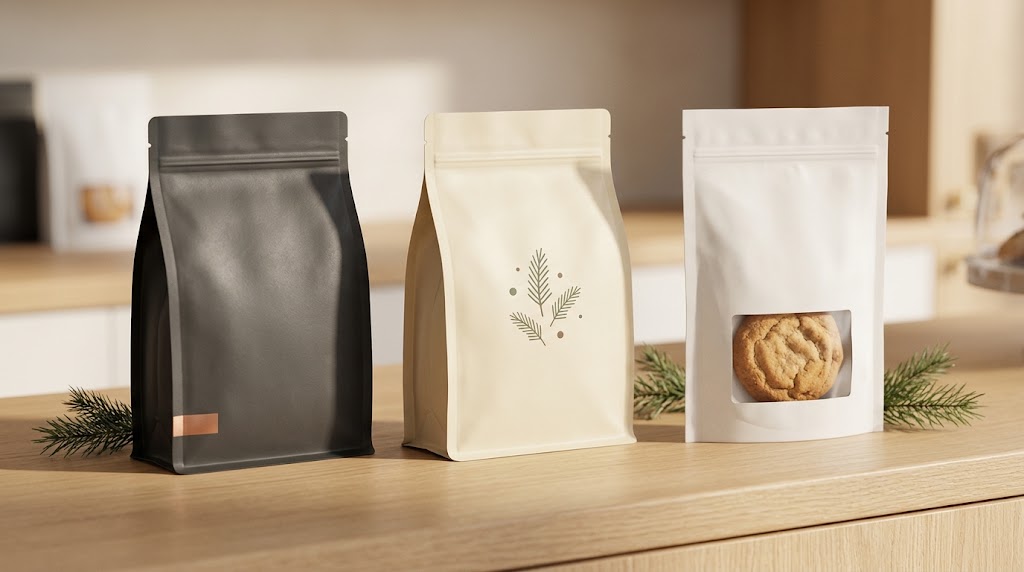
A gift-worthy cookie bag has two jobs. It should make the cookies feel like a thoughtful purchase, and it should deliver those cookies in the condition the buyer expected. Rich black ink cannot stop a fragile shortbread from breaking. A gold detail cannot repair a weak top seal. A pretty window that shows the product may change the package's protection against moisture or light. The best luxury cookie packaging brief treats these as connected design decisions.
The short answer: choose the cookie, pack count, sales route and desired unopened quality period first. Pick a bag geometry that fits the filled product and permits a dependable initial seal. Then choose a restrained visual system—perhaps an opaque matte field, one small metallic accent and a clear place for the flavor and required information—and test the finished printed bag. Plan holiday artwork by version and sell-through, because an attractive seasonal bag can become unusable when a recipe, date or promotion changes.
This guide is about flexible food bags for cookies people eat: individual gifts, small retail multipacks and seasonal assortments. It is not a guide to rigid tins, boxes or pet treats. Packaging performance depends on the actual recipe, materials, seal, fill process, storage and distribution. Visual concepts below are ideas to prototype, not verified specifications for another bakery.
What Makes a Cookie Bag Feel Premium?
Premium is not synonymous with more decoration. A bag can feel considered when a shopper can identify the cookie flavor quickly, see or imagine the product clearly, hold the pack comfortably, and open it without tearing through a confusing stack of trim and seals. The printed surface, pouch shape, filling level, opening and hand feel all contribute. A sophisticated design that hides the flavor or folds a critical label into a gusset is less useful at the shelf.
Start by writing a short brief in ordinary language:
- Product: Is this a crisp butter cookie, a soft filled cookie, a crumbly bite or an iced piece with a raised surface? Record maximum dimensions, count, weight, expected crumbs and the most fragile edge.
- Moment: Is the bag sold from a bakery counter, hung on a display, presented in a gift assortment, shipped directly, or opened repeatedly at home? Each route changes the need for stiffness, fit and reclosure.
- Position: What price and portion does the pack communicate? A single oversized bag containing two small cookies can feel underfilled even if the graphic looks expensive.
- Brand signal: Choose a limited palette, one focal element and a clear flavor name. An intentional hierarchy often reads more premium than multiple metallic effects competing for attention.
- Information: Identify the market, product name, ingredients and allergen copy owner, net quantity, variable lot/date location and barcode position before approving art. The bakery or brand must sign off its actual finished-food label.
- Quality target: State a proposed unopened period and the sensory attributes you will test, such as snap, tenderness, flavor and aroma. Do not assign a shelf life from a visual mockup.
Put the physical bag in the brief. Specify whether the cookie should be seen, whether hands may leave marks on a dark matte field, how the pouch should stand after filling, and how far the initial heat seal sits above any zipper. This turns “luxury” into choices a printer, converter and bakery can evaluate together.
Select the Bag Format Before the Finish
Creative cookie packaging can begin with a flat sleeve or a small stand-up pouch. A finish does not compensate for a format that crushes a decorated cookie or leaves too much empty space. Test the filled bag, not just its nominal width and height.
| Selling situation | Flexible-bag route to trial | Appearance opportunity | Physical issue to check |
|---|---|---|---|
| One decorated or thick cookie | Sized flat pouch or sleeve, with external support where needed | A simple front panel frames one product; a modest window can reveal decoration | Surface clearance, rubbing, corners, seal area and whether the cookie bends during handling |
| Two to four fragile cookies | Sized flat or stand-up pouch, with a pack pattern that limits movement | Upright front can carry a gift message and flavor name | Cookie-to-cookie impacts, crumbs in the top seal, fill level and stable display |
| Small assorted gift pack | Stand-up pouch or another geometry proven for the actual assortment | Color can distinguish the assortment without rewriting the whole brand | Mixed cookie sizes, flavor/ingredient label accuracy and excessive headspace |
| Repeatedly opened multipack | Stand-up zipper pouch with a separate initial heat seal where specified | Reclosure can support a take-home gift experience | Zipper accessibility after tearing, top-seal clearance and zipper performance with crumbs |
| Holiday shipment | A tested food bag plus appropriate outer support and shipping system | A beautiful pouch can be the unboxing focal point | Bag scuffing, crushing, distribution vibration and the state of cookies on arrival |
For a flat bag, measure the cookie's largest footprint and thickness and allow for product variation and a seal-free area at the mouth. For a stand-up pouch, check the bottom gusset after filling: it should support the intended count without distorting the front or making a top-heavy display. Evaluate the actual fill method, because a cookie that fits when carefully hand placed may scrape artwork or contaminate the sealing zone at production speed.
The amount of “air” in a pouch is a design and handling question, not an aesthetic rule. Too much unrestrained movement can lead to breakage; a bag pulled tightly around cookies may abrade raised icing or squeeze delicate edges. Use filled trial packs to find a workable balance. If the gift will travel, the outer shipping support handles loads the food bag alone may not handle.

Black, Matte, Metallic and Window: Choose the Effect for Its Job
Black cookie packaging can make pale cookies and a limited accent color stand out. It can also reveal fingerprints, scuffs, dust and creases, depending on the film and finish. A dark mockup viewed on a screen will not show how the printed and filled bag behaves under a store light. Compare physical production-representative samples on both the front and the folds.
Foil stamping is a decorative metallic detail applied to a defined area; it is not the same thing as an aluminum-foil barrier layer in the bag structure. A metallic-looking ink or metallized film also must not be assumed to perform like a particular foil laminate. Similarly, spot UV gives selected print areas a visual and tactile contrast; it does not by itself establish oxygen or moisture protection. Mylarbag describes foil stamping and spot UV as finishing options. Treat each finish as something to specify, proof and inspect on the intended film.
| Design feature | Where it can help | What can go wrong | What to inspect on a real filled sample |
|---|---|---|---|
| Deep black or dark color field | Makes a limited palette, cookie name and warm metallic accent more prominent | Marks, scratches, banding or low-contrast mandatory text | Different lighting, finger handling, folds, gusset and legibility at normal shopping distance |
| Matte or soft-feel surface | Reduces glare and adds a quieter hand feel | Scuffing, fingerprints or unexpected difference between proof and production | Rub and handling trial, bag-on-bag contact, seal and fold locations |
| Small foil-stamped detail | Creates a controlled highlight on a logo or motif | Registration variation, flaking at a fold, poor readability if used for small text | Alignment, adhesion and abrasion on the exact substrate and pouch shape |
| Spot UV detail | Adds gloss contrast to a matte field | A patchy or misplaced effect; altered readability over fine type | Registration, visible scuffs and appearance under display lighting |
| Clear window | Shows cookie texture and decoration directly | Reduced protection if the window construction differs, light exposure, unattractive product settling | Window size and position, actual barrier data for the complete construction, filled-pack appearance |
| Seasonal color or label panel | Changes the gift mood without redesigning every structural element | Wrong flavor/ingredient label, unused seasonal inventory | Version proof, scan, label adhesion and year-round stock compatibility |
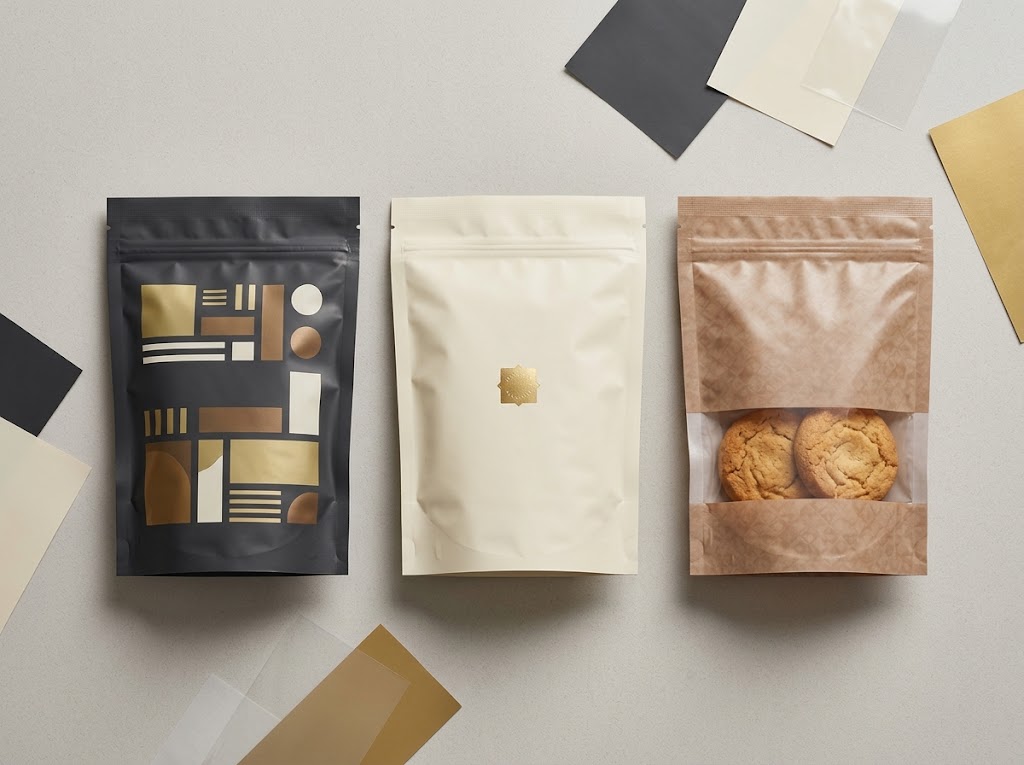
Use effect sparingly. A practical premium front might have a matte field, an unmistakable flavor name, a small stamped mark and a product window only if seeing the cookie adds value. Put operational text where it remains readable after filling. If the barcode sits on dark or reflective art, create a sufficiently calm, flat print area and scan a real sample. GS1's barcode quality guidance discusses contrast, quiet zones, size, position and print defects; a rendered artwork file is not a scan result.
Is a clear window always a good idea for gifts?
No. It can reassure a buyer about the cookie's decoration, color and size, especially for a single gift cookie. It can also expose a product that shifts or breaks in the bag. It may change the package's overall oxygen, moisture or light protection. Ask for the window and opaque areas as one complete specified construction, and compare the intended quality period using that construction. An illustration of a window cannot answer the shelf-life question.
Can cute cookie bags look premium?
Yes, when the motif matches the product and does not erase the useful hierarchy. A tiny illustration or holiday icon can be memorable; a dense pattern over every surface may make flavor, net quantity and ingredients difficult to locate. For a gift set, the bags can share a restrained base system and use color or a small motif to distinguish recipes. “Cute” is a style choice; fit, food contact and seal still need their own checks.
Protect Crispness, Flavor and the First Opening
The visible finish belongs on the outside. The bag structure must answer what the cookie needs inside. Some crisp cookies gain moisture and lose snap; soft cookies may dry or change texture; fat-rich cookies can develop off flavors under unsuitable storage. Product formulation, water activity, oxygen exposure, light, temperature and time all matter. The bag's nominal film data is only part of the package. Seals, folds, windows, zipper features and production variation affect the finished pack.
Ask a supplier to identify the proposed outside print surface, any middle barrier layer, and the food-contact sealant layer. Request the regulatory status information appropriate to the intended use and selling market. The U.S. FDA's food-contact material guidance explains that the status of components and their intended conditions of use matter. It does not certify a finished holiday cookie design by itself. The food business should review its own product and market requirements.
If protection against moisture or oxygen is relevant, request the test method, units and conditions behind any water-vapor transmission rate (WVTR) or oxygen transmission rate (OTR) claim, and check that the reported construction is the one being quoted. A low value for an opaque base film may not describe a windowed finished pouch. Neither test number alone predicts the sensory end point of a particular cookie. Study filled and sealed product at its intended conditions, with a quality criterion agreed in advance.
The initial seal deserves its own space in the graphic and dieline. For a resealable pouch, leave the appropriate region above the zipper for a reliable heat seal, tear or opening feature, and lot/date code where relevant. The zipper is useful after the consumer first opens the pack. It should not be described as a substitute for the initial heat seal if the unopened retail pack requires one. Crumbs or oils in the seal region, incorrect heat settings and wrinkles can all create problems that a metallic logo cannot hide.
Handle and open trial packs the way a customer would. Can someone start the tear without ripping through the printed flavor name? Does the zipper remain reachable? Does a stiff decorative panel prevent the bag from closing? If the gift is handed over at a counter, look at the pack under store lighting and after normal handling. If it is shipped, examine the pouch and cookies after a route-relevant transit trial.
A Real Cookie-Pouch Example, and a Separate Holiday Concept
Mylarbag publishes a 3.5 oz organic-cookie bakery-bites stand-up pouch. The listed structure is PET/VMPET/anti-static PE, the nominal size is 12 × 18.5 + 3 cm, and the product is described as digitally printed with a zipper. Its photographs show a branded front and a densely printed back. These are useful concrete references for the amount of space a small pouch can devote to a product story, flavor and information panels.

Suppose a bakery wants a winter gift version of a similarly sized product. A hypothetical concept would keep an already tested pouch geometry and the correctly specified food-contact structure, while changing the visual palette and a limited seasonal front-panel motif. It would check every new flavor's ingredient and allergen text, test the print and any finish on actual material, fill the most delicate recipe, verify the initial seal, and approve the finished bag before ordering. If the seasonal concept adds a clear window, that is a structural change to evaluate rather than a harmless artwork swap.
The published case does not report this hypothetical project. It does not publish a measured holiday finish durability result, a transit damage rate, a guaranteed quality period, a quote, or a minimum per seasonal design. Its dimensions should not be copied as a size recommendation. Use a case to frame a prototype, then judge the prototype on its own evidence.
Plan the Holiday Versions Before Buying the Print Run
Holiday cookie packaging adds a calendar problem to an ordinary packaging specification. A package can be technically good and still be wrong when it arrives after the selling window, when a recipe changes, or when one flavor sells out while another leaves printed bags in storage. Start with the last day a pack can realistically be sold with that artwork, then work backward through sample, label and production approvals.
Create an artwork register for every version. Record the cookie recipe and count, market, language, ingredient and allergen copy source, barcode, print file revision, proof approver, bag structure, dimensions, finish and intended selling window. Give each flavor and holiday version an unmistakable ID. A common visual system reduces design work, but it does not make two different ingredient panels interchangeable.
| Planning gate | Decision and evidence to keep | Why it matters |
|---|---|---|
| Product and structure freeze | Recipe, count, target quality period, proposed film, window, bag geometry and closure | A design approval cannot rescue a structure that has not been tested with the cookies. |
| Copy and version control | Approved flavor, ingredients, allergens, quantity, claims, barcode and variable code area by version | A seasonal color change may still require a separate correctly labeled SKU. |
| Physical finish proof | Actual substrate, printed colors, black scuff, foil or UV registration, window and filled appearance | Screen colors and flat artwork hide handling and geometry issues. |
| Packing and quality trial | Real fill process, initial seal, closure, product quality and a transit-relevant check | The final decorated bag must work on the actual packing route. |
| Production release | Signed proof, approved sample, quantity by SKU, delivery milestones and buffer decision | An order for combined volume may still create a minimum or stock problem for one design. |
| End-of-season review | Sell-through by SKU, unused printed bags and whether copy or dated artwork will remain valid | This informs next year's art and prevents an optimistic reorder from becoming obsolete stock. |
Treat the sequence as gates, not a promise of a particular number of days. Ask for a written schedule based on the bag format, finishing route, proof process, quantity and number of designs. If a supplier offers a short-run print route, confirm minimums and production timing per artwork and for the complete order. Mylarbag's digital-printing information describes a route for multiple versions, but published general claims cannot replace a project quotation or a signed schedule.

For uncertain demand, compare a shared year-round pouch with controlled seasonal labels against a fully printed holiday pouch. The shared bag may make leftover stock usable after the season, but labels create application and version-control work. The fully printed pouch may make a stronger shelf impression, yet it can tie up cash in art with a short useful life. The right answer depends on actual quotes, labor, forecast by flavor, finish needs and packaging performance. For a general cost model, the separate small-business packaging guide can cover stock-versus-custom economics; this article's decision is specifically the seasonal presentation and approval risk.
Beware of a printed date such as “Holiday 2026” unless that date adds enough value to justify a shorter useful life. A winter palette without a year might remain usable for a later run only if the label, claims, recipe and market requirements still match. Do not assume unused packs are automatically compliant or physically sound after storage; inspect them before reuse. Keep any lot or best-before marking under controlled variable coding, rather than embedding a production date in decorative art.
Inspect the Printed Bag, the Seals and the Gift in Transit
Sign-off is easiest when the buyer and supplier agree on what a passing sample looks like. Ask for a production-representative physical pouch and fill it with cookies from the real process. Compare the approved artwork against the filled front, back, gusset and seal areas. Inspect several bags, including folds and edges, rather than judging one carefully staged photograph.

Use a sample review sheet with specific, observable entries:
- Content and scan: Match the correct flavor, ingredients and allergen panel to each SKU. Confirm barcode scan performance on the finished, filled bag, including dark or reflective designs.
- Appearance after handling: Check color consistency, registration, matte scuff, foil adhesion, spot UV placement, window clarity, folds and rub marks under the lighting where it will be sold.
- Filled geometry: Check the bag standing position, apparent fill, product clearance, fragile edges, gusset stress and whether any cookie presses into the tear feature.
- Seal and opening: Check a clean initial heat seal, seal width and alignment, zipper operation if present, tear usability and date/lot readability. Set acceptance criteria for the actual structure and equipment.
- Cookie quality: Compare texture, aroma, appearance and breakage during the proposed unopened period using your own defined sampling plan and storage conditions.
- Distribution: Pack the intended number of bags in the planned support and shipper, use a route-relevant trial, then record pouch scuff, crushed corners, broken cookies and consumer opening experience on arrival.
Seal strength can be sampled using a defined method such as ASTM F88/F88M-23. A number from that test needs a sampling plan and an agreed acceptance range for the specific pack; it does not, by itself, prove every seal leak-free or set a cookie's shelf life. If the bag travels through parcel or retail distribution, an appropriately scoped distribution protocol may draw on ASTM D4169. Define the actual shipping system and evaluate both the bag and the cookies afterward. A decorative finish should be assessed after that handling, not only on a pristine press proof.

If the same artwork is printed on a different film, or a window, zipper, gusset, seal layer or finish changes, review the sample and test plan again. The word “same design” can hide a changed package. Keep the signed physical reference and revision details so that production checks compare like with like.
Three Practical Premium Cookie-Bag Concepts
These are design briefs to prototype, not endorsements of a specific film or guaranteed cookie shelf life.
1. The dark, restrained retail gift pouch
Use a stand-up pouch sized to the actual cookie count. Keep a deep black or charcoal field, a clearly legible cookie name, one modest metallic mark, and an uncluttered back for food information. Choose the underlying structure for the product, desired quality period and selling route. Test scuffing on the dark surface, foil registration, barcode contrast, top-seal cleanliness and consumer opening. A matte look does not tell you the bag's barrier value.
2. The single decorated-cookie keepsake bag
Show the cookie through a well-placed clear area only after deciding that exposure and appearance are acceptable. Leave enough room above raised icing so the bag does not abrade the decoration. Test the exact window construction and seal. If the gift is shipped, add appropriate support outside the food bag. The decorative cookie should arrive intact; the visual appeal of the empty bag does not predict that outcome.
3. The seasonal assortment with a shared visual system
Keep pouch geometry and core brand elements consistent across flavors that genuinely use the same validated structure and size. Give each recipe a distinct, controlled flavor panel and ingredient/allergen copy. Add a small seasonal motif or color accent while preserving space for the barcode and variable code. Forecast quantity by version, not only the combined assortment. If one recipe has a different quality need, resist forcing it into the common film solely for visual consistency.
Before selecting a route, compare custom cookie-bag options and request samples for the actual cookie, structure and decoration. A supplier conversation is most productive when you send the product dimensions, fill count, target quality period, selling market, packing method, desired finish, forecast by version and the date physical samples need approval.
FAQ: Luxury and Holiday Cookie Bags
What is the best packaging for luxury cookies?
There is no one best bag. Start with the cookie's size, fragility and quality target, then select a tested structure, pouch shape and initial seal. A controlled print hierarchy and a limited finish can make that proven format feel premium. Confirm the result on filled samples, including retail handling and any shipment.
Are black cookie bags suitable for food packaging?
Black is an exterior design choice, not a food-contact or barrier specification. Review the full construction and intended use, then check scuffs, copy contrast and barcode scanning on the printed and filled bag. The film and inner sealant must be appropriate for the actual food-contact conditions.
Does foil stamping keep cookies fresh?
No. Foil stamping is a decorative surface process. Protection against moisture, oxygen or light depends on the specified package construction, seal quality and storage conditions. An aluminum-foil barrier layer is a different component; even a barrier layer does not remove the need for a filled-pack study.
Does a matte finish change the barrier?
Do not infer barrier from the appearance. A matte coating or surface treatment may change hand feel and abrasion behavior. Obtain the properties of the complete material construction being quoted, and test the filled bag under its intended conditions.
Should a holiday cookie bag have a clear window?
Use a window when product visibility helps the purchase and the exact windowed construction meets the product's needs. Test the filled visual appearance, light exposure, seal and unopened quality. A fully opaque bag may be a better brief for a cookie that is especially sensitive to the proposed display conditions.
Can a zipper replace a heat seal on a gift cookie pouch?
For a retail pack specified to have an initial heat seal, no. The zipper serves the consumer after opening. Design enough clearance for the heat seal and opening feature, and verify the seal on the actual packing equipment. Requirements can differ by product and sales route, so define the closure in the project brief.
How many holiday designs should a bakery print?
Build the forecast by actual SKU and artwork version. Ask for minimums and costs per version, then compare the proposed quantity with the selling window and likelihood of label or recipe changes. A shared base design can reduce some artwork work, but a wrong ingredient panel cannot be treated as a cosmetic variant.
Can unused holiday bags be used next season?
Only after checking that the design, ingredients, allergens, claims, barcode, market information and bag condition remain suitable. Year-specific graphics and old promotional text can make stock obsolete even when the material is physically sound. Recheck the stored bags and approval record before using them.
Where can I buy cute cookie bags for a gift line?
Look for a supplier able to identify the bag material, food-contact conditions, closure, print/finish process and sample approval route for the intended cookie. Send the product and version brief and request filled-pack trials. For a custom flexible-bag starting point, see Mylarbag's cookie-bag page; compare any quote to your actual format and conditions rather than buying by photograph alone.
What should be approved before a seasonal print run?
Approve the physical bag specification and sample, the exact versioned label copy, artwork and finish, barcode scan, filling and sealing trial, quality-period plan, shipment check where needed, and quantities and schedule by SKU. Keep a signed revision reference. A screen mockup alone does not show print rub, bag folds, sealing behavior or cookie breakage.
Build the Gift Around the Cookie
Start with a pack the cookie can survive. Then use shape, a disciplined graphic hierarchy and a finish that remains attractive after normal handling to create the gift experience. Black, matte, metallic and windows are useful tools when their purpose is clear; none establishes protection without the specified material, seal and product trial. For seasonal ranges, the same rigor applies to each flavor's label and printed inventory. The result should look intentional when it is full, open easily when it reaches the buyer, and preserve the quality you have actually tested.