
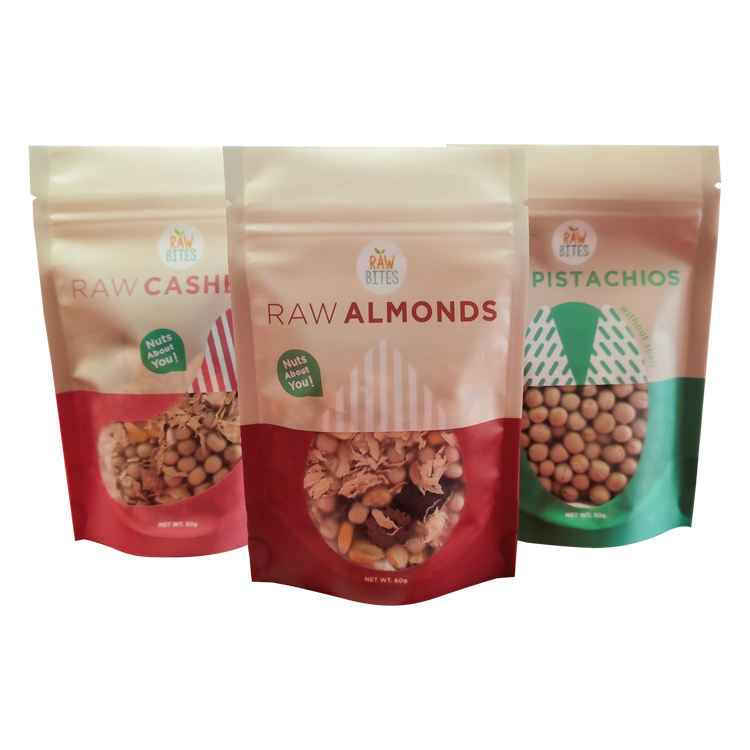
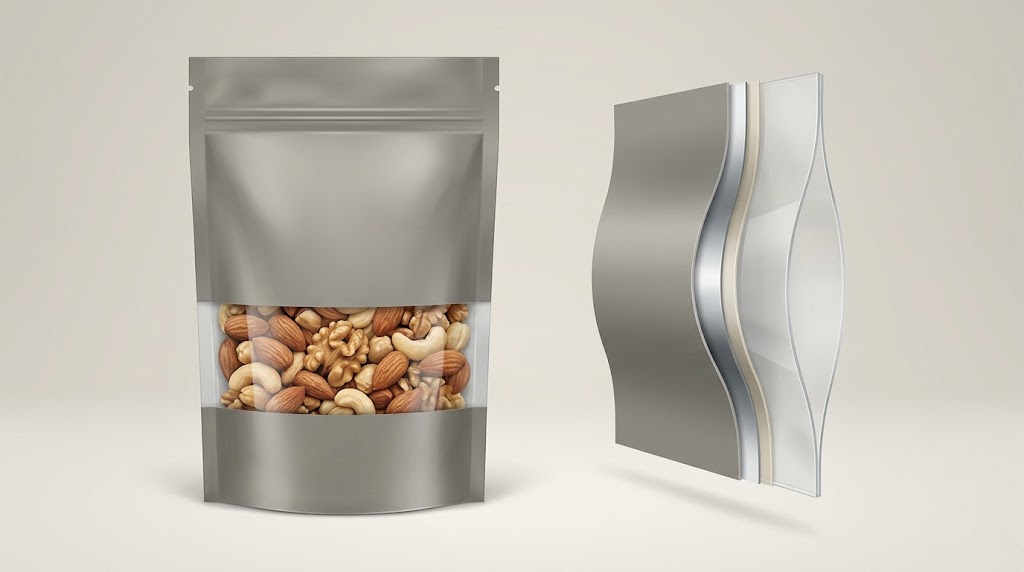
Most retail nut bags are made from one or more flexible films joined into a pouch; some add an outer paper layer, a metallized film or actual aluminum foil. The surface that looks like kraft paper tells you little about the food-contact layer, and a silver interior does not prove that the bag contains foil. A clear window changes the panel construction at that spot. Ask for the entire layer sequence and the finished pouch's performance, not a material nickname, before you choose a bag for peanuts, almonds, cashews or mixed nuts.
That is the short answer to “what are nut packaging made of?” In practice, there is no single standard peanut bag. Dry roasted peanuts might be sold in a heat-sealed printed film pouch, a paper-look laminate with a window, or another qualified construction. The decision depends on the nuts, how they are processed and filled, the intended sales period, the storage and distribution conditions, and the packer's equipment. This article deals with dry retail nut pouches. It does not specify the processing or container for wet boiled peanuts, promise a universal shelf life, or decide whether a finished pouch is recyclable.
The material is only one part of the package system. Oxygen already in the headspace, a contaminated top seal, a puncture, and the customer's storage temperature can each undo an excellent film choice. This guide therefore explains what the material names mean, how to interpret three published nut pouch projects, and what evidence to request before placing an order. The detailed filling, sealing, and shelf-life decisions belong to their own production trials.
Read the bag from the outside toward the food
A printed flexible pouch may have an outer web for appearance and print, a functional middle layer, and an inner layer that faces the food and forms the seals. These can be separate plies bonded by lamination. The film may instead achieve more than one function with fewer plies. Descriptions such as kraft paper/PET/PE are useful starting points, but they are not a complete specification: thickness, grade, adhesives, coatings, window construction, seal design and test conditions are absent.
An outer paper layer can provide a tactile, natural-looking surface; it does not mean that paper alone encloses the nuts. When the published construction says kraft paper/PET/PE, the polymer layers matter for the functional pouch. Likewise, “plastic bag” is too broad to be an engineering brief. Two clear bags can differ in thickness, coatings, sealing layers and measured gas transmission. The appropriate construction has to be specified for the food and the route it will travel.
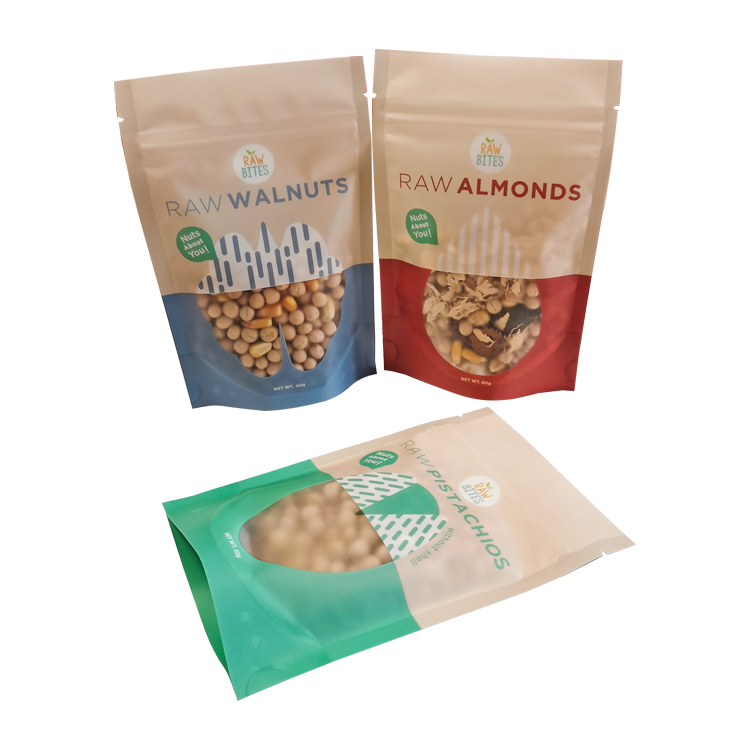
Here is a real example. Mylarbag's US 6 oz nuts-and-seeds project lists a stand-up format, digital printing, kraft paper/PET/PE, a 14 × 20 + 4 size notation and a horizontal window. The public field does not label the size unit; confirm it on the project drawing. The record illustrates a paper outer plus film structure, not an all-paper bag. It does not provide test data from which to calculate your peanut SKU's shelf life.
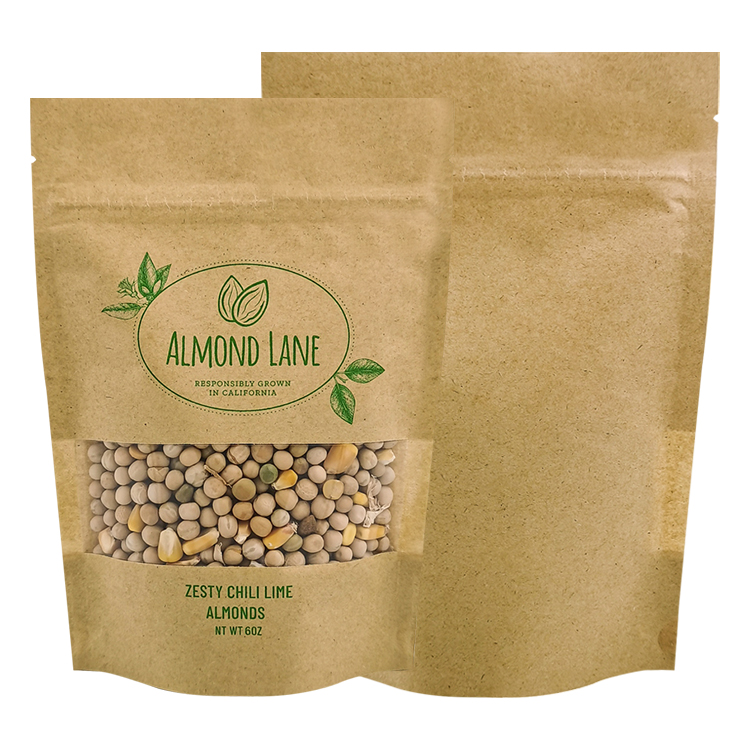
This distinction is practical when a team asks for “paper peanut bags.” Do they want a paper appearance, a paper substrate in the laminate, a paper-only envelope, or a particular recovery route after use? Those are separate requests. For an oily or roasted product, ask how the actual structure controls staining and preserves the intended quality; do not infer a grease or oxygen specification from the brown color. For an unprinted stock bag, obtain its actual technical sheet. A photograph of a similar custom project cannot transfer its material specification to another SKU.
What are peanuts packaged in? Three real constructions, three different questions
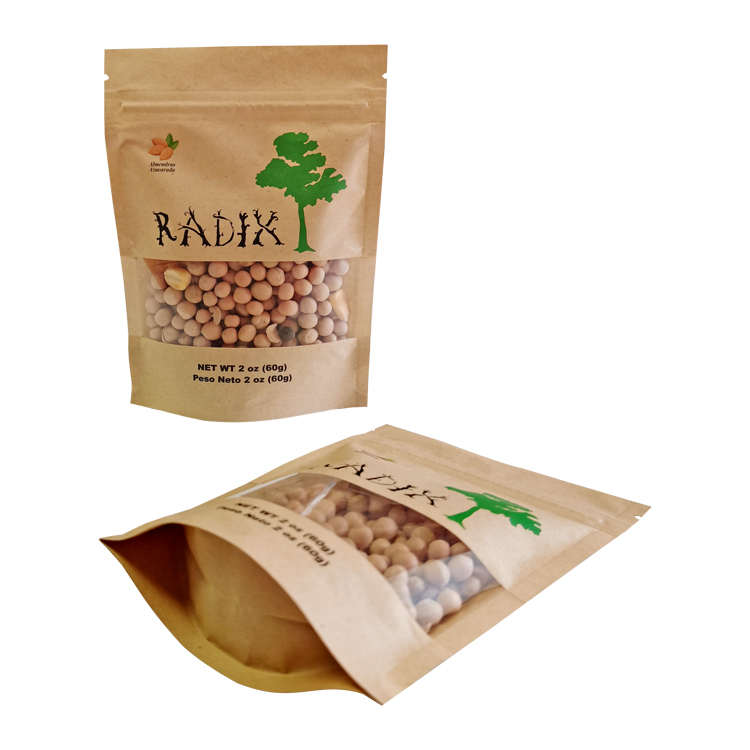
The US kraft project is one combination, not the norm for every peanut. A Puerto Rico candied-nut project lists kraft paper/PET/CPP, digital printing and a windowed stand-up format, with 11.2 × 15 + 2.5 cm on the page. Its title presents “2 oz/60 g”; those are project wording, not an exact unit conversion. Neither the window photo nor the layer shorthand provides oxygen or moisture transmission results.
A third Philippines almonds-and-nuts project shows shaped clear windows and lists Mopp/PET+Vmpet/pe, digital printing and 10 × 15 + 3 cm. The plus sign and capitalization in this publicly displayed sequence are ambiguous: the page does not explain which material is continuous in the window, which is in the opaque area, or whether the notation combines alternative webs. Do not convert that label into a confidently asserted ply-by-ply cross-section. Request the approved construction drawing for each panel, including the window, and the corresponding test report.
The projects also show why “how are peanuts packaged?” has two possible meanings. Material construction names the substrates and interfaces. Packing process describes how a food business fills the package, manages the headspace and closes the top. A site can show a completed pouch and still leave the filling machine, gas treatment and quality-control results unspecified. Do not backfill those unknowns with guesses based on a finished photograph. For a new peanut line, send the actual product, planned net weight, product state and packing route to the supplier, then ask for a sample and drawing that match.
Why are some peanut bags silver inside? Foil is only one explanation
An opaque silver surface can come from rolled aluminum foil, a metallized polymer film, or even a visual finish that is not the claimed functional barrier. “Mylar bag” is often used loosely in purchasing discussions. It is not a sufficient material stack. A buyer who needs aluminum foil should ask for AL in an unambiguous approved construction, the metal gauge and the complete laminate. A buyer quoted VMPET is being offered a metallized PET film, not a sheet of solid aluminum foil.
Cosmo Films describes metallized BOPET as polymer film with a thin deposited metal layer, usually aluminum. The European Aluminium Foil Association describes aluminum foil's high barrier to light, gases and moisture and its use with other plies in flexible laminates. Those are material principles, not proof that any particular nut pouch is leak-free. Thin foil can develop pinholes or damage in converting and distribution; the Sterilization Packaging Manufacturers Council distinguishes a foil-layer pinhole from a through-hole in the whole laminate and notes the role of flexing. The food package must be evaluated as the actual construction and finished bag.
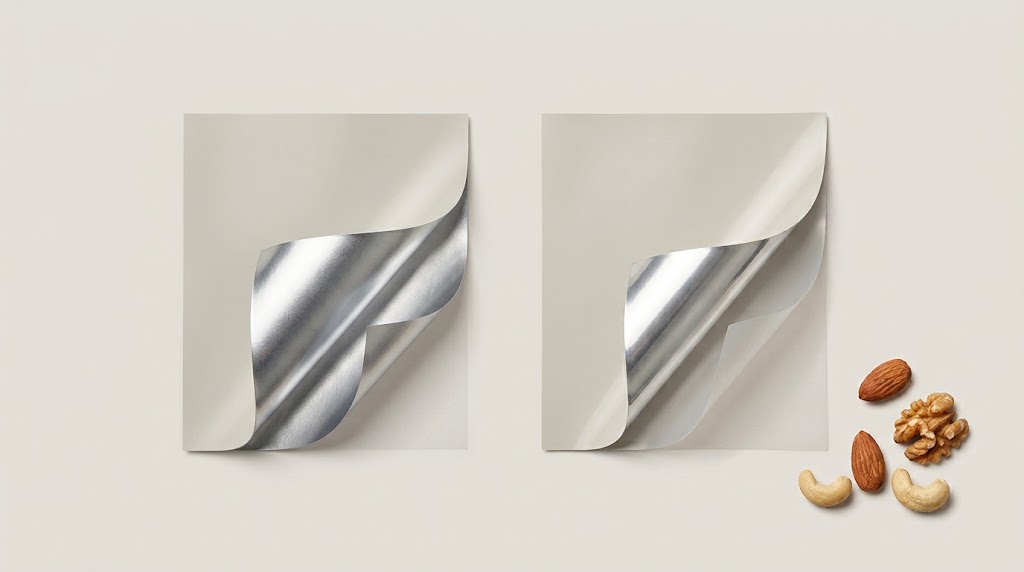
There is no universal winner. Foil can be a strong candidate where a validated opaque barrier is needed, but the pouch still needs a suitable inner sealant, a clean continuous seal and handling resistance. A selected metallized grade may meet a different project's tested requirements with another look or converting behavior. A clear structure may be the appropriate product-display choice when its measured performance fits the real distribution and shelf-life brief. Avoid specifying “foil inside” merely because a competitor's peanut bag is shiny; specify the function and evidence you require.
A clear window changes the local material path
Transparency is useful when buyers want to see whole nuts, a coating or a mix. It also creates a design question that is easy to miss: what exactly replaces, omits or modifies the opaque layers at that region? A window cannot be both visibly clear and covered by continuous opaque foil. A transparent film can still be engineered for protection, but you must ask for its own construction and barrier data. The area, shape, placement, print coverage and interface with the surrounding panel all belong on the approved drawing.
In the US and Puerto Rico cases above, a broad horizontal clear area is part of the visible design. In the Philippines project, different SKU fronts show shaped windows. None of those photos establishes an “acceptable percent of window” for every roasted nut. A larger transparent area exposes more product to light and can change the package's overall gas or moisture path, depending on the two local constructions. That is a design inference, not a measured claim about these customer projects. Set a window size by testing the actual SKU under intended light, temperature and distribution conditions rather than assuming every window is fatal or harmless.
The window decision is partly commercial. A buyer may value immediate product inspection more than an opaque panel; another may prioritize light screening for a sensitive product. Treat the proposed artwork as part of the engineering brief. Ask where the nuts will sit after settling, whether labels and legally required information remain readable, and whether the window edge approaches a seam, crease or heavy-contact point in the shipping carton. A beautiful empty proof is not the same as a well-filled, protected retail unit.
If several products share one printed pouch, a single window position may work for one net weight and miss the visible product in another. Use actual fill samples to place windows. The dimension of the empty artwork cannot establish the height of a settled batch of peanuts, cashews or pieces. Record the filled face after normal handling and inspect the window from the customer's viewing angle.
Request numbers, test conditions and the finished-pack construction
Two common film metrics are OTR, oxygen transmission rate, and WVTR, water-vapor transmission rate. ASTM F1927 is an oxygen-transmission test method for barrier materials at controlled relative humidity; ASTM F1249 covers water-vapor transmission through plastic film and sheeting using a modulated infrared sensor. A quote that supplies only “high barrier” with no units, temperature, humidity, sample description or test method is hard to compare with another quote. A raw film datasheet also does not, by itself, describe the seams, window or fully formed package.
Do not compare two OTR values until you know the units and conditions. Ask whether the numbers refer to the entire specified laminate, the transparent window film, or one unconverted substrate. Ask if light transmission or opacity matters for this SKU, and whether aroma transfer, grease, mechanical scuffing or puncture risk is in scope. An opaque foil panel can have excellent laboratory barrier while a bad top seal or a damaged corner compromises the retail unit. Conversely, a good-looking clear bag may be adequate for one channel and unsuitable for another; the food business must validate the proposed shelf-life and conditions of sale.
Food contact is another document request, especially when the outer ply is paper or the bag includes ink, adhesive and a clear section. For the US, the FDA explains that the regulatory status depends on the substances in the food-contact article and their intended conditions of use, and an effective Food Contact Substance Notification can be manufacturer-specific. Ask for the applicable material and component documentation for the intended food and market. Do not write “FDA-approved bag” based on a generic marketing badge. The converter can supply material information; the food brand or packer must check its market, recipe, process and final label.
For a new project, request at least the following in one version-controlled package:
- The complete layer sequence for front, back, gusset and clear window, with thickness or gauge, grade and total nominal thickness; identify any
AL, VMPET, coating or paper explicitly. - A drawing that shows window geometry, joining areas, side and bottom seams, zipper if present, tear feature and intended top-seal zone. Mark which web actually touches the food.
- OTR and WVTR values with units, method, temperature, humidity and tested sample; separate panel and window results when their constructions differ.
- Food-contact documentation relevant to the exact materials, intended product and destination market, including any use limitations.
- Representative empty samples and a short trial batch made with the actual nut SKU and packing equipment, followed by agreed filled-pack checks.
The list is not a demand that every film supplier run every imaginable test. It is a way to stop a quote from silently substituting one stack for another. Agree which evidence matters to the SKU and its distribution brief, then keep the approved drawing and sample together. A material change, a new window size or a different sealant should trigger a review of the relevant checks.
Recommended packaging configuration: start with the product and display brief
The table below is a sample-request starting point, not a guaranteed recipe or a shelf-life prediction. The correct choice may change with roasting level, oil content, coating, moisture exposure, storage temperature and the time the pack is meant to remain saleable. For roasted nuts, Almond Board of California's quality material explains why oxidation can create rancid flavors and why processing can change exposure of oil to oxygen. A published walnut packaging study considered oxygen permeability, storage temperature, an absorber and nitrogen flushing together. Neither source licenses a fixed month count for a new peanut pouch.
There is a cost and evidence trade-off in each row. A foil barrier may add material complexity; a transparent window may improve inspection but requires local performance review; a kraft outer may satisfy the desired look but says nothing about end-of-life acceptance. Discuss a target OTR and WVTR with your technical team after it defines the product and intended duration; do not choose one from a generic website chart. The answer should come from trials with the actual finished pack, not from a competitor's photo.
For a useful supplier request, send a short brief: nut type and raw/roasted/coated state; net weight; target sales channel and expected storage/distribution conditions; desired display and window area; whether the line uses pre-made bags or form-fill-seal rollstock; opening and reclosure needs; intended top-seal method; carton count; destination market; and the quality endpoints you will measure. Request two or three construction candidates with the same stated test conditions, material drawings and physical samples. That makes a paper-look option, a windowed film and an opaque barrier option comparable on the same project rather than merely comparable in a catalog.
For a custom dry-nut pouch, browse the published nut packaging cases and contact Mylarbag with that brief. Ask the team to identify the actual film stack, window region and documentation for the proposed sample. If a project needs a different packing atmosphere, a cold-chain condition or a high-moisture food, state it at the outset so the material and process can be evaluated together. The visible case examples should inspire questions, not substitute for your product's approval.
Frequently asked questions
Are peanut bags made of paper or plastic?
Either may be present, depending on the bag. A brown kraft-look pouch can have paper as its outer ply and plastic films beneath it, as in the published US kraft paper/PET/PE example. Other retail peanut bags may use film structures without a paper ply. Request a full material sequence for the exact SKU; do not classify it from color, feel or a product photo. Whether a paper-containing laminate is accepted in a particular recycling stream is a separate local-system question.
Why are peanut bags foil inside?
Some use an aluminum-foil laminate for a specified light and gas barrier. Others look silver because a polymer film has a thin deposited metal layer, such as VMPET. A shiny face alone cannot tell you which. Ask the supplier to distinguish AL from metallized film and provide layer, gauge and performance documents for the finished proposal. Neither a silver appearance nor a foil layer excuses an unverified seal.
Is VMPET the same as aluminum foil?
No. VMPET is metallized PET: a PET film with deposited metal. Aluminum foil is a separate rolled metal ply within a laminate when that construction is specified. Their behavior depends on the grades and finished construction, so compare tested proposals at the same conditions rather than declaring one universally adequate or inadequate for nuts.
Does a clear window ruin the barrier of a nut pouch?
It changes the local construction and removes opaque metal coverage from the visible area, if the opaque panel uses it. That does not tell you the resulting whole-package performance. Obtain the clear region's film stack and test values, locate its transitions on the drawing, then validate the filled pouch under intended light, storage and distribution conditions. A clear window can be a deliberate, tested design choice.
Is the layer against the nuts always PE?
No. PE appears in the US project description; CPP appears in the Puerto Rico example. The actual food-contact and sealing surface depends on the approved pouch design. Request its identity and documentation for the intended food and conditions. An outer label reading “kraft” or “foil” does not identify the inner layer, and neither PE nor CPP by name alone is an all-purpose compliance statement.
Can I use a published nut-pouch material specification for my own product?
Use it to select questions and sample candidates. A public case listing usually omits grades, gauges, window details, performance conditions and the trial results needed for another recipe or distribution channel. Send your real nut SKU and packing brief, obtain the approved drawing and test documents, fill samples on the intended line, and set the product's own quality and shelf-life criteria. A project photo documents what was made for that project, not what your new pack has passed.