
To package boiled peanuts for sale, choose the intended distribution route before choosing a bag. A refrigerated product needs an appropriate food-contact container, sound closure, controlled cooling and a maintained cold chain. A frozen product needs a container proven for its filled, frozen handling conditions. Ambient shelf-stable sale requires a professionally established process matched to the actual product and container. A heat seal, vacuum, salt or “Mylar” appearance alone cannot establish shelf stability.
This guide is for a U.S.-oriented brand, food producer or co-packer scoping a commercial product. Boiled peanuts are a cooked, moist product, often distributed with salty liquid. They are a different packaging assignment from dry roasted peanuts. The decision below is a planning framework, not a recipe, a process schedule or approval to put a filled pouch on an unrefrigerated shelf. A qualified food-safety specialist and the relevant authority must determine the actual controls for your formula and sales channel.
Start with the sales route, not the pouch catalog
Imagine three orders for the same flavor: one for a nearby refrigerated store, one for frozen shipment, and one for an unrefrigerated convenience-store shelf. The artwork might look similar, but the food process, package material, closure, distribution, instructions and evidence cannot simply be copied from one order to another. Begin with the finished product and intended use: in-shell or shelled, amount of cooking liquid, spices, portion size, whether the customer eats it immediately or reheats it, and who controls the food after it leaves the producer.
These are routes, not three labels for one stock bag. A product sold cold may have additional processing or packaging controls; a product sold frozen may be cooked and cooled under its own validated program. The table only tells you what to settle before asking a pouch converter for a quotation. If the route changes, review the entire product–process–container system again.
Who determines whether a product is shelf stable?
For U.S. commercial products that fall within the acidified-food or low-acid canned-food framework, FDA explains the establishment-registration and scheduled-process requirements. In applicable cases, the filings distinguish the product, product style, container size and type, and processing method. FDA describes low-acid canned foods in terms of finished equilibrium pH and water activity; it also defines acidified foods by their finished equilibrium conditions. A splash of vinegar, salty brine, an airtight pouch or a low pH reading taken only from the liquid does not classify a finished heterogeneous food by itself. Product formulation, the peanut solids, equilibrium measurements and process design require competent review.
The word canned does not mean the regulatory issue is confined to metal cans: FDA's filing guidance explicitly discusses hermetically sealed flexible pouches. Nor should a home-preservation table be transferred to a factory pouch. The National Center for Home Food Preservation's green-peanut directions address a particular home-canning method in jars. They do not establish a commercial process for your recipe, pouch dimensions or equipment. Discuss an ambient concept with the processor and a qualified process authority before buying printed inventory or promising a room-temperature shelf life.
Route 1: refrigerated boiled peanuts
Refrigeration is a plausible commercial route when the operation can actually control the product through preparation, cooling, packing, distribution, display and consumer handoff. It is not a shortcut around a safety plan. A cooked product can be recontaminated after cooking; the producer has to account for the entire post-cook path, especially where product is ready to eat. The applicable requirements differ between a manufacturing operation and a retail or foodservice establishment. The FDA Food Code is a model for retail and foodservice jurisdictions; check the version adopted locally and the rules that apply to your actual establishment. Do not paste a generic retail cooling number into a commercial pouch specification and treat it as a complete program.
For a refrigerated pouch proposal, give the packer a representative sample including its normal liquid, shells or pieces, and seasoning. Tell the supplier the fill temperature or filling condition established by your process team, planned storage conditions, expected time in distribution, opening method and secondary carton. Seek a food-contact suitability statement for the actual food and contact conditions. FDA's food-contact conditions-of-use reference distinguishes refrigerated storage, frozen storage, hot filling and high-temperature heat sterilization; being suitable in one scenario is not blanket approval for the others.
The practical question is whether the pack remains sound and usable. A wet shell or splash in the closure can interrupt a heat seal. Salt liquid may wet exterior cartons, and a sharp shell edge can rub a film panel during distribution. Decide with the packer how much liquid is intentional, whether the customer should drain or heat the contents, and how the first-opening feature works. A zipper, if chosen for convenience, sits in addition to the manufacturer-applied primary seal where the pack design requires one. It is not a substitute for the specified initial closure or for refrigeration.
For local refrigerated retail, align the label, display case, shipper, receiving checks and retailer instructions. A package that arrives cold and intact but sits on a warm receiving dock breaks the intended system. Record product and lot identity so that a temperature excursion or leak complaint can be tied to a real run. The FDA sanitary transportation rule addresses covered transportation operations and includes food requiring temperature control for safety. Determine coverage and responsibilities for your own route; do not assume a sealed inner bag removes the need for suitable transport conditions.
Route 2: frozen boiled peanuts
Freezing can support a distribution plan, but it cannot undo errors that happened before freezing. FDA states that freezing stops bacterial growth while generally not killing most bacteria. The upstream cooking, cooling, filling and closure controls still matter. The business also needs a frozen-storage and shipping plan, instructions for safe thawing or reheating as established for the product, and a way to assess a shipment that partially thaws. Do not guess a thaw-and-refreeze instruction from package appearance.
Frozen packaging has physical demands beyond “will it fit?” Consider headspace for the product and liquid under the actual pack design; expansion or movement can load the top seal and corners. Frozen shells can press against panels; a loose carton can let packs abrade one another. The pack should be evaluated after representative freezing, handling and thawing conditions, with visual and integrity checks appropriate to the design. A clear window or side zipper may be attractive in a sales mockup, but every added feature needs to be compatible with wet contents, intended fill, initial closure and frozen handling.
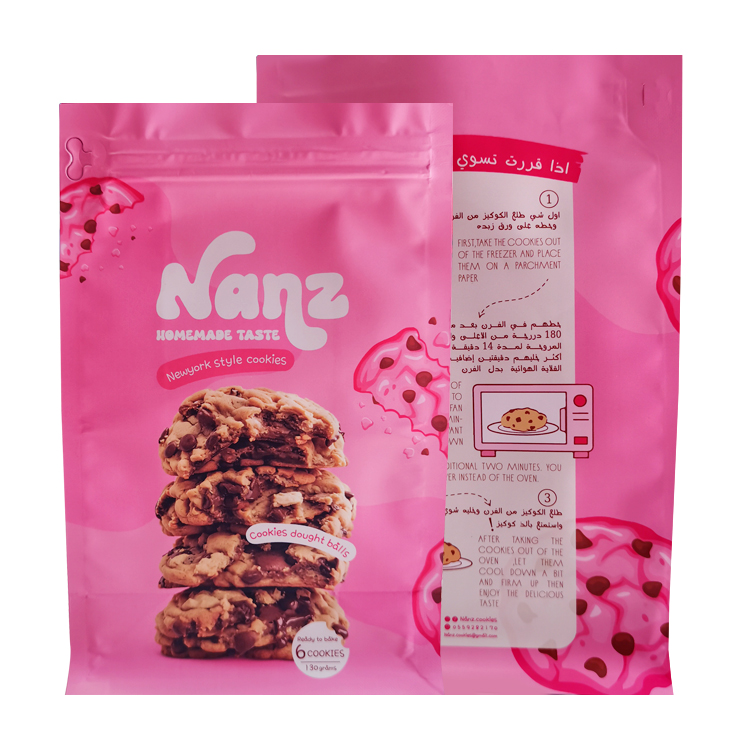
Mylarbag publishes a flat-bottom pouch for frozen cookie dough, listed with a PET/VMPET/NY/low-temperature-PE structure, digital printing, a side zipper and a 14 × 22 + 8 cm format. It is a different food, with a different water and fill profile. The listing shows that a frozen-food pouch project exists; it supplies no evidence that the same pouch can hold brined boiled peanuts, survive this product's freeze–thaw cycle or serve as a retort pouch. Request a new specification and filled trials for the peanut project rather than ordering that configuration by analogy.
If you sell the same recipe in refrigerated and frozen channels, treat them as two release decisions. Confirm which product is in each printed pack, how employees distinguish the codes and cartons, what the consumer is told after purchase, and how you handle returns. A common graphic identity should not hide distinct storage directions. The freezer route also needs a documented answer to a realistic question: what happens when a parcel is delayed or an in-store freezer warms? That answer comes from your food-safety and distribution program, not from a film thickness or a photo of a frozen bag.
Route 3: ambient shelf-stable boiled peanuts
Ambient sale is the route with the strictest process–container coupling. For products to which the U.S. shelf-stable acidified-food or low-acid canned-food requirements apply, the scheduled process and its critical factors are established for the specific product style, container type and size, and processing method. A qualified process authority and commercial processor must define the formula and container-process combination; the business then has to meet applicable filing, operational, record and verification requirements. The FDA's overview gives the framework, while the actual determination belongs to the operation and its specialists.
“Boiled,” “hot filled,” “vacuum sealed,” “pressure cooked at home” and “sterilized” are not interchangeable descriptors. A shelf-stable commercial pouch may require a purpose-specified container, compatible sealant and closure, matched equipment and documented integrity controls. A dry-nut laminate with a shiny layer has no demonstrated suitability merely because it resembles another bag. The FDA food-contact reference separates high-temperature heat sterilization from ordinary room-temperature, chilled and frozen use. Ask for the actual food-contact basis covering the formula and intended conditions, and keep the supplier's structure and revision identifiers with the processor's approved records.
FDA's container-and-closure inspection guide identifies pouch seal contamination, wrinkles, handling damage and integrity tests as material issues for retortable containers. That is why the closure is part of the commercial system, not a final cosmetic step. A claim such as “retortable” on a product catalog page, without matching film, dimensions, seal setup, process and filled-pack evidence, is a question to investigate rather than a release criterion.
If a project is deliberately formulated as an acidified food, its classification and controls still need competent confirmation. Acid diffusion and equilibrium through a heterogeneous solid-and-liquid food can matter. Do not instruct staff to add vinegar until the brine tastes sour and then print “shelf stable.” The processor and process authority should specify relevant measurements, critical factors, process and monitoring. Changes to the peanut style, brine composition, fill weight, package shape, sealant, equipment or process can require review before the next run. This article supplies no formula, processing time, temperature, pH shortcut or shelf-life number because none can be responsibly inferred for an unspecified product.
Translate the route into a package brief
The purchasing brief should name what is actually going into the package and what happens to it. “Boiled peanuts, 8 oz, stand-up pouch” omits the most important variables: in-shell or shelled, solids-to-liquid distribution, filling method, closure, processing after fill, target route, handling and intended storage. A bag manufacturer can propose geometry and material candidates, but the food producer owns its product and process decisions. The following information sheet keeps those responsibilities separate.
Avoid ordering a full print run from a flat drawing alone. A shell can occupy a surprising amount of volume relative to the edible product; the liquid level changes how the pouch stands, and a swollen or underfilled appearance can mislead a buyer. Measure the finished filled sample: the settled fill, opening clearance, printable area, top-seal position, carton fit and shelf display. Use the actual recipe and planned fill equipment for trials. A pouch sold for dry peanuts on the nuts-packaging catalog may help you compare formats, but that catalog is not a boiled-peanut food-safety approval or an ambient-process specification.
Design the opening and the first seal together
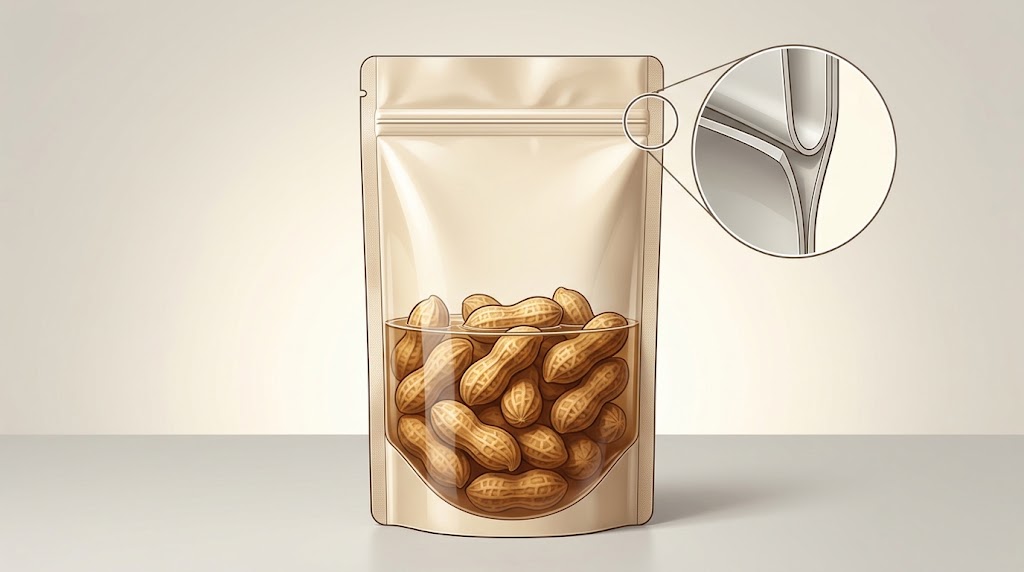
On a typical preformed pouch, the packer fills through the open end and applies the final primary seal. If brine splashes across that seal land, the jaws may press liquid or particles into the closure. If a peanut shell reaches the top, it can create a local channel or wrinkle. Ask the equipment and package teams to agree on a trial fill level, a workable opening, how to keep the seal land clean, and the inspection method. These are trial variables, not universal dimensions. The clean-seal area is established with the real product and machine; a diagram with a decorative line is not a control plan.
The choice of zipper deserves a separate decision. A zipper may support consumer reclosure after opening under the product's stated storage conditions. It cannot replace the producer's initial seal, repair a compromised pack, make a refrigerated product safe at room temperature or extend a validated life by assumption. For a liquid-containing product, also test how consumers open, pour, drain and close the format without squeezing liquid into the zipper or tearing through a heat seal. A tear notch or easy-open feature must be located so it does not undermine the required closure.
What should a filled-pack trial actually check?
A convincing mockup is only the beginning. For a refrigerated or frozen route, build a representative trial under the intended fill and closure conditions, and inspect packs after the actual cooling or freezing, case packing, transit simulation and consumer opening sequence. For any ambient route, the processor and process authority set the applicable validated plan and acceptance criteria; generic consumer “squeeze tests” do not replace commercial controls. In each case, retain the pack revision and lot identity so a result is traceable to the material used.
Check the seal with the correct tools and sampling plan. Look for liquid, salt, shell fragments, creases, channels, incomplete fusion, scuffs and punctures. Inspect side seals and gusset corners as well as the top edge. Assess whether heat or handling has distorted print, weakened the closure or changed the filled bag's footprint. If the pack is intended for cold distribution, include the full storage and handling sequence. If it is intended for an established thermal process, only the responsible processor's approved protocol can establish whether the material and container pass. The FDA guide to pouch closures describes critical sealing variables and integrity testing in a retort context; it does not grant a pass to an unrelated pouch photographed beside a tester.
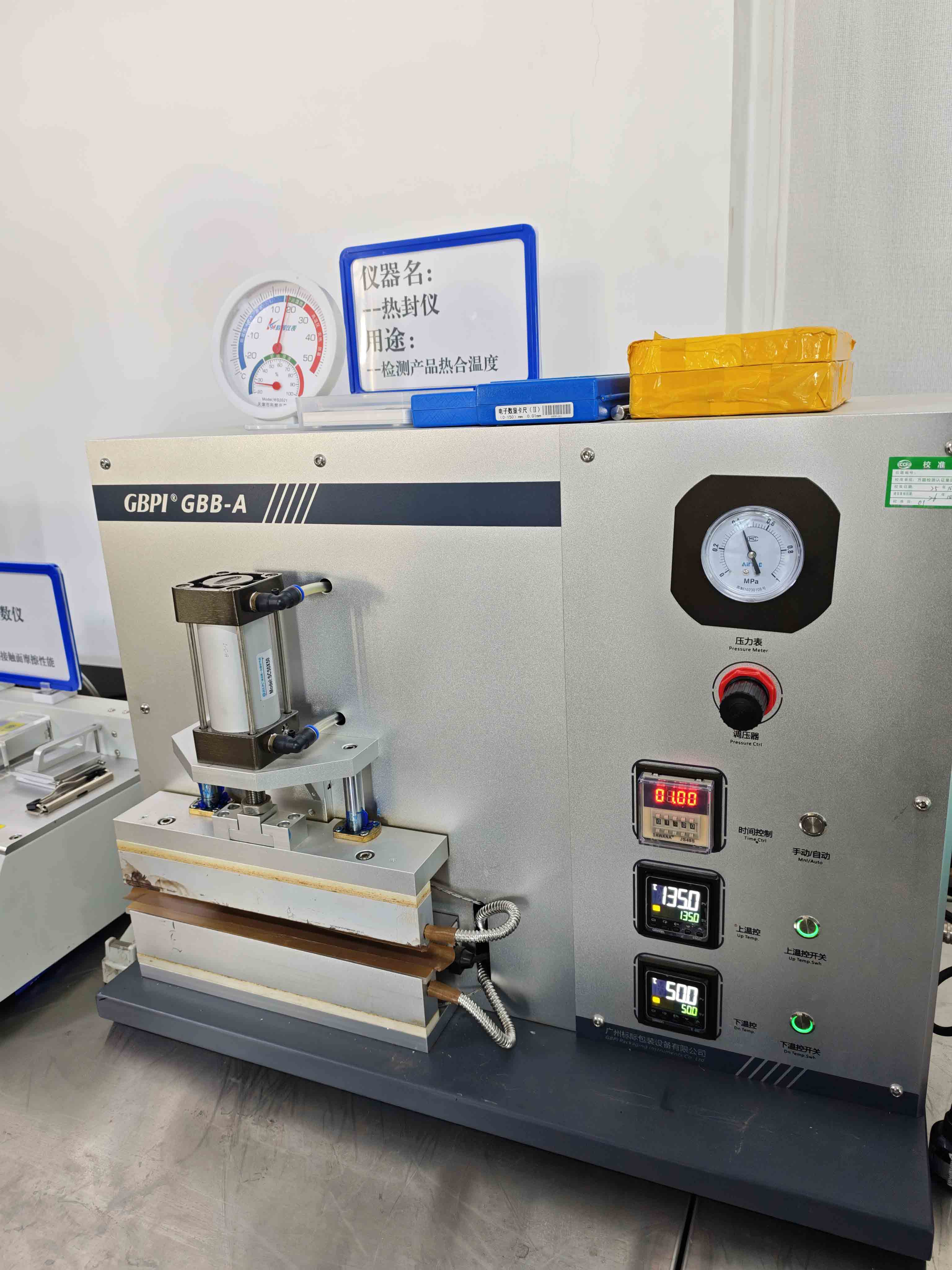
Record not just “pass” or “fail,” but the circumstances: product version, material structure and lot, pouch dimensions, filling equipment, seal settings under the responsible team's control, treatment after fill, inspection date and what defect appeared. This creates a useful conversation with the converter. A leaking top edge after a wet fill may suggest a different corrective action from a puncture caused by shells in a tightly packed carton. Changing the laminate without testing the real mechanism may leave the complaint unresolved.
Never use a blog table to release suspicious food. Hold affected stock and follow the processor's investigation and disposition procedure. A pouch converter can investigate a material or seal defect; the food-safety team must evaluate product safety and the impact on the lot.
Label, traceability and consumer handling belong in the artwork
The artwork is part of the sales route. A refrigerated product needs the storage and use directions appropriate to its validated program; a frozen product needs its own handling message. An ambient product should not inherit “refrigerate until sale” artwork or a shelf-life claim from a different route. Define the label with a qualified reviewer for the product and market, including product identity, ingredients, net quantity, responsible business details and any required instructions. Do not lock the plate or digital file while the food process is still changing.
Peanuts are one of the major U.S. food allergens. FDA's food-allergen guidance describes source-name disclosure for packaged products and controls against cross-contact and undeclared allergens. The exact label format depends on the product and applicable rules, but a graphic that prominently depicts peanuts is not a substitute for required ingredient and allergen declarations. If seasonings bring other allergens, verify those too. Connect every finished bag and carton to the correct artwork version, lot code and storage route.
It is useful to perform a proof-to-filled-pack check: compare approved artwork with a printed empty bag, then with a representative filled bag, and finally with the first commercial run. Confirm that seals, fold lines and possible condensation do not obscure the storage statement or lot code. Check that the code remains legible after the pack's intended handling. If both refrigerated and frozen versions share a brand name, use packaging controls that prevent the two storage instructions from being swapped during production.
Recommended packaging configuration: conditional starting points
There is no single “best boiled-peanut bag” without the product and route. For an evaluated refrigerated concept, ask for a food-contact pouch or other container suited to the actual moist food and filling condition, with a closure layout that keeps the primary seal clear and a carton that protects the filled pack. For an evaluated frozen concept, add filled-pack freeze and handling trials and confirm the package's food-contact basis for frozen conditions. For an ambient concept, do not choose a stock laminate from appearance: have the processor and process authority define the appropriate product, container, closure and process together, then seek a converter able to document a matching candidate for verification.
This is a purchasing sequence, not a performance promise. Mylarbag's public nuts-packaging range shows formats for nuts, and its published frozen-cookie-dough pouch illustrates one unrelated frozen-food project. Neither publication documents a validated boiled-peanut pouch, a retort capability for this recipe or a shelf-stable outcome. A useful inquiry is a scoped request for feasibility and samples, with the processor or process authority copied into the technical review where appropriate.
Send the supplier the intended route, destination market, current product and liquid sample, solids-to-brine range, fill and closing method, proposed portion, carton, display method, storage and transport conditions, opening features, and any process-authority requirements already defined. Ask what documentation and trial quantities can be supplied; do not assume a minimum order, lead time, material performance figure or food-safety certification that has not been confirmed for the proposed pack. For a specific project, contact Mylarbag with that brief and request a proposal subject to processor review and filled-pack validation.
Frequently asked questions
Can I put boiled peanuts in an ordinary Mylar bag and sell them at room temperature?
No room-temperature conclusion follows from the word “Mylar” or the presence of a heat seal. A moist commercial product needs a professionally established route for ambient sale, and the actual formulation, container and process must be assessed together. Ask the processor and qualified process authority whether the applicable acidified-food or low-acid-food framework applies before selecting the bag or printing an ambient label.
Are vacuum-sealed boiled peanuts shelf stable?
Vacuum describes how much air is removed; it is not a sterilization step or shelf-life result. A vacuum-packed cooked, moist food still needs product-specific hazard controls, the correct storage route and an appropriate container. Retail reduced-oxygen packaging may also trigger jurisdiction-specific requirements; determine those with the relevant authority rather than treating a tight-looking pack as proof of safety.
Can I use the green-peanut home-canning directions to make retail pouches?
No. The NCHFP directions describe tested home preservation in specified jars. A commercial flexible pouch changes the container and processing system, so those directions are not a scheduled process for it. Work with the commercial processor and process authority on the actual product and pack.
What type of bag should I use for refrigerated boiled peanuts?
Start with the approved food process and realistic filled sample. Then assess a food-contact container for the actual aqueous product and use conditions, enough usable fill and seal space, reliable closure despite shells and brine, and protection in the intended carton. Verify distribution and label instructions. The best material, dimensions and closure are determined by filled trials, not by the pouch's advertised use for dry peanuts.
Can boiled peanuts be sold frozen in a stand-up pouch?
A stand-up pouch is a possible format to evaluate, not an automatic frozen-food solution. Check the material's intended food-contact conditions and test the actual liquid-containing, filled pack through freezing, handling and thawing. Also validate the upstream food process and frozen distribution. A frozen cookie-dough pouch photograph cannot establish performance for wet peanuts.
How long will packaged boiled peanuts last?
There is no defensible universal number for an unspecified recipe and route. A producer needs product-specific safety and quality work, the actual package and processing conditions, distribution data and suitable studies to set a shelf life and opening instructions. Treat a damaged, leaking, swollen or mishandled lot according to the food-safety program; do not extend a date because the outside of the pouch looks intact.
The practical next step: decide the route and involve the food processor before approving the bag. Once the product, process and distribution are defined, a packaging supplier can help develop and trial a documented container candidate. That order of work prevents a printed package from making a claim the food system has not earned.