
Package a chocolate-covered treat around the finished piece you will actually sell, not the uncoated ingredient or a stock bag’s nominal size. Let the coating set under the producer’s process, choose a documented food-contact surface, and make a physical sample. A dipped pretzel rod needs length and tip protection; a coated sandwich cookie needs face clearance and a bag or tray that will not scrape its decoration; a whole coated apple needs a stable base, enough room for its top and any stick, and a food-safety decision for the fresh-fruit product. For parcel orders, immobilize those retail packs in a suitable outer carton and qualify the route.
The word “chocolate-covered” does not give all three foods the same storage life or shipping temperature. A relatively dry pretzel and a freshly prepared apple have different moisture and handling profiles. Neither a glossy film nor a carton photo can establish a safe sale window. This guide explains how to specify packaging and run useful fit and shipping trials; the food producer remains responsible for the recipe, process, product-specific storage instructions, labeling and applicable local requirements.
Start with three separate product specifications
Before requesting a quote, write one line for each SKU: base food, coating and inclusions, finished dimensions, count per retail unit, intended display and distribution conditions. A large amount of rework comes from measuring the plain cookie or bare pretzel and ordering bags before the chocolate, drizzle and toppers are added. The tallest or widest finished sample is the one most likely to snag a seal or touch a box lid.
Note how each piece will be sold. A single dipped sandwich cookie in a transparent flat bag is a different layout from six cookies in a gift tray. A pair of long rods can look orderly in a narrow sleeve but break if the sleeve hangs loose inside a shipping carton. A whole apple may need an upright carton and a retained platform even if the gift presentation uses an outer clear wrap. The product specification also needs to state whether the apple has a stick, whether its skin is pierced or cut, and whether a caramel or other intermediate layer sits beneath the chocolate.
| Finished treat | Main physical concern | Initial retail-pack trial | Separate food or route question |
|---|---|---|---|
| Chocolate-covered pretzel rods | Long, slender pieces can snap or scrape at the dipped tip | Individual food-contact sleeve or grouped rods with a rigid backing or divider | Coating softening and breakage on the actual lane |
| Coated small pretzel twists | Irregular shapes rub and settle inside a loose pack | Portion-count pouch with enough opening and controlled fill | Moisture transfer and crunch through intended sale period |
| Coated sandwich cookie, including an Oreo cookie if that is the actual ingredient | Flat faces and raised decoration can scuff or crack | One-piece clear pouch or cup/cavity plus outer pouch or box | Real recipe, fillings, allergens and sale window |
| Whole chocolate-coated apple | Heavy, rounded fresh fruit can roll; top or stick can hit a lid | Stable base or cavity and upright box with measured top clearance | Fresh-fruit handling, any stick or cut surface, storage and route assessment |
These are starting designs to sample, not proof that a named material is suitable for the real formula. A product with a fresh dairy filling, cream cheese drizzle, cut fruit, caramel layer or other change cannot inherit the handling decision of a plain dry pretzel. The FDA explains water activity as a factor in microbial growth, but the appearance of a baked base does not give you a measured finished-product value. Set storage and shelf-life criteria with the actual formulation and appropriate food expertise.
Set and inspect the coating before closing the pack
Packaging a warm or tacky treat often creates a problem the bag was never designed to solve. Let dipped pieces complete the producer’s setting and cooling procedure. Inspect the surface that will face a film, cup or neighboring treat. If a decoration still transfers onto a clean contact test surface, a tight clear bag may smear it during insertion even though its width appears adequate on a ruler.
For pretzel rods, look at both ends. One end may be bare for holding, while the coated tip carries a heavier cap of chocolate or sprinkles. The thickest tip and any protruding decoration determine the effective cross section. For small twists, sample the real portion weight and count; loose pieces may settle into a dense corner after the bag stands on a shelf or lies in a parcel. For cookies, include the edge coating, the center filling and the tallest piped decoration in the measurement. Two cookies with the same nominal base diameter may need different packs after dipping.
Fresh apples require their own preparation and sanitation procedure. The FDA advises washing fresh produce under running water before preparation, avoiding soap or commercial produce wash, and drying with a clean towel. Those are general consumer handling directions, not a complete commercial process plan. A business must follow its applicable food rules and validated process for receiving, cleaning, piercing, dipping, cooling and packing the actual apple product. Chocolate on the outside does not sanitize the apple beneath it.
Keep work-in-process and finished units traceable through packing. If a batch develops a cracked coating, a detached topping or excess moisture, isolate the affected units rather than hoping that an opaque bag will hide the defect. Record the coating and packing time in any trial that will later be used to support a sale window or shipping claim. An attractive day-one photograph says little about a packaged product after handling, holding and delivery.
How to package chocolate-covered pretzels for shipping
Separate the retail decision from the parcel decision. At retail, an individual pretzel rod can go into a food-contact sleeve or a flat bag that closes beyond the longest finished rod. A group can go into a wider pouch or tray if the rods do not load one another when the pack is lifted. In a parcel, add a support that keeps the rods from bowing or striking hard edges. A tight shipping box around an unsupported sleeve may still transmit pressure into the pretzels.
Measure the overall finished length, including any bare grip, coating cap or decorative extension. Put the longest rod into a sample sleeve and check insertion without forcing the chocolate past a narrow opening. Leave a clean, practical closure area above the product according to the selected sealing method. If the seal lands against a protruding pretzel or crumbs contaminate it, changing the heat-seal setting alone will not fix the layout. Move the product, change the bag geometry or adjust the packing sequence, then trial again.
For a set of rods, test dividers or a rigid backer as a component of the retail pack. The backer should support the length without presenting a sharp corner against film, and any face touching an exposed edible surface requires suitable food-contact documentation. Do not place ordinary corrugated board against unwrapped chocolate unless that direct use has been reviewed. If a gift box is used, locate the rod ends so a lid or ribbon does not load the fragile tips.
Chocolate-covered twists and knots behave differently. A multi-piece pouch needs a fill trial with the real portion, not only the net weight printed on a mockup. See where pieces settle after upright display and after the pack lies flat. An overly broad pouch may allow the twists to tumble and abrade their coatings; a too-small pouch may need pressure to close and produce breakage at the bottom. Test the smallest and largest normal fill amounts.
For mailing, put the closed inner units in a rigid carton with dividers or cushioning as needed. Keep the products from sliding toward each other, then check whether the assembled carton can tolerate ordinary orientation changes. The FedEx perishable guide warns that a parcel may be handled in different orientations. A “this side up” label is a request, not a structural support. Run a representative shipment with the actual number of units and inspect tip fractures, wrapper punctures and coating transfer on arrival.
If the coating is temperature-sensitive on the planned route, specify the product’s acceptable conditions before choosing insulation and coolant. A metallized pouch can provide a specified barrier but is not an insulated shipper. Follow the carrier’s current rules and test the complete thermal assembly; avoid promising that a gel pack or quick service alone prevents melting.
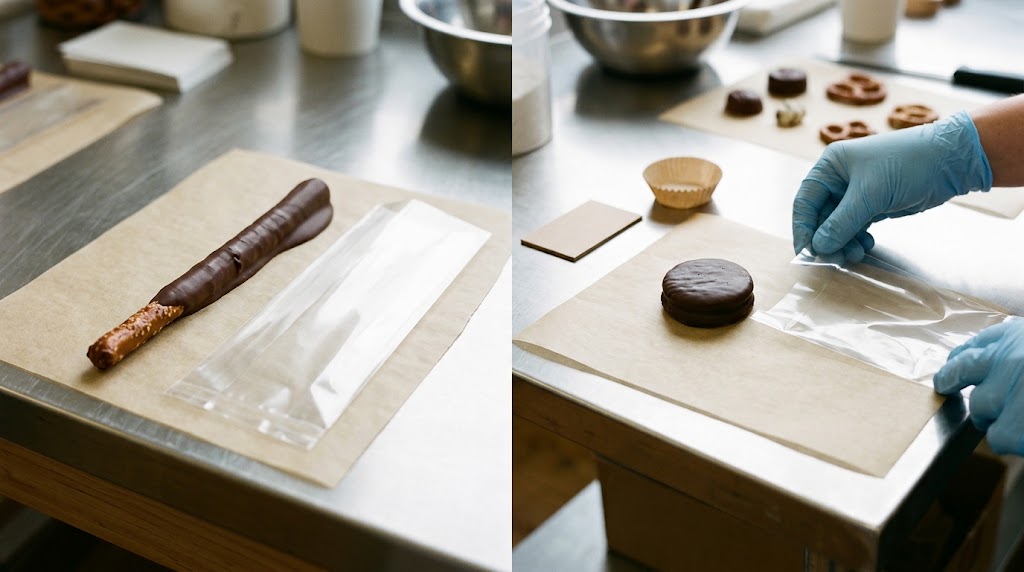
What size bag for one chocolate-covered Oreo?
There is no single reliable measurement such as “one cookie always takes a 4 × 6 inch bag.” First measure the coated cookie, not the undipped Oreo biscuit: widest outside diameter, finished thickness and tallest topping. Then select two or three physical bag samples around that measured piece. Put an actual cookie through each opening, position it for display, close the bag by its intended method and open it again. Reject a sample that scrapes the face, folds the cookie edge, traps coating in the seal or lets the piece rotate excessively.
Many buyers say “cellophane bag” to mean any clear treat bag. The clear appearance does not identify the film as regenerated cellulose, polypropylene or another material. Request the actual construction, food-contact information for the intended use and the compatible closure. A flat clear bag may be enough for a robust, plain one-piece cookie sold locally; a fragile molded coating or tall decoration may need a cup, card or formed cavity before the outer bag. The support should be part of the size trial because it changes the required opening and pack thickness.
Watch the sealed top. Heat sealing a bag with a cookie pushed close to the mouth leaves too little clean area; using a twist tie, foldover card or sticker changes the clearance needed above the product. The right bag is the one the packer can load and close consistently while keeping the cookie presentable. A beautiful empty bag mockup cannot reveal whether the finished piece tears the seal or rotates under a label.
For multiple coated cookies, lay out the actual count in one layer before considering a stack. A divider or shallow tray can keep faces from rubbing. If stacking is proposed, test whether the upper cookies load the lower coating and whether a separating sheet is actually suitable for food contact. Measure the final assembled tray or stack before ordering an outer pouch or paperboard carton. The paperboard box provides presentation and some support; the inner material that contacts the cookie still needs its own review.
When the base is an Oreo cookie, use that product name only where it accurately identifies the ingredient; do not imply a packaging supplier is affiliated with the cookie brand. Ingredient, allergen and other label statements should be checked against the actual purchased cookies, coating and decorations. Different sandwich cookies, fillings and seasonal versions may have different ingredients or dimensions. Do not let a packaging template become an unreviewed ingredient label.
How to package a whole chocolate-covered apple
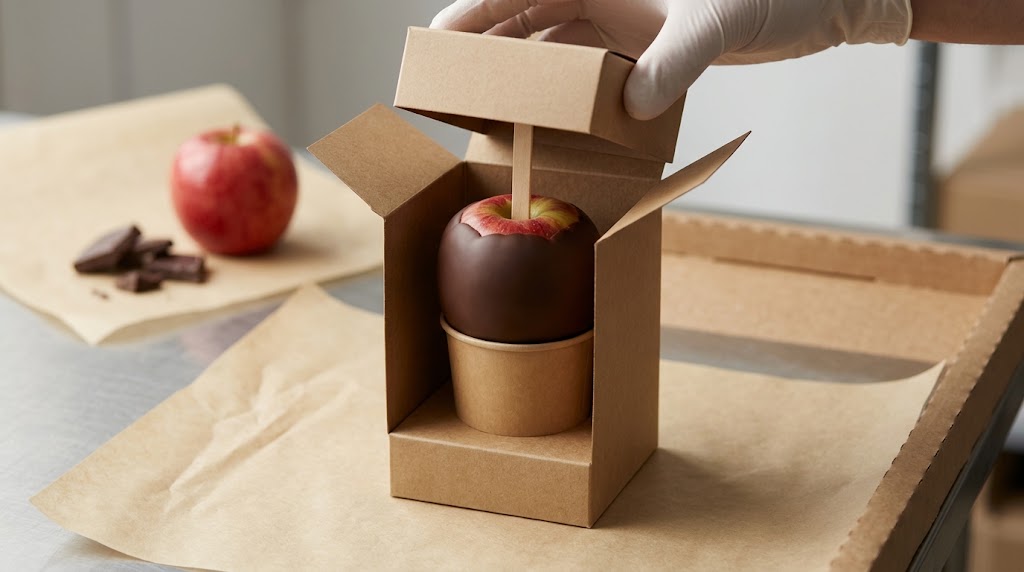
A whole apple is a heavy fresh-fruit unit, so start with a base that controls rolling. Use a clean, suitable food-contact cup, platform or formed cavity and check that the coated apple sits on it without pulling away too much chocolate when lifted. The outer carton should have enough height for the finished top, drizzle and any stick, plus a closure that does not press those features. A clear wrap around an apple may look gift-ready but does not give it a stable platform or protect it from a side impact.
Measure the finished apple at its widest coated point and from the bottom support to the highest solid decoration. If there is a stick, measure the full assembled height and its position relative to the lid. Test the smallest and largest normal apples, because a carton sized only from one neat sample may reject the next batch. Check the carton with the apple upright and gently tilted; if the fruit rolls out of its cavity or the stick leverages against the lid, revise the support before ordering printed boxes.
Food safety needs more attention than the carton geometry. A whole apple, a pierced apple on a stick and cut apple pieces are not interchangeable. University of Minnesota Extension describes refrigeration requirements for candied or caramel-coated apples with inserted sticks under Minnesota’s cottage-food context. That finding is not a direct regulatory classification or validated storage rule for every chocolate-only apple, and state rules vary. It does show why a business should not declare a pierced, coated fresh apple shelf stable because its outer chocolate looks dry. Have the actual formulation and process, including stick insertion and any caramel layer, assessed under the rules where it will be made and sold.
Do not take an ordinary whole apple’s carrier treatment and apply it automatically to a decorated apple. FedEx notes that some intact apples may travel without refrigeration on expedited services, while fruit requiring refrigeration needs a cold shipment. A dipped and possibly pierced product has a different processing history and pack geometry. Choose a handling and route plan for the finished coated product, then verify it in a trial. A bag supplier’s film specification does not settle that question.
If cooling is required, design the entire inner box and insulated shipper around the apple’s height and weight. Keep coolant and condensation from damaging the gift carton or contacting exposed product, according to the approved assembly. Record product-representative conditions during the test and include any missed handoff or warm waiting period. A single successful appearance check is not evidence of a general time-temperature limit. If you cannot establish the necessary food-handling and distribution criteria, do not present an ambient mail-order method as a solution.
Match the inner layer to the outer route
All three formats use a food-contact layer, a structure that limits damage, and a route decision, but they need those functions in different proportions. A single cookie may be sold in a fitted transparent pouch without a rigid retail box; a decorated apple is difficult to keep stable in a loose bag; long pretzel rods may need support along their full length. The carton used to mail several retail units then needs its own fit and cushioning plan. Do not ask a flexible bag to perform the job of a molded insert, or a decorative gift box to perform the job of refrigeration.
| Decision | Coated pretzels | Coated sandwich cookies | Whole coated apple |
|---|---|---|---|
| Measure after coating | Length, thickest tip and group count | Diameter, thickness, raised decoration and support | Maximum diameter, height, base, top and any stick |
| Useful inner trial | Sleeve or pouch; backing/dividers for rods | One-piece clear bag or cup/cavity plus outer bag | Stable food-contact base or cavity |
| Likely outer support | Rigid carton that prevents bending and movement | Shallow tray/box for delicate faces or multipacks | Upright box that restrains weight and clears top |
| Main receipt check | Snapped rods, punctures, rubbed coatings | Cracked faces, smears, broken cookie edges | Rolling, leakage, pressed top, temperature/handling record where required |
| Food handling | Real formula and coating conditions | Base/filling/coating and allergen review | Fresh-fruit process, any piercing or cutting, product-specific storage review |
For a mixed gift assortment, do not use one large bag as a shortcut. An apple can crush a row of rods; loose pretzels can scratch a decorated cookie. Treat each component as a retail unit, give heavy items a separate retained space, and confirm that the closed gift box can be placed into a suitable shipping carton without squeezing the contents. If the apple requires a cold route, the entire assortment’s formulation and temperature compatibility must be assessed; the dry cookie’s ordinary storage habit cannot govern the fresh fruit.
Build a repeatable trial for sale and shipment
Use samples from the real batch and write down the pack version. At the bench, record the finished size range, chosen cup or bag, closure, count, tray and box. Pack several units at the normal production pace to see whether staff can insert coated pieces without handling damage. Let a colleague open the sample as a customer would. Chocolate pulled from the base by a cup or smeared onto a window is a product presentation failure even when the shipping carton remains intact.
Next, test the completed retail pack in its intended display position. A pouch that stands empty may sag when full; a small cookie can sink below its printed window; a pretzel rod’s tip may become the pressure point when a sleeve is hung; an apple box may lean because the fruit is off-center. These are reasons to revise the physical sample before approving a dieline or ordering a full printed run. Do not infer usable dimensions from a neighboring chocolate-bar case or a stock catalog’s nominal count.
For parcel orders, fill the actual shipping carton with the intended number of retail units and their dividers or cushioning. Inspect movement in multiple orientations and run a representative route trial. The UPS cookie-shipping guide emphasizes cooling cookies before packing, separating them, cushioning the inner container and putting it inside a shipping box. Its general cookie examples help with breakage and condensation thinking; they do not validate a fresh apple or a specific chocolate coating.
Keep a record of dispatch and arrival. Photograph the unopened outer box, the internal layout and the unwrapped products in sequence. Look for fractures, smeared chocolate, crushed decoration, punctured sleeves, wet surfaces, shifted trays and unreadable labels. When product-specific limits require time-temperature evidence, gather it with an appropriate monitoring method and compare it to the producer’s actual acceptance criteria. If a route fails, change the relevant component and repeat the test rather than editing the marketing claim alone.
| Observed problem | First variable to investigate | Next sample or trial |
|---|---|---|
| Rod breaks near the dipped tip | Unsupported length, tip contact or carton movement | Add a retained support and repeat a filled-parcel trial |
| One cookie loses decoration on insertion | Bag opening, film contact or unsupported face | Try a larger opening or a cup/cavity and recheck closure |
| Cookies rub in a multipack | Stack load, tray spacing or movement | Trial a single layer or restrained divider |
| Apple presses its stick into the lid | Total finished height or base retention | Revise carton depth/support and test actual size range |
| Moisture appears inside a pack | Warm packing, condensation, fresh-fruit exudate or coolant leak | Trace source and timing; do not assume all wetness has one cause |
| Exterior looks good but required temperature history is missing | Monitoring location and route control | Gather product-relevant trial evidence before approving that lane |
Food contact, labels and sourcing
Specify every surface that can touch food, not just the most visible pouch. Individual cookie bags, pretzel sleeves, cups, apple bases, sheets and tray cavities may all become contact materials. In the U.S., the FDA’s food-contact guidance ties status to component substances and intended conditions of use. Ask the supplier for the actual grade, contact surface, food type, relevant temperature and contact duration, and supporting documentation. A “food grade” claim on a listing or an attractive transparent photo is insufficient for a new use.
Design the label with the real recipe in hand. Chocolate or compound coating, cookie filling, pretzel wheat, milk, soy, peanuts, tree nuts and decorations can affect allergen communication; the actual formulation and manufacturing controls decide which statements are needed. Review the FDA’s food-allergy information and applicable local or target-market rules with the responsible producer. Leave room for mandatory information, lot identification and storage directions as determined for that product. A list-card illustration is not an approved label.
When sourcing, request a quote for a component, not a guarantee that a finished treat will last a set number of days. Send photographs with a scale, finished dimension ranges, intended count, proposed closure, market, handling conditions and an estimate of order quantity. Ask for unprinted samples first. If a box and insert come from different suppliers, agree who checks their fit and tolerances. If a cold shipper is needed, obtain its specifications and test it with the complete food payload rather than relying on a carton supplier’s photograph.
Mylarbag’s chocolate packaging page documents chocolate-related flexible packaging, and the owner has confirmed that paperboard chocolate boxes and inserts can be discussed on request. Those facts do not establish a Mylarbag project for chocolate-covered pretzels, sandwich cookies or apples. Ask Mylarbag which flexible pack, box or insert components can be quoted for the measured treat and request physical samples and contact documentation. The food producer owns product handling, sale-window decisions and route validation unless a specific contract says otherwise.
Frequently asked questions
What is the best way to package chocolate-covered pretzel rods for shipping?
Trial an individual sleeve or grouped pack that closes cleanly beyond the longest finished rod, support the rods along their length, and restrain the retail packs inside a rigid carton. Test the actual order and route for snapped tips, abrasion and coating changes. A loose sleeve or “fragile” label alone does not protect a slender rod.
What size cellophane bag fits one chocolate-covered Oreo?
Measure the coated cookie’s width, thickness and tallest decoration, then try two or three actual clear bag samples with the intended closure. Check insertion, display position, seal clearance and removal. “Cellophane” is often used generically for a clear treat bag; confirm the material and food-contact documentation instead of assuming its composition or a universal nominal size.
Can several chocolate-covered sandwich cookies share one bag?
They can if a filled-pack trial shows the cookies stay separated or supported, the coating does not rub, and the closure remains sound. A single layer in a shallow tray may work better for raised decorations than an unsupported stack. Establish the actual product’s storage instructions separately from its mechanical fit.
Can I ship chocolate-covered apples the same way as cookies?
Do not carry over a dry cookie’s packing and storage decision. A whole coated apple is fresh fruit with greater weight and different handling questions, especially if it is pierced or cut. Use an upright retained base and a product-specific food-safety and route assessment. Research on caramel- or candy-coated apples with sticks is a warning to investigate, not a universal rule that classifies every chocolate-only apple.
Will a Mylar bag prevent chocolate-covered treats from melting?
A flexible pack can provide a specified food-contact and barrier function, but it is not an insulated shipper. Evaluate product temperature tolerance, route, outer pack, and any coolant as a separate system. There is no universal “never melts” result from film choice alone.
What should I send a supplier before ordering bags or boxes?
Send the real finished product dimensions, size range, count, coating and decoration, contact points, desired opening/closure, display and shipping arrangement, market and expected quantity. Ask for physical samples, material documentation and a written component scope. Test the complete packed unit before approving print or a repeat order.
The useful next step is a small physical packing trial with the actual coated treat. Record the size, pack material, closure, support, outer case and arrival observations. For a component quote, send those facts to Mylarbag; for the apple’s handling and any cold-chain decision, work from the producer’s validated process and the rules that apply where it is made and sold.