
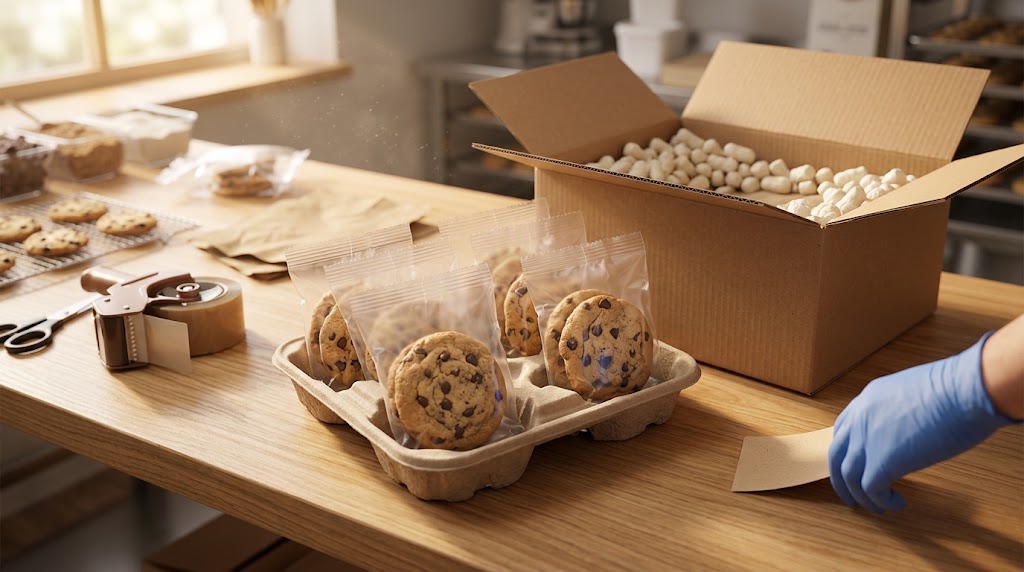
A cookie can look perfect when it leaves the bakery and arrive as crumbs. The damage may start inside a bag that is too roomy, between cookies stacked face to face, or at the corner of a carton that lets the order shift. Changing only the thickness of the bag will not necessarily fix any of those faults.
The short answer: cool and qualify the actual cookie, close it in a suitable food-contact bag, keep pieces from striking one another, support the filled bags against bending and compression, then restrain that assembly in a shipping carton. Send representative trial shipments and record what arrives intact, broken, greasy, damp or unsealed. A tidy exterior box is not proof that its cookies survived.
This guide concerns cookies people eat, especially ordinary drop cookies, crisp biscuits and soft-baked cookies shipped as finished food. It is about the relationship between the flexible cookie bag and the rest of the parcel. Decorated royal-icing cookies and macarons need their own surface-clearance and fragility work; they are the focus of a separate cluster article. The materials and examples below are starting points for a packing trial, not a universal cookie shelf life, carton specification or carrier guarantee.
Start With the Cookie That Will Actually Travel
Before choosing a bag or box, describe the product as it leaves production. A cookie recipe is not enough. The shipping sample needs the normal baked diameter, thickness, mass, edge shape, surface coating and variation across batches. Select examples from the upper end of the approved size range, not only the most attractive pieces from a photo shoot.
A crisp, thin biscuit may fracture under a small bending load. A soft-baked drop cookie may hold together but flatten when another pack rests on it. A chunky cookie with nuts or chocolate pieces can have an uneven high point that takes the first impact. A sandwich cookie may lose alignment or smear at the filling. The package has to match that failure mode.
| Product or order | First physical question | Bag and support trial | Arrival evidence |
|---|---|---|---|
| Thin crisp cookies | Do edges chip when pieces touch? | Separate faces or positions and support the stack | Edge chips, whole-piece count, loose crumbs |
| Soft drop cookies | Do they flatten or stick under load? | Limit stack height and prevent pressure on the faces | Shape, adhesion, oil transfer |
| Chunky cookies | Does an inclusion rub or puncture a film corner? | Check the filled pouch at its highest points | Scuffing, pinholes, seam distortion |
| Mixed textures | Does one SKU damage another or transfer aroma? | Keep unlike items in their own suitable packs | Broken pieces, sticking, odor changes |
| Multiple bags in one order | Can bags slide and strike the carton? | Fix the arrangement with an inner support or divider | Displacement, abrasion, bag-corner wear |
Decide whether the SKU is suitable for the intended route and storage conditions. The bakery, not the shipping carton, establishes whether a recipe may travel at ambient temperature. Moist fillings, dairy-rich toppings and products with special handling instructions cannot be declared shelf stable because they were placed in a metallized pouch. If the product needs temperature control, validate that requirement with the food team and select a qualified shipping system and service. FedEx distinguishes cookies that can travel at ambient temperature from items that need refrigeration or freezing, and advises cooling cookies before wrapping them (FedEx cookie-shipping guide).
Cool Before Closing the Food Pack
Let cookies finish their defined cooling step before closing a bag. A warm product can load the pack with moisture and create condensation or a texture change as it cools. Record product and room conditions if this is a recurring defect. Do not use an arbitrary “cool to room temperature” phrase as the sole process limit when the bakery has a validated cooling specification.
Sort rejects before packing. Cracked cookies, loose chocolate smears and excess crumbs make it harder to tell whether the shipment caused a new defect. Keep a pre-shipment photo or inspection count for trial lots. A baseline lets the arrival team distinguish damage in production from damage in transit.
Give Each Packaging Layer a Defined Job
For most parcel orders, three functions have to be covered. The food-contact bag keeps the food separated from ordinary shipping materials and can provide a specified moisture, oxygen, grease or aroma barrier. An internal support positions the filled bags and limits contact, bending and stack pressure. The corrugated shipping carton and its cushioning carry and isolate the order through handling. An individual order may combine some of these parts, but it still needs all three functions evaluated.
| Layer | What it can do | What it cannot establish by itself |
|---|---|---|
| Flexible cookie bag or wrapper | Provide an approved food-contact surface, closure and chosen film barrier | Stop every cookie fracture, crush load or carton impact |
| Divider, tray or small inner carton | Hold portions apart and resist bending or concentrated pressure | Replace the bag's food-contact or seal requirements |
| Cushioning and outer carton | Restrain the supported contents and take external handling loads | Repair an open heat seal or make a recipe shelf stable |
Keep loose filler, printed carton board, tape and non-food-contact cushioning away from exposed cookies. If any divider or insert touches unpackaged food, specify it for that intended contact. The FDA's food-contact explanation explains that the status of a finished food-contact material depends on its components and authorized conditions of use. In a U.S. project, ask for documents matching the exact film and the relevant food and storage conditions; other destinations require their own applicable review. The FDA also distinguishes bakery products and dry foods with or without free surface fat in its food-type and use-condition tables.
Specify the Cookie Bag Around the Filled Product
Start with the cookie and the intended count per bag. A bag's nominal flat width does not tell you its usable opening after side seals, how far a chunky cookie protrudes, or how the filled pack sits inside a divider. Request a drawing that identifies width, height, seal widths, gusset if any, opening, tolerance and any zipper or tear notch. Fill actual samples by the intended method.
A single-cookie flat pouch may help keep one product isolated. A multi-cookie stand-up pouch may be suitable for a retail portion, but the cookies can still move within it. A zipper is useful for a multi-serving consumer pack only if it serves the use case; it does not substitute for the original top heat seal. For a crisp or easily chipped SKU, consider whether a tighter count, separate portions or a supported stack changes the outcome. The answer has to come from a filled-pack trial, not a pouch catalog photo.
The custom cookie bag range and flat pouch formats can frame a discussion of available shapes. State the actual cookie dimensions and filling method when requesting samples. Avoid copying a “4 oz” bag size from another food: a weight label does not define cookie diameter, thickness or movement inside the filled pack.
Match Film Questions to the Recipe and Route
A crisp cookie may lose its preferred texture through moisture gain. A soft cookie can have a different moisture and texture target. Oil-rich formulas may raise grease-appearance or oxidation questions. Ask for the proposed layer structure, food-contact side, WVTR and any other relevant barrier data with the test conditions and units. Compare like with like; a film figure measured under one humidity and temperature is not automatically transferable to the finished parcel on a different route.
ASTM F1249 describes a method for water-vapor transmission rate through flexible barrier materials. Film WVTR can inform a material comparison, but it does not measure the finished top seal, predict a cookie breakage rate, or set the shelf life of a specific recipe. If a window, changed sealant or different laminate is proposed, evaluate the exact construction that will be produced. The site's plastic film options provide a vocabulary for that material discussion, not a tested recommendation for every cookie.
More barrier is not automatically a better shipping system. A high-barrier pouch with ten loose cookies can still deliver broken pieces. Likewise, a well-cushioned box cannot keep a cookie crisp if the food bag and closure fail the product's storage target. Treat texture and mechanical damage as separate acceptance questions.
Leave a Clean First-Seal Area
The first closure should be made using the real filled product and intended equipment. Crumbs, grease, protruding chocolate and folded film at the top can interfere with an even seal. Specify the sealant layer, target width, product-to-seal clearance and line settings for the approved pack. Inspect beginnings, middles and ends of a run, not just one attractive sample.
ASTM F88/F88M addresses seal-strength measurement for flexible barrier materials. A strip result helps control the sealing process, but a strong measured strip does not reveal every local channel, wrinkle or crumb in a finished cookie bag. Visual examination, appropriate integrity checks and finished-pack handling still matter. Set project-specific criteria rather than inventing one universal peel-force number.
Use the Real Cookie Case as a Material Reference
Mylarbag's published 3.5 oz organic cookie and bakery-bite pouch case identifies a digitally printed stand-up pouch with a zipper, PET/VMPET/PE material and nominal 12 × 18.5 + 3 cm dimensions. The case is useful for asking about a multi-cookie retail bag, barrier construction and how a resealable feature is integrated. It is not a published parcel-drop trial, a count of unbroken arrivals, or a specification for one large cookie.
Do not transplant that structure or size to an unrelated recipe. The case does not report a measured WVTR for the finished bag, a route-specific shipping trial or a damage rate. It cannot show how the filled pouch would be supported in a customer's shipping carton. Instead, use it to ask a precise question: “Our filled cookie pack contains this count and this cookie size; what sample structure and closure would you propose, and what evidence should we collect before mailing it?”

Control Movement Inside the Bag and Outside It
Two gaps matter. Internal clearance affects how a cookie can slide, rotate and strike another cookie or a seam. External clearance affects how the filled bag moves against its support and shipping carton. A “snug” fit is useful only when the cookie can be inserted without damage and the film does not press directly on a vulnerable surface. Squeezing a fragile cookie into the smallest available pouch can trade one problem for another.
For a multi-cookie bag, test the intended layer order and orientation. Flat stacks, nested pieces and loose fill can behave differently. If an insert is used, confirm it prevents face-to-face impacts without concentrating force on the cookie rim. If a single bag contains mixed shapes, test the worst combination rather than a neat uniform display.
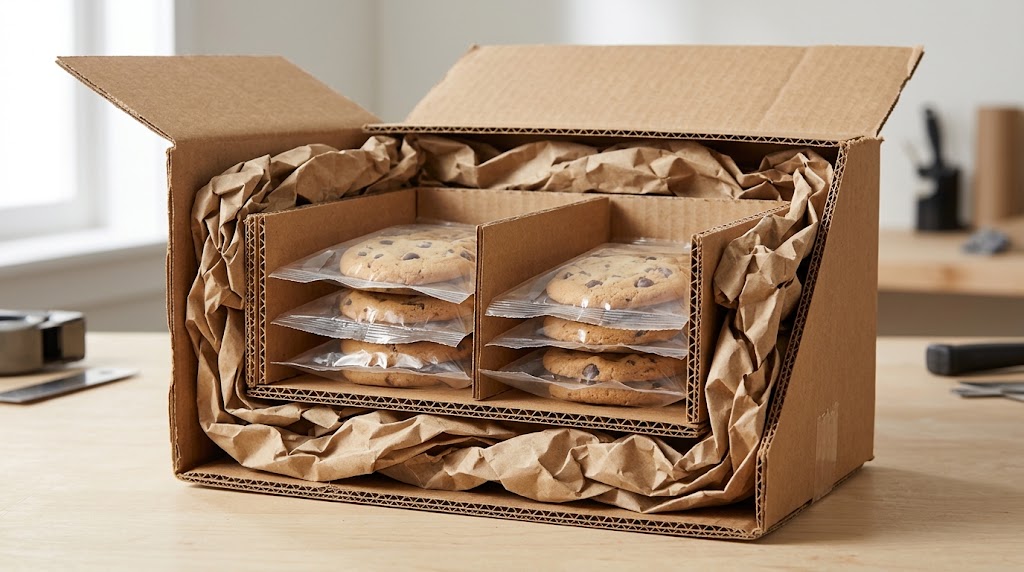
Then position the filled bags in an inner support. A divider can reduce contact between packs; a tray or inner carton can carry loads that the flexible bag cannot. Measure the assembly when it is fully loaded. An empty bag's footprint is not the assembled order's footprint. Check the smallest order as well as the largest: a carton that restrains twelve bags may let two bags tumble.
FedEx's cookie guide recommends a sturdy container within a larger corrugated box, a partition to prevent cookies touching, cushioning around the inner container, and a gentle shake check to look for movement. Its 2–3 inch cushioning description belongs to that carrier's guidance for an ambient example; it is not a universal minimum that proves the user's particular parcel has passed a trial (FedEx guide). Confirm the current guidance for the chosen carrier and service.
A Measured Carton Worksheet
Measure the filled, supported assembly along three axes. Decide what protective components will be used on each opposing side. Then calculate a preliminary internal space for the carton. The equation is simple:
Candidate internal dimension = supported assembly dimension + protective allowance on side A + protective allowance on side B.
The allowances are design inputs to be confirmed through samples and transport trials. Different sides need not be equal. The external closed-carton dimensions and gross weight are separate values used for carrier quotations and service checks. Do not infer the outside size by adding a guessed board thickness to the inside dimensions.
| Field to record | Why it matters |
|---|---|
| Largest filled pouch thickness and corner shape | A nominal empty-pouch drawing can understate the occupied space |
| Supported assembly length, width and height | Determines the starting carton envelope |
| Protective component on each face | Shows where cushioning or a rigid support carries load |
| Minimum and maximum order configurations | Reveals whether low-fill parcels are free to move |
| Closed-carton exterior size and gross mass | Needed for carrier acceptance and shipping cost |
| Opening and arrival observations | Shows whether the proposed space actually worked |
Keep tape and cushioning outside sealed food bags unless those components are separately qualified for direct contact. Do not add loose air pillows around a stack and assume every cookie is protected; the stack itself may still flex or the bags may move together.
Handle Temperature, Humidity and Transit Time as Product Questions
A bag can slow moisture exchange when its structure and seals are suitable, but it does not control the temperature of a parcel left in a vehicle or on a porch. Heat may soften chocolate, encourage oil migration or alter a filling. Cold and reheating can create condensation if the route and pack were not planned. Ambient shipment is therefore a conclusion about a particular finished cookie, shelf-life target and route, not a generic property of “cookie packaging.”
For established shelf-stable cookies, align dispatch timing, expected transit duration and arrival acceptance with the product's documented storage plan. FedEx recommends early-week shipping to reduce weekend delays and checking weather at origin and destination, especially for chocolate-coated or cream-filled goods (FedEx guide). Such advice helps plan a route; it does not replace the food business's product validation or a carrier's current service requirements.
If a cookie requires chilling or frozen transport, treat that as a different package design. A cooler, refrigerant, condensation control and the required service must be qualified together. A film barrier specification cannot demonstrate maintained temperature. Avoid assuming that an insulating shipping component is necessary for a shelf-stable biscuit or sufficient for a perishable filled cookie.
Run a Repeatable Packing Station Procedure
A written procedure reduces the variation that creeps into a busy dispatch day. One operator may use a different box, another may overfill the pouch, and a third may skip the first seal because a zipper looks closed. If those parcels arrive with different damage patterns, the team cannot improve the design without knowing which version was sent.
- Release the cookie lot. Check the defined bake, cooling, size and appearance criteria. Separate pre-existing cracked pieces from the shipping trial.
- Confirm the right food bag. Match the approved construction, dimensions, print version and batch to the SKU and intended contact conditions.
- Fill to the approved count and orientation. Watch for sidewall pressure, protruding inclusions and accidental cookie-to-cookie abrasion.
- Clear and make the first seal. Inspect the full seal width for crumbs, grease, wrinkles and incomplete contact. Do not rely on a zipper alone.
- Check the finished filled bag. Look at corners, the seal and product position after normal handling. Record an example of an acceptable pack and a reject.
- Load the specified support. Put bags in their approved positions; include dividers or trays used in the tested configuration.
- Build the order configuration. Use the carton and protective components listed for that order count, not whichever box is closest to the station.
- Close and identify the carton. Tape it as specified and record the SKU, count, packaging revision, pack date and route or service needed for traceability.
- Perform the dispatch check. A gentle movement check can reveal obvious loose contents; document any corrective action. Do not call a hand shake an ISTA test.
- Retain the trial record. Capture a photo of the completed arrangement and keep a reference pack when qualifying a new format.
A bakery can simplify this procedure for a small operation, but it should not omit the evidence needed to compare a successful parcel with a broken one. For a commercial line, add line-start, changeover and periodic checks suitable to its own process.
Test the Complete Parcel, Then Inspect the Cookies
Start with a baseline: photograph and count intact cookies before packing. Use actual production pieces, the intended number of bags, the specified supports and the final carton. Compare more than one plausible arrangement when a design choice remains open. Keep the recipe, cookie size, route and order count fixed while changing one packaging variable at a time; otherwise a lower breakage count may be impossible to explain.
A simple shake check is useful for spotting an obviously loose pack. A controlled drop or vibration exercise can screen designs, but it must be described by the actual method, sample, orientation and sequence. ISTA lists Procedure 3A for individual packaged products shipped through a parcel delivery system, and its design and testing guidance helps choose a procedure for the distribution system. A lab or qualified packaging team should select and perform any formal protocol. Do not label a home-built test “ISTA 3A certified.”
After the package has completed the selected trial, open it and examine both the exterior and the food. Note which side or corner received a mark, whether a support shifted, which pouch abraded, and where the cookie cracked. Repeat with representative real routes if the distribution system varies. A passed laboratory sequence is useful evidence, but the bakery still needs an arrival criterion and a field feedback process.
Record Both Cookie and Parcel Outcomes
These two denominators answer different questions. A parcel with one chipped cookie may fail an all-intact gift promise while its cookie-level damage percentage remains low. Decide which outcome matters commercially before choosing an acceptance limit.
| Metric | Calculation | What to record alongside it |
|---|---|---|
| Cookie damage rate | Newly broken or unacceptable cookies ÷ cookies inspected × 100 | Definition of damage, inspected count, SKU and lot |
| Parcel complaint or failure rate | Parcels failing the agreed arrival criterion ÷ parcels assessed × 100 | Route, service, carton configuration and arrival delay |
| Seal defect rate | Finished bags with the defined seal defect ÷ bags inspected × 100 | Seal location, contamination type, line and film lot |
For example, if a hypothetical trial inspects 100 previously intact cookies and finds 7 newly broken, its cookie damage rate is 7%. This is an arithmetic illustration, not a published result or an acceptable target. If the same trial included 20 parcels and four parcels failed the agreed arrival rule, the parcel failure rate would be 20%. Do not interchange those two percentages. Record uncertainty from small samples and repeat tests when the product, package, process or distribution path changes; ISTA's retesting guidance identifies changes to product, packaging and distribution as reasons to revisit testing.
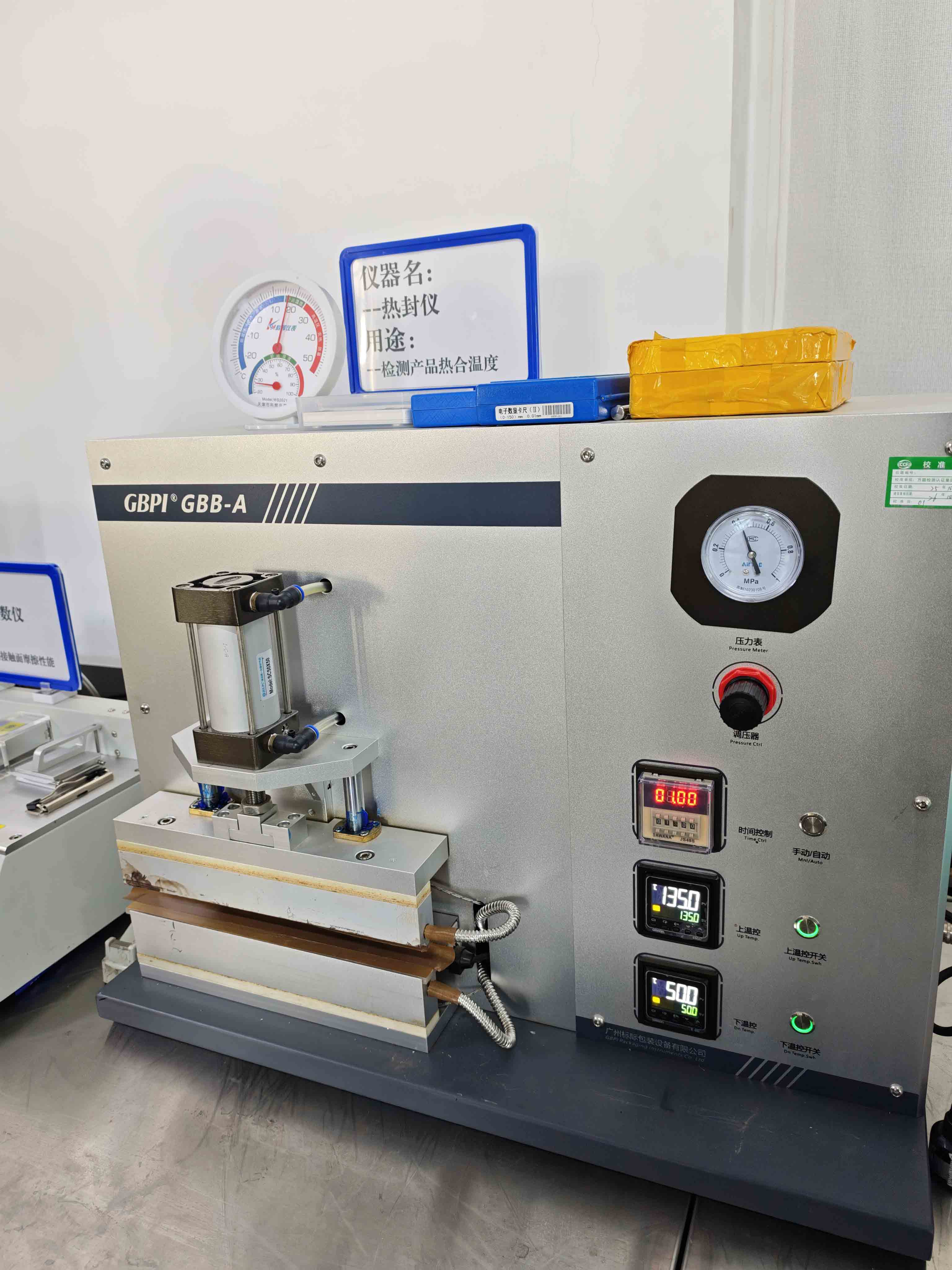
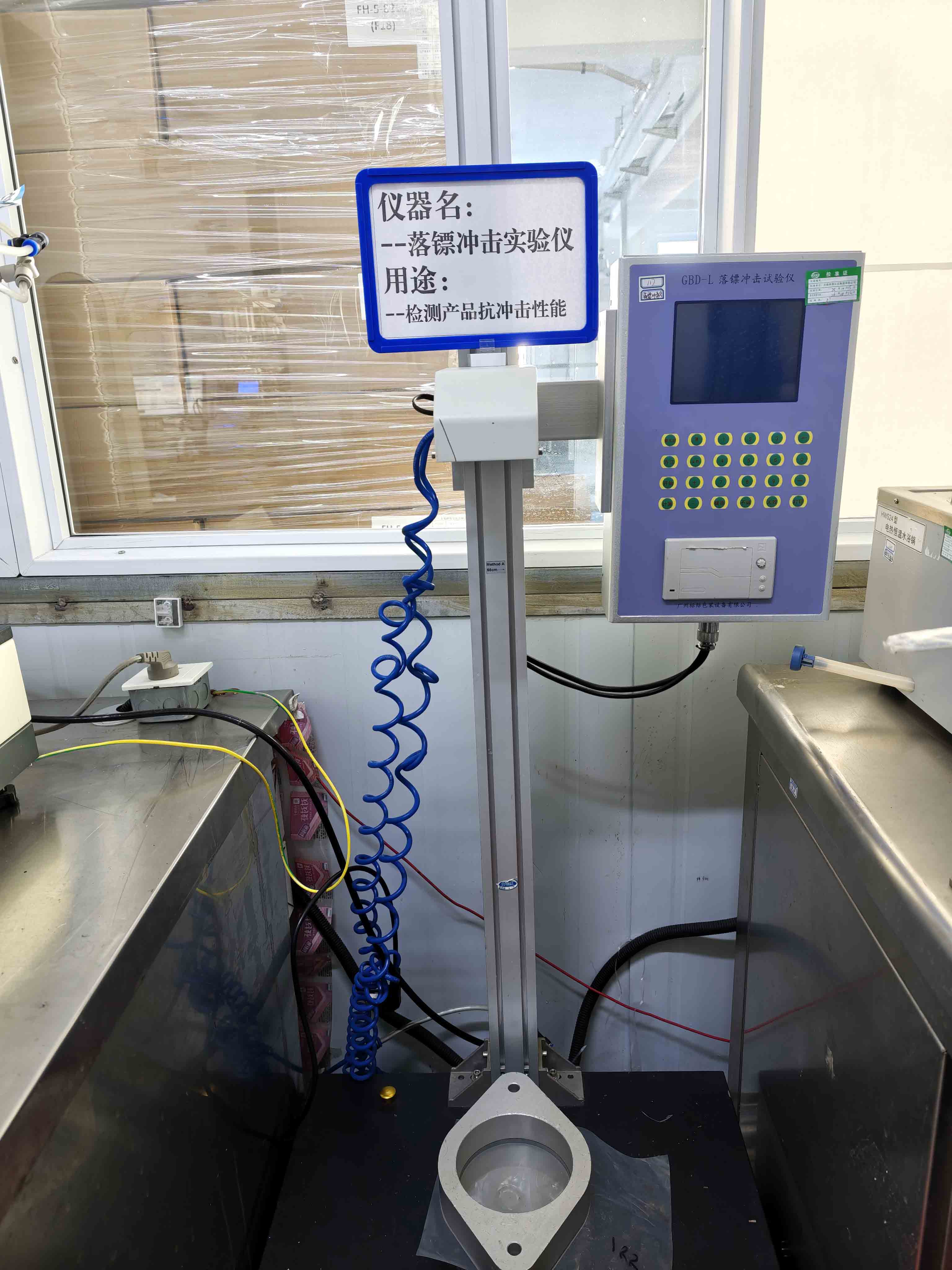
A film test is a different measurement. A falling-dart instrument can characterize film impact behavior under a specified method. It cannot tell you whether a filled cookie bag, divider and shipping carton together prevent a biscuit from breaking. Likewise, a heat-seal instrument does not establish parcel survival without the finished-pack and route checks.
Diagnose the Damage Before Changing the Design
Avoid the reflex to buy a thicker bag or add more filler without identifying the failure. The observation should point to the next trial.
| Arrival symptom | Likely questions | Next controlled comparison |
|---|---|---|
| Chipped cookie edges, intact bags | Did cookies contact each other or shift inside the pouch? | Change portion separation or internal positioning while holding the carton fixed |
| Flattened soft cookies | Was the stack or inner support carrying a top load? | Change support and stack height while keeping the cookie lot constant |
| Punctured bag corner | Did an inclusion, carton edge or adjacent pack create a contact point? | Inspect contact geometry, then trial an adjusted bag/support |
| Moist or softened crisp cookies | Was there a condensation, seal or barrier issue? | Review cooling, finished seal and exact film data; run product storage trials |
| Open or wrinkled top seal | Were crumbs, oil or handling involved? | Adjust filling clearance and seal process; inspect finished packs |
| Outer box sound, cookies broken | Was damage occurring within the support or bag? | Open immediately after a controlled handling trial and map the fracture location |
| Box crushed, inner pack mostly intact | Did the outer carton absorb a load within the product's tolerance? | Record the event and verify all cookies before calling the shipment acceptable |
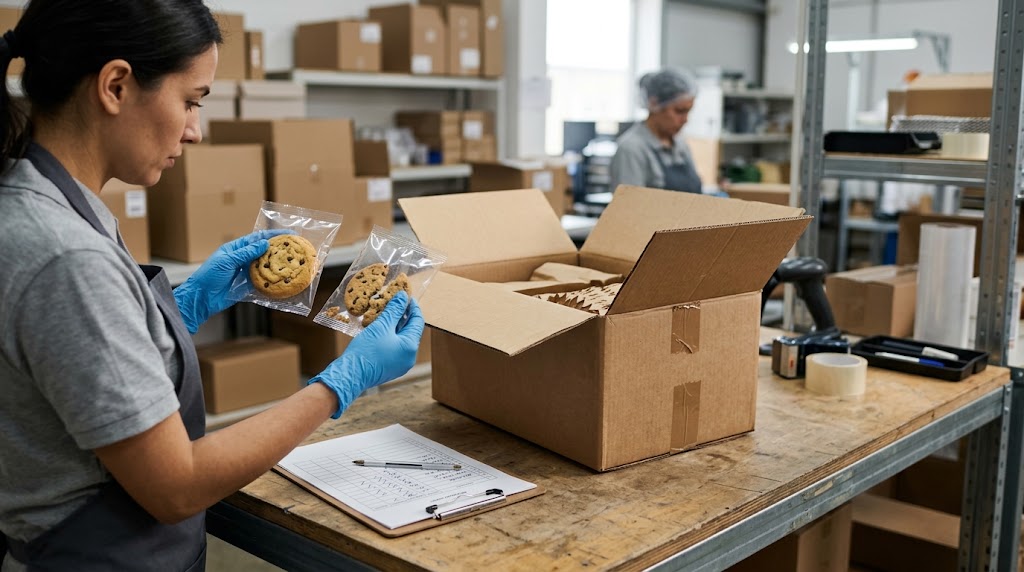
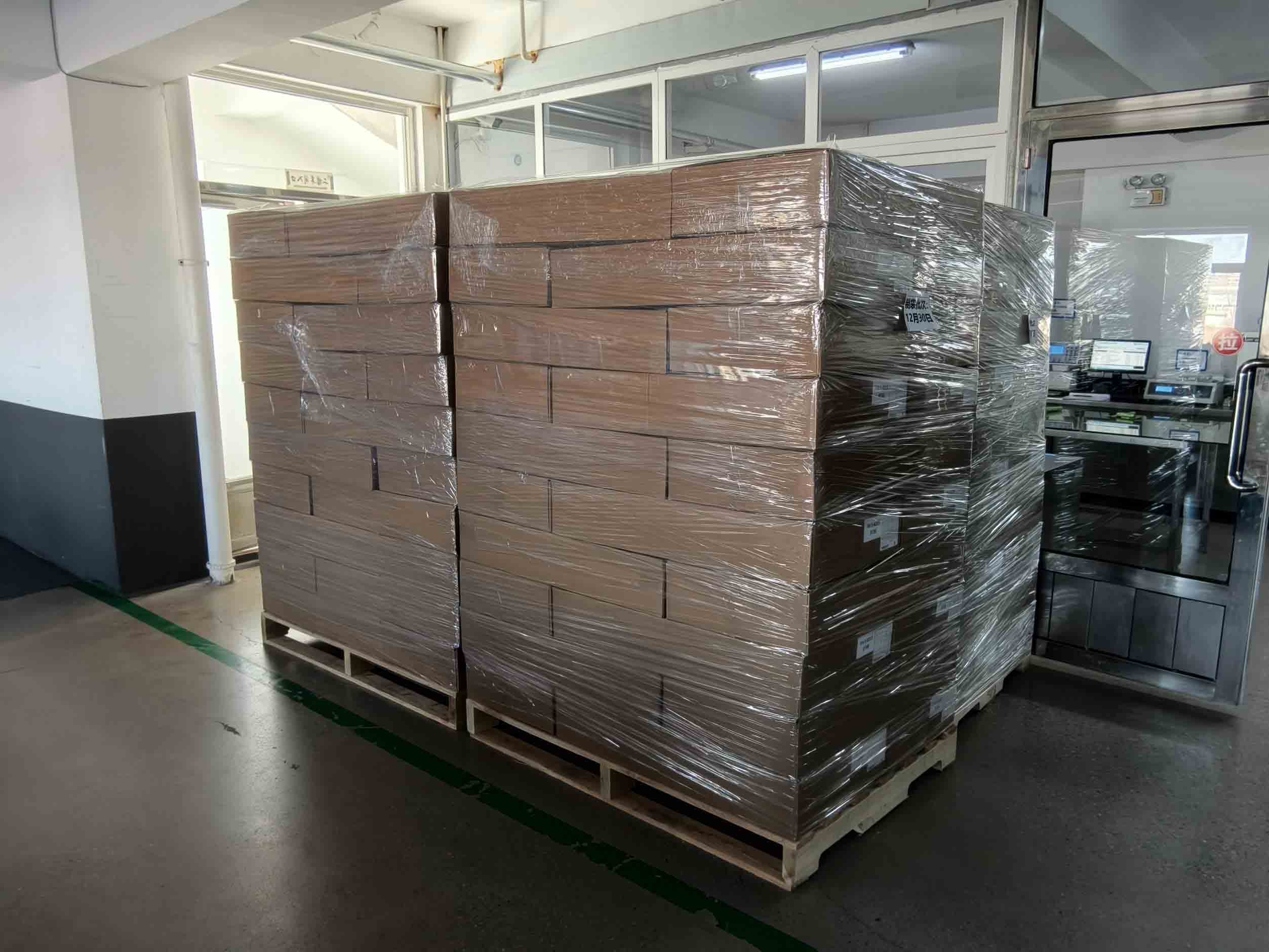
Do not use a photograph of palletized shipping cartons as proof that an individual cookie parcel was qualified. It is useful only as a real factory context image for packing and dispatch. The finished cookie system has to be tested as shipped.
What to Send a Cookie Bag Supplier
A useful inquiry tells a film and bag supplier enough to recommend samples without pretending that the supplier controls the entire carrier route. Include the cookie's largest normal dimensions, thickness range, count per bag, surface fat or inclusions, approved storage conditions and desired first seal. Add the filling method, retail presentation, shipping order counts and the problems seen in current trials. Ask for the exact proposed structure, food-contact documentation relevant to the destination, barrier test conditions, bag drawing, closure details and sample quantity.
Then tell the supplier what the bag trial will measure: filled fit, usable opening, clean seal, appearance after handling, and compatibility with any divider or inner carton. The custom cookie bag page is an appropriate starting point for that conversation. It is not an offer of a particular shelf life or an assurance that one pouch will eliminate shipping breakage. Send actual cookies or measured prototypes to the packaging team when practical, and approve a signed physical reference before a larger run.
A concise brief might say: “We mail six shelf-stable drop cookies per order in two sealed retail bags. Here is the largest cookie, the approved fill count, our packing method and the current arrival photos. Propose two bag samples with a documented food-contact side and heat-seal window. We will test the filled bags in our specified support and outer carton on the intended routes.” This gives both teams a way to measure an improvement.
Frequently Asked Questions
What is the best way to package cookies for shipping so they do not break?
Use a suitable closed food-contact bag, keep cookies from hitting one another, support the filled packs against bending and compression, and restrain the assembly in a sturdy shipping carton. Test the final combination with representative cookies and routes. The best arrangement depends on the cookie and the number in the order.
How do I package homemade cookies for shipping?
Let them complete the cooling step, reject pieces already cracked, group compatible flavors and textures, and use food-suitable wrapping or bags. Separate the portions in a rigid support, cushion that support in the shipping box and ship within the product's established safe storage window. The word “homemade” does not establish whether a filled or frosted recipe is shelf stable.
Should each cookie have its own bag?
Individual bags can reduce direct contact, help portion control and reveal which package failed. They also add handling, film and seal operations. A multi-cookie bag may work when the pieces are adequately positioned and the complete shipping system passes trials. Compare both with the actual cookie rather than treating single wrapping as a guarantee.
Can a thicker Mylar bag stop cookies from breaking?
A different film may change puncture or handling behavior, but flexible film does not automatically resist carton compression or stop cookies moving inside the bag. Identify whether the failure came from film damage, cookie-to-cookie contact or external load before changing gauge. Ask for the exact film data and test the finished parcel.
How do I package drop cookies for shipping?
Measure representative diameter, thickness and protruding inclusions. Choose a bag that fills without crushing the edges, leave a clean first-seal zone, and arrange the bags so the cookies do not slide into one another or bend under a stack. Soft and crisp drop cookies need different arrival checks even when their diameter is the same.
Is a zipper enough to close a shipped cookie bag?
A zipper serves a resealable consumer pack after opening. For a sealed retail shipment, use and inspect the intended first closure under the approved process. Crumbs or a partially engaged zipper can create a poor result, and the outer carton does not correct that failure.
Should bubble wrap touch the cookies?
Ordinary shipping cushioning should remain outside a qualified food-contact bag or another suitable food-contact layer. If a component will touch exposed cookies, establish its suitability for that exact use. A partition can protect pieces mechanically while still needing its own contact evaluation when it touches the food.
Does a moisture-barrier pouch replace a rigid inner box?
No. Moisture barrier and impact support solve different problems. A pouch may help maintain a product's texture when correctly specified and sealed; a divider or rigid support helps resist bending and piece-to-piece contact. Some sturdy cookies need little extra support, while fragile ones need more. Trial the assembled order.
How much empty space should be left in a cookie bag?
Enough to insert the largest approved cookie without scraping it and to make a clean first seal, but not so much that it can slide or rotate into damaging contact. Measure usable interior space after seams and fill thickness. There is no transferable clearance number for every cookie shape.
How can I test a cookie shipping box without a laboratory?
Use consistent filled samples, a recorded packing arrangement, a gentle movement check and trial shipments on representative routes. Photograph intact cookies before dispatch and inspect arrivals using a written defect definition. Those checks are practical screening tools; do not represent them as a formal ISTA procedure. Bring a packaging laboratory in when formal qualification is needed.
Does a falling-dart test prove the cookies will arrive intact?
No. It addresses film impact under its stated test conditions. Cookie arrival depends on the product, filled bag, support, carton and route together. Read a film report as one input, then evaluate the complete shipment.
Can cookies be mailed at room temperature?
Some established shelf-stable cookies can travel without refrigerants, as FedEx notes in its perishables guidance. The bakery must establish the handling and storage needs of its specific recipe, especially for fillings, toppings and temperature-sensitive inclusions. Check the carrier's current rules and the weather on the actual route.
How do I know whether a new package is better?
Set an arrival criterion before the comparison. Hold the cookie lot and shipping conditions as steady as possible, change one packaging variable, and record cookie damage, parcel failures, seal defects and handling observations using the same denominators. Retest after meaningful changes to the product or shipping system.
The goal is a saleable cookie at the destination, not a bag that merely looks protective at the packing table. Start with the product, specify the food-contact pouch, build support around the filled pack, and let arrival evidence decide whether the design is ready.