
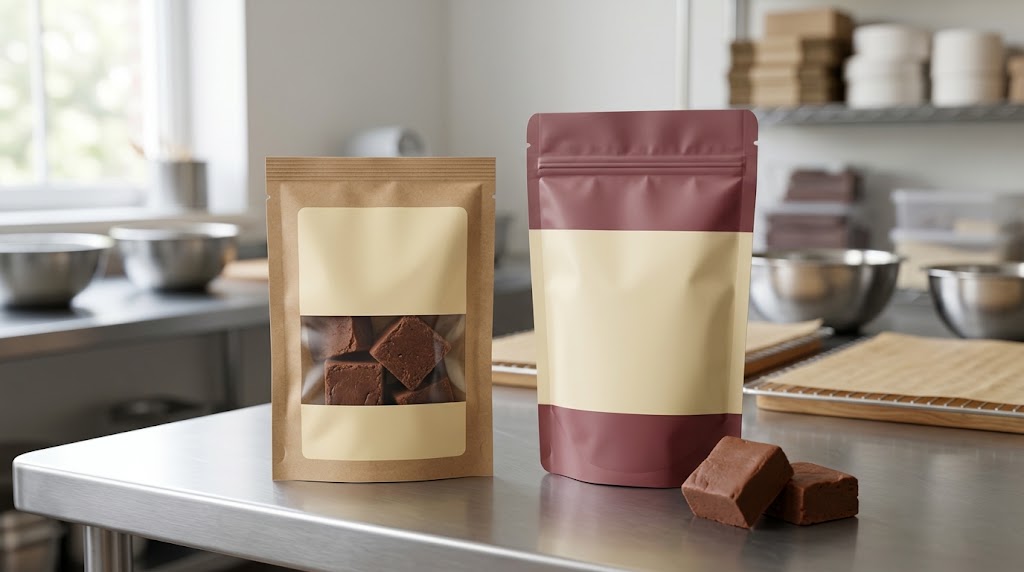
If you are deciding how to package fudge for sale, start with the finished product. Measure the largest portion, record whether its surface sticks or leaves oil on a contact layer, and establish the storage conditions and quality period your food business intends to validate. Decide whether pieces need individual wraps or separators. Only then choose a food-contact-compatible retail pouch, fill and heat-seal samples, check the finished label, and follow the product through its intended storage period. A bag photograph cannot answer whether a particular recipe will release cleanly from the wrapper or remain suitable for sale.
That sequence works for a single fudge square, a small multipack or a larger slab. The choices will differ. A neatly cut square may show every mark left by a sticky wrapper. A heavy slab may stretch a pouch or obscure its back label. Several flavors in one bag create a copy-control problem in addition to a fit problem. This guide gives a commercial food producer a way to make those decisions with real samples. It focuses on flexible bags for fudge people eat, not hot fudge sauce, gummy candy, pet treats, packaging machines or gift-box purchasing.
Write a Product Brief Before Choosing a Bag
The words “fudge packaging” can describe very different jobs. Write one row for each product and flavor version you intend to sell. Record the actual pack at the point of filling, not just the nominal weight on a recipe sheet. If the pieces are individually wrapped, measure them after that wrap is applied. If a slab rests on a support, include the supported dimensions. For hand packing, observe the typical operator's motion; for a line, observe a representative running trial.
| Brief field | Record this for the actual SKU | Decision it affects |
|---|---|---|
| Recipe and finished state | Ingredients, inclusions, surface, finished water activity where relevant, established handling and storage instructions | Contact-material review, product quality plan, labeling and whether ambient storage can even be considered |
| Portion geometry | Maximum width, height, thickness, weight, count, corners, normal variation and any support or individual wrap | Pouch width, gusset, headspace, tear clearance and hand or machine filling |
| Contact behavior | Immediate and later sticking, oil marks, transfer of decoration, crumbs, release on opening | Inner wrap or separator, food-contact sealant and consumer opening experience |
| Retail route | Counter sale, shelf display, hanging display, gift assortment, repeat opening | Flat or stand-up format, display stability, print panels, zipper or hang feature |
| Packing operation | Product temperature at packing, fill method, sealer, code location, planned output and rejected-pack handling | Film/sealant compatibility, seal window, coding and sample protocol |
| Quality target | Intended unopened period and conditions, plus texture, aroma, appearance and safety criteria to establish | Barrier questions, sampling dates and final release decision |
| Selling market | Label language, mandatory information, food-contact requirements and who approves the label | Artwork, version control and supporting documentation |
The phrase “food grade” is not enough to fill that table. For a U.S. example, the FDA explains that the regulatory status of food-contact material components is tied to the substance and its intended conditions of use. Other markets require their own review. Ask the supplier for the material construction, the intended contact layer and documentation for the actual use, including fat contact or the relevant temperature where applicable. The fudge producer remains responsible for its food and the finished product label.
Separate a food safety decision from a quality decision. Fudge can have different formulations and water availability even if the pieces look similar. Water activity describes available water more usefully than a casual impression of “soft” or “dry”; the FDA's water-activity technical guide relates it to food stability. It does not classify your untested recipe or give every fudge the same room-temperature shelf life. Record measured product data and an appropriate food-safety assessment before specifying a storage claim. A better bag cannot turn a recipe requiring controlled storage into a proven shelf-stable one.
Decide Whether the Pieces Need Individual Contact Wraps
“Wrap the fudge” and “put fudge in a retail pouch” are separate operations. A contact wrap or separator can keep two sticky cut faces from adhering to one another and can make a piece easier to pick up. The outer pouch can provide a printed retail presentation and, if suitably specified and sealed, part of the protection against the outside environment. Neither layer automatically does every job.
For a single portion, trial a direct-contact pouch if the fudge releases from that exact contact surface without excessive transfer or deformation. Test the intended holding period, not only the first minute after filling. For multiple portions, wrap or separate pieces if they leave marks on each other, merge under their own weight or make the package difficult to open cleanly. A full-contact wrap around every piece is not automatically better: it adds material and labor and can itself stick to the product.
| Retail unit | First construction to prototype | Check before choosing it |
|---|---|---|
| One small, stable square | Sized flat pouch, with or without a separate contact wrap | Release after the target hold, corner marks, pack appearance and seal-zone clearance |
| Several cut pieces with tacky surfaces | Individually wrapped or adequately separated pieces in a tested retail pouch | Piece-to-piece adhesion, unwrap effort, actual wrapped dimensions and label for mixed flavors |
| Larger slab or bar | Contact layer and support if needed, then a fitted outer pouch | Base support, bending, side-seal stress, handling and product sticking on removal |
| Mixed assortment | Separators or wraps determined by each recipe, then a common retail pack only if it truly fits all | Correct ingredient/allergen information, movement, distinct textures and version control |
Food-contact papers, films and coated materials can behave differently with a sugar-and-fat confection. A material described casually as “wax paper” or “cellophane” may not identify the actual construction or the supplier's intended conditions of use. Request the specific material and test release, oil marking and odor with the finished fudge. A bag printer may supply the outer pouch without manufacturing every type of individual candy wrapper; state the two requirements separately in the brief.
Make the release trial reproducible. Use the same portion size and packing state across candidates. At packing, then at the agreed interim and target observation points, photograph a piece before opening. Peel away the contact layer in a consistent way. Record whether it removes product, leaves a stain, changes the cut face or deposits fibers. Log handling and storage conditions. If the recipe or finishing step changes, repeat the trial. A clean initial release does not establish a clean release weeks later.
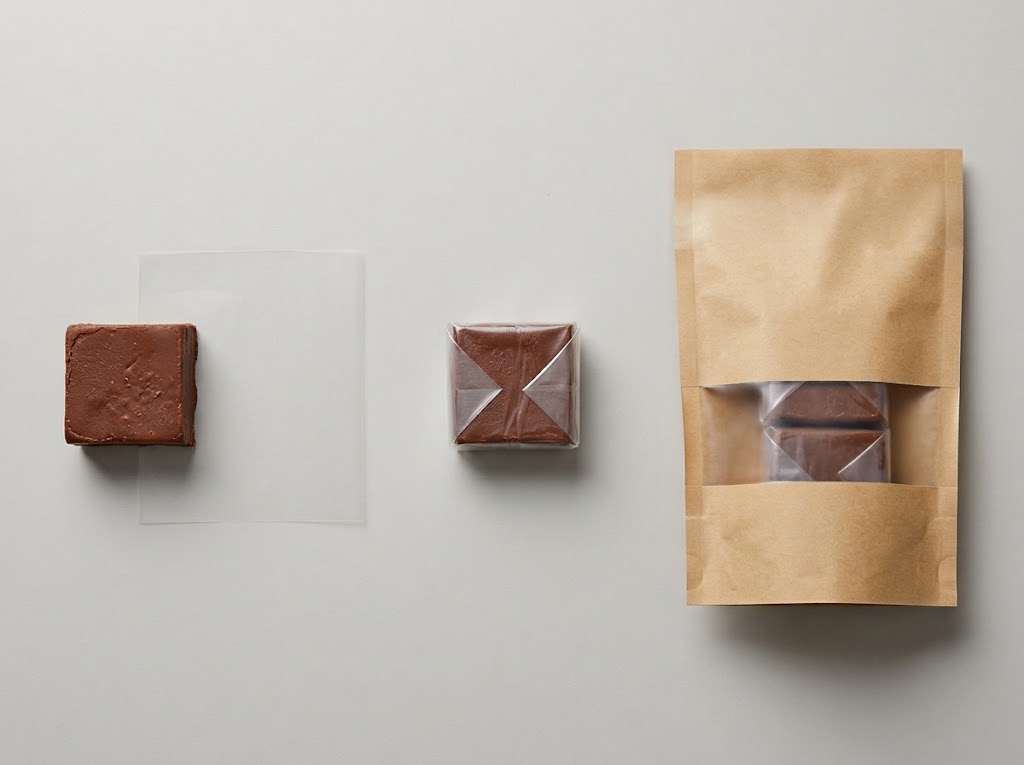
This article keeps the individual-wrap discussion at the decision level. A separate guide on how to wrap fudge can go deeper into fold patterns, contact-layer release and wrapped-piece measurements. Do not assume that a neat paper fold is a dependable initial retail seal if the product brief requires a tested heat-sealed pack.
Choose a Pouch Around the Filled Product
A stock capacity label such as “4 oz bag” is an estimate for some other product geometry. Dense fudge pieces, a stack of individually wrapped squares and a supported slab can have the same net weight but require different pouch dimensions. Ask for several sample sizes in the intended material construction, or at least a close production-representative structure. Fill them with the largest and most awkward recipe variant.
| Pouch format | Sensible trial situation | Advantages to check | Failure to look for |
|---|---|---|---|
| Flat pouch | One portion, a slim bar or a small supported set | Compact front and back, straightforward top seal, low display bulk | Side seam pressing into fudge, over-tight corners, unstable display or insufficient label space |
| Stand-up pouch | Several pieces or a small assortment meant to stand on a shelf | Upright graphic panel and possible reclosure after opening | Sagging or bulging gusset, underfilled appearance, product settling and top-heavy display |
| Windowed version of a proven format | The actual product appearance helps the buyer decide | Visible portion size and decoration | Scuffs or smears visible through window; changed protection if the window area differs from the opaque film |
| Zipper version of a proven format | More than one intended consumer opening | Convenience after opening | Too little initial heat-seal land, zipper fouled with crumbs or a tear feature that damages the front |
Try the pack filled and sealed, not just laid flat. Check the greatest practical fill, the smallest saleable fill, and routine portion variation. Stand the bag on the actual shelf or display tray. Lift it by the usual consumer grip. Does the bottom gusset open consistently? Does the front panel bow outward so the flavor name distorts? Can a consumer remove a piece without scraping a sticky surface against the tear edge? If the pouch has a zipper, does it close after the first opening with the actual fudge crumbs or wrap folds inside?
For size approval, write down the filled bag's width, height and depth; the product's highest point; the clear region required for the initial seal; and the usable label and variable-code areas. Leave working room for filling without oversizing the pack simply to make insertion easy. A pouch that looks half-empty may be poor retail presentation; a pouch pulled tight around the product may mark its cut faces or put load on the seams. Trial both ends of the normal portion tolerance.
A real adjacent confectionery pouch, used honestly
Mylarbag publishes a stand-up pouch for nougats and energy bites. Its public page lists digital printing, MATOPP/PET/PE and nominal 14 × 21 + 4 cm dimensions. The real photograph shows a printed front and back, a shaped viewing window and a hang feature. These are useful questions for any retail confectionery brief: which surface tells the flavor story, where does the required information go, what is visible through the window and where is the untouched top-seal region?
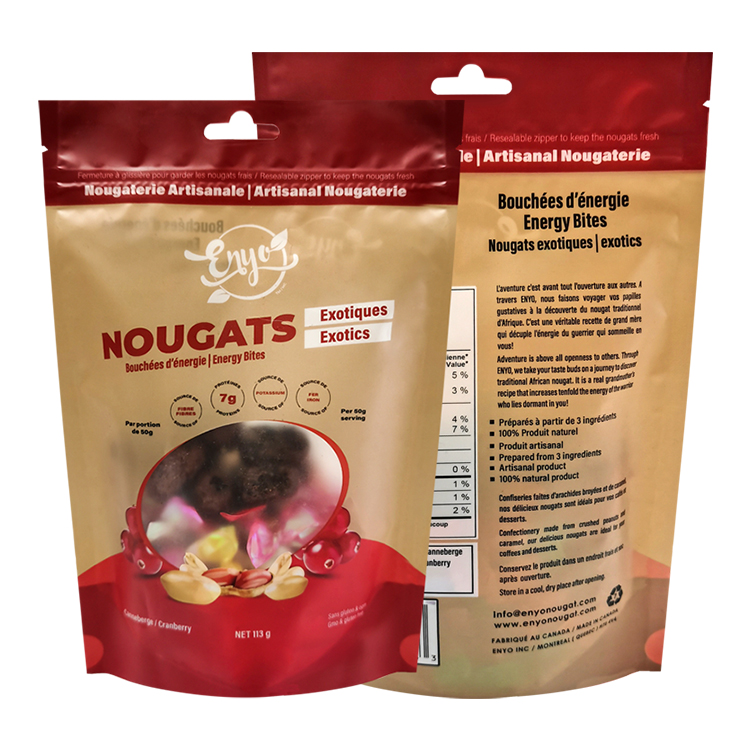
Now imagine a fudge producer considering a similar retail presentation. This is a hypothetical design exercise, not a reported extension of the nougat project. The producer would measure its own wrapped or unwrapped fudge, decide whether a window shows the product well throughout the selling period, reserve a clean seal and code area, and test the filled pouch in the intended conditions. A different food-contact layer or window construction might be needed. The case does not establish that the listed size, film, zipper or shelf result works for fudge. Avoid treating a neighboring confectionery example as a substitute for a fudge prototype.
Specify the Contact Layer, Barrier and Window as One Package
The outer appearance is only one part of a flexible bag. A typical multilayer construction can have an external print surface, one or more intermediate layers and an inner layer that contacts food and heat-seals. The exact sequence varies. Ask the bag supplier to describe each proposed layer and to provide the relevant test report or regulatory basis for the intended product and market. A kraft look is a surface choice, not proof that paper alone is the food-contact or barrier layer. A metallic sheen is not proof that the structure contains aluminum foil or meets a particular oxygen-transmission target.
For a recipe where moisture exchange affects quality, request a water-vapor transmission rate (WVTR) with units, test method, temperature, humidity and the exact film structure tested. For a recipe where oxygen exposure is relevant, request the same context for oxygen-transmission rate (OTR). ASTM's F1249 method concerns water-vapor transmission through plastic film and sheeting, and D3985-24 concerns oxygen transmission using a coulometric sensor. The values are inputs to a package design. They are not a promise that a filled pouch with a window, zipper and production seals will preserve every fudge recipe for a fixed time.
If a clear window is proposed, identify its material and how it joins the opaque part of the bag. A quoted rate for the opaque film alone may not describe the full windowed pack. Assess how the fudge looks after normal settling: a window that displays clean-cut squares on day one may show smear, oil marks or compression later. If appearance does not hold up, an opaque front or a different window position may serve the product better. Compare the filled package at the actual target quality points.
An inner contact wrap changes the system again. The wrap may keep adjacent portions apart, while the sealed outer bag provides the main external environment boundary. The two layers need to work together: the wrapping fold should not foul the outer bag's zipper or heat seal, and a separator should not puncture the pouch. It is worth testing the assembled retail unit, including wrap, supports, product, window and final seal, even if each individual component has a reassuring supplier description.
Prototype the Packing Operation, Not Just the Drawing
Run a small controlled sample set with actual fudge from the process you will sell. Include normal variation in cut size and finishing. Label each trial by recipe batch, contact material, outer pouch structure, size, fill count, sealing settings and observation date. If you are comparing two films, change only the planned variable where practical. Otherwise a nicer result may be caused by a different recipe batch or fill method rather than the bag.
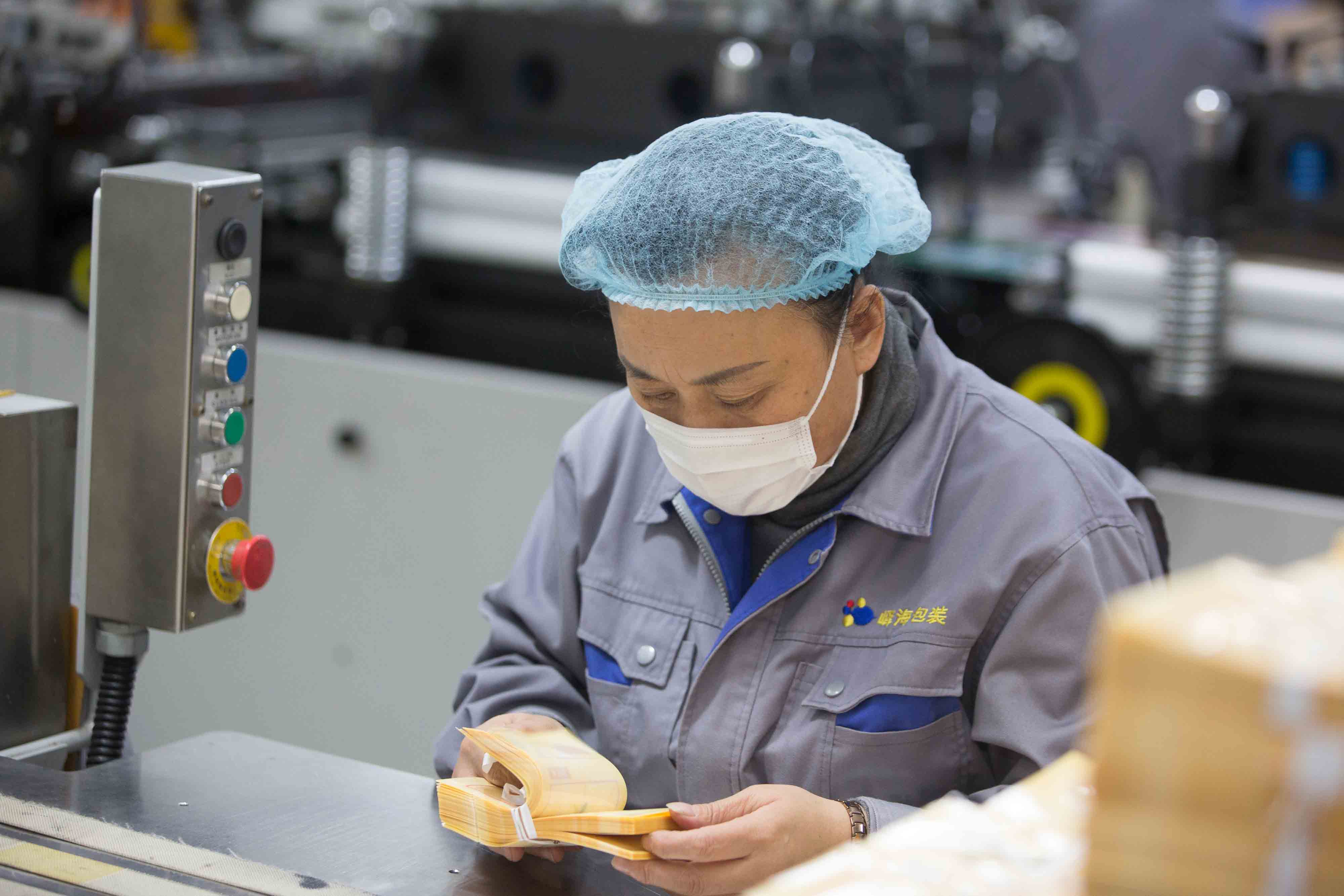
Watch the work from the product's point of view. Does the fudge enter the opening without brushing a freshly cut side against the inner film? Do corners catch on the gusset? Can an operator keep the top seal free of grease, sugar particles and wrapper edges while working at normal pace? Does the bag stand without a carefully staged arrangement? Check the pouch again after it has been handled, placed on a shelf and opened. A supplier's empty-bag sample is useful for material and workmanship review, but it cannot answer these filled-pack questions.
Set pass/fail observations in advance. “Looks good” makes a weak approval note. Write, for example, that no piece may leave an unacceptable mark on the viewing area, the pack must stand after ordinary filling, the initial seal must be continuous under the agreed inspection method, the barcode must scan on the finished pack, and the product must meet its defined quality criteria at the target observation points. The exact acceptance limits belong to the product and its quality system. Keep a signed reference sample and record any changes to structure, window, zipper, artwork or fill count.
A simple three-gate release record
| Gate | Evidence to retain | A failure tells you to revisit |
|---|---|---|
| 1. Product and contact | Finished-product observations, relevant measured properties, wrap-release photos, contact documentation | Recipe or packing state, contact layer, separators, storage assumptions |
| 2. Finished retail pouch | Filled size, artwork and label proof, code/scan result, heat-seal settings and sampled inspection | Pouch geometry, filling motion, contaminated seal zone, print placement or sealer |
| 3. Product over the intended period | Defined time/condition samples, texture, appearance, flavor and appropriate safety evidence | Product formulation, complete bag structure, closure, handling and storage route |
Passing Gate 2 does not automatically pass Gate 3. Strong empty-bag seals do not establish the actual food's quality period. If a product requires refrigeration for reasons established outside the packaging project, the sales and distribution plan must honor that condition. A high-barrier pouch may be useful, but it is not a refrigeration exemption.
Fill and Make a Reliable Initial Heat Seal
For a retail pouch specified to be heat sealed, the top seal is part of the unopened pack's performance. Start with the sealant layer the supplier actually proposes, a sealer suitable for the chosen film and a trial range of temperature, pressure and dwell time. Set up the operation with the real filled product. The good-looking empty pouch may crease when fudge or a folded inner wrap pushes against the top region.
Keep product, oil, sugar and wrapper ends out of the seal land. Establish where the product can rest during filling and where the operator or machine grips the bag. Leave enough clear film above a zipper for the initial seal and a usable tear or opening feature. After opening, the zipper may help the consumer reclose the pouch; it does not retroactively create the first retail seal. A tie, sticker or attractive fold likewise should not be described as an equivalent seal for a project whose quality plan requires a tested heat-sealed closure.
Inspect for a continuous band, alignment, edge wrinkles, burn-through and any path where debris crosses the seal. Define a sampling plan for each run and after significant machine adjustments. A seal-strength method such as ASTM F88/F88M-23 can measure sampled flexible-barrier seals. Interpret it with the structure, specimen preparation and acceptance range specified for the project. Seal strength alone does not prove every bag leak-free or establish a fudge shelf life. If another integrity method is appropriate, define it separately rather than assuming a single peel result answers every question.
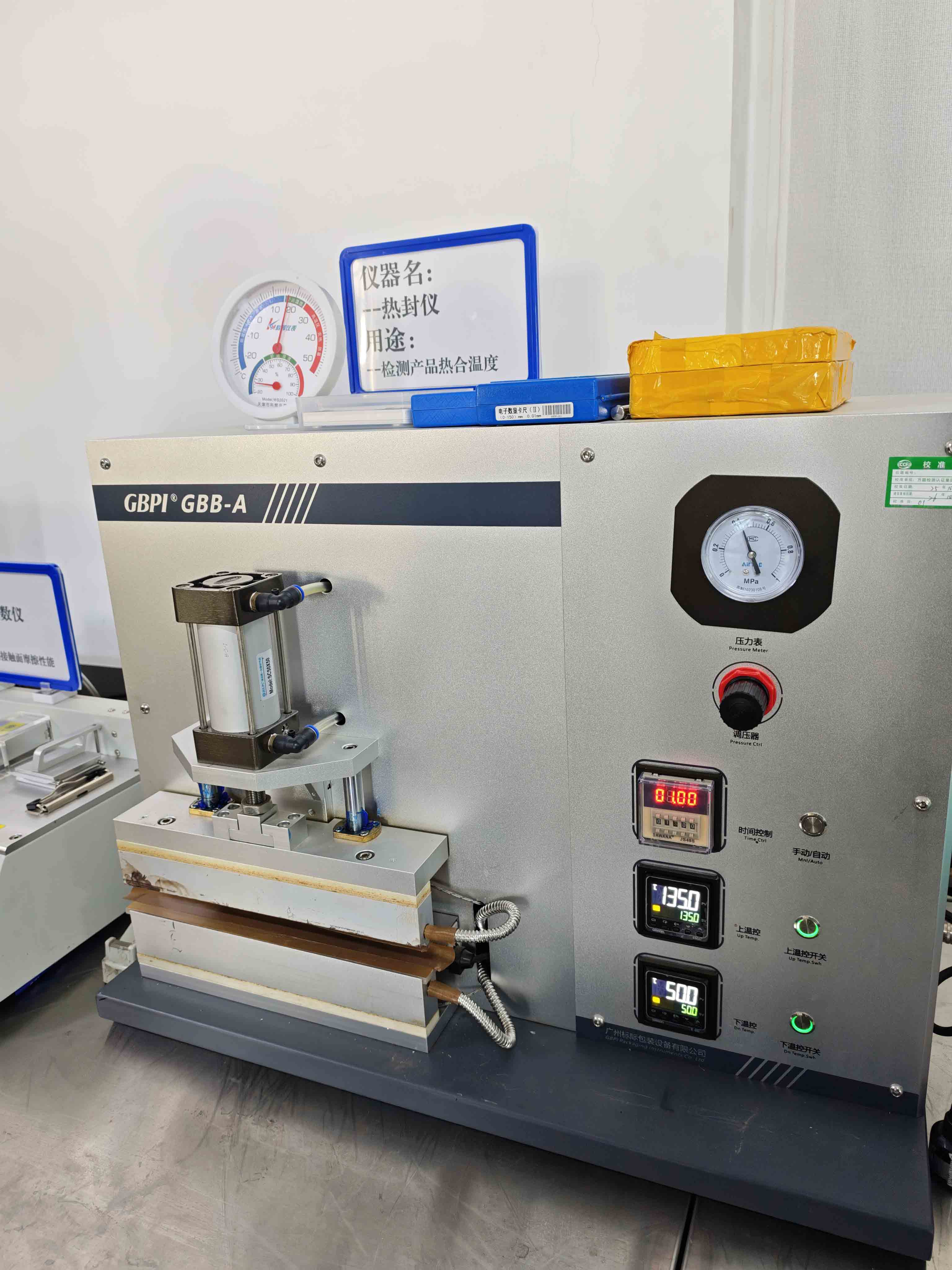
When a trial fails, describe the symptom rather than hiding it in an average score. A wrinkled seal may call for a change in fill clearance or bag presentation. A weak peel may call for a sealing-window review, material check or machine maintenance. A clean seal at startup followed by contaminated seals later suggests an operation-control issue. Quarantine and assess affected packs under the food business's procedure. Do not simply reseal a dirty retail bag and assume the first failure no longer matters.
Prepare the Printed Pack and Label for Its Selling Market
The printed bag must still be readable when it is full. Put the product identity, flavor, required food information, variable code and barcode on surfaces that remain usable after gussets open and the pouch bulges. Keep tiny text away from folds, seals, tear lines and opaque-over-window transitions. Check a real printed sample, then scan the barcode at the finished bag's normal curvature. GS1's barcode quality guidance identifies issues such as contrast, quiet zones, dimensions, position and print defects. A PDF proof is not a checkout scan.
Fudge assortments often vary by ingredients or inclusions. Give each finished recipe an approved copy source and a version identifier. If one flavor contains milk or nuts, or if an assortment changes, have the responsible food business review the ingredient and allergen statement for its actual market. For U.S. sales, the FDA's 2025 food-allergen labeling Q&A is an authoritative reference; it is not a universal label template for every country. Confirm net quantity, date/lot handling and any claims under the applicable rules rather than copying a neighboring confectionery brand's artwork.

Printing several flavors on a common pouch structure may reduce design work, but every printed version still needs correct copy and a quantity the business can use before art or recipe changes. Ask for the minimum and schedule per design, the approved color proof, any physical press sample, and the procedure for revising artwork. A label applied to a blank pouch shifts work to label application and control; it does not remove the food-contact and sealing questions. Choose between stock plus controlled labels and a printed pouch using the actual version mix and packing labor, not an unverified universal order minimum.
Send a Supplier Brief That Can Produce a Useful Sample
When you are ready to discuss custom fudge packaging bags, send a pack brief rather than asking for “the best bag for fudge.” Include the finished portion and any wrap/support dimensions; pieces and net weight per retail unit; intended sales market; established product storage requirements; target unopened quality period to validate; packing method; desired flat or stand-up display; window and zipper preferences; label/artwork versions; and where the initial seal and variable code must go. State which of those decisions are provisional so a sample is not mistaken for final approval.
Ask the supplier to identify the complete proposed film and contact layer, the food-contact basis for the intended use, the available sample geometry and the specifications behind any OTR or WVTR claim. Ask which samples represent production material and which are only generic stock bags. Obtain a project-specific quote and schedule only after format, structure and artwork count are understood. A public product page cannot substitute for those project details.
On receipt, fill and evaluate several sample bags using the real process. Write down the actual dimensions, product contact observations, sealing trial and label review. Send concise feedback with photographs of failed or successful states, not merely “bigger” or “stronger.” If the fudge sticks to its piece-level wrap, changing the outer pouch may not solve the contact problem. If the product fits but the top seal is contaminated, a new bag size or a different filling motion might be the right next experiment. Keep decisions attached to the sample revision.
Troubleshoot the Pack Before It Reaches the Shelf
| What the team observes | Likely investigation path | Useful next check |
|---|---|---|
| Fudge sticks to the individual wrap or inner bag | Finished-product state, contact-material suitability, duration and storage | Immediate and target-time release trial with the actual recipe |
| Pouch front smears or window looks unattractive | Product placement, surface transfer, window position and handling | Filled display sample after normal shelf handling |
| Pieces merge or lower row deforms | Count, weight distribution, separators, support and pack movement | Pack-out trial with maximum and minimum portion sizes |
| Seal contains crumbs, oil or wrapper corners | Filling motion, working clearance and clean seal land | Observe normal-speed filling and inspect sampled seals |
| Seal peels inconsistently | Material/sealant, sealer settings, folds and process drift | Controlled sealing-window study and appropriate sampled tests |
| Printed label is hard to read or scan | Filled geometry, small type, dark art, fold and code position | Physical proof on a filled bag and barcode scan |
| Fudge changes texture during the planned period | Recipe, water activity, storage, full bag structure and seal | Product-specific quality and safety review; do not infer cause from film alone |
Record the suspected cause as a hypothesis until a controlled change or test supports it. Two defects can coexist: a sticky wrap and a weak outer seal are separate issues. A visually attractive pack can also fail for incorrect flavor copy. Keeping these investigations separate makes the next sample request more useful.
FAQ: Packaging Fudge to Sell
What is the simplest way to package fudge for sale?
Define the finished product and its required storage first. Trial whether an appropriate food-contact wrap or separator is needed, then put the actual portion in a correctly sized retail pouch. If the project requires an initial heat seal, verify it with the real filling process. Approve the finished label and assess the product under its intended conditions before assigning a quality period.
Can fudge go directly into a plastic pouch?
It may be a workable construction for a particular product if the specified contact layer is suitable for that food and conditions and the fudge releases cleanly throughout the intended period. Test the actual recipe and surface. Multiple pieces that stick together may need individual wraps or separators even when the outer pouch itself is suitable.
Do all fudge pieces need to be wrapped individually?
No universal rule follows from the word “fudge.” Piece count, cut-face tackiness, inclusions, desired opening and portion stability determine the trial. Compare direct bag contact with separated or wrapped packs, including labor, material use and the condition of the pieces on opening.
Is a stand-up pouch better than a flat pouch?
For a multipack that must stand on a shelf, a filled stand-up pouch may present the front more clearly. A small single portion may suit a flat pouch. Trial the actual dimensions, display and first opening; a bag style does not prove fit or protection by itself.
Does a window keep fudge fresh?
A window shows the product. Its effect on protection depends on its material, area, joining construction and the complete package. Ask for information about the proposed windowed structure and compare filled-product quality during the intended period. Check whether the fudge still looks appealing behind it after handling.
Does a high-barrier bag mean fudge is safe at room temperature?
No. The food business must establish the product's safety and storage requirements using its recipe, process and appropriate measurements. A barrier specification describes part of the package, not the safety classification of every fudge formulation.
Can a zipper replace the first heat seal?
For a retail pack specified to have an initial heat seal, no. Plan enough seal land above the zipper, keep it clean during filling and verify the initial seal. The zipper can serve the buyer after opening.
How do I choose a bag size for fudge?
Measure the largest real filled unit, including individual wraps or support. Fill several sample sizes and check side and bottom stress, product movement, seal clearance, appearance and label space. Net weight alone is not a reliable bag-size rule.
How long will fudge last in a sealed bag?
No single duration applies to all recipes and storage conditions. Define the product's safety and quality criteria, select and seal the actual pack, and study samples under the intended conditions. A supplier's film value or another brand's shelf-life claim cannot set yours.
Can I copy the package dimensions of another confectionery brand?
Use a published pack as a format reference, then measure and trial your own product. The nougat example in this article is not a fudge fit test. Portion shape, contact wrap, product weight and packing equipment can require different dimensions or materials.
What should I ask a custom pouch supplier for first?
Provide the portion and pack brief, including market, fill count, product dimensions, contact concerns, storage requirements, closure and artwork versions. Ask for the proposed full material construction, relevant contact documentation, physical samples, seal approach and project-specific quote. Discuss the acceptance checks before placing a production order.
What do I inspect on the first printed sample?
Fill and seal it. Check the correct flavor copy and market-specific information, barcode and code readability, fit, window appearance, opening, contact release, top-seal quality and planned quality observations. A flat screen proof cannot replace the physical pack.
A Sellable Fudge Pack Is a Tested System
The useful question is not which bag looks most like a fudge bag online. It is whether the finished portion, any contact wrap, the retail pouch, the initial seal and the label work together for the actual food and selling route. Make the brief specific, run filled samples and keep each approval tied to the exact structure and artwork revision. That gives the food business evidence for a pack it can produce consistently and gives the packaging supplier enough detail to improve the next sample.