

To package dry hot chocolate powder, choose the serving format first: a sealed single-serve sachet for one drink, or a larger pouch with an initial heat seal and a zipper for repeated scooping. Then test the actual finished mix in physical bags. Check that the target weight fits with room for a clean seal, that powder does not contaminate the seal or zipper, and that the chosen food-contact material and printed label suit the product and intended market. A bag chosen only by a nominal gram capacity is a guess until it has been filled and closed on the intended equipment.
This article concerns a dry cocoa beverage mix, which may also contain sugar, milk powder, sweeteners, flavorings or inclusions. It does not give instructions for filling prepared hot chocolate as a liquid. A pouch suitable for a dry, room-temperature fill is not automatically suitable for hot filling, holding a hot drink or reheating. It also does not cover the fragile finished spheres discussed in our separate hot chocolate bomb shipping guide. The same word “chocolate” hides very different product, contact and handling conditions.
Start with the formula and the way the customer will use it
Write down what is going into the bag before designing artwork. Pure cocoa powder, an instant cocoa-and-sugar blend, a dairy-containing mix and a mix with miniature marshmallows will fill, settle, pour and label differently. The fat, sugar and particle-size distribution can also change how a powder behaves at the filler and during storage. A research study on cocoa beverage powders and moisture-induced caking found that climate conditions and a carbohydrate-sensitive ingredient affected caking; it does not supply a universal shelf life for a new recipe.
Decide whether the buyer empties the whole unit into a mug or opens the package repeatedly. A one-drink sachet can be sealed on all sides and torn open once. A multi-serving bag needs a practical opening, a pour or scoop path and a closure that can be used with powder on the customer’s hands. If several sachets sit inside a branded outer pouch, distinguish the primary sachet touching powder from the secondary pouch holding closed sachets. Their material and label responsibilities are not interchangeable.
Define the planned markets, ingredients and storage instructions. For a U.S. retail product, review the actual formula and artwork for the required food information, including relevant allergens such as milk or soy; the FDA’s food-allergen guidance describes labeling controls for packaged food. Have the brand’s qualified labeling reviewer check the final small sachet and any outer pack. Do not squeeze a complete legal review into a tiny design mockup and hope that an outer carton will always solve the problem; the selling configuration matters.
The Mylarbag chocolate melts and baking chips pouch is a real chocolate-category packaging example and the article Hero. Its window, 397 g fill and appearance describe solid pieces, not dry cocoa mix. A powder project must reassess whether a window improves presentation, whether powder dust makes it unattractive, and whether the windowed structure meets its own protection target. A compelling category photograph is a design reference, not a powder performance test.
Pick a sachet, stand-up pouch or outer multipack for the right job
The usual choice is driven by dose and opening pattern. A three-side-seal or form-fill-seal sachet can contain a measured one-drink portion; a preformed stand-up pouch can be offered as a multi-serving unit. A flat-bottom pouch may provide more display panels or accommodate a collection of individually sealed sticks, but that outer arrangement should not be mistaken for the stick’s primary barrier. None of these names specifies a material, moisture-vapor transmission rate, sealant layer or tested serving size.
| Format to prototype | Useful when | Main physical checks before ordering |
|---|---|---|
| Single-serve sachet | One measured drink portion, sampling or hospitality use. | Actual dose and mix volume, top seal land, tear position, fine print and powder left at the cut edge. |
| Multi-serving stand-up pouch | Several servings taken from one pack. | Filled stance, usable opening, zipper placement, scoop access, first heat seal and after-opening handling. |
| Flat-bottom outer pouch holding sticks | Several already sealed primary sachets sold together. | Stick count and arrangement, panel copy, outer closure and clarity about which component contacts the powder. |
| Clear or windowed pouch | The seller has a specific visual reason to display the mix. | Powder visibility, dust on the inside face and barrier performance of the complete windowed construction. |
A three-side-seal pouch may be supplied empty for manual filling or be made and filled from rollstock on suitable equipment. Those workflows require different specifications. Ask whether a quoted “sachet” means an empty preformed packet, a printed roll for a form-fill-seal machine, or a filled and sealed product service. A film converter that makes empty printed bags should not be presented as the business that doses the drink powder unless that service is actually established. Confirm which party fills, seals, dates and inspects the product.
If the mix is a gift item with toppings or marshmallows, decide whether to blend them into the powder, make a second sealed compartment, or sell separately sealed components. A wide particulate may block a narrow sachet throat; a light ingredient can separate from dense cocoa powder during handling. Do a representative packing and pour test rather than inventing an attractive drawing that cannot be filled cleanly. The filling method is part of the packaging decision.
What size bag for hot chocolate mix?
Start with the net weight and the physical volume of the completed recipe, then move to filled samples. A gram is mass, while the volume the loose powder occupies depends on its composition, particle size, aeration and settling. A 250 g quantity of one blend will not necessarily sit at the same level as 250 g of a different blend. Research on cocoa beverage mixtures measured bulk density as one of the formulation’s physical properties. That is a reason to measure your formulation, not to copy a published density into a purchasing specification.
For a first comparison, weigh a normal production batch and measure how much space a known mass occupies immediately after gentle filling. Record a second volume after the same settling procedure you expect in production. A simple mass-to-volume calculation can help shortlist bags, but the pouch’s printed width multiplied by its height is not its usable internal volume. Gussets, corner seals, zipper tracks, tear notches and the seal land consume space. Cocoa fines may stay airborne for a moment and then settle, so inspect both the freshly filled and the settled appearance.
Use the actual fill method, whether hand scooping, auger dosing or another controlled process. Make more than one sample from the intended formulation and at least one sample at the upper end of normal fill variation. Confirm net weight with the packer’s approved weighing process. If marshmallows, chocolate chips or other inclusions are part of the sellable unit, test how consistently they enter and leave the packet. A mockup filled with dry rice can show a rough shape but cannot establish flow, residue or final headspace for cocoa mix.
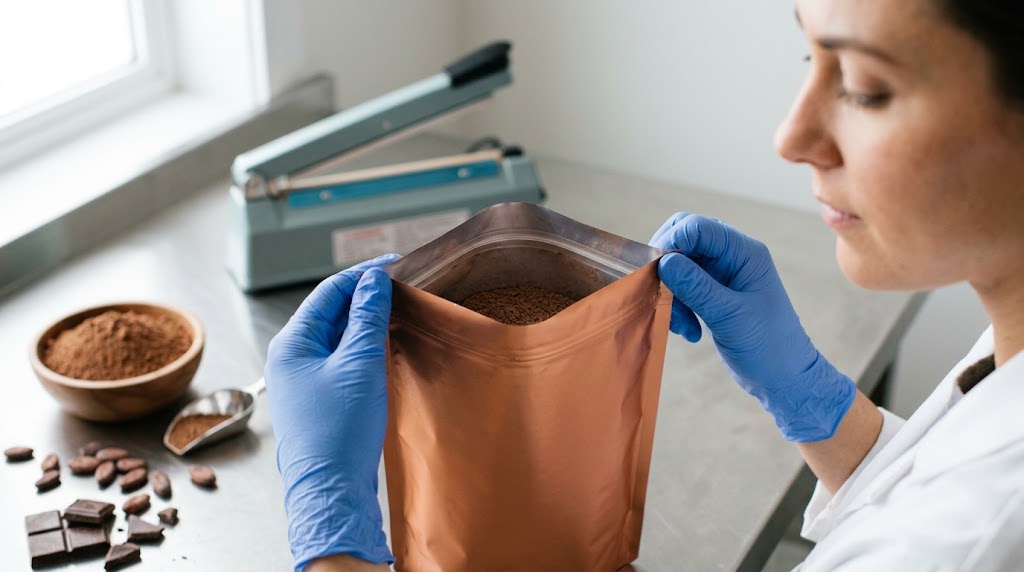
Then close the real bag. Can the operator reach the seal without powder crossing it? Does the zipper remain above the fill line, and can customers pull the top open without releasing a cloud of powder? Is the unopened pouch stable on a shelf and inside a case carton, or does the base collapse? Does the printed front remain legible after normal settling? Repeat a physical mockup after any recipe change that affects volume or flow. The useful output is a tested sample bag and recorded fill condition, not a generic “20 g bag” dimension copied from a marketplace title.
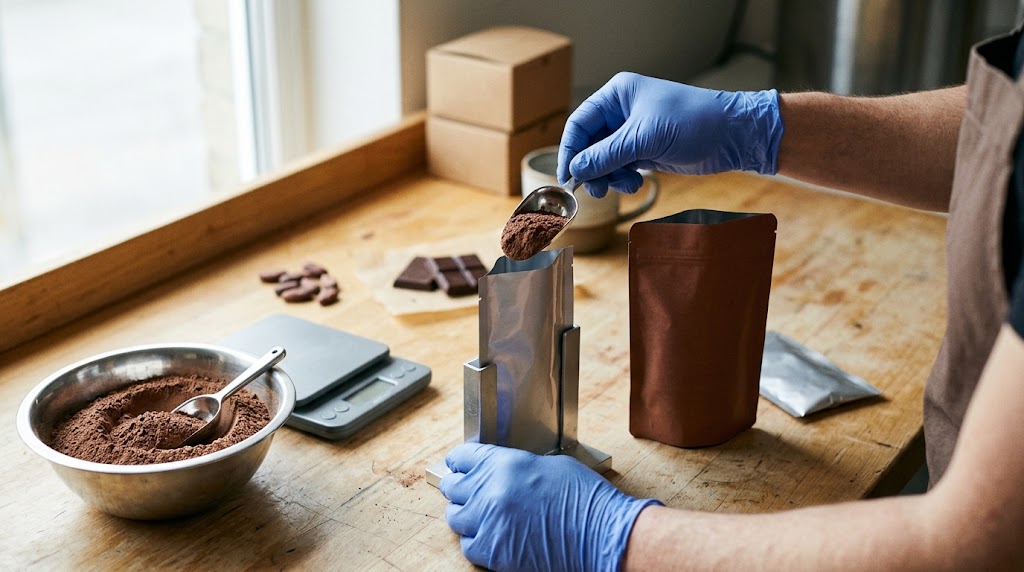
| Record during a physical trial | Single-serve sachet | Multi-serving pouch |
|---|---|---|
| Sellable product | Formula, target dose, permissible fill variation and inclusions. | Formula, target net weight, number of servings and scooping pattern. |
| Bag sample | Actual material, inside dimensions, usable mouth, tear notch and seal land. | Actual material, internal base/gusset, zipper location, top seal and scoop opening. |
| Fill observation | Powder flow, splashing onto the top seam and dose consistency. | Fresh/settled fill height, corner collection, zipper contamination and filled stance. |
| Closed-pack observation | Seal quality, tear-open behavior, powder retained in the sachet and legible instructions. | First-seal quality, reseal behavior, scoop/pour mess, shelf/case fit and readable back panel. |
| Follow-up | Change dimensions or filling controls and repeat with the same recipe. | Recheck after recipe, count, zipper or bag-structure change. |
Keep dry mix dry without making a blanket shelf-life claim
Moisture pickup can change a cocoa drink powder’s flow, make it cake, and affect its appearance and consumer use. The FDA’s water-activity technical guide explains why a food’s water activity matters during storage. Water activity, total moisture, package transmission, seal integrity, storage climate and the formula are related but distinct. Do not assume that a shiny silver bag or a kraft-paper exterior alone sets a safe shelf life.
Ask a converter for the complete film construction, including the layer touching food, and relevant measured barrier data for the specified structure. A foil laminate, a metallized film and a clear high-barrier film do not have identical performance. Nor does “foil look” tell you whether there is aluminum foil inside. Decide which protection properties the product actually requires, obtain comparable test information under stated conditions, and use product-specific storage and shelf-life work to support the claim on the pack. A zipper can be convenient after opening but does not turn repeated household opening into the unopened seal condition used for a shelf-life study.
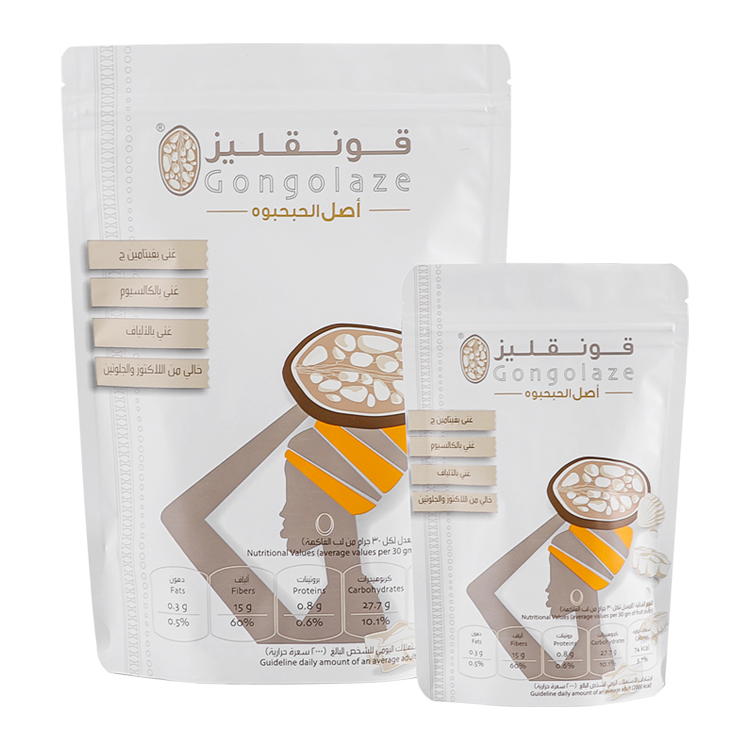
The real Mylarbag baobab powder pouch is publicly listed as MATOPP/AL/PE and 17 × 24 + 4 cm. These are descriptive facts about that case. They do not prove that a cocoa formula should use the same layers or size, or that any proposed bag will prevent all clumping. An alternative real 100 g mushroom-powder pouch illustrates another construction and fill category. A side-by-side physical material review is more informative than treating either photograph as a specification for the new product.

For U.S. food-contact use, ask for the actual components and their intended use documentation, not only an unspecific “food grade” icon on a quotation. The FDA explains that a material’s status depends on each relevant substance, its specifications and authorized conditions of use; a supplier can provide a letter of guaranty for a particular intended use. Include the product type, contact conditions and market when requesting evidence. If a kraft-look bag has an inner plastic layer, it is the inner contact system, plus any exposed seal or zipper components, that must be assessed as used.
Dryness does not by itself make a mix microbiologically safe. The producer remains responsible for its ingredients, processing, contamination controls and validated product safety. This guide treats moisture barrier and clumping as packaging-quality issues; it does not classify any formulation as safe for ambient storage or prescribe a date code. Where a milk-powder, nut-derived, specialty sweetener or inclusion changes the formula, update the safety and label review as well as the pouch trial.
Powder at the seal is a production problem, not a graphic-design problem
A beautiful printed packet can fail if cocoa dust gets between its heat-seal surfaces. Fine powder can ride the air displaced during filling, stick near the mouth, or land across a zipper track. Before setting a seal recipe, keep the intended seal land clear, check the fill height and nozzle position, and compare clean and realistically dusted samples under the intended process. Published experiments on solid contamination of heat-sealed films show that particles in a seal can reduce seal strength; those tested contaminants and films are not a certification of a specific cocoa pack.
Define who inspects the seam, how samples are taken and which tests the packer uses for its chosen film and equipment. Visual inspection is a quick screen for trapped product, channels, wrinkles, burns or incomplete welds. It cannot by itself prove an airtight pouch, a target leak rate or a shelf-life outcome. Seal strength or integrity testing should be specified by the team responsible for the actual packaging process. A change in machine, film, top-seal position, powder formula or dose warrants review of settings and resulting seals.
For an empty preformed pouch supplied to a chocolatier, the converter may have already made the bottom and side seals, while the food producer makes the final top closure after filling. Clarify the handoff. The converter’s sample should have an accessible clean top land, and the food producer needs a verified method for dosing and sealing that exact material. For a rollstock sachet, the form-fill-seal operator controls the machine, fill tube and transverse seals. A “heat sealable” listing alone is not an instruction to use one temperature, pressure or dwell time for every bag.
If a zipper is present, protect it from powder before closing the pouch for sale. Place the initial heat seal where the package design requires it; the zipper is a reclosure feature for after opening, not a substitute for the unopened primary seal. Test whether a consumer can tear above the zipper without cutting through the tracks or leaving an inaccessible opening. Check a light-colored powder or marshmallow inclusion if those are offered as separate flavors: the visible mess and flow behavior may differ from a dark cocoa sample.
Can you put hot chocolate in a plastic bag?
If “hot chocolate” means dry drink mix, a plastic or plastic-lined sachet/pouch may be an option when its actual food-contact construction is suitable for that formula and its intended room-temperature filling and storage, and when the filled and sealed package passes the producer’s checks. “Plastic” describes a broad material family, not an approval for every additive, food, temperature or duration. Check the documented contact layer and the complete closure. If the mix is sold as a finished retail food, complete its labeling and product-safety work as well.
If “hot chocolate” means the prepared hot liquid, the answer changes. Do not pour it into an ordinary dry-powder pouch just because the pouch can be heat sealed. The FDA lists separate food-contact conditions for room-temperature fill, hot fill and reheating in a container. Any hot-liquid package would need its own intended-use documentation, closure and handling design and validation for that beverage and temperature. It is a different project from the empty hot cocoa packets discussed here.
The same distinction applies to a printed picture of a steaming mug. It communicates how the powder is prepared by the consumer; it does not authorize a pouch as a hot-drink container. Include clear preparation directions on the final label, but keep the manufacturing brief explicit that the bag will be filled with dry mix. This avoids a common mismatch when a buyer asks a converter for “hot chocolate bags” and receives a quote for a beverage pouch or a bar wrapper.

Where to buy empty hot chocolate packets
You can begin with a stock food-packaging distributor, a flexible-packaging converter for custom printed empty sachets, or the form-fill-seal operator who will run printed rollstock. These are procurement paths, not interchangeable products. Stock bags are useful for an early bench fit if their material identity and intended use can be established. Custom empty packets allow the design to match the actual dose, print panels and sealer; printed rollstock must match the packer’s machine and sealing workflow. Ask each vendor whether they supply empty packaging only, filled units, or both.
Before requesting price, send a compact packaging brief: complete dry mix formula and any inclusions; target net weight per unit; whether the unit is single-serve or resealable; fill equipment and expected throughput; target market; proposed contact conditions; preferred pouch style and appearance; number of SKUs; labeling panel needs; and the physical sample or measured bulk-fill range. Ask for the exact material structure, contact-use documentation, sample dimensions measured the same way as your trial, tear and zipper geometry, print proof, and an opportunity to run real product through your filler and sealer. A quotation should specify what is actually being sold.
If you sell a multipack of sachets, request an empty primary packet and, if desired, a separate secondary bag. The real Mylarbag collagen powder and supplement stick-pack outer pouch demonstrates a flat-bottom outer package for sticks. It does not demonstrate that Mylarbag filled the sticks or that its pictured outer bag is the direct-contact sachet for cocoa. Confirm which elements are produced by the converter and which by a separate co-packer.

| Ask the supplier to confirm | Why it matters for an empty hot cocoa packet order |
|---|---|
| Preformed empty bag or printed rollstock? | Determines who makes the packet, how it is filled and which sealing equipment is needed. |
| Direct-contact materials and intended use? | A finished food label or “food grade” shorthand does not identify the contact-layer basis. |
| Inside dimensions, gusset and seal/zipper geometry? | Nominal outside dimensions can overstate usable fill and closure space. |
| Sample quantity and trial conditions? | Lets the buyer test actual formula, dose, handling, seal and retail appearance. |
| Artwork, label space and SKU differences? | Prevents a small flavor or allergen change from being hidden by generic artwork. |
| Written acceptance checks and responsibilities? | Assigns bag fabrication, filling, final sealing, coding and release to the correct parties. |
Do not order a large printed run based solely on a rendering. Approve a real material sample, a filled sample, a legible proof and a trial that includes the producer’s final top seal. A sample with the correct dimensions but a different sealant or zipper may mislead the decision. If your final product is a small single-serve unit, check legibility at its actual size and do not infer that a photographed outer pouch can carry all information required of the selling configuration.
A practical sample-to-launch sequence
First, freeze a trial recipe and use normal production ingredients. Weigh the target serving, document loose and settled volume in a repeatable way, and take several proposed sachets or pouches. Record which dimensions leave a clean top seal and workable opening. Use a second mix or inclusion variation if the product line will sell it. Write down the sample material and version, not just a marketplace link or photograph.
Second, fill and close the candidate on the intended process. Inspect for powder on the seam, leaks, spills, unacceptable pouch distortion and an opening customers can actually use. Review barrier and food-contact documentation for the exact proposed structure, and set product-specific shelf-life and quality checks rather than borrowing a supplier’s “freshness” promise. A sealed sample kept briefly on a desk establishes fit and appearance only; it is not an ambient stability study.
Third, assemble the sale unit. Check the printed ingredient and allergen information, net contents, directions, lot/date panel and any outer pack as applicable to the market. Pack units into the intended shipping case and check whether sachets rub, puncture or soil one another. Record the formula, artwork, film, zipper and machinery version. A late change from dairy to plant-based powder or the addition of marshmallows can alter both the label and the physical trial.
Finally, obtain sign-off from the responsible food producer and packaging team on the chosen specification and the tests actually performed. Archive accepted and rejected samples so future reorders can be compared with the approved version. If the goal is to advertise a shelf life, moisture protection, recyclability or measured seal performance, establish each claim separately with the relevant data and local collection rules. A photograph of a pouch can show its layout; it cannot carry that evidence by itself.
Frequently asked questions
What is the best packaging for hot chocolate powder?
The answer depends on the recipe, dose, opening pattern and intended storage. Prototype a sealed sachet for a one-drink portion or a suitable initially sealed, resealable pouch for several servings; compare actual powder fill, food-contact documentation, barrier data and closure performance. No one film or shape is best for every cocoa-and-sugar or dairy-containing mix.
What size bag do I need for hot chocolate mix?
Weigh the finished formulation, measure how much volume it occupies before and after a repeatable settling step, and test actual sample bags. Leave usable space for the top seal, a zipper where applicable and a consumer-friendly opening. Do not convert a gram figure straight into a bag width without a filled trial.
Can I use a clear plastic pouch for dry cocoa mix?
Possibly, if the actual contact construction suits the formula and intended conditions and the complete pack meets the product’s protection and presentation needs. A transparent or windowed film must be assessed as a complete structure. Dust on the inside face and clumping over the intended life are practical checks as well as appearance issues.
Can the same bag hold the prepared hot drink?
Do not assume so. A bag designed for dry, room-temperature powder filling does not establish suitability for a hot liquid, hot filling or heating in the pack. Specify the beverage use separately and verify the material and package for its food type, temperature, closure and handling conditions.
Do hot chocolate sachets need a heat seal?
A proposed single-use retail sachet normally needs an effective primary closure suited to its film and filling process. Whether it is made from preformed bags or form-fill-seal rollstock changes who makes each seam. Define and test the actual seal process; powder caught in a seam can weaken it, and a zipper alone does not replace an unopened first seal.
Where can I buy empty hot chocolate packets in bulk?
Ask a distributor for stock empty food-contact bags or a converter for custom printed preformed sachets; a co-packer may instead require printed rollstock. Give the supplier the actual powder, portion weight, fill method, target market and closure needs. Request material documentation and physical samples, then run a real fill-and-seal trial before a production order.
For a custom flexible-packaging brief, review Mylarbag’s chocolate packaging options and contact the team with your dry formula, target portion, measured fill behavior, bag style, equipment and destination market. Ask for a material proposal and physical samples. The right result is a repeatable package for your powder and packing line, supported by your own checks.