
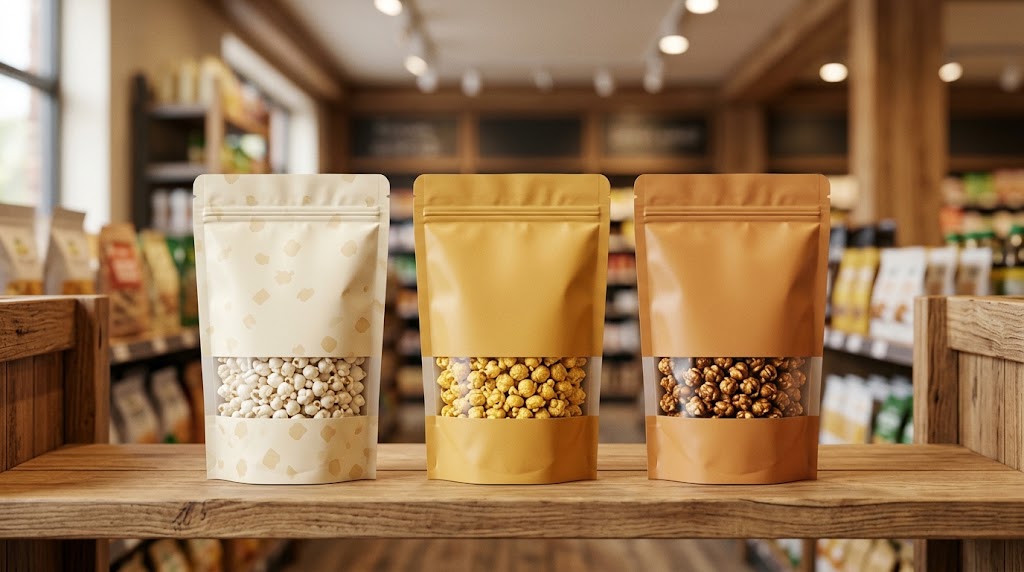
Popcorn is light, bulky, easy to crush, and quick to tell on a weak package. A pouch that looks generous when empty may be too short after a normal fill. A beautiful window can show the product while changing the protection of the finished bag. A seal may look closed even though sugar or seasoning has left a channel through it.
The short answer: define the finished popcorn and where it will be sold. Select a food-contact pouch for that use, fill real samples at the intended net weight, leave a clear top-seal area, and make a verified first heat seal. Then inspect the filled packs after storage and their real shipping route. Use the results to approve the bag, the filling settings, the label, and any shelf-life claim. An empty-bag material specification is only one part of that decision.
This guide is for brands and co-packers selling already-popped popcorn in retail packs. An open paper serving bag can be suitable for immediate consumption; a prepacked product that will sit on a shelf or travel in a parcel needs a separately specified closure and distribution plan. The ordinary retail pouches discussed here are not microwave cooking bags.
First, Define How the Popcorn Will Reach the Buyer
The route to market changes the job of the bag. At an event counter, a filled serving bag may be handed over immediately. In a grocery aisle, a sealed pouch must look consistent, retain its intended eating quality, carry the required information, and tolerate handling. For direct-to-consumer delivery, the retail pouch still needs an outer shipping system; a thin film cannot stop every carton impact from breaking delicate pieces.
| Selling route | What the primary bag must do | What to verify before ordering |
|---|---|---|
| Immediate service | Contain a portion and let a customer handle it for a short period | Serving size, oil transfer, food-contact suitability, and how the bag will be closed or handed over |
| Prepacked retail | Protect an unopened product for the brand's intended distribution period and present it clearly | Actual filled dimensions, first seal, material and window, shelf display, label area, and retained-pack performance |
| Retail plus parcel delivery | Meet the retail checks and work with cushioning and an outer carton | Saleable appearance and breakage after the planned parcel route, not merely an intact outer box |
Do not use a counter-service bag as a shortcut to a longer retail life. The paper feel or printed exterior says little about the complete construction. A kraft-look retail pouch can contain polymer layers and a heat-seal surface. Conversely, a clear pouch is not automatically too permeable for every popcorn product; it needs to be measured against the product and selling period.
Write a one-page brief before shopping for bags: product variants, target net weight, expected number of servings, route to market, intended unopened period, display method, packing equipment, and where the product will be sold. Add whether consumers will reopen the bag, whether a clear window is required, and whether the pack will be shipped individually. The same word, “popcorn,” is not a complete packaging specification.
Record the Product That Actually Enters the Bag
Packaging decisions begin after popping and flavoring. Plain popcorn, oil-seasoned popcorn, and sugar-coated popcorn may have different limiting quality problems. A film that performs acceptably for one cannot be approved for the others by copying its name or thickness.
For plain popcorn, note the initial crunch, broken-piece fraction, dust, temperature at filling, and how the product behaves during a normal scoop or machine transfer. For an oil-seasoned SKU, also look for oil on the finished product and on the inner and outer pouch surfaces after contact. For a coated SKU, look for clusters, sticky contact points, uneven pieces, and material that could be caught in the top seam. These are observations to measure in samples, not predictions about a particular recipe.
Moisture matters to texture. In a published experiment that included popcorn, Katz and Labuza equilibrated snack foods at different water activities and compared instrumental results with sensory crispness. The study supports treating crunch as a measurable product attribute; its reported range across several snacks is not a ready-made acceptance limit for a new popcorn formula. Set a product-specific sensory and, where useful, water-activity baseline instead of borrowing a single threshold. See the original Journal of Food Science paper.
Ask the food team for at least a representative production lot, not a handpicked bowl of the biggest pieces. Record when the product leaves the popper or coating step and its condition when it is filled. If the product's temperature, coating set, or moisture status varies across a shift, sample that variation. A controlled packaging comparison uses the same product lot and packing conditions for each candidate pouch. It also records the actual recipe, because a product change can make an earlier bag approval obsolete.
Before a trial, agree on a small set of observable failure descriptions:
- Loss of crunch: compare sensory notes against a day-zero retained control rather than calling every change “stale.”
- Unwanted aroma or flavor: investigate the ingredients, processing history, headspace, storage exposure, and package integrity together.
- Visible oil transfer or staining: locate it on the food, inner film, window, seam, and outside of the bag.
- Clumping or sticking: record where pieces contact one another, the window, or the seal area.
- Breakage: distinguish pieces broken before filling from damage after case packing or transport.
This baseline prevents an unfair material comparison. If two candidate bags are packed with different batches, the pack with the better popcorn can appear to “win” even when its construction contributed nothing.
Choose a Pouch Format for Filling, Display and Opening
A flat pouch can suit a small portion or a pack displayed in a tray. A stand-up pouch gives a broader front panel and can present lightweight popcorn on a shelf when its base, fill, and dimensions are matched. A larger flat-bottom or side-gusset format may be worth sampling for a bulkier retail SKU, but bigger is not automatically gentler: overfilling, carton pressure, and the filled pack's unsupported shape can still break pieces.
Compare formats with real fill trials. Lay a filled flat pouch where it will be merchandised; stand a gusseted pouch on the actual shelf depth; place each in the intended shipper. Photograph front, side, and top views. A near-empty looking bag can confuse shoppers, but filling so high that popcorn enters the heat-seal zone is worse. Bag size should be approved from usable internal volume and seal clearance, not from a generic “4 oz” or “5 oz” size chart. A weight on the label does not determine a universal pouch width.
The Mylarbag popcorn packaging range can be the starting point for a sample request. Its stand-up pouch and flat pouch pages show the relevant format families. Treat any general site statement about freshness or grease resistance as a claim to validate for the exact product and construction.
A real popcorn pouch example
Mylarbag's public gourmet popcorn pouch case lists a U.S. project: a matte black kraft-look stand-up pouch with a window, MATOPP/kraft paper/PE construction, gravure printing, and dimensions of 15 × 22 + 4 cm. The case description also lists a 140-micron construction. These are useful starting specifications for a discussion about a visible product, print area, and filled shelf shape. They do not reveal the client's actual net weight, seal settings, measured transmission rates, or validated product life.
The engineering question is why the proposed elements help this particular product. The window lets buyers see the popcorn, while the window's material and junctions must be included in whole-pouch checks. The printed exterior carries shelf communication, while the inside contact and sealing surfaces must match the intended food and process. The gusset helps create a standing shape only if the chosen fill and base dimensions support it. None of those features alone proves that every savory or coated SKU will remain crisp.
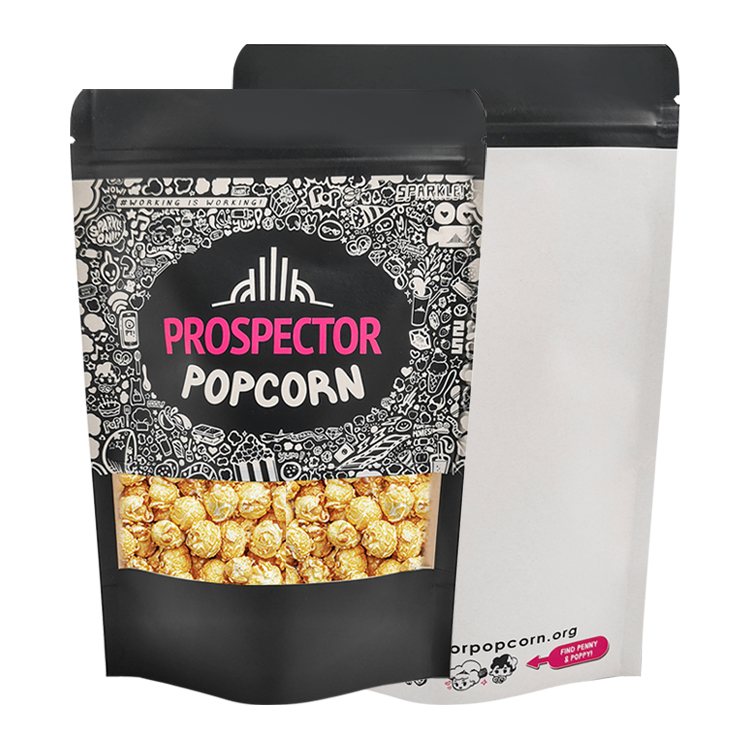
Do not add a zipper to a specification merely because resealable pouches are popular. If the product is intended to be consumed in several sittings, test a zipper below the first heat seal for ease of use after opening. The initial heat seal is the unopened pack's closure. A zipper cannot repair a contaminated first seal, and an attractive tear notch must not cut into the first-seal area.
Specify the Complete Bag, Not a Material Buzzword
Ask for a layer-by-layer construction, nominal thickness, food-contact surface, sealing layer, window material if any, and intended use conditions. “Kraft,” “Mylar,” “high barrier,” and “grease-proof” can each cover more than one construction. A paper-looking outside may be part of a laminate; a metal-looking film may be metallized rather than aluminum foil. The artwork finish is not a reliable cross-section.
For crisp popcorn, water-vapor transmission is one input because moisture pickup can change texture. Oxygen transmission can matter for products with fats or oxidation-sensitive flavors. Ask the supplier for WVTR and OTR with units, method, temperature, humidity, and the precise film tested. Values from different conditions cannot be ranked by the headline number alone. A flat-film result also does not measure the complete bag's window, gussets, zipper, or top seal. The brand must tie material data to a finished-pack trial.
Food-contact suitability is equally specific. The U.S. FDA explains that the status of a food-contact material depends on its components and the conditions of their intended use, and that a supplier may provide a letter of guaranty for the particular food-contact use. Ask for documents covering the actual construction and its relevant food and temperature conditions; do not infer compliance from a generic “food grade” logo. The FDA's component-status guidance is a useful U.S. reference. Other markets require their own review.
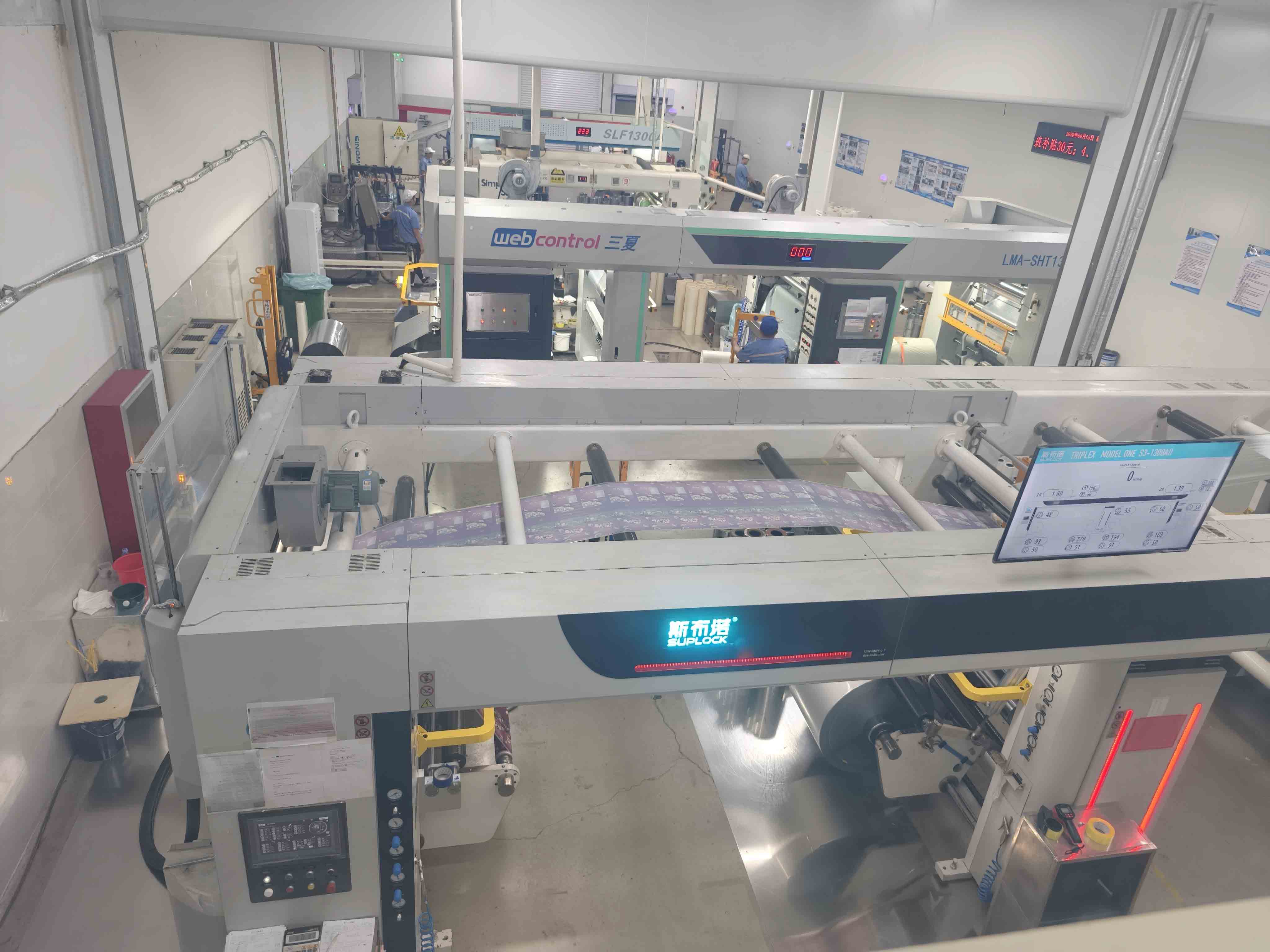
If a supplier proposes a clear window, compare the windowed and non-windowed versions under the same product and storage conditions. If a supplier proposes a thicker film, ask which failure the change addresses. Thickness may alter stiffness or handling, but it cannot make a poorly formed top seal sound or remove a weak window junction. The least costly workable construction is often the one that meets the actual acceptance criteria consistently, not the one with the most layers.
Run a Fill Trial That Protects the Seal
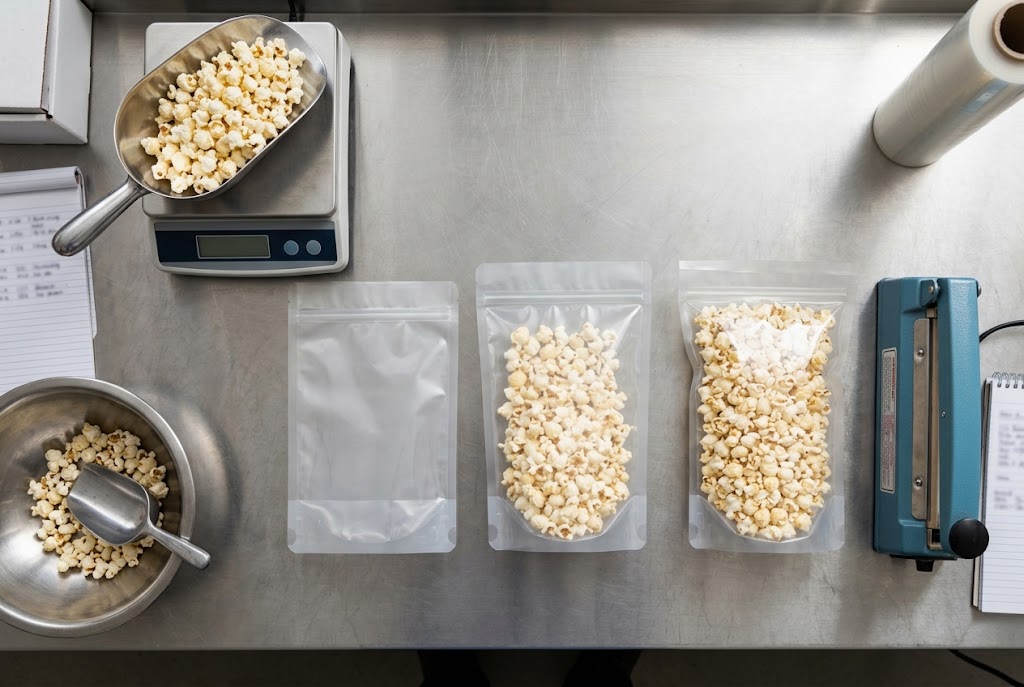
Take several pouches of each candidate size and fill them at the planned net weight using the normal scooping or filling equipment. A very small staged sample can miss normal variation in piece size, coating, dust, and operator technique. Check weights with the packer's approved scale procedure, but do not force extra product into a pouch to make a target weight fit.
Observe how the popcorn settles naturally. Note the freeboard above the product, where a zipper sits if specified, the path the product takes past the zipper, and how much clean, flat film remains for the first heat seal. On a bottom-gusset pouch, look for pieces trapped in folds. Repeat after a realistic transfer and after the pouch has been handled as it would be on the line. If the same pouch looks full with plain popcorn but crowds the seal with a coated variant, size or filling approach must change.
A compact trial record can be more useful than a persuasive sales sample:
| Record | Why it matters | What to look at |
|---|---|---|
| SKU, lot, and fill time | Keeps candidate comparisons tied to the same product conditions | Recipe, coating state, piece mix, dust, temperature and any hold before packing |
| Target and actual net weight | Keeps pack size and declaration aligned | Variation across normal fills, not a single ideal sample |
| Filled height and top clearance | Protects the closure area | Product below the zipper and heat-seal land; no popcorn pinched in the mouth |
| Package dimensions after filling | Tests shelf and shipper fit | Front visibility, base stability, carton arrangement |
| Seal appearance and inspection | Finds obvious formation problems | Wrinkles, particles, channels, incomplete areas, distorted corners |
| Handling observations | Captures what the empty bag cannot show | Broken pieces, product movement, window rub, scuffed print |
The bag supplier converts film into a pouch; the food producer or co-packer fills and closes it. These are different operations. If there is trouble on a production line, keep samples from before filling, immediately after sealing, and after the pack has cooled and been handled. Share the pouch construction, equipment type, jaw settings, dwell conditions, line speed, and defect photos with the converter. The supplier can investigate the bag material and seal compatibility; the packer owns control of food in the seal area and its operating settings.

Form the first seal and inspect it
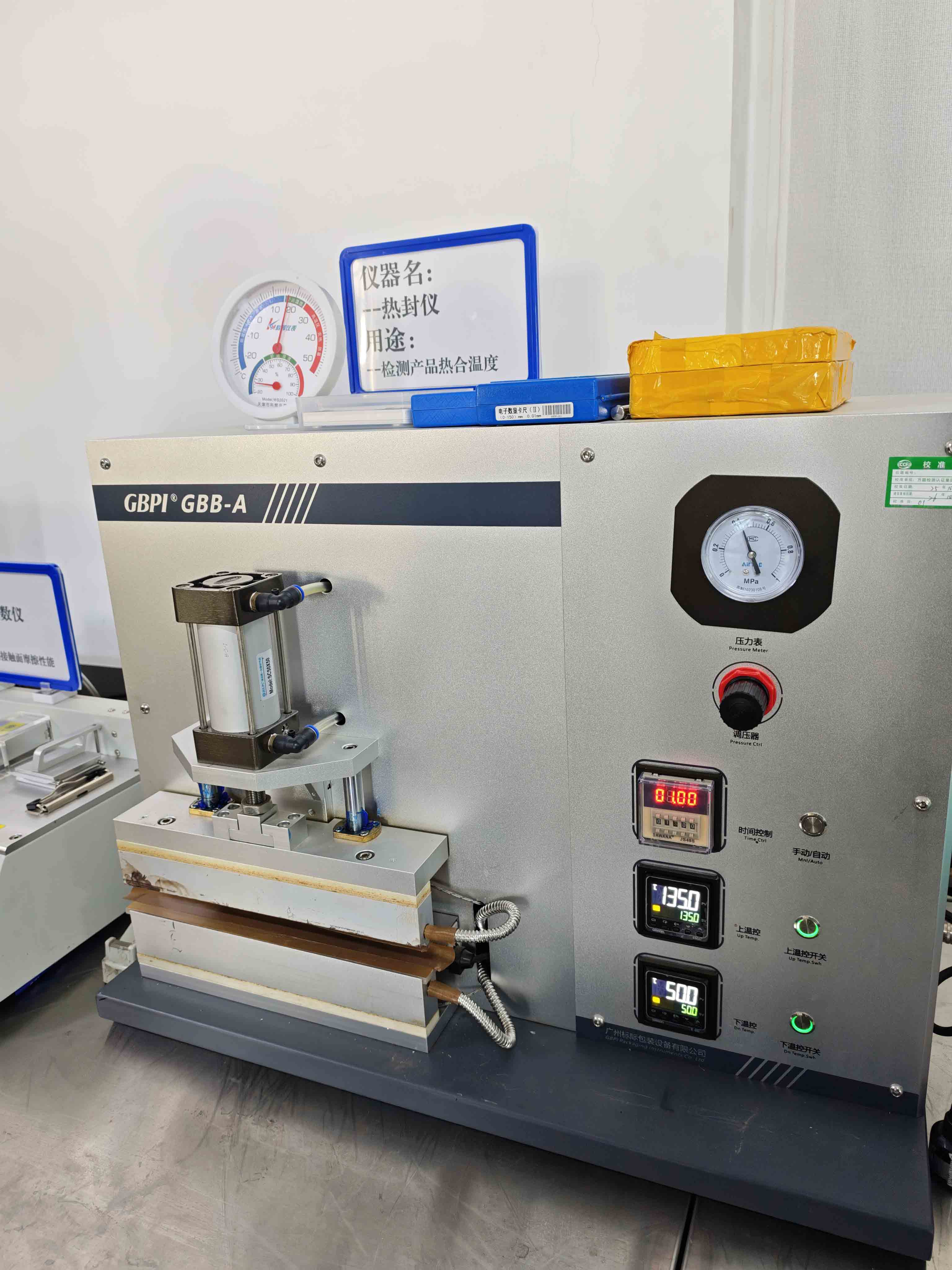
Agree on a suitable heat-seal window for the exact sealant and equipment, then confirm it on filled packs. Too little energy can leave weak bonding. Excessive heat or pressure can distort or thin a seal. Residual seasoning, oil, sugar, and small popcorn fragments can create local channels even when the rest of the seam looks neat. The right response depends on the observed failure: adjust the fill path or clearance if product enters the seam; investigate machine settings and film if a clean seam still fails.
Check the entire top seam, including corners and any transitions near a zipper or side seal. Use the packer's documented sampling plan for visual checks and an appropriate integrity or strength method. ASTM's F88/F88M-23 is a standard test method for seal strength of flexible barrier materials; a strength value is not by itself proof of no leak, and acceptance criteria must suit the specific pack. A product team may combine seal-strength checks with other validated integrity methods and retained filled samples.
If a zipper is requested, review it as a consumer-use feature. It should be accessible after the tamper-evident top is opened and should not interfere with the first seal or reduce usable fill space unexpectedly. Have people open and reclose filled samples with the actual product. A zipper may reduce spills between servings, but it is not a guarantee that opened popcorn will retain its original texture for a stated number of days.
Validate the Filled Pack Through Storage and Distribution
An unopened pouch is a small system: product, headspace, film, window, seams, closure, secondary pack, and environment. Approve it as a system. For a proposed retail period, retain samples from the same production lot in the actual candidate packs and inspect at the start, interim points, and the intended end point. The brand's food-quality team should set the plan and criteria for the recipe, not accept a generic “up to” claim from an empty-bag page.
Measure or record what can change: crispness against a day-zero control, aroma and flavor, visible oil or coating changes, clumping, breakage, seal integrity, and package appearance. Keep the actual storage conditions and lot identity. If the brand has suitable product-specific analytical markers, it can add them; the pouch maker cannot infer a full product shelf life from film WVTR or OTR alone. Test the windowed and non-windowed versions separately when the window changes the finished construction.
Storage and transit are related but distinct. A pouch may seal well in a laboratory and be damaged by case packing, pallets, repeated handling, or parcel sorting. Pack the retail pouches into the planned cartons at the planned count and orientation. After a representative distribution trial, inspect the food as well as the outside of the box. Count broken pieces using the brand's own definition, check seam and corner damage, and photograph what a customer would actually see on arrival. ISTA's design and testing guidance stresses familiarity with the real distribution environment when choosing a procedure. Do not claim an ISTA pass unless a specified procedure was actually run and documented.
| Trial stage | A decision it should answer | Evidence to retain |
|---|---|---|
| Day-zero filled pack | Does the pouch fill cleanly and present the intended product? | Filled photos, net weights, seal samples, product baseline |
| Short holding interval | Are early changes due to product condition, handling, or pack? | Product and package observations against a same-lot control |
| Intended retail period | Does this SKU meet its agreed quality and integrity criteria? | Dated retained samples, actual storage conditions, approved criteria |
| Planned shipper trial | Does the retail pouch work inside the chosen carton? | Carton layout, route or procedure, breakage and arrival inspection |
| Change after approval | Does a different film, window, zipper, print, recipe, or line setting require retesting? | Change record, comparison samples, decision owner |
Write the acceptance criteria before seeing the results. Otherwise it is too easy to relax “acceptable breakage” after an expensive print run. Keep the approval tied to the exact construction, artwork version, food SKU, and packing method. A later substitution of sealant, window, or coating can require another check even when the front panel looks identical.
Reserve Label Space and Keep Claims Traceable
Artwork must leave readable space for the product name, net quantity, ingredients, allergen information where applicable, responsible business details, date and lot coding, and any other information required in the destination market. Do not finalize a print layout before the filled sample establishes the actual front-panel shape and the back panel's usable space. A gusset, window, fold, or zipper can hide text that looked safe on a flat dieline.
In the United States, the FDA Food Labeling Guide is an overview, but its allergen chapter is under revision. Use the FDA's 2025 final allergen-labeling guidance for current FDA thinking on allergens. A flavored popcorn containing ingredients such as milk, nuts, soy, or sesame needs the producer's specific ingredient and allergen review. The pouch maker can reserve a panel and print an approved file; it cannot approve the recipe's label on the food company's behalf.
Likewise, print claims such as “keeps popcorn crisp for months,” “grease-proof,” or “recyclable” must be supported for the finished product, construction, and market where the bag is sold. A seal trial, barrier test, food-contact document, and shelf-life study answer different questions. Keep the evidence behind each claim attached to the approved artwork revision and bag specification.
Turn the Trial into a Useful Supplier Brief
The best inquiry is short enough to act on and precise enough to prevent a wrong sample. Send the pouch supplier the product form and variants; a representative sample or photographs; planned net weights; preferred flat, stand-up, or other format; expected retail and shipping conditions; filling and heat-sealing method; window and zipper decisions; printing and label needs; and the destination market. Ask for two or three distinct candidate constructions only if each tests a real decision. Do not request a dozen cosmetic variations that cannot be compared under the same trial.
Specify what you want returned: layer structure, nominal dimensions and thickness, tolerance, food-contact documents for the intended use, relevant WVTR/OTR data with test conditions, sample bags, a dieline, and any recommended sealing trial conditions. Agree who will measure the filled-pack results and how changes will be approved. When a brand cannot yet state its target selling period, begin with the required route and quality criteria, then set the period through its own validation.
For a practical first conversation, share the filled samples and your acceptance criteria with Mylarbag's popcorn packaging team. Ask them to compare pouch formats and material samples against your actual popcorn, filling line, print, and display requirements. The final approval should come from the food producer's filled-pack trials, label review, and distribution checks.
Frequently Asked Questions
What is the best way to package popcorn for sale?
For prepacked retail popcorn, start with a food-contact pouch suited to the product and intended selling period. Trial the normal net weight, leave a clean area for a verified first heat seal, and check the finished pack after storage and shipment. “Best” depends on the recipe, route, and agreed quality criteria; there is no one film or bag dimension for every brand.
Can I sell popcorn in an open paper bag?
An open serving bag can be appropriate for immediate handover when it meets the food business's requirements for that use. It should not be assumed to protect a prepacked retail product through days or weeks of storage. If the popcorn will be stocked or shipped, specify a closure and test that pack separately.
Should I choose a flat pouch or a stand-up pouch?
A flat pouch can work for a small portion, a tray display, or a compact pack. A stand-up pouch can give a larger front panel and upright shelf presence. Fill and merchandise both at the actual net weight. The gusset, headroom, and carton fit often decide more than a photograph of the empty bags.
How do I keep popcorn from going stale in a bag?
Control the product condition at filling, choose a complete bag with suitable moisture and, where relevant, oxygen protection, make a sound first seal, and store the filled product as intended. Test sensory quality and pack integrity over the proposed period. A material's flat-film barrier number alone cannot establish a retail date.
Does a zipper make a popcorn bag airtight?
A zipper helps a consumer close an opened pouch between uses, but the unopened retail pack still needs its specified first seal. Whether the zipper offers useful after-opening quality depends on the product and consumer use. Do not assign an opened-pack freshness period from the zipper alone.
Will a clear window ruin the popcorn's shelf life?
Not necessarily. It changes the complete bag and therefore requires review. Ask for the window's material and construction, then compare filled, sealed windowed and non-windowed samples under the intended conditions. A visually clear panel is not a measurement of the finished package's performance.
What size bag fits 4 oz or 5 oz of popcorn?
Those figures describe net weight, not a standard bag dimension. Popped density, piece shape, coating, breakage, and fill method affect the space needed. Fill several sample bags at the required weight, preserve the seal area, and check the final display and shipping dimensions. The detailed sizing method belongs in the separate bag-size guide.
Can I use the same pouch for plain, butter-flavored, and caramel popcorn?
Only after trialing each formulation. Fat-containing seasoning, sugar coating, piece shape, dust, and the intended selling period can change the problem the bag must solve. One construction may ultimately work for all variants, but approve it from each product's filled-pack evidence and food-contact use.
How can I tell whether the seal is good?
Inspect the full seam for product, wrinkles, gaps, and distortion. Use a documented plan for appropriate strength and integrity checks on filled production samples. A clean-looking seam can still have a local channel, and a measured seal-strength result does not automatically establish leak-free performance. Keep rejected and approved examples for training.
Does a thicker popcorn bag prevent shipping damage?
Not by itself. The pouch, its filled shape, the number of packs per carton, the cushioning and the distribution route all affect damage. A thicker material can change stiffness or puncture resistance but cannot replace a suitable shipper. Judge the packed food's breakage and saleable appearance after a representative route trial.
Is the published gourmet popcorn pouch a proven shelf-life specification?
It is a documented pouch example with listed materials, printing, format, dimensions, and thickness. Its public page does not provide the recipe, storage conditions, whole-pack test report, or the customer's approved shelf-life data needed to transfer a performance claim to another popcorn SKU. Use it to frame a sample request, then run your own validation.