
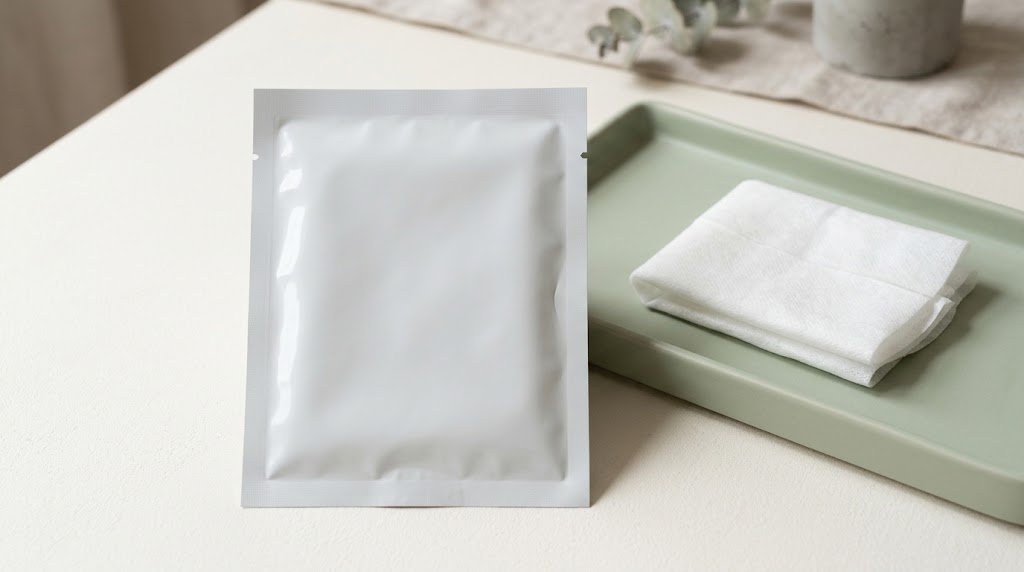
A sheet mask sachet has a deceptively small job description: hold one mask and its serum until someone opens it. In practice, the folded sheet occupies space, the liquid moves when the pack is squeezed, and the final heat seal has to close across clean film. A pouch that looks right in a flat artwork proof may fail when a wet mask is pushed toward its top edge.
The short answer: define the finished cosmetic product first. Trial a pouch with the actual folded mask and intended serum quantity. Leave a dry, unobstructed sealing area above the fill. Seal with settings validated for the exact laminate and filling equipment, then inspect and challenge the filled pouch through the intended storage and shipping conditions. The packaging supplier can specify and make the empty sachet; the brand and filler must verify the finished cosmetic and its packing process together.
Here “face mask” means a facial skincare sheet mask or hydrogel mask, not a protective respirator. This guide concentrates on a single-use, serum-containing unit for retail. Dry mask tablets, mud masks and multi-mask refills call for different filling and reclosure decisions. If you are selecting the empty pack, start with the face mask packaging range, then use the steps below to turn a format choice into a testable specification.
Start With the Finished Mask, Not a Pouch Size Chart
Two brands can both sell “one sheet mask” and need different bags. A thin nonwoven sheet may fold compactly; a hydrogel mask may need a carrier or a gentler fold to avoid tearing. A pre-impregnated mask and a dry sheet followed by a measured dose of serum may enter the pouch differently. A formula can contain fragrance, oils, solvents or other ingredients that make material contact and seal-area control worth checking. The words on the front panel do not resolve any of those questions.
Write one product definition for each SKU before asking for a dieline. Record the sheet material, face-piece count, backing or separator, fold pattern, smallest and largest representative folded dimensions, and expected thickness after folding. Record the intended serum amount and permissible variation, including whether liquid is added separately or accompanies a pre-wetted sheet. Note the fill state at packing, not just the nominal amount on a marketing brief.
Then describe what happens after packing. Will the sachet hang on a peg, sit inside a carton, lie flat in a subscription box, or travel as an individual parcel? Is the consumer expected to tear it open once, squeeze the remaining serum out, and discard it? Does the pack need a batch or lot code on its own surface, or will an outer carton carry some information? These choices affect the top edge, print area, notch and abrasion exposure.
| Product input | Why the sachet team needs it | What to verify with a real sample |
|---|---|---|
| Folded sheet and any backing | Establishes occupied area and thickness | Corners, folds and supports stay clear of side and top seals |
| Serum target and variation | Changes liquid level and handling behavior | High-fill sample still leaves a controllable top-seal zone |
| Formula and fragrance profile | May affect contact materials, adhesives or ink protection | Documented compatibility of the complete construction with the actual formula |
| Display and outer carton | Changes hanging features, artwork and compression | Filled pack fits the display or carton without forcing a seal against an edge |
| Distribution route | Determines likely squeezing, vibration and temperature exposure | Saleable, leak-free condition after a representative route challenge |
| Consumer opening | Determines notch and opening force | Notch starts cleanly without cutting through a seal or spilling unexpectedly |
Keep dry powder masks and paste or mud masks out of this single-unit specification. Their flow behavior, dose, pouch shape and consumer reclosure needs differ. A stand-up pouch may make sense for a multi-use product, but a zipper is usually unnecessary on a sachet meant to be opened once. Do not add one to the one-mask pack merely because another skincare pouch has it.
Choose the Format Around the Filling Method
A preformed, three-side-seal flat sachet is a practical candidate for a single mask: the sides and bottom are already closed, the top stays open for insertion and dosing, and the filler makes the first and only top seal after filling. This is a starting layout, not a promise that any existing three-side-seal stock bag will fit. The actual opening width, handling equipment and folded product may rule out a narrow specimen.
Some operations start with printed rollstock and form the pack on their own equipment. In that case, the brand and filler need to align web direction, registration, sealing surfaces and pack geometry with the machine. A machine-ready film specification is not interchangeable with an order for preformed empty pouches. Ask the filler which input it needs before approving artwork or tooling.
| Candidate | Useful when | Question that can disqualify it |
|---|---|---|
| Open-top, preformed flat sachet | A single sheet or hydrogel mask is inserted through one opening | Can the real folded mask and serum enter without wetting or obstructing the final seal? |
| Formed sachet from rollstock | The filler has a line designed for forming and filling that construction | Does the film run and register reliably at the line's intended speed and seal window? |
| Stand-up or larger resealable pouch | A different, multi-use skincare format is deliberately being developed | Does the product require reclosure and pass its own filled-pack trial? |
For one wet sheet, judge a flat sachet by its usable internal shape. A nominal width measured from the outside includes side seals. A nominal height includes the closed bottom and a top area reserved for the final seal. A gusset or shaped edge changes the occupied volume further. The flat pouch format page shows a relevant pouch family; its published illustrations are a format reference, not a substitute for testing a wet mask.
Think about opening before the dieline is frozen. A tear notch must be accessible while a customer holds a slippery sachet, but its path must stay away from the functional sealed area and from any fold that could catch the tear. Rounded corners may improve handling and carton fit; a hang hole needs enough material around it and must not interfere with the seal. Print, lot marking and opening features all compete for the same limited edge space.
Turn the Product Into a Working Sachet Drawing
Ask for two drawings, not one. The first is the finished outer pouch and artwork dieline. The second is a simple filled-pack cross-section or annotated photograph showing the folded mask, liquid location and reserved top-seal area. The latter catches mistakes that a flat graphic cannot. It does not need to be beautiful; it needs to make a trial repeatable.
Measure representative masks after the production fold, including the backing if it stays with the mask. Use samples that cover normal production variation. Place them into unprinted bags at the proposed dimensions. Check the four corners, the deepest fold, any thick hydrogel overlap, and how far the mask can migrate after the bag is turned or squeezed. Do not assume a compressible dry sheet behaves the same once wet.
Next use the intended serum and the high end of the approved fill range. Hold the pouch in the orientation used at the filling station, then in the orientation likely during sealing. Mark where liquid reaches with ordinary handling. The opening must allow insertion without dragging product across the seal land. The design must leave enough clear film for the filler to form a continuous top seal using its equipment. The required clearance is a result of that trial and the machine's validated seal width; it is not a universal number that can be copied from another brand.
Record each sample in a small table:
| Trial field | Entry to capture |
|---|---|
| Product version | Formula, sheet material, fold, backing and actual fill target |
| Empty pouch | Structure version, inside dimensions, opening direction and supplier lot |
| Filled shape | Width, height, thickness and any corner strain after normal handling |
| Seal land | Whether it remains visibly clean and unobstructed at the intended high fill |
| Opening | Notch position, tear direction and consumer handling observation |
| Fit | Carton, display or shipping configuration and points of compression |
| Disposition | Pass, revise dimension, revise fold, revise fill method or reject |
Photograph a filled sample from the front, back and edge, and make a clearly marked sample showing where the final seal is intended to run. If a fold regularly touches the seal line, a bigger pouch may help, but changing the fold or filling sequence may be the better fix. The table forces the team to record which variable changed instead of approving a bag on appearance.
Review the film and contact surfaces at this stage
Outer print, possible barrier layer, adhesives and the inner contact and seal layer form one construction. An opaque candidate with aluminum foil may be useful for a product that needs light protection; a metallized film is a different material. A transparent window changes the construction that contacts and protects the product. Film names alone do not establish how the finished pouch performs, and a shiny appearance does not identify its layers.
Ask the pouch supplier for the exact proposed structure and relevant film data, then ask the cosmetic team to evaluate that construction with the actual serum. The inner layer and seals must remain suitable after contact with the formula under the proposed storage conditions. Check for visual changes, delamination, odor transfer, swelling, loss of sealing performance and any other formula-specific endpoint the product team identifies. A dry cosmetic or bar-soap reference does not establish compatibility with a water-rich serum.
The plastic films and barrier layers pages help frame material questions. Compare candidate films on the same test basis and with the final seals, printing and any window present. Do not turn a flat-film oxygen or water-vapor number into a promised number of months for a filled cosmetic. The detailed comparison of laminate families belongs in the companion materials guide; for this workflow, the decision is whether a candidate is worth a full filled-pack trial.

Separate Empty-Sachet Conversion From Cosmetic Filling
An empty-bag manufacturer and a cosmetic filler can share a packaging brief while doing different work. The bag supplier can control an approved film construction, print and pouch dimensions, converting workmanship and empty-pouch inspection against agreed specifications. The cosmetic brand and its filler control the approved formula, sheet handling, liquid dosing, sanitary process, final top seal, finished-pack testing and release. If one business performs both roles, the records still need to identify which step was checked.
The distinction matters when investigating a wet outer carton. A side-seal defect in an empty sachet, a splash across the top-seal area during dosing, an unsuitable final sealing setting, and damage in distribution can all produce a leaking unit. The corrective action differs. “The bag leaked” is a useful complaint, but it is not yet a root-cause finding.
The FDA cosmetic GMP inspection checklist calls attention to storage and identification of primary packaging, clean filling equipment, written processing and filling instructions, permanent code marks, retained samples and records. It is U.S. guidance for reviewing cosmetic manufacturing practice, not an approval of a particular sachet or a universal rule for every destination market. Use it to ask who maintains each record in your project.
A sensible trial sequence
- Confirm versions at receipt. Match film structure, pouch drawing, artwork, lot and opening orientation to the approved sample. Store empty primary packs so they do not become mixed, damaged or contaminated.
- Set a representative product lot. Record sheet and formula lots, fold, backing and the condition of the mask when it reaches the filling station. Use actual production material rather than a substitute wet cloth.
- Insert the mask consistently. Check for a corner caught in a side seam or sitting where the final seal will close. A hydrogel mask or carrier may need a different insertion method from a thin fabric sheet.
- Dose the intended serum. Verify the agreed fill and variation with a suitable check. Observe splash, drips on the inner top edge and serum carried up by the folded sheet.
- Inspect the seal land. The film areas that will bond must be free of the mask, backing, wrinkles and uncontrolled liquid. Treat a contaminated edge under the validated disposition procedure; simply making the machine hotter is not a demonstrated correction.
- Make and inspect the final heat seal. Establish a working window for the exact construction and filler equipment, then verify first-off samples and in-process samples as specified. Record seal orientation, lot coding and visible defects.
- Challenge and retain filled packs. Test representative units after the agreed handling and distribution exposures, and retain samples linked to the version and batch.
The order of mask insertion and liquid dosing can differ by line and product. The point is to validate the sequence that keeps the seal area controlled while delivering the intended product. A successful hand-filled photograph cannot substitute for a trial at the proposed equipment and production conditions.
Protect the Seal Before You Measure It
For a single-use wet mask, the final top seal carries a different risk from the preformed side and bottom seals. It is made after the sheet and serum are in the pack. Liquid on the sealing surface, a trapped mask corner or a fold in the film can interrupt contact between the intended seal layers. A pouch can look closed from the front while a small channel remains.
Inspect the seal as a whole line. Check both ends where the top meets the side seals, not only the easy-to-see center. Check whether the film is folded, scorched, incompletely bonded or visibly soiled. If a tear notch is near the top, confirm that cutting and opening do not intersect the functional seal. The goal is a repeatable finished pack that opens as intended and remains intact before opening.
Do not publish a temperature, pressure or dwell-time recipe as if it applies to every sachet. The right window depends on the actual sealant layers, total construction, jaw geometry, equipment calibration, line speed and product that may enter the area. A pouch supplier can provide starting information for its film; the filler must validate its own process with the filled product. More heat can damage a seal as readily as too little heat can leave it weak.
| Observation in a trial | Possible path to investigate | Immediate evidence to collect |
|---|---|---|
| Wet or sticky top edge before sealing | Splash, overfill, drip from nozzle or wet sheet contacting the opening | Fill sequence, high-fill samples, nozzle location and photographs before sealing |
| Folded sheet caught in top seal | Insertion method, too little head clearance or product migration | Fold dimensions, position at sealing and pouch height trial |
| Channel or wrinkle at top-side intersection | Film tracking, corner geometry or uneven jaw contact | Same-location samples across the run, machine condition and seal photographs |
| Side or bottom leak away from top | Empty-pouch converting defect, damage during insertion or later handling | Empty-bag lot, pre-fill inspection and leak location |
| Sealed pack leaks after carton compression | Pressure on a corner, an existing weak point or unsuitable shipper fit | Before/after units, carton layout and distribution exposure |
| Consumer tears across artwork or mask | Notch depth, tear path or pouch orientation | Openability observations using finished filled packs |
These are investigation prompts, not remote diagnoses. One symptom can have several causes, and the same cause can show up in more than one place. Keep rejected examples so the pouch supplier, filler and brand can compare a physical defect rather than exchanging only descriptions.
Verify the Whole Filled Pack, Not Just a Film Sample
An empty-bag drawing, flat-film data and a good-looking first seal answer different questions. Agree on acceptance criteria for each before the trial. The brand's quality team should decide which failures stop release, how many units to inspect, which tests are destructive, and what to do when a sample fails. A number taken from another product has no automatic authority here.
| Check | Sample or condition | Decision it supports | What it cannot prove alone |
|---|---|---|---|
| Empty-pouch dimensions and appearance | Pouches from the intended production lot | Fit, artwork, notch and converting consistency | Compatibility with serum or filled-pack integrity |
| Filled mass and mask position | Start, middle and end of representative filling conditions | Dose control and clear seal land | Microbiological quality or future stability |
| Seal appearance and, where appropriate, strength | Finished top and converted side/bottom seals | Repeatability and likely weak areas | Absence of every pinhole or liquid channel |
| Leak challenge suited to the pack | Filled units at agreed orientations and handling states | Escape of liquid under the selected challenge | Performance under every real distribution event |
| Carton and route challenge | Retail pouches in their intended outer packaging | Compression, scuffing, edge stress and saleable arrival | Long-term formula stability |
| Opening trial | Filled units opened by representative users | Tear initiation, control of liquid and mask removal | Material suitability for an extended storage period |
| Retained-pack observation | Approved formulation in the final package | Changes in liquid, sheet, pack and seal over time | A universal expiry date without a complete study plan |
Include the high and low ends of the proposed fill variation where they could change the outcome. A high-fill sachet may challenge the top seal, while a low-fill one can change consumer perception or mask wetting. If a clear window, new print design, altered laminate or new filling line is introduced later, assess which earlier results remain applicable. The approved object is the complete package-and-process version, not a generic bag name.
It is useful to have a seal-strength method and a leak method, but they answer different questions. A strong peel result does not exclude a puncture or a small unbonded channel elsewhere. A single leak challenge that passes also does not establish the formula's long-term stability. Keep units that fail, map the exact failure location, and inspect both the pouch and filling records before changing the structure.
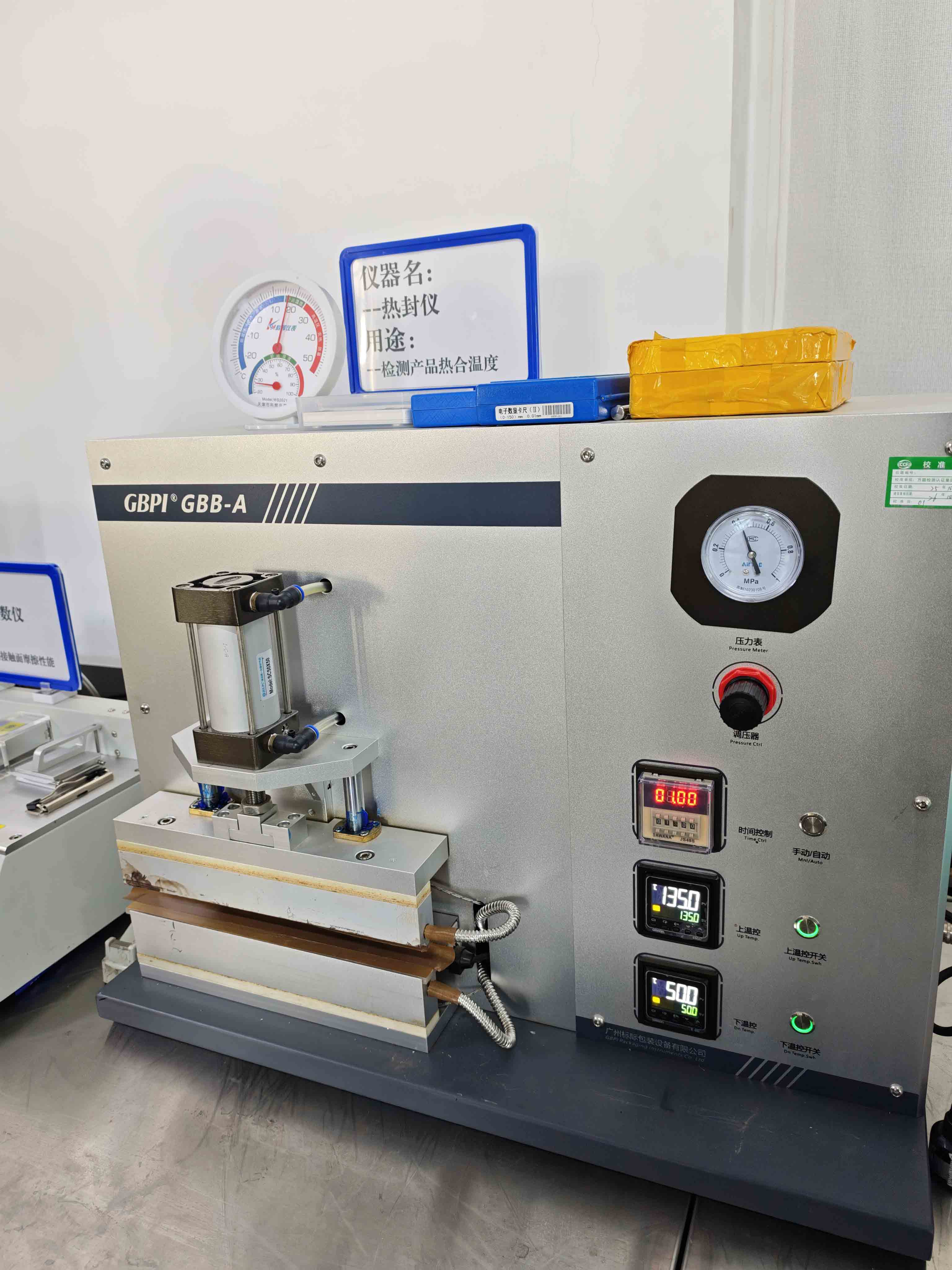
Add cosmetic safety and stability to the package plan
A tight sachet helps protect its contents, but it does not sterilize a mask or replace a suitable preservation system and sanitary production. The FDA's microbiological safety explanation identifies contaminated ingredients, poor manufacturing conditions, ineffective preservation, inadequate protective packaging and poor shipping or storage as possible routes to cosmetic contamination. The cosmetic manufacturer remains responsible for product safety. Packaging should be evaluated as one part of that control system.
Track at least the product attributes that matter to the particular mask: liquid appearance and odor, amount retained by the sheet, leakage, visible changes to the substrate, seal condition and any formula-specific stability or microbiological endpoints selected by the responsible team. Compare retained packs in the intended final construction and relevant storage conditions. A change in fragrance, preservation system, serum amount, substrate or pouch can trigger a new assessment even when the printed front remains the same.
The FDA's cosmetics shelf-life page explains that shelf life varies with product and storage, and that U.S. cosmetic manufacturers are responsible for determining a safe, usable period. It also distinguishes products regulated as drugs, including some with drug claims. This guide does not assign a universal number of months. The companion shelf-life article will cover the evidence path in more detail; until then, an individual product's date must rest on its own formulation and final-pack study.
What a Real Adjacent Pouch Case Can—and Cannot—Show
Mylarbag publicly describes a Philippines three-side-seal PET/AL/PE pouch for cosmetic and soap packaging. Its page identifies gravure printing, Spot UV and a zipper. Those are useful fields for a packaging brief: format, named construction, print treatment and closure can all be specified rather than left to interpretation.
It is an adjacent cosmetic/soap pouch example, not a documented wet sheet-mask customer project. The public case does not supply a sheet-mask formula, serum-contact study, filling method, leak results or shelf-life validation. Its zipper suits a different opening and reuse decision. Copying the zipper or inferring wet-mask performance from that case would turn a real example into a misleading one.
The practical lesson is to ask for the same clarity about the proposed mask sachet: what exactly will be made, where will it be filled, which version will be trialed, and which tests are still needed? If an opaque foil structure is considered, its contact and sealing layers still need to suit the formula. If a different clear or mono-material construction is proposed, treat it as a separate candidate with its own evidence.
How are Neutrogena face masks packaged?
The public Neutrogena Hydro Boost Hydrating 100% Hydrogel Mask product page identifies a hydrogel facial sheet mask. It is a retail product reference, not a pouch engineering specification. The page does not establish a verified layer-by-layer sachet construction, converting line, filling settings, seal test, supplier or relationship to Mylarbag. A brand developing its own mask can study the consumer-facing format and opening experience, but should obtain specifications and validate its own filled pack rather than reverse-engineering hidden production details from marketing images.
Send One Useful Brief to the Pouch Maker and Filler
You can save several rounds of mismatched samples by sending both parties the same revision-controlled brief. It should distinguish facts already approved from targets still under evaluation. Put a physical mask and serum sample alongside the written dimensions when a supplier can review them under appropriate handling arrangements.
Product and fill
- Sheet type, fold, backing or separator, formula identification, target serum amount and permitted fill variation.
- Intended packing sequence, filling equipment or required input form, and any product temperature or handling condition that affects the trial.
- Intended unopened distribution period as a study target, not a promised result.
Sachet and artwork
- Preformed open-top pouch or rollstock, proposed inside dimensions, opening direction and an annotated top-seal land.
- Candidate construction with inner contact/seal layer; whether opacity, window, rounded corner, hang hole or tear notch is necessary.
- Front/back artwork, market-specific label review owner, lot-code location and minimum readable area after sealing.
Trial and release
- Sample quantities and revision names; who owns filled-pouch sealing settings, leak challenges, compatibility and retained-pack studies.
- Defined observations and acceptance criteria for dimensions, liquid containment, opening and shipment.
- What changes require a new trial: formula, sheet, dose, film, laminate, notch, equipment, artwork that moves a feature, or shipper.
Request an unprinted fit sample before committing to a large printed run. Then compare an approved print proof, a production-representative empty pouch, and a filled sample. A beautiful artwork proof cannot reveal a masked seal area. If the face mask packaging page contains a format of interest, send the real folded mask, fill plan and distribution route with your inquiry; ask for a candidate sachet to trial, not an unqualified guarantee of freshness.
Frequently Asked Questions
What is the usual bag format for one wet sheet mask?
An open-top flat sachet with three converted sides is a sensible candidate because it gives the filler one opening for the mask and serum and one final top seal. The actual choice depends on the fold, dose, opening width, equipment, display and outer carton. A material name or stock-bag dimensions cannot replace a filled sample. A hydrogel mask with a backing can behave differently from a thin nonwoven sheet even if both products are sold as one mask.
Does a single-use sheet mask sachet need a zipper?
Usually the consumer opens one sachet once and uses that mask, so a zipper adds a feature without solving the first-seal problem. A multi-use skincare pack is a different design exercise. If the brief genuinely calls for repeated opening, test the zipper and the first heat seal as separate functions; do not assume a resealable closure makes a weak first seal acceptable. The cosmetic/soap case described above has a zipper, but that is not evidence that every facial mask should.
Can the final top seal be made after serum touches it?
Do not assume a wet sealing surface will bond reliably. Observe the planned fill at its high end, check how the nozzle and mask move, and inspect the seal land immediately before sealing. If liquid reaches it, investigate the fill method, pouch dimensions or product position. Any cleaning or rework method must be part of a validated procedure for that product and equipment. A visually closed edge alone is insufficient evidence.
How can we check a filled sachet for leaks?
Start by defining where and when leakage matters: on a shelf, inside a carton, after squeezing, or after a distribution route. Inspect the sealed perimeter and challenge representative filled units in agreed orientations and conditions. Combine that with seal observations, suitable strength checks, before/after weights when relevant, and mapped failure locations. Select the method and acceptance criteria for the exact pack. A pass in one challenge does not prove resistance to every temperature, puncture or long-term exposure.
Is an aluminum-foil laminate always necessary?
No single construction is automatically right for every serum. An opaque foil candidate can be considered when light and barrier needs support it, but the inner contact layer, sealing behavior, print and whole-pouch design still matter. A transparent or different barrier candidate may be appropriate when the product requirements and tests support it. Compare specified constructions with the actual formula, filled seals and distribution route. Do not treat a metallic appearance or a flat-film data point as a finished-pack guarantee.
How long can a sheet mask stay in a sealed pouch?
The pack alone cannot set that period. Formula stability, preservation, substrate, material contact, seal integrity and actual storage all affect it. Retain the final filled product, observe relevant quality and safety endpoints over the proposed period, and review the result after significant changes. The FDA describes cosmetic shelf life as product- and storage-dependent and assigns responsibility for safety to manufacturers in the U.S.; other markets and any drug-related claims require their own review. Do not borrow a generic “12–24 months” statement for a new mask.
Can a pouch supplier certify that the finished mask is safe?
A supplier can document the specified empty pouch and tests it actually performed. It cannot, from an empty-bag sample alone, verify the brand's formula, preservation system, sanitation, liquid dose, final top-seal settings or completed shelf-life study. Agree on handoffs and retain each party's records. If a factory also fills the cosmetic, ask for the specific filled-product evidence rather than assuming the empty-pouch documentation covers it.
What should a small brand send before asking for custom printed pouches?
Send the real folded mask, target and high-end fill, proposed outer carton or display, packing method, desired opening experience, estimated volume and target market. Include the proposed artwork and ask for an unprinted fit trial first. Mark undecided material and shelf-life claims as open questions. A supplier can then recommend samples and a dieline that can be checked on the actual product, and the brand can obtain relevant formulation and regulatory review before final artwork approval.
Make the First Sample Answer a Real Question
The best first sachet is not the one with the boldest barrier claim. It is the one whose dimensions, opening, fill sequence and clean seal area can be demonstrated with the actual sheet and serum. Record what the sample proves, what it fails and what remains to be tested. Once the filled pack passes the agreed checks, lock the construction and process version together so the next order can repeat the result.
For a starting format discussion, review Mylarbag's face mask packaging options and share a filled-sample brief. Ask the packaging team about the empty pouch; ask the filler and cosmetic quality team to verify the final sealed product.
Source notes
- FDA: Good Manufacturing Practice (GMP) Guidelines/Inspection Checklist for Cosmetics — primary packaging handling, filling, code marks, records and retained samples.
- FDA: Microbiological Safety and Cosmetics — responsibility for cosmetic safety and potential contamination pathways, including inadequate protective packaging.
- FDA: Shelf Life and Expiration Dating of Cosmetics — product-dependent shelf life and U.S. cosmetic/drug distinction.
- Neutrogena: Hydro Boost Hydrating 100% Hydrogel Mask — public product identity only.