
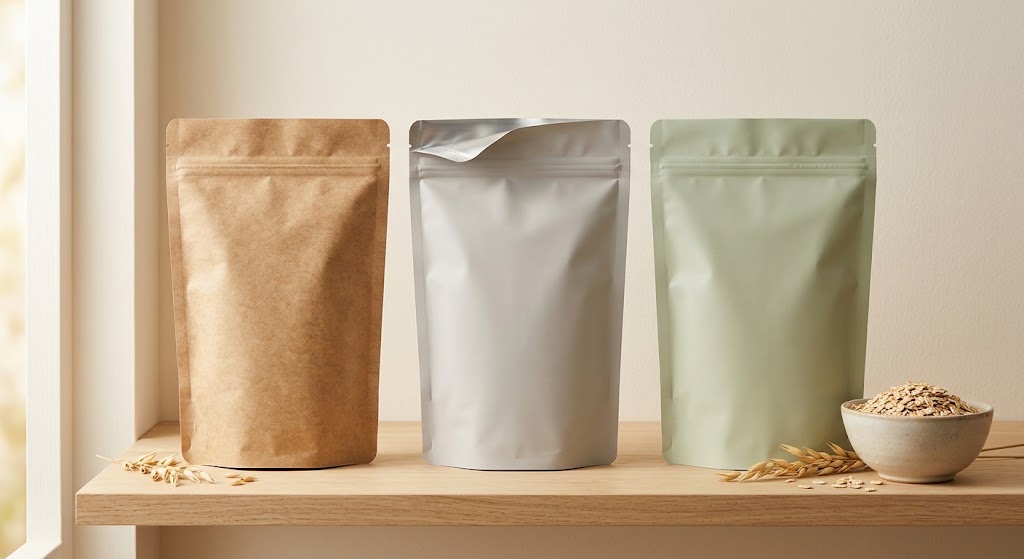
The best oatmeal bag is not defined by whether it looks natural, feels thick or carries a recycling symbol. It is the structure that protects the actual oat product, runs on the packing line, supports the intended shelf life and allows a defensible disposal claim in the market where the pack is sold.
For most retail projects, buyers compare three routes: a paper or paper-look bag, a conventional high-barrier laminate commonly described as a Mylar bag, and a PE-family structure designed for a polyethylene recycling stream. Each can be the right choice. Each can also disappoint when the buyer specifies only the visible surface and ignores the layers underneath it.
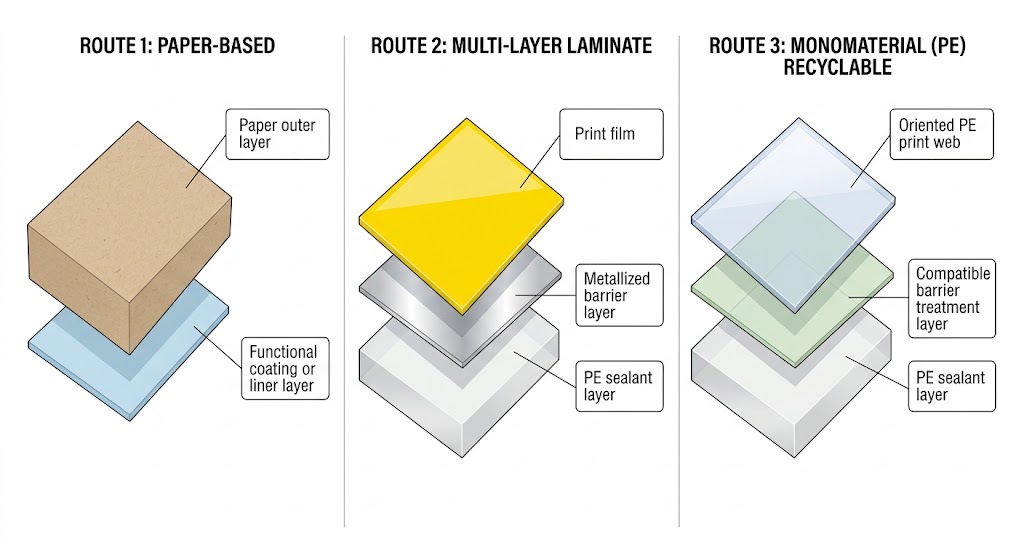
The short answer: choose paper when the format and tested paper-based construction can meet the moisture, grease and seal requirements; choose a high-barrier laminate when protection and distribution risk dominate the brief; and evaluate mono-PE when a PE recycling route is a core objective and the finished package can pass the required barrier, sealing and recyclability assessments. Do not select any of the three from appearance alone.
A Fast Comparison for Packaging Buyers
The table below is a screening tool. It does not replace a technical specification or a filled-pack trial.
| Decision factor | Paper or paper-based route | High-barrier “Mylar” laminate | Mono-PE route |
|---|---|---|---|
| Typical reason to shortlist | Natural look, fibre-based story, tactile shelf presence | Strong protection options and broad converting familiarity | Design goal aligned with a PE recycling stream |
| What the name can hide | Coatings, adhesives, liners, windows and zippers | PET, metallized PET, foil, nylon, PE and other combined layers | Barrier coatings, tie layers, inks, adhesive and non-PE attachments |
| Moisture protection | Highly dependent on coating or liner | Can be engineered for low WVTR | Can be engineered, but the complete structure must be tested |
| Oxygen and aroma protection | Depends on the full paper-based construction | Broad range, including metallized and foil options | Depends on orientation, coating or compatible barrier technology |
| Light barrier | Printed paper may reduce light but is not automatically opaque | Metallized or foil layers can provide strong light protection | Opaque print or qualified barrier design may be needed |
| Heat sealing | Often needs a sealant layer or coating | Usually uses a dedicated sealant layer | PE sealant is part of the same polymer family |
| Recyclability statement | Must be assessed as the finished paper package | Mixed-material structures are difficult to place in one material stream | Requires design-for-recycling review and local collection access |
| Best first question | What is the exact fibre, coating and liner construction? | What are all layers, gauges and test conditions? | What percentage is PE, and how were the barrier, inks and attachments assessed? |
If a supplier answers those questions with a trade name or a single total thickness, the specification is incomplete. Ask for the complete bill of materials and the evidence behind every performance or environmental claim.
Why Oatmeal Packaging Is a Material-System Decision
Oats appear simple because they are dry. The packaging problem is more varied than that label suggests. Rolled oats, quick oats, steel-cut oats, oat flour, granola and muesli do not behave in the same way.
Plain rolled oats can lose eating quality when they gain moisture or absorb unwanted odours. Oat flour creates fine dust that can migrate into the seal area. Granola may contain nuts, seeds, dried fruit, chocolate or added oil, increasing sensitivity to oxidation, aroma loss and grease. Large clusters also create puncture and fill-volume concerns that a free-flowing oat flake does not.
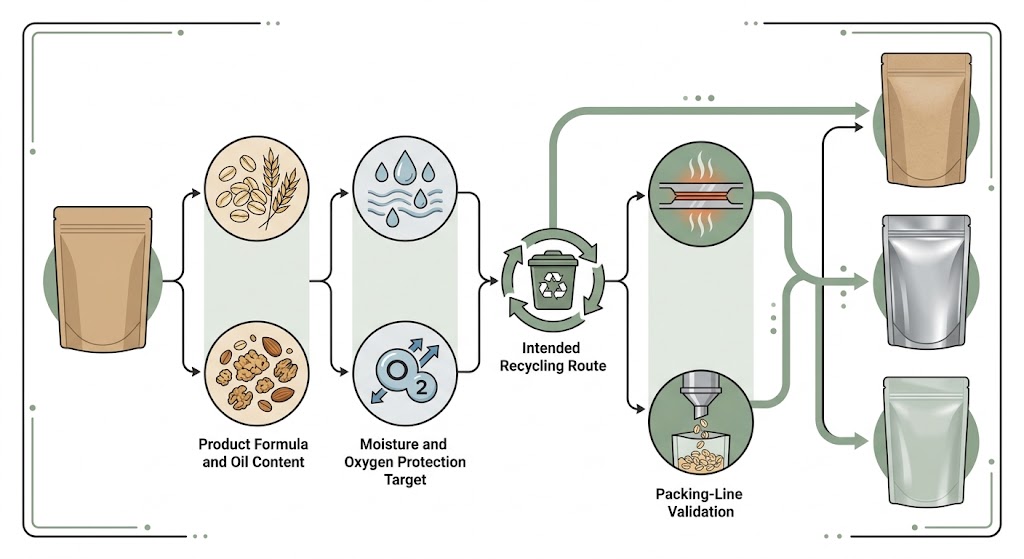
The correct material decision begins with the failure mode that matters to the product owner:
- Does the product soften or cake after moisture pickup?
- Do oil-rich ingredients develop stale or rancid notes?
- Does light affect colour, flavour or nutrient claims?
- Can flakes, flour or inclusions contaminate the top seal?
- Will the pack face humid storage, long ocean transit or hot distribution?
- Will consumers open and close the pouch over several weeks?
Those questions lead to measurable requirements. Water-vapour transmission rate, oxygen transmission rate, seal strength, leak performance, puncture resistance and package dimensions can then be evaluated under stated conditions. A generic statement such as “high barrier” cannot answer them.
ASTM F1249 covers water-vapour transmission testing for flexible barrier materials, while ASTM D3985 covers oxygen transmission through plastic film and sheeting. Ask for units, temperature, humidity, specimen orientation and the exact structure tested. Two values measured under different conditions should not be treated as a direct comparison.
First Define What the Material Names Mean
The biggest source of quotation errors is that buyers and suppliers use the same words for different constructions.
“Paper bag” can describe at least three products
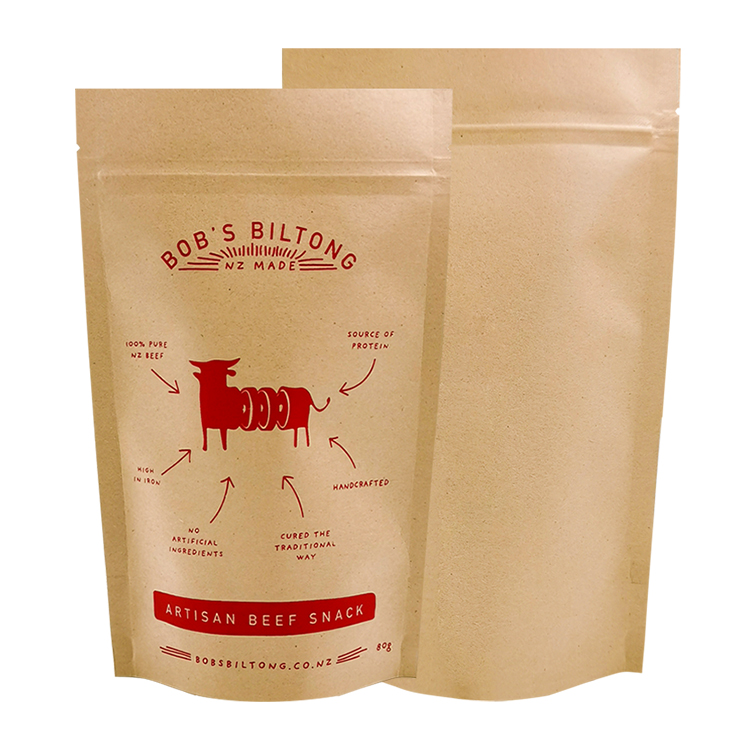
One buyer may mean an unlined paper sack. Another may mean paper with a thin functional coating. A third may mean a flexible laminate with a kraft paper layer over metallized film and PE. All three can look brown and fibrous in a product photograph, yet their barrier, sealing and end-of-life paths are very different.
For direct food contact, ask which surface touches the oats. For recyclability, ask how the coating, adhesive, window, zipper and sealant behave in the intended paper recycling process. For shelf life, test the finished construction rather than the visible paper layer.
“Mylar bag” is usually commercial shorthand
In flexible packaging enquiries, “Mylar” is often used loosely for a shiny, metallized or high-barrier pouch. It does not state the full laminate. A quotation might refer to PET/PE, PET/VMPET/PE, PET/foil/PE, PET/NY/PE or another combination.
Write the actual layer sequence into the purchase specification. Include the thickness of each layer where relevant, the total finished gauge, the sealant, coating, adhesive and any window. If the pack contains foil, say foil. If it contains metallized PET, say VMPET. These are not interchangeable descriptions.
“Mono-PE” does not mean one simple sheet
A mono-PE pouch can use more than one type of polyethylene film. MDOPE may provide stiffness and print performance, while another PE layer provides sealing and toughness. Compatible coatings or barrier layers may be added. The design goal is to keep the finished package within the requirements of a PE recycling stream, not to limit the package to a single layer.
The Association of Plastic Recyclers’ PE Flexible guidance evaluates the whole package. It covers base-resin composition, non-PE layers, coatings, metallic components, inks, adhesives, labels and closures. The zipper and label matter along with the pouch wall.
Option 1: Paper and Paper-Based Oatmeal Bags
Paper is attractive to oat brands because it connects visually with grain, breakfast and natural-food positioning. It accepts a wide range of print styles, offers a tactile surface and can create a warm shelf presence. None of those qualities establishes how the finished bag protects food or enters a recycling process.
When a simple paper structure may work
A relatively simple paper bag can be considered where the product has modest protection needs, the distribution period is short, the secondary pack provides support and the pack will remain in a controlled environment. Bulk food-service formats and inner-pack systems may create opportunities that differ from a long-life retail pouch.
Even then, paper must survive filling, sealing or closing, palletisation, humidity and abrasion. Powder leakage through folds or seams can be a problem for oat flour. An open paper mouth or stitched closure also provides a different consumer experience from a zipper pouch.
Why many “paper oatmeal bags” contain another material
Untreated paper is porous and sensitive to moisture. Brands often add a polymer dispersion, extrusion coating, grease barrier, separate liner or laminated film to obtain heat sealing and product protection. A transparent window introduces another component. A zipper, valve, label or metal tie can complicate the package further.
This does not make the structure wrong. It changes the questions a buyer must ask. A paper layer may deliver the desired look while a VMPET and PE laminate performs the barrier and sealing work. That pack should be described as a paper-containing laminate, not as though appearance alone proves a paper recycling route.
The 4evergreen Recyclability Evaluation Protocol uses laboratory testing, technical evaluation and scoring for paper-based packaging across conventional, flotation-deinking and specialised mill processes. Its approach illustrates why fibre content alone is not enough: the finished packaging system must be evaluated against an appropriate recycling process.
Advantages of a paper route
- Natural texture and strong compatibility with oat and organic brand design
- High-quality matte graphics and a distinctive tactile experience
- Potential alignment with a fibre stream when the full construction is proven compatible
- Useful stiffness for some bag, carton and sachet formats
- Opportunity to reduce plastic in a design where the functional requirements permit it
Limits and common surprises
- The paper may be only an exterior appearance layer
- Moisture, grease and heat-seal requirements can add coatings or liners
- Windows, zippers, adhesives and wet-strength chemistry affect recycling behaviour
- Humidity can change stiffness, friction and dimensional stability
- A paper package may be heavier or bulkier than an equivalent flexible-film solution
- Dark, heavily printed or strongly bonded structures may need specific mill testing
Mylarbag’s paper packaging options show several paper-plus-film routes. For an oatmeal RFQ, describe the intended disposal claim separately from the desired kraft appearance. That prevents the design team from treating a visual brief as a technical material brief.
Option 2: Conventional High-Barrier Mylar Laminates
The high-barrier laminate is the most forgiving starting route when the product, transit and shelf-life brief demand strong protection. A converter can combine an outer print web, a barrier layer and an inner sealant to create the required balance of stiffness, opacity, toughness and sealing.
For example, PET can provide print and dimensional stability. Metallized PET can improve light, oxygen and moisture protection. Nylon may add puncture resistance and toughness. PE commonly forms the food-contact sealant. Aluminium foil may be selected when the project requires an opaque, very high-barrier construction. These descriptions are functional roles, not universal prescriptions.
When this route earns its place
Consider a conventional laminate when the oat product includes oxidation-sensitive ingredients, distribution is long or humid, the retailer expects a long unopened life, the bag needs robust puncture resistance, or the cost of staling and returns is high. It can also be the sensible control structure during development: a brand can first prove the product and filling process, then compare a simpler or recycling-oriented candidate against the same acceptance criteria.
Advantages of a high-barrier laminate
- Wide engineering range for moisture, oxygen and light protection
- Strong print surface and established pouch-converting options
- Good stiffness and shelf appearance at practical gauges
- Ability to combine toughness, barrier and sealability in separate layers
- Compatibility with zippers, tear notches, windows and several pouch formats
Limits to evaluate
- Different polymer families and metal layers are difficult to process as one recycling stream
- A metallized look can interfere with some sorting systems
- Lamination, curing and adhesive choices add production variables
- The strongest available barrier may be unnecessary for a short-life plain-oat product
- “Foil,” “metallized” and “silver” should never be treated as equivalent specifications
APR’s PE flexible guidance classifies paper, PET and aluminium foil as problematic in a PE film recycling route, and calls for testing of many other non-PE layers and coatings. That does not mean a multi-material pack has no value. It means the performance decision and the disposal claim must be stated honestly and separately.
Real oatmeal reference: PET/NY/PE
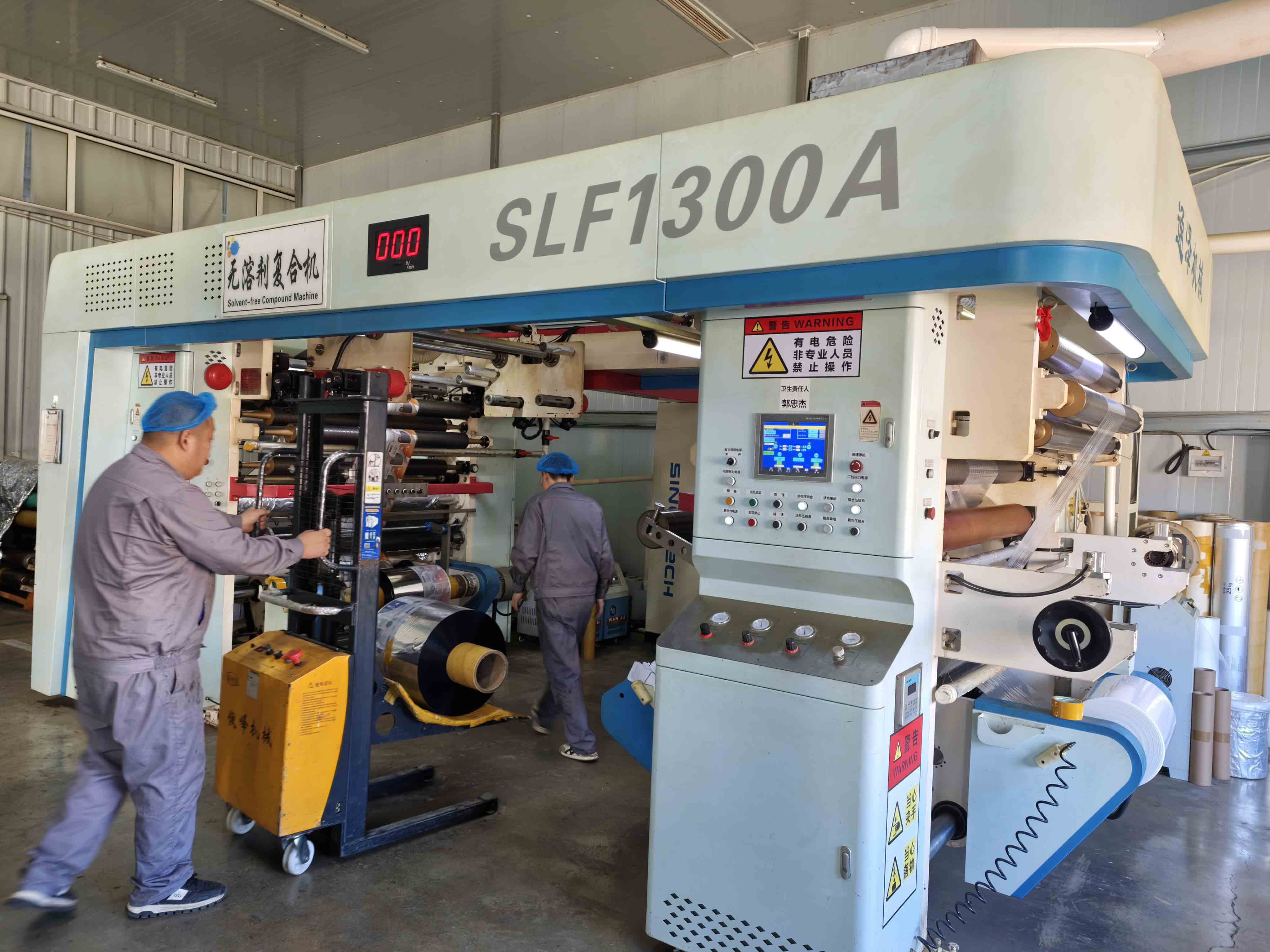
Mylarbag’s published 500g Açaí and oatmeal pouch lists PET/NY/PE, gravure printing, a zipper and dimensions of 21 × 27 + 4.5 cm for a Venezuela project. It is a concrete example of a conventional multi-layer route.

The useful lesson is not that every oatmeal bag needs nylon. It is that the project joined the product, pouch dimensions, zipper, print method and laminate into one specification. A plain rolled-oat product, an oily granola and an oat-flour product should each be tested on their own merits.
Option 3: Mono-PE Oatmeal Packaging
Mono-PE has become a serious development route for flexible packaging because it aims to keep the body, sealant and compatible components within the polyethylene family. It can still be a sophisticated structure. Orientation, coextrusion, coatings, lamination, print and sealing must work together.
How a mono-PE pouch can be built
One common concept uses an oriented PE print web laminated to a PE sealant web. The outer layer supports stiffness and graphics. The inner layer supports sealing and abuse resistance. Barrier performance may come from film orientation, a compatible coating, EVOH used within defined design rules, or another assessed technology.
APR’s current PE Flexible guidance provides detailed categories rather than a single “all PE equals recyclable” rule. It identifies composition thresholds, calls for testing of non-PE layers, treats PE closures favourably, and evaluates inks, adhesives, labels and metallic elements. For example, it provides design conditions for certain EVOH and tie-layer combinations and recognises directly deposited SiOx or AlOx on PE under stated conditions. A buyer should ask which exact guidance path and test protocol supports the proposed structure.
Advantages of the mono-PE route
- Clearer alignment with a PE material stream than a PET/VMPET/PE laminate
- Ability to include a PE zipper and other PE-family components
- Good potential for stand-up pouches and printed rollstock
- Opportunity to build a market-specific recycling message from recognised guidance and testing
- Continual improvement in stiffness, print quality, sealing and barrier technology
Trade-offs to validate
- Heat resistance and stiffness may differ from a PET-based outer web
- The sealing window and machine settings may need adjustment
- Barrier must be measured for the complete commercial construction
- Heavy inks, dark pigments, labels, adhesives and metallic decoration can affect recyclability
- Flexible-film collection is not equally available in every market
- A technically compatible structure does not prove that consumers can recycle it locally
The United States FTC Green Guides summary says recyclable claims should be qualified when appropriate recycling facilities are not available to at least 60 percent of the consumers or communities where the item is sold. For export packaging, one global artwork may therefore need market-specific claim review.

Side-by-Side Technical Decision Matrix
Score each candidate against the same brief. A fair comparison uses the same product, pack weight, dimensions, closure, test conditions, artwork coverage and distribution route.
| Requirement | Paper-based candidate | High-barrier laminate candidate | Mono-PE candidate |
|---|---|---|---|
| Exact layer declaration | Fibre type, coating, liner, adhesive, sealant | Every polymer, metal layer, adhesive and sealant | PE types, coatings, tie layers, adhesive and attachments |
| WVTR and OTR | Test finished construction | Test finished construction | Test finished construction |
| Light protection | Measure or document opacity of full pack | Confirm clear, metallized or foil route | Confirm print, pigment or coating solution |
| Seal-window trial | Confirm coating/liner seals on equipment | Confirm sealant, temperature, dwell and pressure | Confirm machine can run PE structure consistently |
| Puncture and drop handling | Check folds, seams and humidity effects | Check flex cracking and layer durability | Check stiffness, elongation and gusset behaviour |
| Zipper and tear feature | Identify materials and separation route | Confirm fit and seal integrity | Prefer compatible PE feature where the design brief requires it |
| Recycling evidence | Paper protocol and intended mill route | State limitations of mixed construction | PE design guide, testing and collection route |
| Claim language | Qualify by finished pack and market | Avoid broad recyclable wording without evidence | Qualify technical compatibility and consumer access |
| Commercial comparison | Include liner, print, converting and freight | Include cylinders or digital setup and laminate cost | Include development trials, compatible closures and testing |
Do Not Compare Cost per Bag in Isolation
The lowest unit price can become the most expensive option after filling losses, product waste, slow line speed, oversized cartons or obsolete printed inventory are included.
Build the comparison around total project cost:
- Material and converting: film, paper, coatings, adhesive, zipper, pouch making and quality control.
- Printing setup: cylinders, plates, colour proofing, digital setup and minimum quantity per design.
- Line performance: filling speed, missed openings, seal contamination, temperature window and reject rate.
- Distribution: master-carton use, pallet density, package damage and humidity exposure.
- Product risk: staling, caking, rancidity, leaks, returns and brand damage.
- Claim verification: recyclability testing, documentation, artwork review and market-specific labelling.
- Inventory: minimum order per SKU, design changes, storage space and obsolete packaging.
A paper-containing laminate may cost more than a simple printed PE pouch while offering mainly a visual effect. A mono-PE structure may require a development trial but support an important retail requirement. A conventional laminate may lower product-loss risk enough to justify its end-of-life limitation. The buyer needs those trade-offs in one spreadsheet, not three disconnected price quotations.
Packing-Line Performance Can Reverse the Material Decision
A pouch that performs well in a hand sample may behave differently at production speed. Paper surfaces, PET laminates and oriented PE films have different stiffness, friction, heat response and static behaviour. The machine must pick, open, fill and seal the actual construction.
For pre-made oatmeal pouches, record missed picks, double feeds, incomplete openings, product in the seal zone, wrinkled top seals, zipper distortion and finished-pack stability. For rollstock, confirm web tension, registration, forming, sealing and cutting. Run the target print and surface finish where possible because ink and varnish can change friction.
Oat flour needs particular attention. Fine particles can coat the sealant and reduce seal quality. Granola inclusions can bridge at the filling tube or become trapped near the zipper. Paper folds may retain dust differently from smooth film. Mono-PE may require a different temperature and dwell window from the previous PET-based laminate. These are production questions, not reasons to reject a material before testing it.
Food-Contact Review Applies to Every Route
Paper, ink, coating, adhesive, metal, plastic and recycled-content decisions all sit inside a food-contact review. A natural appearance does not prove food-contact suitability, and a familiar polymer name does not cover every additive or condition of use.
The FDA explains that the status of a food-contact article depends on the regulatory status of its individual substances and the applicable conditions of use. For a US project, request documentation tied to the actual construction, supplier and use. For other markets, identify the destination before approving the material.
Give the supplier enough information to perform that review:
- Food type and full formula, including oils and flavour ingredients
- Direct-contact layer and whether a separate inner bag is used
- Filling temperature and any heat treatment
- Storage time and temperature
- Intended countries of sale
- Whether recycled content is proposed in any layer
- Printing location and migration-control design
Do not accept “food grade” as the only supporting document. Ask for a declaration or letter that identifies the materials, regulatory basis and conditions covered.
Environmental Claims Need Market Evidence
The packaging specification and the marketing copy should be developed together. If the material team changes a PE zipper to a non-PE attachment, or adds a paper label to the pouch, the recyclability assessment may change. If the sales team adds “plastic free,” “100% recyclable” or “compostable” without reviewing the whole package, the artwork can overstate the evidence.
For the EU, Regulation (EU) 2025/40 establishes a framework in which packaging recyclability will be assessed through design-for-recycling criteria and, later, recycling-at-scale criteria. Several detailed criteria and methods continue to be set through delegated and implementing acts. A 2026 launch brief should therefore identify the country, packaging category and current legal timetable rather than copying a claim from an older package.
For paper-based packs, use a recognised fibre-packaging protocol and identify the intended mill route. For PE flexibles, use the relevant design guide and testing. For any market, confirm collection and consumer instructions. Technical recyclability, collection access, sortation and actual recycling are related but different questions.
A Practical Selection Sequence
Use the following order to avoid designing the graphics around an unproven structure.
Step 1: Define the food and failure limit
State the oat format, formula, oil-bearing inclusions, particle size, dust level and target net weight. Define what failure means: loss of crunch, moisture gain, oxidation, aroma loss, caking, seal leakage or another agreed endpoint.
Step 2: Set the distribution and shelf-life brief
Record target unopened life, storage temperature and humidity, ocean or domestic transit, retail lighting, e-commerce handling and expected time after opening. Avoid turning the target into a promise before validation.
Step 3: Choose two or three testable material routes
Ask the converter for complete constructions, not broad categories. One project might compare a coated paper-based pouch, PET/VMPET/PE and MDOPE/PE. Another may compare two mono-PE barrier technologies against a proven control laminate.
Step 4: Compare performance data under the same conditions
Review OTR, WVTR, opacity, seal strength and physical durability. Check whether the test specimen matches the commercial print, coating and lamination. Data from a related film can support screening but should not silently become the finished-bag specification.
Step 5: Make filled samples and run the line
Use the real oats at target weight. Inspect headspace, zipper position, dust, seal quality, gusset opening and shelf stability. Retain samples from the beginning, middle and end of the trial.
Step 6: Conduct product shelf-life validation
Evaluate the finished food in the finished package under the intended conditions. Barrier data helps explain and control the design, but it does not create the product’s expiry date on its own.
Step 7: Validate the end-of-life claim
Review the entire package against the destination’s design guidance, testing and collection system. Include closures, labels, inks and adhesives. Write claim language that matches the evidence and market access.
Step 8: Lock the approved specification
The purchase order should name the layer structure, thicknesses, pouch dimensions, seal and zipper, print method, artwork version, tolerances, inspection plan and approved claim. Retain a signed sample and controlled dieline.
What to Put in the RFQ
Send the same brief to each potential supplier so quotations can be compared fairly.
| RFQ field | Information to provide or request |
|---|---|
| Product | Rolled oats, quick oats, oat flour, granola or muesli; full formulation risks |
| Fill | Net weight, bulk-density range, largest inclusion and dust level |
| Market | Countries of sale and retailer-specific packaging rules |
| Shelf life | Target unopened life, after-opening use and storage conditions |
| Format | Pouch or bag type, dimensions, gusset, zipper, notch and window |
| Candidate structures | Complete paper, high-barrier and mono-PE layer sequences |
| Performance | OTR, WVTR, opacity, seal window, puncture and handling data with test conditions |
| Food contact | Documentation for the actual materials and intended conditions of use |
| Recycling claim | Design guide, test protocol, collection route and proposed consumer wording |
| Printing | Number of SKUs, artwork coverage, colours, finish and coding area |
| Filling line | Machine model, speed, sealing method and trial quantity |
| Commercial | MOQ per SKU, setup charges, lead time, freight term and quantity tolerance |
A copy-ready enquiry can be short:
We are comparing paper-based, conventional high-barrier and mono-PE packaging for [oat product] at [net weight] per pack. The product contains [key ingredients or oil-bearing inclusions] and will be sold in [markets] with a target unopened shelf life of [target] under [conditions]. Please propose complete material structures, OTR/WVTR data with test conditions, food-contact documentation, sealing requirements, recycling-claim support, samples for fill and line trials, MOQ per design and an itemised delivered quotation.
Use Mylarbag’s custom oatmeal packaging page as the project starting point, then attach the technical brief. If the recycling route is a core requirement, request a separate proposal through the company’s eco-friendly packaging options so the conventional and PE-oriented structures can be evaluated against the same product brief.
Material Recommendations by Scenario
Plain rolled oats with a moderate local distribution period
Start with a simple, proven structure and avoid buying more barrier than the shelf-life study requires. A qualified paper-based construction or a straightforward film pouch may work. Compare moisture protection, sealing and total cost. If the brand wants a recycling claim, validate the finished pack in the local stream.
Granola with nuts, seeds or added oil
Prioritise oxygen, moisture, aroma and light requirements from the actual formula. A high-barrier laminate may be the practical control. Compare a mono-PE barrier candidate only when its data and shelf-life result meet the same acceptance criteria.
Organic brand seeking a kraft appearance
Decide whether the priority is appearance, fibre content or a verified paper recycling route. A kraft-look multi-material pouch can deliver the first goal without delivering the third. If paper recyclability matters, specify that requirement before the artwork is designed and test the entire pack.
Retailer asks for a PE recycling design
Shortlist an MDOPE/PE or other PE-family construction with compatible zipper, inks, adhesive and barrier technology. Ask which APR or destination-market criteria were used. Verify the collection and claim language for each market.
Long export route or uncertain storage conditions
Use the risk assessment to set barrier and mechanical targets. A conventional laminate may provide the most straightforward development route. Product protection and food-waste prevention remain part of the environmental decision, so compare evidence instead of material names.
Frequently Asked Questions
Why is oatmeal packaged in paper bags?
Paper gives oatmeal a natural appearance, printable surface and tactile feel. In some formats it also supplies stiffness. Many retail “paper” bags still use a coating, liner or laminated film for moisture protection and heat sealing. Ask for the complete construction before drawing conclusions about performance or recyclability.
Is a paper bag for oatmeal moisture-proof?
Paper alone should not be assumed to be moisture-proof. The result depends on fibre treatment, coating, liner, seams and closure. Request a WVTR result for the finished construction under stated conditions and validate the food in the finished pack.
Are kraft oatmeal pouches recyclable with paper?
Some may be designed for a paper recycling process; others contain plastic film, metallized layers, windows, adhesives or zippers that change the result. Use a recognised paper-packaging evaluation method and confirm the collection route. Brown colour and visible fibres are not evidence by themselves.
What is a Mylar bag for oatmeal made from?
There is no single answer. In commercial enquiries, the name may describe PET/PE, PET/VMPET/PE, PET/foil/PE, PET/NY/PE or another laminate. Require the supplier to state every layer and its function.
Does a metallized pouch contain aluminium foil?
Not necessarily. A metallized film usually carries a very thin deposited metal layer, while foil is a separate metal web. They differ in barrier behaviour, flex durability, appearance and recycling impact. The specification should say VMPET or aluminium foil rather than using “silver” for both.
Is mono-PE always recyclable?
No universal claim follows from the name. Composition, barrier layers, pigments, inks, adhesives, labels and closures affect technical compatibility. Collection and recycling access also vary. Assess the finished package against the relevant design guide and market infrastructure.
Can mono-PE protect granola as well as a conventional laminate?
It may be able to meet a particular project brief, but it must be tested. Compare OTR, WVTR, light protection, seal integrity and shelf-life results for the commercial structures. Do not substitute a material-family claim for product data.
Which option is cheapest?
The answer depends on structure, size, print method, order quantity and development work. Compare total cost, including line rejects, cartons, freight, testing, product loss and obsolete inventory. Unit price alone can favour the wrong bag.
Which material is best for oat flour?
Oat flour requires strong moisture control and careful seal-zone management because fine particles can contaminate the seal. Puncture may be less demanding than with sharp inclusions, while dust and leak control become more important. Test the material and filling process together.
Can I use a clear window in a paper or mono-PE pouch?
Yes, but the window becomes part of the technical and recycling assessment. It can change light exposure, barrier performance, stiffness and material composition. Test the actual windowed design rather than relying on data for the opaque parent structure.
Does a thicker bag always provide better barrier?
No. Barrier depends on the materials, layer quality, coating, metal coverage, humidity and test conditions. Thickness can improve some mechanical properties without solving oxygen or moisture transmission. Compare measured data for the proposed construction.
Do I need a zipper on oatmeal packaging?
A zipper is useful for multi-serve retail packs, but it is not the unopened package seal. The bag normally needs a validated first heat seal above the zipper. Include the zipper material in any recycling assessment.
Can one structure cover plain oats, granola and oat flour?
Possibly, but one specification should not be approved from the easiest SKU. Test the oil-rich, dusty or largest-inclusion product that creates the highest risk. Separate structures may reduce overpackaging or improve line performance across the range.
What evidence should support a “recyclable” claim?
Keep the full construction, recognised design assessment or test result, collection-route evidence, market coverage and final consumer wording. Review the claim again when the zipper, label, ink coverage or barrier technology changes.
What should I approve before placing the production order?
Approve a filled sample, material structure, finished dimensions, zipper and seal layout, artwork, print proof, food-contact documentation, performance data, line-trial result, inspection criteria and any environmental claim. Put them in one controlled specification.