
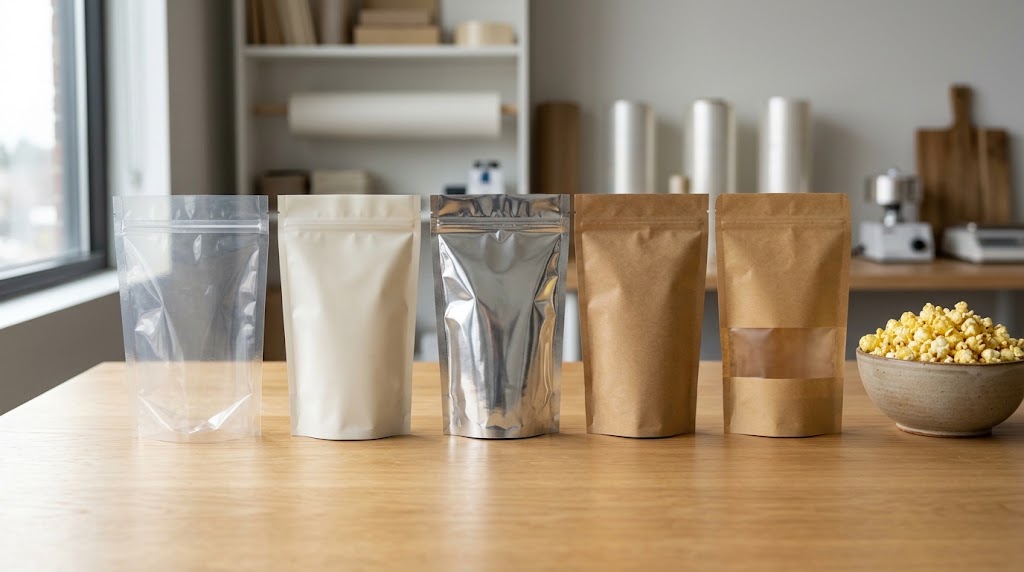
“Popcorn bag” can describe an open paper serving bag or a sealed, printed retail pouch. Even two retail bags that look like brown paper may have different food-contact surfaces and barriers. If you are specifying packaging for already-popped popcorn, ask for a layer-by-layer construction and a physical sample. Color, finish and the word “Mylar” do not disclose the finished bag's material system.
The short answer: a sealed retail popcorn pouch is often built from one or more flexible films and may include paper, metallized film or foil, a print layer, adhesive, a food-contact sealant, a window, and optional reclosure. The exact combination depends on the product, display and validated shelf-life target. An open paper bag for immediate service is a different format. Select material against the actual popcorn and route, then check food-contact status, comparable barrier data, sealing behavior and the whole finished pack.
This article covers human-food, already-popped popcorn in commercial packaging bags. It does not explain microwave cooking bags. It also does not label any unexamined kraft-look laminate “paper recyclable” or any shiny pouch “foil.”
Identify the Bag's Job Before Naming a Film
A concession stand may hand over warm popcorn in an open bag for immediate eating. A brand selling prepacked seasoned popcorn through stores needs a first closure, handling strength, suitable food contact and evidence that the contents meet its quality goals over the intended route. A shipping program adds abrasion, case stacking and parcel handling. Those uses may all be called “popcorn packaging,” but they do not justify copying the same construction.
Start with the product: plain, oil-seasoned, cheese-seasoned or coated; net weight; expected storage conditions; retail display; opening and reclosure needs; and the quality change you need to prevent. Oil transfer, loss of crispness, off-aroma, sticky coating and physical breakage are different observations. The package can help with some routes, but it cannot correct poor starting product or a badly controlled filling line. The emphasis here is what the bag is made from and how to verify it; a separate finished-pack study is needed to establish any quality date.
| Packaging use | First material question | First sample check |
|---|---|---|
| Open, immediate-service paper bag | Is the exact contact surface appropriate for the intended food and brief exposure? | Handling, oil marks and serving experience |
| Sealed single-serve pouch | Which film and sealant suit the product and first heat seal? | Fill, clean mouth, seal, opening and display |
| Sealed multi-serve pouch | Does optional reclosure fit the product and artwork without weakening the first closure? | Zipper access after tear, filled form and closure |
| Retail pouch inside a shipper | Do the pouch and outer carton work as one system? | Scuff, seam, fines, crush and shelf appearance after route |
The table is a decision framework, not a promise that a named material will satisfy every row. Ask for samples that match the proposed production construction. A plain transparent sample is useful for checking dimensions, but it cannot automatically approve a later windowed, printed laminate with another sealant.
Read the Finished Pouch From Outside to Food-Contact Inside
The outside may carry the print and finish. A film such as oriented polypropylene or polyester can provide a printable face and handling characteristics; a paper layer can give a particular texture or visual effect. Adhesive may join distinct webs. A metallized film or aluminum foil can be used as a barrier component in some constructions. The inner sealant forms a heat seal and is part of the intended food-contact surface. These are possible roles, not a fixed recipe for all popcorn bags.
Ask the converter for an exploded layer schedule showing each material, nominal thickness, print location, adhesive, food-contact side and any coatings. If the bag has a clear window, request its separate construction and how it joins or replaces the opaque panel. If it has a zipper, confirm its material and attachment. A gusset and side seals change the complete pack even when the flat film report stays the same.
| Component | Typical purpose to verify | Documentation or trial to request |
|---|---|---|
| Exterior film or paper | Print surface, appearance, stiffness and scuff behavior | Material identity, thickness, finish, filled-pack appearance |
| Printed inks and coatings | Graphics, white backing or tactile finish on the intended surface | Ink location, set-off or migration review as applicable, approved artwork |
| Adhesive or tie layer | Join webs in a laminate | Structure and cure or converting controls relevant to the design |
| Barrier component | Manage transfer of moisture, oxygen, light or aroma when needed | Tested construction, method, units and conditions; window differences |
| Food-contact sealant | Contact with product and formation of specified heat seal | Intended-use documentation, seal window and actual filled-line samples |
| Zipper, tear, hang hole | Opening or merchandising convenience | Physical operation, first-seal position, component identity |
The FDA's explanation of food-contact material component status makes the key distinction for U.S. use: assess the actual components and intended conditions, not a vague whole-bag phrase such as “FDA approved material.” The relevant status may rest on regulations, notifications or other routes for the specific substance and use. The food business and supplier should map the exact finished structure to the destination market and intended food-contact conditions.
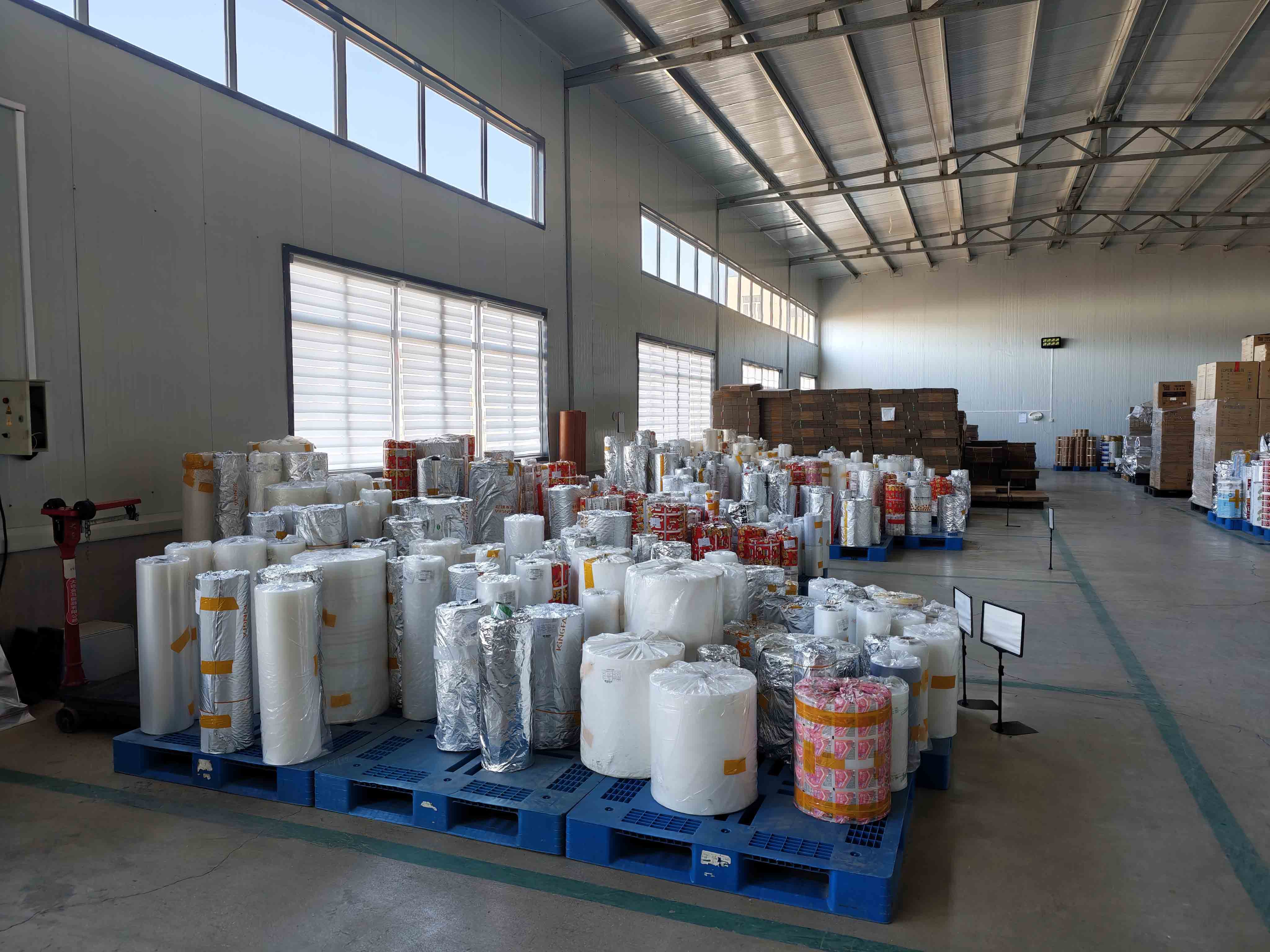
“Kraft,” “Mylar,” and “foil” are not full specifications
Kraft may describe a paper layer or merely a kraft-looking print. “Mylar” is used loosely in marketing for many flexible pouches; it does not disclose each layer or barrier value. A mirror-like silver appearance can come from a metallized film, a foil-containing laminate or a printed finish. Do not order by appearance when the food-contact face, sealant and test conditions matter.
Paper on the outside does not mean the food contacts paper. Likewise, a “plastic-free” claim needs evidence for every functional layer and component, not only the visible face. A metal-looking material does not prove it has the continuous foil structure or performance of another sample. Ask for the actual construction code and retain it with the approval record.
Compare Clear, Metallized, Foil and Paper-Look Candidates
A transparent pouch gives product visibility and can be printed or partly opaque, but it calls for a review of light exposure and any barrier requirements. Metallized film can be incorporated into a laminate where opacity or barrier is desired, but thin deposited metal is not the same thing as a separate aluminum foil layer. Foil-containing designs can be appropriate for a demanding product brief, yet folds, pinholes, seals and filling conditions still need attention. A kraft-look exterior may help brand presentation and may be combined with plastic layers; its visual style does not establish disposal route or shelf life.
| Candidate appearance | Useful reason to sample it | Question to challenge |
|---|---|---|
| Clear or windowed | Let buyers see pieces, seasoning or color | What is the exact window film, and how does it affect light exposure and complete-pack performance? |
| Opaque printed film | Offer a broad design face and possibly reduce light exposure | Which layers provide the stated performance, under what conditions? |
| Metallized laminate | Consider a different opacity or barrier route | Is the deposited layer continuous after converting and handling, and what was tested? |
| Foil-containing laminate | Screen demanding barrier needs | Do folds, corners and seals remain intact in actual distribution? |
| Kraft-look laminate | Provide a paper-like visual and tactile effect | Is this actual paper, a print effect, or a paper/plastic composite? What touches the food? |
This comparison deliberately omits a “best material” winner. The product may be more sensitive to moisture texture changes than oxygen-related flavor changes, or vice versa. A window may be essential for selling an appealing flavor despite a more complex structure. Test candidate films and finished pouches against written product-quality criteria rather than choosing the highest barrier number by default.
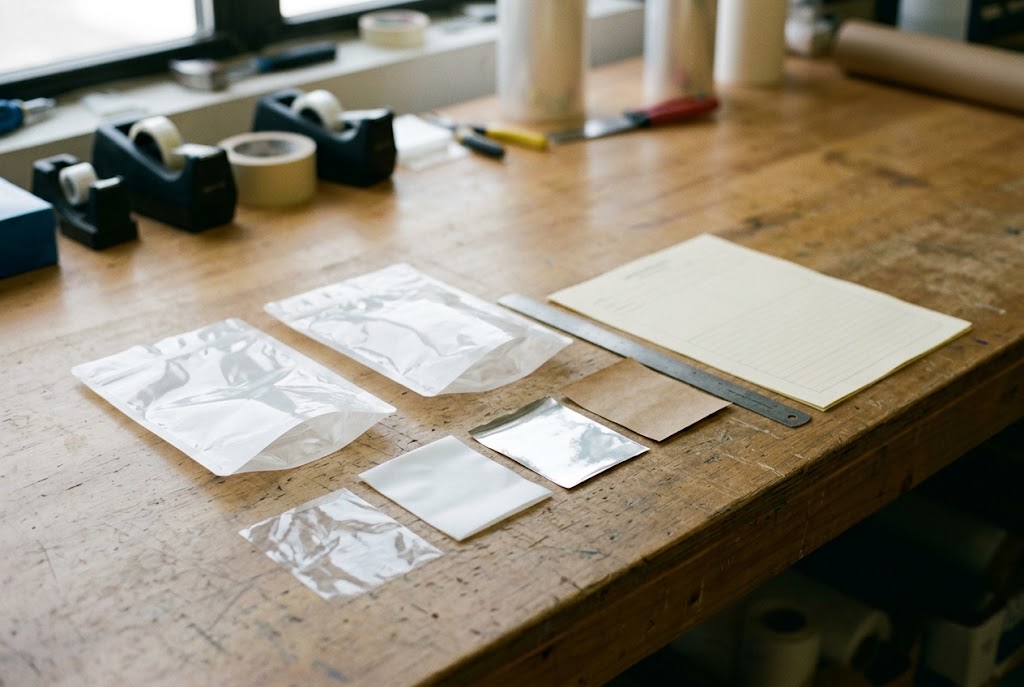
Interpret WVTR and OTR Without Turning Them Into Months
WVTR describes water-vapor transmission through a tested material under stated conditions; OTR does the same for oxygen transmission. The ASTM F1249-25 method concerns water-vapor transmission through plastic film and sheeting, while ASTM D3985-24 concerns oxygen transmission through film and sheeting. Method names are useful when requesting a report, but the report must identify the sample, units, temperature and humidity or gas conditions. Results from different methods or conditions should not be placed in one ranking table without qualification.
A flat-film value is not a finished-pouch shelf life. The side and bottom seams, first heat seal, window and zipper region create routes that a small intact film specimen does not represent. Print and laminate revisions can change the submitted construction. Ask whether the value applies to a single web, the laminated printed film, the window, or a finished pack. If the seller has only flat-film data, use it to screen candidates and then test actual filled pouches.
Do not treat a generic “low WVTR” as proof that popcorn will stay crisp. The starting product condition, any coating, pack size, headspace, storage humidity, and an effective first seal also matter. Nor is a low OTR a guarantee that an oil seasoning will never develop an off-note. Shelf-life decisions belong to a product-specific study. If several candidate structures are close, include total usable packs after filling and shipping, not just a single lab number, in the comparison.
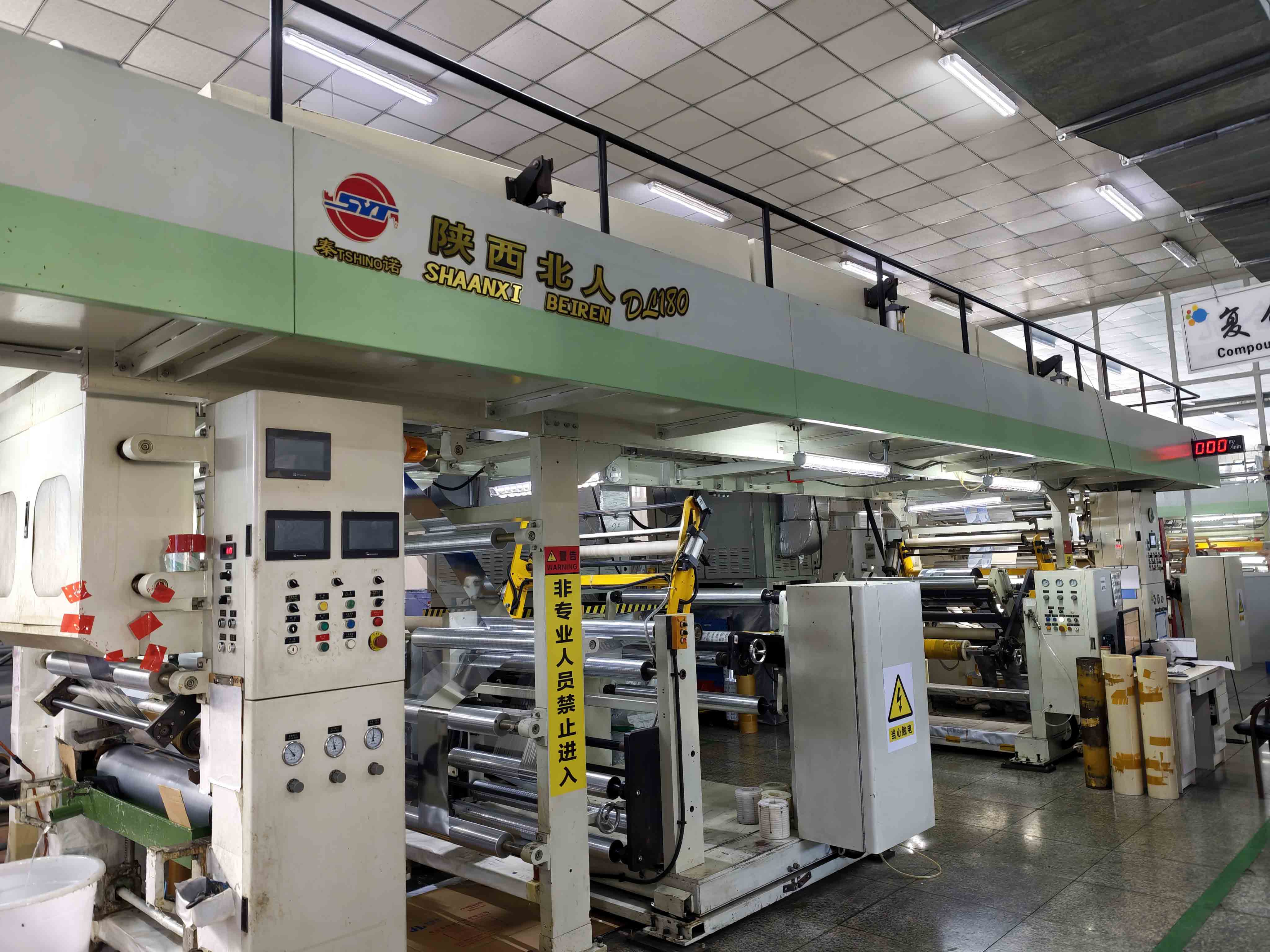
Seal performance is separate from flat-film barrier
An apparently excellent film can fail if its food-contact sealant does not run on the planned line, or if salt, crumbs or oil interfere at the mouth. Request a sealing trial using the exact structure and ordinary product. Record jaw conditions, line speed, sample positions and visual defects. ASTM F88/F88M-23 addresses strength of a sampled flexible seal. It does not certify every complete bag against channels or punctures. Agree on separate whole-pack inspections where needed.
The first heat seal and a zipper are distinct. A zipper provides reclosure after the consumer tears the top of a multi-serve pouch. It cannot replace the unopened first seal or excuse popcorn trapped in that seal. When selecting a laminate, test the same bag with its actual zipper, tear feature, top margin and filling opening. The layer stack in a flat coupon alone cannot predict whether customers can open it cleanly.
Use a Real Popcorn Case for Its Known Construction
Mylarbag's published matte-black windowed stand-up pouch for gourmet popcorn lists a U.S. project, MATOPP/kraft paper/PE in the key-features field, gravure printing, and 15 × 22 + 4 cm. Its text describes a 140-micron construction and a rectangular clear window. These are public design and declared material details. The page does not supply a complete window layer schedule, test conditions for barrier numbers, the buyer's full product specification or independent shelf-life data.
If you are considering a similar appearance, turn the case into questions: Is the paper genuine or only a kraft visual on the proposed revision? Which side contacts the popcorn? Does the window use a different film and heat seal? How does the complete bag handle an oil-coated recipe? What document demonstrates suitability for your destination market? A public case gives a starting configuration, not an automatic approval for another product.

The case is also a reminder that “paper look” and recyclability are separate subjects. If disposal claims are planned, examine the entire structure and the collection system. Do not put an unsupported recycling icon on artwork because the front panel appears brown.
Build a Product-Specific Sample Matrix
Keep variables visible. Compare materials using the same representative popcorn lot, target fill, pouch geometry if possible, first-seal equipment and storage conditions. If the geometry differs, record it rather than presenting the trial as a pure film comparison. A stand-up pouch with a large window and a flat opaque pouch differ in several ways at once. A broad shortlist is useful, but a controlled second round should isolate the most important difference.
| Product or process | Candidate concern | Material and whole-pack evidence to request |
|---|---|---|
| Plain crisp popcorn | Moisture change and package leaks | Relevant WVTR report, construction, clean-seal trial, real-time texture comparison |
| Oil-seasoned popcorn | Oil transfer, aroma change, seal contamination | Contact-surface identity, oil-contact trial, product sensory trend, complete-pouch inspection |
| Powder-seasoned popcorn | Fines in top seal, printed appearance | Sealant/line trial, static and dust observations, filled-pack code and print review |
| Glazed or clustered popcorn | Stickiness, bridges at mouth, physical damage | Fill-opening and window trial, texture/appearance trend, carton route comparison |
| Multi-serve pack | Opening and reclosure after first seal | Actual zipper operation and wear, separate unopened/after-opening studies |
The material supplier can propose technically plausible structures; the popcorn business should define product endpoints and release criteria. Record approved construction code, revision, nominal dimensions, food-contact documentation, reported test conditions, and photographs of filled and transported samples. If a vendor changes the sealant or window after approval, request a documented equivalence assessment or a targeted retest.
Supplier documents worth requesting
Ask for: a layer schedule and thickness by layer or defined laminate; the actual food-contact surface and applicable intended-use evidence; exact window and zipper components; print and coating location; dimensioned pouch drawing; WVTR/OTR reports with method and conditions where relevant; seal-trial data tied to the construction; and a change-control statement. Match the report's sample code to the physical bag delivered. A PDF for “similar film” may be helpful for screening but is not the approval record for the exact commercial structure.
Clarify whether the documentation covers the product as sold, including printing and adhesives, and who holds the underlying evidence. Destination markets may have different requirements; a single generic “FDA food grade” line does not resolve them. Do not infer compliance for every use from a logo on a supplier slide. A qualified food-contact review should check actual materials, use conditions and market.
The popcorn packaging bag page can start a format discussion, and the plastic films page provides broader construction vocabulary. Bring the material matrix above to a supplier discussion. Ask for two or three sample structures that answer the product's identified failure modes, then approve based on tested filled packs rather than a favorite material nickname.
Frequently Asked Questions
What are popcorn bags made of?
It depends on use. An open immediate-service bag may be paper or a coated structure, while a sealed retail pouch may combine printable film, paper, adhesive, barrier component and food-contact heat-seal layer. Request the exact layer schedule and intended-use documents for the particular bag. Appearance cannot establish the composition.
What are popcorn bags made out of when they look like kraft paper?
The outside may contain kraft paper, a paper-like printed film, or a laminate combining paper and polymer. A kraft appearance does not identify the inside food-contact face or a recycling route. Ask for a construction sheet, sample and, if relevant, the separate window and zipper components.
Is a shiny silver popcorn pouch aluminum foil?
Not necessarily. Metallized film, foil laminate and decorative finishes can look similar. They can have different structures and behavior. Ask for the exact material designation and tested construction; do not infer barrier performance or disposal suitability from color and sheen.
Does a clear popcorn bag protect freshness?
It can if the complete selected structure, first seal and storage route meet the product's written criteria. Clear film is not automatically low-barrier or high-barrier. Request relevant WVTR and OTR reports with conditions, then test filled bags, including the window and seams, against the actual recipe's quality endpoints.
What does WVTR tell a popcorn buyer?
It reports water-vapor transmission through an identified specimen under specified test conditions. It can help compare candidate material constructions when method, units, temperature and humidity are understood. It does not assign a finished-pack shelf-life date or describe a leak at a top seal.
What does OTR tell a popcorn buyer?
It reports oxygen transmission through an identified film or laminate under stated conditions. For an oil-bearing snack, it may inform candidate screening. It cannot alone predict flavor stability: ingredient condition, headspace, light, temperature and package integrity matter too. Ask which actual layer and window were tested.
Is a thicker bag automatically a better barrier?
No. Barrier depends on material composition, layer continuity, thickness distribution, defects, windows and conditions. A thicker film of one material may not outperform a thinner, different laminate on the measurement that matters. Compare relevant reports and filled-pack results rather than gauge alone.
Do popcorn bags need a food-contact liner?
The surface touching the popcorn must be suitable for the intended food and conditions. In a laminated pouch, that is commonly an inner sealant or other contact layer, but the exact design varies. Request its identity and applicable documentation. A printed exterior or paper face does not reveal what touches the food.
Does a zipper replace heat sealing?
No. A zipper can reclose a multi-serve pack after opening. The unopened retail pouch still needs its specified first closure, normally a suitable heat seal, plus intact preformed seams. Test the real bag with popcorn, including top-seal cleanliness and consumer opening, rather than assuming the zipper protects the first sale period.
Can a kraft-look popcorn pouch go into paper recycling?
Do not assume so. A kraft-look pouch may include plastic layers, coatings, window and zipper, and local programs differ. The actual structure and collection route determine what claim can be made. Obtain component information and verify the applicable local program before printing a disposal instruction.
Which material should I choose for oily popcorn?
Start by describing the oil and seasoning, planned selling period, contact temperature, appearance needs and likely complaints. Request appropriate contact-surface information and sample constructions. Compare oil marks, aroma, seals and product quality in real filled packs. No one named film can be recommended without those inputs and testing.
Can the published gourmet-popcorn case define my specification?
It is a useful design reference with a publicly stated material field, size, format and print route. It does not provide your recipe, intended fill, complete window structure or validated shelf-life result. Ask for an exact sample, the complete construction and evidence suited to your own use. Approve the filled pack separately.