
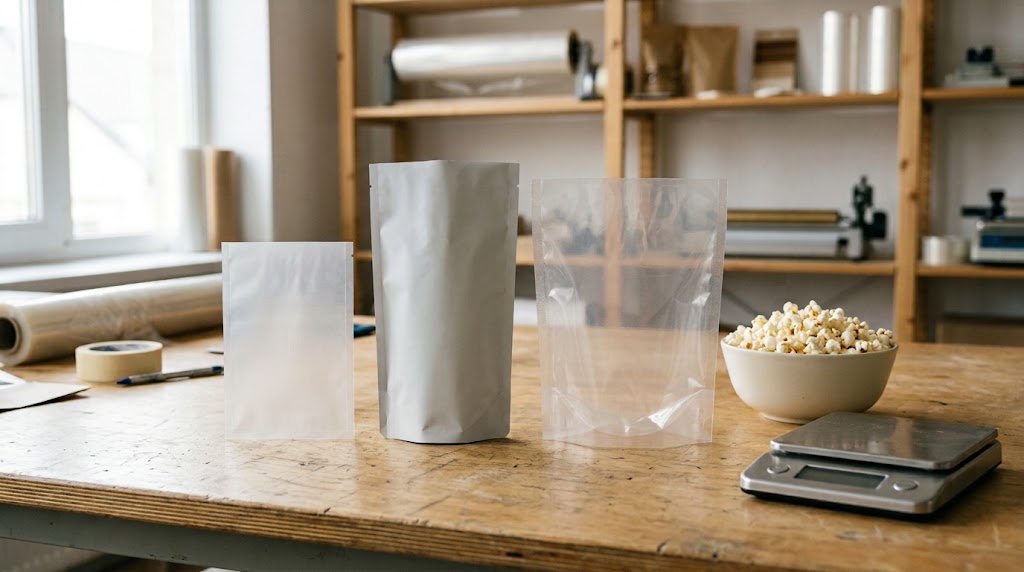
If a buyer asks for “a 4 oz popcorn bag,” the number identifies the popcorn's intended net weight, not a fixed width and height. The same weight of plain butterfly popcorn, dense mushroom popcorn, or coated clusters can occupy different amounts of space. A pouch that looks large enough while flat may become difficult to fill, seal, stand, or pack in a carton.
The short answer: 4 oz is about 113.4 g and 5 oz is about 141.7 g of product. There is no universal external bag dimension for either weight. Weigh representative finished popcorn, fill several candidate pouches by the intended method, leave a clean first-seal area, and compare the filled shape after handling. Approve the exact bag specification only after the product, filling line, retail display, and shipper all work together.
This guide covers empty commercial pouches for already-popped popcorn sold as human food. An open serving bag for immediate consumption is a different job from a sealed retail pouch. The discussion does not cover microwave cooking bags or the dimensions of a particular finished popcorn brand.
Start With Weight, Not a Bag-Length Chart
In U.S. retail use, “oz” on the net-weight statement refers to an avoirdupois ounce of product, while “fl oz” is a volume unit. The NIST Handbook 133 unit table gives 1 avoirdupois oz as 28.349523125 g. The current U.S. food net-quantity rule, 21 CFR 101.7, distinguishes weight ounces from fluid ounces in the label context. A pouch's outer dimensions are a third measurement altogether.
| Label or drawing term | What it describes | What it does not tell you |
|---|---|---|
| Net wt. 4 oz | Approximately 113.4 g of popcorn, excluding the package | The pouch's width, height, gusset, or filled volume |
| Net wt. 5 oz | Approximately 141.7 g of popcorn, excluding the package | Whether an existing 4 oz pouch can accept it |
| Fluid ounces | A volume measure in a different labeling context | The mass of popped popcorn in ounces |
| Pouch W × H + gusset | A supplier's external bag dimensions, subject to its drawing convention | The usable volume below the actual first seal |
| “Small,” “medium,” or “single serve” | A marketing or catalog size description | A dependable net weight or serving size for your recipe |
That 4-to-5-oz change adds one quarter to the target mass. It does not prove that the bag must be 25% taller or wider. A different shape or usable gusset may add space without the same increase in front-panel dimensions. Conversely, a zipper, hang hole, wide seal, or generous top margin can remove useful space from a nominally larger bag. Compare filled samples, not percentages of a flat drawing.
Net weight also differs from serving size on a Nutrition Facts panel. A multi-serve 5 oz bag can contain more than one serving; a one-serve pack can have a different net weight. The brand's labeling team should set the declaration for the actual packaged product and target market. Bag dimensions must support that declared fill, but a nice-looking pouch cannot establish that the label quantity is correct.
Why “standard 4 oz bag” search results are misleading
A supplier's general flat-pouch chart may show a nominal 4 oz size for a dense snack, coffee, or dried fruit. That chart can be useful as a request for a physical sample. It cannot certify the same dimensions for airy popcorn. Ask what product, fill method, closure, and measurement convention produced the chart. If the seller cannot answer, treat its capacity label as a catalog name rather than a validated specification.
The same rule applies to a paper serving bag labeled by a concession-stand volume. A scoop measure, a finished net-weight claim, and a custom retail pouch are different things. The buyer of a heat-sealed bag should start with the finished recipe and a target net weight, then decide how the full pack needs to stand or lie.
Measure the Product That Will Actually Enter the Pouch
Popped popcorn is not a uniform powder. Some pieces are wide and irregular; others are more rounded. Salt and dry seasoning can collect in spaces between pieces. Oil or glaze can change surface behavior, cluster size, and how the fill settles. Broken pieces and fines may accumulate at the bottom or in a different proportion after transport. These are reasons to measure your product, not reasons to assume one variety always needs a particular bag size.
Build a small, repeatable measurement exercise. Take representative finished product from normal production, after the usual cooling and seasoning stages. Record the recipe or SKU, batch, production date, sampling point, and condition at measurement. If you sell plain, cheese-seasoned, and caramel-coated versions in one bag design, include each version. A single handpicked bowl from a photo session is a poor substitute for ordinary line output.
Weigh the planned net quantity for each candidate: a single-serve target, 4 oz, or 5 oz as appropriate. Put the portion into a suitable graduated container using a consistent, gentle transfer. Record the visible loose-fill volume without tamping, shaking aggressively, or crushing pieces to reach a desired mark. Repeat on independent portions and, when possible, different normal batches. The aim is a screening measure of the space your own popcorn tends to occupy, not an official universal density value.
| Trial record | Why keep it |
|---|---|
| Recipe, product form, and batch | Separates a formula or popping change from a bag change |
| Target mass and actual weighed mass | Confirms that the volume observation belongs to the intended net fill |
| Loose-fill reading and method | Lets another operator repeat the comparison without hidden tapping or compression |
| Large pieces, clusters, fines, and visible breakage | Explains why a repeat portion may pack differently |
| Product temperature and time after popping | Shows whether the sample matches normal packing conditions |
| Operator and date | Makes an unexpected result traceable |
For a first calculation, measured apparent bulk density = mass ÷ observed loose-fill volume. Then estimated product volume at a proposed net weight is mass ÷ that measured density. This is an internal screening calculation: the graduated container has straight walls, while a gusseted pouch changes shape as it fills. The estimate does not include a clean seal area, product movement, or display shape. Use the observed range of your samples to shortlist pouches; then test the finished pouch directly.
If measurements vary widely, do not average the problem away. Look for a change in recipe, popcorn expansion, portion handling, fines, or the way a technician read the container. Record the range and investigate whether the fuller legitimate portion still fits without being pressed into the closure. A bag sized around only the smallest measured volume will create avoidable line rejects.
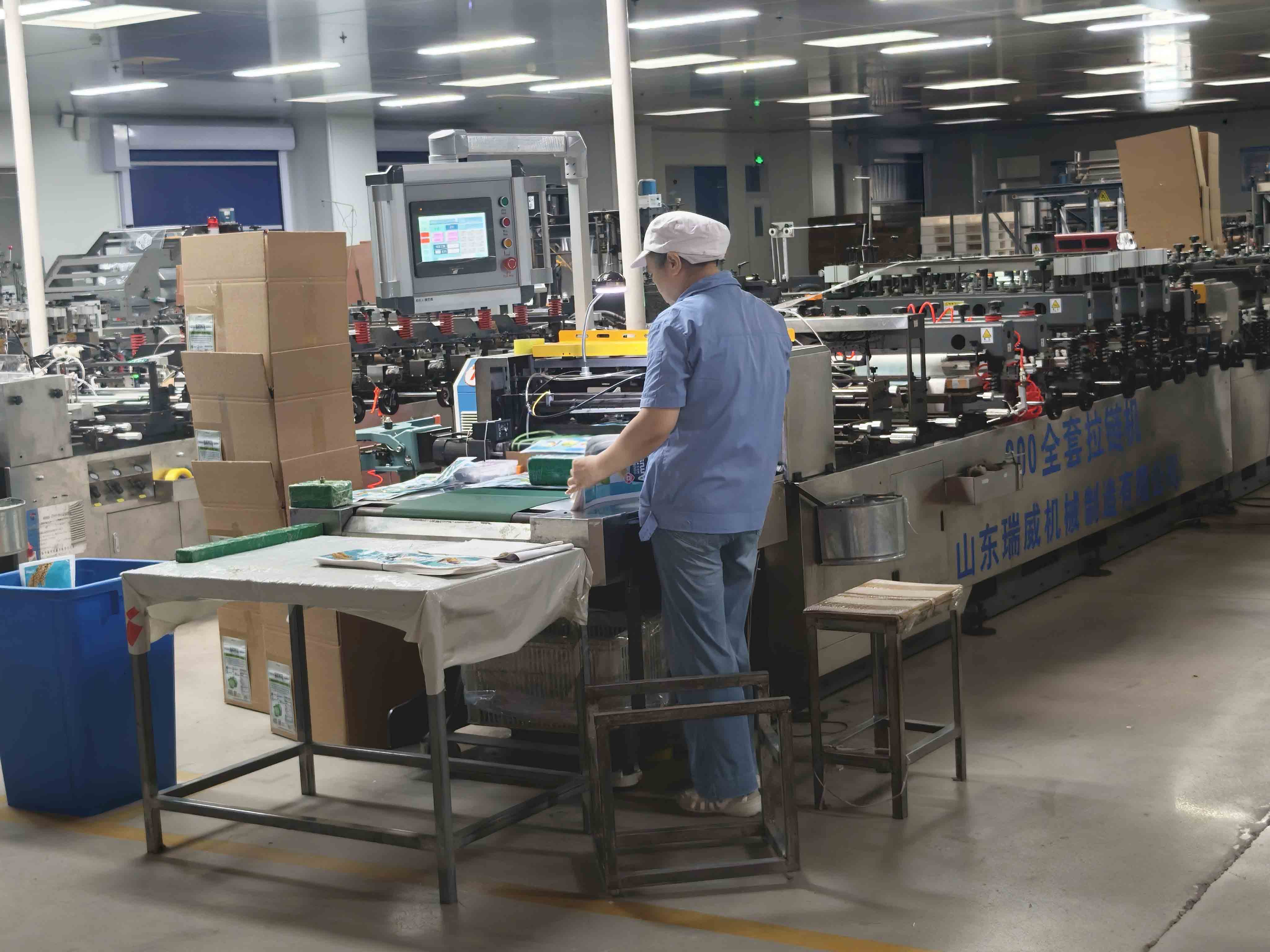
Shortlist Bag Formats for the Way the Pack Will Be Sold
Once you have a representative portion, choose the format and sales route. A flat pouch may suit a modest single portion that lies in a display tray or hangs. A stand-up pouch can give a broader face and a base for retail display, but the base has to open under your actual product weight. A side-gusseted or larger-format pouch may be worth testing for a bulkier fill and case packing. The word “may” matters: the trial, not a format name, decides the fit.
| Target pack | Sensible first sample | Specific fit question |
|---|---|---|
| Small single portion | A compact flat pouch or small stand-up sample | Can the largest normal pieces pass through the opening and stay below the first seal? |
| 4 oz retail pack | Several widths and heights of stand-up pouches | Is there a stable, attractive filled shape with real seal clearance? |
| 5 oz retail pack | A larger candidate or a differently proportioned gusseted sample | Does the extra mass fit without pressing the seal or overexpanding the base? |
| Larger sharing pack | Stand-up or side-gusseted pouch candidates | Does the full pack survive handling and fit the selected carton count? |
This is a sample shortlist, not a promised capacity chart. “Where to buy small popcorn bags” is useful only after you state empty bags for already-popped food, target weight, pouch style, first-seal method, and intended display. Request physical samples in adjacent sizes. Compare them with the same product lot, scale, and filling method. A smaller bag can be efficient for one SKU yet force an operator to crush a coated cluster or contaminate the seal on another.
Do not assume a zipper belongs on every small pack. A one-time portion may need an accessible tear notch and reliable first heat seal, while a multi-serve pouch may justify a resealable feature. The initial unopened barrier and closure come from the finished pack construction and first seal; the zipper is for use after opening. Decide the opening experience separately from the net capacity.
A published popcorn pouch is a drawing example, not a capacity answer
Mylarbag's published gourmet-popcorn pouch project lists a U.S. destination, a stand-up format, gravure printing, a MATOPP/kraft paper/PE material field, and a dimension written as 15 × 22 + 4 cm. It also shows a windowed, matte-black kraft-look appearance. These are useful details to ask for in your own supplier drawing. The “+4” should be interpreted using that supplier's drawing convention, not silently turned into a guaranteed internal depth.
The public project page does not give the customer's net popcorn weight, expanded product volume, filled height, first-seal location, or carton trial. It cannot answer whether that exact pouch holds 4 oz or 5 oz of another company's popcorn. It also does not prove that its published thickness or appearance yields a specific shelf life for your recipe. Use its recorded dimensions as a concrete example of what a case page can tell you, and use a filled sample to find what it cannot.

Turn an External Drawing Into Usable Filling Space
Ask the supplier for a dimensioned drawing of the exact candidate, not just a product photo. Define how width, finished height, bottom gusset, side seals, trim, rounded corners, zipper, tear notch, hang hole, and top seal are measured. Two sellers may use the same-looking W × H + G label with different conventions for the gusset. The document should identify tolerances, the permitted filling opening, and where the packer is expected to put the first heat seal.
Think in zones from top to bottom. At the top are the material edge, possible hang-hole area, opening/tear feature, a region for the first heat seal, and perhaps a zipper below it. Beneath those features lies the upper portion of the product cavity, which must remain clear enough for the jaws and contents. At the bottom, folds and seals occupy material while the gusset opens into a three-dimensional base. On a flat pouch, side and bottom seams likewise reduce the useful internal width and length. A printed front panel can be large while the fill opening or actual cavity is not.
Do not multiply the exterior width × exterior height × nominal gusset and call the result a usable liters figure. A flexible bag is neither a full rectangular box nor filled right up to the top edge. Its rounded filled cross-section, material stiffness, seals, window construction, zipper, and product shape all change the cavity. A supplier may estimate volumetric capacity, but request the method and confirm it with your popcorn.
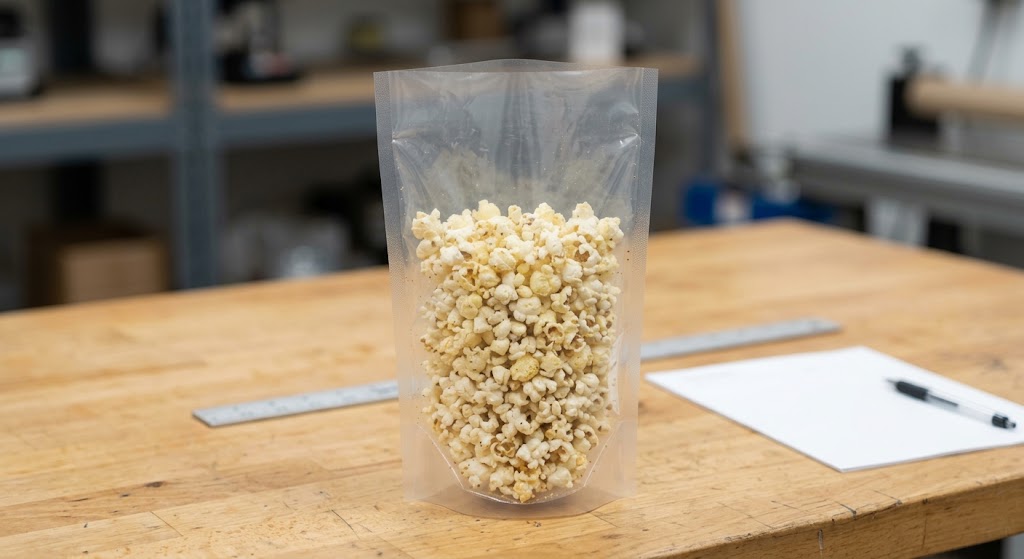
Reserve the first-seal zone before judging the bag “full”
After filling, loose pieces must sit low enough that the mouth can be presented to the sealing jaws without crumbs, coating, or oil in the interface. The appropriate clearance depends on the pouch construction and the actual filling and sealing equipment. Request the supplier's sealable area and run a trial on the intended line. Do not turn a generic millimeter number from an unrelated bag into a universal rule.
If a zipper is present, the first heat seal normally sits above the consumer reclosure. The filling process must still keep both the zipper track and the first-seal region usable. Check that the customer can reach the zipper after tearing at the intended location, and that the tear feature does not remove or damage the reclosure. If the pack has a hang hole, review how its position interacts with artwork, opening, and sealing. These features are not free space just because they appear near the top of a flat drawing.
Check fill opening and base behavior, not only cubic capacity
Large popcorn pieces can bridge at a narrow mouth. A volume calculation will not reveal that the filling nozzle is too wide, the operator must funnel pieces by force, or clusters scrape a clear window. Record the actual mouth opening under the packer's handling. Watch for dropped pieces and product in the side-seal or zipper area.
A stand-up base must open consistently and support the filled bag in the planned shelf orientation. An empty pouch that stands neatly for a photograph may lean once filled; a lightly filled wide pouch may collapse. A higher pouch may look fuller after settling than a broad shallow one with the same nominal volume. Test shelf appearance immediately after filling and again after normal case handling.
Run a Reproducible 4 oz and 5 oz Pouch Trial
Make the test easy to repeat. Identify the exact pouch construction and sample revision, then use actual production popcorn, scales appropriate to the target weight, and the planned manual or automated filling path. Do not let one attractive prototype stand for a production lot. If you trial several candidates, keep the product batch and fill target the same when comparing them.
- Set the question before filling. For example: “Can this stand-up pouch hold our normal 4 oz recipe, make a clean first seal at planned line speed, stand on the intended shelf, and fit eight to a shipper without visible damage?” Write the acceptance criteria and the responsible approvers.
- Record empty-bag dimensions. Measure width, height, gusset and feature positions on multiple samples from each candidate. Note whether the drawing describes outside or inside dimensions. Inspect preformed side and bottom seams, trim, and zipper alignment if applicable.
- Weigh and fill normal portions. Use the actual net-weight target and record each measured portion. Fill by the intended method; do not press popcorn down unless that handling is part of a validated normal process. Photograph the filled height from a consistent front and side view.
- Check the open mouth. Note loose pieces, seasoning, oil, or coating in the future first-seal area; whether the nozzle or operator can withdraw cleanly; and any loss of large pieces. Reject or investigate a candidate that requires constant special manipulation to close.
- Seal and inspect. Use documented settings appropriate to the actual material and equipment, then examine the finished top and preformed seams. Record wrinkles, channels, product in the seal, asymmetric edges, and unexpectedly hard opening. A test strip can be evaluated by a suitable method, but a strip result alone does not establish that every whole bag is intact.
- Handle the pack as sold. Stand or lay it on the target display, place it in the actual shipper, and run a representative handling or distribution trial. Compare retained controls and arrived packs for lean, crushing, scuffs, popped seams, and fines. Recheck the label and date-code readability on the filled shape.
For U.S. products labeled by weight, NIST Handbook 133 describes methods for checking the net contents of finished packages. Its weight-testing chapter addresses measurements and tare. This is different from testing whether a pouch is large enough. The food business owns the final fill-control and labeling decision; the pouch maker can supply drawings, samples, construction, and seal information. Do not use a few fit trials as a substitute for the business's net-quantity control program.
For a seal-strength question, ASTM F88/F88M-23 covers the force needed to separate a strip containing a flexible-material seal and identifies failure mode. It is a method, not an automatic “bag passed” certification or a whole-pack leak test. Choose applicable acceptance limits and, where necessary, separate integrity and distribution checks for the actual filled pouch. A correctly sized bag still fails the job if product routinely gets caught in the seal.
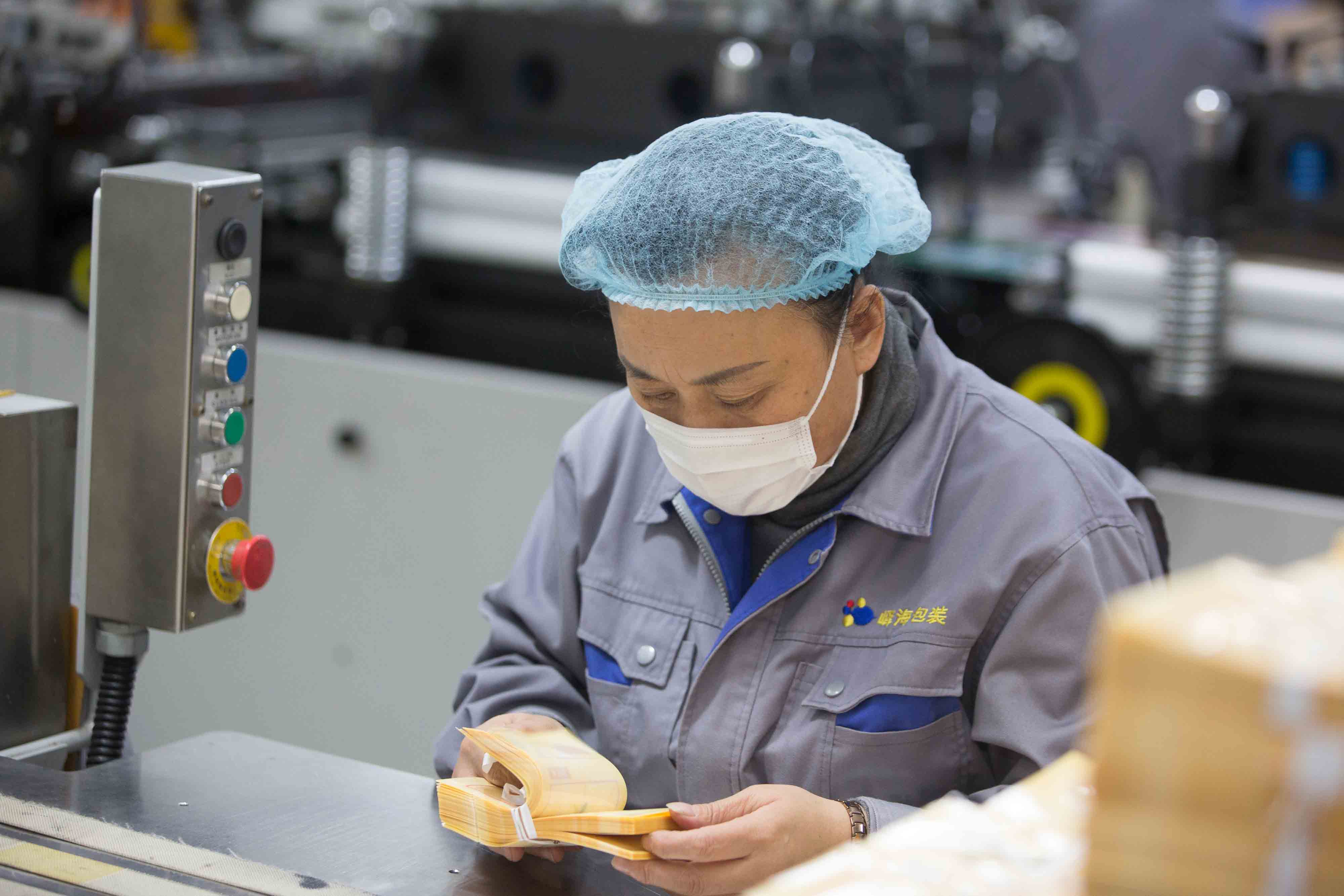
Evaluate the Filled Shape Through Retail and Distribution
The first trial often makes a bag look full on the bench. Subsequent handling changes the picture. Popcorn can settle as cases move; fragile pieces can break; a flat bag may present a different front face when propped in a tray. Photograph the same marked sample at initial fill, after sealing, after case packing, and after a representative trip or handling sequence. Note the exact route and orientation. A before-and-after photo is more useful than a vague judgment that the pouch “feels right.”
Assess three independent dimensions of success. Product fit: does the target weight fit without forced compression or an overfilled look? Process fit: can operators or equipment repeatedly fill and first-seal without contamination and rejects? Commercial fit: does the pack stand or hang as intended, show readable print, and reach the retailer with acceptable breakage? A bag can pass one and fail another. If the product fits but a 5 oz pack leans, a different base or proportion may be more helpful than extra overall height.
Outer cartons do a different job from the retail pouch. Count how many filled units fit in each orientation, including the space used by inflated or rounded pouch bodies. Check top-of-carton pressure on the upper row and whether a divider is needed. Do not rely on an empty-bag stacking calculation. If the pack is sold in parcels, assess the retail pouch together with cushioning and shipper rather than asking the flexible film alone to prevent all crushing.
Watch print and label space on the rounded pack
Lay the artwork over the approved filled sample, not just an empty dieline. A barcode near a gusset, a net-weight statement stretched across a crease, or a date code at a top seal may become difficult to read. The label reviewer should approve the final design for the sales market. In the U.S., 21 CFR 101.7 addresses the net-quantity statement; the complete label has other requirements. The packaging supplier can reserve safe artwork areas, while the food brand is responsible for final declarations.
If several flavor SKUs use one bag size, test the most space-demanding normal fill, the smallest normal fill for shelf appearance, and any SKU whose coating or fines affect sealing. The smallest volume may make the shared pack look empty; the largest may compromise the closure. A single common dieline can simplify inventory, but it should be a tested choice rather than a default assumption.
Use This Worksheet to Approve a Candidate Size
The worksheet below can be copied into a sample-approval record. Replace blanks with your own measurements and written decision limits. A supplier's quoted gauge or theoretical capacity belongs alongside the physical trial, not in place of it. Retain photographs and samples for the approved revision so an artwork or zipper change does not silently invalidate the decision.
| Field | Record for each candidate | Why it matters |
|---|---|---|
| Product and lot | Recipe, finish, production batch, normal time to packing | Keeps trials tied to representative popcorn |
| Declared target | Single-serve, 4 oz, 5 oz or other; actual measured portions | Separates net-weight control from bag fit |
| Pouch identity | Supplier, revision, format, construction, sample lot | Makes repeat orders and changes traceable |
| Empty dimensions | W, H, gusset, seals, zipper, tear, hole and tolerances | Exposes nominal dimensions versus usable geometry |
| Product fill | Loose-fill readings, actual filled height, handling method, photo IDs | Shows the range of legitimate fills |
| Closure | Opening access, clean first-seal area, settings, observed defects | Tests repeatability, not just a static fit |
| Display | Stand/hang result, lean, window and label visibility | Confirms the retail presentation |
| Distribution | Units per carton, orientation, handling route, damage and fines | Checks the sold pack in its real system |
| Approval | Written pass/fail rule, approver, date and required change | Prevents a visually appealing sample from becoming an unexamined production specification |
If a candidate fails, change one controllable variable at a time. A wider mouth can improve filling without changing nominal net weight. A different gusset can improve standing without raising the pouch height. A cleaner fill process may solve seal contamination without changing material. Track each revision and retest the changed feature; do not combine a new zipper, film, gusset, and artwork in one undocumented “fix.”
What to send when requesting small, 4 oz, or 5 oz samples
Send the popcorn packaging bag team or another prospective supplier a compact brief: empty pouches for already-popped food; product recipes and net weights; representative loose-fill range if measured; desired shelf orientation; filling equipment and first-seal method; whether a zipper, tear notch, window, or hang hole is needed; tentative outer dimensions if any; target cartons; sales market; and the approval schedule. Ask for two or three adjacent physical sizes and a drawing for each, with the exact construction and tolerances.
If you are still unsure of bag style, request both a compact flat sample and a stand-up sample where appropriate. Share a sample of the actual popcorn through an agreed safe process, or have your own team run the fill tests. Request food-contact documentation for the proposed construction and intended use rather than accepting a generic “food grade” label. Ask who will approve a changed material or bag dimension on later production lots.
The right answer to “how big should my popcorn bag be?” is an approved filled-pack specification, not one number from an online chart. It records the net quantity, actual usable space, closure, visual presentation, and case fit of the exact bag and product together.
Frequently Asked Questions
How big is a 4 oz bag of popcorn?
There is no universal width and height. Four avoirdupois ounces is approximately 113.4 g of popcorn, but the same mass can occupy different volumes with different popping, seasoning, and breakage. Weigh a normal 4 oz portion, trial candidate pouches, and confirm the clean top-seal area, filled shape, and carton fit before approving dimensions.
How big is a 5 oz bag of popcorn?
Five ounces is approximately 141.7 g of product. It is one ounce heavier than a 4 oz pack, but that does not translate into a fixed one-inch or 25% increase in pouch dimensions. Measure and fill the actual 5 oz SKU in adjacent bag sizes. Check mouth access, base opening, seal clearance, shelf presentation, and distribution after filling.
Can I use the same pouch for 4 oz and 5 oz popcorn?
Possibly, if both real products fit the same approved structure and still look appropriate on the shelf. Test the most voluminous normal 5 oz fill for overfilling and closure clearance, then the least voluminous normal 4 oz fill for an underfilled appearance. Approve both labels and fill controls separately. One successful middle-of-the-range sample is not enough.
Does a 4 oz pouch in a supplier catalog mean it holds 4 oz of popped popcorn?
Usually it is a nominal example for a particular product category or a seller's naming convention. Ask what was used to establish that capacity. Dense foods can fit into space that a fluffy snack cannot. Request the exact external dimensions and actual samples; use your own popcorn to determine whether the candidate can be filled and sealed.
Is a 4 oz popcorn bag the same as a 4 fl oz bag?
No. The first usually refers to net product weight when labeled “Net wt. 4 oz”; fluid ounces are a volume measure. Neither phrase specifies pouch dimensions. For a U.S. retail label, review the applicable net-quantity wording and position with the food label team. Do not convert a fluid measure into a popcorn weight without a measured product-specific relationship.
What is the best small pouch for a single serving of popcorn?
Start with the intended serving weight and sales format. A flat pouch may work in a counter display or hanging tray; a small stand-up pouch may suit a shelf. Trial both if the choice is unclear. Confirm that large pieces pass through the opening, the heat-seal area remains clean, and the pack is easy to open. A zipper may add little value to a pack consumed at once.
Should I size the bag from unpopped kernels?
No, unless your product is actually sold as kernels. This guide addresses already-popped popcorn. The volume and geometry of finished, seasoned popcorn are the relevant inputs. Measure it at the normal point of filling, not before popping or from a different product form.
How much empty space should I leave above popcorn before sealing?
Leave enough for the specified first seal and for the actual filling and sealing operation to keep product out of that zone. The correct clearance depends on the pouch drawing, sealant, zipper placement if present, and equipment. Agree on a clean-area criterion and verify it in a trial; do not copy a generic number from another film or machine.
Does a zipper increase the capacity of a popcorn pouch?
No. It can use some upper area that otherwise might look available on a flat drawing. Its benefit is reclosure after the consumer opens a multi-serve pack. The first heat seal still needs its own space and validation. Trial the exact zipped and unzipped designs separately if capacity is tight.
Does a thicker pouch hold more popcorn?
Thickness by itself is not a capacity specification. Width, height, gusset geometry, seal positions, and stiffness shape the filled cavity. Material and barrier performance belong to a separate construction decision. A thicker film may change how a pouch stands or opens, but only a filled trial will show whether the net portion fits well.
Can I estimate bag capacity by multiplying width, height, and gusset?
That product gives the volume of an imagined rectangular box, not the actual usable cavity of a flexible pouch. Seams, folds, a rounded filled cross-section, the first seal, and optional features consume space. Use measured loose-fill volume to screen candidates, then weigh real portions into physical pouches and inspect the sealed pack.
What should I inspect after the filled bags have been shipped?
Compare arrived packs with retained controls from the same product and bag lots. Check carton location, pack deformation, open or stressed seams, crushed pieces and fines, print readability, and whether the pouch still stands or lies as planned. Record the route and photographs. A carton with no visible outside damage does not prove its popcorn and retail pouches are unchanged.
Can a published popcorn pouch case tell me what dimensions to order?
It can provide a discussion example and help you specify which fields to request. The cited gourmet-popcorn project lists 15 × 22 + 4 cm, format, material field, and printing. It does not disclose the customer's net fill or your recipe's usable volume. Do not relabel it as a universal 4 oz or 5 oz answer. Request samples and approve your own filled-pack specification.